

Journal of Applied Language Learning(JALL)
ISSN: 3068-1332 | DOI: 10.33140/JALL

Research Article - (2025) Volume 2, Issue 1
Early-Age Positive Behavioral Intervention at School: A Scoping Review
Received Date: Jan 16, 2025 / Accepted Date: Feb 20, 2025 / Published Date: Mar 05, 2025
Copyright: ©Ã?©2025 Stefania Badiglio, et al. This is an open-access article distributed under the terms of the Creative Commons Attribution License, which permits unrestricted use, distribution, and reproduction in any medium, provided the original author and source are credited.
Citation: Badiglio, S., Seta, L. (2025). Early-Age Positive Behavioral Intervention at School: A Scoping Review. J App Lang Lea, 2(1), 01-16
Abstract
This article offers a scoping review aimed at examining the characteristics of “universal positive behavioral interventions” addressed to pupils 3-12 years old in school settings. The studies were selected to highlight school-level and class-level targets for all students, without exclusion or inclusion criteria. The interventions were based on a prosocial perspective, aiming to promote positive change in the school climate and increase the frequency and quality of positive behaviours.
The purpose of this review is to analyze how these interventions are described in the literature and to identify some common features in their implementation that allow us to highlight positive factors and possible gaps. Due to the scarcity of work devoted to the 3-12 age group, the review aims to identify the main themes that could be the subject of further analysis. Consequently, the intent of the review is not to verify the effectiveness of these interventions, but to answer some guiding questions including the most prevalent approaches in “universal positive behavior interventions”, the types of behavioral problems addressed, implementation characteristics, and temporal and geographic variations in the uptake of such interventions. From the analysis carried out in this paper several considerations are derived that may be useful in both the preparation and description of behavioral interventions with similar targets.
Keywords
Behavioral Intervention, Positive Behavior Support, Positive Education, Universal Positive Behavior Intervention
Introduction
This article analyses universal behavioral interventions characterized by a positive approach. These interventions involve the entire school, without focusing on individuals with special needs, and are administered within positive education frameworks. The focus was on school-wide interventions carried out by educators and educational staff. Therefore, this study considers “universal positive behavioral interventions”, namely interventions based on a prosocial perspective rather than a punitive one, aiming to promote positive change in the school climate and increase the frequency and quality of positive behaviours. This perspective finds a theoretical basis in both positive psychology and Positive Behavior Support (PBS or PBIS).
As highlighted by Kristján Kristjánsson, positive psychology is not just a simple theory but can be considered a movement, which focuses on the systematic study of human happiness in all its forms [1]. Particularly interesting is the definition given by Wong, who emphasizes that one of the key objectives of positive psychology is to “develop good and respectable people, as well as a civil society promoting meaning/virtue (p.7)” [2]. From the early stages of the positive psychology movement, important applications have also emerged in the educational context, giving rise to the so-called “positive education”. Following White and Waters and White the term “positive education” does not identify a structured and defined intervention program but rather should be understood as an “umbrella term used to describe empirically validated interventions and programs of positive psychology that impact student wellbeing (p. 2)” [3-5].
The interventions based on the PBS approach are often well- structured programs guided by particular attention to evidence. Like positive education, PBS aims to improve student’s quality of life and reduce problematic behaviours. In recent decades, PBS has experienced significant growth, with this approach being applied to an increasing number of subjects and, like Multi-Tiered System of Support (MTSS), at different levels of implementation, from school-wide to individual students [6,7]. As stated by Carr et al. “PBS is an applied science that uses educational methods to expand an individual’s behavior repertoire and systems change methods to redesign an individual’s living environment first to improve the quality of life of the individual and secondarily to reduce their problematic behaviours (p. 4)” [8].
Objective of the Review
The objective of this review is not to verify the effectiveness of the “universal positive behavioral interventions”. In literature, the effectiveness of these types of interventions has been extensively investigated, for example, for PBIS see Noltemeyer et al. and for the Good Behavior Game, Nolan et al. [9,10]. The literature will be selected to highlight relevant features of the universal positive behavioral interventions as applied in real contexts, to better understand the mechanisms that can influence on specific students’ behaviors within the school environment. It is evident how these interventions are increasingly structured, requiring greater attention not only on implementation but also on pre and post- intervention phases, such as organization, teacher training, follow- up, and duration. From the analysis of the literature on “universal positive behavioral interventions”, it would be interesting to delve into some themes. For example, if there are studies in the literature comparing “universal positive behavioral interventions” based on different approaches; this could help understand how transferable the results obtained are to other contexts and for addressing different behavioral problems. Furthermore, it would be important to understand which types of behavioral problems may be more responsive to improvement and how such interventions integrate and fit into the school organization. Another aspect that would be interesting to delve into is the link between the approach used in interventions and the specific culture.
It was decided to focus on “universal positive behavioral interventions” in the age group between 3 and 12 years old, which appears to be less studied in the literature. These considerations led to a literature analysis aimed at answering the following questions:
- What are the most common approaches in “universal positive behavioral interventions”?
- For what types of problems are these interventions primarily applied?
- What characterizes the implementation of these programs? What are the common features and what type of organization do these interventions have?
- How do “universal positive behavioral interventions” change over time and across countries?
- And where are they most prevalent?
Methodology
A scoping review was conducted to analyze and synthesize “positive behavioral interventions” in schools, focusing on students. The study relied on searching the “SCOPUS” electronic database, and selecting various articles, and the analysis was carried out by two researchers and conducted twice.
Research Procedure
The electronic database included SCOPUS, and the following terms were used for a Boolean search: (“positive behavior” AND (school OR scholastic OR education) AND (program OR strategy OR politics) AND (child OR pu- pil OR student) AND NOT (university OR tertiary OR higher OR vocational)) AND (EXCLUDE (DOCTYPE, “ch”) OR EX- CLUDE (DOCTYPE, “bk”) OR EXCLUDE (DOCTYPE , “cp”)) AND (“POSITIVE behavior” AND (school OR scholastic ) AND (family OR teacher OR children)) AND (EXCLUDE (SUBJAR- EA, “ARTS”) OR EXCLUDE (SUBJAREA, “HEAL”) OR EX- CLUDE (SUBJAREA, “NURS”) OR EXCLUDE (SUBJAREA, DENT”) OR EXCLUDE (SUBJAREA, “COMP”) OR EX- CLUDE (SUBJAREA, “NEUR”) OR EXCLUDE (SUBJAREA, “ENVI”) OR EXCLUDE (SUBJAREA, “AGRI”) OR EXCLUDE (SUBJAREA, “BIOC”) OR EXCLUDE (SUBJAREA, “ECON”) OR EXCLUDE (SUBJAREA, “ENGI”) OR EXCLUDE (SUBJA- REA, “MATH”) OR EXCLUDE (SUBJAREA, “VETE”) OR EX- CLUDE (SUBJAREA, “DECI”) OR EXCLUDE (SUBJAREA, “IMMU”) OR EXCLUDE (SUBJAREA, “PHAR”)) AND (EX- CLUDE (DOCTYPE, “ch”) OR EXCLUDE (DOCTYPE, “bk”) OR EXCLUDE (DOCTYPE, “cp”)) AND (“POSITIVE behav- ior” AND (school OR scholastic) AND (family OR teacher OR children)) AND (EXCLUDE (SUBJAREA, “ARTS”) OR EX- CLUDE(SUBJAREA, “HEAL”) OR EXCLUDE (SUBJAREA, “NURS”) OR EXCLUDE (SUBJAREA, “DENT”) OR EX- CLUDE (SUBJAREA, “COMP”) OR EXCLUDE (SUBJAR- EA, “NEUR”) OR EXCLUDE (SUBJAREA, “ENVI”) OR EX- CLUDE (SUBJAREA, “AGRI”) OR EXCLUDE (SUBJAREA, “BIOC”) OR EXCLUDE (SUBJAREA, “ECON”) OR EXCLUDE (SUBJAREA, “ENGI”) OR EXCLUDE (SUBJAREA, “MATH”) OR EXCLUDE (SUBJAREA, “VETE”) OR EXCLUDE (SUB- JAREA, “DECI”) OR EXCLUDE (SUBJAREA, “IMMU”) OR EXCLUDE (SUBJAREA, “PHAR”)) AND (EXCLUDE (DOC- TYPE, “ch”) OR EXCLUDE (DOCTYPE, “bk”) OR EXCLUDE (DOCTYPE, “cp”)) AND (EXCLUDE (DOCTYPE, “er”) OR EX- CLUDE (DOCTYPE, “no”) OR EXCLUDE (DOCTYPE, “ed”)) AND (EXCLUDE (SUBJAREA, “MULT”)) AND (EXCLUDE (SUBJAREA, “MEDI”))
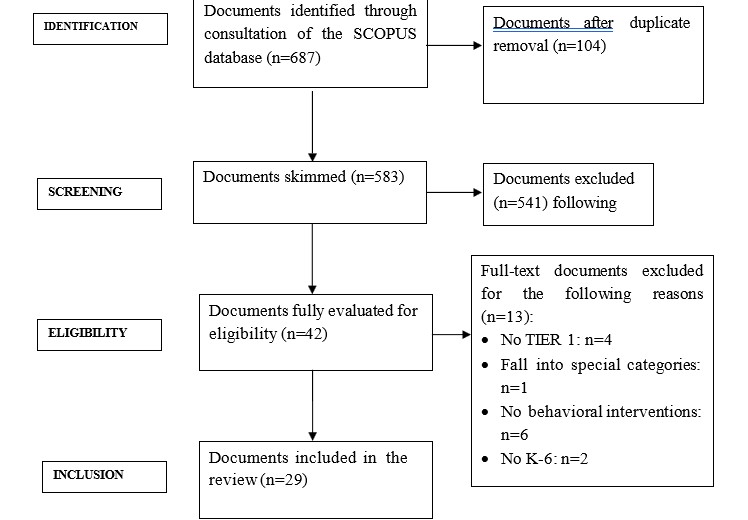
The total of 687 abstracts in SCOPUS were identified through the database search and exported to Excel. The screening was conducted twice by two researchers, and after removing duplicates (104), a total of 583 studies were included for review. The abstracts were reviewed to check for eligibility using the following criteria: a) the study was conducted in preschools and kindergartens up to K-6 schools; b) if a “universal positive behavioral intervention” TIER 1 was implemented in schools or in some classes; c) if schools implemented an intervention strategy to address behavioral problems. Studies were excluded if they did not fall within the age range of 3 to 12 years, if the intervention was not conducted at a school or was conducted at high schools or universities, and if the intervention solely targeted parents or teachers without involving students or was exclusively or primarily directed towards special categories (BES, FBA, autistic, immigrants), TIER 2 and TIER 3 interventions.
Finally, meta-analysis and review studies were excluded.
Full Text Review
Forty-two studies met the inclusion criteria from the abstract reviews. After reviewing the full text, using the same inclusion criteria described above, 29 studies remained, as 3 studies were removed for falling under TIER 2, 6 studies were not related to “positive behavioral interventions”, and 2 studies were conducted at K-12 schools.
Full-Text Coding and Data Extraction
The study characteristics were extracted into Excel using the following criteria:
The selected articles were examined using a grid created specifically for coding by two of the authors (SB and LS). Nine main categories were identified: intervention country; school level (age of subjects involved in the intervention); sample size; type of intervention, i.e., methodological framework inspiring the intervention; type of behavioral problems targeted by the intervention; strategies and technologies used in the intervention; study methodology; tools for verification and evaluation; intervention duration (see Table 1). The selection and definition of categories were made concurrently with the authors’ reading of the articles. After this initial phase, all 42 selected articles were reviewed by two of the authors, considering the identified categories and selected questions, and discrepancies were discussed until reaching 100% agreement.
|
Category |
Questions |
|
Country |
|
|
Level Size Methodological framework |
|
|
|
|
Methodological framework |
|
|
Behavioral target |
|
|
Methodology and technologies |
|
|
Study methodology |
|
|
Assessment tools |
|
|
Duration |
|
Table 1: Coding Categories and Coding Questions
Literature Analysis
From the analysis of the selected works, a clear prevalence of the US over the rest of the world in the application of a positive approach to behavioral treatments emerges. The dissemination of such approaches outside the United States and English-speaking countries (UK, Australia, Canada) appears to be limited to some isolated experiences, mostly at the level of interventions in individual schools (Turkey Greece Spain Finland China) [11-16]. These experiences, besides being rare, also appear to be generally recent, as if only in recent years these types of approaches have been receiving some attention outside the Anglophone context. The reasons for this situation can be diverse: from difficulties in finding materials, instructions, guides, and references that are not in English; to a pronounced adaptation of many of these approaches to the organization of the AngloAmerican school system: from the use of the Office Discipline Referrals system (ODRs) to monitor the progress of the intervention, to the organization of work that fits the articulation of curricular school activities of that system, to the methods of selection and enrolment of statistical samples used for the studies. born in an Anglophone context, studies concerning different cultural and national contexts are beginning to appear, although the reference bibliographies are still strongly oriented towards authors with that cultural background and almost exclusively in English, even if by authors of another native language. This circumstance, which in the field of research does not entail evident risks, is instead a strong factor limiting the dissemination of practices and experiences in the field of applied didactics. Often teachers, psychoeducational operators, and school staff members who are not native English speakers have difficulty finding informative material and tools in their language.
Regarding the development over time, Table 2 shows how the selected works are distributed in the period 2007-2022, with 15 studies in the four years 2019-2022, 8 in the previous four-year period 2015-2018, and 3 in each of the periods 2007-2010 and 2010-1014. From these data, it is evident how the dissemination of this type of intervention, at the primary school level, can be considered recent, especially when looking outside the US, and has been increasing in recent years. Excluding study, all extra-US studies are from the period 2017-22 [8].
|
|
Year of pubs |
Nation |
Level/grade/year |
Number of school |
Number of class |
CW/SW |
Total number of students |
|
1 |
2012 |
US |
Gr 5 Age 10-11 |
1 |
2 |
CW |
50 |
|
2 |
2019 |
UK |
Gr: 5Age: 8-10 |
1 |
1 |
CW |
27 |
|
3 |
2015 |
US |
Gr 4 e 5 age: 9-11 |
2 |
8 |
CW |
191 |
|
4 |
2013 |
US |
Gr 3,4 e 5 age 8-11 |
3 |
NA |
SW |
486 |
|
5 |
2014 |
US |
Gr 6-8 age 11-13 |
3 |
NA |
SW |
NA |
|
6 |
2022 |
US |
K-12 age-5-18 |
4 |
NA |
SW |
1494 |
|
7 |
2020 |
Turkey |
Gr 2 7-8 |
1 |
NA> |
CW |
31 |
|
8 |
2009 |
Turkey |
Gr 4 9-10 |
1 |
2 |
CW |
NA |
|
9 |
2016 |
US |
Gr 3 e 2 age 7-9 |
1 |
3 |
CW |
64 |
|
10 |
2021 |
US |
Gr 3-3-3-1 age 6-9 |
3 |
4 |
SW |
74 |
|
11 |
2022 |
Greece |
Gr 6 age 10-11 |
29 |
NA |
SW |
240 |
|
12 |
2019 |
US |
Gr 6 e 7 age 11-12 |
13 |
NA |
SW |
2771 |
|
13 |
2018 |
Spain |
Gr 3-4Age 7-10 |
NA |
NA |
SW |
420 |
|
14 |
2022 |
US |
Gr 8 – 7 Age 12-14 |
4 |
4 |
CW |
66 |
|
15 |
2020 |
US |
Gr. 1-1-4-1 age 6-7 and 9-10 |
1 |
4 |
CW |
74 |
|
16 |
2020 |
US |
Gr 6-7 age 11-13 |
1 |
3 |
CW |
33 |
|
17 |
2015 |
US |
Gr 7 age 12-13 |
NA |
NA |
SW |
1743 |
|
18 |
2021 |
Australia |
Gr 2 age 7-9 |
1 |
5 |
CW |
169 |
|
19 |
2021 |
US |
Gr 6-8 age 11-13 |
5 |
28 |
CW |
629 |
|
20 |
2017 |
Finland |
Gr 7-8 age 12-16 |
38 |
NA |
CW |
NA |
|
21 |
2020 |
US |
Gr 1-6 age 6-12 |
1 |
NA |
CW |
37 |
|
22 |
2021 |
Canada-US |
Gr K-4 age 5-10 |
NA |
12 |
SW |
194 |
|
23 |
2015 |
US |
Gr K-1 age 5-7 |
3 |
11 |
CW |
118 |
|
24 |
2017 |
US |
Preschool, kindergarten, 2nd gr age 4-8 |
NA |
3 |
CW |
49 |
|
25 |
2007 |
US |
Gr 3 age 8-9 |
NA |
2 |
CW |
27 |
|
26 |
2022 |
China |
Age 7-13 |
1 |
NA |
SW |
285 |
|
27 |
2018 |
US |
2 primary, 1 middle, 1 high |
4 |
NA |
SW |
2510 |
|
28 |
2008 |
US |
Gr 1,2, 3 age 6-9 |
2 |
NA |
SW |
180 |
|
29 |
2019 |
Australia |
Primary age 5-11 |
2 |
NA |
SW |
550 |
Table 2: Year, Country, and Size of Selected Studies
The selected studies address all age groups of primary school, ranging from 5 years old to 12-13, with differences due to different school systems, which involve variations in entry and exit ages from the primary cycle. These studies do not always involve the entire school; often programs and interventions directed only at selected classes are found, involving a few selected teachers. Infrequent are interventions designed for multiple schools or entire school districts. In total, 13 studies describe school-level interventions (SW in the table) and 16 studies refer to interventions implemented at the class level (CW in the table), although universal, meaning they target all students without particular exclusion or inclusion criteria. In some cases, these interventions are also part of schoolwide programs [17-21]. From this analysis, it is evident that universal and schoolwide approaches are not yet consolidated practice for behavioral interventions at school. The full implementation of these interventions establishes considerable organizational and cultural challenges, as it is discussed later. Therefore, the selection often includes targeted and circumscribed interventions, whose impact remains limited, and whose results cannot be easily generalized.
Methodological Features
Regarding the main target behaviors of the selected interventions, the decision to choose interventions with a universal impact led to the exclusion of interventions targeting specific cognitive or emotional disorders. The results showed interventions and programs aimed at strengthening social skills (5 studies), intervening on the school climate by mitigating disruptive behaviors (7 studies), promoting physical and mental well-being and positive values such as kindness (4 studies). Some target behaviors are noteworthy, as their frequent occurrence in the selected studies indicates that they may be considered widespread problems. Programs addressing bullying and cyberbullying stand out, appearing as the focus of several studies (5 studies), especially the more recent ones. Additionally, interventions targeting off/ on-task behaviors (3 studies), and transition phases during class changes (2 studies) are highlighted. Finally, some behavioral interventions with still marginal targets but of definite interest, such as attitudes towards the environment and food safety, are noted [16,18]. These target behaviors are addressed with different methodological approaches, although PBIS seems to prevail over other approaches. Indeed, 21 out of 29 studies refer to PBIS in various forms, often adapted according to the specific problem of interest. From this perspective, PBIS appears as a very versatile and flexible framework. It is found to be applied to enhance social skills improve the school climate by promoting positive behaviors and mitigating disruptive ones and strengthen children’s mental health [11,20-25]. Moreover, PBIS is implemented using various strategies, both group and individual, such as interdependent group contingency, positive peer reporting and “tootling”, stop/ walk/talk, and environmental management [11,17,19,21,26-31]. In the case of bullying and cyberbullying, specific programs within PBIS have been developed, such as “Expect Respect” and “Bullying prevention in PBS” (BP-PBS) [17,30,31]. Besides PBIS, both at the school-wide (SW) and class-wide (CW) levels, there are other approaches that, although like PBIS from an operational perspective, have different theoretical references. In the case of interventions aimed at promoting students’ well-being and, particularly, preventing mental health-related issues, there is frequent reference to Social Emotional Learning [14,25]. Close to the SEL framework, some programs based on the interdependent group theory, such as the “Good Behavior Game” and the “Do Better Game” are noted, especially in interventions targeting social skills with the application of tangible and intangible social reinforcements [32,33]. Also noteworthy is the recent introduction of interventions based on Restorative Practices, targeting issues such as cyberbullying and the school climate [34,35].
From the literature analysis, some interesting insights emerge, where positive behavioral practices are also applied outside of these theoretical and methodological frameworks. For example, concerning the phenomenon of bullying, the development of the “Threat Assessment of Bullying Behavior in Youth” (TABBY) program is noted, within the context of projects funded by the EU, which draws on Bronfenbrenner’s (1989) ecological approach to developmental psychology [13]. Additionally, the Making Socially Accepting Inclusive Classrooms (MOSAIC) program aims to address the problem of integrating ADHD children through a systemic approach that modifies peer dynamics, training teachers to promote an inclusive classroom environment [13]. Another intervention found is based on Teacher-Child Interaction Training (TCIT), a program inspired by ParentChild Interaction Therapy (PCIT), which aims to intervene in the classroom climate by promoting prosocial behavior [36]. Other interventions, more heterodox compared to these, but interesting as they seem to open up to new practices and interesting research avenues, include an intervention aimed at character education and values, and a meditation-based intervention [12,37].
|
|
Target Problem |
Framework |
Strategy |
Technology |
Technique |
Design |
|
1 |
Off-task behavior |
PBIS |
The Mystery Motivator Get ‘EmOn Task |
Yes |
Group contingency |
CS |
|
2 |
Social Skills |
Good Behaviour Game (GBG) |
Positive social interactions Working as team Supporting peers |
No |
Group contingency |
SCD |
|
3 |
Mental health |
PBIS and SEL |
Strong Kids social-emotional learning curriculum. BEST behavior approach to PBIS |
No |
No |
RCT |
|
4 |
Bullying |
PBIS |
Bully prevention in PBS |
No |
Stop/walk/talk |
CS |
|
5 |
Bullying and Harassment Prevention |
PBIS |
Expect Respect |
No |
Stop/walk/talk/bystander routine |
MBD |
|
6 |
Bullying |
PBIS |
Expect Respect |
No |
Stop/walk/talk |
CS |
|
7 |
Social skills |
PBIS |
Systematic social skills training |
Yes (Video recordings) |
Arrangement of the setting |
CS |
|
8 |
Values of universality and benevolence |
Values education |
Values clarification moral development |
Yes (Video recordings) |
Moral conflict stories |
CS |
|
9 |
Disruptive behaviors |
PBIS |
Peers observation |
No |
Tootling |
SCD |
|
10 |
Between-class transitions |
Do Better Game |
Explicit timing; visual performance feedback; progressive performance criteria |
Yes (smartphone application “Stopwatch) |
Interdependent group contingency |
SCD |
|
11 |
Cyberbullying |
TABBY, Threat Assessment of Bullying Behavior in Youth |
Audiovisual; discussion; experiential activities |
Yes (audio visual material) |
No |
LON |
|
12 |
Cyberbullying |
Restorative Practices |
Sustained relationships with adultsskills building |
No |
Restorative pratices |
RCT |
|
13 |
Childhood depression |
Cognitive behavior and SEL |
“Pozik-Bizi” (in English, “Live- Happily”), and cooperative play |
No |
Individual and group reflection exercises, theatrical performances, inventing stories, reading stories with a moral, teacher’s explanations to identify, reflect on, and deepen certain concepts(negative or positive thoughts and their consequences, emotions, fear or anxiety…);relaxation exercises |
CS |
|
14 |
Disruptive behavior |
Good Behaviour Game (GBG) |
Positive reinforce |
Yes ClassDojo (a free online behavior tracking system)- computer with internet access, smart phones, a projector |
Group contingency |
SCD |
|
15 |
Behavioral expectations |
Culturally Responsive PBIS (CRPBIS) |
The Personal Matrix Activity (PMA) |
No |
Direct observation |
MBD |
|
16 |
On-task behavior |
PBIS |
Class-wide function-related intervention teams (CW-FIT) |
No |
Identification and teaching of expectations, precorrection, active supervision of behaviors, immediate and consistent feedback, praise-to-reprimand ratio, minimizing reward of problem behaviors, and an interdependent group contingency; |
MBD |
|
17 |
Self-efficacy of food safety (SEFS) |
Hands On |
Modeling lessons and instructional strategies,hands-on participation in activities, and a seminar style discussion. |
No |
No |
CS |
|
18 |
Well-being |
Meditation programs. ‘Let’s be Still’ |
Stillness-Story telling |
Stillness-Story telling |
School-based meditation programs |
QUA |
|
19 |
On-task behavior |
PBIS |
Class-wide function-related intervention teams(CW-FIT)- Interdependent Group Contingencies |
No |
The two main components of CWFIT MS are (a) establishing classroom expectations and (b) implementing interdependent group contingencies, including pre-correction, praise, points, and rewards. |
RCT |
|
20 |
Disruptive behavior |
PBIS |
No |
No |
Teachers’ cooperation |
RCT |
|
21 |
Transition behavior |
PBIS |
Timely Transitions Game |
Yes (A phone application, Periodic Timer) |
Interdependent Group Contingencies Game |
MBD |
|
22 |
Positive peer climate Increase positive peer dynamics Foster positive teacher-student relationships. |
The Making Socially Accepting Inclusive Classrooms (MOSAIC) |
Reviewing Expectations for BehaviorReinforcing Expectations for Behavior- Reviewing Expectations for Inclusiveness- Reinforcing Expectations for Inclusiveness-Highlighting Positive Attributes-CARE Time- Discreet Corrections |
No |
No |
LON |
|
23 |
Appropriate behavior |
Teacher-Child Interaction Training (TCIT) |
Child-Directed Interaction (CDI) and Teacher-Directed Interaction (TDI) |
No |
No |
CS |
|
24 |
Disruptive behavior |
PBIS |
The Caterpillar Game |
No |
No |
SCD |
|
25 |
Positive reporting |
PBIS |
Positive Peer Reporting (PPR) |
No |
No |
MBD |
|
26 |
Pro- environmental Behaviors |
Social learning theory |
Role modelling |
Yes (Video recordings) |
No |
FAC |
|
27 |
Improve school climate |
Restorative practices |
Responsive circles |
Yes (Video recordings) |
RP-Observe tool |
MM |
|
28 |
Disruptive behaviors |
PBIS |
Multicomponent recess behavior intervention program |
No |
No |
MBD |
|
29 |
Pro-social skills |
PBIS |
Video Self-Modelling (VSM) and Video Peer-Modelling (VPM) |
Yes |
No |
QUA |
Table 3: Target Problems, Methodological Issues, and Designs
It is interesting to note that from the perspective of research design and results evaluation, there is neither uniformity of approach nor an accepted standard. Most interventions are evaluated based on single-case studies. The figure 1 differentiates between multiple baseline design (MBD) and other designs referred to as SCD. Together, these account for 43% of the analyzed studies. Cross- sectional studies (CS) are also common, often based on pre and post-test analyses without a control group. Less frequent are randomized controlled trials (RCTs). Studies with longitudinal (LON), qualitative (QUA), mixed (MM), and factorial (FAC) designs are rare.
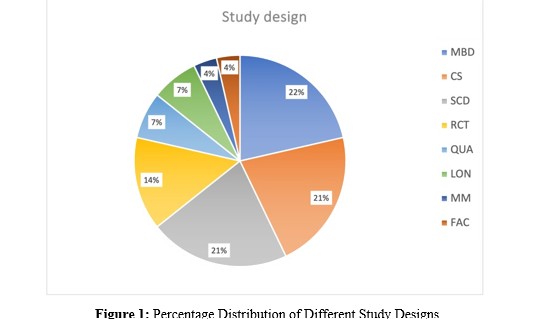
As for the temporal distribution, while in the earlier studies researchers observed less structured research designs, mostly single-case designs (SCD), (MBD), and cross-sectional designs of the pre/post type without control (CS), in more recent works quasi-experimental and randomized controlled trial designs with a control group (RCT) are beginning to emerge, along with qualitative and mixed designs (QUA), (MM) , and in still too few cases, longitudinal (LON), and factorial designs (FAC) [11- 21,23,24,26,27,29,30,32-40].
Regarding the use of technology in the 29 examined studies, 10 explicitly refer to the use of technology during the implementation of behavioral intervention. Mostly, this involves the use of video cameras, and only in one study is a behavior tracking tool mentioned (Classdojo), while in two other studies, reference is made to smartphone applications, for managing time during activities. Therefore, it can be stated that the use of technology is very marginal despite the development in recent years of various tools for behavioral monitoring [33,38,39,41]. Rarely do the examined articles describe in detail the techniques used during the behavioral intervention. Often, there are references to generic methodologies or strategies, but there is no specification of how they are implemented in the school context. However, from the derived data, there appears to be a significant diffusion of the Interdependent Group Contingency technique [19,26,27,32,33,38,39]. This could be related to the specific age group chosen in this analysis, highlighting a preference for structured group behavioral interventions for younger children rather than individual monitoring. Finally, it is interesting to note the association between interventions aimed at preventing bullying problems and the use of the stop/walk/talk technique.â??â??â??â??â??â??â??
Implementation and Practice
In the analysis of the studies some relevant factors in the implementation of behavioral interventions have been isolated (Table 4). Since not all analyzed articles explicitly discuss these factors, in Table 4, it is indicated whether that factor was explicitly mentioned in the study or not. However, this does not imply that the behavioral intervention did not consider it. The results are based on what is reported within the article, although the fact that authors did not deem it important to emphasize that factor is already of interest in our analysis. In Table 5, the percentages of recurrence of the chosen factors are reported.
|
|
Parentsi nvolvement |
Students involvement |
Teachers/ school staff involvement |
Ex- tra-school involvement |
Follow up |
Teacher training |
Organiza- tion |
Moni- toring |
Reward- ing |
Duration |
|
1 |
No |
No |
Yes |
No |
No |
No |
No |
Yes |
Yes |
4 weeks |
|
2 |
No |
No |
Yes |
No |
No |
Yes |
No |
Yes |
Yes |
19 weeks |
|
3 |
No |
No |
Yes |
Yes |
No |
Yes |
No |
Yes |
Yes |
6 months |
|
4 |
Yes |
Yes |
Yes |
No |
No |
Yes |
No |
No |
No |
1 year |
|
5 |
No |
Yes |
Yes |
No |
No |
Yes |
No |
Yes |
No |
1 year |
|
6 |
No |
Yes |
Yes |
No |
No |
Yes |
No |
No |
No |
1 year |
|
7 |
No |
Yes |
Yes |
No |
No |
Yes |
Yes |
Yes |
Yes |
1 year |
|
8 |
No |
Yes |
Yes |
No |
No |
Yes |
No |
Yes |
No |
1 year |
|
9 |
No |
Yes |
Yes |
No |
No |
Yes |
Yes |
Yes |
Yes |
1 year |
|
10 |
No |
Yes |
Yes |
No |
No |
Yes |
Yes |
Yes |
Yes |
1 year |
|
11 |
No |
No |
No |
No |
Yes |
No |
Yes |
No |
No |
1 year |
|
12 |
No |
Yes |
Yes |
Yes |
Yes |
Yes |
Yes |
No |
No |
2 years |
|
13 |
No |
Yes |
Yes |
No |
Yes |
No |
Yes |
No |
No |
1 year + 6 months follow up |
|
14 |
No |
No |
Yes |
No |
No |
Yes |
Yes |
Yes |
Yes |
1 year |
|
15 |
No |
Yes |
Yes |
No |
No |
Yes |
No |
Yes |
Yes |
1 year |
|
16 |
No |
Yes |
Yes |
No |
No |
Yes |
No |
Yes |
No |
1 year |
|
17 |
No |
No |
Yes |
No |
Yes |
Yes |
No |
No |
No |
2 days training, 1 week interven- tion, after 6 weeks follow up |
|
18 |
No |
No |
Yes |
No |
No |
No |
No |
No |
No |
10 weeks |
|
19 |
No |
Yes |
Yes |
No |
No |
Yes |
No |
Yes |
Yes |
Baseline 2 weeks In- tervention 10 weeks |
|
20 |
No |
No |
Yes |
No |
Yes |
Yes |
No |
Yes |
No |
1 year |
|
21 |
No |
No |
Yes |
No |
No |
No |
No |
Yes |
Yes |
Summer |
|
22 |
No |
No |
Yes |
No |
No |
Yes |
No |
No |
Yes |
1 year |
|
23 |
No |
No |
Yes |
No |
Yes |
Yes |
No |
Yes |
No |
1 year |
|
24 |
No |
No |
Yes |
No |
Yes |
Yes |
Yes |
Yes |
Yes |
1 year |
|
25 |
No |
No |
Yes |
No |
No |
Yes |
No |
Yes |
No |
1 year |
|
26 |
No |
No |
Yes |
No |
No |
No |
Yes |
Yes |
No |
1 year |
|
27 |
No |
No |
Yes |
No |
Yes |
Yes |
Yes |
Yes |
No |
7 months |
|
28 |
No |
No |
Yes |
Yes |
Yes |
Yes |
No |
Yes |
No |
2 years |
|
29 |
Yes |
Yes |
Yes |
No |
No |
Yes |
Yes |
No |
No |
1 year |
Table 4: Implementation and Organizational Features
It is noteworthy that teachers’ engagement and the implementation of specific teachers’ training programs are common to almost all described interventions and, together with behavioral monitoring, constitute fundamental characteristics of behavioral interventions in this age group. The direct involvement of parents and the broader community outside the school environment appears to be less emphasized in the literature. Even students, although half of the studies describe their direct involvement, still seem to be considered more as beneficiaries than direct protagonists of the intervention. The direct involvement of students means they are directly engaged in the decisionmaking and evaluative processes of the implemented intervention. Two other implementation characteristics that appear to be less addressed are follow-up, which should be the concluding phase for evaluating the effectiveness of the intervention, and the reward system, which, although a fundamental component of every behavioral intervention, is not always discussed and described in the literature. Regarding the duration of interventions, there seems to be some heterogeneity: the majority show a duration equal to or exceeding one year, but interventions lasting one or two weeks are also present. However, it is suggested that a universal intervention requires at least a year to fully unfold its effects. Finally, such interventions often require changes in the organization of school life and spaces, as highlighted by several analyzed articles [11,14,16,19,20,22,29,33-35,38].
|
Implemented factor |
Percentage |
|
Parents’ engagement |
7% |
|
Students’ engagement |
45% |
|
Teachers’ engagement |
97% |
|
Others’ engagement |
10% |
|
Follow-up |
31% |
|
Teachers’ training |
79% |
|
Organizational changes |
38% |
|
Monitoring |
69% |
|
Reward system |
41% |
|
Duration >1y |
72% |
Table 5: Percentage Incidence of the Implemented Features
Evaluation and Outcomes
|
|
Outcome |
Fidelity |
Acceptability |
Social validity |
Other assessments |
Academic results |
|
1 |
Decreasing of off-task behaviors |
Yes |
Yes |
No |
No |
No |
|
2 |
Positive social interactions with a peer, working as a team and supporting peers |
No |
No |
Yes |
No |
No |
|
3 |
SIBS-SEBS |
Yes |
Yes |
No |
Yes (Feasability) |
No |
|
4 |
Self-assessment, Bullying, harassment, and school safety |
Yes |
No |
Yes |
No |
No |
|
5 |
Bullying behaviors direct of observations |
Yes |
No |
No |
Yes (School climate) |
No |
|
6 |
Self report |
Yes |
No |
No |
No |
No |
|
7 |
Social Skills Assesment Scale |
Yes |
No |
Yes |
Yes (Reliability) |
No |
|
8 |
The values-related cognitive behaviors posttest scores of the pupils in the experimental group were significantly higher than those of their pretest scores. |
No |
No |
No |
Yes (Reliability) |
Yes |
|
9 |
Results demonstrated decreases in disruptive behaviors and increases in academically engagedbehaviors during intervention phases as compared to baseline and withdrawal phases in all classrooms. |
No |
Yes |
No |
No |
No |
|
10 |
The intervention resulted in decreases in transition durations for all four classes |
Yes |
Yes |
Yes |
No |
No |
|
11 |
A short version of the “Cyberbullying Questionnaire” |
No |
No |
No |
Yes (Self-esteem) |
No |
|
12 |
Social Skills-Bullying Victimization- Student Report of Restorative Practices |
No |
No |
No |
Yes (School ClimateSchool ConnectednessPeer Attachment) |
No |
|
13 |
The “Pozik-Bizi” program significantly decreased their level of clinical maladjustment, schoolmaladjustment, emotional, and behavioral problems, and theyincreased positive behaviors that inhibit depression-Thecooperative play program improved self-concept and social skills |
No |
No |
No |
No |
No |
|
14 |
Academically Engaged Behavior and Disruptive Behavior |
Yes |
Yes |
Yes |
Yes (Procedural Integrity and Treatment Integrity) |
No |
|
15 |
Respectful and disruptive behavior |
No |
No |
Yes |
No |
No |
|
16 |
Whole Class On-Task, Teacher Praise and Reprimand Statements, Teacher and Student Consumer Satisfaction |
Yes |
No |
Yes |
No |
No |
|
17 |
Food safety behaviors (FSB) |
No |
No |
No |
No |
No |
|
18 |
This study aimed to consider the voices of children and teachers in examining the subjective benefits ofa 10-week Australian stillness psychoeducational program called ‘Let’s be Still’ |
No |
No |
No |
No |
No |
|
19 |
CW-FIT MS as a classroom management program is effective in improving on-task behavior of the whole class. CW-FIT MS is also an effective intervention for increasing teacher praise and decreasing teacher reprimands. |
Yes |
Yes |
Yes |
Yes (Training Satisfaction) |
No |
|
20 |
The results suggest that with an easily teachable and applicable intervention, the classroom behavioral climate in middle-school classes can be enhanced. The interventions acceptable for both teachers and students. |
Yes |
Yes |
No |
Yes (Teacher evaluations and Student evaluations) |
No |
|
21 |
The primary purpose of this study was todetermine whether a modified TTG could reduce inappropriatehallway transition behavior in elementary school classrooms. |
Yes |
No |
Yes |
Yes (Treatment Integrity) |
No |
|
22 |
Academic enablers, sociometric ratings |
No |
No |
No |
No |
Yes |
|
23 |
Teacher skill acquisition |
No |
No |
No |
Yes (Teacher’s satisfaction and Teacher Distress) |
No |
|
24 |
Teacher behavior specific praise |
Yes |
No |
No |
Yes (Teacher’s satisfaction) |
No |
|
25 |
Critical Events Index (CEI) |
Yes |
No |
Yes |
No |
No |
|
26 |
Subjects’ behavior picking up, throwing down or walking by. This shows that positive demonstration by the teacher was significantly more effective than that by the peer in improving children’s proenvironmental behavior of picking up litter and in inhibiting the environmentally neglectful behavior of walking by. |
No |
No |
No |
No |
No |
|
27 |
Observations of responsive circles implemented by educators, (b) assessment of each responsive circle using theRP-Observe tool, and (c) interviewswith staff members in the four case study schools. |
No |
No |
No |
Yes (Credibility and confirmability) |
No |
|
28 |
Frequency of teacher active supervision and the total frequency of student problem behaviors. |
No |
No |
No |
No |
No |
|
29 |
Feedback from students, Feedback from staff, Ease of use, Benefits for teaching prosocial skills |
No |
No |
No |
No |
No |
Table 6: Outcomes and Assessment Tools
This paragraph is aimed at analyzing the presence or absence of evaluation tools as described in the selected literature. From Table 6, it is evident that the most frequently cited measures are those related to fidelity (14 cases out of 29), followed by measures of social validity (10 cases out of 29), and measures concerning acceptability (7 cases out of 29). One of the useful characteristics for describing the internal validity of behavioral intervention is fidelity methodology, which aims to confirm whether the implementation of a particular protocol adheres to what is expected by the developers of the model. In the literature, this understanding of fidelity has been subject to various criticisms, but the checklist mode remains prevalent when assessing treatment fidelity [42]. From Table 6, in 30% of cases, articles directly reference fidelity measures, with such measures predominantly present in interventions referencing the PBIS methodology. In cases of interventions outside this framework, explicitly described fidelity measures are never found. Social validity measures also appear predominantly in interventions based on PBIS or associated with it, such as the Good Behavior Game and the Do Better Game. Specifically, social validity measures have become important as tools for verifying the ecological validity of behavioral interventions. Wolf defined social validity in the case of behavioral interventions as the social significance of objectives, the social appropriateness of treatment procedures, and the social importance of resulting behavioral change [43]. Interest in these aspects has led to the definition of various instruments concerning both the social acceptability of procedural aspects and user satisfaction.
As previously highlighted in earlier works, the rare reporting of explicit social validity measures in studies may also be due to a lack of standardized measurement tools and shared vocabulary [44]. What has been observed for social validity measures is also reflected in the case of acceptability measures. This concept refers to a still poorly defined characteristic of the general “acceptability” of a behavioral intervention by a target group. In this case, factors that can make an intervention acceptable may encompass very broad characteristics of the intervention, involving beliefs, social, cultural, and personal norms, and this may also be why such measures are rarely reported in the analyzed studies. In addition to measures of key characteristics such as fidelity/integrity, acceptability, and social validity, only a few studies include measures of other characteristics of the behavioral intervention, such as feasibility, teacher and student satisfaction, school climate, and external validity [11,12,15,17,19,20,25,34-36]. From the literature analysis, it is evident that, in general, the relationship between behavioral intervention and academic outcomes is not discussed (only 2 cases out of 29, [12,40]).
Results
The literature analysis presented does not intend to be exhaustive or conclusive. Starting from some keywords, articles focusing on the description of universal behavioral interventions, based on positive psychology approaches, implemented in a school context, aimed at a population not exceeding 12 years of age, without specific problems or disorders, and addressing widely prevalent issues or attitudes were selected. The aim was to isolate from these interventions some common characteristics and recurring themes, as well as to highlight persistent gaps in this field.
Regarding recurring characteristics, the most common ones are highlighted below.From a methodological perspective, interventions that refer to Positive Behavior Support (PBS), directly or indirectly, constitute a clear majority. This may be due to several factors:
- Historically, the PBS approach was among the first behavioral approaches to be described and formalized. It has been recognized in the United States as the intervention of choice in some cases of specific disorders. Its dissemination benefits from a wide organizational network and a specialized journal.
- Geographically, it is still predominantly widespread in Anglo- Saxon countries, also thanks to a lot of informational material in English, but there is an increase in its dissemination in Europe as well, especially thanks to the development of national PBS approaches and the new attention towards cultural specificities.
- Methodologically, the PBS approach is well-documented, and its structure well-defined, allowing for easier adoption, relying on a long experience and consolidated scientific results.
- Of course, some factors oppose its rapid and widespread adoption.
- Organizationally, implementing a PBS intervention may require redesigning information transmission and sharing processes, setting up work teams, and strong leadership to guide the entire school community through the definition of a common vision and shared goals.
- In terms of implementation, PBS must build a common knowledge base through a teacher training process that may take time and a certain stability in the staff in service, not always easy to achieve in some specific national contexts.
- From a cultural point of view, a paradigm shift is required that embraces an epistemology of teaching as a science based on evidence, integrating the more established paradigm that considers teaching as an art, or as a good craftsmanship activity. The collection, analysis, and discussion of quantitative data must become common practice, as well as the adoption of both formative and summative assessment and evaluation systems.
Some of these aspects are also evident from the analysis of the literature selected here. In fact, it can be observed that the adoption of PBIS is more frequent in Anglo-Saxon cultural countries; it is often associated with durations of no less than a year; it includes teacher training programs, and the use of tools to verify the integrity, acceptability, and social validity of the intervention. In addition to PBIS, other methodologies appear in the literature analysis conducted. Interventions that aim to integrate cognitive aspects with emotional ones are highlighted, such as those based on Social Emotional Learning and Mindfulness; studies that refer to the Social Learning Theory or that emphasize the role of the teacher as a model for students; behavioral interventions based on restorative practices and on explicit education about universal values and benevolence, in other words, interventions that focus on the moral development of children [12,14,16,25,34-37,40]. An interesting characteristic common to many positive behavioral interventions aimed at preschool and primary school children is that, unlike what happens with older children, they are mostly designed by organizing classes into groups, predominantly using interdependent contingencies.
Another recurring characteristic in the selected studies is the presence of programs that, although universal, have very specific behavioral targets. There are interventions for managing off-task behaviors and transitions, interventions aimed at nutrition education, incentivizing pro-environmental behaviors, bullying prevention, and cyberbullying prevention [13,16-19,26,27,30,31,34,38,39].
As highlighted in the literature analysis, methodologically, evaluations based on experimental studies with control groups are rare, and qualitative analyses or single-case techniques prevail. This is certainly due to the choice of selecting only field interventions, where it is less “ecologically sustainable” to apply the intervention to only a portion of the school population, but it also seems to reflect a general trend to evaluate such interventions in their context without concern for replicability and generalizability. Another common characteristic is the very limited use of technology, almost always confined to video capture tools or simple time management programs. Excluding the use of a specific tool such as ClassDojo [33]. From an organizational point of view, common to all interventions is the focus on teacher training, with programs of varying durations, while references to other staff members, both within and outside the school, rarely appear in the literature.
Several gaps have been highlighted in the literature analysis concerning both the methodology of interventions and their organization, follow-up systems, and rewarding mechanisms. Analyzing the methodological aspects reveals the following gaps in the selected literature:
- The lack of a clear reference to theory justifying intervention practices. In some cases, such as PBIS, the supporting theory is well-known, but in others, it is neither evident nor welldiscussed in the exposition.
- Only in rare cases were the cultural specificities of the contexts in which the interventions were implemented considered. Literature often discusses differences in terms of socioeconomic status, belonging to minority groups, and poverty conditions, but differences between national cultures and territorial specificities are scarcely analyzed.
- The choice of target behaviors varies greatly, ranging from interventions targeting general behaviors to those targeting very specific behaviors. Thus, it is unclear in which cases and for what problems it is more appropriate to develop a universal behavioral intervention.
- A very limited use of technology for both behavioralmodeling and monitoring.
- A limited discussion of experimental designs, as if there were a gap between research-oriented studies and those primarily aimed at education.
- In the case of organizational aspects, the following gaps are noticeable:
- Apart from the strong involvement of teachers, which is present in all the analyzed studies, there is a low level of participation concerning students, parents, other school staff, and extraschool staff. Rarely is the contribution of all these figures described in the choices made in the implementation of behavioral intervention. This can be justified regarding students, who in the selected literature are very young, but it is unclear regarding the other figures, especially parental figures.
- The limited attention to the follow-up moment is striking. Only in a few cases is explicit reference made to this phase, and even in these cases, the results and consequences are only hinted at. There are no established rules for its conduct, and the timing and duration appear quite arbitrary and vary in an undefined manner. Essentially, there is a lack of a shared protocol on how and when to conduct follow-up.
- Regarding the duration of behavioral interventions, apart from the implementation of PBIS, where the duration is almost always not less than a year, in other cases, non-uniform periods with durations ranging from one week to two years are highlighted [12,17,18]. So, in the end, it is not clear how much time is needed to achieve an effective behavioral intervention.
- Finally, concerning the analysis of intervention results, a variety of tools are used, making it difficult to compare between different implemented behavioral programs. Without standard measures to assess the effectiveness of interventions, comparison becomes almost impossible. Also, regarding tools for evaluating the validity, internal, external, and ecological, of interventions, there is no clear standard, and when such results are present, they are discussed using different references.
Conclusion
For the discussion of the results and limitations of this study it is convenient to start from the questions underlying this review, which are recalled here:
- What are the most common approaches in “positive behavioral interventions”?
- What types of problems are these interventions primarily applied to?
- What characterizes the implementation of these programs? What is the common denominator and what type of organization do these interventions have?
- How do “positive behavioral interventions” change over time and across countries? And where are they most prevalent?
From the analysis conducted, it can be affirmed that among all types of positive behavioral interventions, PBIS is the most widespread and implemented, especially considering the geographical prevalence of the United States for this type of intervention. In addition to this type, also commonly used are SEL and the Good Behavior Game. There is also the presence of interventions based on restorative practices and moral education.
Regarding the main behavioral problems recurring in the selected literature, some interventions target specific issues, such as in-class attention-deficit behaviors or problems during transitions between classes. In some cases, interventions are preventive, especially concerning bullying and cyberbullying (five out of 29 works), student health and mental well-being (five out of 29 works), and social skills (three out of 29 works). Other interventions, however, seem not to identify specific behaviors but rather speak generally of disruptive behaviors. As already noted, the methodology of behavioral interventions is finding applications beyond its usual fields of interest, such as food safety and environmentally respectful behaviors. Common characteristics of these types of interventions include constant and ongoing attention to teacher training and involvement and a widespread use of group work. While no common organizational characteristics are noted, or at least not highlighted in the literature examined. These interventions appear to be heterogeneous regarding all aspects concerning their implementation, such as duration, the scope of the sample examined, technologies used, verification tools, and the organization of any follow-up.
From the selection made using the database, clear temporal trends do not appear regarding both the type of behavioral intervention chosen and the issues targeted by the intervention. However, some temporal characteristics can be noticed. For example, starting from 2018, there is a greater proliferation of behavioral interventions based on methodological approaches different from PBIS, and from 2016 onwards, the spread of positive behavioral interventions outside the United States can be observed. Finally, concerning these latter educational programs, the nations that appear are: UK, Australia, Turkey, Greece, Spain, Finland, and recently China has been added. Nevertheless, this study presents some limitations that make the analysis presented here an interesting starting point but certainly do not cover all the literature on the subject. The first limitation is the choice to use a single source for constructing the database. While this choice certainly limited the validity of the results presented here, it, on the other hand, allowed for homogeneity in the selection of the studies. This limitation does not appear to prejudice the result since the purpose of this review was not so much to provide a complete overview of all the behavioral interventions that have occurred over time but rather to define some common characteristics of such interventions that go beyond methodological and theoretical differences. Another limitation of this review is the decision not to consider behavioral interventions targeting subjects with specific difficulties. This led to the exclusion of intervention programs, such as CICO, widely used but almost always addressed to classes or subjects different from those involved in the universal intervention. Unfortunately, in the literature, it is not clear what should be understood by “universal” intervention, and here it was preferred to adhere to a definition of “universal” that included only interventions aimed at non-specific categories. It is believed that this study can be an interesting starting point for other studies that will decide to deepen some of the themes highlighted here, to arrive at a better definition of “universal positive behavioral intervention” aimed at students aged 3-12 years in the school context.
References
- Kristjánsson, K. (2012). Positive psychology and positive education: Old wine in new bottles?. Educational psychologist, 47(2), 86-105.
- Wong, P. T. (2011). Positive psychology 2.0: towards a balanced interactive model of the good life. Canadian Psychology/Psychologie Canadienne, 52(2), 69.
- White, M. A., & Waters, L. E. (2015). A case study of ‘The Good School:’Examples of the use of Peterson’s strengths- based approach with students. The Journal of Positive Psychology, 10(1), 69-76.
- White, M. (2014). An evidence-based whole school strategy to positive education. Better than OK: Helping young people to flourish at school and beyond, 194-198.
- White, M. A. (2016). Why won’t it stick? Positive psychology and positive education. Psychology of Well-being, 6(1), 2.
- Dunlap, G., Sailor, W., Horner, R. H., & Sugai, G. (2009). Overview and history of positive behavior support. In Handbook of positive behavior support (pp. 3-16). Boston, MA: Springer US.
- Lucyshyn, J. M., Dunlap, G., & Freeman, R. (2015). A historical perspective on the evolution of positive behavior support as a science-based discipline. Individual positive behavior supports: A standards-based guide to practices in school and community-based settings, 3-25.
- Carr, E. G., Dunlap, G., Horner, R. H., Koegel, R. L., Turnbull, P., Sailor, W., ... & Fox, L. (2002). Positive behavior support: Evolution of an applied science. Journal of positive behavior interventions, 4(1), 4-16.
- Noltemeyer, A., Palmer, K., James, A. G., & Wiechman,S. (2019). School-wide positive behavioral interventions and supports (SWPBIS): A synthesis of existing research. International Journal of School & Educational Psychology, 7(4), 253-262.
- Nolan, J. D., Houlihan, D., Wanzek, M., & Jenson, W. R. (2014). The Good Behavior Game: A classroom-behavior intervention effective across cultures. School Psychology International, 35(2), 191-205.
- Olcay, S., Koc, M., Vuran, S., & Serdar Koksal, M. (2020). Effectiveness of Class-wide Positive Behavioral Support Intervention in Teaching Social Skills to Students in a Primary School Activity Club. International Journal of Early Childhood Special Education, 12(1).
- Iscan, C. D., & Senemoglu, N. (2009). Effectiveness of values education curriculum for fourth grades. Egitim Ve Bilim, 34(153), 1.
- Touloupis, T., & Athanasiades, C. (2022). Evaluation of a cyberbullying prevention program in elementary schools: The role of self-esteem enhancement. Frontiers in psychology, 13, 980091.
- Garaigordobil, M., Jaureguizar, J., & Bernarás, E. (2019). Evaluation of the effects of a childhood depression prevention program. The Journal of psychology, 153(2), 127-140.
- Närhi, V., Kiiski, T., & Savolainen, H. (2017). Reducing disruptive behaviours and improving classroom behavioural climate with classâ?wide positive behaviour support in middle schools. British educational research journal, 43(6), 1186- 1205.
- Liang, M., Chen, Q., & Zhou, Y. (2022). The influence of various role models on children’s pro-environmental behaviours. Frontiers in Psychology, 13, 873078.
- Nese, R. N., Horner, R. H., Dickey, C. R., Stiller, B., & Tomlanovich, A. (2014). Decreasing bullying behaviors in middle school: Expect Respect. School psychology quarterly, 29(3), 272.
- Beavers, A. S., Murphy, L., & Richards, J. K. (2015). Investigating change in adolescent selfâ?efficacy of food safety through educational interventions. Journal of food science education, 14(2), 54-59.
- Wills, H. P., Caldarella, P., Williams, L., Fleming, K., & Chen, P. Y. (2023). Middle school classroom management: A randomized control trial of class-wide function-related intervention teams for middle schools (CW-FIT MS). Journal of behavioral education, 32(2), 189-211.
- Floress, M. T., & Jacoby, A. L. (2017). The caterpillar game: A SW-PBIS aligned classroom management system. Journal of Applied School Psychology, 33(1), 16-42.
- Morrison, J. Q., & Jones, K. M. (2007). The effects of positive peer reporting as a class-wide positive behavior support. Journal of Behavioral Education, 16, 111-124.
- Naylor, A., Spence, S. E., & Poed, S. (2019). Using video modelling to teach expected behaviours to primary students. Support for learning, 34(4), 389-403.
- Muldrew, A. C., & Miller, F. G. (2021). Examining the effects of the personal matrix activity with diverse students. Psychology in the Schools, 58(3), 515-533.
- Franzen, K., & Kamps, D. (2008). The utilization and effects of positive behavior support strategies on an urban school playground. Journal of Positive Behavior Interventions, 10(3), 150-161.
- Cook, C. R., Frye, M., Slemrod, T., Lyon, A. R., Renshaw, T. L., & Zhang, Y. (2015). An integrated approach to universal prevention: Independent and combined effects of PBIS and SEL on youths’ mental health. School Psychology Quarterly, 30(2), 166.
- Kraemer, E. E., Davies, S. C., Arndt, K. J., & Hunley, S. (2012). A comparison of the Mystery Motivator and the Get'Em On Task interventions for offâ?task behaviors. Psychology in the Schools, 49(2), 163-175.
- Speight, R., Whitby, P., & Kucharczyk, S. (2020). Impact of CW-FIT on student and teacher behavior in a middle school. Journal of Positive Behavior Interventions, 22(4), 195-206.
- VanMaaren, V., Daniels, S., Ignacio, P., McCurdy, M., & Skinner, C. H. (2020). Reducing hallway disruptions in elementary students using a modified timely transitions game. Journal of Positive Behavior Interventions, 22(1), 15- 24.
- McHugh, M. B., Tingstrom, D. H., Radley, K. C., Barry, C. T., & Walker, K. M. (2016). Effects of tootling on classwide and individual disruptive and academically engaged behavior of lowerâ?elementary students. Behavioral Interventions, 31(4), 332-354.
- Ross, S. W., & Horner, R. H. (2014). Bully prevention in positive behavior support: Preliminary evaluation of third-, fourth-, and fifth-grade attitudes toward bullying. Journal of Emotional and Behavioral Disorders, 22(4), 225-236.
- McDaniel, S. C., Nese, R. N., Tomek, S., & Jiang, S. (2022). District-wide outcomes from a bullying prevention programming. Preventing School Failure: Alternative Education for Children and Youth, 66(3), 276-284.
- Sewell, A. (2020). An adaption of the Good Behaviour Game to promote social skill development at the whole-class level. Educational Psychology in Practice, 36(1), 93-109.
- Ford, W. B., Radley, K. C., Tingstrom, D. H., Dart, E. H., & Dufrene, B. (2025). Evaluation of the good behavior game using ClassDojo in secondary classrooms. School Psychology Review, 54(1), 69-83.
- Acosta, J., Chinman, M., Ebener, P., Malone, P. S., Phillips, A., & Wilks, A. (2019). Evaluation of a whole-school change intervention: Findings from a two-year cluster-randomized trial of the restorative practices intervention. Journal of youth and adolescence, 48, 876-890.
- Wang, E. L., & Lee, E. (2019). The use of responsive circles in schools: An exploratory study. Journal of Positive Behavior Interventions, 21(3), 181-194.
- Fernandez, M. A., Adelstein, J. S., Miller, S. P., Areizaga, M. J., Gold, D. C., Sanchez, A. L., ... & Gudino, O. G. (2015). Teacher-child interaction training: A pilot study with random assignment. Behavior Therapy, 46(4), 463-477.
- Yerbury, R. (2021). ‘Let’s be Still’: A school psychologist delivered stillness meditation program for wellbeing. Journal of Psychologists and Counsellors in Schools, 31(2), 227-237.
- McArdle, P. E., McMahon, M. X., Ardoin, S. P., Trump, C. E., & Molony, M. A. (2021). Efficacy and social validity of a class-wide interdependent group contingency to decrease between-class transition durations. Journal of Behavioral Education, 30, 280-298.
- Owens, J. S., Qi, H., Himawan, L. K., Lee, M., & Mikami, Y. (2021, January). Teacher practices, peer dynamics, and academic enablers: A pilot study exploring direct and indirect effects among children at risk for ADHD and their classmates. In Frontiers in Education (Vol. 5, p. 609451). Frontiers Media SA.
- Merlo, G., Chifari, A., Chiazzese, G., Denaro, P., Firrera, N., Savio, N. L., ... & Seta, L. (2023). The behave application as a tool to monitor inclusive interventions for subjects with neurodevelopmental disorders. Frontiers in Psychology, 13, 943370.
- Hogue, A. (2022). Behavioral intervention fidelity in routine practice: Pragmatism moves to head of the class. School Mental Health, 14(1), 103-109.
- Wolf, M. M. (1978). Social validity: the case for subjective measurement or how applied behavior analysis is finding its heart 1. Journal of applied behavior analysis, 11(2), 203-214.
- Huntington, R. N., Badgett, N. M., Rosenberg, N. E., Greeny, K., Bravo, A., Bristol, R. M., ... & Park, M. S. (2023). Social validity in behavioral research: A selective review. Perspectives on behavior science, 46(1), 201-215.
- Ayala, G. X., & Elder, J. P. (2011). Qualitative methods to ensure acceptability of behavioral and social interventions to the target population. Journal of public health dentistry, 71, S69-S79.