

Advances in Theoretical & Computational Physics(ATCP)
ISSN: 2639-0108 | DOI: 10.33140/ATCP
Impact Factor: 2.6

Research Article - (2026) Volume 9, Issue 3
The Expression of Classical Mechanics Laws Using Wave Mechanics Equations Reflects the Compatibility Between Quantum and Classical

Received Date: Jun 03, 2026 / Accepted Date: Jul 29, 2026 / Published Date: Aug 07, 2026
Copyright: ©2026 Runsheng Tu. This is an open-access article distributed under the terms of the Creative Commons Attribution License, which permits unrestricted use, distribution, and reproduction in any medium, provided the original author and source are credited.
Citation: Tu, R. (2026). The Expression of Classical Mechanics Laws Using Wave Mechanics Equations Reflects the Compatibility Between Quantum and Classical. Adv Theo Comp Phy, 9(3), 01-04.
Abstract
In reality, micro objects and macro objects coexist harmoniously, and each macro object depends on micro particles to exist (macro is a collection of micro objects, indicating that they have a very extensive relationship and are symbiotic). However, classical mechanics and quantum mechanics have long been regarded as binary oppositions. This is a serious disconnect between theory and phenomena, requiring the establishment of new theories and methods that are compatible between quantum and classical. Prior to this, many reasons and methods for combining quantum theory with classical theory have been found (providing numerous computational examples). The wave mechanics equations of classical mechanics laws have been written. The technical method used is still the conversion rule of the Hermitian operator in the fundamental postulates of quantum mechanics. There are no new assumptions. The key is to use the relationship between force and energy in the planetary model to obtain wave mechanics equations that include force, Newton's second law, and the law of conservation of momentum. Thus, quantum mechanics, which is compatible with classical mechanics, truly becomes a form of 'mechanics'. This kind of mechanics is generalized wave mechanics. Quantum and classical are coordinated and compatible, resulting in no clear boundary between quantum and classical. It will seriously affect the credibility of quantum decoherence and wave function collapse.
Keywords
Quantum and Classical, The Wave Mechanics Equation of Classical Mechanics Laws, Quantum Mechanics, Generalized Quantum Mechanics, Tu's Equation
Introduction
The author of this article has published a series of papers on quantum and classical compatibility, where quantum mechanics methods can be used together with classical mechanics methods for use [1-19]. This article is the progress and depth of the author's previous research. Wrote the wave mechanics equations of classical mechanics laws such as the Law of Momentum and Newton's Second Law, as well as operators for forces, accelerations, etc. The derivation method is based on the rules regarding Hermitian operators in the fundamental postulates of quantum mechanics, without using any new assumptions. In the Schrödinger equation, the upper limit of mass m can be arbitrarily increased, and the properties of potential energy can also be changed. This is because the Schrödinger equation itself cannot be logically constrained. This indicates that the Schrödinger equation itself does not set a boundary between quantum mechanics and classical forces applicable to macroscopic bodies. These two characteristics simultaneously demonstrate the effectiveness of the research method and results presented in this article. Equations (5) - (9) in the text are the fundamental equations that combine quantum mechanics and classical mechanics. Their corresponding basic theory should be classical quantum mechanics (also known as generalized quantum mechanics). The other significance of this research work will be introduced in the "Discussion and Results" section.
On June 21, 2027, the author submitted a manuscript titled 'The Classical Mechanics Wave Equation of' Classical and Quantum Compatible 'to Physics Essays. But the lack of response from Physics Essays one month later. On July 21, 2026, a Brazilian scientific journal published an article titled Reasons and consequences for the combination of quantum and classical theory (The arrangement of volume and issue numbers for this magazine requires queuing. The actual publication date of this article is July 2026, but the printed version number is Volume 6, Issue 2 (2027) [19]. https://periodicos.cerradopub.com.br/bjs/article/view/929). There is also a section that introduces the derivation process of the formulas in section 2. On July 24, 2026, a manuscript titled "Representing classical mechanical laws using wave equations" was submitted to Nature magazine (tracking number: 2026-07 22353). Prior to this, there were many errors in the derivation of several formulas in Section 2, and the methods were not the most concise. The derivation in this article is an important revision of the previous derivation process and method.
Introduction to the quantum mechanical equations of classical mechanids laws
The steady-state Schrödinger equation for the ground state hydrogen atom is
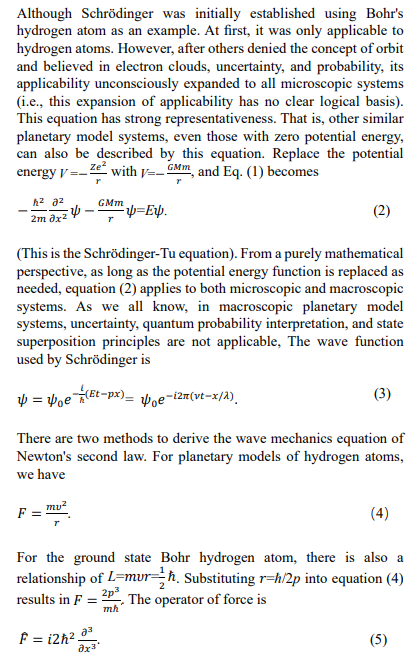
Equation (5) is the wave mechanics expression of Newton's second law. Readers can verify the above third-order partial differential by finding it.
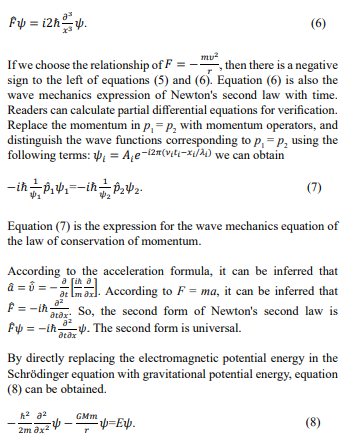
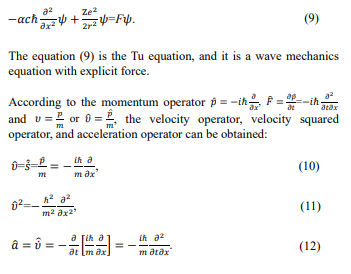
For uniform circular motion maintained by centripetal force, the relationship between radius r and circumference s is s=2 πr. Therefore
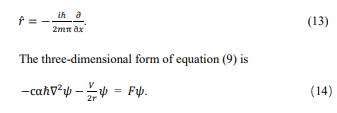
Equation (8) is the Schrödinger-Tu equation. Equations (9) and (14) are both equations. The establishment of Eq. (14) is like Bohr's successful use of old quantum theory to describe the hydrogen atom, which is a preliminary success in the effort to "give wings of force" to wave mechanics. It can intuitively demonstrate that wave mechanics itself does not exclude classical mechanics. The establishment of equation (14) is like Bohr's successful use of old quantum theory to describe the hydrogen atom, which is a preliminary success in endowing wave mechanics with wings of power. It can intuitively prove that wave mechanics itself does not exclude classical mechanics.
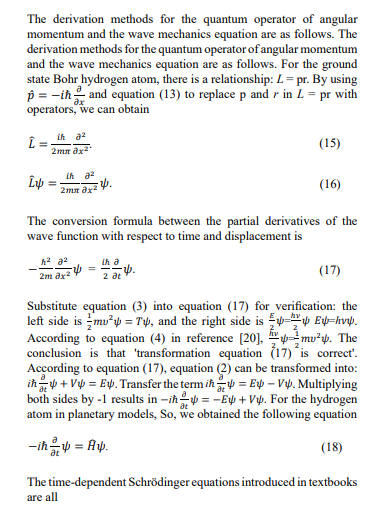

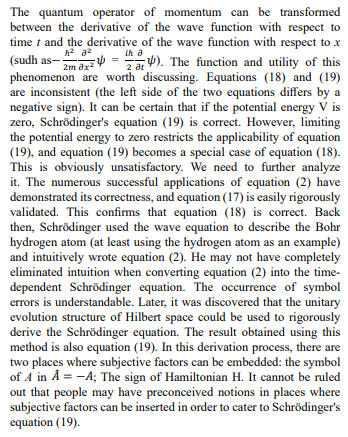
Is Schrödinger wrong, or is the author of this article wrong? This will be discussed in the next section.
Discussion on Significance
The significance of the research findings summarized by the author is as follows:
Core Viewpoint Proposed: Breaking Down Disciplinary Barriers
In this paper, the author explicitly challenges the traditional notion that the Schrödinger equation cannot describe macroscopic objects (such as the Earth), and Newtonian mechanics cannot describe microscopic systems. The author points out that this inherent concept severely limits people's understanding of the natural world, the development of physics theories, and the application of existing theories.
Key Breakthrough: Building Cross Scale Descriptive Equations
The author successfully derived the Schrödinger equation that can describe planetary motion by replacing the potential energy term in the Hamiltonian operator with gravitational interaction potential energy instead of electromagnetic interaction potential energy. This innovative equation achieves:
a) Macroscopic verification: When approximating the distance between the sun and the earth as a constant, the energy eigenvalues obtained by solving the Schrödinger equation for the Earth's revolution are completely consistent with the results of classical mechanics calculations.
b) Unified scale: proves that classical mechanics and wave mechanics are compatible, and there is no insurmountable gap between the two.
c) Simplified calculation: Established a theoretical framework that can simultaneously describe all objects (without mass limitations), simplifying the calculation process of quantum mechanics.
Theoretical Significance: Promoting the Paradigm Shift in Physics
The author's research findings have significant implications as follows:
a) Cognitive update: Proving that quantum mechanics and classical mechanics can be combined, overturning the traditional notion that the two are mutually exclusive.
b) Application Expansion: Provides new tools for cross scale physics research, with the potential to promote cross disciplinary applications in fields such as astrophysics and quantum mechanics.
c) Disciplinary integration: laying the foundation for establishing a more unified theoretical system of physics and promoting the integrated development of macro and micro physics.
d) Research Extension: Forming a Systematic Theoretical System.
Combining with the author's other literature lists, it can be seen that this paper is an important component of the author's series of studies. The author also published "Establishing the Schrödinger equation for macroscopic objects and changing human scientific concepts”, “Schrödinger-Tu equation: A bridge between classical mechanics and quantum mechanics” Waiting for works (including nearly 20 articles demonstrating the combination and compatibility of quantum and classical, and one book). Reference 2 is a summary discussion. The book 'Quantum Mechanics Returns to Local Realism' is a critique of the Copenhagen interpretation of quantum mechanics and an introduction to the application of local realism in quantum chemistry. Gradually constructing a systematic theoretical framework that integrates quantum mechanics and classical mechanics, pointing towards the category of localized real quantum mechanics—the generalized quantum mechanics that encompasses classical mechanics (this article makes a significant contribution to this direction).
References
- Tu, R. (2025). Research progress on the Schrödinger equation that can describe the Earth's revolution and its applications. London Journal of Research in Science: Natural & Formal, 25(1), 17-28.
- Tu, R. (2027). Reasons and consequences for the combination of quantum and classical theory. Brazilian Journal of Science,6(2), 1-28.
- Tu, R. (2025). Research Progress on the Schrödinger Equation of Gravitational Potential Energy. Adv. Theo. Comp. Phy, 8(1), 01-07.
- Tu, R. (2025). International Journal of Quantum Technologies.Int J Quantum Technol, 1(1), 01-09.
- Tu, R. (2024). Progress and Review of Applied Research on New Theory of Electronic Composition and Structure. Infinite Energy, 28(167), 57.
- Tu, R. (2025). Quantum Mechanics and Classical Mechanics Can Be Used Together. Adv Theo Comp Phy, 8(4), 01-07.
- Tu, R. (2025). Quantum Mechanics and Classical Mechanics Can Be Used Together. Preprint at viXra.
- Tu, R. (2025). Add wings of force to quantum mechanics. Zhihu.
- Tu, R. (1989). Preliminary application of non-point electron model in structural chemistry. Abstract Collection of Papers from Physical Chemistry Academic Conferences in Henan, Hunan, and Hubei Provinces. 237-238.
- Tu, R. (2025). A New Theoretical System Combinating Classical Mechanics and Quantum Mechanics. Adv Theo Comp Phy, 8(2), 01-06.
- Tu, R. (2014). Some Success Applications for Local-Realism Quantum Mechanics: Nature of Covalent-Bond Revealed and Quantitative Analysis of Mechanical Equilibrium for Several Molecules. Journal of modern physics, 5(6), 309-318.
- Tu, R. (2016). The principle and application of experimental method for measuring the interaction energy between electrons in atom. International Journal of Scientific Reports, 2(8), 187-200.
- Tu, R. (2024). A Wave-Based Model of Electron Spin: Bridging Classical and Quantum Perspectives on Magnetic Moment. Adv. Theo. Comp. Phy, 7(4), 01-10.
- Tu, R. (2024). A review of research achievements and their applications on the essence of electron spin. Advances in Theoretical & Computational Physics, 7(4), 01-19.
- Tu, R. (2024). Solving the problem of source of electron spin magnetic moment. Physical Science International Journal, 28(6), 105-110.
- Tu, R. (2026). The Conversion between Schrödinger Equation and F= ma. Applied Sciences Research Periodicals, 4(01), 144-157.
- Tu, R. (2024). Establishing the Schrödinger Equation for Macroscopic Objects and Changing Human Scientific Concepts. Adv Theo Comp Phy, 7(4), 01-03.
- Tu, R. (2024). Progress and Review of Applied Research on New Theory of Electronic Composition and Structure. Infinite Energy, 28(167), 57.
- Tu, R. (2027). Reasons and consequences for the combination of quantum and classical theory. Brazilian Journal of Science, 6(2), 1-28.