

Journal of Electrical Electronics Engineering(JEEE)
ISSN: 2834-4928 | DOI: 10.33140/JEEE
Impact Factor: 1.2


Research Article - (2025) Volume 4, Issue 6
The Effect of Ultra-Weak Radiation on the Shoots of Crassulae
Received Date: Oct 15, 2025 / Accepted Date: Nov 24, 2025 / Published Date: Dec 04, 2025
Copyright: ©Â©2025 Batyanov A. P. This is an open-access article distributed under the terms of the Creative Commons Attribution License, which permits unrestricted use, distribution, and reproduction in any medium, provided the original author and source are credited.
Citation: Batyanov, A. P. (2025). The Effect of Ultra-Weak Radiation on the Shoots of Crassulae. J Electrical Electron Eng, 4(6), 01-11.
Abstract
The effect of ultra-weak radiation on biological objects is discussed. It is assumed that coherent radiation generated by disturbances in the electron equilibrium in the outer orbitals of transition metals directly affects phosphorylation reactions in biological systems.
Introduction
This paper presents new data on the effects of ultra-weak radiation on the development of Crassulae shoots. As in previous studies, the radiation source was a hollow plastic cylinder, a resonator with a metal insert [1-3]. These studies demonstrated the specificity of the resonator's radiation action on photomultipliers, AlGaN, and HgS, depending on the insert material. From this perspective, the question of whether this specificity would manifest itself when exposed to radiation on biological systems is of interest. For this purpose, a series of experiments were conducted with an emitter containing Al.W inserts, in addition to the data from the study using a resonator with Pt [3].
Materials and Methods
Crassulae shoot development was monitored for 10 months after planting and irradiation of the experimental group with a resonator with a Pt insert. Results are presented in Figures. 2–4.
In a series of experiments for the Al emitter, 6 Crassulae shoots with 6 leaves on each were used, planted on flower soil 1.5 hours after cutting with the base of the branch. Experimental group: shoots No. 1, No. 2, No. 3. Control group: No. 4, No. 5, No. 6. Observation period: 08.05.25-23.10.25.
As in the series for the Pt emitter, branch No. 1 was irradiated without exciting the Al insert (without connecting the Al insert to the negative (-) pole of the battery (8 V), which corresponds to phase 2 of the model experiment with a photomultiplier [2]. The total irradiation time was 30 hr 24 min ~ 1.5 hr * 20 days. The average temperature during irradiation was 23.70 C.
Branch No. 2 was irradiated with exciting the Al insert and connecting it to the (-) pole of the 8 V battery, which corresponds to phase 3 of the model experiment [2]. The total irradiation time was 30 hr 1.5 hr * 20 days. The average temperature during irradiation was 22.80 C.
Branch No. 3 was irradiated after disconnecting the (-) pole of the battery from the Al insert, which corresponds to phase 4 of the model experiment with PMT [2]. Total irradiation time: 31 hr 18 min ~ 1.5 hr * 20 days. Average temperature during irradiation: 22.2°C.
In a series of experiments with a W emitter, 6 Crassulae shoots with 4 leaves each were used. They were planted flower soil 1.5 hours after cutting from the main branch. Observation period: 01.09.25 - 07.11.25. Experimental groups: No.1, No. 2, No. 3 were irradiated with the same parameters and sequence as in the series with Pt and Al. Control group: No. 4, No. 5, No. 6.
Total irradiation time for shoot No.1: 30 hr 2 min ~ 1.5 hr * 20 days. Average temperature during irradiation: 23.6°C.
For shoot No. 2: 31 hours 42 minutes ~ 1.5 hours * 20 days, T 23.7°C.
For branch No. 3 - 31 hours 24 minutes ~ 1.5 hours * 20 days, T 22.8°C.
The experimental methodology is described in more detail in [3].

Figure 1: Block diagram of the plant irradiation setup
1. Beaker with potting soil and a planted cutting in a light-tight chamber.
2. Crassula seedling.
3. W-fragment (10 mm) of a 60 W incandescent lamp filament or granulated Al, pure for analysis, irregular ellipse S = 260 mm 2 d ~ 0.75 mm.
4. Foam diaphragm inside a light-sealed plastic cylinder resonator.
5. Light-sealed plastic cylinder resonator (with linearly increasing transmittance of up to 15% from λ = 8 µ to λ = 28 µ).
6. Light-tight chamber.
8. 8 V power supply
Results & Discussion
When monitoring the growth of Crassula shoots irradiated with a Pt resonator in the first month after planting, an increasing difference between the control and the experimental group was noted over the following 10 months [4,5].
For shoot No. 1, 6 months after planting, the average area of individual leaves was 52% less than the control, and shoot No. 1 growth was 27% less than the average growth of the control.
After 10 months,these same indicators reached 79% and 56%, respectively. Moreover, in terms of leaf count (10), No. 1 outpaced the other shoots by ~3 months.
For shoot No .2, slight differences from the control were observed: 7 months after planting, the average leaf area was 14% greater, and after 10 months, 6% less. In the lower tier, a reduction of 2 full-fledged leaves and spontaneous leaf loss were observed ~8 months after planting.
For shoot No .3, 6 months after planting, the average leaf area was 51% less than in the control, while growth was 7%.
After 10 months, the figures were 52% and 13%, respectively. Moreover, in terms of leaf count (12), No .3 outpaced the other shoots by ~2 months. Ten months after planting, the control leaf area was on average 24% larger than that of the experimental group, and growth was 15% greater {Figure 2-4}.
In a series of experiments on the effect of an Al emitter on the development of Crassulae shoots, as in the Pt emitter series, a significant difference was observed between the control and experimental groups {Fig. 5-10}.
For shoot No .1, one month after planting and irradiation with a resonator containing non-electrified Al, the average leaf area was 12% smaller than the control, and growth was 5% smaller; after five months, the figures were 32% and 48.7%, respectively.
For shoot No .2, one month after planting and exposure to a resonator with electrified Al (-8V), the average leaf area was 3.7% greater than in the control group, and growth was 25% less; after 5 months, this was 9.6% and 17%, respectively.
For shoot No .3, one month after planting and exposure to a resonator with non-electrified Al (after switching off -8V), the average leaf area was 24% greater than in the control, and growth was 5%; after 5 months, this was 28% and 7%, respectively.
Thus, the greatest differences from the control in the experimental group, as in the series with Pt, occurred in shoots No .1 and No. 3.
In a series of experiments on the effect of W resonator radiation on the development of Crassulae shoots, differences were observed between the control and the experimental group {Figure 9-13}.
For shoot No. 1, the average leaf area, one month after planting and irradiation with a resonator containing non-electrified W, was 12% greater than in the control, with growth being 22% less.
For shoot No.2, the average leaf area was 7.3% greater than in the control, with growth being 12.5% greater.
For shoot No .3, the average leaf area was 37.8% greater than in the control, with growth being 9.6%.
On average, the leaf area in the experimental group 1 month after planting and irradiation was 19.3% larger than in the control, while the growth of shoots in the control and experimental groups was approximately the same.
Two months after planting, the average leaf area in the experimental group was 12% greater than in the control group, and the average shoot growth in the experimental group was 12.9% greater than in the control group (Figure11-18).
Thus, the greatest differences from the control in the experimental group, as in the Pt and Al series, occurred in shoots No .1 and No .3. Moreover, when using a Pt resonator on shoots No.1 and No.3, both a stimulating (earlier emergence of new segments and leaves than in the control) and an inhibitory effect (a decrease in leaf area and shoot growth later after planting; shoot No.2 showed a reduction in lower-tier leaves) were observed. A similar trend was observed when using an Al resonator: a slower development of shoot No .1 and an acceleration of the development of shoot No .3, compared to the control. As with the action of resonator radiation on photomultipliers {Figure 17-19},AlGaN.HgS, specificity is observed depending on the material of the inserts, and when acting on Crassulae shoots, some differences in development are observed, depending on the resonator inserts. Perhaps this is due to the high degree of coherence of the resonator radiation, which acts directly on the phosphorylation reaction - a key reaction for plant growth and development [3].

Figure 2: 6 shoots of Crassula 10 months after planting. 1,2 3 experimental group – irradiated with a resonator with Pt. 4,5,6 – control (left to right).
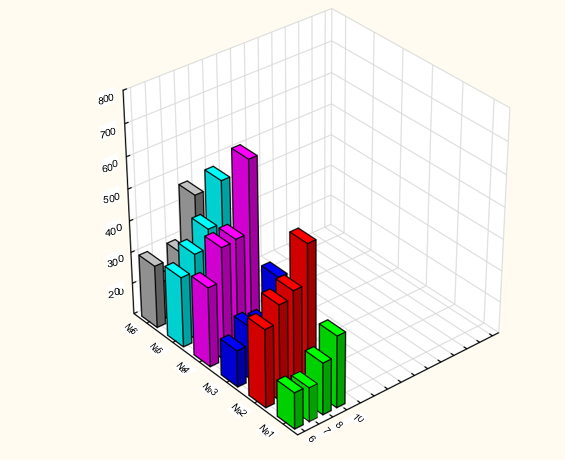
Figure 3: Average leaf area of 6 Crassulae shoots during 10 months after planting. 1, 2, 3 - experimental group - irradiated with a resonator with Pt. 4, 5, 6 - control. Z-axis: mm2, X-axis: month of observation after planting, Y-axis: shoot numbers
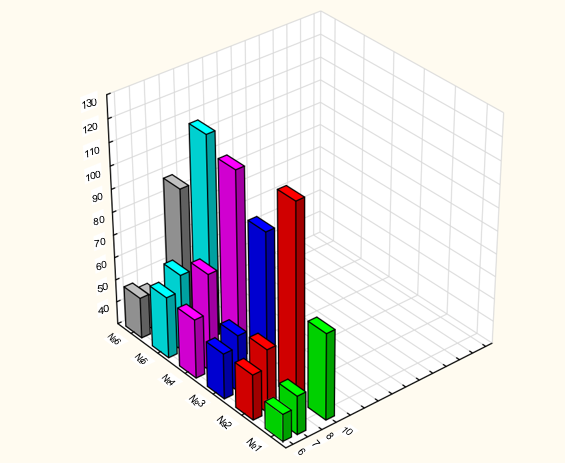
Figure 4: Growth of 6 Crassulae shoots during 6-10 months of observation. 1, 2, 3 - experimental group - irradiated with a resonator with Pt. 4, 5, 6 - control. Z-axis: mm, X-axis: month of observation, Y-shoot numbers

Figure 5: 09.05.2025. A group of Crassula shoots planted on 08.05 (No. 1-No. 2-No. 3 - experimental group, irradiated from a plastic resonator with Al) (No. 4-No. 5-No. 6) - control group
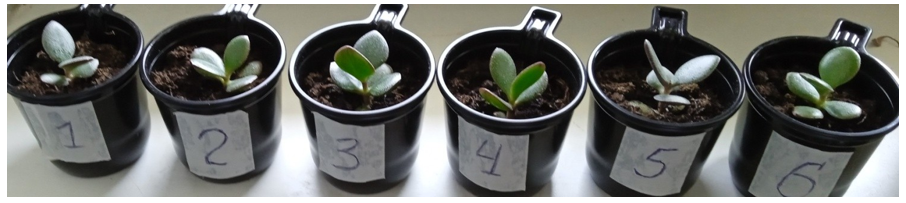
Figure 6: 09. 06.2025. Crassulae shoots 1 month after planting08. 05.2025. Experimental group No. 1, No. 2, No. 3, irradiated for 20 days for 1.5 hours a day from an emitter with Al, No. 4, No. 5, No. 6 - control group
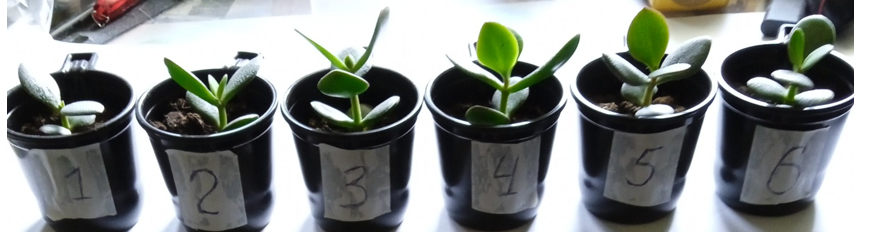
Figure 7: Crassulae shoots 3 months after planting on May 8, 2025. Experimental group No. 1, No. 2, No. 3 were irradiated for 20 days for 1.5 hours a day from an emitter with Al, No. 4, No. 5, No. 6 were the control group

Figure 8: Crassulae shoots 5 months after planting on May 8, 2025. Experimental group No. 1, No. 2, No. 3 were irradiated for 20 days for 1.5 hours a day from an emitter with Al, No. 4, No. 5, No. 6 were the control group. óÃÂ??ÃÂ??ÿÿa
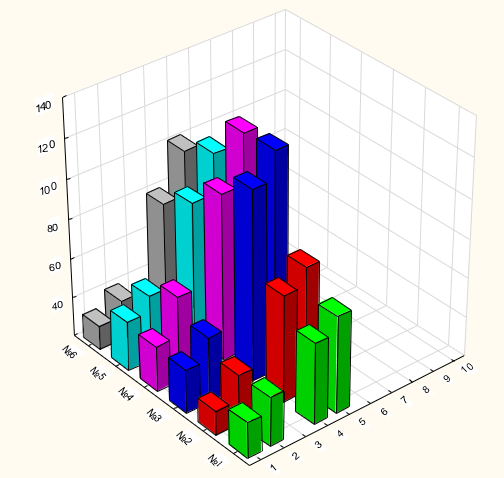
Figure 9: Growth of Crassulae shoots 5 months after planting: 1-3 experimental group - irradiated with a resonator with Al. 4-6 control group. Z-axis - mm, Y-axis - shoot numbers, X-axis - month after planting
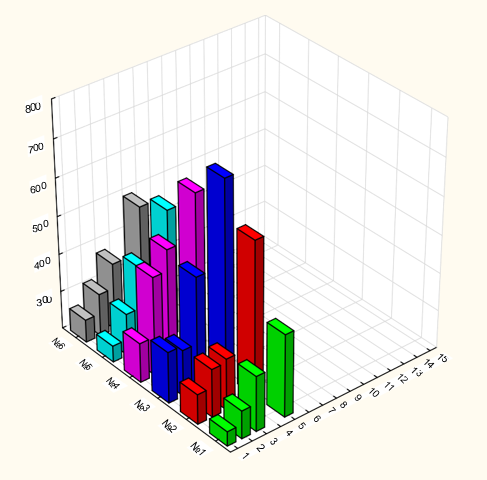
Figure 10: Average leaf area of 6 Crassulae shoots, 5 months after planting. 1, 2, 3 - experimental group - irradiated with a resonator with Al. 4, 5, 6 - control. Z-axis - mm2, X-axis - month of observation, Y-axis - shoot numbers
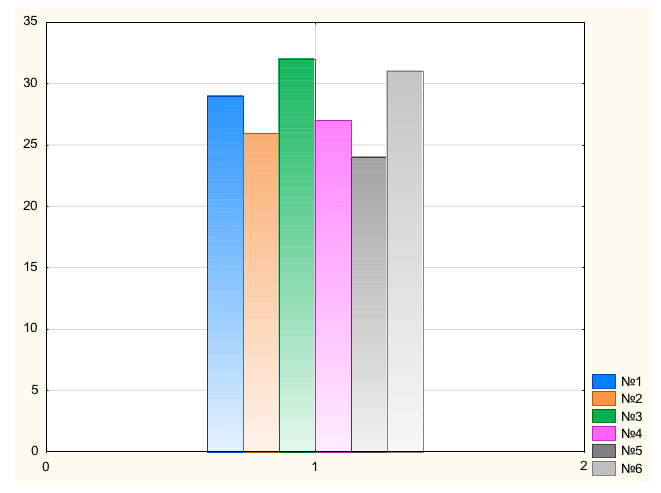
Figure 11: Length of 6 Crassulae shoots in mm before planting and irradiation of experimental groups 1, 2, 3 with a W emitter. Along the ordinate axis: mm. Along the abscissa axis: shoot number (left to right)
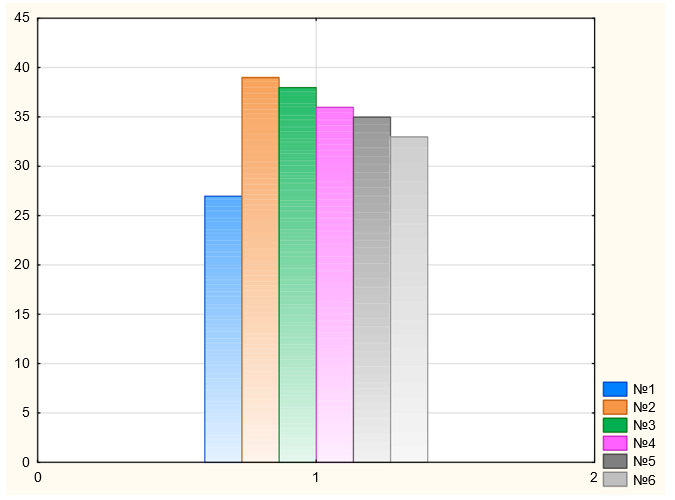
Figure 12: Growth of Crassulae shoots (from ground level), 1 month after planting, experimental group 1, 2, 3 - irradiated with a W emitter. Along the ordinate axis: mm. Along the abscissa axis: shoot numbers (left to right)
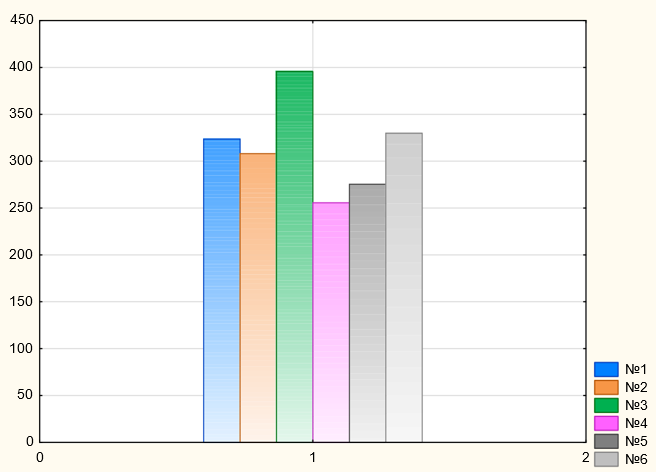
Figure 13: Average area of Crassula leaves 1 month after planting 6 shoots, 1, 2, 3 - irradiated with a W emitter. Along the ordinate axis:mm2. Along the abscissa axis: shoot numbers (left to right)
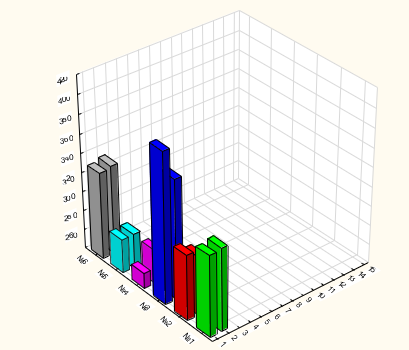
Figure 14: Average leaf area of 6 Crassulae shoots 1 and 2 months after planting. 1, 2, 3 - irradiated with a resonator with W. 4, 5, 6 - control. Z-axis - mm2, X-axis - month after planting of the shoot, Y-axis - shoot number
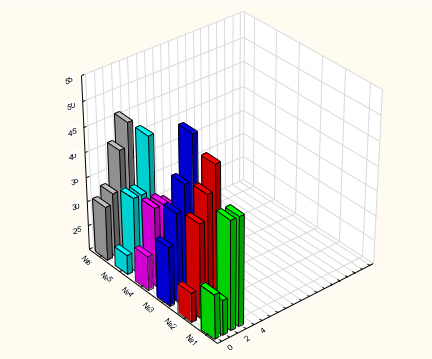
Figure 15: Growth of 6 shoots of Crassulae during a period of 3 months after planting and irradiation of the experimental group (1,2,3) with a resonator with W. The Z-axis is mm, the Y-axis is the shoot numbers, and the X-axis is the month of observation. (0 is the length of the shoots before planting)
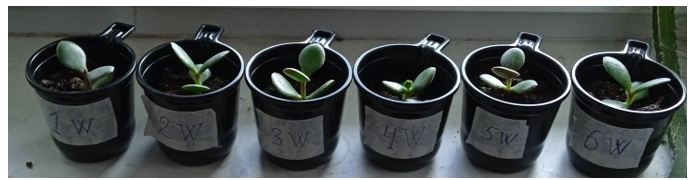
Figure 16: 6 shoots of Crassulae 2 months after planting. 1, 2, 3 - experimental group, irradiated with a resonator with W. 4, 5, 6 - control(left to right).
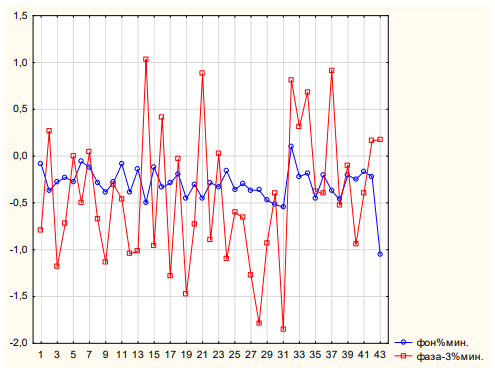
Figure 17: PMT signal changes (% min) during recording of radiation from a plastic hollow resonator with Pt inside, for 43 separate, sequential experiments. Blue curve is background, red curve is phase 3, Pt plate is electrified (contact with one pole of the battery -5V~15mn). Y-axis: % min. X-axis: number of experiments
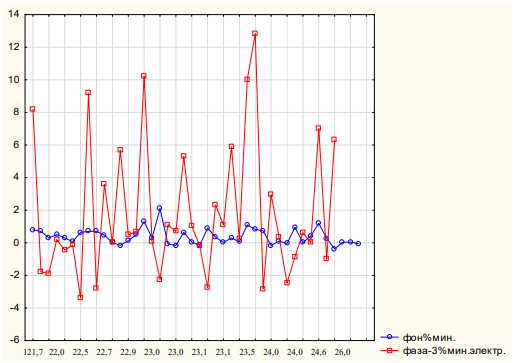
Figure 18: Changes in the PMT signal - % min. when recording radiation from a plastic hollow resonator with Al inside, for 42 separate experiments. Blue curve - background, red curve - phase 3 (Al plate is electrified - 5v ~ 15 min.). Along the ordinate axis: % min., along the abscissa axis - TOC
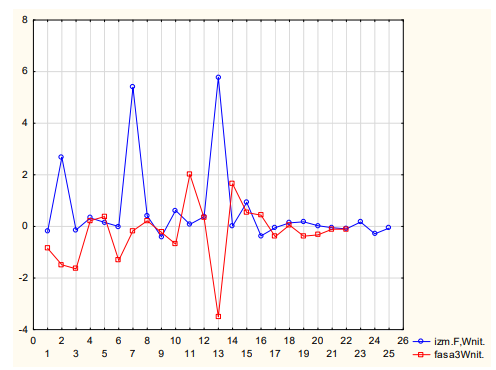
Figure 19: Changes in the PMT signal during sequential registration of radiation (Pase-3) from a resonator with W (a fragment of an incandescent lamp filament is irradiation -250nm , 15 min.) over 25 days. Along the ordinate axis: % in min., along the abscissa axis: number of days
Declarations
Ethical Approval
Institutional Review Board Statement: The study was conducted according to the guidelines of the (DIRECTIVE 2010/63/EU OF THE EUROPEAN PARLIAMENT AND OF THECOUNCIL on the protection of animals used for scientific purposes of 22.09.2010.), and approved by the Institutional Ethics Committee of the Institute of General Pathology and Pathophysiology (final protocol # 1 of 01.02.2023.)
Competiting Interest
Informed Consent Statement
Informed consent was obtained from all subjects involved in the study
Authors Contribution
Inadaptabiliy
Funding
His research received no external funding
References
- Batyanov, A.P. (2023). Super weak Electromagnetic Radiation in Bio and Inorganic Systems. J.Electrical Electron. Eng.2(4)339-346.
- Batyanov, A.P. (2024). A Model Recording Ultra-WeakElectromagnetic Radiation from Metals and
- Semiconductors . J.Electrical Electron.Eng.3(5)1-16.
- Batyanov, A.P. (2025). The Effect of Ultra-Weak Radiation onBiological Objects. J.Electrical Electron.Eng. 4(3)01-07.
- Lehninger, A. L., & Lehninger, A. L. (1975). Biochemistry: the molecular basis of cell structure and function (Vol. 2). New York: Worth Publishers.