

Journal of Human Resource Sustainability and Organizational Studies(JHRSOS)
ISSN: 3143-7222 | DOI: 10.33140/JHRSOS

Research Article - (2026) Volume 1, Issue 2
Mobile Telecommunication Networks and Decent Work in the Cape Coast Metropolis of Ghana
 , Alexander Opoku-Danso , Afua Anima Ntow , Elizabeth Yankah and Alberta Abena Kunadu Owusu
 Received Date: Aug 08, 2026 / Accepted Date: Sep 11, 2026 / Published Date: Sep 21, 2026
Copyright: ©2026 Blessed Ashmond, et al. This is an open-access article distributed under the terms of the Creative Commons Attribution License, which permits unrestricted use, distribution, and reproduction in any medium, provided the original author and source are credited
Citation: Ashmond , B., Opoku-Danso, A., Ntow, A. A., Yankah, E., Kunadu Owusu, A. A. (2026). Mobile Telecommunication Networks and Decent Work in the Cape Coast Metropolis of Ghana. J Hum Res Sus Org Stud, 1(2), 01-14.
Abstract
Mobile telecommunication networks are a source of employment for many Ghanaians, especially the teeming youth. It is therefore expected that the employment generated by these telecommunication networks will be decent, as recommended by the International Labour Organization’s provisions on the decent work agenda. This current study investigates the activities of MTN and Vodafone, which are the two leading mobile telecommunication networks in Ghana, and their contribution to decent work in the Cape Coast Metropolis of the Republic of Ghana. Using the mixed-method research design and the International Labour Organization’s framework on the decent work agenda, the study finds that the two telecommunication networks (MTN and Vodafone) have promoted decent work in the Cape Coast Metropolis. The study recommends that management of the telecommunication networks could consider regularizing the activities of the retailers and institute pension and other social protection schemes which will take care of the staff and the retailers in the event of retirement, old age, or invalidity
Keywords
Decent Work, Social Protection, Working Conditions, Human Resource Management, Mobile Telecommunication Networks, MTN, Vodafone, Employment Creation, Human Capital Development, Labour Rights, Social Dialogue, Foreign Direct Investment (FDI), Multinational Companies (MNCs), Employment Growth, Cape Coast Metropolis, ILO Decent Work Agenda, Ghana
Introduction
Developing countries have committed to providing decent work for their citizens. One sector in Ghana that is perceived to be providing decent jobs and is dominated by Multinational Companies (MNCs) is the telecommunications network. The mobile telecommunication networks have been a vehicle for the transfer of Foreign Direct Investment (FDI) to the growth of Ghana’s economy. Maree (2011) identifies labour and employment generation as areas within which a country’s economy or society has been influenced by mobile telecommunication networks [1]. Even though the entrance of mobile telecommunication networks into the Ghanaian economy has not been around for very long compared to other industries, they have made a significant impact on the growth of the Ghanaian economy by creating jobs in both urban and rural areas [2]. The diffusion of telecommunication networks in Ghana has had a significant impact on the creation of both direct and indirect jobs and has ensured improved working conditions and social protection [3]. Mobile telecommunication networks create an enabling environment for business growth that eventually creates job opportunities to improve the standard of living of the people [4]. Cohen (1992) identifies that the Global System for Mobile telecommunication (GSM) has contributed to employee social protection and serves as a source of income and employment to many youths in the host country [5].
The working conditions of mobile telecommunication workers are supposed to enable them to derive maximum satisfaction and give their best. Saeed, Lodhi, Iqbal, Nayyab, Mussawar and Yaseen (2013) conclude that the physical design of a building, salary level, healthy work environment, fairness on the employer’s part and employees’ promotion from a lower rank to a higher rank all contribute towards ensuring decent work in the telecommunication industry [6]. Saeed et al (2013) further observe that social protection interventions such as hospital, housing, and transportation relief packages contribute to the benefit of the workers [7]. The money that would have been spent on these living expenses is saved and spent on other things, making the worker better off.
Problem Statement
Developing countries are confronted with macroeconomic challenges which have led them to look favorably at the various FDI’s because it is believed that they can contribute to the creation of decent work in the host country. One sector that is perceived to be providing decent work in Ghana is the telecommunications sector. The mobile telecommunication industries in Ghana are plagued with the problem of frequent strikes and agitations by workers in respect of poor working conditions [2]. For labour to be satisfied and give its best to enhance productivity, the working conditions and the nature of social protection given to the workforce should be satisfactory.
A good deal of studies on multinational mobile telecommunication networks (such as the telecommunication industry and job creation, the impact of telecommunication revenue and economic growth, and mobile telephony and employment creation in developing countries) have analyzed mobile telecommunication networks and economic growth from the perspective of Gross Domestic Product (GDP) and revenue growth. However, these studies fall short of mobile telecommunication networks and decent work, with emphasis on the working conditions and social protection for the workers in the Cape Coast Metropolis of Ghana; hence, this current study.
Objective of the Study
The objective of the study is to investigate the activities of MTN and Vodafone telecommunication companies, and their contribution to decent work in the Cape Coast Metropolis of Ghana. Specifically, the study seeks to achieve the following objectives:
i. Determine the nature of social protection that is offered to the workers in the MTN and Vodafone mobile telecommunication networks.
ii. Investigate the nature of working conditions offered by the MTN and Vodafone telecommunication networks in Ghana.
iii. Make recommendations to ensure decent work in the MTN and Vodafone mobile telecommunication networks.
Research Questions
The research questions that this research seeks to answer are:
i. What is the nature of social protection given to the workers of MTN and Vodafone telecommunication networks?
ii. What is the nature of working conditions in the MTN and Vodafone telecommunication networks?
iii. What recommendations could be offered to ensure decent work in the MTN and Vodafone mobile telecommunication networks?
The Development of Mobile Telecommunications in Ghana
Mobile telecommunications experience in Ghana started in the early part of the 1990s. Before then, only fixed-line services were available. Ghana Telecom had an exclusive monopoly over telecommunication services. The policy reforms initiated in the telecommunication sector as a way of fulfilling the conditions tied to the Structural Adjustment Program agreement created a competitive environment that enabled mobile telecom network providers and other wireless service providers to operate. The first commercial mobile telecommunication network in Ghana came into being in 1992 by Millicom Ghana (Mobitel), a subsidiary of Millicom International Cellular which operated in 17 countries across Latin America, Africa and Asia [7]. The company started out using an analogue network. The network covered Accra and selected regional capitals such as Tamale, Sunyani, Kumasi, Koforidua, Takoradi and Cape Coast. In 1993, another mobile network operator, Celtel, commenced operation in Ghana. Celtel was renamed Kasapa in 2003 as a way of giving it a local identity. Celtel was also an analogue network. These analogue networks were followed by digital networks, the GSM, which came into being in 1996 [7].
The first company to operate a digital network in Ghana was Scancom Ghana Ltd in 1996 using GSM 900 technology with the brand name Spacefone. Spacefone soon became the market leader with an increasing number of subscribers. The company was subsequently taken over by Investcom and was renamed Areeba in 2005. Areeba was acquired by Mobile Telecommunication Network (MTN), a South African multinational mobile telecommunication network, in 2006 and was renamed Mobile Telecommunication Network (MTN) Ghana in 2007. The successful introduction of a digital network by Scancom motivated the other companies to migrate from analogue to digital networks. In the year 2000, Millicom Ghana switched from analogue to digital under the name Buzz. The company’s name was again changed to Tigo in March 2006 [3]. In the year 2000, Ghana Telecom launched One-touch, which was to provide mobile services. The company was able to attract 6,000 customers within the first year of operation. On 23rd July, 2008, Vodafone International acquired seventy percent of Ghana Telecom, making Vodafone the majority shareholder while the Government of Ghana holds a thirty percent share. In 2008, another mobile operator entered the mobile industry with the brand name Zain (now Airtel). The company is a subsidiary of Zain International that operates in several African countries and the Middle East [8].
As a way of staying in business in a perfectly competitive market, the network service providers have extended network coverage to a lot of places in Ghana. Mobile coverage is extensive in southern and eastern Ghana and limited in northern Ghana [9]. In 2008, another mobile telecommunication network called Globacom (Glo) entered Ghana. Glo acquired an operating license through its Glo Mobile division in Ghana. On April 8, 2011, Glo launched the submarine optical fiber to usher in another major player in the Ghana telecommunication industry. Glo Ghana launched a ceremony to officially operate in Ghana in January 2012. Telecommunication service providers in Ghana increased from three to six from the period 2005 to 2015. The telecommunication service providers in the mobile telecom industry, specifically the Global System for Mobile Telecommunication service providers, are all multinational companies.
Empirical Perspectives of Decent Work in The Mobile Telecommunication Industry
The diffusion of mobile phone technology in Ghana has made a significant impact in creating both direct and indirect jobs in Ghana [3]. For example, traders in Ghana, whether small or large, are among those who have seen the indirect positive impact of mobile phone diffusion on their businesses [10]. Overa (2006) argues further that transaction and transportation costs are the two major factors that are used by these traders to determine their “producer-wholesale margin” that affects incomes of both the producer and the traders and ultimately determines the availability and cost of the goods that consumers will purchase [10]. Therefore, any means such as the use of mobile phones to reduce the transaction and transportation costs make business more profitable. A profitable business means the business owner’s ability to pay more taxes into the economy, hence more revenue to promote socio-economic development and employment creation in the country.
One technology that has the potential to reduce poverty, thereby promoting development and creating jobs, is mobile phone diffusion [11]. Garreau (2008:4) further argues that mobile phone “is the fastest global diffusion of any technology in human history and it is even faster than the polio vaccine” [11]. China is also another good example of how mobile phone technology has brought about socio-economic advancement in the country. It has certainly helped in transforming China’s world image, and the 2008 Beijing Olympic Games were a good testimony to the impact of mobile phone technology. During the opening ceremony of the Olympic game alone, the number of mobile phone subscribers who used their cellphones in and around the stadium was 250,000 nearly double the number of users during the Athens 2004 opening ceremony, and the peak number of calls made using China’s mobile’s network in the Bird’s Nest Stadium and the Olympic central area in Beijing reached over 110,000 each hour [3]. The massive use of mobile telecommunication during the Olympic Games boosted employment and facilitated employment creation in Beijing [12]. Unemployed people use their mobile phones to find work as well as to contact loved ones that they have left at home [12].
The use of any technology, such as the mobile phone, has some negatives, such as creating social and income inequalities, deepening unemployment, and cultural shock. However, the benefits of mobile phone technology far outweigh its demerits. Aker (2009) rightfully argues that mobile phones are transforming lives in low-income countries faster than ever imagined [13]. The effect is particularly dramatic in rural areas of Sub-Saharan Africa, where mobile phones have often represented the first modern infrastructure of any kind. Ghana’s telecommunication service providers make significant financial contributions in terms of payment of tax revenue to the government and incomes which are paid to people who are employed directly by the mobile telecommunication companies and those who engage in the sale of their services [14].
Theoretical Perspective of The Study
Neo-Classical Theory
The Neoclassical approach to the study of MNCs adopts the position of those theorists who highlight the benefits and the positive impacts of foreign direct investment from the perspective of Neoclassical economic theory. Their position has been that MNCs ensure the flow of capital to poor and less endowed countries and, in the process, ensure efficient allocation of resources. These include human and financial resources received internationally as a way of maximizing global satisfaction and ensuring the bridge of inequality gaps. By extension of Nurkse's thesis that countries are poor, there is the need to inject foreign capital through FDI, and this has been the stand of these theorists. The view of these theorists is that poor countries could not raise their low level of savings to a higher income very quickly in their quest to ensure the provision of decent work [15].
Authorities who explain MNCs from the neoclassical point of view have concluded that MNCs’ investment creates benefits for the host countries in developing countries. Blomstrom and Kokko (2003) identify additional effects of FDI, stating that FDI creates technological externalities and knowledge spillovers for the local economy [16]. MNCs bring on board FDI, which adds to the capital stock in the host country, creating employment and raising wages. In furtherance of this, neoclassical theorists posit that no meaningful decent work could be created in the absence of capital stock, knowledge spillover, and technological externalities [17].
The Telecommunication Industry and Decent Work Creation
Some empirical studies have been conducted on the impact of telecommunication investment on the growth of the host country. These empirical studies have centred on the experiences of developed countries on the linkages between telecommunication networks and their contribution towards employment growth. Greenstein and Spiller (1995) find that a positive and significant effect exists by investigating the impact of telecommunication on employment growth in the United States [18]. Yilmaz, Hayne and Dinc (2000) indicate that the accumulation of telecommunication infrastructure improves the overall productive capacity at the regional level by examining the impact of telecommunication on employment output both at the aggregate and sectoral levels [19].
Dholoakia and Harlem (1994) show the relationship between investment in telephone and employment creation by examining the connection among some factors such as education, energy, telephone, other physical infrastructure, and economic growth [20]. The result of their multiple regressions suggests that simultaneous investment in development inputs such as education, telecommunications, and other physical infrastructure is complementary in helping to promote employment growth for economic development. However, Canning (1999), in his study, evaluates the contribution of investment in telecommunications towards ensuring employment growth [21]. He observes that telephones have a larger impact on employment output than other sectors of an economy. According to Canning (1999), the telecommunication networks generate larger spillovers to othersectors of the economy [21]. Wired telecommunications carriers accounted for about 6,661,000 of these jobs in 2008, while 202,700 were in wireless telecommunications carriers [22].
Individuals in installation, maintenance, and repair occupations work in a variety of settings, both indoors and outdoors, and in all kinds of weather. Their work involves lifting, climbing, reaching, stooping, crouching, and crawling. They often work in high places, such as rooftops and telephone poles. Their jobs bring them into proximity with electrical wires and circuits and therefore expose them to all kinds of risk. These workers are requested to wear safety equipment when entering manholes to fix telecommunication wires [22]. Most workers in the telecommunication industry work 40 hours per week. Workers in this industry are sometimes required to work overtime, especially during emergencies such as floods or hurricanes when employees may need to report to work with little notice to help restore network connections [22]. However, most telecommunication managers, administrative workers, and professionals work in clean, comfortable offices. Customer service representatives often work in call centers where they answer customer calls and may be required to work in the evening and weekend hours.
Exploring another branch of empirical literature, some empirical studies attempted to use a transaction-cost approach to evaluate the relationship between ICT expansion and decent. In a cross-sectional study, Hulten and Robert (1991) conclude that expansion of telephone infrastructure provides “substantial growth and investment- enhancing activity and thus facilitates job creation and, for that matter, creates decent work [23]. Norton’s explanation for his findings is grounded in the argument that access to telecommunications reduces transaction costs.
The telecommunication industry employs professionals and related occupations. Nineteen percent of the industry employees are professionals and related workers. Most workers in these occupations are employed at the district, regional, and national headquarters or research facilities of telecommunications companies [24]. Engineers plan cable routes, equipment installations, and the expansion of existing structures. Some engineers also engage in research and development of new equipment. Engineers study the limitations and uses of laser and fiber optics, find new applications for lasers and fiber optics, and oversee the building, testing, and operation of new applications [22]. The telecommunication industry also creates employment in the sales and related occupations. Henderson (2012) posits that about 17 percent of the industry’s employees are in sales and related occupations [24]. These workers, such as representatives and retail or salespersons, are responsible for selling and providing telecommunication services to their mobile and residential customers.
Working Conditions as A Component of Decent Work
Employees in an organization have always been key assets as they drive the company to achieve its objectives to gain a competitive advantage. Human capital, therefore, is the driving force of every organization since workers constitute the fulcrum around which any company or business revolves. Their departure could have significant effects on the implementation of the organization’s strategic goals and objectives and may eventually cause a decline in productivity [25]. Sutherland (2004) contends that companies with high-quality human resource perform better and deliver higher and more consistent returns to shareholders [26]. For an organization to gain and sustain competitive advantage, it requires that the organization retains its valuable employees since employee turnover costs approximately fifty percent of the total revenue that is generated by that organization [9].
Kwenin et al. (2013) conducted a study on the relationship between work environment and career development opportunities as a component of employment growth in Vodafone Ghana Limited [9]. They observed from their study that the majority of the respondents (55.2%) agreed that they would leave if they found promotional and learning opportunities somewhere. This result portrays that employees place much importance on decent work.
Mobile Telephony and Decent Employment in Developing Countries
There are two distinct channels through which mobile telephony contributes to improving employment growth: a direct impact and an indirect impact. The direct impact can be captured by interpreting the level of mobile penetration in a market as a proxy for the development of the mobile telecommunication industry in the country. Countries with higher levels of mobile penetration tend to be the countries with comparatively higher levels of employment base in the mobile sector. Higher investment in the mobile sector generates more employment, more mobile-related economic activity, and more activity in the wider economy [27]. Williams et al (2012) conclude that the marginal effect of mobile phone penetration on employment varies across countries with the average level of mobile penetration [27]. Mobile penetration has a higher impact on employment growth in countries with low levels of penetration than in countries with higher levels of penetration.
Mobile phone providers have made a significant impact on the growth of the Ghanaian economy by adding to jobs both in the urban and rural areas [2]. Kuofie et al (2010) further posit that mobile phones are bringing the Ghanaian communities more closely together even though they are miles apart [2]. It is improving businesses and their ability to employ and engage more labour force that otherwise couldn’t have been possible. Through mobile phone diffusion in the country, the Ghanaian job market has directly and indirectly been impacted, with some high-paying jobs not just in the cities but in rural areas of the country as well. This means that the number of people who are engaged in employment avenues has increased because of the emergence of mobile telecommunication networks.
Kluger (2006) finds that out of 104 participants, 34 percent of them strongly agree that their companies have a favorable opinion of the mobile phone diffusion and its impact on decent work in the Ghanaian economy [28]. About 63.9 percent agreed that their companies perceive mobile diffusion as instrumental in promoting employment in Ghana. The study also finds that 25 percent of the 104 respondents said their mobile phone companies ensure social protection for all employees in their company. The study further finds that out of the 104 participants, 15.5 percent of the participants strongly agreed, and 81.4 percent of the participants agreed that all sectors of the Ghanaian economy have benefited from mobile phone diffusion expansion in labour force and improved working conditions.
Conceptual Framework
Multinational Companies are believed to have several positive impacts to the host country. One of these positive impacts is decent work. The ILO explains the components of decent work in its Decent Work Agenda document. The indicators in these documents include promoting jobs, the ability to create employment opportunities,
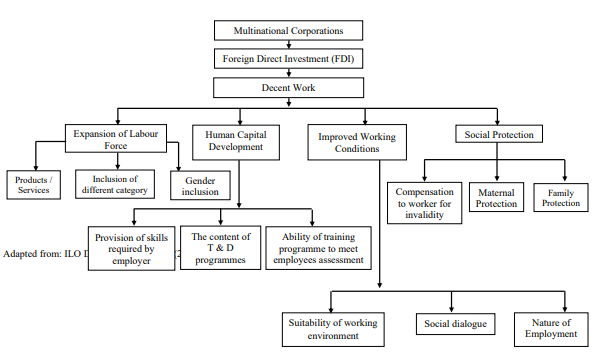
remunerative employment, human capital development, ensuring social protection and good conditions of work which are explained in terms of occupational safety and health, economic democracy, extension of social protection and maternal protection. The MNCs are the vehicle for the transfer of FDI which is needed for economic growth. Inherent in economic growth is decent work. The provision of decent work in any country is explained in terms of the number of citizens who are employed and the quality of the employment. The components of employment growth as described in the ILO documents on decent work agenda, and their interrelationship are subsumed under the size of employment, the mode of human capital development, the nature of social protection and the nature of working conditions offered to the workers. The figure below provides a conceptual model for the components of decent work as transported by MNCs through FDIs.
The conceptual framework looks at the interrelationship between the various components of decent work. The figure shows that MNCs are the vehicle for the transfer of FDI which is a vehicle for the transfer of FDI into the host country for attaining economic growth in general and decent work in particular. Decent work is therefore enhanced through expansion of labour force, human capital development, improved working conditions and socsocial protection.
If FDI enters any country through MNC, it should have the ability to create employment (expansion of labour force) and develop the skills of the labour force (human capital development). The labour needs to work in an improved working condition such as creating opportunities for social dialogue and ensuring suitable working environment. Also, employment growth cannot be completed if the social protection component is ignored. The social protection aspect of employment growth according to ILO’s decent work agenda consists of compensation that is paid to workers in an event of invalidity, maternal and family protection. The expansion of labour force as component of employment growth takes the dimension of introduction of varieties of products and services, and gender inclusion. Human capital development takes into consideration the content of the training and development programmes and the ability of the training programmes to assess employees’ needs
Methodology
Study Area
The study was undertaken in the Cape Coast Metropolis in the Central Region of Ghana. The Cape Coast Metropolis is bounded to the south by the Gulf of Guinea, west by the Komenda Edina Eguafo Abrem Municipality, east by the Abura Asebu Kwamankese District and to the north by the Twifo Heman Lower Denkyira District. The population of the Cape Coast Metropolis according to the 2010 population and housing census was estimated to be 145,246. The Metropolis is a host of mobile phone companies and their mobile telecommunication services are accessible within the metropolis.
The reception of the telecommunication networks in the Cape Coast metropolis is very high in areas such as Pedu, Kotokoraba, Amamoma, Apewosika, Nkanfoa, Abura, Effutu, Kakumdo and all other residential areas in the Cape Coast Metropolis [29]. This high reception within the metropolis could partly be attributed to masts that have been erected by the mobile telecommunication companies. The operation of mobile telecommunication networks is widely spread and visible in the Cape Coast Metropolis. The presence of a number of educational institutions (specifically secondary and tertiary institutions) requires the presence of mobile telecommunication companies to operate in the Cape Coast Metropolis because the students offer ready market or high patronage of mobile telecommunication services. It has been established in the literature that the mobile telecommunication networks, right from their inception, targeted educational institutions to provide affordable means of communication between students and their parents or guardians. Students, who hitherto, had to travel home for school fees and pocket money now had easy and cheaper means of reaching their parents and guardians without having to travel from campus to their homes.
Research Design
The study used the mixed-method research design, which involves both qualitative and quantitative approaches to investigate the operations of multinational telecommunication networks and decent work in the Cape Coast Metropolis in the Central Region of Ghana. The qualitative research approach was used to collect data from the Heads of Department who were expected to provide detailed information on how MTN and Vodafone telecommunication companies ensure social protection, human capital development, and good working conditions. The educational background of the retailers of MTN and Vodafone services is perceived to be very low, and this situation requires that face-to-face interaction be adopted to provide a clear explanation of issues that they do not understand, and also impossible to do so in a quantitative approach such as administering a questionnaire.
The study also used the quantitative approach, which includes secondary materials like document analysis and questionnaire administration for the general staff category. The nature of information that required a quantitative approach includes the change in staff strength because of the change in management. Furthermore, the general staff of MTN and Vodafone telecommunication companies are perceived to be literate and could provide independent information on the working conditions and social protection that are offered to them by the companies and therefore require a quantitative approach such as administering questionnaire to obtain such information. Mixed-method research design provides more evidence in studying a research problem than either quantitative or qualitative research alone. Researchers are enabled to use all the tools of data collection available rather than being restricted to the types of data collection typically associated with quantitative or qualitative research [30,31].
Study Population
The population for the study comprised all staff of the MTN and Vodafone telecommunication networks. The population of Vodafone and MTN staff nationwide is 1420 and 1600, respectively. The proportion of MTN and Vodafone staff in the Greater Accra region is 190 (11.8%) and 195 (13.7%), respectively, while the Central region has 160 (10%) and 140 (9.8%) of MTN and Vodafone staff, respectively [32].
The total number of MTN and Vodafone staff in the Central Region is 160 and 140, respectively. Out of this number, the total number of staffs in Vodafone and MTN in the Cape Coast Metropolis are 19 (13.6%) and 19 (11.8%) respectively, and these numbers exclude the retailers. The general staff categories of MTN and Vodafone are found in the departments comprising sales and marketing, Information and Communication Technology (ICT)/Engineer, Customer Care, Finance/Auditing/Accounting, and Corporate Affairs. The total number of retailers in MTN and Vodafone telecommunication networks in the Cape Coast Metropolis is 25 and 25, respectively. Cape Coast was chosen as the study area because of the high concentration of both second cycle and tertiary institutions in the Cape Coast Metropolis, which has required mobile telecommunication companies to spread their operations within the metropolis because there is a market for their services Ofori-Atta, 2013). This has made Cape Coast Metropolis an ideal study area for this current research. The staff category comprises all the Heads of Department, middle-level staff, and trainers. The Heads of Department, staff in all the departments (middle-level staff), trainers, and retailers/vendors were the respondents. A complete coverage (census) was done for all the staff. Again, 25 sales and 25 retail points were identified for MTN and Vodafone, respectively, in the Cape Coast Metropolis. Complete coverage was also used for all the retailers within these two mobile telecommunication networks. A census was used for the study because of the small population involved.
Data Collection and Instruments
Data were obtained mainly from primary and secondary sources. Information that was obtained through primary sources with respect to this current study includes: working conditions and social protection offered to workers. The secondary sources were mainly information gathered from books, journal articles, work policy, and other documented information of both MTN and Vodafone mobile telecommunication networks. The documented information includes the Annual Review Report of MTN and Vodafone. The study adopted structured interviewing to elicit information from the senior management staff (Heads of Department) who are the key informants, and the retailers. The research also adopted questionnaire administration as a data collection method for the general staff category. The general staff comprises all staff, including junior staff, senior staff and Heads of Department.
Data Analysis
There were three levels of data collection methods involved in this study. These were interviewing, questionnaire administration and document analysis. The first step of the analysis process of the data obtained through interviewing was to transcribe the data from the original form on a recorder onto paper. The paper manuscripts were subsequently cleaned and edited to eliminate typographical errors and contradictions in the text. The transcripts were checked and edited to ensure that the various parts of the data were related for further analysis.
The findings of the individual interviews were interpreted with reference to the conceptual framework, which is situated within the ILO’s decent work agenda. Differences and similarities were identified, and this has been captured in the general recommendations. The data obtained through the survey were first coded and analyzed with the help of Statistical Product and Service Solutions (SPSS). The results were analyzed, categorized, summarized and interpreted on a thematic basis, such as the nature of social protection and the nature of working conditions of staff and retailers in the MTN and Vodafone mobile telecommunication companies.
Result and Discussions
Working Condition in MTN and Vodafone Mobile Telecommunication Companies
Suitability of Working Environment
The retailers of MTN and Vodafone services explained that the companies do not provide any permanent shelter for them. They must find a place themselves to sell the products. They further added that mobile telecommunication companies only provide umbrellas for retailers. Fourteen respondents who represent 56 percent for each of MTN and Vodafone mobile telecommunication companies observed that the working environment within which they sell MTN and Vodafone services is conducive to their health. They further explained in relation to the above that they are not exposed to any form of physical harm or health hazard. Eleven respondents who represent 44 percent for each of the MTN and Vodafone companies also observed that the environment within which they provide MTN and Vodafone services is not conducive. The conducive nature of the environment is explained on the grounds that the ambience is free from direct sunshine, rainfall, strong wind, and bad air. The respondents further explained that the umbrella is not protective enough against sunshine, rainfall, strong wind and other unfavorable elements of weather. The Heads of Department in both MTN and Vodafone telecommunication companies, reporting on the suitability of their working environment, responded that the general ambience in which the staff work is very conducive to their health and that they are not exposed to any harm or danger at their workplace
|
Staff Category |
Salary Schedule |
|
MTN staff Junior Staff Senior Staff Management |
GHâ?µ400.00 - GHâ?µ700.00 GHâ?µ800.00 - GHâ?µ1600.00 GHâ?µ1700.00 - GHâ?µ2500.00 |
|
Vodafone staff Junior Staff Senior Staff Management |
GHâ?µ300.00 - GHâ?µ700.00 GHâ?µ900.00 - GHâ?µ1600.00 GHâ?µ1700.00 - GHâ?µ2800.00 |
|
Source: Field Survey, Ashmond (2015) |
|
Table 1: The Salary Schedule of MTN and Vodafone Staff per Month
Wages and Salaries
It is important that the salary levels that are paid to labour are investigated in the study of how mobile telecommunication networks contribute towards decent work. Countries and companies have set minimum wages below which labour should not be paid. In Ghana, the prevailing minimum wage paid to a labourer for a day is GHâ?µ8.00. This means that the minimum wage rate for a month for a hired labourer in Ghana is GHâ?µ240.00. The salary ranges that are given to MTN and Vodafone retailers were sought. Ten of them responded that they make between GHâ?µ300.00 and GHâ?µ400.00 (US$75.00- US$100.00), while 8 respondents gave their monthly salary ranges as GHâ?µ450.00-GHâ?µ500.00 (US$81.00- US$87.00). The rest, 7 respondents, said that they make between GHâ?µ200.00 and GHâ?µ300.00 (US$50.00- US$75.00) a month. The amount they earn as commission is based on the sales they make selling MTN and Vodafone products. The retailers reported that for every sale of GHâ?µ10.00 of MTN and Vodafone service, they earn 10 percent as commission. Twenty-One respondents who represent 84 percent added that the amount they earn as commission in a month through the sale of MTN and Vodafone services is not enough to meet their basic needs as measured by the prevailing minimum wage rate. In an interview with the Heads of Department, the following salary schedules, which are paid to the general staff, were reported:
Heads of Department in both MTN and Vodafone companies added to the above salary schedule that it is good and adequate to meet the needs of the staff. The Heads of Department also reported that the above salary scales are relatively better since they are above the minimum wage rate of GHâ?µ240.00, which is given to the average worker in Ghana. The Heads of Department responded in this way in respect of the above, we as a company cannot determine whether the money paid to the various staff categories is capable of meeting their needs. This is because individuals have different needs and they differ from person to person. What I can say is that the company cannot pay salaries to meet the demands of all the workers. However, three criteria are used to determine how much should be paid to a worker. First and foremost, the company ensures that no worker is paid below the prevailing minimum wage rate. Secondly, academic qualifications are a determining factor as to how much should be paid to a worker. Finally, experience or the number of years served in the company also determines the salary levels which are paid to the workers.
The salary schedule given to workers, which is a determinant of the nature of working conditions, could be affected by the company’s policy of revenue retention and plough back in profit. In a business establishment where the policy is to retain and plough back a very high percentage of revenue, it tends to affect the salary levels paid to the workers and the state of the working conditions of the workers. The management of MTN Company Ltd reported that the company pays between 50 and 60 percent as salaries and other allowances to the workers. This means that after salaries and allowances are paid, the MTN Company retains between 40 and 50 percent for reinvestment. In the case of Vodafone Company, the Heads of Department explained that the company ploughs back between 40 and 50 percent of its revenue after taxes, salaries, allowances and other obligations have been honored. The remaining percentage is put into reinvestment of the company. Management of MTN and Vodafone companies in the Cape Coast Metropolis reported in respect of the above that, the amount which is left after corporate taxes and other statutory obligations are paid is enough to pay salaries and emoluments to workers. The employees’ salaries are not affected by the policy of the telecommunication industries on reinvestment. We ensure that no worker suffers a slash in salary because the company wants to meet its target on savings and investment. We respect the welfare and contributions of our workers and will ensure that they are given what is due to them.
The ILO’s provision on the decent work agenda explains improved working conditions that the wealth that is created in production by any business should be sustainable and fairly distributed. In view of this, the ability of the workers’ income to meet their basic needs was ascertained. In the case of MTN Company, 16 respondents who represent 84.2 percent of the general staff category responded that their income levels, which are paid to them by the company, are sustainable to meet their basic needs. In the case of Vodafone Company, 12 respondents, who represent 63.2 percent, were of the view that their income levels are sufficient to meet their basic needs. These respondents who gave a positive response on the level of sustainability of their income levels did so by comparing their income levels to the prevailing minimum wage rate and the ability of their income to meet their necessities of life such as food, clothing, education and shelter.
Social Dialogue
The conceptual framework, which was adapted from the International Labour Organization’s decent work agenda, indicates that to ensure a harmonious working environment for workers, decent work could be achieved when there is workers' and management democracy. The democratic environment is guaranteed in labour unionism and social dialogue [33]. It was noted that all 25 retail respondents for each of the two mobile telecommunication networks responded that there is no association, union, or representatives of the retailers on the management boards and committees. This situation is in abeyance with the provision in the International Labour Organization’s decent work agenda which recognizes labour unionism. The interview further revealed that this situation has arisen because the engagement of retailers in the sale of MTN and Vodafone products is not regularized, because it is not the mobile telecommunication networks that directly engage them but the vendors sell the MTN and Vodafone services for their own economic benefit since they earn some commission on their sales.
Workplace democracy between labour and management promotes a healthy atmosphere that empowers labour to feel part of the organization. Page 14 of the ILO’s documents on the decent work agenda enumerates social dialogue as part of good governance, empowerment and organizational capital. The tendency of employees to feel part of an organization is assured through labour unionism and association. The mouthpiece of workers is presented in social dialogue and workers' democracy, which are also presented in the forms of labour unions and workers' associations. For this reason, the representation of labour on both MTN and Vodafone boards and committees were sought. The Management of both MTN and Vodafone mobile telecommunication networks reported in this way, we allow the workers to form unions and associations since it is their right to do so. We invite the union leaders to discuss matters which affect their welfare. In fact, the opinions and contributions from the union leaders are sought and recognized at management board and committee meetings. The public should not think that the multinational mobile telecommunication companies are running a rubber stamp institution. Just like any other formal institution in Ghana where the rights of workers are respected, the mobile telecommunication networks also respect the rights of their workers and welcome their concerns. We do not witch hunt or victimize the union leaders because they agitated for improved working conditions. We cannot do that. In fact, we know the move to do so is against the labor laws of the land.
Inallthe19respondentsforeachofthetwomobiletelecommunication companies, 15 and 18 respondents who represent 78.9 percent and 94.7 percent for Vodafone and MTN staff respectively responded that they have union or association in their companies. The union or association is called the Communication Workers Union (CWU). The respondents further explained that the leaders of the unions are actively represented on management committees which receive complaints and workers' grievances for redress by management. In addition to this function, 17 staff and 12 staff for MTN and Vodafone companies, respectively, responded that the function of the leaders on management Boards and Committees is to fight for the interests and welfare of the workers. The rest of the respondents in the two telecommunication companies responded that they do not know the functions of the union leaders as part of management committees. Furthermore, the respondents reported that the leaders perform the function of protecting the interests of their members through mutual dialogue at regular meetings. In situations where mutual dialogue and consensus building fail, they resort to demonstrations, picketing and strike actions.
The Heads of Department, who are also the key informants, responded that the general staff in the MTN and Vodafone telecommunication companies have unions and the leaders of the unions are well represented on management boards and committees which periodically meet to receive the concerns of workers. The Heads of Department reported that the functions of the union leaders who are represented on management boards and committees are to fight for improved working conditions at management/staff consultative committee meetings and through dialogue and negotiations, good working conditions are secured for workers. This assertion by the Heads of Department was confirmed by the general staff that they have unions and the union leaders form part of management boards and committees.
Social Protection in the MTN and Vodafone Mobile Telecommunication Companies
Values of social justice require explicit policies for distribution, equity, ending discrimination in the labour market and promoting social inclusion. Equity principles for employment policy mean that steps are taken in addressing all sources of discrimination in labour markets and in society at large, and putting emphasis on investing in people, especially the most vulnerable in their education, skills training, lifelong learning, access to quality jobs, health and safety [33]. Similarly, social programmes must be seen not just as safety nets to protect consumption capacity or incomes of workers but as investments in human capital. Social protection is a productive factor which helps people to cope with life risks. It is for this reason that the International Labour Organization’s decent work agenda recognizes the importance of social protection in achieving employment growth. The following paragraphs provide an analysis of data collected in the study on social protection, which include compensation to workers for invalidity, parental protection and family protection.
Compensation to Workers for Invalidity
Compensation to workers arises when a worker proceeds on maternal or paternal leave or becomes permanently incapacitated but still enjoys his or her benefit as if he or she is still in active service. Some employers ensure this for their employees by instituting some social welfare schemes such as pension and welfare schemes to take care of the worker in the event of death,injury, and retirement.
In all the twenty-five retailers, each for MTN and Vodafone mobile telecommunication networks, none of them reported that the company offers any form of pension scheme for retailers; neither does MTN nor Vodafone offer any form of compensation to the vendors in the event of any casualty, losses, or reduced income. The reason for the denial of these compensation schemes, parental leave, and family protection was explained on the grounds that the retailers are not permanent staff or employees of the telecommunication companies and that they are seen to be engaging in the sale of MTN and Vodafone products on their own personal volition.
Out of the 19 staff of Vodafone Telecommunication Company, 17 of them, who represent 89.5 percent, responded that the company has instituted a pension scheme which takes care of them in the event of invalidity or retirement. However, two respondents (10.5 percent) were of the opinion that they do not have any pension scheme in the Vodafone Company. Also, in an attempt to investigate the nature of the pension scheme which is instituted for Vodafone workers, 17 out of the 19 staff reported that, the pension scheme which is instituted for them is the Social Security and National Insurance Trust (SSNIT) while 5 out of the 17 staff responded that, in addition to the SSNIT pension scheme, they also enjoy company-based pension scheme and Tier Two pension scheme.
In an attempt to investigate the nature of the compensation scheme that the Vodafone Company offers to its workers in an event of losses or reduced income, 15 out of the 19 staff who represent 78.9 percent responded that they are given a lump sum benefit while 3 respondents representing 15.8 percent responded that, in addition to the lump sum benefit, they are also given monthly allowance in an event of losses or reduced income. Only one respondent (5.3 percent) reported that, in addition to the lump sum benefit and monthly allowance, he also enjoys other retirement packages from the Vodafone telecommunication company. It was explained that the special retirement package is given to employees in management positions (manager or manageress).
Maternal Protection
In addition to determining the compensation scheme as part of the nature of social protection given to the workers in the telecommunication industries, the issue of maternal and family protection for workers was investigated. The staff in the Vodafone telecommunication company in the Cape Coast Metropolis were asked whether they are entitled to parental leave with pay. Out of the 19 staff, 17 of them (89.5 percent) responded in affirmation to this, while the rest (10.5 percent) responded that they are not entitled to parental leave with pay in the Vodafone Company. Their reason for the denial of this parental leave with pay was attributed to the fact that they are not permanent employees or staff of the Vodafone Company.
In the case of the MTN Company, all 19 staff responded in affirmation that they are entitled to three-month maternal or paternal leave. The workers further reported that the women work for half a day after their three-month maternal leave until the child attains one year. This arrangement enables the mother to breastfeed and attend to other needs of the child. The workers who embark on either maternal or paternal leave enjoy the full benefits that their counterpart workers who are still at post enjoy.
Family Protection
The issue of social protection as a measure of employment growth takes into consideration the nature of family protection or allowance that is enjoyed by workers. In the case of Vodafone Company in the Cape Coast Metropolis, 3 staff who represent 5.9 percent responded that in addition to hospital, canteen, housing and transportation allowances, they also benefit from a scholarship scheme from the company. Fourteen staff (27.5 percent) responded that they enjoy hospital, canteen, housing and transportation allowances from the Vodafone Company. Again, 13 staff who form 25.5 percent explained that they enjoy canteen allowance, while 15 staff representing 29.4 percent responded that the company gives them transportation or commuting allowance.
Again, on account of the nature of family protection or allowance given to workers, 4 respondents (8.2 percent) explained that, in addition to transportation, housing and canteen allowance, they also benefit from hospital allowance. Eighteen out of the 19 staff responded that they enjoy hospital allowance from the company, while 16 staff also added that, in addition to housing and transportation allowances, they are also given canteen allowance. In summary, it should be stated here that a total of 18 out of the 19 staff in the MTN Company enjoy at least one form of family protection or allowance from the company.
Summary of Findings
The data analysis centered on mobile telecommunication networks and decent work using the framework of the ILO’s decent work agenda. The thematic pillars upon which decent work revolves include improved working conditions and enhanced social protection.
Retailers of MTN and Vodafone services are not recognized staff in the mobile telecommunication industry even though this category of staff forms the majority of workers in the mobile telecommunication industry. For this reason, they are not entitled to any form of social protection or working conditions from the company that they sell for. It was observed that both MTN and Vodafone mobile telecommunication companies do not differ in terms of work policies for their retailers.
Social protection needs of the workers are prioritized in the MTN and Vodafone companies. However, it was found that the type of social protection package that has been instituted for workers differs from one worker to the other and it is in relation to the worker’s rank.
Conclusion and Recommendations
Key Findings of Each Specific Objective
The following key findings were made from the perspective of each specific objective: It was found that both MTN and Vodafone Companies priorities the social needs of their workers. Social protection interventions such as hospital, housing, transportation, and canteen allowance have been instituted for the benefit of the workers. The money which otherwise would have been spent on these expenditures is now saved and used for other expenditures, and this situation leaves the worker better off. It was also found that parental leave with pay and incapacitated allowance are enjoyed by the staff of MTN and Vodafone companies. The two telecommunication networks are found to have promoted decent work by offering social protection to their workers. It was further found that, even though these social protection allowances are instituted for the general staff and management, the number of allowances enjoyed by one worker differs from that of another. That is, while some enjoy one form of allowance, others enjoy two or more forms of allowances depending on the rank of the individual.
The Nature of Working Conditions of Workers in the MTN and Vodafone Companies
It was found that the working conditions of MTN and Vodafone staff are conducive, as it was reported that the workers are not exposed to any danger or harm and for the fact that their monthly income is sustainable to meet their basic needs. However, this finding is not applicable to the entire staff in the MTN and Vodafone companies. The retailers, for example, think that the amount that they earn through commission every month is not sustainable, and also, the environment in which they sell MTN and Vodafone services is not conducive. The union leaders in MTN and Vodafone companies are represented on management boards and committees. The union leaders ensure improved working conditions for the general staff through consultative meetings and dialogue. The MTN and Vodafone telecommunication networks were found to have ensured improved working conditions for their workers in this regard.
Conclusions
Based on the findings of the study, the following conclusions are made: The workers in both MTN and Vodafone companies are also entitled to social protection in the form of compensation to workers for invalidity, maternal protection and family protection. The ILO’s decent work agenda posits that workers’ social protection should be considered very important. Workers' social protection, according to the decent work agenda, includes: compensation to workers for invalidity, maternal protection, and family protection. We therefore conclude that MTN and Vodafone have contributed to promoting decent work in the telecommunication sector. However, the retailers of MTN and Vodafone mobile telecommunication services are not entitled to any form of social protection because they are not permanent staff. It has been noted that vending of mobile telecommunication services is one of the fastest-growing employment opportunities in Ghana. In investigating the nature of working conditions of MTN and Vodafone workers, 89.47 percent of MTN and Vodafone workers are of the view that the working conditions in both MTN and Vodafone companies are very good. We therefore conclude that MTN and Vodafone telecommunication companies ensure good working conditions for their permanent workers. However, this situation is not the same in the case of the vendors, who reported that their working conditions are not conducive because they are exposed to physical harm and unfavorable weather conditions such as rainfall, sunshine, and strong wind. We also conclude, from the perspective of the mode of human capital development, the nature of social protection and working conditions in these two mobile telecommunication networks, that both MTN and Vodafone do not differ in terms of work policies for their workers.
Recommendations
Based on the findings and conclusions drawn, the following recommendations are made: The mobile telecommunication companies could consider regularizing the activities of the retailers and offer training programmes for them. This will equip the retailers to keep abreast of modern changes in technology.
The retailers should organize themselves into recognized associations that will see to protecting their interests. This will help to ensure that they are given the needed social protection, a healthy working environment and good working conditions that they deserve.
A permanent, well-secured environment, such as sales points and offices, could be provided for the retailers of MTN and Vodafone products. Companies could consider providing buildings, stores, or metallic containers for the vendors to replace the current umbrellas that they use for shelter and operate in. Gender dimension and inclusion are very crucial in determining decent work. It is recommended that affirmative action be instituted in these two mobile telecommunication companies to ensure gender parity, equality, and inclusion. Affirmative action will provide the effort and opportunity to improve employment and job opportunities for those in the minority groups and promote their rights and progress. Furthermore, it is recommended that maternity leave with pay be given priority and granted for all categories of staff.
As a way of ensuring social protection for all categories of workers in both MTN and Vodafone Companies, pension schemes which will take care of the staff, including the retailers, in the event of retirement, old age or invalidity could be instituted for them. The staff could also be encouraged to form welfare schemes and also undertake other private insurance policies for future uncertainties. These social protection packages were absent in the MTN and Vodafone mobile telecommunication companies.
Funding Statement
No funding was received for this research project.
Conflict of interest
There is no conflict of interest or competing interest to declare as far as this research project is concerned.
References
- Maree, J. (2011). The mobile telecommunication production network in Africa: From indecent work to development and performance enhancement. International Journal of Comparative Sociology, 49(6), 234–247.
- Kuofie, M., Boateng, O., Yellen, R., & Garsombke, P. (2011). Mobile phone providers and economic development in Ghana. Journal of Information Technology and Economic Development, 2(2), 17–29.
- Sey, A. (2008). Mobile communication and development: A study of mobile phone appropriation in Ghana [Doctoral dissertation, University of Southern California]. ProQuest Dissertations & Theses.
- Igun, S. E., & Olise, F. P. (2008). Unified licensing: Facilitator for ICT empowerment and national development in Nigeria. Library Hi Tech News, 25(2/3), 8–10.
- Cohen, R. (1992). The impact of broadband communication on the U.S. economy and on competition. Economic Strategy Institute.
- Saeed, R., Lodhi, R. N., Iqbal, A., Nayyab, H. H., Mussawar, S., & Yaseen, S. (2013). Factors influencing job satisfaction of employees in telecom sector of Pakistan. Middle-East Journal of Scientific Research, 16(11), 1476–1482.
- Ahortor, C. R. K. (2003). Regulatory impact in Ghana [Conference paper]. Conference on Regulatory Impact Assessment: Strengthening Regulation Policy and Practice, University of Manchester, Manchester, UK.
- Ahn, H., & Lee, M. (1999). An econometric analysis of demand for access to mobile telecom networks. Information Economics and Policy, 11, 297–305.
- Kwenin, D. O., Muathe, S., & Nzulwa, R. (2013). The influence of employment rewards, human resource policies and job satisfaction on the retention of employees in Vodafone and Ghana. European Journal of Business and Management.
- Overå, R. (2006). Networks, distance, and trust: Telecommunications development and changing trading practices in Ghana. World Development, 34(7), 1301–1315.
- Garreau, J. (2008, February 22). Our cells, ourselves. The Washington Post.
- Passerini, K., Patten, K., Bartolacci, M. R., & Fjermestad,J. (2007). Reflections and trends in the expansion of cellular wireless services in the U.S. and China. Communications of the ACM, 50(10), 25–28.
- Aker, J. C., & Mbiti, I. M. (2010). Mobile phones and economic development in Africa. Journal of Economic Perspectives, 24(3), 207–232.
- Nimako, G. S., Azumah, K. F., Donkoh, F., & Adu-Brobbey,V. (2010). Overall customer satisfaction in Ghana’s mobile telecommunication network: Implications for management and policy. African Technology Development Forum Journal, 7(3/4), 35–49.
- Streeten, P. (1973). The multinational enterprise and the theory of development policy. World Development, 1(10), 1–14.
- Blomström, M., & Kokko, A. (2003). The economics of foreign direct investment incentives (NBER Working Paper No. 9489). National Bureau of Economic Research.
- Borensztein, E., De Gregorio, J., & Lee, J.-W. (1998). How does foreign direct investment affect economic growth? Journal of International Economics, 45(1), 115–135.
- Greenstein, S. M., & Spiller, P. T. (1995). Modern telecommunications infrastructure and economic activity: An empirical investigation. Industrial and Corporate Change, 4(4), 647–665.
- Yilmaz, S., Haynes, K. E., & Dinc, M. (2000). Geographic and network neighbours: Spillover effects of telecommunication infrastructure. Journal of Regional Science, 40(2), 293–315.
- Dholakia, R. R., & Harlam, B. (1994). Telecommunications and economic development: Econometric analysis of the U.S. experience. Telecommunications Policy, 18(6), 470–477.
- Canning, D. (1999). Telecommunications infrastructure, human capital and economic growth. CAER II Discussion Paper, Harvard Institute for International Development.
- Bureau of Labor Statistics. (2015). Telecommunications industry. U.S. Department of Labor.
- Hulten, C. R., & Schwab, R. M. (1991). Is there too little public capital? Infrastructure and economic growth [Conference paper]. American Enterprise Institute Conference, Geneva.
- Henderson, R. (2012). Industry employment and output projections to 2020. Monthly Labor Review, 135(1), 65–83.
- Mello, J. A. (2007). Strategic human resource management (2nd ed.). South-Western Cengage Learning.
- Sutherland, M., & Jordaan, W. (2004). Factors affecting the retention of knowledge workers. SA Journal of Human Resource Management, 2(2), Article 39.
- Williams, C., Solomon, G., & Pepper, R. (2012). Mobile telephony and productivity in developing countries. GSMA.
- Kugler, M. (2006). Spillovers from foreign direct investment: Within or between industries? Journal of Development Economics, 80(2), 444–477.
- Dadzie, A., & Boachie-Mensah, F. (2011). Brand preference for mobile phone operator services in the Cape Coast metropolis. International Journal of Business and Management, 6(11), 190–199.
- Kothari, C. R. (2006). Research methodology: Methods and techniques. New Age International.
- Creswell, J. W. (2003). Research design: Qualitative, quantitative, and mixed methods approaches (2nd ed.). SAGE Publications.
- Ghana Statistical Service. (2012). 2010 population and housing census: Summary report of final results. Ghana Statistical Service.
- International Labour Office. (2003). Decent work: Concept and indicators. International Labour Review, 142(2), 113–145.