

Advance in Environmental Waste Management & Recycling(AEWMR)
ISSN: 2641-1784 | DOI: 10.33140/AEWMR
Impact Factor: 0.9

Research Article - (2026) Volume 9, Issue 1
Wounds of Granite Quarries in Kanakpura Taluka of Karnataka State, India. Mirage of Rehabilitation and Restoration-A Case Study
Received Date: Mar 05, 2026 / Accepted Date: Mar 26, 2026 / Published Date: Mar 30, 2026
Copyright: ©2026 U.V. Singh. This is an open-access article distributed under the terms of the Creative Commons Attribution License, which permits unrestricted use, distribution, and reproduction in any medium, provided the original author and source are credited.
Citation: Singh, U. V. (2026). Wounds of Granite Quarries in Kanakpura Taluka of Karnataka State, India. Mirage of Rehabilitation and Restoration-A Case Study. Adv Envi man Rec, 9(1), 01-21.
Abstract
Based on complaints of large-scale illegal quarrying in forest lands; encroachments in Govt lands and inaction of Govt machinery, State Govt issued an order on 27.4.2006 forming a team of officers under the leadership of the Author of this article to survey and investigate all quarries in Kanakpura taluka and also in Bangalore Rural district and report to Govt for further action. Accordingly, 484 granted quarries and other illegal quarries in 63 villages were surveyed / investigated and a report was submitted by the Author on 26.6.2006 for further action. Survey sketches were prepared, photos were taken and locations were identified by taking longitudes and latitudes of all quarries. After the survey, some Writ petitions were filed and Hon’ble high Court issued directions to bring in law to Rehabilitate the Quarries.
Accordingly, State Govt inserted some Rules in the Karnataka Minor Minerals Rules 1994 in 2013. During the survey it was revealed that Areas granted for quarries by the mines department was 2493.29 Acres, areas located in forest lands was 471.19 Acres, encroachments of forest lands 137.24 Acres and encroachments in all types of land 807.23 Acres. State /quarry owners have not taken any step even after lapses of two decades to restore the ecosystems destroyed, agriculture fields ruined. Rehabilitation of granite quarries is a very complex and difficult task because of the large-scale generation of granite waste, small size leased areas, located in rural areas and non-weathering nature of granite. There is further need of refinement of laws and rehabilitation planning. Successful rehabilitation often centres on establishing local flora to regenerate the original ecosystems or at least near to it. Large number of photos are placed in the article to show the seriousness of the destruction happened.
Introduction
During the first decade of this century, there was unprecedented illegal quarries of multi color granites underway and unchecked due to nexus between political and executive wings of the State. In such circumstances, the State Govt of Karnataka had issued an order No. FEE45,FFM2006 dated 27.04.2006 by constituting a team of officers of various departments under the Chairmanship of the Author of this case study to investigate the illegal quarries in forest and other lands and also encroachments in various lands and submit a report to State Govt for further action.
As per the Govt of India Census 2011 data, there are 303 villages in the Kanakapura taluka of previously Bengaluru district, Karnataka [1]. The taluka includes Kanakapura town and some major villages like Kodihalli, Achalu, Agara and serves a total rural population of 296,863. The Kanakapura taluka was earlier (before 10.04.1952) known as Kankanhalli Taluk. Kanakapura is an administrative sub-district (tehsil) known for its surrounding rural, agricultural, and forest areas, including the Arkavathi River vicinity.
Rehabilitating granite quarries is particularly challenging because granite is an igneous rock that doesn’t weather into "soil" easily, leaving behind steep, sterile vertical faces and massive amounts of waste (overburden). For the successful Rehabilitation the ideal steps and strategy may not be successful because of situations varies from quarry to quarry in commercial exploitations with a aim of maximum profits. To overcome, law may be formed with strong independent implementation and monitoring.
Based on the Govt order No. FEE-45, FFM-2006 Bangalore Dated 27.04.2006, all the quarries of multicolour and black granites were surveyed by a team of officers/officials of Forest, Mines and Revenue Departments under the Chairmanship of the Author of this article from 15.04.2006 t0 26.06 2006 and a report was submitted to Govt by the author for further needful action. State Govt have initiated some action against the encroachers and other violators for prosecution. But no action has been initiated for rehabilitation and restoring of the quarry’s areas.
The quarries of various multicolor granite types are not located in all corners of the taluka. They are mainly located in the middle-south-east part of the taluka in various villages. A taluk map in this regard is placed at Figure-1. About 484 quarries n 63 villages located in Forest, Govt lands, Gamal lands and private (patta) lands of an extend of2493.29 acres were found working or stopped were surveyed/ perambulated. In Kanakpura taluka about 3301.12 acres of land has been opened and the same is required to be rehabilitated. The further details are given in Table-1 below:
|
Sl.no. |
Particulars |
Areas (acres) |
|
1 |
Areas granted for quarries by the mines department |
2493.29 |
|
2 |
Areas located in forest lands |
471.19 |
|
3 |
Encroachments of forest lands |
137.24 |
|
4 |
Quarries areas granted other than forest land |
1334.16 |
|
5 |
Encroachments of other than forest lands |
399.35 |
|
6 |
Areas granted for quarries by department in patta lands |
687.34 |
|
7 |
Encroachments in patta lands |
270.04 |
|
8 |
Encroachments in all types of land |
807.23 |
Table-1: Status of Quarry Areas as on 26.6.2006 in Kanakapura Taluka
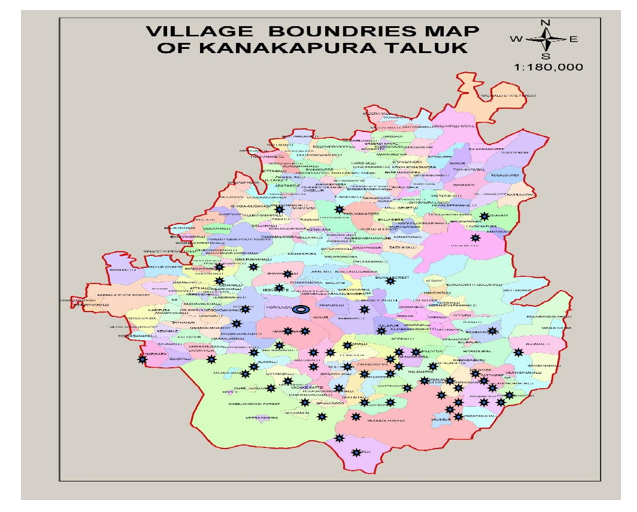
Figure-1: Map of Kanakpura with Villages Indicating Location of Quarries
Granite is an intriguing/intrusive igneous rock formed from the cooling and solidification of magma deep within the Earth’s crust. This process, often spanning millions of years, allows for the slow crystallization of its primary minerals – quartz, alkali feldspar, and plagioclase. These minerals give granite its signature coarse-grained (phaneritic) texture, where individual crystals are visible to the naked eye. The appearance of granite can vary widely, with colours ranging from pink to Gray, depending on its mineral composition.
The pink hues are typically due to the presence of potassium-rich feldspar, while the Gray tones come from the quartz and feldspar balance. Intriguingly, granite often contains trace amounts of other minerals, such as mica or amphibole, adding to its unique pattern and depth.
Physical properties: (a). Durability and Hardness- Granite is renowned for its hardness and durability, owing to the interlocking crystal structure formed during the slow cooling of magma. This makes it resistant to scratches and wear, ideal for surfaces that endure regular use. (b). Texture and Grain Size-The phaneritic texture of granite, characterized by grains visible to the naked eye, is a hallmark of its slow crystalline formation. The size and arrangement of these grains can vary, giving each granite piece a unique appearance. (c). Color Variations- The colour of granite can range from pink to grey, depending on its mineral composition. Quartz typically imparts a grey or white colour, while feldspar adds pink, orange, or blue hues. The presence of other minerals like mica can introduce black or green shades. (d). Density and Porosity-Granite typically has a density between 2.65 and 2.75 g/cm³. It is relatively less porous compared to other stones, contributing to its strength and resistance to weathering. (e). Chemical Resistance-Granite is generally resistant to acids and alkalis, making it suitable for various installations where chemical exposure is possible. (f). Thermal Stability- Its high melting point and ability to withstand temperature variations make granite an excellent material for high-temperature applications. (g) Radiation-Natural granite contains trace amounts of radioactive elements like uranium, which can emit radon gas, albeit typically at very low, safe levels.
Chemical Properties: Granite’s chemical properties are primarily determined by its mineral composition, predominantly quartz, alkali feldspar, and plagioclase. These minerals contribute to the overall chemical characteristics of granite, making it a unique and versatile rock. Here are key chemical properties:
(a). Silica Content (SiO2): Granite has a high silica content, typically ranging from 65% to 75%. This high silica content is largely due to the abundance of quartz, a major constituent of granite.
(b). Alumina (Al2O3): Alumina, usually in the form of aluminum oxide, constitutes about 10-15% of granite’s composition. It’s primarily sourced from feldspar minerals in the granite.
(c). Metals: Granite contains significant amounts of alkali metals, particularly potassium (K2O) and sodium (Na2O), which generally range between 3-8%. These elements are derived from alkali feldspar minerals like orthoclase and microcline.
(d). Calcium Oxide (CaO): Though less abundant than silica and alumina, calcium oxide is still a notable component of granite, usually around 1-2%. It mainly comes from the plagioclase feldspar.
(e). Minor Components: Granite may contain trace amounts of other oxides like iron oxide (FeO, Fe2O3), magnesium oxide (MgO), titanium dioxide (TiO2), phosphorus pentoxide (P2O5), and manganese oxide (MnO). These contribute to the minor variations in color and physical properties of different granite types.
(f). Acid Resistance: Due to its high silica content and the lack of easily carbonated minerals, granite is quite resistant to weathering by acids. This makes it a durable material in environments exposed to acid rain or acidic pollutants.
(g). Radioactive Elements: Granite often contains trace amounts of radioactive elements like uranium, thorium, and potassium-40. The concentration of these elements can vary, but they are typically low and not harmful in most applications. Tibi Puiu and Mihai Andrei (2024) [2].
Granite is also important economically. One of granite’s most celebrated characteristics is its robustness. This strength stems from its interlocking mineral grains, which provide immense durability. This attribute, combined with its aesthetic appeal, has made granite a favoured material in various architectural and sculptural applications throughout human history.
The formation of granite begins with magma generated deep in the Earth’s mantle or lower crust. This magma is typically rich in silica and alkali metals, which also define granite’s chemical composition. As the magma rises towards the Earth’s surface, it starts cooling slowly. This gradual cooling is crucial, as it allows time for the large, identifiable crystals of quartz, feldspar, and other minerals, to form . cores of mountains
Granite is primarily found in two geological settings. The first is in continental crust, where it forms massive plutonic bodies known as batholiths. These batholiths are often the cores of mountains and can cover hundreds of square kilometers. The second common setting is in smaller intrusions like dikes, sills, and stocks. These are essentially offshoots of the main magma body that were injected into cracks and spaces in the surrounding rock.
As the magma cools, different minerals crystallize at different temperatures, a process known as fractional crystallization. This leads to the diverse mineral compositions found in various granites and contributes to the wide array of colors and textures that we see in granite rocks. Tibi Puiu and Mihai Andrei (2024)
Results and Discussions
(A). Kanakpura's Multi Colour Granite: Kanakpura Multicolour Granite, also known as Multicolour Red Granite, is a captivating and exquisite natural stone of exported quality which is quarried in Kanakpura, Bangalore, Karnataka, India. This granite is celebrated for its striking colour combinations, with red being the dominant hue. Kanakpura Multicolour Granite is usually classified as a commercial grade granite. The unique blend of colours in this granite creates a visually captivating and dynamic appearance. It is also known Kanakpura Rosso Multicolour, Kanakpura Red Multicolour Granite, Red Multicolour Granite, Kanakpura Multicolour Granite etc. in commercial circles.
Some of its physical parameters are- water absorption 0.25 %; density 2622kg/m3; flexural strength 16.47 MPa and compressive strength:207.9 MPa.
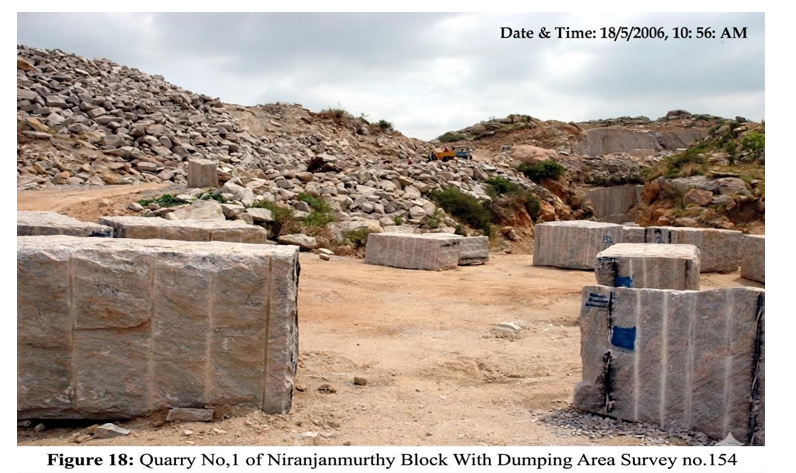
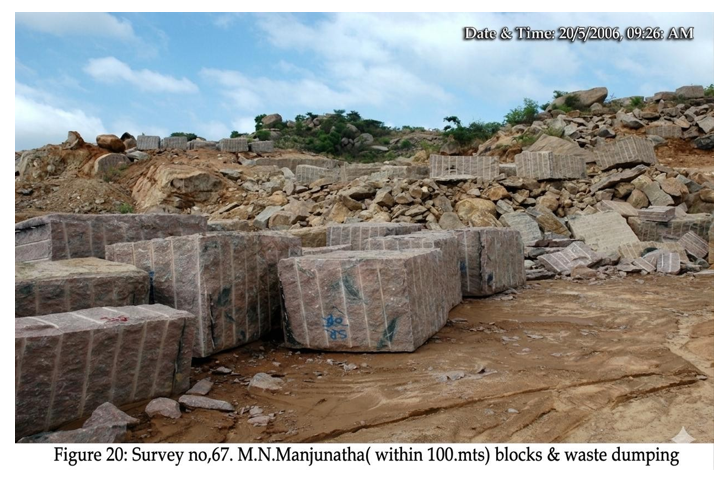
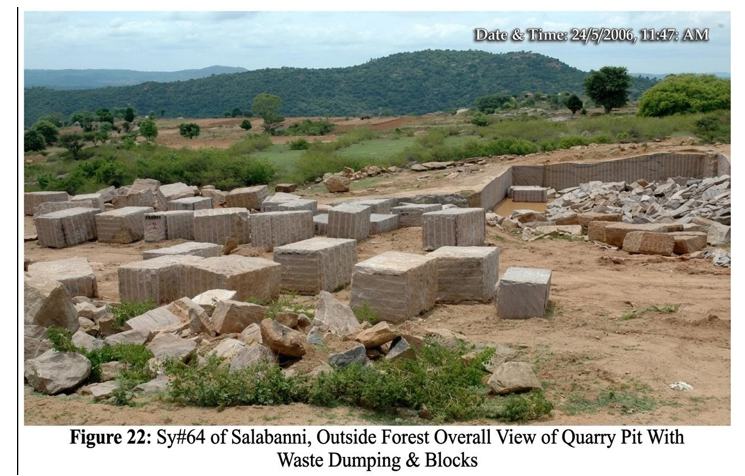
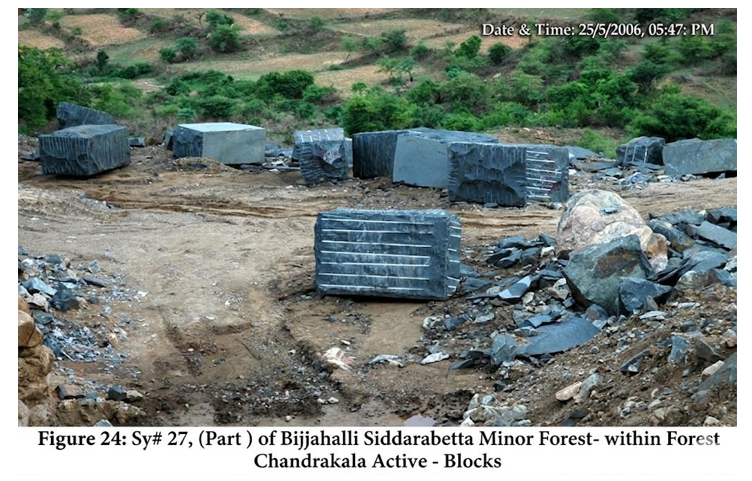
The most prominent feature of Kanakpura Multicolour Granite is its red colour variation, which ranges from light to dark shades Table-2 read with Figures-3 to 23. The red tones serve as the focal point of the stone's design, infusing spaces with warmth, vibrancy, and a sense of energy. The red hues are complemented by other colours that add depth and character to the granite's overall appearance. These additional colours may include black Figure-24, grey, brown, and occasional specks of white or beige, creating a beautiful contrast against the dominant red base. The variation of colours within Kanakpura Multicolour Granite makes each slab unique, offering a one-of-a-kind pattern that adds individuality and charm to any installation. As a result, the granite is favoured by designers and architects seeking distinctive and eye-catching materials for their projects.
The durability and strength of Kanakpura Multicolour Granite make it an ideal choice for various interior and exterior applications. It is commonly used for flooring, wall cladding, kitchen countertops, vanity tops, and outdoor features such as pavements and garden landscaping, mosaic, waterjet pattern, balustrades, fireplaces surround, columns, wall panels, table tops etc.The provenance of this granite from the Kanakpura region in Bangalore, Karnataka, adds to its appeal, as the area is known for its rich geological resources and expertise in the stone industry.
In summary, Kanakpura Multicolour Granite, or Multicolour Red Granite, is a stunning natural stone known for its exquisite blend of colours, with red being the dominant hue. Its dynamic and vibrant appearance, combined with its durability, makes it a favoured choice for enhancing the aesthetics and functionality of various architectural and design projects. Whether used in residential or commercial spaces, Kanakpura Multicolour Granite brings a touch of elegance and natural beauty that stands the test of time.
India's Kanakpura multicolor granite is usually classified as a commercial grade granite. There are indeed color variations of India's Kanakpura Multicolor Granite. It is a naturally multi-colored stone and can feature a range of colors including black, grey, brown, tan, and various shades of red and pink. The specific color and pattern variations can vary from batch to batch and quarry to quarry. The average hardness of Kanakpura Multicolor Granite is around 6-7 on the Mohs scale. The various types of multicolor granites found in villages of Kanakapura are summarized in Table-2 and their physical appearances in Figures-3 to 24.
Pink granite is extremely durable and weather-resistant, often used in monuments designed to last for centuries. Under natural environmental conditions, granite erodes very slowly, roughly one inch in every 10,000 years. While it may take tens of thousands to millions of years to completely break down, in many environments, it can remain virtually unchanged for 15,000 years or more. While highly resistant, it can weather faster in humid tropical environments or if heavily fractured, with chemical weathering breaking down its surface over hundreds to thousands of years. This character of granite makes the task of rehabilitation almost difficult.
|
Sl. No. |
Villages |
Granite Variety |
|
01. |
Marale Bekuppe |
Multi Color & Black Granite |
|
02. |
Kanakapura , Thamasandra, Kebehally, Shivanahally, Shivanahally, Balepura Chikkamudavadi, Garalapura, Anjevadi, Gollahalli, Hallimaranahalli |
Light Multi Color |
|
03. |
Kebehally , Chikkamudavadi, Balepura, Garalapura, Anjevadi, Hallimaranahalli |
Light Multi Color |
|
04. |
Kuthgalle, Kunoor, Yedamaranahally, Nidagal,, Doddakoppa, Puradoddi, Achalu, Chikkoppa, Maragondanapura, Nalahalli, Narayanapura, Seegekotte, Alur, Hukunda, Byalalu, Salabanni, Hosadurga Hanakadabur, Kottekoppa, Billdale, Tattekere, Maniyambal, Kanivekatte, Hosahalli, Mahimanahalli, Harecholanahalli, Thanganayakanhalli, Kokrehosahalli, Guddeveeranahalli,, Singasandra Kabal, Kodihalli, Kachuvanahalli, Gerahalli, Margadayangundi |
Multi Color |
|
05 |
Kadujaksandra, Chulanakere |
Grey Granite |
|
06 |
Thippur, Bommasandra, Gattigunda, Chennasandra Kollagondanahalli, Doddakebbehalli, Arkere Herandapanahalli, Herandapanahalli, Bijahalli, Sasalapura |
Black Granite |
|
07 |
Chikkamudavadi, Balepura, Garalapura, Anjevadi, Hallimaranahalli |
Light Multi Color |
Table-2: Village wise different Verities of Granite Quarries in Kanakapura Taluk, Bangalore Rural District
(B). Position of Law in Rehabilitation and Implementation of Environment Management Plan of Granite Quarries in Karnataka.
In pursuant to the Hon'ble High Court directions and exercise of the powers conferred in sub-Section (1) and (1-A) of Section 15 of Mines and Minerals (Regulation and Development) Act, 1957, the State Government amended the Karnataka Minor Mineral Concession Rules, 1994 vide Gazette Notification No. CI 449 MMN 2011 (P) dated 08.08.2013. In the said amendment rules, the definitions are newly inserted in Rule 2 (1) (iii) as '(d-1)-Environment and Environmental Pollution; (d-2)-Environment Management Plan (EMP); (d-3)-Environment Management Fee (d-6)-Final mine closure plan. In Rule 2 (1) (iv) as (e-1)-Mine Closure means steps taken in accordance with progressive mine closure plan or final mine closure plan for Reclamation & Rehabilitation measures in respect of a quarry/ cluster or part thereof to restore physical, chemical and biological quality disturbed by the quarrying. In Rule 2 (1) (vi) (k-1) -Quarrying Plan. Rule 2 (1) (vii) (m-3) -Simplified Quarrying Plan. A new Chapter II-A.- After Chapter II of the said rules the following was newly inserted, namely. ' Chapter II-A; Systematic, Scientific Mining and Protection of Environment.
The Chapter deals with the Rule 8-C to 8-Y. The Rule 8-Q. Environmental Management Plan for individual or clusters of leases/license/working permission/sand tender areas was inserted. However, it is also amended that the Rule 8-U and 8-V of KMMCR, 1994 amendment 2013, shall be enforced intra-alia, under the provisions of the Water (Prevention and Control of Pollution) Act, 1974 and the Air (Prevention and Control of Pollution) Act, 1981. The Environment (Protection) Act, 1986 and also any other orders passed by the Hon'ble Supreme Court of India / High Court of Karnataka and any court of law relating to the subject-matter.
Further, in Sub Rule (iii) of Rule 8-W- details regarding reclamation and Rehabilitation of lands. - (a) Restoration, reclamation and rehabilitation of land affected by quarrying operations shall be undertaken in a phased manner so that work is completed before the conclusion of quarrying operations and the abundant of the quarry with a view to leave a productivity and sustainable site. Later, the State Government amended the said rules in 2024 vide Notification No. CI ' MNM/48/2024 dated 30.12.2024 (Gazette dated 02.01.2025) wherein, the same apprehension is sustained in connection with the Reclamation & Rehabilitation and Implementation of the EIA & EMP for lands affected by quarrying operations.
Rule 8-W. Issues to be included in the Environment Management Plan - The following shall be included in the Environment Management Plan, namely: -
(i) Details regarding removal and utilization of top soil-
(a) The top soil and murram collected during quarrying operations shall be stored systematically at an approved site earmarked in quarrying plan without allowing its run off; and
(b) Top soil so stacked shall be utilized for plantation or for restoration and rehabilitation of the land no longer suitable for continuing quarrying operations or for stabilizing/landscaping the overburden dumps.
(ii) Details regarding storage of overburden waste rock-
(a) The overburden, waste rock and non-saleable mineral generated during quarrying operations shall be managed to stack separately in properly formed dumps on grounds earmarked in approved environment management plan;
(b) The overburden dump shall be properly secured to prevent the degradation of the surrounding land or silting of water courses;
(c). Wherever possible, use such waste rock or overburden or other rejects for backfilling the worked-out quarry or mine where mineral has been recovered up to the optimum depth as suggested by the Competent Authority with a view to restore the land to its original use or desired alternate use. Where the backfilling is not feasible, the waste dumps shall be scientifically vegetated by suitable native species to prevent erosion and surface run off; and
(d) The maximum height of the already existing waste dumps shall not exceed 5 meters at each terracing with a slope of 45 degree and it shall be protected by toe wall of rubble stones all along to prevent the run off/creep.
(iii) Details regarding reclamation and rehabilitation of lands
(a) Restoration, reclamation and rehabilitation of land affected by quarrying operations shall be undertaken in a phased manner so that work is completed before the conclusion of quarrying operations and the abandonment of the quarry with a view to leave a productive and sustainable site.
(b) In case of sand quarrying the following shall be included.
1) necessary embankment rehabilitation measures shall be implemented to achieve river bank stability;
(2) reclamation and rehabilitation of riverbed affected by quarrying operations shall be undertaken in a phased manner so that work is completed before the conclusion of quarrying operations and the abandonment of the quarry.
(iv) Details regarding precaution against air pollution - Air pollution due to dust, exhaust emissions or fumes during, quarrying or processing operations for mineral and related activities shall be controlled and kept within permissible limits as specified under any environmental law for the time being in force. Main haulage roads of quarry shall be kept wet by sprinkling of water or make metal road to avoid dust.
(v) Details regarding discharge of effluents. -All details regarding precautions to prevent or reduce to a minimum, the discharge of toxic and objectionable liquid effluents from quarry, workshop or processing plant, into surface or groundwater bodies and usable lands. These effluents shall conform to the standards laid down in this regard.
(vi) Details regarding precaution against noise. - Noise arising out of quarrying and processing operations for mineral at the source shall be controlled so as to keep it within permissible limit.
(vii) Details regarding restoration of flora. -
(a) Effective measures shall be taken for plantation in the area earmarked in environment management plan of the cluster in area earmarked in environment. It is pertinent to note that in the above said Rules/ guidelines, the provision for removal of waste for use in various construction activities are not included. This shall be must.
(C). Status of Granite Quarries in Kanakpura Taluka
The State Govt in Department of Forest, Ecology and Environment issued an order No. FEE45, FFM2006 dated 27.04.2006 constituted a team of officers of various departments under the Chairmanship of the Author to investigate the illegal quarries in forest lands and also encroachments in various lands and submit a report to State Govt. for further action. The author constituted nine/seven teams of surveyors of mines, forest and revenue departments. The teams carried out the survey of 484 quarries in 63 villages and submitted their reports to the author. After thorough examination I have prepared a report based on their surveys and submitted to State Govt through PCCF Bangalore on 26/28 June 2006. The summary of some of the details of the report is placed below in tables.
|
SL |
Particulars |
Numbers |
|
1 |
Quarries in forest areas (including encroachments- |
99 |
|
2 |
Quarries falling within 100 mtrs. from the forest boundary |
90 |
|
3 |
Quarries in Gomal / Kharab land |
190 |
|
4 |
Quarries in patta land (functional and non-functional) |
166 |
|
5 |
Quarries in land bank |
50 |
|
|
Total |
585 |
Table-3: Granite Quarries in Various Kind of Lands
|
SL |
Particulars |
Numbers |
|
1 |
No. of lease granted under KMMCR 1994 |
75 |
|
2 |
No. of quarries due to encroachment |
24 |
|
3 |
No. of active quarries |
27 |
|
4 |
No. of inactive quarries |
27 |
|
5 |
No. of quarries not yet started |
11 |
|
6 |
No. of leases expired / determined / cancelled etc. |
34 |
|
|
Total |
198 |
Table-4: Quarries in Forest Area
|
Sl |
Year |
M3 |
|
1 |
1999-2000 |
14,470.40 |
|
2 |
2000-01 |
31,662.40 |
|
3 |
2001-02 |
41,063.00 |
|
4 |
2002-03 |
55,385.40 |
|
5 |
2003-04 |
60,729.30 |
|
6 |
2004-05 |
62,917.10 |
|
7 |
2005-06 |
50,366.30 |
|
|
Total |
316,593.90 |
Table-5: Extraction of block granites since 1999-2000 to 2005-06-
Figure-2: Showing the Year Wise Extraction of Granites from All the Quarries in Kanakpura
(D). During the Investigation Various Issues Were Also Analysed and Some of Related to This Topic is Discussed Here in Under
(I). Issue of Dispatch Mineral Permit: The Deputy Director, Mines and Geology issue dispatch mineral permits by providing 7 days' time. The period of 7 days is reasonably high. There is no bar under the section 42(5) to provide lesser period. From Kanakapura to Bangalore 6 hours period is sufficient. From Kanakapura to Chennai and Mangalore Sea Ports, 24-hour period is more than sufficient. The period should be given based on distance from Quarry lease to destined place. Giving more time, invite the illegalities by having of chances of more tripe using the same permit since there is no checking due to shortage of staff.
(II). Failure of Demarcation of Quarries on the Ground: Boundaries all around the quarries have not been fixed. It is required under section 17 of the KMMCR 1994.The lessee has to pay the cost of measuring the boundary of Rs.500 per acre. The Deputy Director, Mines should insure to fix the proper boundary for each quarry by erecting 4 feet high stone pillars. One of the reasons for encroachment is not fixing the boundary. About 708 acres of the land (all types) have been encroached. As per section 18 of the Rules 1994, a management plan should be prepared for each quarry by indicating dumping area etc. No such plan has been prepared and implemented. Name board in front of each quarry should be displayed with the relevant information.
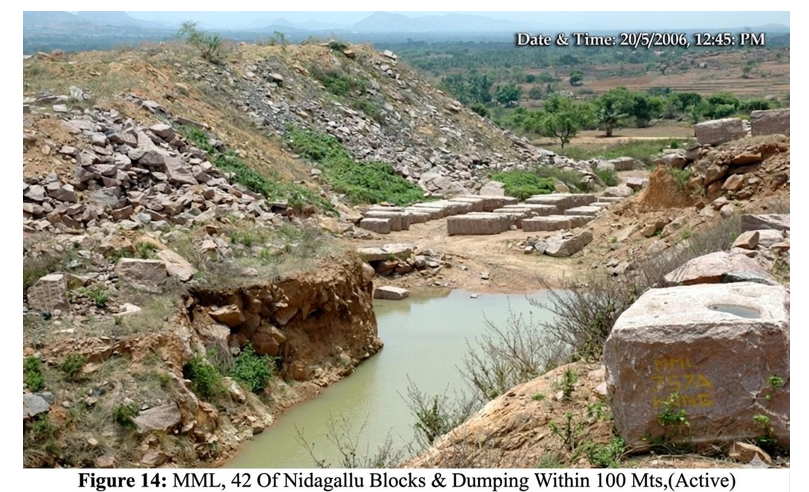
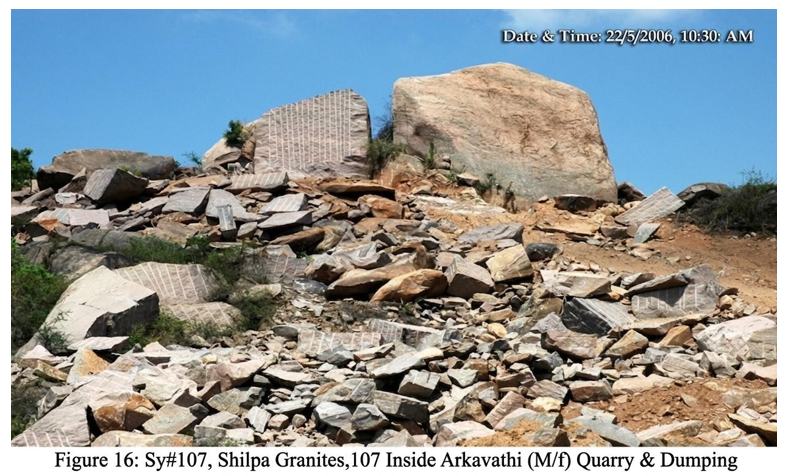
(III). Quarries in Forest Areas: 99 quarries have been found in forest lands during the survey .75 quarries have been given the leases under the KMMCR 1994 without prior approval under the Forest (Conservation) Act 1980 (FCA). All such leases are unauthorized and illegal, and unlawful. No non forestry activity can be done without prior approval under the FCA. The Supreme Court of India has said in its order dated 12-12-96 in WP 202/1995 that all the non-forestry activities should be stopped forthwith. Quarrying in the forest area is a non-forestry activity. There are 27 quarries running presently in the forest area (Figures 16,17,24). No quarry operation shall be allowed in forest All quarries shall be stopped in the forest. All the encroached area shall be estimated with the help of Dept. of Mines and Geology. There are 11 quarries running in the forest due to encroachment. Forest offence cases should be booked under the section 24 (f), (g), (gg), (h), 73 (d) of Karnataka Forest Act 1963 (KFA) and under section 2 of the FCA 1980. There are 14 inactive quarries, 11 quarries have not yet started and 34 quarries lease period have been expired hence nonfunctional. All the leases granted under the KMMCR 1994 should be cancelled by following the procedure.
(IV). Quarries Within 100 Meters from D Line: As per Section 41 (2) of Karnataka Forest Rules 1969 (KFR) no land should be granted to occupy within 100 mtrs. from the boundary of the Reserve Forest, Protected Forest etc. About 90 quarries (including encroachments) coming within the 100 mtr buffer zone. There are about 30 active quarries in this category. There are two active patta quarries also come in this category. There are 7 quarries which are not yet started. There are 39 quarries which are inactive. Out of this, 26 quarries have their lease period in currency.14 quarries lease period have already been expired. All the quarries lease period is in currency. The leases of 60 quarries (whose lease period is in currency) which are active, inactive and not yet started should be cancelled under the KMMCR 1994.The loss to the State due to encroachment should be estimated and recovered from the concerned lessees.
(V). Quarries in Land Bank Areas: In Kanakapura taluk, about 2993.29 ha. in various Survey numbers of the villages have been notified vide Govt. order dated 20-07-94 as land bank. The land from the land bank can only be used for public purpose. There are about 50 quarries have been granted leases in land bank (Figure-23). Some pattas (granted foe cultivation) have also been granted in the land bank. All the grants made in the land bank are irregular and unlawful. There are about 13 active quarries (out of 50).The quarries near Kanakapura town are the part of Sy. No. 636 which is land bank area. Some land bank areas are well wooded (Sy No.126 of Thattikere and Sy. No.48 of Hosahalli). The quarry leases in land bank should be cancelled under the KMMCR 1994 or any other action the State Govt. may take.
(VI). Quarries in Granted Patta Lands: Deputy Director, Mines and Geology have given a list of 46 leases which are granted in the granted patta (Figures 03,04,05,06). There are 6 pattas have been granted in the forest land and leases have been given. 6 pattas given in the forest without de-notification under section 28 of KFA and prior approval under Section 2 of FCA 1980. All such leases shall be cancelled. There is allegation from the public that in such granted patta the original spot has been changed to a place good for quarry during the Phodi Dursti. Records of many such pattas are missing from the Tahsildar office. Further, inquiry for these granted patta is required with the reference to change of spot and other irregularities. In some of the cases the original pattadar is also cultivating the land as per the RTC records. At the same time the quarry is also operated in the same Survey. number.
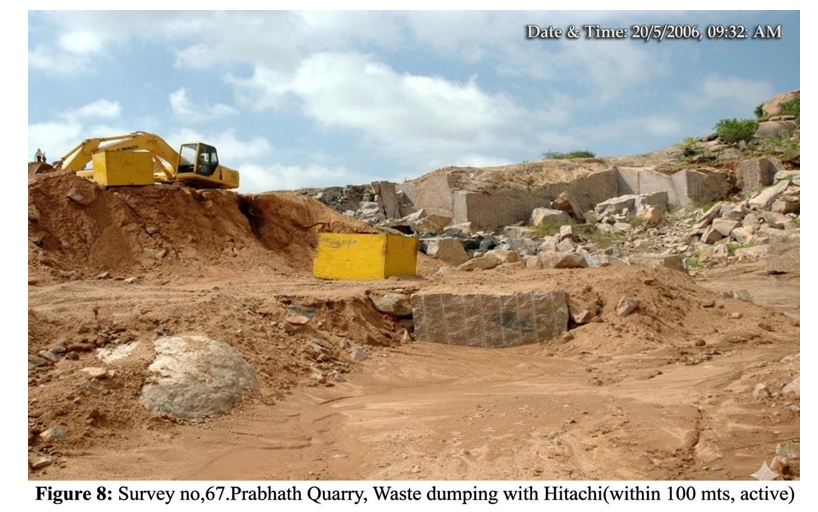
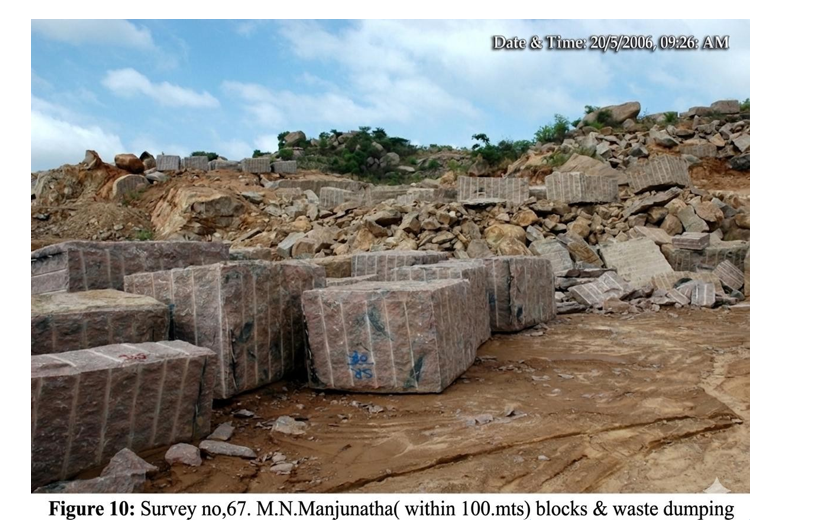
(VII). Quarries in Gomal / Kharab Lands: There are about 52 quarries (other than 100mtr & land bank) granted in the gomal / kharab lands (Figures 09,10,11). About 399.35 acres of land have been encroached. Under Section 73 of the Karnataka Land Revenue Act 1964 (KLRA) loss to the Govt. for the encroached land shall be estimated and recovery of value of natural product unauthorized removed from such land shall be made from the lessees. Further action against violations committed by the lessees in the gomal / kharab land should be taken by the Deputy Commissioner.
(VIII). Quarries in Patta Land: There are about 166 quarries have been surveyed in patta lands (Figures 18,21,22). About 270.04 acres of land has been found as encroachment in patta lands.28 quarries in ancestral patta lands are found active and remaining inactive during the survey. As regards the violations in the quarries of patta lands the Deputy Director, Mines and Geology Dept. and Deputy Commissioner should take necessary action.
(IX). De-notification of Section 4 Notified Area: State Government has issued a notification dated 25-06-1991 under section 4 of KFA to notify certain area to constitute Reserve forests in Chickoppa-Doddakoppa area. Subsequently another notification dated 11-11-1998 was issued to create an enclosure to facilitate to give the leases for quarrying.4 leases were granted in this enclosure. The second notification was issued without prior approval of Central Govt. under FCA. No notified forest area can be excluded without prior approval under FCA 1980.The forest area so excluded is well wooded area. State Govt. should take action to re-notify the area and all the leases should be cancelled. There is hardly any area left out if 100 mtr buffer zone is taken into consideration.
(X). Issue of No Objection Certificate (NOC) for the Forest Land: In many cases of leases the officials of Forest Department have issued NOC stating that the land purposed for quarry is not a forest land contrary to the facts that the land is forest land. There is no provision under KFA to issue such NOC. The officials who have issued NOC are liable for disciplinary action. The NOCs issued shall be withdrawn to facilitate to cancel the leases under KMMCR 1994.To prevent such irregularities during lease grant in the Govt. land, a joint inspection of the officials of Revenue, Forest and Mines & Geology Departments of the rank of sub-division level shall be made compulsory for each proposed quarry.
(XI). Manpower Used for Survey: No. of Officer 2, No. of Surveyors, Draftsmen etc.,58, Helpers etc.20, Local staff of Revenue, Forest, Mines 50, Vehicles used 15.
Rehabilitating a granite quarry is essentially a massive environmental "glow-up." Because granite extraction involves deep excavations and significant land disturbance, it can't just plant a few trees and call it a day. It requires a blend of engineering, ecology, and community planning for use of waste.
The author has practical experience about 14 years in Rehabilitation and reclamation of iron and manganese mines in the districts of Bellary, Hospet, Chiturdurga and Tumkuru in Karnataka Singh 2025, Singh2026 [3,4]. The Rehabilitation and reclamation of these mines are quite different being large in sizes and nature of mineral. A well tested methodology and working has been applied in the mines. True ecological restoration isn't an overnight fix. It often takes 10 to 20 years of monitoring to ensure the new ecosystem is self-sustaining and the water quality remains safe.

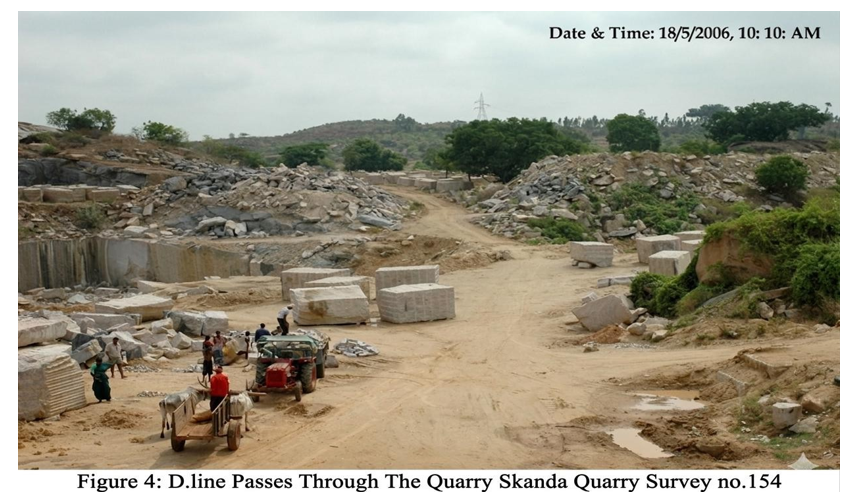

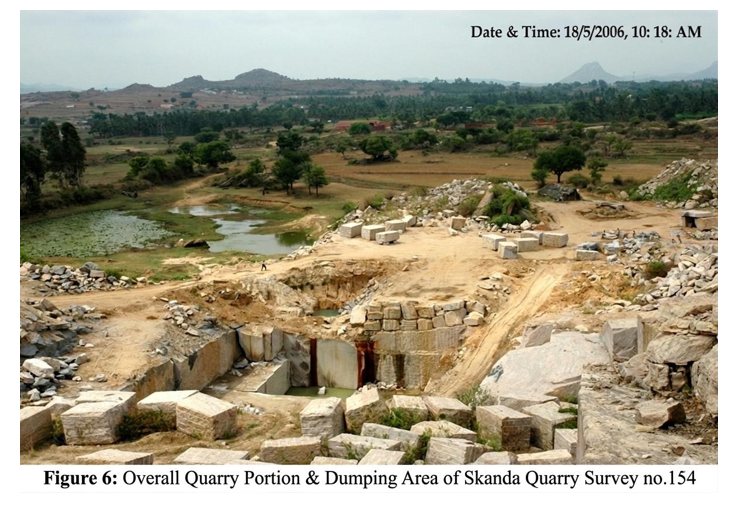









Granite Quarry Rehabilitation: A Comprehensive Guide-Kanakapura is where some of the most scenic geography of the Kaveri (Cauvery) river basin unfolds. The primary river passing through this taluk is the Arkavathi, which is one of the Kaveri's most significant tributaries. The defining hydrological feature of Kanakapura is the Sangama (confluence), located about 30 km from the town centre, where the Arkavathi finally merges with the Kaveri.
The Arkavathi is the lifeline of Kanakapura taluka. It flows southward through the heart of the taluk before meeting the Kaveri. It originates in the Nandi Hills (Chikkaballapur district) and passes through Ramanagara district before entering Kanakapura taluka. It joins the Kaveri at Sangama, which is a popular pilgrimage and tourist spot. Along its path in the taluk, it forms the famous Chunchi Falls near Haroshivanahalli. Since the Arkavathi is a major sub-basin, several smaller streams (hallas) and rivers flow through Kanakapura to join it: They are-Vrishabhavathi which joins the Arkavathi upstream (mostly outside the taluk but impacts the basin flow);Kumudvathi- another major tributary of the Arkavathi that contributes to the overall watershed and Suvarnamukhi which originates in the Bannerghatta hills and joins the Arkavathi.
The Kanakapura watershed is divided into several sub-watersheds named after the local streams and villages they pass through. Significant "Hallas" (seasonal streams) are -Dodda Halla- a major seasonal stream in the region; Kutle Hole & Banda Halla-smaller streams that drain the rugged terrain of the Kaveri Wildlife Sanctuary and Antaragange Hole- passes through the forest areas. As could be seen and make out, the rehabilitation of quarries has got special significance to maintain clean water flows in the Kaveri River as well as maintain the ecosystem of the area.
There is wide difference of model and strategy to rehabilitate and restoring of a single granite quarry and large number of commercial excavated quarries or cluster of quarries of different lessees. The rehabilitation of quarries in Kanakpura taluk falls in later category [5]. Rehabilitating granite quarries is particularly challenging because granite is an igneous rock that doesn't weather into "soil" easily, leaving behind steep, sterile vertical faces and massive amounts of waste (overburden).
Granite is an intriguing/intrusive igneous rock forms from the cooling and solidification of magma deep within the Earth's crust. This process, often spanning millions of years, allows for the slow crystallization of its primary minerals - quartz, alkali feldspar, and plagioclase. These minerals give granite its signature coarse-grained (phaneritic) texture, where individual crystals are visible to the naked eye. Due to its nature of hardness in rocks and waste generated, it takes thousands of years to weather out and suitable for vegetation grow.
F. Key Components of Successful Rehabilitation: Safety First- Before the "green" stuff happens, the site has to be made safe. Granite quarries often leave behind sheer vertical cliffs. Ensuring stability of slopes, removing hazardous infrastructure, and sometimes fencing to secure the area. Slopes are "stepped" to prevent landslides. Stakeholder Engagement- Actively working with local communities and landowners to align the new land use with local needs. Phased Rehabilitation- Instead of waiting until the end of the quarry's life, modern rehabilitation involves working on the site systematically, reclaiming used sections while others are still in operation. Non-commercial rock waste (overburden) is moved back into the pits to reduce depth. Drainage systems are installed to prevent acidic runoff or massive erosion during storms or high rain falls.
|
Sl |
Strategy |
Particulars |
|
1 |
Selective blasting |
Smoothing out jagged edges to make the walls safer for climbing or tourism |
|
2 |
Hydroseeding |
Spraying a mixture of seeds, mulch, and fertilizer onto rock faces to encourage "pioneer" plant species may be seed balls |
|
3 |
Planting of man-made seedlings |
Seedlings prepared of local species in Nurseries/s are to be planted in and around in vacant landscapes of quarries. |
|
4 |
Bench restoration |
Creating "steps" in the rock face that can hold soil and support trees, breaking the visual impact of the vertical wall. |
|
5 |
Engineering structures |
Retention walls, drainage system, check dams and silting tanks etc |
|
6 |
Hydrological management |
Converting deep pits into controlled lakes for recreation or aquatic biodiversity (though water quality must be monitored for heavy metals). |
|
7 |
Soil reconstruction, topsoil replacement |
Granite dust isn't exactly "fertile." To get anything to grow, the land needs a new foundation. Ideally, the original topsoil was stockpiled at the start of mining. If not, organic matter (like compost or treated sludge) is mixed with crushed rock. |
|
8 |
Nutrient cycling. |
Nitrogen-fixing plants (like legumes) are often planted first to naturally "charge" the soil for future trees. |
|
9 |
Creative End-Use models |
Nitrogen-fixing plants (like legumes) are often planted first to naturally "charge" the soil for future trees. |
Table-6: The Process Typically Unfolds for Rehabilitation
One of the most difficult tasks of rehabilitation of granites quarries are its extremely hardness of the rocks long durable, weather-resistant and last for centuries. Under natural environmental conditions, granite erodes very slowly, roughly one inch every 10,000 years. While it may take tens of thousands to millions of years to completely break down, in many environments, it can remain virtually unchanged for 15,000 years or more. While highly resistant, it can weather faster in humid tropical environments or if heavily fractured, with chemical weathering breaking down its surface over hundreds to thousands of years. Its water absorption is as meager as 0.25 % with high density:2622kg/m3. The flexural strength is about 16.47 MPa and compressive strength remains as 207.9 MPa
During the survey in the months of April to June 2006, I have visited all the 484 quarry leases plus some unknown illegal quarries and found that in none of the quarries, the systematic mining plan was prepared and implemented. Almost all quarries were granted small in size and no places were provided for dumping of waste, storing of blocks, loading place and likewise others. The quarries of patta lands were limited to the area of the patta itself and no concept of mining plan adhered too. Similarly, the quarries given in Govt lands also having the same fate of execution. This is also one of the primary factors for large areas of encroachments. Disposal of Waste: During the granite quarrying, enormous waste is being generated. It varies from quarry to quarry. This makes the most difficult task in the process of rehabilitation. After having discussion at large with the field staffs of mines and forest department and engineers, I have come to an understanding in the subject matter that the waste generated shall be used for various construction activities by making use of M-Sand, Jelly, sized stone for building construction and ballast (1.9cm to 5.1 cm). These by products can be prepared from the waste generated from these quarries after having the lab test for suitability from mine to mine.
Successful rehabilitation often centers on establishing local flora to regenerate ecosystems. Soil Amendment- Successful restoration often involves adding topsoil and organic amendments to restore soil quality, allowing native species to return within 5–6 years. Water Management- Many granite quarries in India and Europe are converted into rainwater harvesting structures or pisciculture (fish farming) areas, enhancing local water supply, such as the proposed conversion of multi-color granite quarries into percolation tanks.
Rehabilitation of granite quarries involves transforming exhausted mining sites into safe, stable, and productive landscapes, ranging from ecological restoration and to public amenity spaces in urban/ habitat areas. Successful rehabilitation projects focus on re-contouring, topsoil replacement, and revegetation, often turning environmental liabilities into assets.
Here are some key examples and details of successful granite quarry rehabilitation:
a. The Braga Municipal Stadium (Portugal) - Perhaps the most iconic example, this stadium was built in 2013 on the site of a former granite quarry on Monte Castro. The architect, Eduardo Souto de Moura, integrated the natural granite rock walls into the stadium structure, with spectator stands only on the sides of the pitch. It is a 30,000-seat venue that serves as a unique architectural landmark and a functional, high-profile stadium.
b. Residential Rehabilitation (Kosovo)-A case study by Sharrcem involved the comprehensive rehabilitation of a depleted quarry pit and surrounding degraded land. The 3.4-hectare site underwent backfilling, leveling, and proper ground configuration. The land was reclaimed and returned to local owners, resulting in 12 new residential dwellings, providing housing and infrastructure (water, electricity) for new residents.
c. Palin Granit Quarry (Finland)-This quarry, known for extracting Aurora granite, serves as a model for creating recreational water features. After the granite extraction was completed, the pit was allowed to fill with clean water. It was successfully converted into a scenic lake, suitable for recreation and blending into the natural landscape.
Acknowledgments
I extend my sincere thanks to the State Govt for appointing me as Chairman for the Committee for investigation of illegal quarries in Kanakpura Taluka in 2006. I also thank to Committee members and surveyors of Forest, Mines and Revenue Departments and all other staff/ officers/officials involved in this exercise. I also thank to IT cell of the forest department for helping to use GPS first time for such exercise in the department.
References
- Population Census report of Govt of India 2011
- Tibi Puiu January 4, 2024 - Updated on February 12, 2024 in Rocks and Minerals.
- Singh, U.V. (2025), Rehabilitation and Reclamation of Waste Dumps of Iron ore Running Mines in Karnataka India. A Case Study. Advance in Environmental Waste Management &Recycling, 8(3),01-18.
- Singh, U.V. (2026). Rehabilitation and Reclamation of Iron and Manganese Ore Mines in Bellary Sector India. Theory and Practices. Conservation Biogeography and Forest Management, Springer Nature, Book, pages 301-348.
- Singh, U.V. (2006). Report on illegal quarries in Kanakpura submitted to State Govt.