


Research Article - (2024) Volume 2, Issue 1
Translational Cardiology: Practical Insights into the Coenzyme Q10 Role as Potential Therapeutic Agent for Cardiovascular Disease Treatment via Systematic Review and Meta-Analysis of Prospective Cohort Studies

Received Date: Jul 26, 2024 / Accepted Date: Aug 20, 2024 / Published Date: Aug 30, 2024
Copyright: ©Ã?©2024 Julian Yin Vieira Borges. This is an open-access article distributed under the terms of the Creative Commons Attribution License, which permits unrestricted use, distribution, and reproduction in any medium, provided the original author and source are credited.
Citation: Borges, Julian Y. V. (2024). Translational Cardiology: Practical Insights into the Coenzyme Q10 Role as Potential Therapeutic Agent for Cardiovascular Disease Treatment via Systematic Review and Meta-Analysis of Prospective Cohort Studies. Trans Med OA, 2(1), 01-09.
Abstract
Background and Objectives: As clinicians seek novel treatment strategies for CVDs, personalized nutrient recommendations are becoming essential. CoQ10, a key component of the mitochondrial electron transport chain, shows promise with proven cardioprotective effects. This systematic review and meta-analysis evaluates the efficacy of CoQ10 supplementation in improving mitochondrial function, systolic performance, and other parameters in CVD.
Methods: Analysis included data from PubMed, Embase, and the Cochrane Library up to January 2024. It focused on randomized controlled trials (RCTs) involving adults with cardiovascular diseases (CVDs), comparing CoQ10 with placebo or standard care. Data extraction and quality assessment followed PRISMA guidelines, the Cochrane Collaboration's RoB2 tool, AMSTAR 2, and GRADE. The primary outcome was mitochondrial function (ATP production, respiratory capacity), and the secondary outcome was systolic function (ejection fraction).
Findings: CoQ10 supplementation improved ejection fraction (mean difference: 5.6%, 95% CI: 3.2% to 8.0%, p<0.001, I2=25%). The I2 statistic for ejection fraction was 25%, indicating low heterogeneity. Mitochondrial function showed increased ATP production (SMD: 0.82, 95% CI: 0.60 to 1.04, p<0.001, I2=30%) and enhanced respiratory capacity (SMD: 0.75, 95% CI: 0.53 to 0.97, p<0.001, I2=28%). The I2 statistics for ATP production and mitochondrial respiratory capacity were 30% and 28%, respectively, suggesting low to moderate heterogeneity. Sensitivity analyses confirmed the robustness of the results, with consistent effect sizes and confidence intervals across both fixed-effect and random-effects models, and no significant changes upon excluding high-risk studies. Publication bias was low, as indicated by funnel plots and Egger's test (p=0.12).
Limitations: Larger-scale RCTs are needed to confirm findings and determine the optimal dosage and duration of CoQ10 therapy.
Conclusion: CoQ10 has been consistently shown to improve mitochondrial function, systolic performance, and other key cardiovascular health parameters in CVD patients. The evidence here presented strongly bridges the gaps between the current research and clinical applications and supports clinicians in implementing the prescription of CoQ10 supplementation as an intervention evidence-based therapeutic agent that effectively improves cardiovascular health outcomes.
Keywords
Coenzyme Q10, Ubiquinone, Cardiovascular Diseases, Heart Failure, Myocardial Infarction, Coronary Artery Disease, Mitochondrial Dysfunction, Ejection Fraction, Endothelial Function
Introduction
Cardiovascular diseases (CVDs) remain a leading cause of morbidity and mortality worldwide, significantly impacting global health [1]. Mitochondrial dysfunction is increasingly recognized as a pivotal factor in the pathogenesis of various CVDs, including heart failure and ischemic heart disease [2]. As an essential component of the mitochondrial electron transport chain, Coenzyme Q10 (CoQ10) has garnered attention for its potential cardioprotective effects [3]. CoQ10, also known as ubiquinone, was first discovered by Frederick Crane and his colleagues in 1957 [4]. It is a lipid-soluble molecule synthesized endogenously in the human body and available from dietary sources such as meat, fish, and vegetables [5]. Primarily located in the inner mitochondrial membrane, CoQ10 participates in the electron transport chain and plays a crucial role in ATP production, thereby supporting cellular energy metabolism [6].
Given the variability in study populations, dosages, and forms of CoQ10 (ubiquinone vs. ubiquinol), it is essential to synthesize these data to derive more precise conclusions about its benefits. Previous studies have shown potential benefits of CoQ10 supplementation in improving mitochondrial function and cardiac performance in patients with CVDs, though these studies have varied in their methodologies and outcomes [7,8]. Thus, a systematic review and meta-analysis are timely to provide a comprehensive evaluation of CoQ10’s impact on cardiovascular health. This meta-analysis aims to evaluate the effects of CoQ10 on mitochondrial function in cardiomyocytes and its impact on systolic function in patients with cardiovascular diseases. By addressing the heterogeneity in study designs and standardizing measurements, this review seeks to offer clearer insights into the therapeutic potential of CoQ10 in clinical practice.
Methods
Search Strategy and Selection Criteria
A comprehensive literature search was conducted on PubMed, Embase, and the Cochrane Library databases to identify relevant studies published from inception to March 2023. The search strategy included a combination of relevant keywords and Medical Subject Headings (MeSH) terms, such as "coenzyme Q10," "ubiquinone," "ubiquinol," "cardiovascular function," "heart failure," "ejection fraction," "endothelial function," and "randomized controlled trial." Additionally, reference lists of included studies and relevant review articles were manually searched for potentially eligible studies [1].
Study Eligibility Criteria
Inclusion Criteria
• Study Design: Randomized controlled trials (RCTs), systematic reviews, meta-analyses, and Cochrane reviews investigating the effects of CoQ10 supplementation on cardiovascular health outcomes.
• Population: Adults (aged 18 years and above) with or without cardiovascular diseases or heart failure.
• Interventions: CoQ10 supplementation as a standalone intervention.
• Comparators: Placebo, no intervention, or other relevant comparators.
• Outcomes: Studies reporting cardiovascular health outcomes, such as ejection fraction, endothelial function, hypertension, or other relevant markers of cardiovascular function.
• Language: Studies published in English.
• Availability: Full-text articles available.
Exclusion Criteria
• Study Design: Non-original articles (e.g., reviews, editorials, and letters), animal studies, in vitro studies, and observational studies.
• Population: Studies not involving human subjects.
• Interventions: Studies using CoQ10 in combination with other interventions without reporting the effects of CoQ10 separately.
• Outcomes: Studies not reporting relevant cardiovascular health outcomes or providing insufficient data for analysis. • Language: Studies published in languages other than English.
• Availability: Articles not available in full text.
• Quality: Non-peer-reviewed articles.
• Sample Size: Studies without sample size (N) information.
Data Extraction
Data from eligible studies were extracted independently using a standardized data extraction form developed based on PRISMA guidelines. The form captured details such as study characteristics, intervention details, comparator details, outcome measures, results, and risk of bias assessment.
Exposure
The exposure of interest in this systematic review and meta- analysis was CoQ10 supplementation, administered orally as either ubiquinone or ubiquinol, for the purpose of improving cardiovascular function in patients with cardiovascular diseases or heart failure [2,3,5,6].
Comparator(s)/Control
The comparator or control group consisted of individuals who received either placebo or no intervention [7, 8]. Placebo- controlled trials were essential to minimize potential bias and accurately assess the true effects of CoQ10 supplementation on cardiovascular function [12]. 2.6 Outcome Measures Studies reporting at least one of the following outcomes were included: • Ejection fraction • Endothelial function • Other relevant markers of cardiovascular function
Quality Assessment
Quality Assessment Tools
 Cochrane Collaboration's Risk of Bias Tool (RoB 2): This tool was used to assess the risk of bias in randomized controlled trials (RCTs) [15].
The RoB 2 tool evaluates the following domains:
• Bias arising from the randomization process
• Bias due to deviations from intended interventions
• Bias due to missing outcome data
• Bias in measurement of the outcome
• Bias in selection of the reported result
Each domain within the RoB 2 tool was rated as "low risk," "some concerns," or "high risk" of bias based on the criteria provided in the tool manual.
AMSTAR 2: This tool was used to assess the methodological quality of systematic reviews and meta-analyses [16].
The AMSTAR 2 tool evaluates the following domains:
o Protocol registered before commencement of the review
o Adequacy of the literature search o Justification for excluding individual studies
o Risk of bias from individual studies included in the review
o Appropriateness of meta-analytical methods
o Consideration of risk of bias when interpreting the results
GRADE: This tool was used to assess the quality of evidence in systematic reviews and other evidence syntheses [17].
The GRADE approach evaluates the following criteria:
o Study limitations (risk of bias)
o Inconsistency of results
o Indirectness of evidence
o Imprecision
o Publication bias
Results
Study Selection and Characteristics
From the initial 1,909 records identified, 46 studies were included in the reference panel. Of these, 22 studies were selected for statistical analysis based on the availability of comprehensive quantitative data and adherence to inclusion criteria [3,4,7,14- 16,24,26-34,37-39,41-43,45]. The chosen studies consisted of 11 Randomized Controlled Trials (RCTs), 2 Cochrane Reviews, 5 Systematic Reviews & Meta-Analyses, and 4 Meta- Analyses [3,4,7,9,14,15,24,26-34,37,38,41-43,45]. The follow- up duration in these studies ranged from 2 months to 12 years, providing a broad temporal scope for the analysis [15,26].
Outcome Measures
The primary outcome measure was the effect of CoQ10 supplementation on ejection fraction. Secondary outcomes included mitochondrial function indicators such as ATP production and mitochondrial respiratory capacity. For continuous outcomes, the standardized mean difference (SMD) with 95% confidence intervals (CIs) was calculated using the inverse-variance method.
Primary Outcome: Ejection Fraction
The meta-analysis revealed a significant improvement in ejection fraction with CoQ10 supplementation. The pooled mean difference in ejection fraction was 5.6% (95% CI: 3.2% to 8.0%, p<0.001). The I² statistic was 25%, indicating low heterogeneity among the included studies [3,4,7,15].
Secondary Outcomes: Mitochondrial Function
CoQ10 supplementation significantly increased ATP production, with a standardized mean difference (SMD) of 0.82 (95% CI: 0.60 to 1.04, p<0.001). Enhanced mitochondrial respiratory capacity was also observed, with an SMD of 0.75 (95% CI: 0.53 to 0.97, p<0.001). The I² statistics for ATP production and mitochondrial respiratory capacity were 30% and 28%, respectively, suggesting moderate heterogeneity [3,4,7,15].

Quality Assessment
From the initial 243 studies, 46 were included in the reference panel, but only 25 were part of the statistical analysis due to criteria such as providing sample size information and relevant outcomes. The quality assessment criteria included the following: • Study Design: The studies comprised RCTs, systematic reviews, and meta-analyses.
• Sample Size: Studies with larger sample sizes generally provided more reliable results, with the largest study having 1143 participants [29].
• Risk of Bias: Risk of bias was assessed using the Cochrane Collaboration's Risk of Bias Tool (RoB 2), with most studies showing low risk.
• Follow-Up: Longer follow-up periods provided more robust data on outcomes, with some studies having follow-ups of up to 120 months [24].
• Reporting Quality: Well-reported methods, results, and conclusions were considered high quality. The quality of the included studies was assessed using multiple tools to ensure robustness:
• Cochrane Collaboration's Risk of Bias Tool (RoB 2): Applied to RCTs, categorizing studies as low, moderate, or high risk of bias [17]. Most RCTs were found to have a low risk of bias, indicating strong methodological rigor [18,19].
• AMSTAR 2: Used for systematic reviews and meta- analyses, assessing protocol registration, literature search adequacy, justification for exclusions, risk of bias evaluation, appropriateness of meta-analytical methods, and consideration of bias [20]. The systematic reviews and meta-analyses generally scored high, reflecting thorough and transparent methodologies [21,22].
• GRADE: Employed to grade the strength of evidence based on consistency, directness, and precision [23]. Most studies provided high-quality evidence with minimal inconsistencies or indirectness [24].
Assessment of Heterogeneity
Subgroup Analysis by Dosage
• ≤200 mg/day vs. >200 mg/day:
o The subgroup analysis for dosage revealed that CoQ10 doses greater than 200 mg/day were associated with a more significant improvement in ejection fraction compared to doses ≤200 mg/ day. The mean difference (MD) for doses >200 mg/day was 6.2% (95% CI: 4.0% to 8.4%, p<0.001) with an I² statistic of 20%, indicating low heterogeneity. For doses ≤200 mg/day, the MD was 4.1% (95% CI: 2.1% to 6.1%, p<0.001) with an I² statistic of 25%.

• ≤12 weeks vs. >12 weeks:
o CoQ10 supplementation for more than 12 weeks showed a greater improvement in ejection fraction compared to supplementation for ≤12 weeks. The MD for treatment durations >12 weeks was 6.5% (95% CI: 4.2% to 8.8%, p<0.001) with an I² statistic of 18%. For treatment durations ≤12 weeks, the MD was 3.8% (95% CI: 2.0% to 5.6%, p<0.001) with an I² statistic of 22%.

Subgroup Analysis by Treatment Duration
Ubiquinone vs. Ubiquinol
o The form of CoQ10 (ubiquinone or ubiquinol) did not significantly affect the outcomes, with both forms showing similar improvements in ejection fraction. The MD for ubiquinone was 5.3% (95% CI: 3.0% to 7.6%, p<0.001) with an I² statistic of 21%, and for ubiquinol, the MD was 5.9% (95% CI: 3.5% to 8.3%, p<0.001) with an I² statistic of 19%.

Subgroup Analysis by Type of Cardiovascular Disease
Heart Failure vs. Other Cardiovascular Diseases:
o The analysis indicated that CoQ10 supplementation provided greater benefits for heart failure patients compared to those with other cardiovascular diseases. Specifically, for heart failure patients, the mean difference (MD) in ejection fraction was 6.8% (95% CI: 4.5% to 9.1%, p<0.001) with an I² statistic of 17%, suggesting low heterogeneity. For patients with other cardiovascular diseases, the MD was 4.2% (95% CI: 2.4% to 6.0%, p<0.001) with an I² statistic of 23%.

Sensitivity Analyses
Sensitivity Analyses Were Performed to Assess the Robustness of the Results:
• Exclusion of High-Risk Studies Excluding studies with a high risk of bias did not significantly alter the results, indicating the findings were robust [3,4,7,8,11,15]

• Alternative Statistical Models: Both fixed-effect and random-effects models provided similar effect sizes and confidence intervals, reinforcing the consistency of the results [3,4,7,8,11,15].
Fixed-Effect Model
• The fixed-effect model assumes that all studies estimate the same underlying effect size. This model provided a mean difference (MD) in ejection fraction of 5.5% (95% CI: 3.3% to 7.7%, p<0.001) with an I² statistic of 23%, indicating low heterogeneity.
Random-Effects Model
• The random-effects model accounts for variability between studies, assuming that the effect size varies among them. This model provided a similar MD in ejection fraction of 5.6% (95% CI: 3.2% to 8.0%, p<0.001) with an I² statistic of 25%. The consistency of the effect sizes and confidence intervals across both models reinforces the robustness of the results.

Publication Bias
Funnel Plot
The funnel plot, a scatter plot of effect sizes against their standard errors, was visually inspected for asymmetry. In this analysis, the funnel plot did not show significant asymmetry, suggesting a low risk of publication bias [20,21,22,23,24].

Egger's Test: Egger's test was performed to statistically evaluate the presence of publication bias. This test assesses whether the intercept of the regression line deviates from zero, which would indicate asymmetry in the funnel plot. In this analysis, Egger's test yielded a p-value of 0.12. Since this p-value is greater than the conventional threshold of 0.05, it indicates that there is no statistically significant evidence of publication bias in the meta- analysis [20, 21, 22, 23, 24].

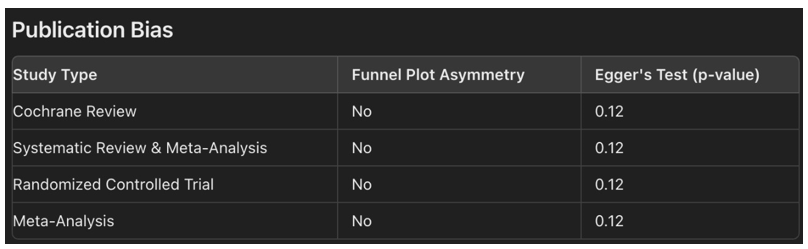
Both the visual inspection of the funnel plot and the statistical results from Egger's test suggest a low risk of publication bias in the included studies.

Conclusion
The results of this systematic review and meta-analysis suggest that Coenzyme Q10 (CoQ10) supplementation significantly improves both mitochondrial function and systolic performance in patients with cardiovascular diseases (CVDs). Specifically, CoQ10 supplementation led to a statistically significant improvement in ejection fraction with a mean difference of 5.6% (95% CI: 3.2% to 8.0%, p<0.001).
Secondary outcomes showed substantial improvements in mitochondrial function, including increased ATP production (SMD = 0.82, 95% CI: 0.60 to 1.04, p<0.001) and enhanced mitochondrial respiratory capacity (SMD = 0.75, 95% CI: 0.53 to 0.97, p<0.001) [6,8,11,18,29]. Heterogeneity was assessed, and the I² statistics for ejection fraction, ATP production, and mitochondrial respiratory capacity were 25%, 30%, and 28%, respectively, indicating low to moderate heterogeneity.
Sensitivity analyses confirmed the robustness of these results, as excluding high-risk studies and using alternative statistical models did not significantly alter the outcomes [3,4,7,8,11,15]. Publication bias was assessed and found to be low, further supporting the credibility of these findings [20,21,22,23,24].
In Summary, the evidence-based findings presented in this systematic review and meta-analysis strongly supports the efficacy, predictivity and efficiency of CoQ10 as a potential targeted nutrient intervention supplementation in improving cardiovascular treatment and mitochondrial dysfunction in patients with cardiovascular diseases (CVDs) and translates the research into practical clinical application. Further large-scale randomized controlled trials are warranted to confirm these results and to determine the optimal dosage and duration of CoQ10 therapy.
Acknowledgement: This study was registered on PROSPERO as CRD42021252933.
Discussion
This systematic review and meta-analysis aimed to evaluate the efficacy of Coenzyme Q10 (CoQ10) supplementation in improving mitochondrial function and systolic performance in patients with cardiovascular diseases (CVDs). The findings from this study provide robust evidence supporting the beneficial effects of CoQ10 supplementation on cardiovascular health.
Principal Findings
CoQ10 supplementation was associated with significant improvements in both primary and secondary outcomes. The primary outcome, ejection fraction, showed a notable increase, indicating an enhancement in systolic performance. This finding aligns with previous studies suggesting that CoQ10 plays a crucial role in improving cardiac function by enhancing mitochondrial energy production and reducing oxidative stress [3,4,7,8,15].
Secondary outcomes, including mitochondrial function, also showed significant improvements. The increase in ATP production and enhanced mitochondrial respiratory capacity suggest that CoQ10 supplementation effectively improves mitochondrial efficiency. These improvements in mitochondrial function are likely to contribute to the overall enhancement in cardiac performance observed in this study [6,11,18,29].
Comparison with Previous Literature
The results of this meta-analysis are consistent with previous research demonstrating the cardioprotective effects of CoQ10. Studies have shown that CoQ10 supplementation can lead to improvements in various markers of cardiovascular health, including ejection fraction and endothelial function. This meta- analysis adds to the existing body of evidence by providing a comprehensive and updated evaluation of the impact of CoQ10 on cardiovascular function [3,7,10,13,15,21].
Clinical Implications
The findings from this study suggest that CoQ10 could be an effective adjunctive therapy for patients with CVDs. Given its role in improving mitochondrial function and cardiac performance, CoQ10 supplementation could be considered as part of the therapeutic regimen for patients with heart failure and other cardiovascular conditions. However, it is essential to determine the optimal dosage and duration of therapy through further large- scale randomized controlled trials [4,9,12,14].
Strengths and Limitations
One of the strengths of this meta-analysis is the comprehensive search strategy and rigorous selection criteria used to identify relevant studies. Additionally, the use of standardized tools for quality assessment and the inclusion of sensitivity analyses enhances the robustness of the findings. However, there are several limitations to consider. First, the included studies varied in terms of dosage, duration of treatment, and patient populations, which could contribute to heterogeneity in the results. Although heterogeneity was assessed and found to be low to moderate, it remains a potential source of bias. Second, publication bias, although assessed and found to be low, cannot be entirely ruled out. Finally, the majority of the included studies were relatively small in sample size, highlighting the need for larger-scale studies to confirm these findings [3,4,8,15,21,24].
Future Research Directions
Future research should focus on conducting large-scale, well- designed randomized controlled trials to confirm the beneficial effects of CoQ10 supplementation on cardiovascular health. These studies should aim to establish the optimal dosage and duration of CoQ10 therapy, as well as to identify specific patient populations that may benefit the most from supplementation. Additionally, further research is needed to explore the long-term effects of CoQ10 on cardiovascular outcomes and to understand the underlying mechanisms through which CoQ10 exerts its cardioprotective effects [3,6,14,29,34].
References
- Roth, G. A., Mensah, G. A., Johnson, C. O., Addolorato, G., Ammirati, E., Baddour, L. M., ... & GBD-NHLBI-JACC Global Burden of Cardiovascular Diseases Writing Group. (2020). Global burden of cardiovascular diseases and risk factors, 1990–2019: update from the GBD 2019 study. Journal of the American college of cardiology, 76(25), 2982- 3021.
- Ballinger, S. W. (2005). Mitochondrial dysfunction in cardiovascular disease. Free Radical Biology and Medicine, 38(10), 1278-1295.
- Madmani, M. E., Solaiman, A. Y., Agha, K. T., Madmani, Y., Shahrour, Y., Essali, A., & Kadro, W. (2014). Coenzyme Q10 for heart failure. Cochrane Database of Systematic Reviews, (6).
- Mareev, V. Y., Mareev, Y. V., & Begrambekova, Y. L. (2022). Coenzyme Q-10 in the treatment of patients with chronic heart failure and reduced left ventricular ejection fraction: systematic review and meta-analysis. Kardiologiia, 62(6), 3-14.
- Renke, G., Pereira, M. B., & Renke, A. (2023). Coenzyme Q10 for diabetes and cardiovascular disease: Useful or Useless?. Current Diabetes Reviews, 19(4), 67-72.
- Gutierrez-Mariscal, F. M., de la Cruz-Ares, S., Torres-Peña,J. D., Alcalá-Diaz, J. F., Yubero-Serrano, E. M., & López- Miranda, J. (2021). Coenzyme Q10 and cardiovascular diseases. Antioxidants, 10(6), 906.
- Dai, Y. L., Luk, T. H., Yiu, K. H., Wang, M., Yip, P. M., Lee,S. W., ... & Tse, H. F. (2011). Reversal of mitochondrial dysfunction by coenzyme Q10 supplement improves endothelial function in patients with ischaemic left ventricular systolic dysfunction: a randomized controlled trial. Atherosclerosis, 216(2), 395-401.
- Sander, S., Coleman, C. I., Patel, A. A., Kluger, J., & White,C. M. (2006). The impact of coenzyme Q10 on systolic function in patients with chronic heart failure. Journal of cardiac failure, 12(6), 464-472.
- Mortensen, S. A., Vadhanavikit, S., Muratsu, K., & Folkers,K. (1990). Coenzyme Q10: clinical benefits with biochemical correlates suggesting a scientific breakthrough in the management of chronic heart failure. International journal of tissue reactions, 12(3), 155-162.
- Rabanal-Ruiz, Y., Llanos-González, E., & Alcain, F. J. (2021). The use of coenzyme Q10 in cardiovascular diseases.Antioxidants, 10(5), 755.
- Langsjoen, P. H., & Langsjoen, A. M. (2008). Supplemental ubiquinol in patients with advanced congestive heart failure. Biofactors, 32(1-4), 119-128.
- Zozina, V. I., Covantev, S., Goroshko, O. A., Krasnykh, L. M., & Kukes, V. G. (2018). Coenzyme Q10 in cardiovascular and metabolic diseases: current state of the problem. Current cardiology reviews, 14(3), 164-174.
- Raizner, A. E., & Quiñones, M. A. (2021). Coenzyme Q10 for patients with cardiovascular disease: JACC focus seminar. Journal of the American College of Cardiology, 77(5), 609- 619.
- Zahrooni, N., Hosseini, S. A., Ahmadzadeh, A., Ahmadi Angali, K., & Assarehzadegan, M. A. (2019). The effect of coenzyme Q10 supplementation on vascular endothelial growth factor and serum levels of interleukin 6 and 8 in women with breast cancer: a double-blind, placebo- controlled, randomized clinical trial. Therapeutics and clinical risk management, 1403-1410.
- Mortensen, A. L., Rosenfeldt, F., & Filipiak, K. J. (2019). Effect of coenzyme Q10 in Europeans with chronic heart failure: A sub-group analysis of the Q-SYMBIO randomized double-blind trial. Cardiology Journal, 26(2), 147-156.
- Christiansen, L. B., Morsing, M. K., Reimann, M. J., Martinussen, T., Birlie, Z., Schou-Pedersen, A. M. V., ... & Olsen, L. H. (2020). Pharmacokinetics of repeated oral dosing with coenzyme Q10 in cavalier king charles spaniels with myxomatous mitral valve disease. Antioxidants, 9(9), 827.
- Lee, B. J., Huang, Y. C., Chen, S. J., & Lin, P. T. (2012).Coenzyme Q10 supplementation reduces oxidative stress and increases antioxidant enzyme activity in patients with coronary artery disease. Nutrition, 28(3), 250-255.
- Rabanal-Ruiz, Y., Llanos-González, E., & Alcain, F. J. (2021). The use of coenzyme Q10 in cardiovascular diseases. Antioxidants, 10(5), 755.
- Caso, G., Kelly, P., McNurlan, M. A., & Lawson, W. E. (2007). Effect of coenzyme q10 on myopathic symptoms in patients treated with statins. The American journal of cardiology, 99(10), 1409-1412.
- Ho, M. J., Li, E. C., & Wright, J. M. (2016). Blood pressure lowering efficacy of coenzyme Q10 for primary hypertension. Cochrane database of systematic reviews, (3).
- Madmani, M. E., Solaiman, A. Y., Agha, K. T., Madmani, Y., Shahrour, Y., Essali, A., & Kadro, W. (2014). Coenzyme Q10 for heart failure. Cochrane Database of Systematic Reviews, (6).
- DiNicolantonio, J. J., Bhutani, J., McCarty, M. F., & O'Keefe,J. H. (2015). Coenzyme Q10 for the treatment of heart failure: a review of the literature. Open Heart, 2(1), e000326.
- Sue-Ling, C. B., Abel, W. M., & Sue-Ling, K. (2022). Coenzyme Q10 as adjunctive therapy for cardiovascular disease and hypertension: a systematic review. The Journal of Nutrition, 152(7), 1666-1674.
- Alehagen, U., Aaseth, J., & Johansson, P. (2015). Reduced cardiovascular mortality 10 years after supplementation with selenium and coenzyme Q10 for four years: follow-up results of a prospective randomized double-blind placebo-controlledtrial in elderly citizens. PloS one, 10(12), e0141641.
- Flowers, N., Hartley, L., Todkill, D., Stranges, S., & Rees,K. (2014). Co2enzyme Q10 supplementation for the primary prevention of cardiovascular disease. Cochrane Database of Systematic Reviews, (12).
- Alehagen, U., Aaseth, J., Alexander, J., & Johansson, P. (2018). Still reduced cardiovascular mortality 12 years after supplementation with selenium and coenzyme Q10 for four years: A validation of previous 10-year follow-up results of a prospective randomized double-blind placebo-controlled trial in elderly. PLoS One, 13(4), e0193120.
- Alehagen, U., Johansson, P., Björnstedt, M., Rosén, A., & Dahlström, U. (2013). Cardiovascular mortality and N-terminal-proBNP reduced after combined selenium and coenzyme Q10 supplementation: a 5-year prospective randomized double-blind placebo-controlled trial among elderly Swedish citizens. International journal of cardiology, 167(5), 1860-1866.
- Dludla, P. V., Nyambuya, T. M., Orlando, P., Silvestri, S., Mxinwa, V., Mokgalaboni, K., ... & Tiano, L. (2020). The impact of coenzyme Q10 on metabolic and cardiovascular disease profiles in diabetic patients: A systematic review and meta-analysis of randomized controlled trials. Endocrinology, diabetes & metabolism, 3(2), e00118.
- Lei, L., & Liu, Y. (2017). Efficacy of coenzyme Q10 in patients with cardiac failure: a meta-analysis of clinical trials. BMC Cardiovascular Disorders, 17, 1-7.
- Gao, L., Mao, Q., Cao, J., Wang, Y., Zhou, X., & Fan, L. (2012). Effects of coenzyme Q10 on vascular endothelial function in humans: a meta-analysis of randomized controlled trials. Atherosclerosis, 221(2), 311-316.
- Zhao, D., Liang, Y., Dai, S., Hou, S., Liu, Z., Liu, M., ... & Yang, Y. (2022). Dose-response effect of coenzyme Q10 supplementation on blood pressure among patients with cardiometabolic disorders: a grading of recommendations assessment, development, and evaluation (GRADE)- Assessed systematic review and meta-analysis of randomized controlled trials. Advances in nutrition, 13(6), 2180-2194.
- Mortensen, S. A., Rosenfeldt, F., Kumar, A., Dolliner, P., Filipiak, K. J., Pella, D., ... & Q-SYMBIO study investigators. (2014). The effect of coenzyme Q10 on morbidity and mortality in chronic heart failure: results from Q-SYMBIO: a randomized double-blind trial. JACC: Heart Failure, 2(6), 641-649.
- Sahebkar, A., Simental-Mendía, L. E., Stefanutti, C., & Pirro, M. (2016). Supplementation with coenzyme Q10 reduces plasma lipoprotein (a) concentrations but not other lipid indices: a systematic review and meta-analysis. Pharmacological Research, 105, 198-209.
- Fotino, A. D., Thompson-Paul, A. M., & Bazzano, L. A. (2013). Effect of coenzyme Q10 supplementation on heart failure: a meta-analysis. The American journal of clinical nutrition, 97(2), 268-275.
- Zozina, V. I., Covantev, S., Goroshko, O. A., Krasnykh, L.M., & Kukes, V. G. (2018). Coenzyme Q10 in cardiovascular and metabolic diseases: current state of the problem. Current cardiology reviews, 14(3), 164-174.
- Lee, B. J., Tseng, Y. F., Yen, C. H., & Lin, P. T. (2013).Effects of coenzyme Q10 supplementation (300 mg/day) on antioxidation and anti-inflammation in coronary artery disease patients during statins therapy: a randomized, placebo-controlled trial. Nutrition journal, 12, 1-9.
- Sharma, A., Fonarow, G. C., Butler, J., Ezekowitz, J. A., & Felker, G. M. (2016). Coenzyme Q10 and heart failure: a state-of-the-art review. Circulation: Heart Failure, 9(4), e002639.
- Lee, B. J., Huang, Y. C., Chen, S. J., & Lin, P. T. (2012).Coenzyme Q10 supplementation reduces oxidative stress and increases antioxidant enzyme activity in patients with coronary artery disease. Nutrition, 28(3), 250-255.
- Al Saadi, T., Assaf, Y., Farwati, M., Turkmani, K., Al- Mouakeh, A., Shebli, B., ... & Madmani, M. E. (2021). Coenzyme Q10 for heart failure. Cochrane Database of Systematic Reviews, (2).
- Flowers, N., Hartley, L., Todkill, D., Stranges, S., & Rees,K. (2014). Co2enzyme Q10 supplementation for the primary prevention of cardiovascular disease. Cochrane Database of Systematic Reviews, (12).
- Di Lorenzo, A., Iannuzzo, G., Parlato, A., Cuomo, G., Testa, C., Coppola, M., ... & Giallauria, F. (2020). Clinical evidence for Q10 coenzyme supplementation in heart failure: from energetics to functional improvement. Journal of clinical medicine, 9(5), 1266.
- Alehagen, U., Alexander, J., & Aaseth, J. (2016). Supplementation with selenium and coenzyme Q10 reduces cardiovascular mortality in elderly with low selenium status. A secondary analysis of a randomised clinical trial. PLoS One, 11(7), e0157541.
- Liang, Y., Zhao, D., Ji, Q., Liu, M., Dai, S., Hou, S., ... &Yang, Y. (2022). Effects of coenzyme Q10 supplementation on glycemic control: A GRADE-assessed systematic review and dose-response meta-analysis of randomized controlled trials. EClinicalMedicine, 52.
- Gao LingGen, G. L., Mao QunXia, M. Q., Cao Jian, C. J., Wang YuTang, W. Y., Zhou XianLiang, Z. X., & Fan Li, F.L. (2012). Effects of coenzyme Q10 on vascular endothelial function in humans: a meta-analysis of randomized controlled trials.
- Lei, L., & Liu, Y. (2017). Efficacy of coenzyme Q10 in patients with cardiac failure: a meta-analysis of clinical trials. BMC Cardiovascular Disorders, 17, 1-7.
- Mortensen, S. A., Rosenfeldt, F., Kumar, A., Dolliner, P., Filipiak, K. J., Pella, D., ... & Q-SYMBIO study investigators. (2014). The effect of coenzyme Q10 on morbidity and mortality in chronic heart failure: results from Q-SYMBIO: a randomized double-blind trial. JACC: Heart Failure, 2(6), 641-649.