

Journal of Applied Language Learning(JALL)
ISSN: 3068-1332 | DOI: 10.33140/JALL


Review Article - (2026) Volume 3, Issue 2
Transactional Writing: Divergent Formative Assessment and Writing Plans
Received Date: Jun 10, 2026 / Accepted Date: Jul 06, 2026 / Published Date: Jul 14, 2026
Copyright: ©2026 Winifred M Burke. This is an open-access article distributed under the terms of the Creative Commons Attribution License, which permits unrestricted use, distribution, and reproduction in any medium, provided the original author and source are credited.
Citation: Burke, W. M. (2026). Transactional Writing: Divergent Formative Assessment and Writing Plans. J App Lang Lea, 3(2), 01-10.
Abstract
This article seeks to raise awareness among practitioners and researchers of the potential of the writing plan as an important formative assessment tool for informing teacher’s planning and students’ learning. A review of transactional language sets the scene before convergent and divergent formative and summative assessment are considered in terms of study practice as well as preparation for examinations. As transactional writing has such a high profile in schools and colleges and becomes more difficult as higher levels of examination are undertaken the author seeks to share why she considers writing plans as a potential source for divergent formative assessment are worthy of greater consideration by practitioners and researchers.
Keywords
Transactional Writing, Writing Plans, Convergent and Divergent Formative Assessment, Essay-Based Examinations
Introduction
Essay-based examinations, to varying degrees, can be daunting to students across schooling levels and as students advance to higher levels of education, writing and writing well is expected. This article is not an examination of examinations nor a study of how to study; however, it does provide a synopsis of processes of studying prior to, and the recall of topic-related content during essay-based study sessions or tests and ex aminations completed by primary, secondary and university students. The purpose of this article is to prioritize discussion about an associative part of the transactional writing process – the writing plan- and to consider its form, function and the range of initial responses students might include to propel their essay writing. The reader might say that the answer is obvious -that students generate topic-related ideas they subsequently incorporate in their essays. That observation would be accurate and there is literature to support that students who generate a writing plan are likely to achieve higher writing scores than those who do not have an accompanying plan [1]. However, might there be other features students might consider cueing their deliberations over the topic prompt and could an assessment conversation with the student during planning, rather than just imparting strategies earlier in the term offer a valuable opportunity to pitch feedback within the student’s zone of proximal development ? In other words, could teacher intervention at this stage add to deeper learning of content or skills on the student’s part not just performativity on a test or examination [2,3].
A review of transactional writing is included as perceived and accepted in the context of writing informatively for an audience, usually the instructor-cum-examiner [4]. This is followed by a reminder of the major differences between summative and formative assessment as well as what happens in UK classrooms. These are illustrated by the author’s personal experience as a student and latterly as an inspector and researcher in this field.
Finally, each of these strands are drawn together to focus the readers’ attention on the value of divergent as opposed to convergent formative assessment for developing student learning and teacher planning during the study process and how the writing plan can provide an opportunity for this to happen.
Transactional Writing Defined
Britton et al reported that the overwhelming use of writing in British schools was transactional [4]. This was a transaction between the teacher and student usually for the purpose of evaluating what the student knew. Transactional writing is examined for specific traits or holistically. These include format and presentation; clear form and logical sequence; developed and elaborated ideas to convey and clarify meaning; recognizable letters and words; first or third person writing depending on genre or mode; complexity/specialized use of language/structure; clear purposeful effect; audience needs and perspectives; breadth of vocabulary; abstraction and speculation; extension beyond personal experiences [5,6]. Assessors of the National Assessment of Educational Progress (NAEP) in Writing rated essays based on the adequate development of ideas; well-chosen details (reasons, examples); clear organization; conventional spelling, punctuation, formatting, etc. precision in word choice; sustained controlling idea, effective use of transition and variety in sentence structure [7].
Transactional writing is still the writing style cultivated in most educational settings; it strives for analysis and explication through objective observation and to a lesser extent, personal anecdotal experiences. Transactional writing in essay form is sub divided into the two categories, informative and conative language [4]. According to these authors, informative language makes information available and is ‘used to record, report, classify, compare, infer, deduce and hypothesis, to ask and answer questions, to assert, explain and evaluate’ (p91). By contrast, the writer uses conative language to influence the reader by ordering, instructing, advising, or persuading.
This article acknowledges the work of Britton and his associate’s notion that when students are generating and inscribing tentative responses about the writing topic on a provided planning page, they apply both informative and conative language to prompt themselves (reader/writer) as they develop their essay draft. One form of transactional writing not referred to so far but most evident in the work of students studying for higher degrees is argumentative writing. It draws on the features mentioned above but students must be able to back up statements with evidence. This can take the form of quantitative or qualitative data to support the case being made or references to other writers’ work to clarify a point, support a hypothesis or raise reader’s awareness.
Transactional Writing as Conforming
It is expected that as students’ progress within and from primary to secondary schooling to tertiary education, they are instructed in and consequently expected to demonstrate a range of organizational patterns depending on the purpose of writing, the topic to be written about and the writing context. Through schooling students are regularly exposed to and encouraged to practice writing conventions. As they advance through education levels, they are also expected to emulate the academic literacies and conventions that are part of the subject matter or discipline they pursue. As such, in the initial minutes of an examination, a student might consider their presentation style and record organizing categories or signposts to help them order their information recollections. Skeletal structure might be likely to be evident in the writing plans of older students rather than younger ones and consequently impact on the quality of the essays.
To conform may be to shape, to class or represent, to develop according to established standards or criteria. Structure or arrangement is taught to help writers organize their ideas and present them clearly to an audience [8]. The introductory and concluding sections of an essay are bookends that capture or lose a reader’s interest. Written texts are commonly divided into three sections; ‘the beginning, the middle and the end.’ Another set of terms is the Introduction, development, or complication (body) and resolution (conclusion). (p348) While it is expected that essays submitted for assessment are organised as recommended above there is debate about the form that essays take [9].
A commonly taught essay structure in schools is the five-paragraph (henceforth 5P) essay, with an introduction, three supporting points, or paragraphs; and a summary/conclusion [10]. The 5P essay is not an intimidating structure and may serve as a starting point for beginning writers, for students who are apprehensive about writing; for students who speak English as a second or foreign language; for students with learning difficulties; for students who have not experienced success in their compositions; and, for students who did not previously engage in any form of prewriting [11-15]. Opposing views about the 5P essay abound [16,17]. Foley argued that the 5P is ‘a useful first step for beginning student writers’ (p232), but that the format was restrictive and formulaic because not all ideas fit well into the 5P theme [18]. She pointed out that it reinforced the syndrome of writing ‘to please the teacher.’ Another opponent of the 5P essay is Emig who insisted that this essay format is not a structure real writer use [19]. Negative outcomes included hindrance to intellectual discovery and thinking, restriction of students to a shallow, predictable level of coherence, depriving them of motivation to probe conceptual relationships, denying them the pleasures of meeting the challenges of writing, and inadequately preparing them for academic, and practical -world writing. While limitations do exist an advocate of the 5P structure argued that it got ‘the job done…students have seized upon the 5P structure as salvation’ (pp 80/82) [20]. Kuehner averred that it enabled students to ‘learn important concepts about expository writing…to make assertions about the primary concepts of the essay (and help them) through essay exams, or when ideas get complex or confusing’ (pp83-4) [21]. As an extension of, or an alternative to, the 5P format Foley advocated teaching students the following patterns of organization, a chronological order, a spatial order, an emphatic order, or a causal order [18]. Kellogg ( p332) explained that ‘specific ideas could be organised by first presenting the pros and cons and (beginning) each category (first) with practical reasons (next with) emotional or psychological reasons and last with general, abstract, or philosophical ones [15]. Other researchers put forward that texts have a scheme of organization such as the following: likes with likes; explanation before complication; the obvious before the remarkable to name but a few [22].
A British team of researchers led by Hicks (reported in the Qualifications and Curriculum Authority, 2003) collected and reviewed a sample of writing plans generated by one hundred year six and year nine students and surveyed these individuals and their respective teachers from eight schools. Teachers were reported to agree on several issues; that ‘analysis of task type and planning for writing has a positive impact in the work of their students; (p18); that organization of ideas for structure was ‘the most important element of planning’ and essay structure is ‘the key area that improved with planning’ (p19) and that detailed planning resulted in higher quality written work, particularly in terms of structure and use of vocabulary for effect.’ These teachers were also aware that students may plan dutifully and still not apply their plans efficiently. Year six teachers indicated that in preparation for longer writing tasks and writing for test conditions, they encouraged their students to focus on the following elements: text type specific frames to support text organizing; paragraphing and organization of ideas. Year nine teachers provided similar advice; that planning was important and to consider structure, paragraphing, and opening phrases.
Transactional writing in its preparatory state in writing plans involves recall and attention to conventional writing practices, previous teacher instruction and guided practice to conform to the principles of organization of the writing being undertaken [23]. It is also about the recovery or re-forming of prior knowledge and expressing this content in a timed writing-on-demand setting.
Transactional Writing as Re-forming and Informing
Understanding the intent of an assessment prompt and addressing it comprehensively are essential as missing the point is detrimental to one’s subsequent written communication [24]. Each prompt in the form of a statement, a question, a scenario or a quote with an instruction to ‘do’ one of the following: analyze, illustrate, suggest, criticize, relate, demonstrate, to name but a few can contain key concepts and have operative words that students are expected to be familiar with, be able to identify and extract and subsequently craft a well-considered explanation in writing. Throughout the initial minutes while mulling over one or several key words in the prompt and even writing one or all keywords on the planning space available, the student reconstitutes and re-forms the prompt that could trigger information. This could cause a flood or a trickle of recollections (or none) sufficient and relevant at that moment to support his/her composing and developing composition.
Ideas are abstractions and are dynamic; sometimes condensed in a single work and sometimes broad concepts or categories are used. These higher-level abstractions are essential to writing. Since abstractions are filled with meaning, the writer must include details or facts to substantiate and make them valid. So, to inform oneself as a writer-reader is to impart, to state, to give character or essence to meaning and prior knowledge. Researchers noted in their studies of primary children’s essays that the content tended to exemplify knowledge telling as a list of idea units [25]. Ideas do provide oneself with more ideas than are needed in one’s writing; however, it is necessary to impart to students that they learn to monitor:-
• How much is enough?
• Time spent generating.
• The consequences of tangential ideas during the test or examination period.
Novice writers’ essays tend to be composed of information drawn from memory with little or no consideration for purpose or audience. Freedman et al’s (p317) examination of student levels of abstracting in their essays revealed ‘the degree to which the primary data dealt with in the essay had been classified, ordered and integrated by the writer within some superordinate hierarchic conceptional pattern [26].’
Writers can choose to elect and to work with one or several controlling ideas, to rearrange a sequence of connected assertions, and to replace first-idea units with the use of other examples and detail during writing. Perl (p331) aptly pointed out that writers generate ideas as they composed which involved ‘some measure of both construction and discovery [27].’ The display of topic-related content is influenced by writing conditions and time constraints, by one’s prior knowledge of the prompt or topic, and whether the students had been equipped with pre-writing strategies as a means of retrieving, organizing, and developing their initial and subsequent responses. It is reasonable to believe that topic-related content evinced in writing plans are configured in varying degrees of complexities and represented through the established structures of semantic organizers, clustering, formal outlines or written in full but as rough drafts [15,28,29].
Writing plans can serve as a problem space or platform for example, to test spelling for word accuracy intended for incorporation, and as a sounding board for self-prompts such as ‘don’t forget’, ‘describe’, ‘remember to tell’, ‘talk about the ‘, ‘explain’, and especially questions that appear to serve as memory joggers. To question is to survey and is a structured strategy writers use to generate ideas [24].
Other researchers investigated the effective use of the standard journalistic format: What? When? Where? Who? Why? How? (henceforth, Wh/H questions). Wh/H questions are useful schemes for helping writers to explore and develop their ideas, especially in informative and argumentative texts. Wh/H questions and verb-like prompts are like the conative language writers use to achieve their objectives, which is to influence, order, instruct, advise, or persuade, the writer himself or herself [4]. The inclusion of questions in writing plans may also be a form of consideration by the writer imagining what the ‘other’ not self as reader might need to know – an intentional projection of what the communication is to be. Gorrell (1996) observed that students who generated a central question in relation to the topic rather than a thesis response statement had more control and focus when responding to the writing topic. Dougherty (19886, p86) pointed out that ‘students need to understand that by asking and then answering specific questions; writers use questions to probe a topic and investigate relationships more fully for us and our readers. Cumulative writing experiences in terms of length of schooling may impel some writers to record their Wh/H cues in their plans [24]. Regardless of prewriting strategy applied in a writing plan, writing plans may be perceived as re-collection (as in recall, and as in stockpile) platform for tentative topic responses, some in abstracted form while others with much elaboration. Students can activate their prior knowledge as well as accentuate their intended meaning by combining, substituting, or separating topic-related responses when they write their essays.
Further investigation is needed to ascertain:-
• if there is one or a combination of prewriting strategies that effectively helps the reader-writer recall information, to generate and organize tentative ideas.
• The relationship between students’ understanding of a topic prompt and their ability to plan to write about it and how this association influences successful writing quality.
• Cross-textual examination between the Wh/H questions recorded in writing plans and how students address and incorporate responses into the body of their essays would provide insights to students’ topic appreciation and comprehension as conveyed through their writing. Clearly researchers have extensively researched transactional writing and as a researcher in the fields of literacy and assessment I can see many advantages for both students and teachers for an assessment conversation whilst students are at the planning stage of essay writing. First let us remind ourselves as to what this might involve.
Summative and Formative Assessment
Summative assessment…may be criterion-referenced or norm-referenced, formative assessment is always made in relation to where students are in their learning in terms of specific content or skills (370). In other words, formative assessment is both criterion-referenced and student-referenced (ipsative). The amount of effort the student puts into the work, the context of the work as well as the amount of progress the student has made over time are important variables in this process. The student’s conceptual ability as well as the relevant criteria will therefore determine the judgement made about the work and the feedback given to the student. The importance of this form of assessment is that it is diagnostic for each individual student and as such is an essential part of teaching. The student may recognize the small ideas as they are developed but the teacher will recognize the bigger ideas to which s/he intends the student to make progress (373). Confusion, however, may arise from the same criteria being used by the teacher for both formative and summative purposes. This is why, I believe, writing plans have received so little attention as a tool for formative purposes because their use in tests and examinations are associated with end of key stages or completion of higher levels of study although they are also very much a part of regular classroom writing. In formative assessment errors or misunderstandings in the writing plan could be regarded as useful clues to aid the teacher to scaffold future learning (80). The metaphor scaffolding was coined by Bruner to refer to the aid the teacher gives to the student because they are based on common criteria.
Summative assessment relates to progression in learning against public criteria and here the results of different students can be combined for various purposes (such as comparison between schools). Methods used must be dependable (can be replicated in a different situation), without endangering validity (accuracy), and must be monitored for quality assurance procedures. The evidence should also be based on the full range of performance relevant to the criteria being used.
Researchers interested in formative assessment highlight the important level of subject knowledge and inter-personal skills necessary for engaging at this level if metacognitive processes (thinking about thinking) are to be stimulated in the student.
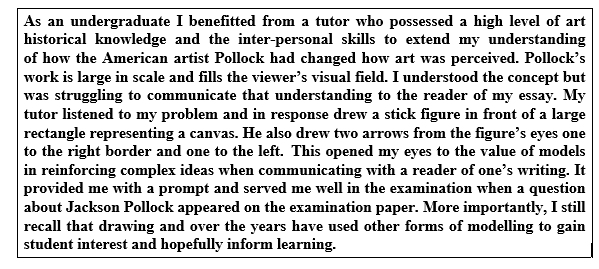
Sadler and Perrenoud both found that student reactions to feedback were not always positive or acted upon even when based on valid and reliable judgements [30]. Perrenoud believed that the contract between the students and teacher needed to be renegotiated if positive change was to happen.
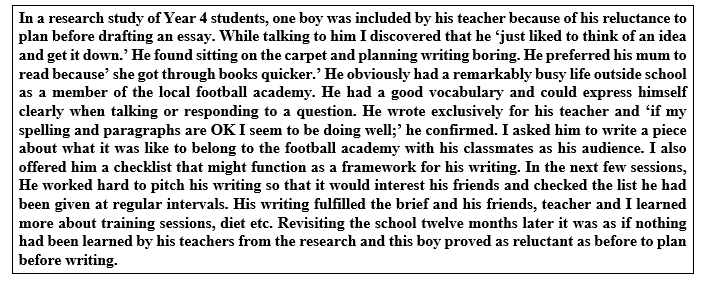
Feedback from these teachers highlighted their concerns that large class sizes prevented them from engaging at this level with students. The headteacher of this school commented that taking part in the research had meant she was able to talk to students about their perceptions after years of ‘jumping through hoops’ as one government initiative followed another unfortunately she had not passed the importance of finding time for these interchangers with her staff.
Pryor et al started work on an action research partnership with teachers by supplying models and supporting teachers in their developing understanding of the potential of formative assessment for learning [31]. They found that progress was slow because primary teachers had to relearn approaches to observation and questioning before they could really understand the deeper consequences of their actions on students’ learning. Much is written about the zone of proximal development as applied to students as learners [2]. This is the gap between what the student can do on their own and their potential achievement with help from an informed adult. These researchers confirmed the need to be aware of the zone of proximal development within which each teacher is operating before any development work could be contemplated.
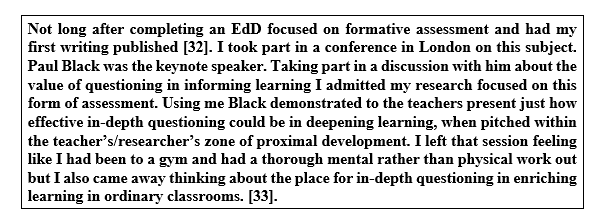
Following the Black and Wiliam review (1998) of formative assessment, the government’s interest in this form of assessment for informing learning and particularly improving examination grades for students with learning difficulties meant that with government funding this form of assessment was suddenly very visible in UK classrooms. From my reading I was already aware of two conceptually distinct ideal approaches to formative assessment which researchers termed convergent and divergent (207) [34]. I recognized that this model came close to linking descriptive theory with instructional practice as it identified two conceptually distinct ideal approaches to formative assessment. What I witnessed in school classrooms was convergent assessment.
The model, Convergent and Divergent Formative Assessment grew from the work of the ESRC-funded project ‘Investigating and Developing Formative Teacher Assessment in Primary Schools.’ In convergent teacher assessment the researchers identify that the most important thing is to find out if the student knows a predetermined thing. This form of assessment, the researchers maintain, is characterized by detailed planning, the use of tick lists and can-do statements and an analysis of the student and curriculum from the point of view of the curriculum. It is accomplished routinely using closed or pseudo-open questions and tasks. The formative implications are behaviorist although the researchers maintained that recourse to behaviorism may not be self-conscious. This is assessment of the student by the teacher with the intention being to teach or assess the next predetermined thing in a linear or at least a pre-planned progression. This method stresses measurement against objectives.
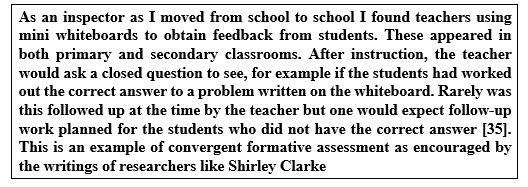
Divergent teacher assessment, on the other hand, emphasizes the learner’s understanding rather than the assessor’s agenda. The important consideration is to find out what the student knows and more importantly understands. This kind of approach is characterized by less detailed planning, open forms of questioning and recording and an analysis of the student and the curriculum from the student’s point of view. The formative implication of divergent teacher assessment is that a social constructivist view of education is adopted with an intention to teach within the zone of proximal development (212) [2]. In this case assessment is accomplished jointly by the teacher and student. Researchers point to the advantages of an ‘educational model that meshes with a constructivist curriculum, and where assessment is inherently idiosyncratic and context-dependent (100) [36].
The divergent model fits well with a social constructivist theory of learning and assessment as a collaborative enterprise where students are taught to think for themselves and to acquire a similar concept of quality to that held by their teacher as this integrates assessment with learning. Prior and Torrance maintain that most formative assessment practices contain a mixture of convergent and divergent elements rather than being purely one or the other [34].
As a teacher I had always tried to work within each student’s zone of proximal development and as a researcher the divergent model informed my practice. The following is an example from a piece of writing research I carried out with Year six students (p22)
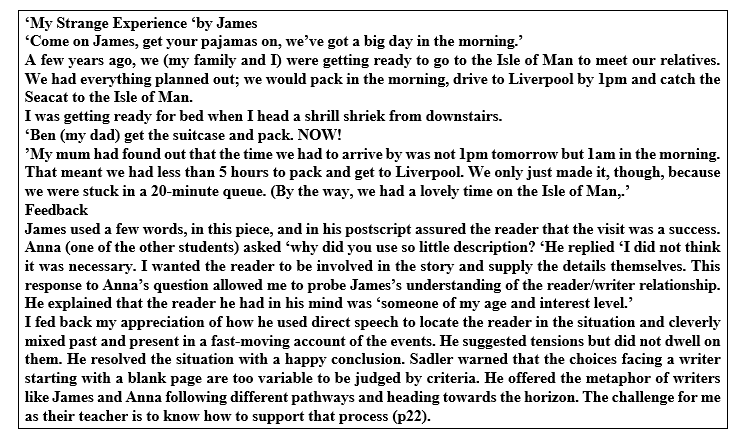
As an ex-teacher faced with the above situation I recognize that my intervention and feedback would have been of more value to James at the planning stage [37]. He had written a plan. Like myself I wonder how many of my teachers/ readers, would have had to change mindsets when trying to adopt divergent formative assessment practices in the classroom because judging pupils completed writing has become such an integral part of practice? In research mode I asked one Year 6 teacher what her students thought literacy was about. She confirmed ‘I think they would think it is about writing.’ When asked why she replied, ‘I try to give them variety but as teachers we need evidence that they are performing as they should and writing ensures we have that.’
Writing as a mode of learning and as an intentional strategy is also a means of learning [38]. Studying from a text, from several texts, and from classroom/lecture notes can involve attentive reading and interpreting; personalized notetaking and summarizing; thinking through, clarification of and making connections between concepts; re-reading and committing to memory relevant information necessary for written application [39]. At primary, secondary, and tertiary education levels tests and past examination questions are often made available to students to scaffold or support their revision preparations; these can vary in quality. Studying and becoming familiar with types of assessment questions and how to respond to them are skills that ought to be taught to, and internalized by, students for successful learning. Study strategies include previewing, questioning, underlining, note-taking, outlining and forms of diagrammatic outlining, and summarizing [40]. The last four strategies involve writing ‘helps them discover meanings for themselves’ [40]. In summary, studying demands a student’s concentrated effort to extract, synthesize, abstract, and transform information. This period of study allows students to reflect and explore subject matter and to check, test, and revise where necessary their understanding for which they will be examined.
This article’s premise is that since reading and writing are two sides of the same coin that the strategies used while studying (and reading) serve equally as prewriting strategies when embarking on essay writing -to recall or retrieve memorized content information as quickly and efficiently during the planning time when specified. The selection and application of one or more strategies therefore serve as a function or idea retrieval and preliminary formation of an essay.
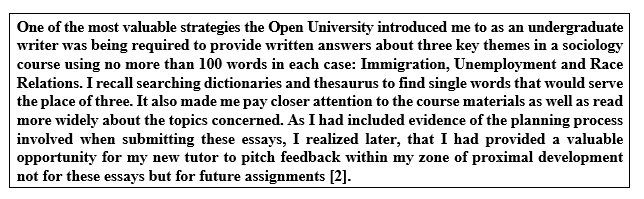
This is an example of where divergent formative assessment is most effective for improving learning and teacher planning.
Pryor et al. found that teachers used a mixture of convergent and divergent formative assessment in their practice. From experience I know that effective formative assessment needs to be part of a complete approach to learning. Unfortunately, government interventions in recent years have drained too many teachers’ confidence to be innovative.
Prompt-based writing examinations do not appear to be going away anytime soon, despite the reality that they judge writing ability in an artificial and inauthentic writing situation. The purpose of essay-based examinations (summative assessment) is to measure a student’s level of proficiency and progress after a period of classroom instruction and self-initiated study revision. The expectation is to ascertain a student’s ability to:
• Interpret, comprehend, and respond to the assignment prompts which can be presented in the form of a statement or a quote together with an instruction, and
• Demonstrate adequate topic familiarity and prior knowledge, comprehension, and succinct written expression of relevant topic-related content in the allocated writing time. Often most examinees choose to spend some time planning their essay/s before they embark on crafting and submitting the essay per assessment topic. Essay lengths vary depending, in addition to the writer’s knowledge and familiarity with the topic, on the amount of time spent on a previous question (s) and the amount of time left for a subsequent question (s) plus the fluency and pace with which the writer writes.
In summary this article’s definition of an essay-based examination encompasses the student’s ability to write about a pre- supplied topic as well as mastery of a known set of facts about the writing process.
There is no mandate that preparing a writing plan in an examination or the classroom is compulsory or that though encouraged, students make choices about whether to prepare a plan before composing an essay. The content recorded in a writing plan may consist of doodles, drawings, or detailed or skeletal topic-related content ‘a kind of data collection’; (p423), a writing space for thoughts thus anchoring them for later attention, expansion, and elaboration; these could be perceived as hardcopy snapshots of initial responses to an assigned prompt [41]. The writing plan becomes ‘a secondary conversation partner’ (p291) [39]. The act of preparing a writing plan, if at all, commences after consideration of the prompt or writing topic, conditioned by personal choice, habit, or teacher or instruction, reminder, and the time factor in the writing situation, and in the context of end of term, Standardized assessment tests, GCSE, A level or higher degree examinations, and severe pressure.
I do not discount planning cognitively as planning is an ongoing process that occurs while each student interprets the prompt, summons information from memory, generates and records, translates and reviews tentative topic-related responses on paper during the first few minutes of the examination period. It is not my intent to discuss student writer’s internal cognitive processes which have been investigated and reported by other researchers [42,43]. The focus here is to consider students’ tentative impressions and objectives at their inception and how this writing plan could help teachers to gain a window on the student’s thinking whilst there is time to provide feedback. Perrenoud writes that feedback should be undertaken with selected individuals during an activity through face-to-face exchange.
• Positive feedback based on interpretation of the writing plan is an effective way of gaining the learner’s attention and setting in motion the writer’s metacognitive processes (thinking about thinking)
• The writing plan could provide an environment in which intervention by the teacher is most meaningful for the student and where the effects of the feedback will be effective.
• Success or failure will depend on such factors as how feedback is communicated and the significance of the timing.
‘Even the mood or receptivity of the student will have a bearing on whether the feedback is internalized and the student learns’ (p86). The assessment conversation at the point of need could lead to the correction of misunderstandings, extend ideas, or raise self-esteem. One to one or in a small group the teacher has an opportunity at this planning stage to consider whether classroom instruction as a prewriting strategy has been internalized and can now be generalized into timed writing conditions as students make jottings (subject matter content previously studied, the writing style and practices previously taught and to be demonstrated) be recorded from thought in part onto a planning page (or the margins) in the initial moments before the essay is crafted.
In Conclusion: Traversing Transactional Writing Plans
Space -the blank page, an area with no print or imprint- silent, waiting -a frontier for text reconstitution, re-discovery and meaning making. Writing space -made available to students under examination or classroom conditions -may be a welcome space for some students but not all to record tentative responses, personal text for integration into and the development of such text in the lined pages. Transactional writing does not just happen it needs careful planning.
If teachers have prepared students by teaching many of the strategies referred to earlier they might expect a proportion to succeed in writing under formal examination conditions but what about the rest? As a researcher with an interest in the importance of formative assessment for teacher planning and student learning I am concerned that too much credence is given by pressurized teachers to whole class preparing for writing for exams with not enough time devoted to working with individuals such as those with learning difficulties to find out how much of what has been taught has been internalized so that students are able to use that information to regulate their own learning. In my experience too few teachers draw distinctions between convergent and divergent assessment in their own practice, use too many closed questions when finding out what students know. Their focus is often in covering the curriculum within tight time limits. An imbalance so easily occurs at classroom level between the use of convergent and divergent formative assessment. Although the Black and Wilam review of formative assessment research found that under laboratory conditions students with learning difficulties gained higher grades in examination writing when exposed to formative means of assessment, later these same researchers admitted that practice in normal classrooms was more complex.
Writing and writing assessment, is not a once-a-year exercise; to observe and harvest student writing improvement by the teacher and the student, several details ought to be attended to; the teacher’s own appreciation of the use of writing plans, teacher clarification and explanation of how to employ the blank space made available to students, the teacher modeling, provision of a repertoire of routines and strategies and writing plan exemplars and joint teacher-student or student-student formative assessment on students’ developing essay content [16]. The knowledgeable classroom teacher, irrespective of school level or especially subject matter, ought first to acknowledge that he or she is also a teacher of writing in a specialist area. Preparing a writing plan through modelling by the teacher, especially at the pre-university stage helps engage students to think through their writing topic. Understandably not every response to the prompt will be recorded on paper nor is every response set in concrete for use but serve as tentative points to go forward. Teacher modelling would include demonstration of the myriad of ways of generating and re-generating ideas shaping, organizing, and re-visioning ideas, clarifying the need to shift operations according to tasks and circumstances and that these techniques can be developed through much practice and time [44]. By highlighting research exemplars from both formative assessment and transactional writing I hope that I have opened minds to the possibilities for improving learning if more open-ended questions are used and a better balance is achieved between convergent and divergent formative assessment at the level of essay planning. It is time for teachers as professionals to be given more say in what is possible in post pandemic schools so that more students are motivated to learn and fewer teachers are driven to leave the profession too early in their careers. I hope this article opens a discussion among those concerned with education about the value of the writing plan as a potential source for improving student learning and teacher’s planning [45-48].
References
- Goldstein, A. A., and Carr, P. G. (1996). can students benefit from process writing? NAEPfacts, I, 1-6. Washington DC. National Centre for Educational Studies (ED). ERIC Document Reproduction Service Number ED 395 320.
- Vygotsky. (1987). The collected works of L.S. Vygotsky Vol 1, New York, Plenum
- Broadfoot, P. (1999). Empowerment or Performativity? English assessment Policy in the late twentieth century. Paper delivered as part of the Assessment Reform Group Symposium on Assessment Policy at the British Educational Research Association Conference, University of Brighton Sept 2-5.
- Britton, J., Burgess, T., Martin, N., McCleod, A., and Rosen, H., (1975). The Development of Writing Abilities (11-18) London, Macmillan.
- Stein, V., (1990). Elaboration: using what you know, in L.Flower, V.Stein, J.Ackerman, M.J. Kantz, K.M. McCormickand W.C. Peck (eds) Reading to Write: exploring a cognitive and social process pp144-155, Oxford, Oxford University Press.
- White, E. M. (1994). Teaching and Assessing Writing: Recent Advances in Understanding, Evaluating and Improving Student Performance (2nd edition) San Francisco: Jossey-Bass Publishers.
- Greenwald, E. A. (1999). NAEP 1998 writing report card for the nation and the states. US Government Printing Office.
- Graham, S., Harris, K. R., Fink-Chorzempa, B., & MacArthur,C. (2003). Primary grade teachers' instructional adaptations for struggling writers: A national survey. Journal of Educational Psychology, 95(2), 279.
- Tompkins, G. E. (1994). Teaching writing: Balancing process and product. Macmillan College.
- Gere, A. R., Christenbury, L., & Sassi, K. (2005). Writing on demand: Best practices and strategies for success. (No Title).
- Schweiker-Marra, K. E., & Marra, W. T. (2000). Investigating the effects of prewriting activities on writing performance and anxiety of at-risk students. Reading Psychology, 21(2), 99-114.
- Raimes, A. (1998). Exploring through writing: A process approach to ESL composition. Cambridge University Press.
- Harris, K. R., & Graham, S. (1992). Self-regulated strategy development: A part of the writing process.
- Chiste, K. B., & O'Shea, J. (1990). The Prewriting of Unsuccessful Writers on Timed Writing Competence Tests. English Quarterly, 22, 45-54.
- Kellogg, R. T. (1990). Effectiveness of prewriting strategies as a function of task demands. The American Journal of Psychology, 327-342.
- Hillocks Jr, G. (2005). At last: The focus on form vs. content in teaching writing. Research in the Teaching of English, 40(2), 238-248.
- Pirie, B. (1997). Reshaping High School English. National Council of Teachers of English, 1111 W. Kenyon Road, Urbana, IL 61801-1096 (Stock No. 56681-0015: $10.95members, $16.95 nonmembers).
- Foley, M. (1989). Unteaching the five-paragraph essay.Teaching English in the two-year college, 16(4), 231-235.
- Emig, J. (1971). The composing processes of twelfth graders.
- Parker, C. G. (1990). Jettisoning the Five-Paragraph Essay: Mistaking the Cure for the Disease. Teaching English in the Two-Year College.
- Kuehner, A. (1990). Reteaching the five-paragraph essay.Teaching English in the two-year college, 17(2), 82-84.
- Podis, J. M., & Podis, L. A. (1990). Identifying and teaching rhetorical plans for arrangement. College Composition & Communication, 41(4), 430-442.
- Kellogg, R. T. (2008). Training writing skills: A cognitive developmental perspective. Journal of writing research, 1(1), 1-26.
- Clark, I. L. (2003). Concepts in composition: Theory and practice in the teaching of writing. Routledge.
- Scardamalia, M., Bereiter, C. (1987). Research on Written composition, in M. Wittrock (ed), Handbook of Research inTeaching(3rd edition., pp778-803) New York, Macmillan.
- Freedman, A., & Pringle, I. (1980). Writing in the college years: Some indices of growth. College Composition & Communication, 31(3), 311-324.
- Perl, S. (1979). The composing processes of unskilled college writers. Research in the Teaching of English, 13(4), 317-336.
- Pehrsson, R. S. (1985). The Semantic Organizers Approach to Writing and Reading Instruction, Rockville, MD: Aspen Systems Corp.
- Rico, G. L., & Claggett, M. F. (1980). Balancing the Hemispheres: Brain Research and the Teaching of Writing. Curriculum Publication No. 14.
- Perrenoud, P. (1991). Towards a pragmatic approach to formative evaluation. Assessment of Pupils’ Achievement: Motivation and School Success. Weston, 79, 101.
- Pryor, J., Torrance, H. (1999). Investigating and Developing Formative Teacher Assessment paper presented in the Symposium, British Educational Research Association, University of Sussex, September, pp1-17
- Burke, W. M. (2004). Road-testing your AFL Practice: finetuning for success p47-53 Curriculum Briefing Vol 2 No 2.
- Black, P. (2006). Workshop with Professor Paul Black, A Deeper Look at Two Aspects of AFL in Putting Assessment at the Heart of Learning,pp19-26, Creative Education Conference, London
- Pryor, J., & Torrance, H. (1996). Teacher-pupil interaction in formative assessment: assessing the work or protecting the child?. The Curriculum Journal, 7(2), 205-226.
- Clarke, S. (1998). Targeting assessment in the primary classroom: strategies for planning, assessment, pupil feedback and target setting. Hodder & Stoughton Educational.
- Calfee, R. (1996). Review Essay, Carts, Horses and Rollercoasters, Gipps, C.V. Beyond Testing towards a theory of educational assessment, Assessment in Education, 3, 1pp99-104.
- Burke, W. (2011). Log jammed by standard assessment tests: how feedback can help writers. Literacy, 45(1), 19-24.
- Emig J. (1977). ‘Writing as a mode of learning; in C. Bazerman and D.R. Russel (Eds) Landmark essays on Writing Across the Curriculum, Davis, C.A.Hermagoras Press 1994.
- Piolat, A., Olive, T., & Kellogg, R. T. (2005). Cognitive effort during note taking. Applied cognitive psychology, 19(3), 291-312.
- Devine, T.G. G., Kania, J. S. (2003). ‘Studying skills, strategies, and systems’ in J.Flood, D.Lapp, J.R. Squire, andJ.M. Jensen (Eds) Handbook of Research on Teaching the English Language Arts (second edition pp942-954 Mahwah, NJ Lawrence Erlbaum Associates, Inc.
- Colyar, J. (2009). Becoming writing, becoming writers.Qualitative Inquiry, 15(2), 421-436.
- Flower, L. (1990). ‘The role of task representation in reading-to-write; in L. Flower, V. Stein, J. Ackerman, M.J. Kantz,K.M. Mc Cormick and W.C. Peck (Eds) Reading -to – Writing: Exploring a Cognitive and Social process (pp35-75 Oxford; Oxford University Press.
- Torrance, M., Van, Waes. L., Galbraith, D. (eds) (2007). Writingand Cognition: Research and Applications, Amsterdam, The Netherlands: Boston, Elsevier.
- National Council of Teachers of English (2004) NCTE Beliefs about the teaching of writing available at (accessed 15thMarch, 2012).
- Burke, W. M. (1999). Log jammed by standard assessment tests: how feedback can help writers in Literacy Volume 45,Number 1, April 2011 pp 19-244.
- Daugherty. (1986) p86
- Pressley, M., Harris, K. R., & Guthrie, J. T. (1992). Promoting academic competence and literacy in school. (No Title).
- Hillocks, G. (1986). Research on written composition: New directions for teaching. National Conference on Research in English.