

Open Access Journal of Applied Science and Technology(OAJAST)
ISSN: 2993-5377 | DOI: 10.33140/OAJAST
Impact Factor: 1.08


Research Article - (2026) Volume 4, Issue 1
The Hidden Dimension
Received Date: Mar 02, 2026 / Accepted Date: Apr 03, 2026 / Published Date: Apr 08, 2026
Copyright: ©2026 Colin J Cook. This is an open-access article distributed under the terms of the Creative Commons Attribution License, which permits unrestricted use, distribution, and reproduction in any medium, provided the original author and source are credited.
Citation: Cook, C. J. (2026). The Hidden Dimension. OA J Applied Sci Technol, 4(1), 01-16
Abstract
A Theory of Matter
To the Seekers:
Why are there three dimensions of space? Where is the antimatter created at the Big Bang? How do quantum entangled particles connect across space? How is there now energy that was not there before the Big Bang? These and other questions are answered in this revealing treatise!
Introduction
This writing contains some things that can only be expressed mathematically, and while I may write a line or two to introduce a subject, the writing is aimed at readers with at least some learning in mathematics at sixth form level.
This treatise is a list of ideas, with supporting logic, and no proofs are present other than logical conclusions. But in a general scientific style there are observations of how the properties of the mathematics herein may mirror some of the properties of matter particles coming from experiment. The work is also incomplete, and open to several forms of investigation by those with an interest in similar mathematical areas to those covered here. My mathematics is limited to a 1960s GCE A-level standing, and requires little more than a notebook and spreadsheet with graphing ability to pursue. I am publishing this treatise in the hope that someone finds it interesting, can check my calculations, and make a little more progress than I have done.
To those who find this work speculative, I point you towards the popular physics press, which is full of speculation!
My aim is to explain my concepts clearly – which often means, slowly. During the text I may repeat something written earlier, or appear to put material in a non-sequential order, but in fact each concept relies for its proper understanding on at least some part of the other concepts. So most probably the reader will need to read through this treatise twice.
This treatise is intended as a different perspective on the current thinking, and therefore just as an opportunity to venture off the beaten path, in the hope that some new territory may be noticed and may be explored by mathematically- and scientifically-educated minds sharp in critical thinking and curiosity.
What I am about to reveal is a system of thinking about reality that has been intruding upon my daily thoughts for decades rather than years. Only the reader can decide whether to accept any, a few, or many of the conclusions I have reached, and I accept I have to allow people to make their own judgments. But I do ask that they should be given some thought by the reader, since they derive from what I consider to be the fundamentals or axioms: the absolute basis of reason and logic in the physical world, as I see it. Really the only way to understand the structure of matter particles must be from the bottom up – and we would really like to know what electrons and quarks are composed of!
What I am trying to do here is supply a method of thinking about things, a first level of insight. I provide possible scenarios, with the hope that someone will be able to think constructively and provide a second level of insight that will help mathematicians and physicists to start working in this field. I am looking for young minds, as they are very flexible, whereas the 77year old mind of the investigator here is very set! I would be happy to sit at the feet of a precocious teenager versed in mathematical puzzles, maybe someone from a poor country where there is little for a young person to do except study, while they explain how these scenarios all work!
I start with axioms that seem right to me for a physical world that must have come from something pre-existing, something that actually requires no existing universe, like the rules of mathematics and logic.
Something for Nothing
My first principle is that there is never something from nothing in the origin of the universe. While we observe real things there, whether in the everyday, or the very small, or the very big - up to galaxies and their clusters – we have assumed they are just there forever or have been created by a Big Bang from a singularity, or have been created by a supernatural Being. But, whichever, we know we are real because we have experiences that are shared by many, thus ruling out the individual experience which could be isolated to an individual brain. In legal terms, we can assert that our understanding is consistent with real beings living in a real universe, rather than our world being a simulation in some alien computer, like in the film “The Matrix”.
So we apparently live in a universe that just came into being, particularly in terms of matter and energy, both of which have a numerical value that can be assessed to some arbitrary accuracy but which are real and have a positive presence to all sentient individuals. What came before it appears to be just the potential for existence in some fluctuating field of space, (or mathematical probability before space existed) that had a mean value of zero but oscillated randomly and assumed positive and negative values of both matter and energy. Time, which is really only our perception of change, is generally accepted to be absent before the event that created the universe, which is now known as the ‘Big Bang’ because of the vast amounts of energy unleashed in a very short time. The absence of time may mean that there was no constraint on a random process and that it was equivalent to infinite time for any such process to take place. While the random process itself is almost infinitely unlikely to take place, the likelihood is not zero, and that therefore given infinite time, the random process is 100% likely to take place and that therefore the development of a universe would appear to have spontaneously taken place as it would be observed directly after its creation. The reader will need some understanding of probability to follow this argument, but in mathematical terms we can multiply the probability >0 (greater than zero) by the time (infinity) to obtain a value of one for certainty. (I refer you to my discussion of infinity later in this treatise.)
But this scenario appears to contradict the something-for-nothing faith, in that matter and energy were not there before and are now manifestly present. So what could account for it? Just suppose that the initial state amounted to zero matter, zero space and zero energy. The current state appears to be non-zero –but is it really?
Just suppose, for the sake of argument, that space, and indeed energy, could be ‘split’ into positive and negative types, and that the amount of each were exactly the same now. How would we know? I think there is a way for this to be true, and this is the basis of this whole treatise.
The Dimensions of Space
We can show easily that everything in the universe exists in a matrix of three dimensions. While we can imagine and compute the properties of shapes in one, two, four and higher dimensions, all real shapes present in the universe can be specified in just three dimensions. The values of an object in each of the three dimensions are a type of information about the object. This is not the same type of information as is present in an image, a text or a computer, but just a set of three values physically held by the object that completely define it.
We can create representations of shapes in lower dimensions, but they have no basis in the real universe, and it is an article of faith, for me anyway, to believe that the best test of reality is where something actually exists in the universe, and can be sensed or proven by many observers to exist.
Lower dimensioned objects are easy to create, on paper or in the mind. A zero-dimensional object is defined as a point, which has position but no magnitude, so in a real universe would be undetectable. In such a universe, there could only be one point, since the addition of others would require at least one other dimension to allow separation between one point and another.

A one dimensioned object would be a line, or a set of co-linear lines where each line could be of any length and be separated from the other lines by gaps, also of any length. Note that even in one dimension, the presence of a “solid” line requires some difference from the presence of an “empty” line or gap. This difference is explored later in the text.

In two dimensions, things become more interesting, and we have our familiar triangles, squares, circles and polygons.
We tend to imagine such shapes as representing real objects as they are viewed in a three-dimensional world drawn on paper, forgetting that even these could not have any real existence in our universe because they would possess no thickness. They are also very limited in their function, and to understand what I mean by that, we need to consider the various connected spaces (for example, tubing) within the average living organism. Living beings at their most simple (a worm) is just a tube, where nutrients come in at one end and waste is expelled at the other. Tubes can only exist in a minimum of three dimensions, because in two dimensions the internal space connected to the external space would cut any structure in two, leaving nothing to hold the two parts together. As soon as a structure connects the two halves, it blocks the passage. This is an example of the limiting effect of a two dimensional space: one dimension is even more limiting. A writer called Edwin Abbott created a world called “Flatland” where the inhabitants were two-dimensioned, but he did not explain how living beings could function, although I guess shapes with one entrance that is also an exit could function to digest other shapes and expel the waste. Such a world would require its fundamental particles, whether atoms or something smaller, to also possess two dimensions, so I guess that this could work mathematically if we discover the principles operating in three dimensions and then try to devise a two-dimensional version. I will not be sharing that adventure with any readers!
While I have heard about such things as knots being impossible in four dimensions (and higher?), I do not know whether structures of four or higher could be limited enough to contain anything (such as separate volumes or hyper volumes). But given the sequence of dimensions 0,1, 2 and 3, and their increasing fluidity, it appears likely that four and higher dimensions produce shapes that are too fluid or too open for separate structures to be present. This may be the reason that we live in a three-dimensioned universe: that the structures within nuclear particles contain connections that make sure the structures remain stable and not fall apart. A good geometrical mathematician or topologist may be able to tell us!
Infinite Dimensions: An Article of Faith?
Why should the universe that was generated in the initial random fluctuation have just three dimensions? My second article of faith suggests that the initial splitting of space into positive and negative values of space (however that is measured) would have had an unlimited number of dimensions – simply because there could not be any restriction present to place any limits on it. A restriction would need to become part of the universe, but only after the initial configuration in infinite dimensions was there to create the restriction.
“An unlimited number of initial dimensions” is the same as saying an infinite quantity of dimensions – or simply, the freedom of any space created to adopt any dimensionality that was possible. The concept of infinity is one of the most controversial in mathematics, so I must here set a few rules, which may go against some current thinking on the topic!
Infinity, that Old ‘Chestnut’
Infinity cannot be counted. If one creates a line of integers and keeps adding one to it, we can continue adding ones forever and never reach infinity, because we can always add once more, and very large numbers are not the same as infinity. This, to my mind, is proof that infinity is not on the number line, but has a different meaning entirely. For those that have not heard of the number line, it is simply a conceptual line (one-dimensional) with markers along it to signify the positions of the integers, and the values in between, and go from the negative to the positive.
…-4 -3 -2 -1 0 1 2 3 π 4 5 6…etc
Of course, in a real world like the one we live in, it would be impossible to place any markers on the line, because it would require perfect positioning. Nevertheless, the number line is useful as a concept because it introduces us to the concept of value rather than number, because position is a type of value, which is different from an integer, the latter being a more appropriate name for counting numbers, which are whole numbers 1,2,3 etc.
A value is anything that cannot be fixed, or known exactly. Mathematicians have striven (pointlessly in my opinion) to generate the exact value of π (pi) to millions of decimal places, even after there was a proof that pi was irrational: - which means that it cannot be represented as the quotient of two numbers, and therefore never repeats its sequence.
Just to illustrate this, all values of the form 1/99999 compute as 0.0000100001… and so on in that pattern for other lengths of the string of nines. A number like 0.12345671234567… etc just computes as 1234567/9999999, so any repeating sequence found in a long decimal fraction can always be represented as the whole number of the repeating sequence divided by a string of nines of the same length of that sequence, which just describes a fractional quotient of those two. This would be added on to the part of the decimal fraction before the repeating got started, and all decimal fractions take the form of a number divided by a power of ten. Add two fractions and you just get another fraction, which is the quotient of two integers. It has been easily proven that the square root of 2, √2, is irrational, and can never be represented as a fraction, and Johann Heinrich Lambert proved that pi is irrational also. So anyone searching the digits of the decimal part of pi for any pattern is wasting their time.
Other things that have a value are length, mass and time, or derivatives of these such as force, acceleration and volume. Value is something that comes from the physical world.
Integers, on the other hand, are things that can be counted: 1, 2, 3 etc. They are discrete entities and have a mathematics all of their own, such as the ability to be grouped into rows, columns, arrays and higher dimensional elements. They have properties such as primes, which cannot be grouped into similar elements, and triangular numbers and numbers of the Fibonacci sequence. Integers are the way we count years, where year one is the first year in the western calendar of naming years from the birth of Jesus Christ. The first decade was year 1 to year 10 AD; the first century was year 1 to year 100; the first millennium was year 1 to year 1000. (Don’t believe those who tell you that the third millennium started in 2000: it was 2001 (on 1st January), the clue being that the first year of anything in the calendar always ends with a 1.)
Values are always infinitely bigger than integers, because any quantity of something in the physical world can (in concept) be infinitely divided and never becomes nothing. (In fact, of course, an atom can be divided into particles and the latter can be divided further into quarks (according to current physics at the time of writing), but there the process stops. In any case, a divided atom is something else, different from an atom, so we would not be determining the same thing.) Infinity, when divided, is still infinity, just another one of a different size.
Another way of viewing infinity is to consider a length of string, but as an idealised object without any fine structure. It is like a line in one dimension, which contains an infinite quantity of zero-dimensional points. Cut the string and it still contains an infinite quantity of points, but you now have two pieces of string, each infinitely long in terms of quantity of points, but of different values in terms of lengths.
Integers can only be conceptually cut into smaller pieces if the pieces have a value. So, cutting the integer “1” into two equal sized pieces generates the integer “2”, but each 1 and 1 of 2 are half the size of the original “1”. Cutting the number 1 takes it outside the integer sequence: we have created something else; much like cutting an atom creates something else. Note that to be able to “cut” an integer into two, it would need to be a composite object in the real world, and therefore have properties requiring some level of complexity – and such an object requires more information hidden somewhere with it that defines the object as composite. Real integers are much purer than that in concept, and cannot be divided. Really, when we are calculating with integers, our computers treat them as values that can be divided.
The Starting Point of Creation
So: in a quantum fluctuation, something of zero dimensions lost its restrictions and became a space with unrestricted dimensionality. Then, structures formed, broke and re-formed until only those with the dimensions of three remained. Maybe these 3D structures were dotted around a four dimensional hypersphere, rather like a similar model of a two dimensional universe, with no thickness and looking like drawings, sitting on the surface of a spherical balloon? (In which case in our universe, if we travel far enough in one direction, we come back on ourselves from the opposite direction! Also, one of the galaxies discovered in Deep Field astronomy could be our own Milky Way!) The four-dimensioned hypersphere in the case of a real world like ours would be expanding like an inflating balloon does in three dimensions, stretching the fabric of spacetime and pushing galaxies further apart – but this is a subject well covered in the science books!
Doesn’t this break the rule of never making something from nothing? Again, not if the total volume of this created universe is still zero. How could this be true? Supposing the “matter matrix”, as a three-dimensional volume, was split into negative and positive matrices? If they were in equal amounts, the total volume would still be zero. (By “matter matrix” I mean the presence of something that occupies space but is not the same as empty space. A bit like the solid line and the gap in one dimension shown earlier.)
How can a matter matrix have a negative component? Richard Feynman, in his 1949 paper "The Theory of Positrons" postulated that a positron was like an electron travelling backwards in time. In my opinion, he was not far off. A positron, according to my reasoning, is negative matrix matter. (By matrix matter I am describing the most fundamental substance of matter, from which particles such as electrons and protons are derived. This writing explores the possibility that matrix matter is a form of pure space that differs from empty space, as discussed further on.)
Remember that nature does not respect our conventions in positive and negative. All that is required for nature’s creations to exist is internal consistency in Nature’s own accounting; its ‘mathematics’ if you like, so that aberrations such as ‘something for nothing’ cannot occur. Not that nature respects our mathematics, which are only our way of describing the world, but nature must have its own way of accounting for things. Physicists describe a world where any void is capable of generating so-called “virtual particles”, which the reader should read about; for example, in Wikipedia: (search for Virtual Particles). So, energy to create a virtual particle must be “borrowed” by the interacting bodies and then got back from them in some way. So, positive and negative for nature may be viewed as either a mathematical construct, using nature’s own accounting, or seen like “mirror matter”, where lengths of objects are reversed as though reflected in a mirror, and that could include time if we follow Feynman’s reasoning.
The Presence of Time
What our mathematics does quite well is give a narrative on the behaviour of matter. Our maths pictures electrons and positrons as being opposites in charge and as being “points” in the electromagnetic field. A real point, as discussed above, can have no volume, but if we allow for positive and negative matrix matter, the components of electrons and positrons could contain both but in a situation where the positive and negative components cannot react with each other or neutralise each other. All that would be necessary for a positive element of matrix matter not to neutralise a negative element of matrix matter is for there to be no time available for them to do so. So, as we can say that there was no “time” in existence before the point of creation, there must now be three types of volumes of matrix matter, with two types having either positive or negative spacetime (equivalent to the solid line) and the third type having none (equivalent to the space between the lines). Electrons and positrons will react to produce a gamma ray (which is a very short wavelength burst of electromagnetic radiation), and the latter propagates through space at the speed of light. Time is certainly experienced by observers for electromagnetic radiation such as gamma rays, light or radio waves, although when travelling with the wave, time is absent according to Einstein. But what might it be like for something in space to have no time within it? The nature of time has been studied by physicists, such as Carlo Rovelli, whose work should be read, but my interpretation is that our observation of time derives from an emergent phenomenon, produced by the interaction between material objects, whether very large like galaxies or very small like electrons. It emerges because one change in the arrangement of matter always causes another change, and it is changes that we observe that give us the impression of time passing. This type of ‘time passing through changes’ is a different concept from the time present within particles, as I will now try to explain.
What defines something as being “real” in the physical world; of having “existence”? We can understand space currently as being just empty, and just evidential as the separation of physical bodies. Yet if we obtain a magnet and hold an iron nail near it, we will feel the pull, so we know there is something there even if we can’t see it (ignoring the air! We can do the same test in a vacuum, and it will feel the same apart from the spacesuit!). In fact, if we replace the iron nail with a loop of copper wire with a resistor in the loop, we will feel no attraction at all. Yet, if we move the copper loop quickly past the magnet, we will feel something pulling (or pushing) at the wire. So, there was nothing there while there was no motion, but there was something there if we introduced motion.
Physicists explain this very well with Maxwell’s and Faraday’s theories of electromagnetism, but while the equations work perfectly they leave many (including myself) wondering what is actually present, as a ‘substance’, whether moving or stationary, and whether it has anything to do with the nature of space itself. We found by the experiments of Michelson and Morley that there is no “aether” necessary to transmit electromagnetic radiation across space, like what is necessary to transmit sound from source to listener. But that does not mean that space itself cannot have some properties that can be modified by electromagnetism, whether moving or stationary.
Time and Discussions
In zero dimensions, if we add Time to our observation and cause the single point to move, we just get the point in a different position over a time period, according to the duration and the velocity:
Distance = speed × time
If, however, we integrate that point over time, thereby giving time a permanency in the real world rather than being a property of the fleeting, we create a line, which is a one dimensional object now. We have added a dimension! The line is “solid”, a bit like a pencil line in the real world, where you start with a sharp black point and generate a black line, which is another way of showing an infinity of points on a page of paper.
If we start with a solid line and move it at right angles to itself, while removing the time dimension for permanence, we obtain a solid, two dimensional rectangle by the same argument. We have moved up a dimension again. Not only that, but we have created two infinite sets of lines, only they are different infinities from the first one, not only in size but also in type.
It is a bit like integrating an expression like y = x with respect to x in Calculus. When displayed in a graph, y = x produces a straight line at 45º to each axis. After integration, we get ½ x2, or ½ (x × x), which is the triangular area under the graph, and a triangle (or square, or rectangle), is one dimension higher than a line.
We can of course do the same thing again by moving a solid rectangle at right angles to itself to create a solid block in three dimensions, with another infinity of a different size and type added. Our ½ x2 becomes 1 /6ð?¥3 during integration, and our dimensionality has increased by one. So, as well as objects of whatever dimensionality moving and just changing position, we can imagine other objects as moving but with a different sort of time being present, one that actually creates a trace in space that does not disappear.
This kind of thing must be what happened at the beginning of the universe. As the zero dimensioned point suffered a fluctuation to be free to express any dimensionality, a multitude of two different types of matrix matter was formed: some with time to move, and some with a different form of time to leave a trace.
The Hidden Dimension
Nature is free to adopt any configuration that is internally consistent. Matrix matter can be positive or negative in type. There is more possible, of course, because the mathematics of real things, as examined by modern physics, now includes the mystifying i, the square root of minus one: √−1. (it is used to represent wave functions and in electrical engineering, both very down-to-earth.)
Before the reader rejects something that looks so artificial, consider the following, and forgive the repetition. Nature does not respect our precious sensibilities. Nature has a freedom unlike anything we previously imagined. It can adopt any configuration providing it is internally consistent mathematically according to nature’s own accounting system. It can have any number of dimensions, providing structure can remain stable in them.
We will pause here at the jump in our imagination that this requires, while this sinks in. Imagine just a point floating in three-dimensional space. It can move in one direction and possess the information that it is travelling with a speed of +1 (plus-one). But if it moves in the opposite direction at the same speed, it will now possess the information that it has a speed of -1 (minus-one or negative-one in some cultures). Our own conventions do not take a positive or negative motion into account: to us, something is just moving in a particular direction. But nature needs something much more strongly defined for something to be in existence, and its mathematical properties become central to what it is. So, whatever the substance is that holds the information about a particle of matter is, it will act as if that information is positive,negative or imaginary (√-1), and apart from whatever constraints its mathematics imposes on it, nature will treat all three forms as equivalent.
Matrix matter as a fundamental particle in its simplest form can, then, have solidity in the positive, negative and imaginary directions. What type of shape will it have?
In three dimensions, the shape must be the same whichever way the shape is viewed, for such a simple thing with no finer interior structure. Therefore, the shape will appear spherical, from whichever type of space (positive, negative, imaginary) we are in to view the object, because this is the only shape that appears the same from all directions.
This gets more difficult as we consider the identities of spaces. While we as mathematicians might construct a circle, say, by rotating a pencil point around a fixed point with a pair of compasses, nature has no such creative mechanism to construct its shapes. Any mechanism would be like a machine, however crude, and would require some pre-existing structure to generate it. Three-dimensional space just exists because the matter that now defines space worked best in three dimensions. Therefore, we can also say that in a sense, matter defines space, both in the separation of discrete particles of matter, and also the movement of those particles relative to each other.
There is yet another level of understanding available to us. We understand 3D space as having volume. So, in our classical understanding, a particle with a three-dimensional volume generates conceptual radii, each at 90 degrees to the other, and we can measure those radii, r, from the volume, knowing that the
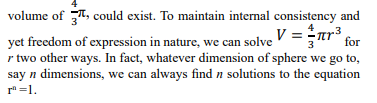
It may be well to pause here for a while and consider what these solutions mean, in the physical world.
Look, for example, at the circle, the area of which is well known as πr2. According to our strict definitions, if the area of a circle was exactly equal to π, r would have two values to satisfy the equation Area = πr2, and these would be r = +1 and r = -1. Let us look at a circle to find out what these values mean.
Here are two circles with the radii drawn in. For the positive value of r I have drawn the radii to the right and upwards, since this is the way mathematicians show a positive direction in graphs with two axes, which are normally labelled X for the direction to the right and Y for the direction upwards. Conversely, for the negative values of r the radii go to the left or downward.

Spatial dimensions are always drawn at 90º to each other; this way, there is no space of whatever dimension shared between them, thus maintaining each dimension’s independence. Just to re-state an earlier point, if these circles were real in a two-dimensional world, they would need to hold both pieces of information about the radius to properly define them.
The Simplest Structure in Three Dimension
To simplify matters, let us just fix the volume of our sphere to 4π, 3 (approximately 4.1888) so we can solve 1=r3 for the time being We have found that r3 = 1, and can rewrite it as r3 -1 = 0. For the non-mathematicians who are reading this, changing the expression into r3 -1 = 0 helps us, because we know that one solution is r = 1, and therefore r – 1 = 0, and that therefore we can factorise the expression, to find any other factors for the value 1, by dividing the expression, r3 -1, by [r-1] using the process of long division as follows:
Representations of the three Spheres
So, the prime particles of matrix matter must show as spherical as observed in a space of three dimensions plus one extra,‘partial’ dimension (or direction) with a relationship to these three dimensions that is an equivalent to the mathematicians’ concept of the square root of minus-one (or negative-one in some cultures). That does not mean that nature is some sort of mathematical construct – we must not be anthropomorphic – but only that if we modelled the universe according to strict mathematical rules, we would have to use the imaginary dimension to model the matrix matter itself and the space it exists in.
The Argand diagram, shown below, is a good way to show how the imaginary dimension is modelled mathematically. This diagram looks like an X-Y graph, except that the Y-axis is used to plot the value of the imaginary component, and the X-axis the real component, of the complex number.
If we plot these three solutions A, B and C we get this graph in the Argand diagram:
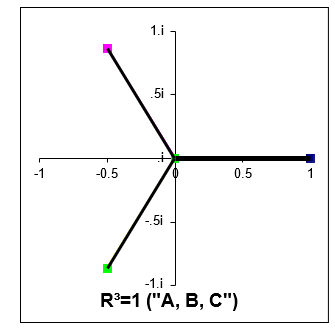
Sphere A here is shown in indigo; sphere B in magenta and sphere C in light green. The lengths of the arms are arbitrary and depend on whatever volume is accepted for the spheres, but they will always be of the same length (in my example, one).
The Fuzzy Nature of Particles
Let us go on an imaginary journey from the macro to the micro and nano. First, in the macro world, we see the object, with all its edges, textures, boundaries and volume. As we zoom in, we see the larger structures within the object, and picking up our microscope in the micro realm, its surface irregularities. Going further, into the nano realm and illuminating the object with electrons, we will see the individual atoms, often in regular patterns comprising some crystalline structure. But what appears to us to be an image of the surface of an atom is really only the high reflectivity of an atom for electrons being fired at it: there is no true surface there. We are used to any kind of material having a granularity, whereas an atom does not have anything of that kind. All atoms, of course, contain a positively charged nucleus and a negatively charged electron cloud, and these can be separated by sufficiently high temperatures or a high voltage. But what would we see if we could zoom up towards an isolated electron or proton?
This is where human understanding breaks down. While particles, we must presume, are limited in size, and such as the proton seem to be comprised of smaller units, they cannot have composite boundaries; at least, not when the smallest particles of matter such as electrons and quarks are being considered. For a boundary to exist, some type of boundary material would need to be present, and that would need to be strongly defined by the particle – which would need more than just the particle itself to be present. In effect, the most fundamental particles must be finite but unbounded. I call these fundamental particles “quasi-particles”, or “quasons” for short.
Physicists currently regard electrons and, in fact, quarks too (their name for the constituents of protons and neutrons) as “point-like”, but in fact this cannot be the case because, since they confer mass on a particle, their densities would be infinite and they would behave as black holes towards light. Also, ‘points’, which are zero-dimensioned, do not work in the three dimensions of space. All particles must have some real volume in three dimensions, and a point has zero volume.
In three dimensions and higher, the radii and volumes of quasons can be graphically represented in the Argand diagram by positions around the central point of the graph (known as the origin), as in the graphs below, each graph containing all the solutions to rn=1 where n is the number of dimensions.

String theorists have described the structure of matter as being like vibrating strings in 10 or 11 dimensions, and the above diagram on the right shows how the radii of a spherical volume in 10 dimensions would appear on the Argand diagram. The Argand diagram can also display the radii of an infinite-dimensioned hypersphere, which is interesting because it is really just a circle with a boundary comprising all of the infinite points: a continuous circle rather than discrete points. If such a sphere existed at the Big Bang, however, it would have a volume of zero, because as every serious maths student knows, the maximum size of ‘hyperspheres’ (spheres of higher dimension than 3) is reached in a dimensionality of 5, and from then on, hyperspheres get steadily smaller. The infinite dimensioned sphere would be infinitely small and not actually exist! (A bit like the zero-dimensioned point discussed earlier.)
The Physicists’ Concept of Action
The reader should read the Wikipedia article on Action, where the statements of Planck, Euler, Feynman, Lagrange, Hamilton and others can be seen. (I apologise for any missed names.). Action is a quantity of a system that includes the least path of an event that takes place in more than one place, over the many possible paths that it could have taken, and the changes a system must go through to get from one state or position to another. This principle should be kept in mind for those that study the interaction of spheres that share space, as discussed later.
Symmetry and Wave Forms
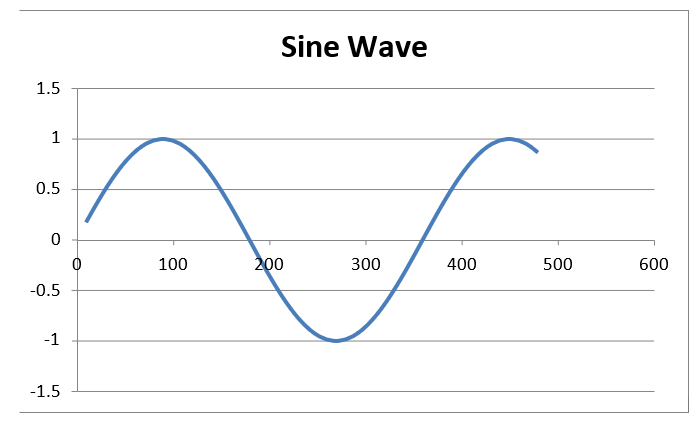
It can be seen from the Argand diagrams that the positions of the points representing volume are plotted on a circle around the origin, and circular structures are inherently linked to rotation and to a wave-like structure when the heights, or spacings, of these positions are plotted again using a linear axis representing time.
The true sine wave is smooth, whereas sequential rotations of sphere type A into B and then C will just give a series. A smooth rotation actually requires an infinite ‘number’ of points, which would need an infinite ‘number’ of dimensions. (I digress, but there is a reason for this aside!)
Wave Structures
And so it also appears in the real world, because all particles have a wave structure, which is typical for any kind of disturbance in whatever field they originate from.
It is known among physicists that photons originate from the electromagnetic field, but other particles such as electrons, while probably fundamental, also have a presence in the Higgs field which confers some mass on them. These “fields” may actually be spatial but have different orientations in the types of space that have one axis in this “hidden dimension” of i: see the forms of space described below.
All disturbances in nature come with a wave structure: even in the macro world: when someone throws a stone into water, a water wave is produced. There is a simple mathematical reason for this, which I will not discuss here, but it comes from the propagation of energy in one point causing a change that propagates into a neighbouring region and changes that region, and so on outwards. Waves are commonly seen when one particle interacts with another, whether it is a stone (or pebble) hitting water or a photon being detected in a scientific instrument. For all we know, a particle just travelling might be just that, a particle, until it meets something else.
We should remember that a particle “just travelling” is, as far as the particle’s locality goes, not moving at all: it is only moving relatively to other things, and those things which we see as stationary are moving relatively to the perspective of the particle. It is interesting, isn’t it, that waves of any shape can be resolved into one or more sine waves, where the height of the field being disturbed varies as a sine function of the time period, like y = sine(x) where y is the height of the wave part at a particular time and x is the time. Such analyses into sine waves is called the Fourier Transform, and could separate the waves in the ocean into a summation of pure sine waves if anyone wanted to. From the real world disturbance, we have a link to the circle, almost as if there were something rotating – but the question is, where? Maybe it is in the hidden dimension, in the dimension of i?
Spheres from the Complex Nature of Space
Here we have looked at the most fundamental particles and found that their “structure”, or at least their basis, lies partly in another part dimension in the “imaginary” direction; that is, involving the square root of ‘minus-one’ or ‘negative-one’. Our three basic spheres in normal space have radii:
r =1, r= -½ + ½√3.i and r = -½-½√3.i, where i=√(-1), which I have named A, B and C types as explained previously.
But this is not the only form of the base structure of matrix matter. Nature treats all dimensions equally, not to favour our anthropomorphic views on positive, negative and imaginary. It is worth repeating that all nature can do is be consistent and not to “cheat” by selecting any particular configuration to please us, but we can still “test” its consistency by following its actions with another consistent system: that of mathematical reasoning, and also logic; plus the guiding principle of nature’s freedom to express itself in a dimensionality that generates structures.
Therefore, space for matrix matter must be observable, via our mathematics, as having negative and imaginary directions as well as what we would consider “real”. This means that as well as solving for the radius, r3=1, we must solve for r3=-1, r3= i and r3= -i. This gives us three solutions for each of these three alternative forms of space, giving us a total of four forms of space each with three solutions and a total of twelve basic structures for fundamental particles. (See graphs below and the previous graph in the Argand diagram). These I have named as A, B, C, -A, -B, -C, Ai, Bi, Ci, -Ai, -Bi, -Ci.
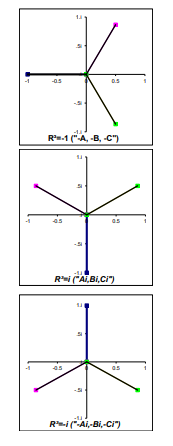
So, in principle, it is possible for composite particles to be made with any combination of these twelve. It could be a coincidence, but there are also twelve hypothesised fermions, (which include quarks) some of the fundamental building blocks of matter, known to physicists at the current time (2026). These are: up, charm, top; down, strange, bottom; electron, muon, tau; electron neutrino, muon neutrino, and tau neutrino. The twelve I discuss here contain some with negative volumes, so for example, the sphere with a volume of -1 corresponds to an antimatter version of the one with volume +1, so if antimatter particles and quarks are considered, there is not a perfect relationship with just 12 particles. But, some of the quarks that comprise some of the particles in experiments with particle colliders do seem to affect each other, resulting in particles with very short lives. Maybe it is not just their space which is reversed, but their time as well.
It is also interesting that each solution of the radii of these spheres in the four types of space is a rotation of a similar pattern. Since there is an equal probability of the A, B or C type of arrangement, the radius of any one sphere type could be regarded as a rotation of another sphere type, and rotation in a circular motion naturally generates an amplitude of either the real or imaginary value that varies according to a sine function, even though the changes are not continuous like in a true rotation, unless they can rotate through ‘unlimited’, also known as ‘infinite’ dimensions.
The Principle of Zero Volume
The question remains of how any chosen number of fundamental particles could join together to make a composite particle such as a proton – there must be some principle operating that makes a particle stable. One possible principle comes out of the initial conditions when the universe came into being, which is when space of zero dimensions and zero volume expanded into an unlimited number of dimensions, with positive and negative volumes forming. Perhaps in the formation of matter, some remnant of the initial structure is preserved, and matter particles are “trying” to reach a local zero volume again? What this really means is that, since particles do not have the ability to “try” anything, what they actually do is oscillate between the various forms of space, only to settle into the form that contains the lowest volume or requires the least Action. It is as if nature is “trying” out various configurations to reduce its impact on the principles that allowed it to form.
An Invitation to Experimenters
Back in the 1990s, I investigated the interaction of spheres as if they were solid objects with a spherical boundary. Of course, as I explained earlier, this cannot be so, but the mathematics of, say, two spheres approaching each other does not care about whether they are solid or not. The physical information they contain, which is really just a state, will control what happens when they interact. So I looked at how two spheres overlap in real space, and calculated various features as if they were solid. This is what I derived, and I must warn the reader, this calculation has not been checked, and I invite anyone capable to do so. As this author is now 77 years old, I will not try to repeat any of the work!

Spheres are shown as different sizes for illustrative purposes only.
Volume of individual overlap, V, = (pi/6).h.(h2 + 3a2) where h is the height of the lens-shaped segment,
and total volume requires calculation for h1 and h2 and summing the results
a2 = (R1.R2/d)2 – ((d2-R1 2-R22)/2d)2
These formulae produce overlap volumes with interesting values when the individual real and imaginary parts for the three spheres A, B and C are entered into the formulae and used to calculate the real and imaginary parts of the overlap volume for various separation distances of the pair of spheres. This proved to be an exercise in simple algebra in real and imaginary numbers, which could be undertaken by anyone with a GCSE A-level in Pure Mathematics. I used Lotus 1-2-3 spreadsheets, which is why the graphs I have pasted below look a little clunky!
Experimenters can apply the separation distance, d, using any of the 12 amplitude values that are present in complex 3-dimensional space, or more if they prefer. (Distances can have any dimensionality; it is only structures themselves that require three dimensions.) The amplitude of a complex number is its position on the Argand diagram around the central origin, expressed usually as a tangent of the angle anticlockwise from the X-axis.
In the illustrative cases below, the amplitude of the complex number of the overlap volumes are plotted on the Y-axis for the various separation distances on the X-axis.
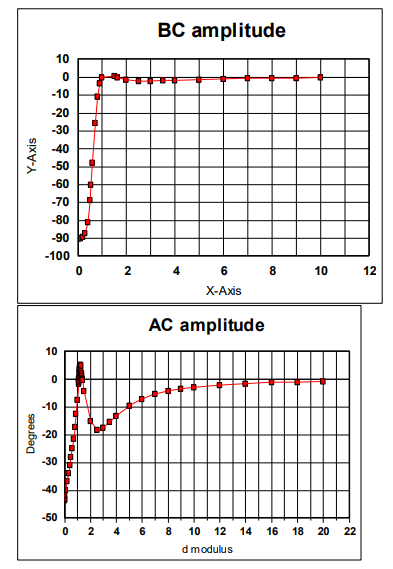
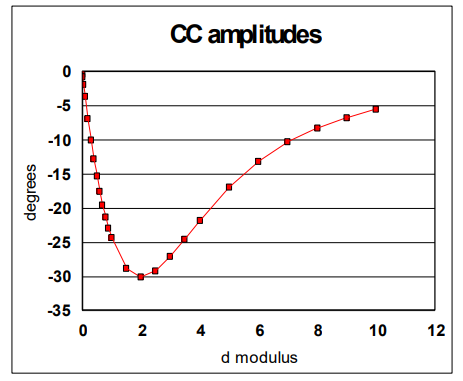
As will be observed if you do the work, the volume (not shown here) does go to zero at several distances between certain pairs of spheres. It is also conceivable to use three of the spheres to obtain a total zero volume, in case it has anything to do with the three quarks that have been observed in protons and neutrons. Note that the graph of AC in amplitude contains a sudden change, which would be a large Action and therefore unfavourable to the natural state. Large and small values for Action could explain differences in mass or the strength of fields.
That two real spheres, type A (normal spheres with no hidden dimension), produce a volume of intersection is hardly surprising, but what is more surprising is that the formula for the area of intersection produces a negative value when the spheres are far enough apart, and a negative value for the overlap also in this condition. Due to the form of the volume formula, this produces a positive value for the intersection volume, which increases the further away the spheres get. This is balanced by a negative value for spheres of type B and C. The equations and their graphs will extend the experimenter’s world into real, negative, imaginary and complex spaces, which is where just exploring the area can return interesting leads. Just remember that when we go beyond the positive, negative and complex signs of the 12 basic particles’ radii, we leave the world of three dimensions behind. So when deciding on the form of separation distance in complex space, remember that in 3-dimensional space, the distances must be a multiple of the radius, whether that radius is real or complex. So, for example, it is possible for the separation distance to become -1+â?»3i without leaving 3D space behind, since this is twice one of the radii for a sphere of volume = 1. Nevertheless, caution is advised. We will not know whether, in a universe with potentially an unlimited number of dimensions, spheres could separate over distances not in 3D space. Higher dimensions require hypervolumes for such particles. If we go back to our balloon model of the universe, with two dimensional galaxies dotted over its expanding surface, we might see some of the particle structures having hypervolumes (such as three in this two-dimensional model) and just dipping above or below the balloon’s two-dimensional surface – and then try to imagine the same happening as our 3D universe sits on an expanding 4-dimensional surface.
Looking at the graphs for dimension 3, where r3=1, -1, i and –i, we see that each radius solution occurs distributed evenly around a circle, centred on the origin, and the angle between each radius solution is 120°. Comparing the graphs for r3=1, i, -1 and –i, we see that one graph can be rotated anticlockwise by 30° to obtain another, and that all 12 radii when plotted on the same graph can be spaced out equidistantly around a circle.
Going to a dimension of 4, we will find that r4=1 has four solutions. These are each at 90º to each other, and while it is beyond me to calculate overlap volumes in four dimensions, I can see that all of the radii have no common vectors, by which I mean that unlike dimension 3, all of the radii are solely in a part of the Argand that does not share its space with the other radii. There are no complex numbers with sensible values, just pure real or imaginary numbers,so in a sense, two such hyperspheres oppose each other instead of being partially compatible. There will be some sharing when r4 = -1, i or –i where there are sixteen forms of the Argand diagram.
Nature will have a problem with the overlapped volume. To which of the two spheres does it belong? Since each sphere is a “state”, rather than an actual particle, the information content of each state will not be able to support part of space that originates from two spheres, and therefore, in some way that I admit I don’t understand, something is “lost” from the overlap volume. An alternative possibility is that the overlap volume actually creates a condition for time to exist, so that non-simultaneity occurs to relieve the condition of information overload or structure insufficiency. Since all of the spaces produced from overlapping extend far out in space, this could be the actual space that we observe between solid matters like stars, where time exists and allows light to travel.
Where does the Universe’s Energy Come From? X
It is clear from my previous argument that energy cannot have been created from nothing, any more than matter can. For there to be positive energy in the universe means there must be negative energy to balance it. The energy of the expanding universe is a combination of kinetic and thermal, and the kinetic part, relating to its motion, would have been there at the beginning, before any hydrogen fusion began. Its action was to enable gravitational attraction between matter particles to be overcome, and to allow them to separate and the universe to expand.
Kinetic energy, E, of a massive body is expressed in the equation E=½mv2, where m is the mass and v is the velocity of motion. So even if v is found to be negative (to something else positive), the kinetic energy would still be positive. But now if we understand that space can have an imaginary dimension, v2 can indeed be negative, since i2 = -1. This must mean that at least some matter in the universe is moving in the imaginary dimension – we just cannot see the motion, because we have no access to that dimension. This movement could, in principle, account for the property of mass itself, especially since the particles’ radii partially exist in the imaginary dimension.
Connection and Separation of Spaces
Two 3-dimensional spheres are still connected over the imaginary dimension as they separate, as they are always sharing a common space. This observation can be extended to a number of other forms, as long as the imaginary “hidden” dimension is included in their full physical description. It can be proven to occur in 2-dimensional circles, merely by deriving the formulas for how the area of overlap changes as the circles separate, where they can go on indefinitely until there is no apparent “real” overlap at all and the circles appear totally separate. I invite the keen student to investigate this.
It is, then, quite possible that the phenomenon of quantum entanglement, which is where two particles can share a property even when separated over large distances and communication between them appears to be faster than light, i.e. instantaneous, can be explained more easily if the hidden dimension is included in the full physical description. In other words, while two particles may become separated a long way in our normal space, they may remain quite close in the hidden dimension of i.
The separation of two spheres that are initially overlapping is an example of a continuous function, where the same mathematics exists in all positions of the spheres. This is a consequence of the limited amount of information defining the spheres: there is no surface defined and so no possibility of the mathematical function “knowing” when the two objects are separate. As I stated before, the objects are finite but unbounded. Compare this to two triangles overlapping, where each triangle requires a lot of information about their vertices and sides, or angles. If the reader has ever had to draw a triangle on a computer screen using screen coordinates, they will know what I mean. The shapes need to be defined quite narrowly to enable the computer to draw them. Therefore, there will be a sudden transition from overlapping to separation in the case of triangles.
How do we Mentally Cope with the Imaginary Dimension?
Let us very carefully consider our consciousness of our surroundings. We see our three-dimensional world through the eye-brain connection, and can follow the movements and changes in things through that, and it all makes sense according to our mental model of the world. Until! When we see a magician’s trick, we realise we are capable of being fooled, because what we see does not match up with our mental model of the world. We realise our model is imperfect, and it is because our eyesight has missed something that it needed to make the model complete.
In a similar way, when we learn about quantum theory, the actions of fundamental particles appear to be impossible according to our mental model of the world. (I advise a study of the subject.) We are missing something important, and I believe it is the hidden dimension within space and within particles.
Our mental model of the world is, I believe, created from all our senses acting together to initially write the model into our brains and keep it updated. This connection to the world through our senses is what I believe produces consciousness, so that the more conscious we are, the more the model is being updated or checked over.
The consciousness of other creatures will be different from ours, because other creatures have either different senses or enhanced or suppressed versions of our own. The mole underground in his/ her tunnels will not feel themselves to be trapped underground in a confined space because they know the layout of their tunnels and openings into the above ground, and it will fill their consciousness. Their mental model of the world will include all that. Similarly, when a famous person once asked “What is it like to be a bat?”, the answer should be that this animal creates its model of the world from its sonar echoes, as well as some light/dark observation and proprioception (sense of body position). So we humans can never experience what it is like to be a bat, nor many other creatures besides. Even our familiar domesticated dogs will have a mental map peppered with odours that they have picked up during their many stops during the walk – and as we humans know, odours have many “dimensions”, so, lots of information there.
So our own mental model of the world enables us to detect change and the motion of things by being conscious of the difference between our recently updated mental model and the one we presently perceive through our senses. There is a dissonance that our brains can use to calculate, say, the position of a ball thrown towards us, and enables us to catch the ball. But the ball is moving in three-dimensional space according to the structures present, and the light reflected off things must be limited by those three ‘ordinary’ dimensions. The extra ‘hidden’ dimension is just a derivative of those three enabled by space’s freedom of representation, and this is not, by the evidence of our visual sense, shown by light. We can never perceive the hidden dimension by our senses, but only by our intellect.
Conclusion
• Experimental Verification of the Overlap Theory
I foresee arguments coming back that this is pure speculation and is untestable (a bit like the current string theories). But the obvious test for matter particles being finite but unbounded would be to shoot them at each other at smaller and smaller separations, when I would expect there to be particles generated from the interactions of the complex volumes of the particles via the overlap volumes described earlier. These quasi-particles split space, and since there is no other way of splitting space, they will split it in a similar way to the mechanism that split space into positive and negative spaces at the point that the universe began forming. So I would expect there to be very little produced at distances much greater than the size of the particles but a lot of particles at short distances, which it may be possible to observe with a bubble- or cloud-chamber. Of course, the same effect will be observed when shooting a particle at very close distances past a stationary target, when as well as disturbing its wave function, resulting in diffraction, I would expect to see other particles being generated.
• I think that if the Large Hadron Collider gets an uprade to higher energies, all that will be observed is many more particles being created than before, as the rate of space-splitting increases, rather than those particles being the decomposition products of protons or quarks. It will be a miniature version of Creation!
• Emergence: The Whole is Greater than the Sum of its Parts
The other argument I will use is that if we are to accept that matter can only have real dimensions means that there is some human-like observer or creator that made them so, or at least sorted the complex-dimensioned particles from the everyday-dimensioned ones. I am not saying that such a Being could not have formed from the initial conditions, but it would seem necessary that the physical universe would need to exist first, unless we posit a being of pure spirit that exists because eternal truths, laws and principles exist with apparently no physical structure necessary to hold them. We have to acknowledge that these eternal truths, such as those in mathematics, geometry and the rules of logic, seem to have added to them those we have encountered in our lives, and noticed that they seem to be of value or meaning. It could be argued that the latter appear to have derived from the current shape of the universe itself, and this could be true, yet we often sense something eternal from them. So it could be possible that something so precious to us as a Divine Being could have evolved within the “place” where these rules and values exist, even while “place” is not a good word for it. (Since mathematical rules, logic and human-made laws are “of the spirit”, maybe “spirit realm” is a better name, and has been used in writing on divinity and other subjects.) If so, and allowing for sufficient complexity of eternal truths and values, and taking the principle that the whole is greater than the sum of its parts is true, this Being could have a consciousness like ours and thus be a counterpart to our existence in the matter universe. How we view this being will be dependent on our own structure, history and environment, all of them being of spiritual meaning to the individual and their culture. In terms of collective consciousness being necessary to agree that something is true, our different views of the Divine make a consensus of the nature of the divine impossible to reach. Each religion sees only part of its nature, like a person viewing a scene through a coloured filter that enhances certain colours has to admit to some of the rainbow’s wavelengths have been removed, making us insensitive to them. Each religion chooses a different coloured filter, but they do agree on one thing: that what they are observing is by its nature, Eternal.
• We all see the property of Emergence in our lives, where the whole is greater than the sum of its parts and something new, like a bicycle, forms from parts, or a society forms from a large enough number of individuals. Once formed, these emergent phenomena have an identity of their own.
• The Music of the Spheres
Accepting a natural formation of the universe appears to be necessary for us to then test the universe as a structure obeying strictly mathematical rules, geometry and the principle of freedom of the universe to evolve into consistent forms. But this does not rule out the Eternal state where no universe is necessary, and one could view the universe as being a form of self-expression of a spiritual being – a Being that is not Supernatural but entirely Natural: just not limited to the Material. The eternal values, if complex enough, could be regarded as a form of music, perhaps, and the physical world as a dance to that music?
• Last Thoughts: Why is the Universe So Big?
When space of zero volume was split into positive and negative space, it cannot have happened just once or it would be a very simple universe indeed. It happened so many times and produced so many particles that its results can only be counted in large powers of 10
• The British astrophysicist Arthur Eddington reckoned there were about 1.57 × 1079 protons in the universe, and it is now considered to be about 1080. With each proton in the commonest element hydrogen being accompanied by an electron, and each proton being formed by three ‘quarks’ (believed to be fundamental), this brings the number of the fundamental particles nearer to 1081. It is fun to speculate that a number in this region, actually a very large integer, may have some unique properties, so that when space split into positive and negative volumes, it did so via a pattern of repeated splitting via a sequence like 1, 2, 4, 8, 16, 32, and so on until a magic number was reached. Well, there are 1080 integers to explore between 1080 and 1081 if we want to look for one with interesting properties, that is (maybe?) also a power of two, but maybe that is a mystery for another time….
Colin J Cook (“Colchemy”)