

Annals of Civil Engineering and Management(ACEM)
ISSN: 3065-9779 | DOI: 10.33140/ACEM


Research Article - (2024) Volume 1, Issue 1
The Building Information Modeling (BIM) Maturity Level in the Egyptian Architecture, Engineering, and Construction (AEC) Industry
2M.Sc. Holder, Faculty of Engineering at Mataria, Helwan University, Egypt
Received Date: Sep 10, 2024 / Accepted Date: Oct 03, 2024 / Published Date: Oct 14, 2024
Copyright: ©Â©2024 Ahmed Mohamed Abdelalim, et al. This is an open-access article distributed under the terms of the Creative Commons Attribution License, which permits unrestricted use, distribution, and reproduction in any medium, provided the original author and source are credited.
Citation: Abdelalim, A. M., Haras, K. S. (2024). The Building Information Modeling Maturity Level in the Egyptian Architecture, Engineering, and Construction Industry. Ann Civ Eng Manag, 1(1), 01-19.
Abstract
This paper investigates the Maturity level of applying BIM in the Egyptian construction industry. Despite the limited researches to measure BIM maturity in the Egyptian AEC environment, this study demonstrates practical operations of BIM in Construction Projects in Egypt. A methodical frame was adopted to study the most common BIM maturity models in particular; the models were derived from literature review of relevant researches worldwide. This study concentrated on the idea of maturity not the capability. Therefore, only maturity models were considered. The Capability is on the organization scale, while maturity is concerned with the project scale. Moreover, the Macro-Level of BIM maturity model was investigated to determine the characteristics of BIM maturity in Egypt. BIM implementation inside the organizations either public or private, firms, contracting companies, projects, and the maturity of this BIM implementation, the revealed that the maturity level for the projects and even for the organizational scale is medium-low. It is clear that BIM has gained increasing acceptance and dissemination within the Egyptian AEC industry. The maturity of the BIM models that carried out for this research, the sample size, and the data gathering mobility, are the main limitations of the study. It was also concluded that Strategy for Implementation BIM inside the organizational scale in Egypt is a critical step. Organizations should have an external party as an expert in outlining the procedures that need to be performed and policies that should be implemented to build a BIM implementation plan within the organization.
Introduction
Building information modeling (BIM) has demonstrated its ability to tackle key AEC industry challenges during the last decade. Internationally, there is a growing number of standards, software solutions, research, conferences, publications, and committees devoted to BIM as a new data-driven decision culture for the whole AEC sector. Following the success stories of BIM, we can state that there is a global agreement about BIM as the future of AEC industry practice, although applying BIM is still in progress and varies by nation. BIM, as a new project management tool, is, in reality, an information management tool throughout the project life cycle, and in order to achieve this main project's objective, BIM is based on the concept that there is always one source of truth for all information among the stakeholders and throughout the life cycle of a construction project.
To begin with, the BIM implementation process is a marathon, not a sprint. This indicates that because there is a danger of faulty implementation, BIM installation takes time for each project, organization, or even industry in any country. The aim of current research is to evaluate BIM deployment in the Egyptian AEC industry. To assess the BIM implementation at the Egyptian AEC industry level for projects, organizations, and industry levels. BIM maturity is a measurement tool for BIM implementation. Starting establishing maturity models for managing the BIM implementation dated back to 2007 for capability maturity model. With the evolution of BIM, a lot of models were revealed and developed to align with the new implementation areas BIM incorporated. The importance of measuring BIM maturity is critical because BIM maturity is regarded as a benchmark tool for assessing the degree of BIM implementation on a project, in an organization, or across a region [1].
The Objectives of this Research are
• Conceptualize what is BIM maturity and the benefits achieved at a high level of BIM maturity.
• Identify the developments of international BIM maturity studies.
• Identify the current international models of BIM.
• Investigate the best fit BIM maturity models in the organization, the project, and the industry level within the Egyptian AEC industry.
Literature Review
BIM has become the ‘game changer’ for the construction industry. Recently, increasing research has been conducted to assess the maturity of BIM implementation. Through investigating the available maturity models in the previous studies, this research aims to evaluate and select the most appropriate model for evaluating BIM maturity level on the scale of projects, organizations, and the entire AEC Egyptian industry. This research will use these Key terms and concepts regarding BIM maturity [2].
A) Adoption
A single construct combines the concepts of implementation and diffusion, Implementation is considered a three-phased approach combining;
• An organization’s readiness to adopt; Organization’s capability to perform, and performance maturity.
• Point of adoption: This point separates four sequential stages of capability (i.e., pre-BIM, modeling, collaboration, and integration). It denotes the capability progress between different capability stages.
• Adoption benchmark: Applying special models and tools to assess and compare macro-BIM adoption systematically across different countries.
B) Diffusion
Diffusion represents the spread of the system/process within a population of adopters.
C) Implementation
The set of activities undertaken to prepare, deploy or improve specific deliverables (products) and their related processes:
• Readiness: The pre-implementation status represents the tendency of an organization to adopt BIM techniques, workflows, processes, and protocols. It is articulated as the level of preparation, the potential to participate, or the capacity to innovate.
• Capability of the abilities gained during the implementation of BIM tools, workflows, and protocols. It is attained through well defined evolutionary stages (object-based modeling, model based collaboration, and network-based integration) separated by many evolutionary steps.
• Maturity: The gradual and continual development in quality, repeatability, and predictability within obtainable capabilities.
D) Macro
An Organizational Scale representing large collections of organizational operating adopters within a defined national border.
E) Policy
A course or principle of actions approved or planned by a policymaker.
F) BIM Policy Development
The set of activities undertaken by a policymaker within a defined market to encourage the implementation of BIM tools, processes, and protocols.
Maturity Definitions
The Total Quality Management movement gave birth to the concept of process maturity when statistical process control (SPC) techniques were applied and it was discovered that increasing a technical process's maturity reduces inherent variability and raises the process's mean performance [3]. Being fully developed or having achieved the peak of development is the definition of maturity. Numerous scholars have attempted to define maturity through various approaches, with a few of the definitions being as follows [4].
• Maturity is "the extent to which a specific process is explicitly defined, managed, measured, controlled, and effective," according to Paulk et al. Maturity denotes the ability to expand in capabilities and shows how well-developed an organization's process is as well as how consistently it is used in projects across the whole organization.
• According to Appleby et al. an organization's maturity can be defined as "a comparative level of advancement about any given process or set of activities." Mature organizations are those that have well-defined and frequently utilized policies, standards, and procedures. 2008's PM Solutions [5].
It is clear from the aforementioned definitions of maturity that task perfection, not capability, is a prerequisite for maturity. The real results surrounding targeted results become less unpredictable as maturity increases. For example, in a young organization, there is a lot of variation and unpredictability in the delivery times of projects with comparable sizes [4].
Theoretical Framework
This theoretical framework is intended to investigate prominent approaches for evaluating BIM implementation across project, organization, and country scales.
*BIM Maturity Classifications
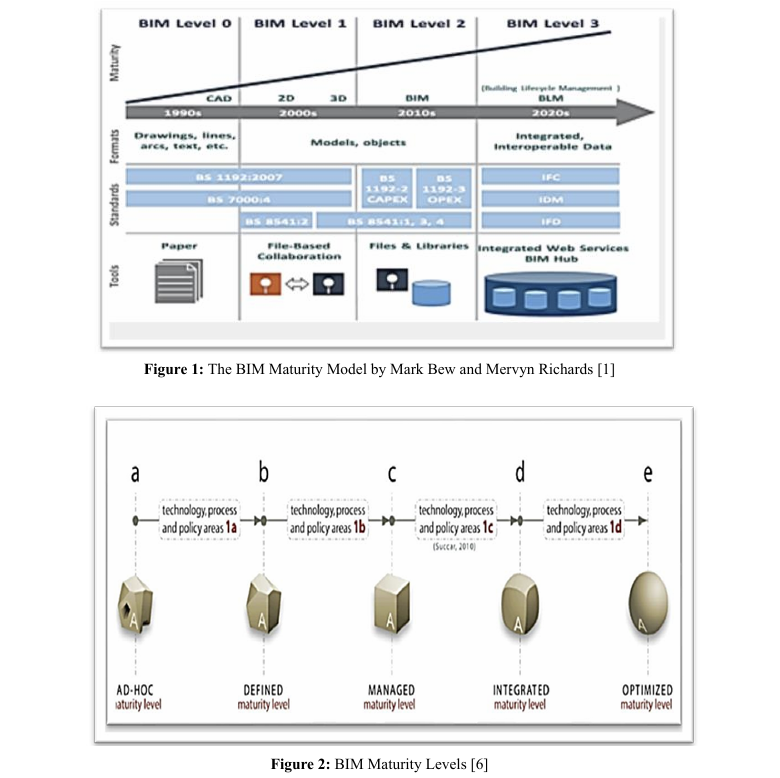
The two most common BIM maturity category levels are as follows:
• Bew-Richards’ BIM maturity levels 0, 1, 2, and 3. As shown in Figure 1.
• The Succar descriptive BIM maturity levels a; b; c; d and e as shown in Figure 2.
BIM Maturity Definition
Applied at all organizational scales, the framework outlines five basic stages of maturity: Initial, Defined, Managed, Integrated, 2.3. BIM Maturity Definition and Optimized. Levels show how maturity levels go from lower to higher and indicate; [6-10].
• Increased predictability and forecasting of achieving cost, time, and performance objectives;
• More efficacy in achieving established goals and setting new, more ambitious ones [11-14].
• Improved control as a result of fewer deviations between performance targets and actual results.
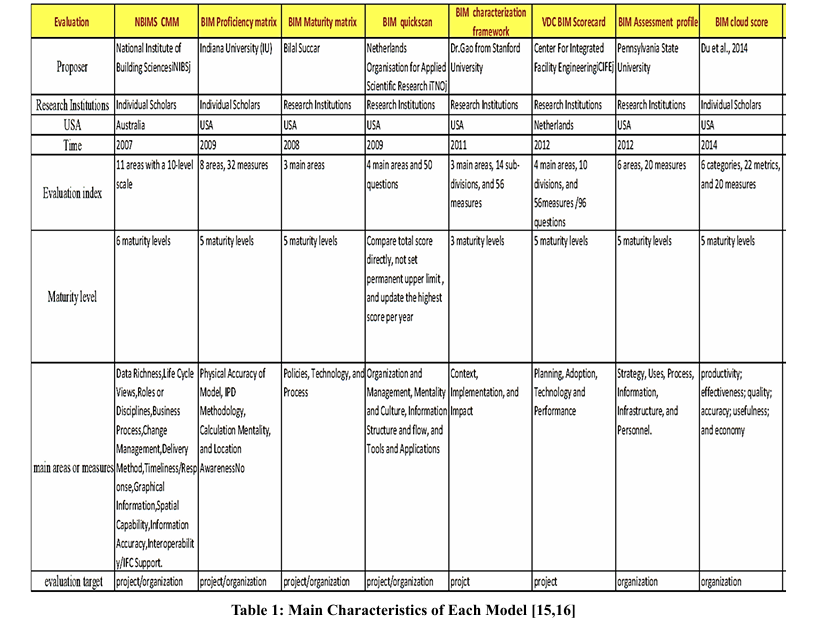
BIM Project/Organization Maturity Evaluation Models Recap
The following table 1 illustrates different maturity evaluation models.
Research Scope
This research aims to measure the BIM maturity level, (not the capability), and this is a trend in a lot of business models; building information modeling (BIM) is no exception; since adding value to any business model will be gained from the maturity of the performance attributed to this model, not capability. The aim this research is to investigate the present state of BIM in the Egyptian AEC industry. How does the Egyptian AEC industry engage with BIM as a worldwide AEC innovation; by answering the following two questions?
• What are the areas of BIM adoption the Egyptian AEC industry?
• How excellent and high-quality is this implementation?
The BIM maturity level may be utilized to study this interaction. The construction industry is project-based; evaluating projects within this industry will reflect considerably the entire status of this industry. Technology, process, policy, people, and information are the most interesting areas or maturity dimensions frequented in all the BIM maturity models. Process and information are the top two dimensions. At the organization level measuring maturity level metrics for capability stages and maturity levels are used. They can be used for pre-qualification; implementation strategy and process improvement evaluation within the organization. At the project level measuring maturity level metrics are used for performance metrics. They can be used by employers to match team capability and capacity to project requirements. At the industry-level metrics of macro maturity are used for assessment; comparisons; development of adoption policies and roadmaps. These support governments; academia and industry bodies.
Problem Statement
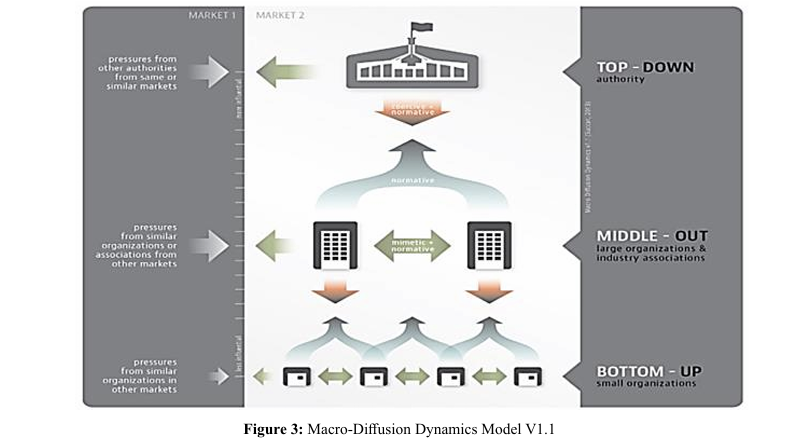
Based on the existing research on BIM dissemination in the Egyptian AEC business, it can be concluded that BIM has already spread among people and AEC firms. In this dispersion, there is no uniform standard practice; either there isn't one, or international norms are outsourced. The nature of Diffusion can be considered as market pressure and diffusion of innovation model which align with the model of BIM diffusion according to Succar, refer to Figure 3. Macro-Diffusion Dynamics model V1.1. It diffuses among small and medium-sized organizations with bottom-up middle-out mechanisms of diffusion and normative and mimetic types of pressure without top-down mechanism from the government up till now and no coercive or mimetic type of pressure [17-20]. According to the current state of BIM implementation in the Egyptian AEC industry, it is critical to assess the capability and maturity of BIM as a tool for assessing and managing BIM implementation and developing a roadmap for the next step. Both national authorities and all other parties participating in the implementation of BIM should carry out this task. A nation's BIM maturity eventually reveals what has been accomplished, what is still missing, and what can be learned from other nations. This is due to the fact that organizations are more likely to improve their organizational capabilities the more informed they are of the maturity of essential company procedures. The author's extensive research articles were revised and used in the preparation of this study to find out any relevant efforts for this concern [21-26].
Model Development
According to the brief discussion above, our area of concern in this research is measuring BIM maturity level for project and organization scale. According to the literature review and focusing on the concept of maturity three models were selected for the purpose of measuring BIM maturity:
1- BIM maturity measure model for project scale [27-30].
2- Organizational BIM assessment model for organization scale [30-32].
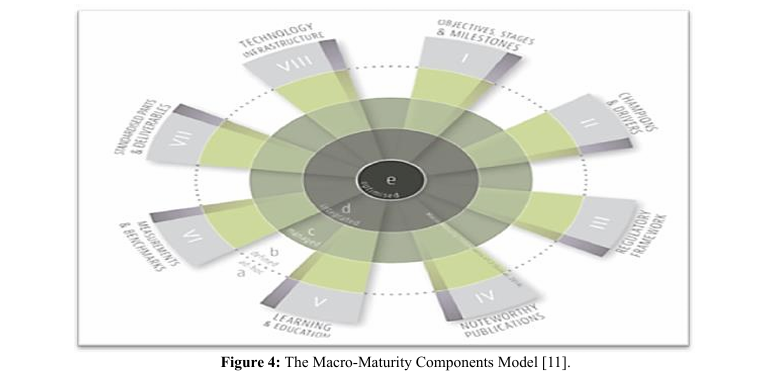
3- The Macro-Maturity Components model as shown in Figure 4.
Research Method
This study was conducted using a quantitative and qualitative method, which complement and strengthen each other. The primary goal of this research is to assess the level of BIM maturity in the Egyptian AEC industry, as well as the key areas of BIM implementation and the degree of excellence in those areas. Starting with data gathering, the study flow relies on a literature evaluation connected to BIM maturity models, with the most suited model for the project's and organization's scale. Considering Model B: macro-maturity components, which assess the common properties of BIM within a country. Two questionnaires are designed, the first one is the expert questionnaire which measures the macro-maturity components and the second one is the survey-based questionnaire which measures the organization/project scale BIM maturity. An online questionnaire was distributed targeting the selected respondents finally, statistical methods were utilized for analyzing data collected from the two questionnaires to identify the BIM maturity level quantitatively [33-37].
Data Analysis
This section aims to analyze the data gathered from two questionnaires prepared for the maturity of BIM in the Egyptian AEC industry. The objective of this research is to explore how the Egyptian AEC industry interacts with BIM technology, and measuring the maturity level of BIM will achieve this goal. Analyzing gathered data statistically is the first point to extract information about BIM maturity level in the Egyptian AEC industry [29,38-40].
Statistical Procedures for Research
In this segment, psychometric, demographic, and descriptive characteristics of the study will be executed.
*Psychometric Analysis of Study
For the two questionnaires:
• Expert Questionnaire (Macro-BIM Maturity Model)
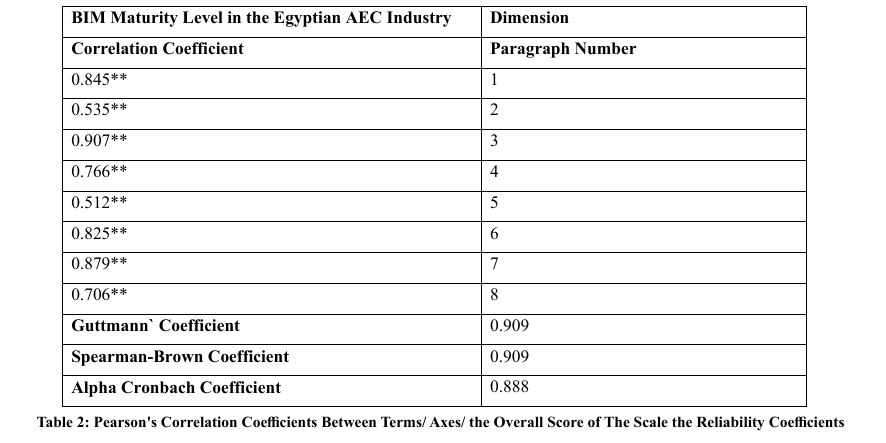
The output of the analysis is represented in the table (2). The table shows the values of internal consistency validity Pearson's correlation coefficients and the reliability coefficients of Alpha Cronbach, Spearman, and Guttmann.
• Organization/Project Model
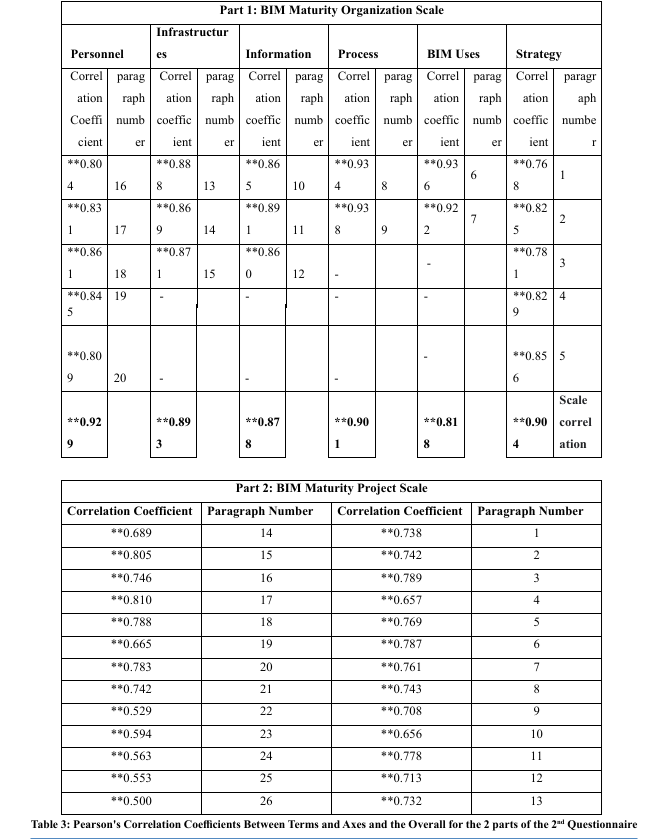
A) Internal consistency validity: As shown in the table.3 below.
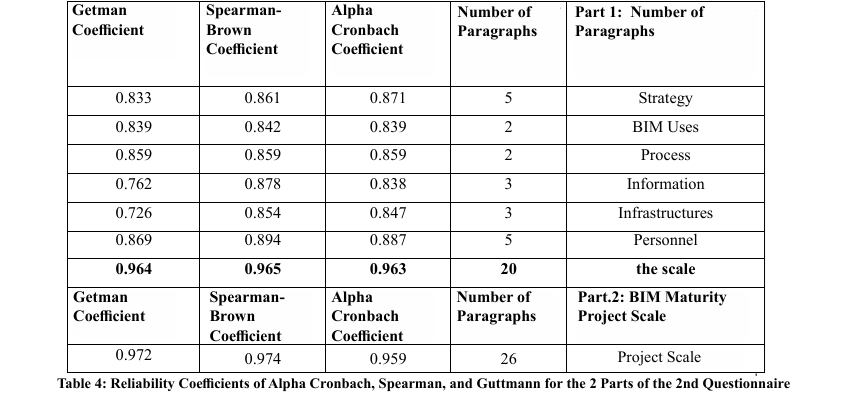
B) Scale reliability: As shown in table 4 below,
Demographic Analysis of Study
• Expert Questionnaire (Macro-BIM Maturity Model)
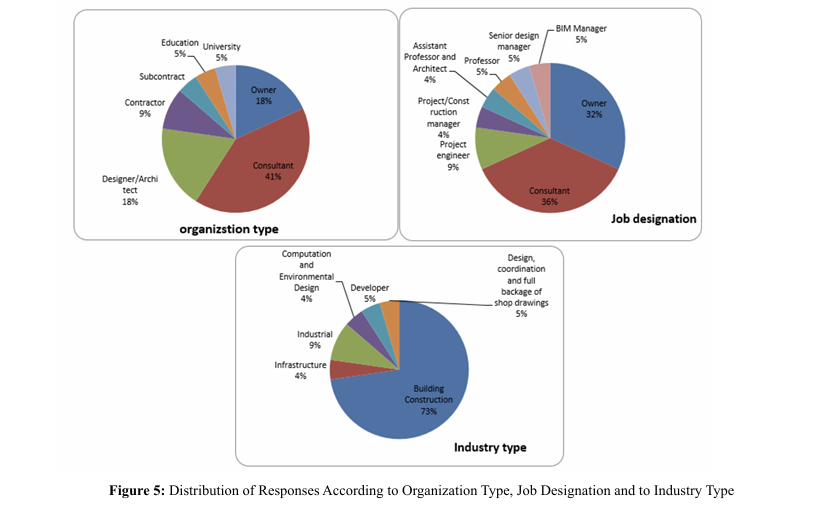
As shown in Figure 5, the Distribution of responses according to Organization type, Job designation and to Industry type are illustrated.
Survey-Based Questionnaire (Organization/Project Model)
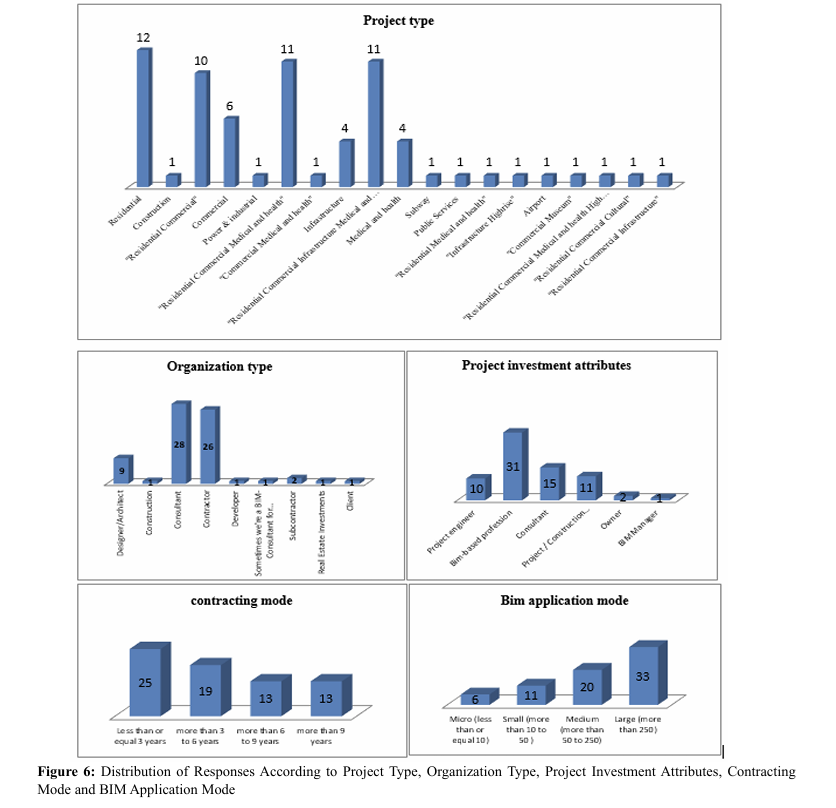
The Distributions of responses according to Project type, Organization type, Project investment attributes, contracting mode and BIM application mode are illustrated in Figure 6.
Descriptive Statistical Analysis of Study
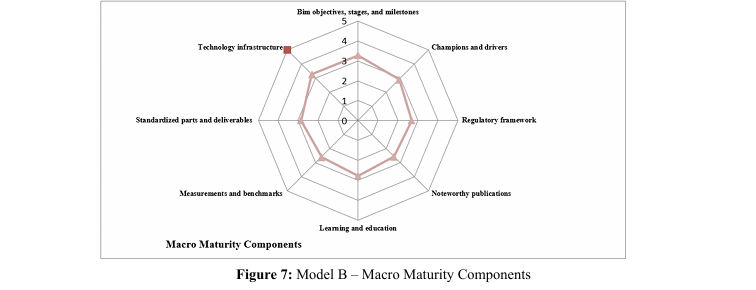
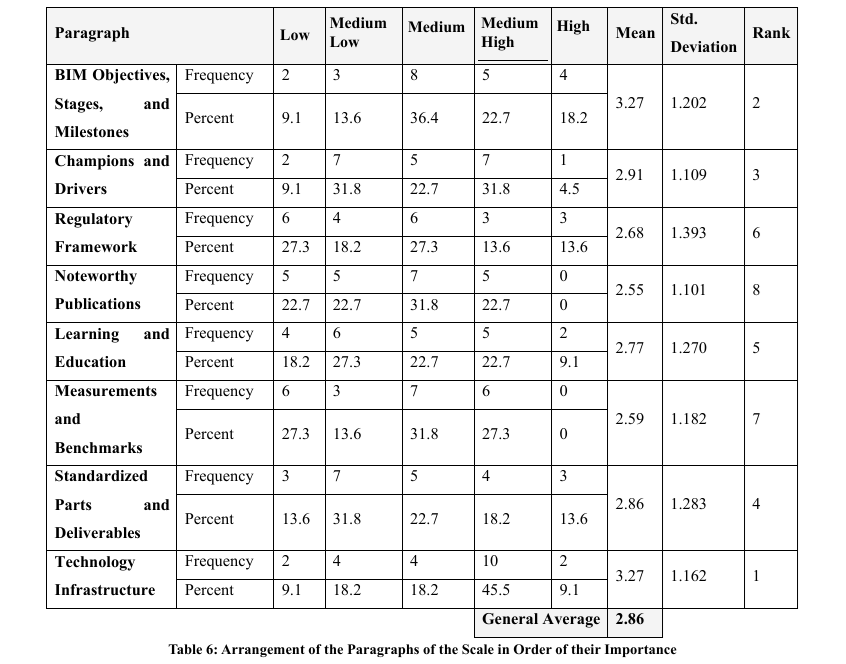
• Expert Questionnaire (Macro-BIM Maturity Model) as shown in figure 7, table 6.
Survey-Based Questionnaire (Organization/Project Model)
Part 1: BIM Maturity Organization Scale
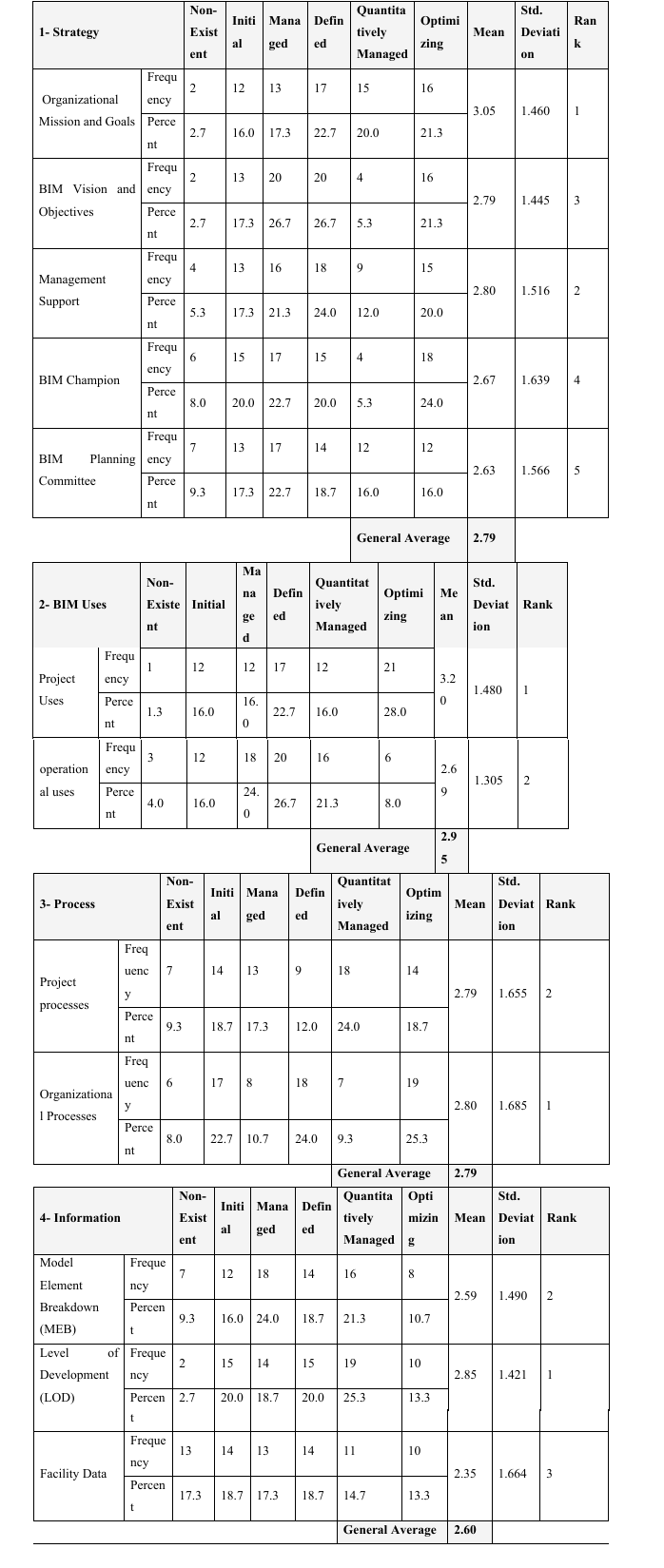
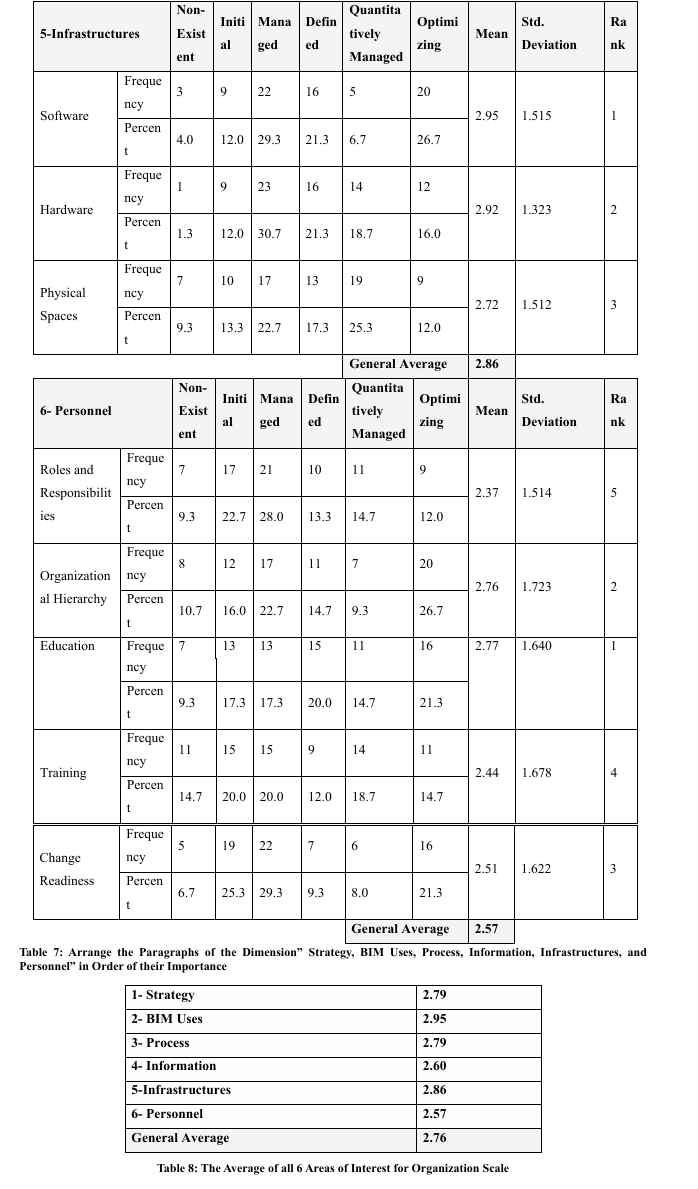
In order to develop the findings of the current study, this paper analyzed the scale item outcomes and arranged the items for each axis in the table.7 according to relative importance:
Part 2: BIM Maturity Project Scale
In order to develop the findings of the current study, this paper analyzed the scale item outcomes and arranged the items for each axis in the table.9 according to the relative importance: 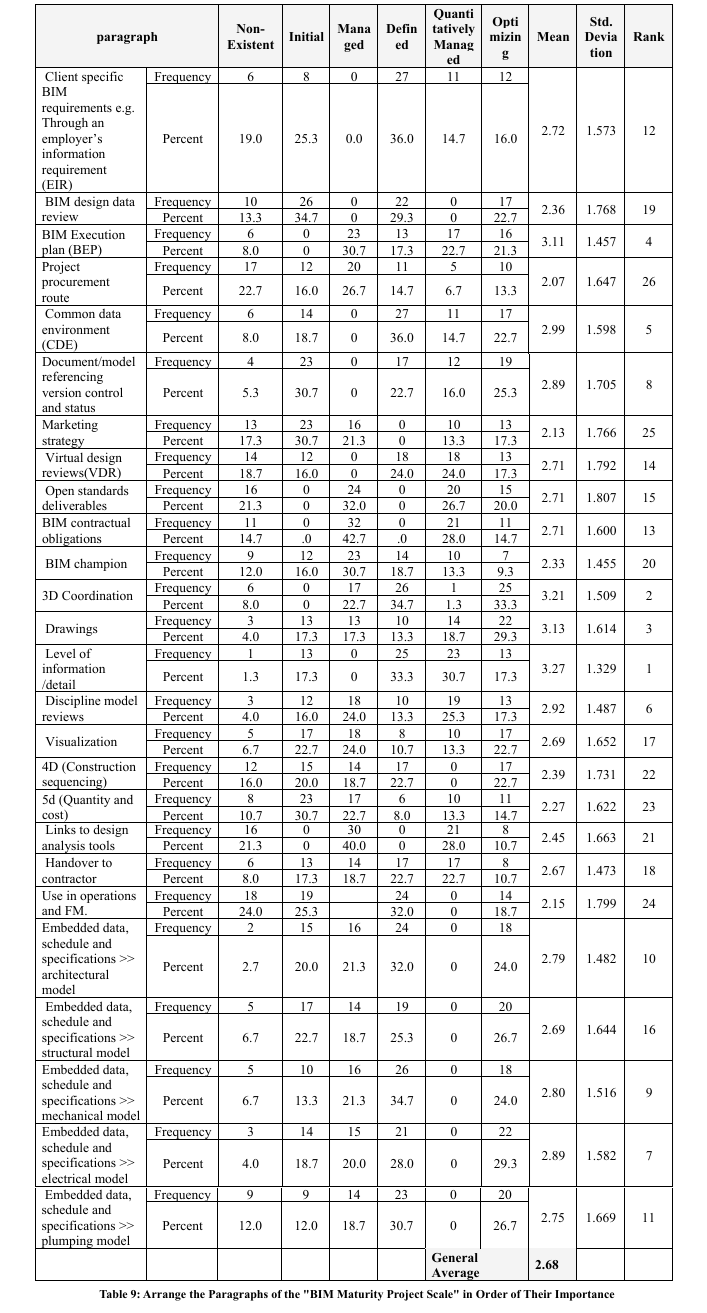
From previous results, the entire maturity level can be calculated for the project scale within the AEC Egyptian industry which equals (2.68) which considered as managed maturity or (medium-low) maturity
Discussion of Findings
Expert Questionnaire (Macro-BIM Maturity Model)
The preceding table 6 makes this evident: the last ranking (notable publications) has an arithmetic mean (2.55) and a standard deviation (1.1101), whereas the first ranking (technology infrastructure) has an arithmetic mean (3.27) and a standard deviation (1.162).
Survey-Based Questionnaire (Organization/Project Model)
Part 1: BIM Maturity Organization Scale
It can be observed from previous table 7:
• Strategy Items
i) The Organizational Mission and Goals ranking came in first place with an arithmetic mean of 3.05 and a standard deviation of 1.460, while the BIM Planning Committee rating came in last place with an arithmetic mean of 3.63 and a standard deviation of 1.566.
ii) The value falls into the medium-low range on the scale since it is evident that the dimension's overall mean has achieved its value of 2.79.
• BIM Uses Items
i) In the first ranking (Project Uses) with an arithmetic mean (3.20) and a standard deviation (1.480), in the last ranking (operational uses) with arithmetic mean (2.69) and a standard deviation (1.305).
ii) As it is clear that the general mean of the dimension reached its Value (2.95), the value is (medium-low) on the scale
• Process Items
i) The arithmetic mean of the organizational processes ranking is 2.80, with a standard deviation of 1.685. The arithmetic mean of the project processes rating is 2.79, with a standard deviation of 1.655.
ii) As it is clear that the general average of the dimension reached its Value (2.79), the value is (medium-low) on the scale
• Information Items
i) The Level of Development (LOD) ranking has an arithmetic mean of 2.85 and a standard deviation of 1.421 in the first ranking. The Facility Data ranking has an arithmetic mean of 2.35 and a standard deviation of 1.664 in the last ranking.
ii) The result falls into the medium-low range on the scale since it is evident that the dimension's overall average has achieved its value of 2.60.
• Infrastructures
i) The arithmetic mean (2.95) and standard deviation (1.515) in the first ranking (software) and the arithmetic mean (2.72) and standard deviation (1.515) in the last ranking (physical spaces) respectively
ii) The value is (medium-low) on the scale since it is evident that the dimension's overall average attained its value (2.86).
• Personnel
i) With an arithmetic mean (2.77) and a standard deviation (1.640) for Education in the first ranking, and an arithmetic mean (2.37) and standard deviation (1.514) for Roles and Responsibilities in the last ranking.
ii) The value falls into the medium-low range on the scale since it is evident that the dimension's general average has achieved its value of 2.57%.
BIM Maturity Project Scale
* The arithmetic mean (3.27) and standard deviation (1.329) for the first ranking (Level of information/detail) and the arithmetic mean (2.07) and standard deviation (1.647) for the last ranking (Project procurement route) respectively.
* Given that the dimension's overall average has evidently attained its value of 2.68, the value falls within the medium-low range of the scale.
Conclusions
The goal of this research is to investigate the current state of BIM in the Egyptian AEC industry. How the Egyptian AEC industry interacts with BIM as an innovation in the global AEC industry. Measuring the BIM maturity level can be used to investigate this interaction by answering the following two questions:
1. What are the BIM adoption areas in the Egyptian AEC industry?
2. How excellent and high-quality is this implementation?
Throughout the research chapters, from the introduction to the literature review and empirical investigation, this research clearly illustrates the BIM status quo in the entire Egyptian AEC industry for both organization and project scale on the one hand and macro BIM maturity model on the other and reflects the BIM maturity level within the AEC Egyptian industry, and it can be concluded that:
1. The maturity level for both organizations and projects in the AEC Egyptian industry is medium-low; this is an intuitive result because the maturity level of the organization is the foundation of the project level. Only when organizations have the competence of BIM planning, highly qualified BIM skill, an excellent BIM training environment, and other BIM adoption capacity could indeed they deeply use BIM in projects successfully.
2. It is evident that BIM is becoming a more widely accepted innovation in the Egyptian AEC industry based on the project scales, the sections of the organization where BIM is being implemented, and the maturity of this BIM implementation.
3. Organizations and projects are attempting to integrate BIM in many areas of their workflow; this is seen in questionnaire responses for organization and project scale for non-existent items, in general, is the lowest proportion.
4. The majority of BIM-implemented projects are owner-driven, reflecting the role of project owners in integrating BIM inside their initiatives, whether public or private.
5. Strategy for Implementation BIM inside the organizational scale is a critical step. Organizations should have an external party as an expert in outlining the procedures that need to be performed and policies that should be implemented to build a BIM implementation plan within the organization.
Recommendations
Based on the findings of this study, and to improve BIM maturity in the Egyptian AEC industry, a series of recommendations has been produced, which should be followed by all parties involved.
• Because, as described in this thesis, implementing BIM is a marathon effort rather than a sprint, starting with the classic kind of workflow and gradually transitioning to the new BIM type is recommended to avoid BIM implementation failure. And it is from this perspective that government and public sector organizations should think about implementing the BIM paradigm.
• Egypt is on its approach to integrating BIM-based technology and procedures into its thriving building industry. Based on the conclusions of this study, various areas should be prioritized to maintain this positive trend.
• Adoption of BIM on a national basis should go through three stages (readiness, capabilities, and maturity). This implies that forcing BIM use in public projects is not conceivable, and the infrastructural needs for BIM (hardware, software, internet, etc.) are not yet complete.
• Create a national council to oversee the AEC industry's digital transition. This council's main task is to easily transition the present kind of workflow in the Egyptian AEC industry to a new digital one that meets international standards.
• Encouraging manufacturers and suppliers to supply digital libraries for their BIM products to be utilized in the design and construction stages, under the supervision of the national council. And this will make BIM implementation and maturity in the Egyptian AEC industry much easier.
• Adopting worldwide BIM standards in the Egyptian AEC business would encourage foreign AEC companies who use BIM to invest in Egypt, which will improve BIM maturity overall.
• With the help of industry players, create a time frame roadmap for BIM implementation. Over time, the roadmap should incorporate the minimal BIM needs.
• It is necessary to clarify the legal ownership of collaborative digital models. Provide bidders with BIM methodologies for a cost estimate to reduce quantity fluctuation.
• During the transition between these stages, more focus should be made on BIM competency assurance.
• Invest in the company's technology infrastructure and staff training. To encourage cooperation and communication within the project team, make any necessary changes to the company's business or discipline structures.
• BIM objects for manufacturers' and suppliers' items should be provided to the design team for use in building analysis and simulation.
• Create 3D Content Libraries to Aid the Project Lifecycle Supporting the full project lifecycle will be the most potent future use of BIM. As a result, 3D BIM material that will be relevant to stakeholders from design to facilities management and replacement must be generated.
• BIM stands for Building Information Modeling. By connecting these viewpoints, we can bridge the gap between subsectors and promote interdisciplinary BIM adoption in projects.
• A multi-level framework for organization BIM maturity evaluation should be established to give a standard approach to BIM maturity assessment at the industry level. The framework should specify a wide variety of BIM abilities that are necessary, as well as measures for evaluating them. A universal framework level should apply to all disciplines in the construction industry and be adaptable to unique companies.
• The final recommendation to organizations in the construction industry is to officially standardize activities, responsibilities, processes, and procedures in light of the BIM methodologies that have been used. As a result, BIM procedures will be more reliable and consistent, and organizational learning will be faster.
References
1. Sacks, R., Eastman, C., Lee, G., & Teicholz, P. (2018). BIM handbook: A guide to building information modeling for owners, designers, engineers, contractors, and facility managers. John Wiley & Sons.
2. Kassem, M., & Succar, B. (2017). Macro BIM adoption: Comparative market analysis. Automation in construction, 81, 286-299.
3. Cooke-Davies, T. J., & Arzymanow, A. (2003). The maturity of project management in different industries: An investigation into variations between project management models. International Journal of Project Management, 21(6), 471-478.
4. Dakhil, A., Underwood, J., & Al Shawi, M. (2016, September). BIM benefits-maturity relationship awareness among UK construction clients. In Proceedings of the f irst international conference of the BIM academic forum, Glasgow, UK (pp. 13-15).
5. Yimam, A. H. (2011). Project management maturity in the construction industry of developing countries (the case of Ethiopian contractors). University of Maryland, College Park.
6. Succar, B., Sher, W., & Williams, A. (2012). Measuring BIM performance: Five metrics. Architectural Engineering and Design Management, 8(2), 120-142.
7. Kassem, M., Succar, B., & Dawood, N. (2013). A proposed approach to comparing the BIM maturity of countries. In 30th International Conference on Applications of IT in the AEC Industry.
8. Mohamed, A. E. (2019). The implementation of building information modeling (BIM) towards sustainable construction industry in Egypt" The pre-construction phase”.
9. Wu, C., Xu, B., Mao, C., & Li, X. (2017). Overview of BIM maturity measurement tools. Journal of Information Technology in Construction (ITcon), 22(3), 34-62.
10. BIAN, T. (2016). BIM implementation maturity in Chinese construction projects: evaluation model and empirical investigation.
11. Succar, B., & Kassem, M. (2015). Macro-BIM adoption: Conceptual structures. Automation in construction, 57, 64 79.
12. Abd El-Karim, M. S. B. A., Mosa El Nawawy, O. A., & Abdel-Alim, A. M. (2017). Identification and assessment of risk factors affecting construction projects. HBRC journal, 13(2), 202-216.
13. Medhat, W., Abdelkhalek, H., & Abdelalim, A. M. (2023). A comparative study of the international construction contract (FIDIC Red Book 1999) and the domestic contract in Egypt (the Administrative Law 182 for the year 2018).
14. Abd El-Hamid, S. M., Farag, S., & Abdelalim, A. M. (2023). Construction Contracts’ Pricing according to Contractual Provisions and Risk Allocation. International Journal of Civil and Structural Engineering Research ISSN, 2348 7607.
15. Yousri, E., Sayed, A. E. B., Farag, M. A., & Abdelalim, A. M. (2023). Risk identification of building construction projects in Egypt. Buildings, 13(4), 1084.
16. Awad, S., Gad, S., & Abdelalim, A. M. (2023). Critical Failure of Construction Projects and Their Remedial Actions from the Perspective of Applying Total Quality Management. International Journal of Engineering, Management and Humanities (IJEMH), 4(1), 147-167.
17. Sherif, A., & Abdelalim, A. M. (2023). Delay analysis techniques and claim assessment in construction projects. International Journal of Engineering, Management and Humanities (IJEMH), 10(2), 316-325.
18. Rizk Elimam, A. Y., Abdelkhalek, H.A, Abdelalim, A.M., 2022, “Project Risk Management during Construction Stage According to International contract (FIDIC)”, International Journal of Civil and Structural Engineering Research ISSN 2348-7607 (Online) Vol. 10, Issue 2, pp: (76-93), Month: October 2022 - March 2023, pp.76-93.
19. Hassanen, M. A. H., & Abdelalim, A. M. (2022). A proposed approach for a balanced construction contract for mega industrial projects in Egypt. International Journal of Management.
20. Hassanen, M. A. H., & Abdelalim, A. M. (2022). Risk identification and assessment of mega industrial projects in Egypt. International Journal of Management and Commerce Innovation (IJMCI), 10(1), 187-199.
21. Abdelalim, A. M. (2019). Risks Affecting the Delivery of Construction Projects in Egypt: Identifying, Assessing and Response. In Project Management and BIM for Sustainable Modern Cities: Proceedings of the 2nd GeoMEast International Congress and Exhibition on Sustainable Civil Infrastructures, Egypt 2018–The Official International Congress of the Soil-Structure Interaction Group in Egypt (SSIGE) (pp. 125-154). Springer International Publishing.
22. Khedr, R., & Abdelalim, A. M. (2021). The impact of strategic management on projects performance of construction firms in Egypt. International Journal of Management and Commerce Innovations ISSN, 2348-7585.
23. Khedr, R., & Abdelalim, A. M. (2021). Predictors for the success and survival of construction firms in Egypt. International Journal of Management and Commerce Innovations, 9(2), 192-201.
24. El Dean, S. M., & Abdelalim, A. M. (2021). A Proposed System for Prequalification of Construction Companies & Subcontractors for Projects in Egypt. International Journal of Management and Commerce Innovations, 9(2), 290-304.
25. Abdelalim, A. M., & Eldesouky, M. A. (2021). Evaluating Contracting Companies According to Quality Management System Requirements in Construction Projects. International Journal of Engineering, Management and Humanities (IJEMH) Volume, 2, 158-169.
26. Abdelalim, A. M., El Nawawy, O. A., & Bassiony, M. S. (2016). Decision supporting system for risk assessment in construction projects: AHP-simulation based. IPASJ International Journal of Computer Science (IIJCS), 4(5), 22-36.
27. Abdelalim, A. M., Khalil, E. B., & Saif, A. A. (2021). The effect of using the value engineering approach in enhancing the role of consulting firms in the construction industry in Egypt. International Journal of Advanced Research in Science, Engineering and Technology, 8(2), 16531-16539.
28. Abdelalim, A. M., & Abo. elsaud, Y. (2019). Integrating BIM-based simulation technique for sustainable building design. In Project Management and BIM for Sustainable Modern Cities: Proceedings of the 2nd GeoMEast International Congress and Exhibition on Sustainable Civil Infrastructures, Egypt 2018–The Official International Congress of the Soil-Structure Interaction Group in Egypt (SSIGE) (pp. 209-238). Springer International Publishing.
29. El-Kholy, A. M., & Abdelalim, A. M. (2016). A comparative study for fuzzy ranking methods in determining economic life of equipment. International Journal of Construction Engineering and Management, 5(2), 42-54.
30. Ali Mohamed, N., Mohammed Abdel-Alim, A., Hamdy Ghith, H., & Gamal Sherif, A. (2020). Assessment and prediction planning of RC structures using BIM technology. Engineering Research Journal, 167, 394-403.
31. Abdelalim, A. M. (2018, December). IRVQM; A Conceptual Framework for Integrating Risk, Value and Quality Management for Construction Project Management. In 2nd International Conference of Sustainable Construction & Project Management (pp. 16-18).
32. Abd-Elhamed, A., Amin, H. E., & Abdelalim, A. M. (2020). Integration of Design Optimality and Design Quality of RC buildings from the perspective of Value Engineering. International Journal of Civil and Structural Engineering Research, 8(1), 105-116.
33. Abdelalim, A. M., Elbeltagi, E., & Mekky, A. A. (2019). Factors affecting productivity and improvement in building construction sites. International journal of productivity and quality management, 27(4), 464-494.
34. Khaled Al-Barghouth, El.Samadony, A. And Abdelalim, A.M, 2016, “The Applicability of Public Private Sector Partnership (PPP) in the futuristic Reconstruction in Syria”, The Engineering Sciences Magazine- Faculty of Engineering at Mataria- Helwan University, 148(1).
35. Abdelalim, A.M., El. Samadony, A. and Alaa Al-Harouny, 2016, “Risk Assessment and Mitigation for Construction Projects in Egypt”, the International Conference of Sustainable Construction and Project Management, ICSCPM-16, 29-31March, 2016, Aswan, Egypt.
36. Abdelalim, A. M. (2018, December). IRVQM, Integrated Approach for Risk, Value and Quality Management in Construction Projects; Methodology and Practice. In the 2nd International Conference of Sustainable Construction and Project Management, Sustainable Infrastructure and Transportation for Future Cities, ICSCPM-18 (pp. 16-18).
37. Afifi, A., Elsamadony, A., & Abdelalim, A. M. (2020). Risk response planning for top risks affecting schedule and cost of mega construction projects in Egypt. International Journal of Civil and Structural Engineering Research, 8(1), 79-93.
38. Afifi, A., Elsamadony, A., & Abdelalim, A. M. (2020). A Proposed Methodology for Managing Risks in the Construction Industry in Egypt. International Journal of Civil and Structural Engineering Research, 8(1), 63-78.
39. Abdelalim, A. M., & Said, S. O. M. (2021). Dynamic labor tracking system in construction project using bim technology. Int. J. Civ. Struct. Eng. Res, 9(20).
40. Abdelalim, A. M., & Said, S. O. M. (2021). Theoretical Understanding of Indoor/Outdoor Tracking Systems in the Construction Industry. International Journal of Civil and Structural Engineering Research ISSN, 2348-7607.