

Journal of Electrical Electronics Engineering(JEEE)
ISSN: 2834-4928 | DOI: 10.33140/JEEE
Impact Factor: 1.2


Research Article - (2026) Volume 5, Issue 5
Structure Formation by Application of the Theory of Variable Speed of Light

Received Date: Sep 02, 2026 / Accepted Date: Oct 05, 2026 / Published Date: Oct 15, 2026
Copyright: ©2026 Markus Schonlinner. This is an open-access article distributed under the terms of the Creative Commons Attribution License, which permits unrestricted use, distribution, and reproduction in any medium, provided the original author and source are credited.
Citation: Schonlinner, M. (2026). Structure Formation by Application of the Theory of Variable Speed of Light. J Electrical Electron Eng, 5(5), 01-06.
Abstract
One of the greatest challenges of the Standard Model is the question of the structure formation in the early universe. From the currently widely accepted way of temporal evolution of the scale factor follows, that the structure formation by gravitational forces seems not possible without additional assumptions and only with the help of Dark Matter. The theory of variable speed of light, however, suggests a linear progression of the scale factor. This corresponds to the model of the “empty universe”. A linear evolution of the scale factor is compatible with the observations. It is investigated, which consequences a linear evolution of the scale factor has on the structure formation and this is compared to the classical derivation.
Introduction
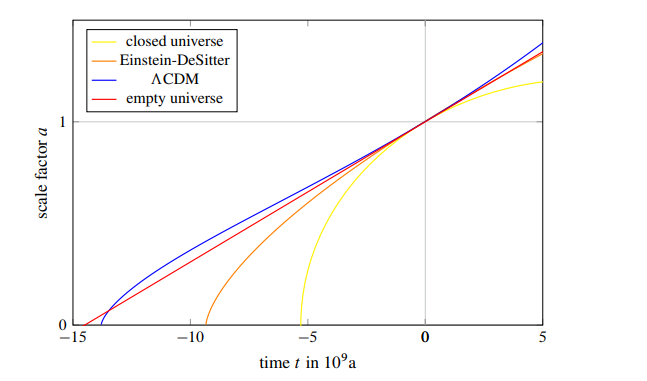
Figure 1: The Development of the Scale Factor According Different Models
For a long time, the Einstein-DeSitter-Model was commonly regarded as the best candidate of the development of the universe. This model assumes a vanishing cosmological constant ƒ and describes the limiting case of a matter density exactly sufficient for a flat, infinite space. Only the attraction of mass acts on the dynamics of the universe. The evolution of the scale factor has a positive curvature at all times and a positive slope, which approaches zero at infinite time.
But the model bears unsuperable discrepancies with measured data, because it was not possible to accommodate an age of the universe of 9 billion years with the observation of objects with an age of significantly beyond 10 billion years.
The current prevailing idea assumes a perfectly flat universe like the Einstein-DeSitter-Cosmos, but adds a cosmological constant  as a new parameter in order to fit the evolution of the scale factor to the observations. In doing so, the scale factor conspicuously converges to a linear evolution. The infinite slope at the beginning, though, is inherent to the model and cannot be resolved within the Standard Model. A linear evolution in the model of the empty universe, however, is compatible with the observations, because the earliest section of the scale factor cannot be assessed by measurement.
Classical Derivation
The classical way to describe the structure formation is done by fluid dynamics according to James Jeans [1]. He used a Newtonian model for the calculation of collapsing dust clouds. This is also appropriate for the description of density fluctuations  (t ) Dg/gin an expanding cosmos. The common derivation (e.g. Longair, chapter 11.2 [2]) leads to the following differential equation:

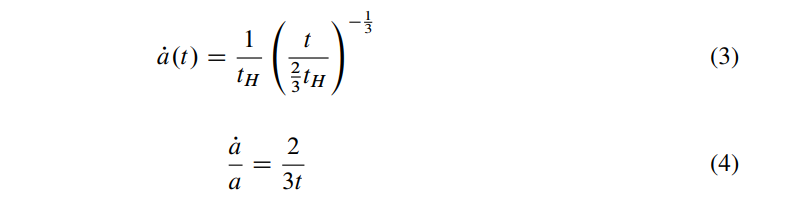
This equation is valid in general for any development of the scale factor a (t) and density gm(t). Here, k is the wave number and cs the speed of sound [2]. In the Standard Model, the scale factor of the Einstein-DeSitter-Model is taken as approximation for the initial phase of the universe:

with the Hubble-time tH and the Hubble-constant H0 = 1/tH
For the density of the universe, the critical density  is assumed. That guarantees a flat universe in the Standard Model.

This means for the density term in equation (1):

Inserted in equation (1) we get:

We choose a potential function as an approach for the solution of the differential equation:
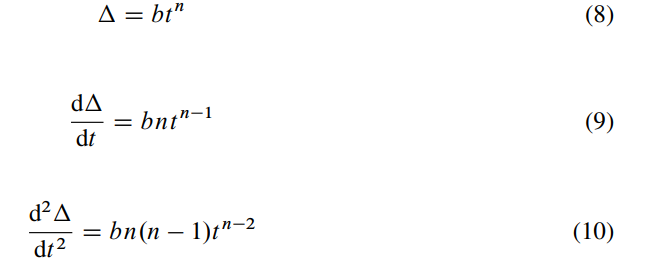
These terms now are inserted into equation (7). We take into account only large-scale solutions.
Thus, the wave number k is set to zero:

The equation can be devided by bt n—2 and resolved for the exponent n, because all terms appear with the same factor t n—2.

Hence, the growth of the density fluctuations in the Standard Model occurs essentially with the same exponent  as the expansion of the cosmos itself. As a result, both grow only linearly with time from the point of view of a local observer compared to the density itself. It is no surprise, because the dynamics of the density fluctuations is described with the same mechanisms as the expansion of the universe, whom was given exactly as much “momentum”, such that the expansion will eventually come to a standstill. Only gravitational mass attraction is assumed as retarding factor, which precisely also governs the density fluctuation. Thus, it does not develop a stronger or weaker dynamic than the expansion itself.
To accommodate the observations with the Standard Theory, a couple of ad-hoc-assumptions are made. The inflation phase remedies the horizon problem. Dark Matter fills, on one hand, the deficit in the critical mass (flatness problem). On the other hand, the structure formation can be explained as well by assumed density fluctuations of the Dark Matter. The density fluctuations of the Dark Matter could have formed already during the radiation dominated era of the cosmos, because Dark Matter does not interact with radiation. Into these preformed troughs of Dark Matter, the visible matter may also have accumulated due to the gravitational attraction after the end of the radiation dominated era. However, the direct proof of Dark Matter still is pending.
Recent observations of the James-Webb-Telescope currently bring these conceptions into difficulties, because there were found galaxies, that have developed very early very far, up to a red-shift of z = 13. This is not compatible with the Standard Model in this form at all [3].
A further difficulty could arise by the observation of rotation curves of galaxies. Indeed, the flat rotation curves measured by Vera Rubin were a main argument to introduce Dark Matter into the Standard Model [4]. In 2017, Reinhard Genzel measured rotation curves of early galaxies with high red-shift [5]. It turned out, that these distant galaxies show rotation curves with a steep velocity fall off in the outer regions. Just at the time of origin, when Dark Matter was necessary as a seed for structure formation, it seems, that no conglomeration of it was there in the galaxies.
Thus, the Big Bang Model recently is confronted with a series of surprises with the introduction of newer and significantly better observation instruments. Surely, a solution for each problem will be searched and will be found within the Standard Model. But it is no ideal situation for a theory, if new findings apparently do not fit into the current model in series and have to be patched individually. A linear evolution of the scale factor copes with the challenges far better in any case.
Structure Formation under Linear Scale Factor
The Friedmann-Lemaître-equations, which the cosmic Standard Model is based on, are mathematically consistent, but physically questionable in the authors opinion. As Robert Dicke showed in, the expansion can be interpreted in a fundamentally different way, namely as variation of the potential of the universe [6].
In doing so, it is possible to explain the red-shift of the galaxies consistently and, as elaborated in, the scale factor evolves in a linear fashion with (proper) time [7]. With that, the temporal evolution of the scale factor is decoupled from the dynamics of the attractive force of matter.
The classical derivation of equation (1) is valid for any kind of evolution of the scale factor a (t) . This is already formulated in “comoving distance” and it corresponds to the reference distance in the frame of the theory of variable speed of light. We now insert, instead of the Einstein-DeSitter-Model, a linear evolution of the scale factor:
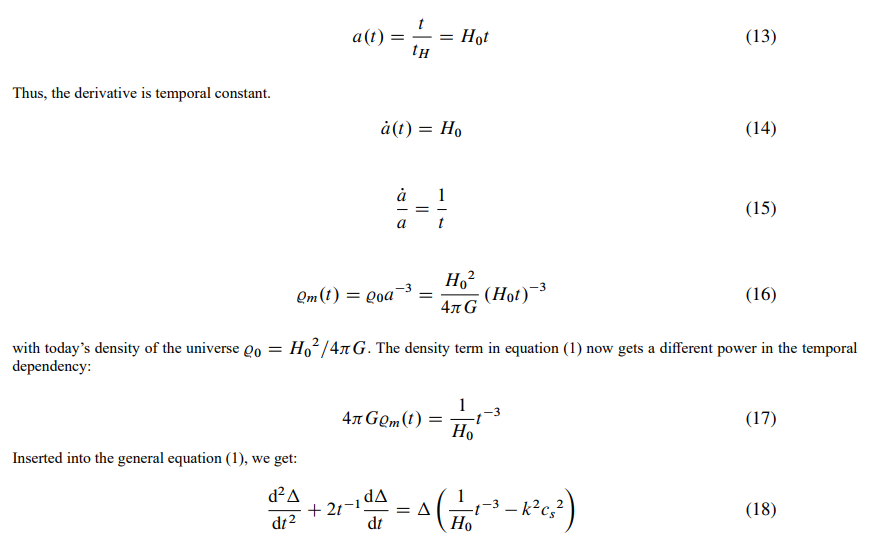
In the classical view of the “empty universe”, the right side of the equation would be zero indeed, because al linear evolution of the scale factor is only possible, if in fact no attractive forces of matter exist and, thus, no acceleration occurs. In our model, we only state, that attractive forces between matter do not affect the space geometry. Nevertheless, the scale factor can develop undisturbed linearly in spite of matter. The structure formation, however, is a different topic. Here, the mutual attraction plays a role very well. Hence, the right side of equation (18) is not zero, but contains the actual matter density
If we only consider structures significantly greater than the Jeans-wave-length, the wavenumber k can be neglected again and, thus, also the term k2c 2. We also use the classical approach with (t ) = bt n:
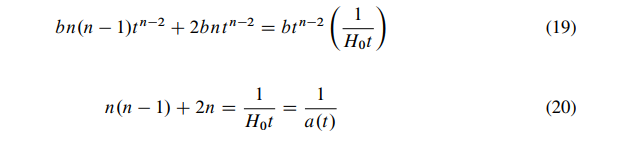
The solution of this differential equation is a little bit more complicated than in the classical case, because the powers of time are not eliminated entirely. To get a qualitative overview of the solutions, we regard the scale factor a(t) as quasi stationary. Then, there is adifferent solution of equation (20) for each point of time for the exponent n:

We only look at the positive solution n1 of this quadratic equation.

\pgfplotsset{compat=1.17, width=13cm, height=9cm, samples=100
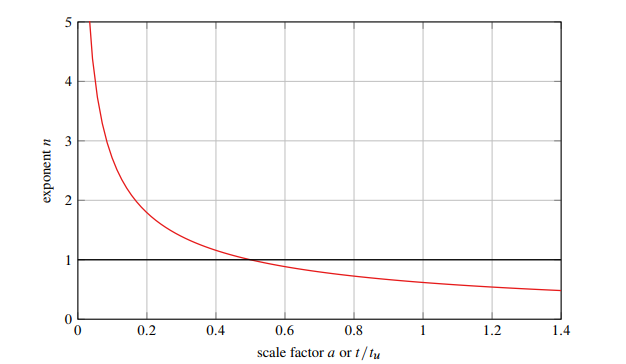
Figure 2: The Evolution of the Exponent N of the Density Fluctuations
A growth of the density fluctuation (t ) happens as long as the exponent n is greater than the exponent of the evolution of the scale factor, which is constant 1 in our model, which means, it evolves linearly with time t. Accordingly, in the early stage of the cosmos, the dynamics of the density fluctuations by far predominates the expansion. This is true, however, only after the end of the radiation dominated phase, in which the gravitation was yet surpassed by the radiation pressure.
The red-shift at the time of decoupling was about z = 1000, as we believe to know from the measurement of the micro-wave background radiation. It is linked with a time of 380000 years in the standard model. In the model of variable speed of light with its line,ar evolving scale factor, however, it is linked with a time of 14 million years. This causes according to equation (22) an exponent n ≈ 1000 ≈ 32 . From this point of time a quick structure formation started. An exponent of n = 32 surely is an upper estimation, because the transition from the radiation dominated to the matter dominated era occurred smoothly and the forces at the time of recombination, at which we assume a density fluctuation of 10—5, may have been in an equilibrium. Only since the radiation pressure has vanished to a greater extent, the gravitational forces were able to unfold their impact completely.
Over time, the exponent became smaller and the density fluctuations were damped increasingly. Today, the structure formation is completed and the structures in the universe are quasi frozen, because the expansion exceeds the forces that clump matter together.
To seize the dynamic of the arising structures more accurately, we look at the time after recombination. We assume that after the 10-fold time, distinct structures already existed. With a linearly evolving scale factor, this would mean about 140 million years after the initial begin. The latest observations of the James-Webb-telescope suggest indeed such spaces of time [3]. This means that the density fluctuations of 10—5 from the time of decoupling have grown to 1. Thus, an average exponent of n 5 is necessary to effect such a compression of the structures within this span of time. According to equation (22), this is absolutely within the expected range. The structure formation significantly looses momentum already after 1 to 2 billion years and the exponent drops below n = 2, as can be seen from figure 2.
Naturally, this is a very simplified presentation here. The description using density fluctuations actually is valid only for small deviations from the uniform distribution, neglecting the wave-number disregards the repulsive forces caused by the gas pressure at small structures etc. Nevertheless, it is possible to say, that the dimension of time spaces fits remarkably well. No special assumption or other efforts are necessary like in the Standard Model, in order to explain the fundamental evolutions in structure formation at the beginning of the universe.
Conclusion
The assumption of a linear evolution of the scale factor has significant consequences on the structure formation compared to the Standard Model. The initially steep increase of the scale factor in the early phase of the universe restricts the structure formation substantially in the Standard model. A plausible model for the structure formation is only possible with the help of many additional assumptions. With the hypothesis of a linear evolution, however, essential difficulties dissolve. Here, after the end of the radiation dominated era, gravitation predominates the expansion by far. Thus, there is an early, very dynamic structure formation. Dark Matter or Dark Energy is not necessaryReferences
- Jeans, J. H. (1901). The stability of a spherical nebula. Proceedings of the Royal Society of London, 68(442-450), 454-455.
- Longair, M. (2023). Galaxy Formation. Third Edition. Springer.
- Robertson, B. E., Tacchella, S., Johnson, B. D., Hainline, K., Whitler, L., Eisenstein, D. J., ... & Wallace, I. E. B. (2023). Identification and properties of intense star-forming galaxies at redshifts z> 10. Nature Astronomy, 7(5), 611-621.
- Rubin, V. C., Thonnard, N., & Ford Jr, W. K. (1977). Extended rotation curves of high-luminosity spiral galaxies. I-The angle between the rotation axis of the nucleus and the outer disk of NGC 3672. Astrophysical Journal, Part 2-Letters to the Editor, vol. 217, Oct. 1, p. L1-L4., 217, L1-L4.
- Genzel, R., Schreiber, N. F., Übler, H., Lang, P., Naab, T., Bender, R., ... & Wilman, D. (2017). Strongly baryon-dominated disk galaxies at the peak of galaxy formation ten billion years ago. Nature, 543(7645), 397-401.
- Dicke, R. H. (1957). Gravitation without a principle of equivalence. Reviews of Modern Physics, 29(3), 363.
- Schönlinner, M. (2026). “The Application of the Theory of Variable Speed of Light on the Universe”. In: J Electrical Electron Eng 5(5), 01–16.