

Journal of Electrical Electronics Engineering(JEEE)
ISSN: 2834-4928 | DOI: 10.33140/JEEE
Impact Factor: 1.2


Research Article - (2025) Volume 4, Issue 6
Special Relativity with Modified Relativity of Physical Laws
Received Date: Nov 03, 2025 / Accepted Date: Dec 08, 2025 / Published Date: Dec 18, 2025
Copyright: ©2025 Hyoungseok Koh. This is an open-access article distributed under the terms of the Creative Commons Attribution License, which permits unrestricted use, distribution, and reproduction in any medium, provided the original author and source are credited.
Citation: Koh, H. (2025). Special Relativity with Modified Relativity of Physical Laws. J Electrical Electron Eng, 4(6), 01-07.
Abstract
This study reveals the coexistence of observer relativity and the absoluteness of inertial frames by modifying the relativity of physical laws of special relativity into the relativity of photonic laws. Here, the relativity of photonic laws refers to light-based physical laws, including electromagnetism, optics, and electrodynamics. By combining the relativity of photonic laws with the invariance principles of rigid rulers, atomic clocks, and light, the Lorentz transformation and its inverse are derived. In this framework, the rest frame employs rigid rulers, light, and atomic clocks, whereas the constant-velocity frame relies only on light and atomic clocks. Since rigid rulers are exclusive to the rest frame, the two frames are physically distinguished. Notably, the discrepancy between the length measured by light in the constant-velocity system and that measured by a rigid ruler demonstrates the coexistence of observer relativity and the absoluteness of inertial frames. Photon round-trip experiments using light as a ruler reveal the absolute properties of inertial frames, whereas interference experiments using rigid rulers demonstrate observer relativity. This interpretation of special relativity, grounded in the relativity of photonic laws and the invariance of measuring instruments, provides a comprehensive understanding of spacetime measurement and physical laws.
Keywords
Lorentz Transformation, Relativity of Photonic Laws, Observer Relativity, Absolute Relativity, Special Relativity, Michelson Morley Experiment
Introduction
In his 1687 publication Mathematical Principles of Natural Philosophy, Isaac Newton divided time and space into absolute and relative categories. He asserted that while relative time and space are accessible to measurements, absolute time and space are not [1]. Paradoxically, the Galilean transformation and its inverse, which underpin classical mechanics, are founded on the coexistence of absolute time and relative space. However, with the advancement of electromagnetic theory, it has become evident that the Galilean transformation fails to preserve Maxwell’s equations. To overcome this limitation, H. A. Lorentz derived the Lorentz transformation, which preserve the form of the laws of electromagnetism [2]. However, Einstein reconstructed the Lorentz transformation based on two postulates: the principle of the relativity of physical laws and the invariance of the speed of light. The Lorentz transformation and its inverse appear to support only relativity between time and space. However, just as relativity and absolutism coexist in the Galilean transformation and its inverse, they can also coexist in the Lorentz transformation and its inverse.
Accordingly, this study aims to modify the relativity of physical laws and newly derive the Lorentz transformation and its inverse, in which relativity and absolutism coexist. This refers to replacing the relativity of physical laws with the relativity of photonic laws. Here, the relativity of photonic laws means that physical laws based on electric charge and light apply identically to all inertial- frame observers. Einstein extended the relativity that Lorentz had applied to electromagnetism to all physical laws. However, this paper reduces it to the photonic laws, such as electromagnetism, optics, and electrodynamics, in which the invariance of the speed of light applies. Lorentz transformations and their inverses hold because observers use light in common. Therefore, the Lorentz transformation and its inverse can be derived from the relativity of photonic laws and the invariance of the speed of light. Moreover, in the Lorentz transformation and its inverse, only the rest frame can use a rigid ruler, while the constant-velocity frame cannot. This asymmetry in measuring instruments suggests that the rest frame is presupposed within the Lorentz transformation and its inverse.
The theory in Chapter 2 reconstructs the Lorentz transformation and its inverse by applying the invariance of the rigid rod, the periodicity of the atomic clock, the invariance of the speed of light, and the relativity of photonic laws. In this framework, the rest frame uses a rigid ruler, light, and an atomic clock, whereas the constant-velocity frame uses only light and an atomic clock. Therefore, in the rest frame, the speed of light c is directly measured through the round-trip experiment of photons, but in the constant velocity frame, the concept of the coincidence in the vicinity is applied, and the speed of light measured in the rest frame is adopted. In the synchronization of atomic clocks, the rest frame achieves simultaneity using a rigid ruler and light, whereas the constant-velocity frame achieves simultaneity using lights from both the rest and inertial frames.
The Lorentz transformation and its inverse reveal the relativity of observers, but the differences in measuring instruments and synchronization demonstrate the inherent absolutism of inertial frames. Chapter 3 analyzes experiments that reveal the absolutism of inertial frames and the relativity of observers as applications of the Lorentz transformation and its inverse. Unlike in the rest frame, the photon round-trip experiment conducted in the constant-velocity frame shows different round-trip times for photons: the photon traveling perpendicular to the direction of motion returns to the origin first, followed by the photon traveling in the horizontal direction. In the Michelson–Morley experiment, although the round-trip times of photons differed in the moving frame, no interference fringes were observed. This is because the phase difference was measured using a rigid ruler. Just as wave–particle duality appears in quantum mechanics; the round-trip experiment also reveals a duality of absolutism and relativity. The photon round-trip experiment using a “light ruler” demonstrates the absolutism of inertial frames, while the wave interference experiment, which measures phase time with a rigid ruler, demonstrates the relativity of observers.
Chapter 4 presents the results derived from modifying the relativity of physical laws in special relativity. When the relativity of physical laws is restructured as the relativity of photonic laws, the Lorentz transformation and its inverse reveal the coexistence of observer relativity and the inherent absoluteness of inertial frames. Through this reconstruction, the study explains that the rest frame, which employs rigid rulers, atomic clocks, and light, is physically distinct from the constant-velocity frame that relies only on light and atomic clocks. Furthermore, it emphasizes that the photon round-trip experiment and the Michelson–Morley interference experiment are not contradictory but complementary. The former demonstrates the absoluteness of inertial frames by using light as a ruler, whereas the latter reveals observer relativity through phase differences measured with rigid rulers. Ultimately, this paper concludes that the modification of the relativity of physical laws provides an integrated understanding of special relativity, in which relativity and absolutism coexist within a single theoretical framework.
Theorey
Einstein constructed a reference frame using a rigid ruler, a clock, and light [3]. However, when constructing a moving frame, instead of relying on the physical invariance of the rigid ruler, clock, and light, he applied the relativity of physical laws and the constancy of the speed of light. Moreover, he interpreted the relativity of physical laws as the relativity of inertial frames, thereby excluding the possibility of the absoluteness of inertial frames. By comparing the measuring instruments used by observers in inertial frames, it becomes clear that it is not the relativity but rather the absoluteness of inertial frames that holds. This is because the rest frame can utilize a rigid ruler, light, and an atomic clock, whereas the constant- velocity frame cannot access a rigid ruler. If the constant-velocity frame relies only on a rigid ruler for measurement, the Galilean transformation and its inverse hold. In contrast, if an observer in the constant-velocity frame uses both light and an atomic clock, the Lorentz transformation and its inverse can be derived.
The following describes the process of constructing a rest frame by applying the physical invariance of three measuring instruments. First, the length of the rigid ruler remains constant regardless of its orientation. Second, the speed of light measured by round-trip experiments is invariant, regardless of direction [3]. Third, the periods of relatively fixed atomic clocks coincide. The coordinates of a rest point P(x, y, z, t) are measured with a rigid ruler for spatial components x, y, z, and an atomic clock for the time component t. However, as the rest observer is fixed at point P, they cannot directly measure the coordinates of the moving point P'(x, y, z, t) passing nearby. Instead, the rest observer assigns their coordinates to the moving point P'. This is called the coincidence in the vicinity [4]. By applying the coincidence in the vicinity, if the moving point P' passes through another rest observer P1(x +  x,y +y,z,t + t), then the moving point is expressed as.
P'(x+ x, y + y, z +z, t + t). (1)
The speed of light is measured using a round-trip photon experiment. If the length of a rigid ruler in the rest frame is x' and the round-trip time of light is t', the speed of light is:
c = 2x' / t'. (2)
For the speed c to remain constant, the round-trip time t' must be fixed. Thus, a frame in which remains constant is defined as the rest frame. This is known as the measurement of the speed of light using the round-trip method [4]. In contrast, in a moving frame, the round-trip time t' varies depending on the orientation of the rod; therefore, the speed of light cannot be directly measured. Hence, the frame is defined as a constant-velocity frame.
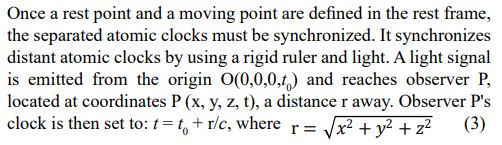
This technique is called “distance synchronization” or a light clock [5]. Equation (3) can be rewritten as:
t = t0 + r\c= t1 + r'/c (4)
This equation indicates that by adjusting the timing of the light emitted from the origin and by employing a rigid ruler, all points within the rest frame can be synchronized. When the two points Q1(x1, y1, z1, t) and Q2(x2, y2, z2, t) are synchronized, the distance measured by the light is
L = c(t2 − t1). (5)
This method of measurement is called the light ruler [5].
Among the moving points, if a point P′ moves at constant velocity and is equipped with light and an atomic clock, it constitutes an observer in the constant-velocity frame. The constant-velocity observerp'(ξ, n, ξ, τ) aligns the ξ-axis with the x-axis of the rest observer P (x, y, z, t), arranging the η- and ζ-axes to be parallel to the y- and z-axes, respectively. For the observer P' in the constant velocity frame to align with the rest frame observer using light and an atomic clock, the speed of light must be measured. Light emitted simultaneously from the rest source O(0,0,0,0) and the constant velocity source O'(0,0,0,0) arrives, after some time, simultaneously at the rest observer P (x, y, z, t) and the constant- velocity observer p'(ξ, n, ξ, τ) ). Light that departs simultaneously from the vicinity travels in straight lines and reaches observers in the vicinity simultaneously. The speed of light remains constant at c, regardless of the velocity and direction of the light. This is called the law of invariance of the speed of light due to coincidence in the vicinity [6]. In this way, although the law of invariance of the speed of light holds in inertial frames, the difference in methods of measuring the speed of light distinguishes the rest frame from the constant-velocity frame. In the rest frame, the speed of light c is measured through the round-trip experiment of photons as in Eq (2), whereas in the constant velocity frame, the speed of light c is determined based on coincidence in the vicinity. Accordingly, the law of the invariance of the instantaneous speed of light can be stated as follows: If x² + y² + z² = (ct)2, then ξ² + η² + ξ² = (cτ)2. Conversely, if ξ² + η² + ξ² = (cτ)2 then
x² + y² + z² = (ct)2. (6)
As the method of measuring the speed of light differs between rest and constant-velocity frames, the synchronization method also differs. As shown in (3), in the rest frame, atomic clocks separated in space are synchronized using rigid rulers and light. This is called synchronization of distance. However, in the constant velocity frame, rigid rulers cannot be used, so the atomic clocks in the constant velocity frame use light signals satisfying (6) to synchronize with the rest atomic clocks passing in the vicinity. This is called synchronization of vicinity.
By employing the synchronization of vicinity, the relationship between the constant-velocity observer P′(ξ, η, ς, τ) and the rest observer P(x, y, z, t) is obtained as follows. As the constant-velocity observer P′(ξ, η, ς, τ) moves with velocity v in the x-direction relative to the rest frame observer P(x, y, z, t), ξ = 0 when x = vt, i.e.,
ξ = f(v)(x−vt)(f(v) is not a function of x or t). (7)
At v = 0, ξ = x, and the relation f(0) = 1.
Furthermore, as the η- and ς-axes of the constant-velocity observer P′(ξ, η, ς, τ) are perpendicular to the direction of motion, they are independent of time but depend on the relative velocity v.
Therefore, the following relations hold between the coordinates: η = m(v)y (m (0) = 1). (8)
Similarly,
ς = m(v)z, (m (0) = 1). (9)
The rest observer P and the constant-velocity observer P′ both possess light and atomic clocks. Both observers P and P′ measure time and distance using a light source and an atomic clock that are at rest relative to each of them. Just as the rest observer claims that the constant-velocity observer is moving relative to his own light source, the constant-velocity observer also claims that the rest observer is moving in the opposite direction relative to his own light source. In other words, by using light in common, each observer applies the relativity of photonic laws. Here, the relativity of photonic laws means that in an inertial frame, light-based physical laws—including optics, electromagnetism and electrodynamics, which use light to measure time and space—retain the same form regardless of the coordinate frame. The relativity of photonic laws is different from the relativity of physical laws that Einstein asserted. The relativity of photonic laws means that the rest frame and the constant-velocity frame can be distinguished, but when light is used, the rest observer and the constant-velocity observer cannot be distinguished.
According to the relativity of photonic laws, the constant-velocity observer P′(ξ, η, ς, τ)observes the rest observer P(x, y, z, t) moving with velocity -w along the ξ-axis. Thus, the relation is given by[6]
x = g(−w)(ξ + wτ)[6]. (10)
Because the y- and z-axes of the rest observer P(x, y, z, t) are perpendicular to the direction of motion, they are independent of time but depend on the relative velocity w.
Therefore, the following relations hold between the coordinates
y =n(-w)η, (n (0) = 1). (11)
Similarly,
z = n(-w)ζ, (n (0) = 1). (12)
Linearity and the invariance of the speed of light apply between the coordinates of the constant-velocity observer P′(ξ, η, ς, τ) and those of the rest observer P(x, y, z, t), so they can be determined step by step.
First, due to the relativity of photonic laws, we measure the η and ξ coordinate of the constant-velocity observer P′(ξ, η, ς, τ).
From (8) and (11), we derive m(v)n(-w) = 1 (where m(0) = n(0) = 1):
If m(v) > n(-w) or n(-w) < m(v), the relationship m(0) = n(0) = 1 cannot be applied [6].
Thus,
m(v) = = 1, i.e., η = y. (13)
Similarly, from (9) and (12), we have
ξ = z. (14)
As shown in (13) and (14), the axes perpendicular to the direction of motion in a constant-velocity frame show agreement between the coordinates measured by rigid rulers and light. Even in a constant-velocity frame, planes perpendicular to the direction of motion allow for distance synchronization. This is referred to as the synchronization of the perpendicular planes [7].
Second, based on the invariance of the speed of light, we determine the coordinate of the ξ-axis, which is parallel to the direction of motion, and the time coordinate.
From Eq. (6), when x = ct, ξ = cτ holds, and conversely, when ξ = cτ, x = ct also holds. From Eqs. (7) and (10), cτ = f(v)(c - v)t, and ct = g(-w)(c + w)τ. Therefore,
c² = f(v)g(-w)(c - v)(c + w). (15)
Similarly, when x = -ct, ξ = -cτ', and when ξ = -cτ', x = -ct. From Eqs. (7) and (10), -cτ' = f(v)(-c - v)t, and -ct = g(-w)(-c + w)τ'Thus,
c² = f(v)g(-w)(c + v)(c - w). (16)
From Eqs. (15) and (16), it follows that
v = w. (17)
From Eqs. (7), (10), and (17), ξ = f(v)(x - vt), and
x = g(-v)(ξ + vτ). (18)
From Eqs. (16) and (17), f(v)g(-v) = c² / (c² - v²), where f(0) = g(0) = 1. In this case, if
f(v) > g(-v), then f(v) > 1, and the relation f(0) = 1 no longer holds (19)
Similarly, if
f(v) < g(-v), then f(v) < 1, and the relation f(0) = 1 no longer holds. (20)
From Eqs. (19) and (20), we have
f(v) = g(-v). (21)
From Eqs. (19) and (21),

Substituting Eq. (22) into Eqs. (7) and (10), we obtain ξ = k(x - vt), and x = k(ξ + vτ). Therefore, these relations can be rearranged as follows:
τ = k(t - vx / c²), and t = k(τ + vξ / c²). (23)
From (13), (14) and (23), the Lorentz transformation is expressed as follows:
ξ =k(x − vt), η = y, ζ = z, and τ =k (t-vx/c2). (24)
Accordingly, the inverse Lorentz transformation is given by:
x = k (ξ + vτ), y = η, z = ζ, and t = k (τ + vξ/c²). (25)
By comparing (24) and (25), we observe that the Lorentz transformation and its inverse satisfy the relativity of the observer. This means that the relativity of the observer holds due to the relativity of photonic laws. However, Einstein not only regarded the relativity of physical laws as the relativity between inertial frames, but also failed to specify the conditions under which such relativity between inertial frames holds. For the relativity between inertial frames to be valid, the rulers and clocks used by observers must be identical. In the principle of special relativity, both the rest observer and the constant-velocity observer commonly use light, but the rigid ruler is used only in the rest frame.
When the constant-velocity observer utilizes both the light ruler and the rigid ruler in the Lorentz transformation, the coordinates along the direction of motion differ. The following equation holds:
ξ = k x − vt = κx' (x' is the length measured with a rigid ruler). (26)
This indicates that the coordinate ξ measured with a light ruler is k times longer than x′ measured with a rigid ruler [8]. In the rest frame, the length measured using a rigid ruler and a light ruler always coincides. However, in a constant-velocity frame, the lengths measured using a rigid ruler and light ruler differ along the motion axis. However, Einstein believed in the relativity of inertial frames, so he thought that the lengths measured with a rigid ruler and a light ruler in a constant velocity frame are the same [9]. However, the rest frame and the constant-velocity frame are absolutely distinguished. This indicates not the relativity of inertial frames, but the absoluteness of inertial frames.
Applications
As examined in Chapter 2, the Lorentz transformation and its inverse reflect both the relativity of the observer and the absoluteness of the inertial frame. When analyzing the Lorentz transformation and its inverse, both the relativity of photonic laws applied through the use of light and the stationary system defined by the use of rigid rulers must be considered together. Thus, when measuring the distance in an inertial frame, it is necessary to distinguish between using a light ruler and a rigid ruler (where a light ruler calculates the distance by multiplying the time light travels by the speed of light). In the constant-velocity frame, a photon round-trip experiment is conducted: one beam of photons travels perpendicular to the direction of motion, whereas the other travels parallel to it. At a distance of from the origin, mirrors were placed along a rigid rod in each direction to reflect the light beams back to the origin. In the first photon round-trip experiment, a device was installed to measure the time required for the photons to return from both directions. In the second wave interference experiment, a device was installed to measure the interference patterns caused by waves returning from two directions.
First, in the photon round-trip experiment, the time difference between the photons traveling back and forth in the two directions was measured.
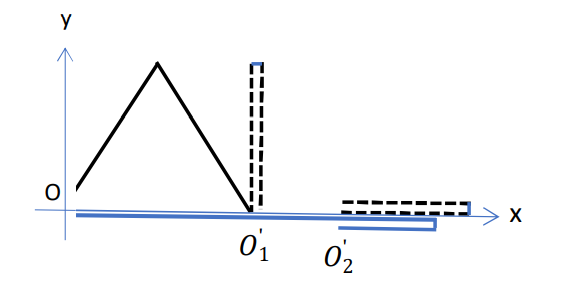
Figure 1: The round-trip experiment of photons conducted in a constant velocity frame is shown on the xy-plane. Light is emitted simultaneously in two directions from the light source O' of the constant velocity frame.The light reflects off mirrors located at a distance x′ and returns to the light source O'1 and O' 2, where the return times are measured.
Figure 1 schematically depicts the round-trip photon experiment. As observed from the rest frame, the photon traveling in the direction perpendicular to the motion from the origin O′ of the inertial frame takes kx′/c to reach the mirror and kx′/c to return to O1' , resulting in a total round-trip time of
2kx′/c. (27)
As seen from the constant-velocity frame, the photon traveling perpendicular to the direction of motion takes x′/c to reach the mirror and x′/c to return resulting in a total round-trip time of
2x′/c. (28)
Moreover, from the viewpoint of the rest frame, the photon traveling parallel to the direction of motion takes t1 = x′/(c − v) to reach the mirror and t2 = x′/(c + v) to return to the origin, giving a round-trip time of
t3= 2k2x′/c. (29)
From the viewpoint of the constant-velocity frame, according to (24), the time taken for the photon to reach the mirror is τ = kx'/c and to return to O'2 is τ2 = kx'/c, resulting in a round-trip time of
τ3 = 2kx′/c. (30)
In the inertial frame, the round-trip photon experiment shows that, based on (28) and (30), the light traveling perpendicular to the direction of motion enters first at time 2x'/c, and the light traveling in the horizontal direction enters later at
2kx' /c. (31)
Thus, the inertial observer recognizes that light traveling perpendicular to the direction of motion enters first, followed by light traveling along the direction of motion. However, as measured in the rest frame, both the vertically and horizontally traveling light beams arrive at time
t = 2x′/c. (32)
When performing the round-trip photon experiment in inertial frames, a light ruler is used, allowing distinction between the rest frame and the constant-velocity frame. However, Einstein not only adopted the principle of the relativity of physical laws as an axiom but also interpreted it as the relativity of inertial frames, avoiding any attempt to experimentally distinguish between the rest and inertial frames [10].
Second, in the Michelson–Morley interference experiment, the interference fringes produced by two wave fronts sent in different directions were measured. The decisive experiment that led to the abandonment of the absolutism of classical mechanics and the emergence of the relativity of photonic laws was the Michelson- Morley experiment. However, no physical experiment has been more widely misinterpreted than this interference experiment. An error was made in calculating the distance traveled by the wave from the source, reflected, and returning to the source.
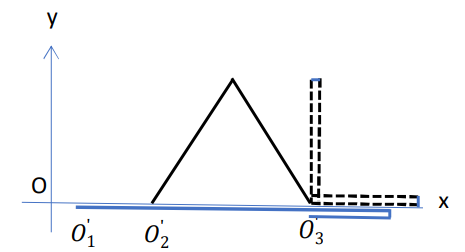
Figure 2: The wave emitted from the source O'1 , moving parallel to the direction of motion, enters the source O' 3after 2kx′/c, and the wave emitted from the source O'2 , moving perpendicular to the direction of motion, enters the same point O' after 2x′/c
Figure 2 schematically illustrates the Michelson-Morley interference experiment. A wave emitted in the horizontal direction from the inertial source O'1 and another wave emitted in the vertical direction from source O'2 are reflected by mirrors, and both arrive at the common source O'3 . If this were a photon round-trip experiment, then, according to (24), the light traveling horizontally would cover a total distance of 2kx′, and the light traveling vertically would move 2x', which should create an interference pattern. However, despite the path differences, no interference patterns were observed.
To explain this result, FitzGerald and Lorentz proposed the theory of contraction in the direction of motion, the FitzGerald-Lorentz contraction [11]. However, it is not the object moving at a constant velocity that contracts itself, but rather the distance traveled by light is contracted, resulting in time dilation. Therefore, there was no physically plausible basis for these results. Einstein did not comment directly on this interference experiment but interpreted the absence of interference as a consequence of the principle of relativity [12]. As seen in the round-trip photon experiment, the presence of a time difference between the two paths confirmed the absoluteness of the inertial frame. Therefore, Einstein’s interpretation of the absence of interference fringes resulting from the relativity of inertial frames is unconvincing.
The reason for the absence of interference fringes in the Michelson–Morley experiment is that the distance traveled by the wave from the source must be measured using a rigid ruler. If the wave emitted from the inertial source travels vertically and arrives after a round-trip time of 2x′/c, then the wave’s phase is
τ′1 = 2x′/c − 2x′/c = 0. (33)
Similarly, if the wave traveling horizontally from the same source arrives after a round-trip time of 2kx′/c, its phase is
τ2' = 2kx′/c − 2x′/c. (34)
When both waves arrive simultaneously at O'3(0,0,0,τ) in the constant-velocity frame, their phases are both
τ′ = τ − 2x′/c, rendering them identical. (35)
Thus, the distances traveled by the reflected waves returning to the common source O' are consistently interpreted as 2x′ when measured with a rigid ruler.
Although the photon round-trip and wave interference experiments appear similar, they yield completely different results. In the photon round-trip experiment, differences arise in the travel times of the photons because the distance from the inertial photon source to the photon is measured using a light ruler (Lorentz transformation). In contrast, in the wave interference experiment, the distances from the inertial wave source to the wave are measured using a rigid ruler; therefore, no phase differences occur. Consequently, in the inertial frame, the photon round-trip experiment—relying on the light ruler—serves as an experimental demonstration of the absoluteness of inertial frames. In contrast, the Michelson– Morley experiment—employing the rigid ruler—demonstrates the relativity of the observer. These findings suggest the need to reconstruct the special theory of relativity on a revised foundation in which relativity and absoluteness coexist.
Conclusion
This study began with the following fundamental question: Why does modern physics interpret the Lorentz transformation solely within the framework of relativity while overlooking any element of absolutism inherent within it? To address this issue, the Lorentz transformation and its inverse were reconstructed on the basis of the invariance of the length of a rigid rod, the periodicity of atomic clocks, and the invariance of the speed of light. By modifying the relativity of physical laws into the relativity of photonic laws, this study demonstrates that observer relativity and the absoluteness of inertial frames can coexist simultaneously.
A central finding was that the rest and constant-velocity frames were not physically equivalent. The rest frame allowed the use of rigid rulers and synchronization of distance, whereas the constant- velocity frame was limited to synchronization of vicinity using light. This measurement asymmetry revealed an overlooked form of the physical absoluteness embedded in the Lorentz framework. This theoretical distinction was confirmed by two contrasting experimental applications. The photon round-trip experiment supported frame-dependent absoluteness by revealing the time differences in the return paths of light. In contrast, the Michelson– Morley interference experiment, relying on rigid rulers, exhibited observer-based relativity. These results were not contradictory but rather complementary, reflecting fundamentally different measurement methodologies.
Although this study was confined to flat spacetime, future research should explore how the concept of absolute relativity may extend to general relativity. In particular, it raises important questions regarding the existence of rest frames in gravitational fields and the nature of simultaneity in curved spacetime. These directions offer promising grounds for continued theoretical developments.
Data Statement
This paper does not use any experimental data
Acknowledgements
Author Contributions
The author formulated the conceptual system work, conducted the theoretical analysis, and synthesized relevant literature. AI assistance was limited to ensuring linguistic precision, standardizing terminology, and verifying the logical coherence of new ideas
Financial Declaration
The author did not receive support from any organization for the submitted work.
Declarations
The author declares no conflict of interest. All findings and interpretations presented in this work are derived independently, without any external influence that could bias the conclusions.
References
- Newton, I., Cohen, I. B., & Whitman, A. (1999). The Principia: mathematical principles of natural philosophy. Univ of California Press.
- Lorentz, H. A. (1937). Electromagnetic phenomena in a system moving with any velocity smaller than that of light. In Collected Papers: Volume V (pp. 172-197). Dordrecht: Springer Netherlands.
- Einstein, A. (1905). On the electrodynamics of moving bodies.
- Koh, H. (2023). Coexistence of relativity between observers and the absoluteness of inertial frames. J. Electronics. Electron. Eng. 2, 33.
- Koh, H. (2023). Special relativity and absoluteness. J. Electronics. Electron. Eng. 2, 452.
- Koh, H. (2023). Coexistence of relativity between observers and the absoluteness of inertial frames. J. Electronics. Electron. Eng. 2, 35.
- Koh, H. (2023). Coexistence of relativity between observers and the absoluteness of inertial frames. J. Electronics. Electron. Eng. 2, 37.
- Koh, H. (2023). Coexistence of relativity between observers and the absoluteness of inertial frames. J. Electronics. Electron. Eng. 2, 36.
- Einstein, A. (1925). On the electrodynamics of moving bodies. In: The Collected Papers of Albert Einstein, vol. 2, Doc. 23, p.149. Princeton University Press, Princeton.
- Einstein, A. (1905). On the electrodynamics of moving bodies. In: The Collected Papers of Albert Einstein, vol. 2, Doc. 23, p.140. Princeton University Press, Princeton.
- Lorentz, H. A. (1952). The Principle of Relativity. Dover Publications, New York, p. 229.
- Einstein, A. (2020). Relativity: The Special and the General Theory. Princeton. Princeton University Press, p. 45.