

Current Trends in Mass Communication(CTMC)
ISSN: 2993-8678 | DOI: 10.33140/CTMC



Research Article - (2024) Volume 3, Issue 1
Research on Mobile Seva Services of the Electronic Government in India: A Qualitative and Quantitative Approach
Received Date: Nov 21, 2023 / Accepted Date: Dec 11, 2024 / Published Date: Jan 19, 2024
Copyright: ©Ã?©2024 Dr.V. Thangavel. This is an open-access article distributed under the terms of the Creative Commons Attribution License, which permits unrestricted use, distribution, and reproduction in any medium, provided the original author and source are credited.
Citation: Thangavel, V., (2024). Research on Mobile Seva Services of the Electronic Government in India: A Qualitative and Quantitative Approach. Curr Trends Mass Comm, 3(1), 01-14.
Abstract
In emerging nations like India, the use of mobile devices is booming. There have been several recent advancements and studies in this field. These days, mobile is turning into a crucial ICT tool for both urban and rural areas, as well as remote ones. The smartphone is a suitable and flexible instrument to close the digital gap because of its simplicity of use, quick technological advancements, and declining device costs. The number of Indians owning mobile phones is rising quickly, in 2023, 606.57 million users in India, and there were 467.0 million social media users included, or 32.8 percent of the country's total population. In early 2023, there were 1.10 billion active mobile phone connections in India, which translates to 77.0 percent of the country's total population. An innovative program called Mobile Seva seeks to mainstream mobile governance, or m-Governance, throughout the nation. It offers a unified platform to all Indian government departments and organizations so that services may be easily delivered to residents and businesses via mobile devices. By utilizing the creative potential of mobile applications in the delivery of public services, it seeks to increase the reach and accessibility of diverse public services to the stakeholders. The primary focus of this article was the public's access to e-government services offered by state and federal governments, ranging from health and childcare to education, research, and up to pension plans. The base of citation methodologies has been adopted in this research output. To highlight the numerous output facilities available to agriculture for education through voice messaging systems and access through government apps made possible by NIC, this study has combined qualitative and quantitative techniques. Many of the facilities have been utilized by the public all around the nation. This kind of facility is highly applied by the many government authorities from various countries.
Keywords
E-Government, Web Portal, E-Services, Mobile Seva, Open Data, Digi Locker and E-Sampada.
Introduction
A. E-Government to Mobile Governance: E-Government has become a global phenomenon for the delivery of government services. However, in terms of actual implementation, e-governance is limited to using computer-based internet access to provide citizen services. There are concerns that the adoption of e-government may be constrained in nations like India where computer and internet usage is still relatively low. Due to the limited reach of e-government, several peripheral nations are considering more affordable and alternative technology, including mobile phones, to connect with their citizens and provide public services. The main cause of this situation has been the sharp increase in mobile phone users in several emerging nations. The newest development in e-governance services is mobile governance, or m-governance, which makes use of wireless and mobile technology services, applications, and devices to provide services to the public, commercial, or government sectors. It covers the provision of all public services, including the use of mobile technology to pay for government services [1-10].
B. Mobile Seva
Mobile Seva hopes to offer all federal and state government departments and organizations nationwide a one-stop shop for all their mobile service delivery needs through the Mobile Service Delivery Gateway (MSDG) [3]. To enable all government departments and agencies to quickly begin providing their services via mobile devices without having to invest heavily in developing their mobile platforms, the initiative aims to centrally provide m-enablement and m-delivery infrastructure and platform. To provide customers with public services, Mobile Seva makes it possible to integrate mobile applications with the shared e-Government infrastructure. Faster development and lower costs for the merging departments are made possible by the availability of shared infrastructure and services for the entire government [1].
By utilizing mobile applications (m-apps) and voice/IVR (interactive voice response), SMS (short message service), USSD (unstructured supplemental service data), and other mobile channels, Mobile Seva seeks to empower all integrating government departments and agencies to offer their services. The project's long-term goal is to provide every resident in the nation with access to all non-emergency governmental services via a single, nationally recognized 3-digit number. Deity already has the short code 166 for this purpose. Additionally, Deity has acquired the short code 51969 for mobile governance [11-15]. These two shortcodes are currently being used to access over 210 public services. To enable citizens to pay for government services using their mobile devices, a Mobile Payment Gateway has also been integrated with MSDG. Additionally, services based on IVRS and USSD have been established. Additionally, a mobile AppStore has been launched, and as of right now, it offers over 150 real, fully functional mobile apps.
The following are some of the different options that mobile seva envisions:
1. SMS Gateway: The SMS Gateway offers citizens and the government, respectively, both Push and Pull SMS services. A common information service can be sent via the push service to a group of people based on community, location, gender, and other factors. Individual citizens can also send an SMS to a specific number in a specific format to seek information at the individual level.
2. Supplementary Unstructured Supplementary Services Data (USSD): It is a session-based service that's typically utilized for things like balance inquiries. For a variety of government services, it is being utilized to establish an interactive menu-based session with the user.
3. Interactive Voice Response System (IVRS): This technology enables the prerecording of menu choices and greetings that a caller can choose from using his phone keypad. The IVRS application is meant to support 10 Mid-Term Evaluation's C2G and G2C wings in the context of mobile governance. Mobile Seva [16-18]. The e-governance model, July 2013. The government offers attractive services that elicit a lot of inquiries from the public, including the vital passport and certain fundamental services like ration cards.
4. Location-Based Services (LBS): These allow departments to tailor their offerings based on a citizen's location, which can be ascertained with a Global Positioning System (GPS).
5. Cell Broadcasting Based Services (CBS): When specific messages or alerts must be disseminated to the local populace, CBS is especially pertinent. Pre- and post-disaster management can greatly benefit from this.
6. Mobile Payment Service: To use certain transactional government services, a government department must receive payment. This will help with this service.
7. M-apps or mobile applications: A software program created specifically for smartphones, tablet PCs, and other mobile devices is known as a mobile application. M-apps are quickly taking the place of other ways to obtain a certain product or service, particularly for the nation's youth.
What is M-Seva or e-Seva Portal Systems: An inventive project called Mobile Seva aims to mainstream mobile governance in the nation. All government departments and agencies nationwide can use it as an integrated whole-of-government platform to deliver public services to residents and companies via mobile devices via SMS, USSD, IVRS, CBS, LBS, and mobile applications installed on phones. The different elements of Mobile Seva are shown in the diagram below [3].

Figer 1
C. Digital India
The Government of India's flagship initiative, Digital India, seeks to establish a knowledge economy and society that is empowered by technology. It integrates a great deal of concepts and ideas into one cohesive vision, making each one appears to be a component of the overall objective. This program's focus unites numerous current initiatives [19, 20]. The program's objectives are to guarantee digital inclusion, financial inclusion, and digital empowerment by offering digital services, and digital access, and bridging the language and digital divides. The goals are to be met with technology in an accessible, inclusive, sustainable, and growing manner. The three main pillars of the concept are Digital Empowerment of Citizens, Governance, and Services on Demand, and Infrastructure as Utility to Every Citizen [11].
Digital India's Foundations the Digital India Programme established nine pillars and digital efforts to guarantee timely implementation and attention to each of the vision areas:
• Routes for Broadband
• Public Internet Access Programme.
• Universal Access to Mobile Connectivity.
• e-Government: Restructuring Government with Technology.
• The initiatives include e-Kranti, which is an electronic service delivery system.
• Information for All.
• Target NET ZERO imports in electronics manufacturing,
• IT for Jobs, and
• Early Harvest Programmes.
There have been various digital projects implemented to realize the vision, vision areas, and nine pillars.
Digital Infrastructure Facilities
|
S.No. |
Infrastructure |
Services |
|
1 |
Digital Identity |
Aadhaar: A focused and effective platform for service delivery |
|
e-Pramaan: One-Time Login |
||
|
e-Sign (e-Hastakshar) online |
||
|
The service called Aadhaar Data Vault (ADV) |
||
|
The National Single Sign-On (NSSO) portal, MeriPehchaan |
||
|
State-Wide Network Access (SWAN) |
||
|
Centre for State Data (SDC) |
||
|
Project Name: National Data Centre in North-East Region (NDC-NER) |
||
|
Improvements to National Cloud Services at the National Informatics Centre (NIC) |
||
|
Meghraj's GI Cloud |
||
|
Network for National Knowledge (NKN) |
||
|
Seva Mobile Platform |
||
|
Geographic Data and Information System (GIS) |
||
|
Program for Public Internet Access, Including Wireless in Universities |
||
|
2 |
Authority and On-Demand Services All Services Available on Mobile & Online |
"Interactive Information Dissemination System (IIDS)" implementation using ICAR |
|
Accessibility of e-Government Services in Sign Language |
||
|
"eGOVMMCASES - Creation of Multimedia Cases with Instructional Materials on e-Government Projects" |
||
|
Electronic Digital Locker |
||
|
Training costs are reimbursed under the Scheduled Caste Sub Plan and Tribal Sub Plan |
||
|
Layer of Aggregation and Analysis for Electronic Transactions (eTaal-2.0) |
||
|
National Data Highway (NDH) implementation |
||
|
Proactive Governance and Timely Implementation, or PRAGATI 2.0 |
||
|
My Scheme |
||
|
|
|
App Store for e-Gov |
|
India website or Portal |
||
|
Architecture for Enterprise India (IndEA) |
||
|
MeitY's accessibility-related programmes and projects |
||
|
Government user experience on websites and apps 4G UI/ UX |
||
|
Secure email service for the Indian government |
||
|
The National Scholarship Website |
||
|
Government Open Data 2.0 |
||
|
Digital Payments Division and the Digital Economy |
||
|
Standards and Guidelines for e-Government |
||
|
Unified Mobile Governance Application for the New Age (UMANG) |
||
|
Conversational AI platform for government/UMANG service delivery |
||
|
Predictive analytics powered by AI for those who visit public spaces |
||
|
Adaptive Assistive Technology for Children with Moderate Mental Disability |
||
|
Creation and development of a Medical Practitioner Assistance System Based on Machine Learning |
||
|
3 |
Digital Inclusion or Electronic Empowerment |
MyGov. |
|
Bhashini of digital India |
||
|
North-East BPO Scheme and India BPO Scheme |
||
|
PRIME Future Skills |
||
|
Get Forge Open |
||
|
Transfer of Direct Benefits (DBT) |
||
|
Project Name: Common Service Centres (CSC-2.0: A Way Forward) |
||
|
Building Capacity |
||
|
Portal for eGreetings and Sampark 2.0 |
||
|
Internet-Based Education named e-Learning |
||
|
Language Processing or computing |
||
|
The Web Standards Initiative |
||
|
Information and Resource Centre for ICT Accessibility |
||
|
Communication & Awareness for Digital India |
||
|
4 |
MeitY-supported Digital India Initiatives in Other Ministries |
Food processing and agriculture: |
|
PM KISAN- Pradhan Mantri Kisan SAmman Nidhi |
||
|
PM Kizan Smartphone App |
||
|
Integrated Fertilizer Management System |
||
|
Kisan Rath |
||
|
PGS-India (Participatory Guarantee System of India) Portal |
||
|
SAMPADA Suite |
||
|
PMFME Portal |
||
|
Health & Family Welfare: |
||
|
AarogyaSetu |
||
|
|
|
Covid-19 Sample Collection Management System (RT-PCR/ RATI Mobile App) |
|
The Management Information System -OxyCare |
||
|
The Online Registration System (ORS) and the e-Hospital Project |
||
|
Integrated Digital Diagnosis Platform |
||
|
Central Health Scheme of the Government |
||
|
Reproductive & Child Health (RCH) |
||
|
National Health Mission - Progress Monitoring System, or NHM-PMS |
||
|
Control Programme for Sickle Cell Disease |
||
|
Finance: |
||
|
The PFMS, or Public Financial Management System |
||
|
e-Way Bill |
||
|
GST First or Prime |
||
|
Online Billing System |
||
|
e-Abgari |
||
|
Electronic Data Interchange System for Indian Customs (ICES) |
||
|
eAuction India |
||
|
PPP-India |
||
|
Education: |
||
|
School Learning and Management Platforms |
||
|
Examination and Admission Services |
||
|
National Scholarship Portal |
||
|
Schemes and Welfare Program Management |
||
|
Educational Institutes Information Management |
||
|
e-Transport: |
||
|
Growth as a Public Digital Platform |
||
|
mVahan |
||
|
Integration of eChallan with Intelligent Traffic Management System (ITMS) |
||
|
Bharat Series vehicle registration |
||
|
Vehicle Recall Management System |
||
|
All India Tourist Permit (AITP) module |
||
|
Vehicle Location Tracking & Emergency Alert System (VLT&EAS) |
||
|
Automatic Fitness Management System/ Automated Testing System |
||
|
Registered Vehicle Scrapping Facility (RVSF) |
||
|
Faceless, contactless, Aadhar-eKYC based services |
||
|
Next Gen mParivahan Mobile App |
||
|
Inclusive Development: |
||
|
Pradhan Mantri Adarsh Gram Yojana – PMAGY |
||
|
Mahatma Gandhi National Rural Employment Guarantee Act (MGNREGA) |
||
|
Jal Jeevan Mission (JJM) |
||
|
Swachh Bharat Mission (Grameen) |
||
|
|
|
Consumer Affairs and Food & Public Distribution: |
|
Confonet |
||
|
Targeted Public Distribution System |
||
|
One Nation One Ration Card (ONORC) |
||
|
"Mera Ration Mera Adhikar," the Common Registration Facility of Ration Cards (CRF) |
||
|
The Central Food Grain Procurement Portal (CFPP) |
||
|
Law & Justice: |
||
|
Supreme Court Support for eGovernment |
||
|
Commercial courts, regulatory bodies, and tribunals |
||
|
Case Information System and eCourts |
||
|
Grid for National Judicial Data |
||
|
Online Courts or virtual courts |
||
|
Home Affairs: |
||
|
Interoperable Criminal Justice System (ICJS) |
||
|
National Cyber Crime Reporting Portal |
||
|
ePrisons |
||
|
Portal for the Private Security Agency-License (PSALicense) |
||
|
Social Welfare: |
||
|
PM CARES |
||
|
Track Child and Khoya-Paya Portal or Monitor Kids |
||
|
NGO Aid Proposal and Monitoring System (e-Anudaan) Grants |
||
|
Development Action Plan for Scheduled Castes (DAPSC) |
||
|
National Helpdesk Against Atrocities |
||
|
Unique Disability ID (UDID) |
||
|
Labour and Employment & Skill Development: |
||
|
Jan Shikshan Sansthan MIS portal (JSS) |
||
|
SANKALP (Skill Acquisition and Knowledge Awareness for Livelihood Promotion) |
||
|
National Database of Unorganized Workers (eShram Portal) |
||
|
Unified Shram Suvidha Platform (USSP) |
||
|
The PenCiL, or Platform for Effective Enforcement for No Child Labour, |
||
|
SAMADHAN Portal |
||
|
National Career Service Centre for SC/STs Portal |
||
|
Power and Energy: |
||
|
National Power Portal (NPP) |
||
|
National Portal for Rooftop Solar (NAPS) |
||
|
Biogas & BioUrja Portals |
||
|
Good Governance & Enforcement: |
||
|
eOffice |
||
|
IVFRT: Immigration, Visa, and Foreigners Registration & Tracking |
||
|
e-Visa |
||
|
|
|
PARIVESH (Pro Active and Responsive facilitation by Interactive and Virtuous Environmental Single window Hub) |
|
Indian Virtual Herbarium (IVH) of Botanical Survey of India (BSI) |
||
|
NEVA (National e-Vidhan) |
||
|
Service Plus |
||
|
NGDRS (National Generic Document Registration System) |
||
|
Unique Land Parcel Identifier Number (ULPIN) |
||
|
Aadhaar Enabled Biometric Attendance System (AEBAS) |
||
|
E-Sign Gateway |
||
|
Jeevan Pramaan |
||
|
Single Window Clearance System Portal |
||
|
Regulatory Compliance Portal |
||
|
CPGRAMS (Centralized Public Grievance Redress And Monitoring System) |
||
|
Bhavishya (Online Pension Scheme) |
Table 1
Kendra e-Sewa
On a trial basis, e-Sewa Kendras have been established in each State's High Court and one District Court. It allows plaintiffs to get copies of judgments and orders as well as information on the progress of their cases. These centers also offer support for electronically filing cases. The establishment of these Kendra’s is a major step forward for the average person's right to access justice [2].
Facilities that will be available in the e-SEWA Kendra the following services will be initially made available to litigants and solicitors through e-Sewa Kendra’s:
• Answering questions regarding the status of the case, the hearing date, and other information.
• Enable online applications for copies that are certified.
• Enable the e-filing of petitions, including the creation of filing numbers, the scanning of hard copy petitions, the addition of eSignatures, and their uploading onto CIS.
• To help with the online e-Payments and e-Stamp paper purchases.
• To assist with applying for and receiving a digital signature based on Aadhaar.
• Promote and help people download the eCourts mobile app for iOS and Android.
• Help arrange eMulakat appointments so that family members incarcerated can be visited.
• Responding to questions regarding judges who are on vacation.
• Inform people on how to get free legal assistance from the Supreme Court Legal Service Committee, High Court Legal Service Committee, and District Legal Service Authority.
• Make it easier to dispose of traffic tickets in virtual courts nd to compound traffic tickets and other minor offenses online.
• Describing how to set up and conduct a judicial session via video conferencing.
• Send judicial orders and judgments in soft copy by email, WhatsApp, or any other feasible method.
Citizen Corner
In the citizen corner section, there are many services available to the public. Through this outsourcing, people can access and utilize the following given services. There are:
1. Virtual court
2. E-Court fee payment
3. National Judicial Data grid
4. High Court Services
5. E-Court Services Portal
6. E-Court Services Mobile app.
7. KIOSK Services.
8. Automated email
9. SMS Push Pull.
10. District Court Portal
11. E-Seva Kendra
12. E-Filing
Classification of Services
These are the primary services provided to the public the Government of India plans via mobile applications classified according to the categories.

Area of Applications for Government Sector
A nation can take advantage of clusters by deploying them in computationally intensive and sophisticated applications such as oil and gas exploration, disaster management and control systems, weather forecasting, and mineral exploration. Government programs like the National Knowledge Network, among others, can make such high computing power available.
Clusters are often used in many different sectors to meet the increasing computational resource needs of modern applications. These are the principal applications of the cluster. In addition, the government may not initially invest as much in fields like education, academia, long-term data archiving, and data mining, but these solutions nevertheless offer an excellent place to start [4].
|
S.No. |
Domain Areas |
Uses |
|
1 |
Computationally Intensive Activities |
Optimization problems, stock trend analysis, financial analysis, complex pattern matching, medical research, genetics research, and image rendering. |
|
2 |
Scientific Computing and Research |
Engineering simulations, 3D modeling, finite element analysis, computational fluid dynamics, computational drug development, seismic data analysis, PCH/ASOIC routing. |
|
3 |
Large-Scale Data processing |
Data mining, complex data searches, and results generation manipulating large amounts of data, data archival, and sorting |
|
4 |
Web or Internet uses |
Web farms, application serving, transaction serving, data serving |
|
5 |
Biomedical Sciences |
Gene expression data analysis, multiple sequences alignments, genetic |
Domain Area of Cluster
Table 2
Area Identification for Automation:
Numerous facets of the Panchayat government were identified by the study (Figure 1) as prospective candidates for automation. Due to their great demand, eight of these Panchayat operational regions were chosen for central development. The government was given the task of automating the remaining sectors. Resource profiling, planning, accounting, scheme/works implementation reporting, asset management, and service delivery grievance redressal were the eight sectors that were determined to be centrally automated. - Social Audit - Management of Skills and Training [6].

Functions and Operations Framework
Table 3
Various Departments Information Channels and Services to Citizens
It demonstrates the connections between the different agencies that offer urban residents (users) essential services. After completing a transaction, users must go through several rework loops to obtain information and update information [5].
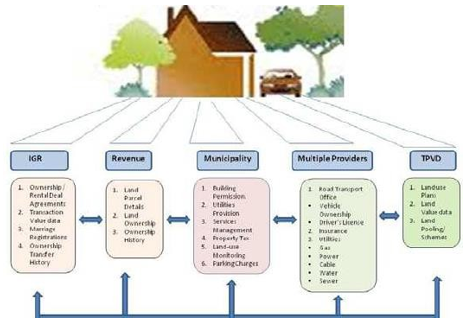
Information Channels
Figer 3
Integration Among Panchayat Enterprise Suite (Pes) Appli-cations
Symbols of democracy and decentralization, panchayats are India's rural local administrations [6]. Panchayats make up about 250,000 of the nation. There is a significant disconnect between the concept and reality despite their formation and the promise they present to enhance grassroots government. Panchayats lack the authority that the Constitution intended in many states. The Ministry of Panchayati Raj was established by the Indian government in 2004 to fortify these local government institutions [21-25]. MoPR used a multifaceted approach to fulfill its purpose. Utilizing the power of information and communication technology (ICT) tools to introduce comprehensive and all-encompassing automation in panchayats was one important strategy. This allowed the panchayats to become efficient and transparent, which in turn allowed them to establish themselves as trustworthy and accountable institutions in the eyes of the public and higher levels of government. As a result, MoPR created the panchayat Mission Mode Project (MMP) as a component of the Indian government's National eGovernance Plan (NeGP).

Figer 4
E-Governance Network Architecture
E-government, which stands for electronic government and is also referred to as e-gov, digital government, online government, or connected government, is the process of establishing an easy, transparent, and affordable means of communication between the government and the public (G2C), the public and businesses (G2B), and the public and other governments (G2G – inter¬agency relationship). E-government can be divided into four areas: information and communication technology, business process re-engineering, governance, and e-citizen. Using graphical user interfaces (GUI), instant messaging, audio and video presentations, and other online communication tools, e-governance should allow visitors to city websites to engage and connect with city employees in a way that goes beyond sending straightforward email correspondence to the address provided on the site.

Figer 5
E-Government Applications
The use of information and communication technology (ICT) for government service delivery, information interchange, transaction processing, integration of pre-existing services, and information portals is known as e-government. "Electronic" is what the "e" in "e-Governance" stands for [8]. Through electronic communication and procedures, e-government provides individuals and the government with the means to carry out their respective roles and obligations. There are various facets of e-government, such as public administration, political, economic, social, and technical.
Below it shows the suggested framework for Electronic-Government Applications (EGA) [9]. It is divided into four layers: Users, Channels, Data Analysis Layer, and Network Enabled Data Processing Applications (Common and Department Specific Applications). Several advantages with widespread use include. The government departments were provided with centralized common aspects, including uniform applications, acts, rules, and automated tasks (workflow, business rules, processes, etc.), through a single entity that was also equipped with well-defined common tools, also referred to as synergistic tools.

Table 4
Common Applications of E-government
Applications that address common requirements for all departments and citizen-centric functions are referred to as common applications (also called core applications or centralized applications). Examples of such applications include the Personal Management System, which covers Personal Pay, Leave, Loan, Pension, and Maintenance of Service Book; the Grievance Management System and Budget Accounts Management System (BAMS); Procurement of Goods and Services; and Citizen Databases, which include Unique-ID of India. Common applications are therefore "low-hanging fruits" that could be utilized to increase efficiency and transparency [9].

Table 1
Specific Application of E-Government
Division Applications tailored to a department's needs, such as those for education, health information systems, transportation, land records management systems, etc., are provided in the below table for information [9].

Table 2
Pension Sanction and Payment via Online: BHAVISHYA
An online tool for tracking pension sanctions and payments is called BHAVISHYA. This web-responsive programme offers an "end-to-end solution" for processing pensions. Retirement benefits are paid out and the first pension is credited to the bank account once the retiring employee fills out online pension forms and receives an "Electronic Pension Payment Order" (ePPO) and "Electronic Special Seal Authority" (eSSA) [11].
The following apps have been easily integrated with Bhavishya Digi Locker, espada, Pension Authorization Retrieval and Accounting System (PARAS), Employee Information System (EIS), and Public Financial Management System (PFMS). To complete post-retirement needs such as pension slips, form-16, life certificate status, etc., Bhavishya has merged with banks.
Research Methodology
There was use of both qualitative and quantitative methodologies. The results of the quantitative analysis of survey data points were explained and interpreted using the qualitative approaches.
Research Objective:
• Qualitative: To evaluate the effect of the Mobile Seva program on end users, spot any discrepancies between the benefits that are received and those that are just perceived, and offer suggestions for closing any gaps.
• Quantitative To create and monitor important performance metrics that allow for a comprehensive assessment of the Mobile Seva initiative's efficacy.
• Research Design:
• Qualitative: Through a variety of journals, sessions, yearly reports, research projects, and research papers, closed-ended citation methods have been used to formalize and develop the many ways and aids conducted by the emobile facilities.
• Quantitative: Significant data have been referenced on official government websites and web portals, along with in-depth descriptive and research-oriented files and web pages.
Research Analysis:
• Quantitative data was obtained from the national web portal for analysis.
• The departmental website and official sites that have been published through their separate networks were the sources of qualitative data.
• Research Deliverable:
• Recommendations: Based on various researcher's publications; insights from user experiences; and evaluation of Mobile Seva's influence on stakeholders and end users by comprehending their viewpoints and usage patterns.
• Conclusions and Generalizations: Measurement of KPIs that confirm the efficacy of the Mobile Seva project utilized by the public.
Recommendations:
Drawing from the input received from Mobile Seva's involved departments, the assessment team recommends the following:
1. Create an entity for business development.
2. Determine which departments have a high impact, as impact depends on reach and necessity.
3. Departments that have prospective areas where all or some of the services offered under Mobile Seva can be implemented are considered high-need departments. The number of persons the department can influence with these services will be used to calculate reach.
4. Form a team to analyse business demands so they may investigate the needs of the departments that are partners and come up with ideas for unique solutions.
5. Work closely with partner departments to improve client relationships by exchanging updates regularly and holding feedback sessions.
6. Collaborate with different public and private service providers to enable affordable access to Mobile Seva services.
7. Note that these suggestions are based on the main areas of discomfort found in the study.
Conclusion
This study examines how well e-governance is working in India through the eMobile services in all sectors, rural development, and social welfare promotion. The transmission of government services and information to the public using electronic methods, including the distribution of information to individuals and agencies, is known as e-government, or "electronic governance." In India, the term "e-governance" originated in the 1980s when the National Informatics Centre attempted to link all district headquarters via computers [12]. In 2002, there was a proposal to establish an Indian portal that would provide the public with access to information on several facets of government operations. E-governance encourages efficiency, upholds accountability, introduces openness into the government system, and cuts down on waiting times. Just as all significant government programs are helpful to the public, so is e-governance. Infrastructure, policies, and technology are all involved.
The goal of e-government is to enable citizens to access a wider range of public services effectively using a variety of services through Kindra Seva called mobile seva services. In an economical method. Government openness is made possible by e-government. Government openness is crucial because it informs the people about the projects the government is working on and the policies it is attempting to put into place. It could be simpler to complete simple chores with electronic government access. For residents, several changes, such as changing their address or marital status, can be time-consuming and involve a lot of paperwork. E-government makes it possible for these duties to be completed more quickly and conveniently for people. The public can easily get more active in political campaigns through e-government. It might raise voter awareness, which might encourage more people to cast ballots in elections. Businesses find it convenient and economical, while the public gains by having ready access to the most recent information available without having to invest time, money, or effort in obtaining it.
Acknowledgment: The citation-based desk study on the subject "Research on Mobile Seva Services of Electronic Government in India: A Qualitative and Quantitative Approach" produced the paper. "A Comparative Research" assesses the readiness for digital transformation from the agriculture sector to zoological departments, as well as the basic needs and technical details, methods to be adopted, measurement, and types of digital e-services and related systems.
Funding: There was no specific grant awarded for this research by public, private, or nonprofit funding organizations.
Disputes of Interest: No conflicts of interest are disclosed by the writers.
References
- Agrawal, A., Chipara, A. C., Shamoo, Y., Patra, P. K., Carey,B. J., et, al. (2013). Dynamic self-stiffening in liquid crystal elastomers. Nature communications, 4(1), 1739.
- Justice RC Lohit. 2005. e-Committee. Supreme Court of India. Information Communication and Technology in Indian Judiciary. https://ecommitteesci.gov.in/ administrative-setup/
- Govt. of India. Mobile Governance (m-Government). CDAC. Centre for Development of Advance Computing. https://mgov.gov.in/about
- Chamoli, S., Chauhan, R., Thakur, N. S., Saini, J. S. (2012). A review of the performance of double pass solar air heater. Renewable and Sustainable Energy Reviews, 16(1), 481-492.
- Gharpure, P. Theme: Conceptual Frameworks in eGovernance Transforming Service Delivery with Information Exchange Enablers. About the Editors, 23.
- Hariharan, R., Misra, D. C. (2012). Enterprise Suite for Panchayats. About the Editors, 29.
- Manikpuri, M. M., Choudhary, S. (2013). Pour Point description of watershed based on DEM of Bilaspur District. International Journal of Advanced Computer Research, 3(3), 197.
- Drishti IAS. E-Governence Portal. https://www.drishtiias. com/to-the-points/Paper2/e-governance-1
- Rao, V. R. (2012). Understanding common and specific applications of e-government: A case from India. About the Editors, 96.
- Priya, P., Mathiyalagan, M. K. (2014). Energy Efficient Transmission for Mobile Data in Wireless Sensor Networks. International Journal of Engineering Research, 3(3).
- Govt. of India 2022: Ministry of Electronic Information Technology (meitY. Annual Report 2022-23. MeitY. Pa 14-63.
- Sharma, A., Cressman, E., Attaluri, A., Kraitchman,D. L., Ivkov, R. (2022). Current challenges in image-guided magnetic hyperthermia therapy for liver cancer. Nanomaterials, 12(16), 2768.
- https://apps.mgov.gov.in/events
- https://www.india.gov.in/spotlight/mobile-seva-citizen-services-mobile-phones#moblie.
- Goyal, S., Pillai, A., Chauhan, S. (2021). E-governance using mobile applications: A case study of India during the COVID-19 pandemic. Australasian Journal of Information Systems, 25, 1-29.
- Kyem, P. A. K. (2016). Mobile phone Expansion and Opportunities for E-Governance in Sub-Saharan Africa. The electronic Journal of information systems in developing countries, 75(1), 1-15.
- Prakash, M., Manyam, K. (2018). Effectiveness and Efficiency of E-Governance in Andhra Pradesh. International Journal of Advanced Scientific Research Development, 5(01).
- Prasad, K. (2020). Capacity building and people’s participation in e-governance: Challenges and prospects for digital India. Handbook of communication for development and social change, 1177-1194.
- Malick, M. H., Murthy, A. V. K. (2001). The challenge of E-Governance. Indian Journal of public administration, 47(2), 237-253.
- Muttoo, S. K., Gupta, R., Pal, S. K., Pal, S. K. (2019).Changing technological trends for E-governance. E-Governance in India: The Progress Status, 79-105.
- Nagaraja, K. (2016). E-governance in India: issues and challenges. IOSR Journal of Economics and Finance, 7(5), 50-54.
- USTE, R. B., GUZEL, B. (2012). From e-governance through m-governance: Turkey applications. International Journal of eBusiness and eGovernment Studies, 4(1), 47-58.
- Sapkale, S. C., Kulkarni-Bhende, R. (2015). Mobile Enabled Governance for Local Governments in India. Indian Journal of Computer Science and Engineering (IJCSE). Retrieved Septemeber, 1, 2017.
- Yadav, N., Singh, V. B. (2013). E-governance: past, present and future in India. arXiv preprint arXiv:1308.3323.
- Bhuiyan, S. H. (2011). Modernizing Bangladesh public administration through e-governance: Benefits and challenges. Government Information Quarterly, 28(1), 54-65.