

International Internal Medicine Journal(IIMJ)
ISSN: 2837-4835 | DOI: 10.33140/IIMJ
Impact Factor: 1.02

Research Article - (2024) Volume 2, Issue 11
Prevalence and Associated Factors of Ottis Media Among Children with Ear Compliant Attending at Some Selected Hospitals in Mogadishu, Somalia
Received Date: Nov 11, 2024 / Accepted Date: Dec 06, 2024 / Published Date: Dec 12, 2024
Copyright: ©©2024 Halima Abdirahman Khaliif, et al. This is an open-access article distributed under the terms of the Creative Commons Attribution License, which permits unrestricted use, distribution, and reproduction in any medium, provided the original author and source are credited.
Citation: Khaliif, H. A., Abdihakim, Z. A., Hassan, J., Hassan, M. M., Hussien, A. W. M., et al. (2024). Prevalence and Associated Factors of Ottis Media Among Children with Ear Compliant Attending at Some Selected Hospitals in Mogadishu, Somalia. Int Internal Med J, 2(11), 01-10.
Abstract
Background: Otitis media (OM), an inflammation of the middle ear, is one of the most common pediatric illnesses, affecting children worldwide. Despite advances in healthcare, OM continues to be a significant cause of morbidity, with recurrent cases contributing to hearing impairment and developmental delays.
Methods: A cross-sectional analysis was conducted, involving 384 participants from some selected hospitals in Benadir region. Data on the occurrence of otitis media were collected through clinical diagnoses, patient history, and caregiver. Potential risk factors and underlying health conditions, were examined using multivariate logistic regression models.
Results: The prevalence of otitis media was found to be 32.8% among the participants. Several significant risk factors for OM were identified, including Gender (OR = 1.80, 95% CI: 1.20–2.70; p = 0.005), age (OR = 2.0, 95% CI: 1.15–3.48; p = 0.015), a exposure to smoke (OR = 3.0, 95% CI: 1.50–5.99; p = 0.002), daycare attendance (OR = 2.05, 95% CI: 1.35–3.12; p = 0.001), and lower socio-economic status (OR = 3.0, 95% CI: 1.22–7.35; p = 0.016). A Parental employment and the history of allergies were also linked to an increased risk of OM.
Conclusion: Otitis media remains highly prevalent among children, with multiple risk factors contributing to its prevalence. Public health initiatives should focus on reducing known environmental risks, improving early diagnostic measures, and promoting education on the prevention of OM, particularly in high-risk populations.
Keywords
Otitis Media, Prevalence, Risk Factors, Somalia, Children, Benadir Region
Abbreviations
AOM: Acute Otitis Media
CSOM: Chronic Supporative Otitis Media
ENT: Ear Nose Throught
OM: Otitis Media
OME: Otitis Media with Effusion
MUAC: Mid Upper Arm Circumference
HI: Hearing Impairment
SES: Socio-Economic Status
TM: Tympanic Membrane
Introduction
Otitis media is an inflammatory disorder affecting the middle ear cleft's mucous membrane, resulting in fluid buildup in the middle ear. (OM) is a leading cause of childhood morbidity and one of the most prevalent infections in preschool-aged children Over 2 million DALYs and 28,000 fatalities are attributed to CSOM. Africa, a small number of Pacific-rim ethnic minorities, and countries in South-east Asia and the Western Pacific bear over 90% of the burden. In the Americas, Europe, the Middle East, and Australia, CSOM is uncommon [1-3].
OM is categorized according to three factors: 1) duration (acute OM infection lasting less than six weeks and chronic COM infection lasting more than six weeks), 2) discharge type (suppurative vs. non-suppurative), and 3) tympanic membrane perforation [3]. AOM causes both local and systemic symptoms with a swift onset major reason why children in industrialized countries need antibiotic treatment. Otitis media with effusion (OME) tends to occur during the resolution of AOM once acute inflammation has resolved but bacteria are still present [4]. On the other hand, chronic otitis media (CSOM) requires ongoing middle ear inflammation, which can lead to tympanic membrane perforation and otorrhea lasting at least two weeks [5]. Over time, OM is becoming more common. Eighty percent of children in affluent countries will have experienced at least one episode of AOM before turning three, and forty percent will have experienced six or more recurrences by the time they are seven years old [6]. Chronic or recurrent forms of the OM can negatively affect scholastic performance and learning capacity in addition to causing substantial hearing loss [7].
Complications from OM cause nearly 20,000 deaths annually, with children under the age of five having the greatest death rates [4]. Numerous epidemiological investigations have been conducted to clarify the risk factors associated with OM. There are two categories of risk factors: environmental and host-related. young age, crowded conditions, attendance at day care. Risk factors include male sex low socioeconomic level shorter breastfeeding length, upper airway infection, allergic rhinitis and smoking [8- 15]. The same characteristics, along with malnourishment and low parental education, have been observed by several writers in a few research from underdeveloped nations where otitis media is highly prevalent Otitis media is still a problem in East African nations like Kenya, Tanzania, and Uganda, where an estimated 2 million children under the age of five are affected by it annually on average [16]. Nevertheless, it is unknown how many people die from this illness within Somalia [17]. They are vulnerable to the illness because they have the risk factors. Low-income families might not have easy access to healthcare and if they put off getting treatment, chronicity- related perforations and hearing loss will eventually occur [18]. The aim of this study was to estimate the prevalence and associated risk factors of otitis media among children with ear compliant attending at some selected hospitals in Benadir region.
Methods
Research Design Setting and Population
This investigation was carried out using an analytical cross- sectional design. The rationale behind selecting this study design is its ability to quickly and effectively determine the prevalence of otitis media, its associated characteristics, and its analysis data through numerical comparisons in children with compliant ears.
All youngsters with ear complaints who were receiving care in private hospitals in the Benadir region and who were at least 12 years old served as the study's source population.
The youngsters with ear complaints who were randomly selected and saw ENT clinics in Benadir's private medical facilities between November 6, 2021, and July 6, 2022 made up the study population. Children who were above twelve, those whose parents had not granted their consent, and extremely ill patients in need of admission were not included in this study.
Sampling Techniques and Sample Size Determination
consecutive consenting convenient sampling was used to select the study population.
Out of 700 total potential participants across four hospitals, 384 individuals consented to participate. The consent rate appears to be relatively consistent across hospitals. For example: Somali Sudanese Hospital: ~54.67% consent rate (82/150) Al-Ihsan Hospital: ~54.86% consent rate (192/350)Hanano Hospital: 55% consent rate (55/100)Bahnano Hospital: 55% consent rate (55/100). The sample size is fairly distributed across the hospitals, with similar consent rates (around 54–55%). Al-Ihsan Hospital contributed the most participants because more ENT patient were found there. to the study with 192 consented participants, followed by Somali Sudanese Hospital with 82 participants. Table 1.
|
Hospital |
sample |
|
|
Somali Sudanese Hospital |
150 |
82 |
|
Al-Ihsan hospital |
350 |
192 |
|
Hanano hospital |
100 |
55 |
|
Bahnano hospital |
100 |
55 |
|
|
700 |
384 |
Table 1: Distribution of Sample Size Among Hospitals
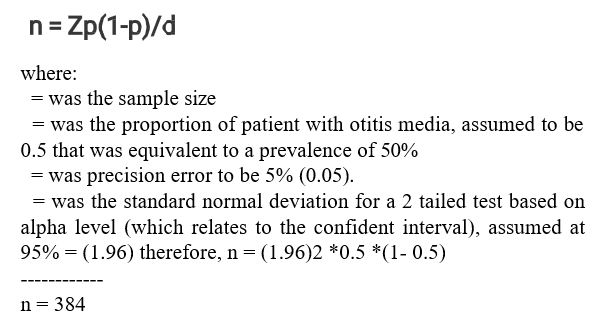
This table shows the distribution of the study population, where 384 participants were selected from four different hospitals. The number of patients sampled from each hospital is proportional to their total patient populations. the sample size was calculated using kish formula.(19),P = 0.5.
Data Collection Techniques and Research Instrument
A questionnaire was utilised in this study to collect data, and it is a more dependable way than other types. a series of forms or a questionnaire made up of several questions typed or written in a particular order. The participants would possess the capacity to independently answer to the enquiries. The senior ENT consultant made the diagnosis of OM. Every participant underwent an otoscopy, ENT examination, and clinical history in addition to a questionnaire. To diagnose individuals with acute, chronic, suppurative, or effusion-related otitis media, otoscopy was used. The otoscopic findings were classified as glue ear, retracted ear drum, indications of scarring/thin ear drum, and normal. Children that exhibit otoscopic signs of OM are considered positive screens. to determine the weight of the younger child we used MUAC and for older kid we used BMI.
Results
Prevalence of Otitis Media
The pie chart below illustrates the prevalence of otitis media (OM) among the study population. 32.8% (126 participants) have otitis media, while 67.2% (258 participants) do not have figure 1

Figure 1: Prevalence of Otitis Media (OM) Amoung Study Participants
Patient Characteristics and Potential Associated Factors
the characteristics of a study population comprising 384 children. The majority of these children are aged between 8-12 years (49.9%), followed by those aged 4-8 years (28.9%), and a smaller proportion aged 1-4 years (21.4%). The gender distribution is nearly balanced, with 52.1% male and 49.9% female, indicating no significant gender disparity in the condition being studied. In terms of socioeconomic status, a considerable number of parents or guardians are unemployed (63.8%), which could reflect economic hardships that might impact healthcare access or health outcomes. This is corroborated by the family income levels, with 58.8% of the families categorized as having low
Otoscopic Examination Finding (n=126)
income, 23.4% as moderate income, and only 12.5% as high income. Most children belong to families with 7-10 members (50.5%), and a majority reside in urban areas (94.8%). The educational level among families varies, with 28.6% being illiterate and only 15.6% holding a degree or higher. Breastfeeding is prevalent, with 86.5% of the children having been breastfed, and 55.2% of these children were breastfed for more than 11 months. Exposure to tobacco smoke or the use of wood and charcoal as primary energy sources is reported by 49.9% of families, while 11.2% of children have direct exposure to tobacco smoke. Nutritionally, 85.4% of the children are well-nourished, but 14.6% are malnourished. Additionally, 45.1% have a history of allergic rhinitis, and 52.9% attend daycare, which may present potential risk factors influencing their health outcomes.
the findings from further otoscopic investigations conducted on 126 children from the study population who exhibited symptoms requiring additional examination. The results reveal that 35% of these children have otorrhea, indicating the presence of ear discharge, which could suggest ongoing infection or inflammation. A significant majority, 82.5%, report experiencing otalgia, or ear pain, highlighting the prevalence of discomfort among these cases. Hearing loss is less common, reported in 9.5% of the children, but is still a concern that may necessitate further audiological assessment. Additionally, 27% of the children report a sensation of fullness in the ear, which can be associated with fluid buildup or pressure changes within the ear. Ear itching, another common symptom, is reported by 30.1% of the children. The examination also identifies the condition of the tympanic membrane (TM), with 47% showing perforations. Central perforations are the most frequent, occurring in 9.9% of cases. The onset of symptoms varies, with some children experiencing sudden symptoms (5.7%), acute ear pain (3.6%), trauma (4.2%), or foreign bodies (0.8%) as precipitating factors. Upper respiratory tract infections (FURTI) are noted as a common underlying condition in 12.8% of the cases. This detailed investigation of otoscopic findings provides critical insights into the severity and underlying causes of ear-related symptoms in this subgroup of the pediatric population.
Types of Otitis Media
The bar chart below shows the distribution of otitis media types among the study population. Chronic suppurative otitis media was the most common (55 cases), followed by acute otitis media (37 cases) and otitis with effusion (34 cases).
Chronic Suppurative Otitis Media (CSOM): 55 cases of chronic suppurative otitis media were reported, making it the most common type in this study. Chronic Suppurative Otitis Media (CSOM)is the most prevalent form of otitis media in this study, accounting for the highest number of cases (55). Acute Otitis Media (AMOM) Otitis Media with Effusion(OME) have similar case numbers, with 37 and 34 cases respectively.

Figure 2: Distribution of Different Types of Otitis Media Among Study Participants
|
Child |
Characteristics |
Category |
Frequen % |
|
age |
1-4 yr. |
82 |
21.4 |
|
|
4-8 yr. |
111 |
28.9 |
|
|
8-12 yr. |
191 |
49.9 |
|
Gender |
Male |
200 |
52.1 |
|
|
Female |
184 |
49.9 |
|
Occupation |
employee |
139 |
36.2 |
|
|
Un-employee |
245 |
63.8 |
|
Family monthly income |
Very low |
22 |
1.4 |
|
|
low |
224 |
58.8 |
|
|
moderate |
90 |
23.4 |
|
|
high |
48 |
12.5 |
|
Family size |
<3 people |
14 |
3.6 |
|
|
4-6 people |
138 |
35.9 |
|
|
7-10 people |
154 |
50.5 |
|
|
>11 people |
38 |
9.9 |
|
Residence |
urban |
364 |
94.8 |
|
|
Rural |
20 |
5.2 |
|
Educational level |
Illiterate |
110 |
28.6 |
|
|
Primary school |
91 |
23.7 |
|
|
Secondary school |
123 |
32.0 |
|
|
Degree and above |
60 |
15.6 |
|
Type of feeding |
Breast feed |
332 |
86.5 |
|
|
Formula feed |
52 |
13.5 |
|
Duration of breast feeding |
>11months |
212 |
55.2 |
|
|
<11 month |
120 |
31.3 |
|
|
N/A |
52 |
13.5 |
|
Smoke |
Exposure to tobacco smoke |
43 |
11.2 |
|
|
Use of wood and charcoal as main source of energy |
189 |
49.9 |
|
|
others |
7 |
1.8 |
|
|
No exposure |
145 |
37.8 |
|
Cleft lip and palate |
Yes |
4 |
1.0 |
|
|
No |
380 |
99.0 |
|
Nutritional status |
Well nourished |
328 |
85.4 |
|
|
malnourished |
56 |
14.6 |
|
History of allergy rhinitis |
yes |
173 |
45.1 |
|
|
No |
211 |
54.9 |
|
Day care attendance |
Yes |
203 |
52.9 |
|
|
No |
181 |
47.1 |
Table 2: Patient Characteristics and Factors Associated
|
Otoscopic Examination finding(n-126) |
Frequency |
% |
|
otorrhea |
44 |
35 |
|
Yes |
82 |
65 |
|
No |
104 |
|
|
Yes |
22 |
82.5 |
|
No |
12 |
17.4 |
|
Hearing loss |
114 |
90.4 |
|
Yes |
12 |
9.5 |
|
No |
114 |
90.4 |
|
Fullness of the ear |
|
|
|
yes |
34 |
27 |
|
No |
92 |
73 |
|
Ear itching |
|
|
|
yes |
38 |
30.1 |
|
No |
88 |
70 |
|
Others |
|
|
|
Yes |
9 |
7.1 |
|
No |
117 |
92.9 |
|
Tympanic membrane characteristics |
|
|
|
perforation on TM |
59 |
47 |
|
yes |
67 |
53 |
|
Location of TM (n=59) |
|
|
|
Marginal |
6 |
1.6 |
|
central |
38 |
9.9 |
|
Total |
10 |
2.6 |
|
Sub-total |
5 |
1.3 |
|
Mode of onset |
|
|
|
sudden |
22 |
5.7 |
|
Acute ear pain |
14 |
3.6 |
|
Trauma |
16 |
4.2 |
|
Foreign body |
3 |
.8 |
|
FURTI |
49 |
12.8 |
|
Others |
22 |
5.7 |
Table 3: Ososcopic Examination Finding (n=126)
Binary Logistic Regression Analysis for Otitis Media (OM) and its Associated Factor
The analysis identified several significant factors associated with the risk of developing Otitis Media (OM). Gender was a significant predictor, with males showing 1.80 times higher odds of developing OM compared to females (95% CI: 1.20–2.70; p = 0.005). This finding suggests that biological and possibly behavioral differences may contribute to a higher susceptibility among males. Age also emerged as a significant factor; children aged 1-4 years had 2.00 times higher odds of OM compared to those aged 8-12 years (95% CI: 1.15–3.48; p = 0.015). The increased risk in younger children could be attributed to anatomical factors, such as shorter and more horizontal Eustachian tubes, and to the immaturity of their immune systems, which makes them more vulnerable to infections.
Household environment, specifically the number of people per room, was another significant factor. Children living in households with more than three people per room had 2.47 times higher odds of developing OM compared to those living in less crowded conditions (95% CI: 1.53–4.01; p < 0.001). This indicates that overcrowding, which facilitates the transmission of infectious agents, could be a key risk factor for OM. Socioeconomic status, measured by family monthly income, also significantly influenced OM risk. Children from very low-income families had 3.00 times higher odds of developing OM compared to those from high- income families (95% CI: 1.22–7.35; p = 0.016), and those from low-income families had 1.89 times higher odds (95% CI: 1.14– 3.12; p = 0.013). This suggests that lower socioeconomic status, potentially due to limited access to healthcare and poor living conditions, is associated with an increased risk of OM.
Parental employment status further impacts the risk, as children of unemployed caregivers had 1.60 times higher odds of developing OM compared to those of employed caregivers (95% CI: 1.04– 2.45; p = 0.031). This finding could be reflective of the economic and psychosocial challenges associated with unemployment, which may affect health outcomes. Feeding practices were strongly associated with OM; formula-fed children had 4.95 times higher odds of developing OM compared to those who were breastfed (95% CI: 2.49–9.82; p < 0.001). Additionally, breastfeeding duration played a protective role; children breastfed for less than 11 months had 5.75 times higher odds of developing OM compared to those breastfed for more than 11 months (95% CI: 3.31–9.98; p < 0.001). These findings emphasize the importance of breastfeeding in enhancing immune protection against early childhood infections.
Environmental exposure to tobacco smoke was also significantly associated with OM, with exposed children having 3.00 times higher odds of developing OM compared to non-exposed children (95% CI: 1.50–5.99; p = 0.002). This supports the established evidence that passive smoke exposure can impair respiratory and immune function, increasing the susceptibility to infections. A history of allergic rhinitis increased the odds of OM by 1.65 times compared to those without such a history (95% CI: 1.10– 2.48; p = 0.015), likely due to the inflammation and obstruction of the Eustachian tube caused by allergic reactions. Lastly, daycare attendance was a significant risk factor; children attending daycare had 2.05 times higher odds of developing OM compared to those not in daycare (95% CI: 1.35–3.12; p = 0.001), highlighting the role of increased pathogen exposure in group childcare settings. Table 4
Discussion
In this present study is to investigate the prevalence of otitis media in Somalia, among 384 children aged between 0-12 years old. OM is one of the most common health problems seen in children and it may lead to sequelae or complications such as hearing loss, delay of speech and language. These probable complications may be prevented by early diagnosis of OM(20) In our study prevalence of otitis media was found to be 32.8%. This comprises of acute otitis media (AOM) 9.6%, chronic suppurative otitis media (CSOM)14.3% while otitis media with effusion OME was found to be 8.9%.
Acute otitis media presents with pain and fever and hearing loss at times while CSOM presents with ear discharge and hearing loss(21). Hearing loss was not a common complaint. This is contrary to other studies where HI is the main complaint for CSOM(22). In our study 15.4% were having perforation on TM as result of chronicity of the disease and most of them the perforation was centrally located.
|
Characteristics |
Total (%) |
OM Present (%) |
OM Absent (%) |
Odds Ratio (95% CI) |
P-value |
|
Gender |
|
|
|
|
|
|
Male |
200(52.1) |
90(45.0) |
110(55.0) |
1.80 (1.20-2.70) |
0.005 |
|
Female |
184(47.9) |
40(21.7) |
144(78.3) |
Ref cat |
|
|
Age |
|
|
|
|
|
|
1-4 yr. |
82(21.4) |
36(43.9) |
46(56.1) |
2.00 (1.15-3.48) |
0.015 |
|
4-8 yr. |
111(28.9) |
38(34.2) |
73(65.8) |
1.45 (0.86-2.44) |
0.162 |
|
8-12 yr. |
191(49.7) |
56(29.3) |
135(70.7) |
Ref cat |
|
|
#of people/room |
|
|
|
|
|
|
< 3 people |
294(76.6) |
85(28.9) |
209(71.1) |
Ref cat |
|
|
> 3 people |
90(23.4) |
45(50.0) |
45(50.0) |
2.47 (1.53-4.01) |
<0.001 |
|
Family monthly income |
|
|
|
|
|
|
Very low |
22(5.7) |
12(54.5) |
10(45.5) |
3.00 (1.22-7.35) |
0.016 |
|
Low |
224(57.8) |
80(35.7) |
144(64.3) |
1.89 (1.14-3.12) |
0.013 |
|
Moderate |
90(23.4) |
28(31.1) |
62(68.9) |
1.29 (0.72-2.31) |
0.379 |
|
High |
48(12.5) |
10(20.8) |
38(79.2) |
Ref cat |
|
|
Occupation |
|
|
|
|
|
|
Employed |
139(36.2) |
40(28.8) |
99(71.2) |
Ref cat |
|
|
Unemployed |
245(63.8) |
95(38.8) |
150(61.2) |
1.60 (1.04-2.45) |
0.031 |
|
Type of feeding |
|
|
|
|
|
|
Breastfeeding |
332(86.5) |
85(25.6) |
247(74.4) |
Ref cat |
|
|
Formula feeding |
52(13.5) |
32(61.5) |
20(38.5) |
4.95 (2.49-9.82) |
<0.001 |
|
Durationof breastfeeding |
|
|
|
|
|
|
>11 months |
212(55.2) |
30(14.2) |
182(85.8) |
5.75 (3.31-9.98) |
<0.001 |
|
<11 months |
120(31.3) |
70(58.3) |
50(41.7) |
Ref cat |
|
|
Smoke Exposure |
|
|
|
|
|
|
Yes |
43(11.2) |
27(62.8) |
16(37.2) |
3.00 (1.50-5.99) |
0.002 |
|
No |
7(1.8) |
2(28.6) |
5(71.4) |
Ref cat |
|
|
History of allergic rhinitis |
|
|
|
|
|
|
Yes |
173(45.1) |
65(37.6) |
108(62.4) |
1.65 (1.10-2.48) |
0.015 |
|
No |
211(54.9) |
65(30.8) |
146(69.2) |
Ref cat |
|
|
Day care attendance |
|
|
|
|
|
|
Yes |
203(52.9) |
88(43.3) |
115(56.7) |
2.05 (1.35-3.12) |
0.001 |
|
No |
181(47.1) |
42(23.2) |
139(76.8) |
Ref cat |
|
Table 4: Binary Logistic Regression Analysis for Otitis Media (OM) and its Associated Factors
This study provides insights into the factors associated with the risk of developing Otitis Media (OM) in children within Somalia, a country characterized by a low-resource healthcare setting and various socioeconomic challenges. The analysis identified gender as a significant predictor, with males having 1.80 times higher odds of developing OM compared to females (95% CI: 1.20–2.70; p = 0.005). This finding is consistent with other studies conducted in low- resource settings, where cultural, biological, and behavioral differences may influence healthcare access and exposure to risk factors [23]. In Somalia, where healthcare access is often limited, these differences can be exacerbated, potentially leading to higher OM prevalence among boys due to different care- seeking behaviors or greater exposure to outdoor activities where pathogens are present.
Age was another critical determinant, with children aged 1-4 years having 2.00 times higher odds of developing OM compared to those aged 8-12 years (95% CI: 1.15–3.48; p = 0.015). This finding aligns with studies in other sub-Saharan African contexts, where the burden of OM is highest among younger children due to anatomical factors and an immature immune system [8,24]. In Somalia, younger children may also face additional risk due to inadequate immunization coverage and poor nutrition, which further compromise their immune responses [25]. Educating parents and caregivers on otitis media and raising their index of suspicion especially in the vulnerable age group of children aged below 3 years may help to pick and treat otitis media early to avoid complications Socioeconomic status, as measured by family monthly income, was also a crucial factor. Children from very low-income families had 3.00 times higher odds of developing OM compared to those from high-income families (95% CI: 1.22– 7.35; p = 0.016), while those from low-income families had 1.89 times higher odds (95% CI: 1.14–3.12; p = 0.013). In Somalia, poverty is a pervasive issue that affects access to healthcare, nutrition, and overall living conditions, all of which are critical in determining children's health outcomes. Studies in similar contexts have highlighted that low socioeconomic status is often linked to delayed healthcare-seeking behavior, inadequate treatment, and increased disease burden, including OM [9].
Parental employment status also emerged as a significant factor, with children of unemployed caregivers having 1.60 times higher odds of developing OM compared to those with employed caregivers (95% CI: 1.04–2.45; p = 0.031). Unemployment often correlates with financial instability, which limits the ability to afford medical care or maintain healthy living environments [26]. This is particularly impactful in Somalia, where economic challenges are pervasive, and social safety nets are weak, further affecting children's health [27].
Feeding practices were strongly associated with OM risk. Formula-fed children had 4.95 times higher odds of developing OM compared to those who were breastfed (95% CI: 2.49–9.82; p < 0.001). Additionally, children breastfed for less than 11 months had 5.75 times higher odds of developing OM than those breastfed for more than 11 months (95% CI: 3.31–9.98; p < 0.001). Breastfeeding provides essential antibodies and nutrients that bolster the immune system against infections [12]. In Somalia, where infectious diseases are prevalent, promoting exclusive and prolonged breastfeeding is critical to reducing the incidence of OM and other common childhood illnesses [28].
Environmental exposure to smoke significantly increased the odds of OM. Children exposed to smoke had 3.00 times higher odds of developing OM compared to non-exposed children (95% CI: 1.50–5.99; p = 0.002). Second-hand smoke is a known risk factor for respiratory infections, and in settings like Somalia, where public health awareness is limited, indoor smoking can contribute significantly to OM risk [15]. Similar findings have been reported in other low-income countries, where passive smoke exposure is a critical determinant of childhood respiratory conditions [12] .
A history of allergic rhinitis was associated with a 1.65 times higher risk of developing OM (95% CI: 1.10–2.48; p = 0.015). Allergic rhinitis leads to inflammation and blockage of the Eustachian tube, increasing susceptibility to OM (28). Given the environmental conditions in Somalia, including high levels of dust and pollen, allergic conditions may be more common and underdiagnosed, contributing to OM's burden.
Finally, daycare attendance was identified as a significant risk factor, with children attending daycare having 2.05 times higher odds of developing OM compared to those not attending daycare (95% CI: 1.35–3.12; p = 0.001). Daycare settings facilitate close contact among children, making them hotspots for the transmission of infectious agents. In Somalia, where infection control practices may not be strictly enforced, the risk of OM can be substantial [10].
The findings underscore the multifactorial nature of OM risk in Somali children, influenced by demographic, socioeconomic, environmental, and health history factors. Addressing these risk factors requires a comprehensive public health approach, including improved access to healthcare, better living conditions, enhanced breastfeeding practices, and heightened public awareness of risk factors like smoking and crowding.
Conclusion
The study showed that prevalence of OM was observed to be 32.8%, most common type of OM was CSOM 14.3%.and underlying factors that has statistically significant relation to otitis media were gender, age, low ses, parental employment, exposure to smoke, history of allergic rhinitis, feeding practice, duration of breast feeding and daycare attendances.
Otitis media remain a public health problem in Somalia. The prevalence is far higher than the threshold used by the World Health Organization to qualify as a public health problem. However, many parents were not aware of its presence in the affected children. formula feeding is risk factor whereas prolongation of breast feeding for>11 month to be protective.
Declaration
Authors Contribution
HAK Conceptualized this idea. The study design was developed collaboratively by ZAA and MAS. Material preparation and data collection were performed by MMH and AMH. MH analyzed and interpreted the data. The initial draft was composed by JH, and all authors contributed to the writing, reviewing, and editing of the subsequent versions of the manuscript.
Availability of Data and Materials: The Data supporting the findings of this study are available from the corresponding author upon reasonable request.
Ethical Approval and Consent to Participation
Ethical approval for this study was obtained from the Institutional Review Board (IRB) of SIMAD University, Mogadishu, Somalia, as per the approval letter dated March 30, 2024, with reference number 2024/SU-IRB/FMHS/P063. In accordance with this approval, informed consent was obtained from all individual participants involved in the study. Participants were adequately informed about the study's objectives, their right to confidentiality, and their right to withdraw consent at any time without repercussions.
Acknowledgement: We gratefully acknowledge the support of SIMAD University (SU-PG-2024-0139) throughout this research endeavor.
References
- Zernotti, M. E., Pawankar, R., Ansotegui, I., Badellino, H., Croce, J. S., Hossny, E., ... & Zhang, L. (2017). Otitis media with effusion and atopy: is there a causal relationship?. World Allergy Organization Journal, 10, 1-9.
- Maharjan M, Bhandari S, (KUMJ) IS… medical journal., 2006 undefined. Prevalence of otitis media in school going children in Eastern Nepal.
- World Health Organization. (2004). Chronic suppurative otitis media: burden of illness and management options.
- DeAntonio, R., Yarzabal, J. P., Cruz, J. P., Schmidt, J. E., & Kleijnen, J. (2016). Epidemiology of otitis media in children from developing countries: A systematic review. International Journal of Pediatric Otorhinolaryngology, 85, 65-74.
- DeAntonio, R., Yarzabal, J. P., Cruz, J. P., Schmidt, J. E., &Kleijnen, J. (2016). Epidemiology of community-acquired pneumonia and implications for vaccination of children living in developing and newly industrialized countries: A systematic literature review. Human vaccines & immunotherapeutics, 12(9), 2422-2440.
- Monasta, L., Ronfani, L., Marchetti, F., Montico, M., Vecchi Brumatti, L., Bavcar, A., ... & Tamburlini, G. (2012). Burden of disease caused by otitis media: systematic review and global estimates. PloS one, 7(4), e36226.
- Teele, D. W., Klein, J. O., Chase, C., Menyuk, P., Rosner, B. A., & Greater Boston Otitis Media Study Group. (1990). Otitis media in infancy and intellectual ability, school achievement, speech, and language at age 7 years. Journal of Infectious Diseases, 162(3), 685-694.
- VIJAYASEKARAN, S. (2014). Acute otitis media in young children. [Internet].
- Siddartha, Bhat, V., Bhandary, S. K., Shenoy, V., & Rashmi. (2012). Otitis media with effusion in relation to socio economic status: a community based study. Indian Journal of Otolaryngology and Head & Neck Surgery, 64, 56-58.
- Marx, J., Osguthorpe, D. J., & Parsons, G. (1995). Day care and the incidence of otitis media in young children. Otolaryngology—Head and Neck Surgery, 112(6), 695-699.
- Teele, D. W., Klein, J. O., Rosner, B., & Greater Boston Otitis Media Study Group. (1989). Epidemiology of otitis media during the first seven years of life in children in greater Boston: a prospective, cohort study. Journal of infectious diseases, 160(1), 83-94.
- Hoffman, H. J., Daly, K. A., Bainbridge, K. E., Casselbrant,M. L., Homøe, P., Kvestad, E., ... & Vernacchio, L. (2013). Panel 1: Epidemiology, natural history, and risk factors. Otolaryngology–Head and Neck Surgery, 148, E1-E25.
- Paterson, J. E., Carter, S., Wallace, J., Ahmad, Z., Garrett, N., & Silva, P. A. (2007). Pacific Islands Families Study: Risk factors associated with otitis media with effusion among Pacific 2-year-old children. International Journal of Pediatric Otorhinolaryngology, 71(7), 1047-1054.
- Stenström, C., & Ingvarsson, L. (1997). Otitis-prone children and controls: a study of possible predisposing factors. 2. Physical findings, frequency of illness, allergy, day care and parental smoking. Acta oto-laryngologica, 117(5), 696-703.
- da Costa, J. L., Navarro, A., Neves, J. B., & Martin, M. (2004). Household wood and charcoal smoke increases risk of otitis media in childhood in Maputo. International journal of epidemiology, 33(3), 573-578.
- Sophia, A., Isaac, R., Rebekah, G., Brahmadathan, K., & Rupa, V. (2010). Risk factors for otitis media among preschool, rural Indian children. International journal of pediatric otorhinolaryngology, 74(6), 677-683.
- Gulani, A., & Sachdev, H. S. (2012). Zinc supplements for preventing otitis media. Cochrane Database of Systematic Reviews, (4).
- Morrison, J., & Malik, S. M. M. R. (2023). Population health trends and disease profile in Somalia 1990–2019, and projection to 2030: will the country achieve sustainable development goals 2 and 3?. BMC Public Health, 23(1), 66.
- kish formula. 1965 - Google Scholar [Internet]. [cited 2022 Feb 8]. https://scholar.google.com/scholar? hl=en&as_ sdt=0%2C5&q=kish+formula+1965&oq=kish+formula+196
- VayısoÄ?lu, S. K., ErdoÄ?an, O., Öncü, E., & Mutlu, M. (2020). Prevalence and risk factors of otitis media with effusion in primary school children in Mersin. Journal of Health Sciences and Medicine, 3(4), 448-453.
- Acuin, J. (2004). Chronic suppurative otitis media: burden of illness and management options. In Chronic suppurative otitis media: burden of illness and management options (pp. 83-83).
- Monasta, L., Ronfani, L., Marchetti, F., Montico, M., Vecchi Brumatti, L., Bavcar, A., ... & Tamburlini, G. (2012). Burden of disease caused by otitis media: systematic review and global estimates. PloS one, 7(4), e36226.
- Merzel, C. (2000). Gender differences in health care access indicators in an urban, low-income community. American journal of public health, 90(6), 909.
- Thomas, J. P., Berner, R., Zahnert, T., & Dazert, S. (2014).Acute otitis media—a structured approach. Deutsches Ärzteblatt International, 111(9), 151.
- Orey, F. A. H., Mohamud, K. H. S., Abdulle, I. A. N.,Mohamoud, J. H., Garba, B., Adam, M. H., ... & Dirie, N.I. (2023). Backsliding on childhood immunizations due to ongoing COVID-19 pandemic: A retrospective study in Banadir Region, Somalia. African Journal of Infectious Diseases, 17(2), 6-12.
- McMaughan, D. J., Oloruntoba, O., & Smith, M. L. (2020). Socioeconomic status and access to healthcare: interrelated drivers for healthy aging. Frontiers in public health, 8, 231.
- THE FEDERAL GOVERNMENT OF SOMALIA Ministry ofLabour. and Social Affairs Somalia Social Protection Policy.
- Yeo, S. G., Park, D. C., Eun, Y. G., & Cha, C. I. (2007). Therole of allergic rhinitis in the development of otitis media with effusion: effect on eustachian tube function. American journal of otolaryngology, 28(3), 148-152.