




Research Article - (2025) Volume 3, Issue 7
Photons with Scalar Fields Should Exist
Received Date: Jun 23, 2025 / Accepted Date: Jul 23, 2025 / Published Date: Jul 28, 2025
Copyright: ©©2025 Shuang-ren Zhao. This is an open-access article distributed under the terms of the Creative Commons Attribution License, which permits unrestricted use, distribution, and reproduction in any medium, provided the original author and source are credited.
Citation: Zhao, S. R. (2025). Photons with Scalar Fields Should Exist. Eng OA, 3(7), 01-17.
Abstract
The author believes that scalar photons should exist. Scalar photons are photons corresponding to scalar fields φ. This type of photon is different from the photons we usually understand, as they correspond to the vector potential A.This paper explores the theory of mutual energy flow within the framework of the Helmholtz equation, proposing a novel interpretation of particle-like energy transfer through the interaction of retarded and advanced waves. Traditional electromagnetic and quantum theories describe energy flow via self-energy flow (e.g., Poynting vector or probability current density), which fails to localize energy transfer. In contrast, mutual energy flow arises from the synchronized interaction between a retarded wave emitted by a source and an advanced wave emitted by a sink, forming a localized energy channel. We demonstrate that the Helmholtz equation must be modified - by introducing source-sink dynamics, defining a corrected magnetic field, and halving the mutual energy flow intensity - to derive a consistent energy conservation law. The resulting mutual energy flow density exhibits particle-like behavior: it is generated at the source, propagates directionally, and annihilates at the sink, with zero leakage outside this path. Crucially, self-energy flow is shown to represent reactive power, incapable of energy transfer, while mutual energy flow alone accounts for active energy propagation. This approach bridges electromagnetic theory and quantum mechanics, aligning with action- reaction principles and transactional interpretations. The findings suggest that particles can be modeled as mutual energy flows, resolving wave-particle duality by unifying retarded and advanced waves into a single physical entity. This work challenges classical field theories and offers a pathway to revise Maxwell’s and Schrödinger’s equations for particle-like localization.
Keywords
Poynting Theorem, Reciprocity Theorem, Huygens’ Principle, Mutual Energy Flow, Helmholtz Equation, Wave Equation, Klein-Gordon Equation, Schrdinger Equation, Green’s Function, Magnetic Field, Absorber Theory, Transactional Interpretation of Quantum Mechanics
Introduction
The theory of action and reaction at a distance has developed in two directions. First, from the physical perspective: the action-at-a- distance theory proposed by Schwarzschild and others after 1903; Dirac’s self-action theory in the 1930s; Wheeler and Feynman’s absorber theory from 1945 to 1948; Cramer’s transactional interpretation of quantum mechanics around 1980; and Stephenson’s advanced wave theory [1-7]. Second, in electromagnetic theory: Lorentz’s reciprocity theorem proposed in 1896; Rumsey’s action and reaction theory in 1954; Welch’s time-domain reciprocity theorem in 1960; the author’s concept of "mutual energy" and the "mutual energy theorem" proposed in 1987; de Hoop’s cross-correlation reciprocity theorem in 1987; and Petrusenko’s second Lorentz reciprocity theorem in 2009 [8-15].
These two directions are closely related, yet have long developed independently. The author follows the path of electromagnetic theory but emphasizes "mutual energy" rather than "reciprocity". unlike most others. Calling a theorem one of mutual energy implies it is a physical theorem; calling it reciprocal suggests a mathematical perspective. When the author proposed the mutual energy theorem in 1987, it was widely criticized for equating reciprocity with mutual energy. Thus, the author has long intended to clarify this issue. An initial attempt was made to prove the mutual energy theorem from the complex Poynting theorem, but it failed. This effort was delayed until the author revisited the topic and in 2017 succeeded in proving Welch’s time-domain reciprocity theorem from the Poynting theorem, and then, through Fourier transform, derived the mutual energy theorem. This reinforced the author’s belief in the mutual energy concept, leading to the proposal of mutual energy flow and the mutual energy flow theorem [16].
Moreover, the Welch reciprocity theorem implies that for it to be considered an energy theorem, advanced waves must physically exist. This led the author to study theories of advanced waves, including the absorber theory, Cramer’s transactional interpretation, and Stephenson’s advanced wave theory - further supporting the belief in the physical reality of advanced waves and the energy-theorem nature of mutual energy and mutual energy flow.
Later, the author realized that if mutual energy flow transmits energy, then self-energy flow must not - otherwise, it would imply the existence of two types of photons: mutual and self-energy flow photons, which would then have to be reconciled into one, a near- impossible task. Moreover, allowing both to transmit energy would exceed the correct total energy. Thus, the concept of reverse collapse of self-energy flow was introduced. The mutual energy flow, shaped like a tadpole - thin at both ends and thick in the middle - resembles the conceptual image of a photon. Hence, the author began to interpret particles as mutual energy flows [16].
It was then found that mutual energy flow is twice the self-energy flow since it includes two terms, E1 × H2 + E2 × H1, whereas self-energy has only one: E1 × H1 or E2 × H2. To replace self-energy flow with mutual energy flow, normalization is needed to compress mutual energy flow to half [17].
Further, in calculating mutual energy flow in a dual-wire transformer, it was found that self-energy flow is reactive power. Thus, self-energy flow need not collapse. This led to the idea that electromagnetic radiation should also be reactive power. This implies a 90-degree phase shift between electric and magnetic fields, not in phase as in Maxwell’s theory. Consequently, self-energy flow need not reverse collapse - but it also means that Maxwell’s electromagnetic theory needs revision. The issue lies in the conditional validity of defining the magnetic field as the curl of the vector potential (B = ∇ × A). This only holds in quasi-static conditions, not for radiative electromagnetic fields, which require corrections in the far field. Assuming:
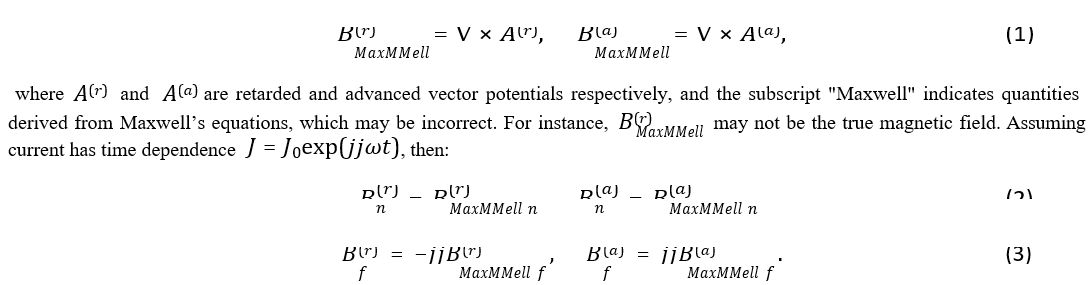
It’s worth noting that both directions of action-reaction theory conflict with Maxwell’s ether and field theory. According to Maxwell, the transmitting antenna gives energy to the electromagnetic field/wave, which then transfers part of it to the receiving antenna, with the remainder continuing infinitely - even out of the universe. Transmission is independent of the receiver. However, action-reaction theory holds that the energy emitted by the transmitting antenna only affects the receiving antenna. If there is only one receiver in space, the energy acts solely on it. The receiver provides a reaction (advanced wave) when acted upon by the source (retarded wave), causing recoil of the transmitter. If no receiver exists, energy cannot be emitted. This requires that electromagnetic waves are reactive power, unable to escape the universe. In contrast, Maxwell’s in-phase E and H fields imply active power emission - clearly an error in Maxwell’s theory.
The author speculates that in nature, there may indeed exist a photon corresponding to a scalar potential ÃÃÃÃÃÂ????ÂÃÃÃÂ???ÂÃÃÂ??ÂÃÂ?ÂÂ?. This type of photon is different from the photons we usually see, as they correspond to the vector potential A. The author argues this from the Helmholtz equation.
Helmholtz Equation
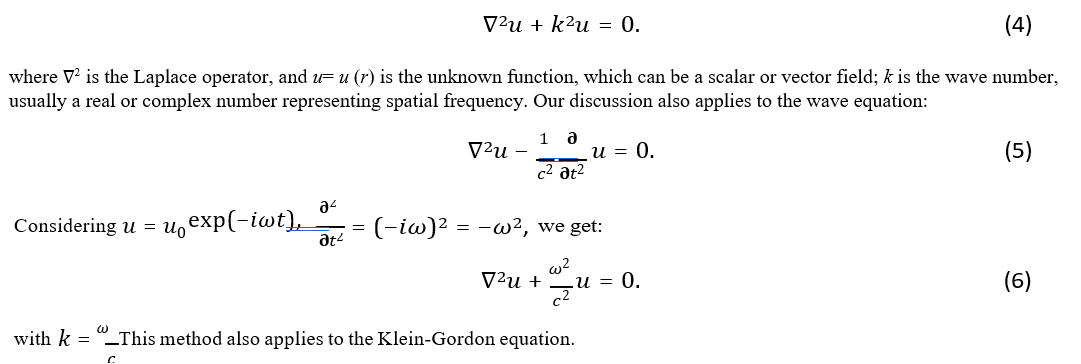
The standard form of the Helmholtz equation is:
Poynting-like Theorem
The Helmholtz equation is source-free. Adding a source term:
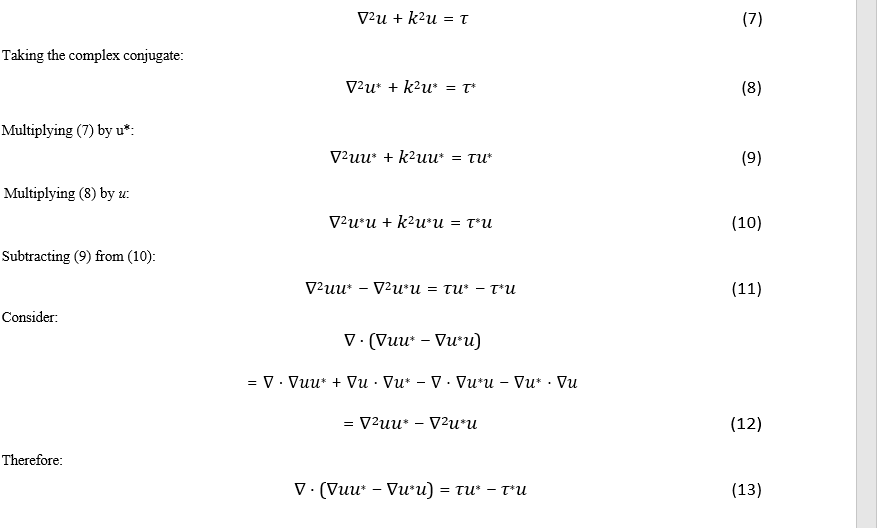
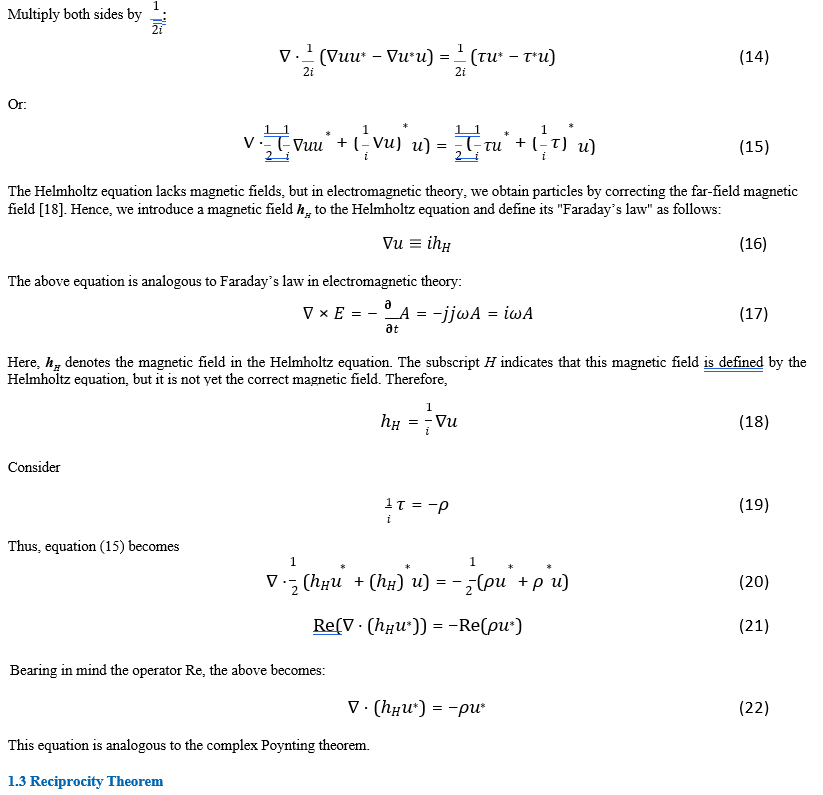
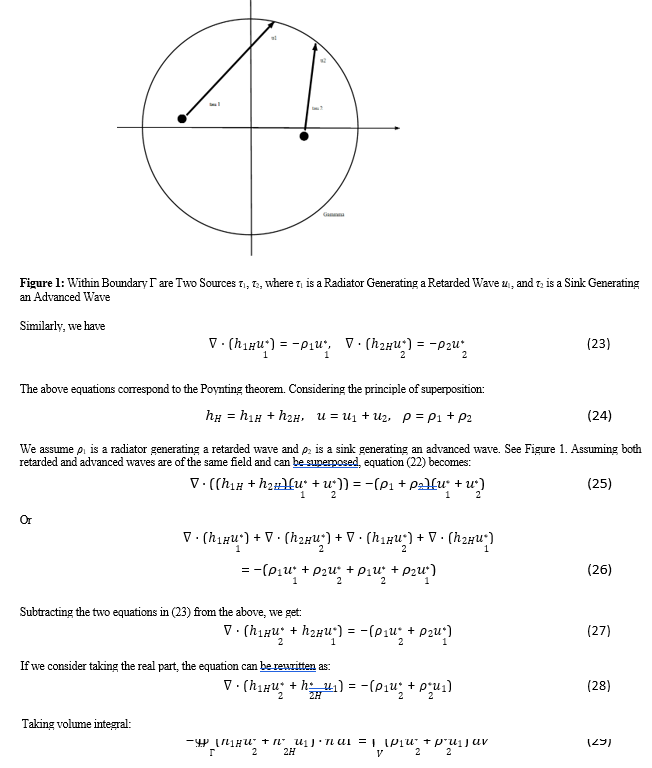
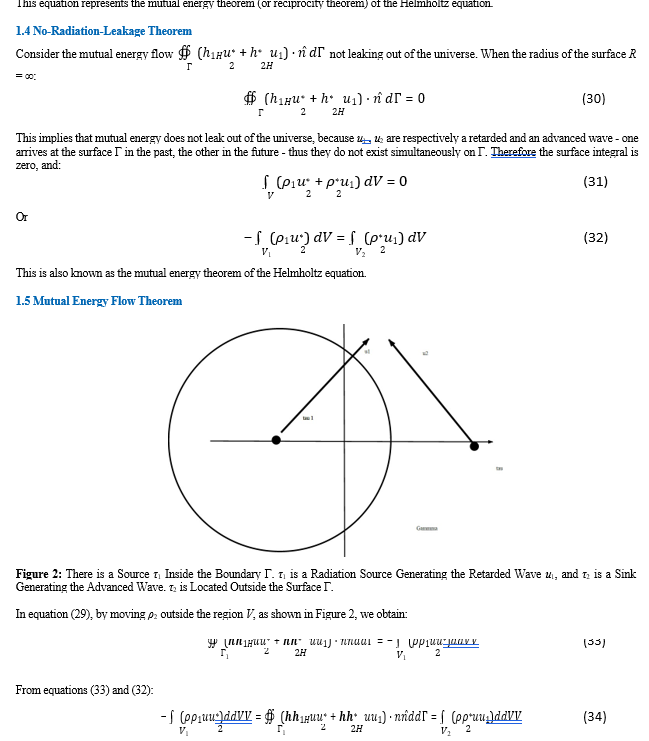
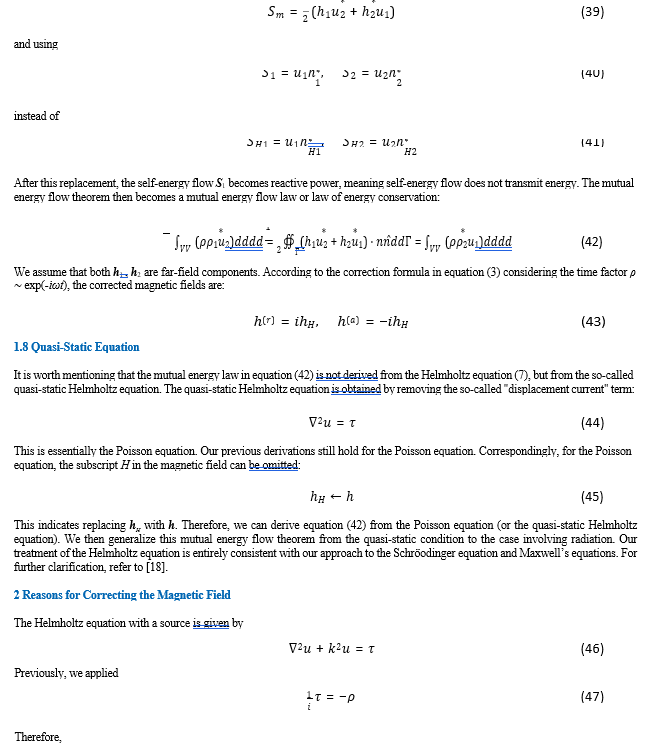
This is the mutual energy flow theorem. Although the surface Γ encloses the source ρ1 during the derivation, in fact, the surface only needs to separate the sources ρ1 and ρ2. It can be a closed surface enclosing ρ1, a closed surface enclosing ρ2, or an infinite plane between ρ1 and ρ2. See Fiure 3.
 â??
â??
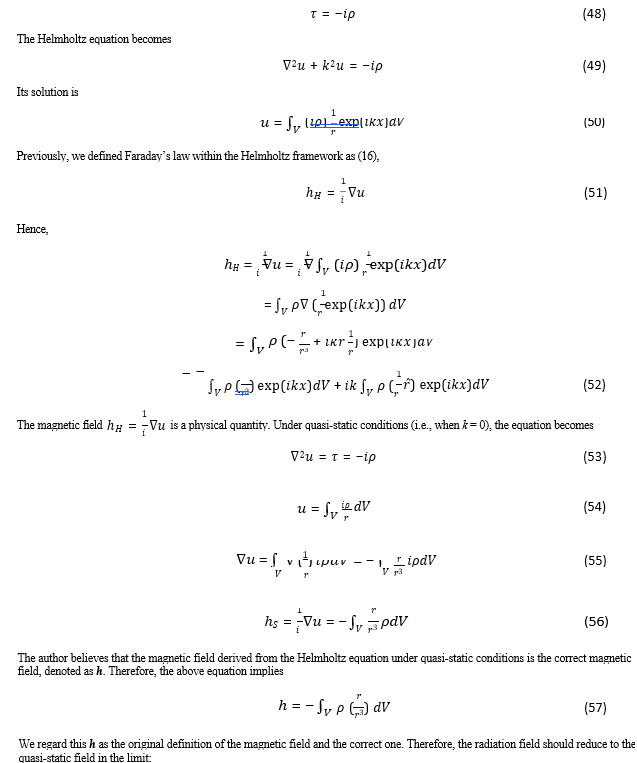
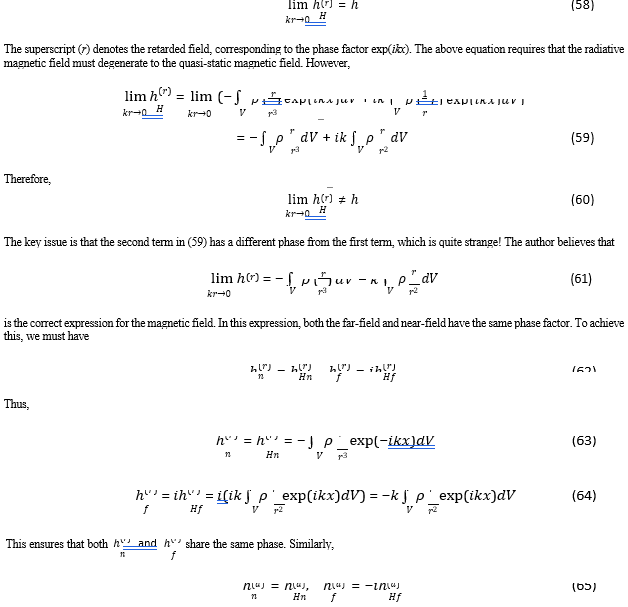
The superscript (a) denotes the advanced field, corresponding to the phase factor exp(-ikx). If the reader is confused by this part of the author’s procedure, please refer to the author’s similar treatment of electromagnetic field theory [18].
Derivation of Mutual Energy Flow Theorem Using Green’s Function Method
The derivation in Section 1.2 above essentially uses the real part of a complex quantity. That is, we obtained only the real part of Equation (42), not the full equation. Below we derive it again using Green’s function method to fully recover Equation (42), including its imaginary part. Rewrite the Helmholtz equations (7) as
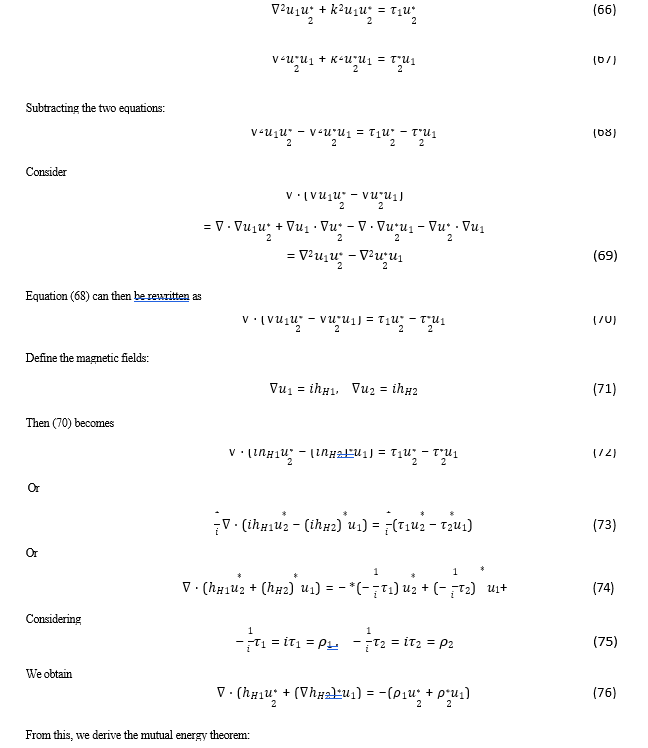
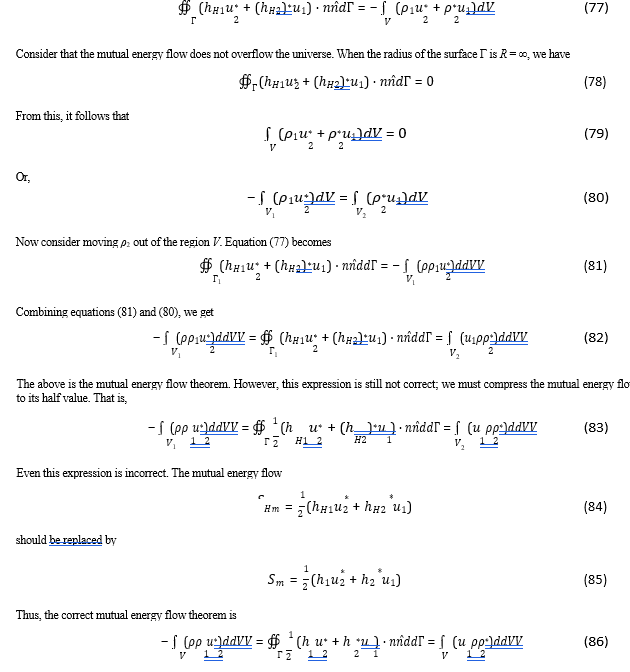
Previously, we obtained (42). During the derivation of the mutual energy flow theorem, the real part was taken. Therefore, it is only valid for the real part, while both the real and imaginary parts of the above expression are correct. Considering that self-energy flow corresponds to reactive power, the above expression has become the law of energy conservation or law of mutual energy flow.
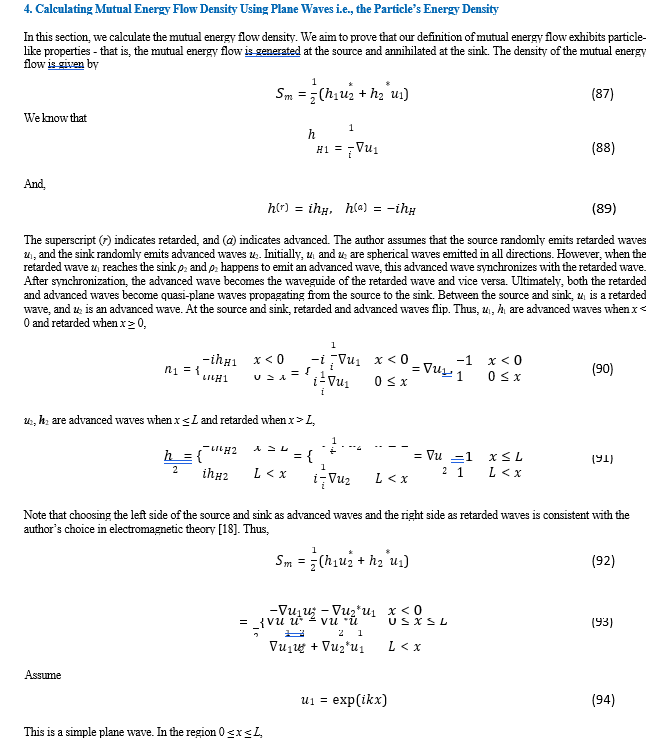
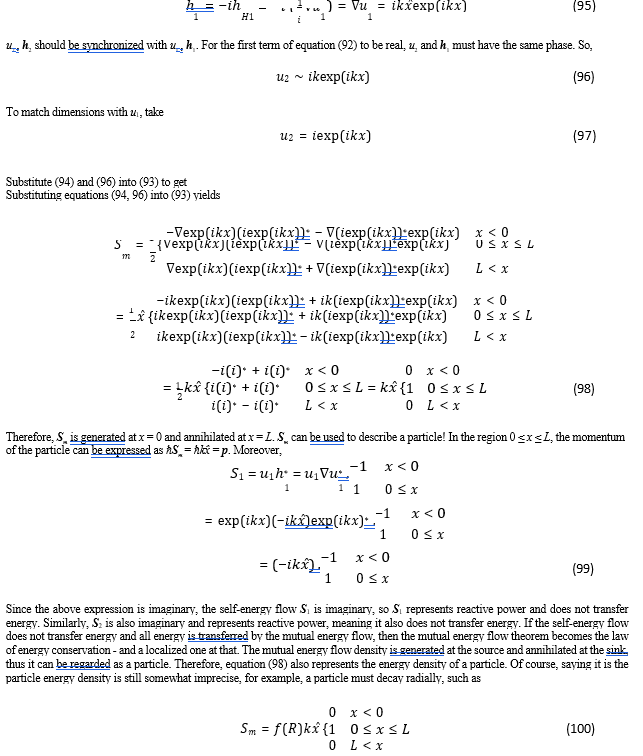
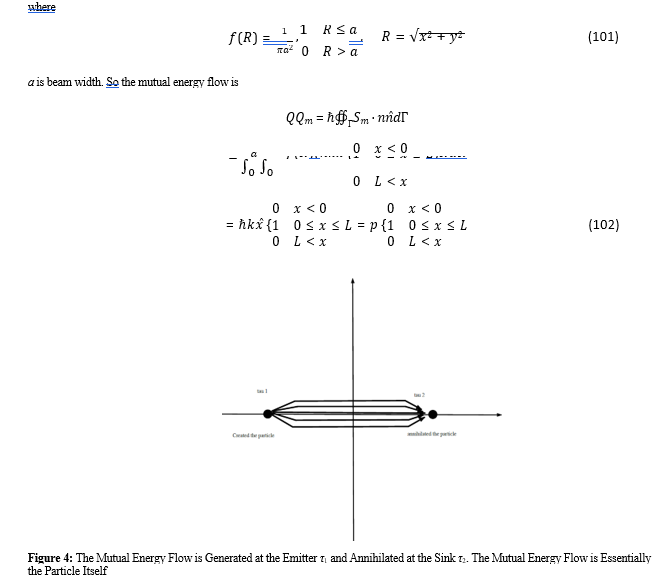
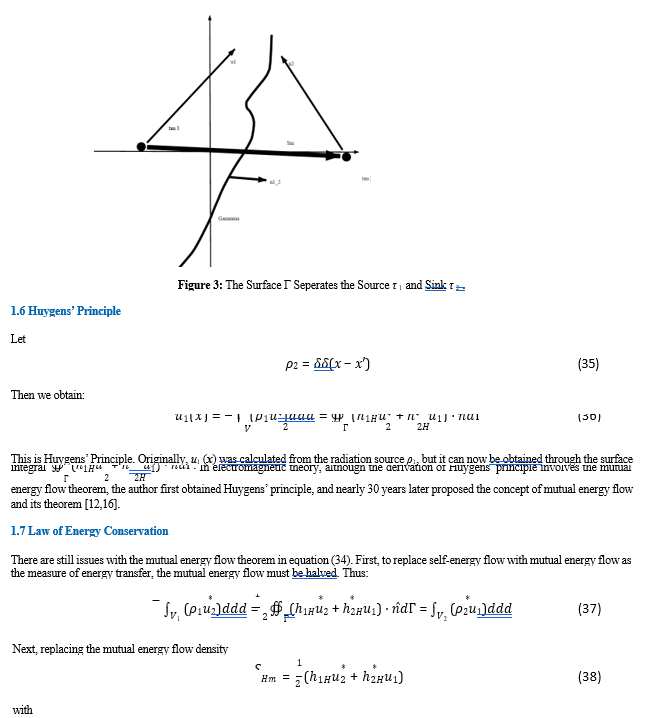
In this way, the mutual energy flow Qm corresponds to the particle’s momentum p in the region 0 ≤ x ≤ L and is zero outside this region. Thus, Qm can be regarded as the particle itself. See Figure 4.
Conclusion
This paper starts from the Helmholtz equation and demonstrates that the energy flow of a particle should be described by mutual energy flow, rather than self-energy flow. The so-called self-energy flow corresponds to the Poynting vector in electromagnetic field theory and to the probability current density in quantum theory. The self-energy flow consists of waves generated by a single source. In contrast, mutual energy flow must be composed of waves from two different sources: one being a radiation source generating retarded waves, and the other a sink generating advanced waves. The mutual energy flow is formed by the combination of both retarded and advanced waves. However, particles cannot be directly constructed from the Helmholtz equation alone. It is necessary first to modify the Helmholtz equation by adding a source and a sink, introducing a magnetic field, and then correcting the magnetic field. Additionally, the intensity of the mutual energy flow must be compressed to half of its original value. These modifications imply that mutual energy flow is not derived directly from the Helmholtz equation, but rather, the Helmholtz equation is used as an auxiliary equation. By utilizing the quasi-static form of the Helmholtz equation, mutual energy flow is obtained and then extended to radiation conditions, resulting in the mutual energy flow law, or the energy conservation law. The fields in the mutual energy flow thus derived already deviate from the solutions of the Helmholtz equation. Only with such deviations can a proper description of particles be constructed.
In traditional electromagnetic theory and quantum theory, starting from Maxwell’s equations or Schrödinger’s equation never leads to the formation of particles. The reason is that, in order to obtain particles, one must deviate from the solutions of these equations. These equations all yield self-energy flow, whereas constructing the correct mutual energy flow requires deviations from them. It is necessary to correct the so-called "magnetic field". Only after such corrections can the correct particle energy flow be constructed. These energy flows are mutual energy flows. The mutual energy flow density is precisely the energy flow density of a particle. In this way, particles are constructed using retarded and advanced waves.
The author speculates that the scalar potential Ï? corresponding to the electromagnetic field can also form a scalar photon or light particle.
This work establishes a unified theoretical framework connecting electromagnetic wave theory, classical field equations, and quantum mechanics through the concept of mutual energy flow. By rigorously analyzing the Helmholtz, wave, Klein-Gordon, and Schrödinger equations, we demonstrate that:
Energy Localization Mechanism: Traditional self-energy flow (Poynting vector/probability current) describes reactive power, while mutual energy flow forms particle-like energy channels via retarded-advanced wave synchronization.
Field Equation Revisions: A corrected magnetic field definition and halved mutual energy flux are required to derive energy-conserving solutions, resolving classical radiation paradoxes.
Wave-Particle Unification: Particles emerge as quantized mutual energy flows, bridging Maxwell’s and Schrödinger’s equations while aligning with absorber theory and transactional interpretation.
Key Implications: Challenges classical field theory’s treatment of radiation reaction and proposes testable advanced wave signatures.
Future work will focus on experimental validation and relativistic extensions.
References
- K. Schwarzschild. Nachr. ges. Wiss. Gottingen, pages 128,132, 1903.
- H. Tetrode. Zeitschrift fuer Physik, 10:137, 1922.
- A. D. Fokker. Zeitschrift fuer Physik, 58:386, 1929.
- P. A. M. Dirac. Proc. Roy. Soc. London Ale, 148, 1938.
- Wheeler. J. A. and Feynman. R. P. Rev. Mod. Phys., 17:157, 1945.
- Wheeler. J. A. and Feynman. R. P. Rev. Mod. Phys., 21:425, 1949.
- Lawrence M. Stephenson. The relevance of advanced potential solutions of maxwell’s equations for special and general relativity. Physics Essays, 13(1), 2000.
- H. A. Lorentz. The theorem of poynting concerning the energy in the electromagnetic field and two general propositions concerning the propagation of light. Amsterdammer Akademie der Wetenschappen, 4:176–187, 1896.
- V.H. Rumsey. Reaction concept in electromagnetic theory. Phys. Rev., 94(6):1483–1491, June 1954.
- W. J. Welch. Reciprocity theorems for electromagnetic fields whose time dependence is arbitrary. IRE trans. On Antennas and Propagation, 8(1):68–73, January 1960.
- Shuang ren Zhao. The application of mutual energy theorem in expansion of radiation fields in spherical waves. ACTA Electronica Sinica, P.R. of China, 15(3):88–93, 1987.
- Shuangren Zhao. The simplification of formulas of electromagnetic fields by using mutual energy formula. Journal of Electronics, P.R. of China, 11(1):73–77, January 1989.
- Shuangren Zhao. The application of mutual energy formula in expansion of plane waves. Journal of Electronics, P. R. China, 11(2):204–208, March 1989.
- Adrianus T. de Hoop. Time-domain reciprocity theorems for electromagnetic fields in dispersive media. Radio Science, 22(7):1171– 1178, December 1987.
- I.V. Petrusenko and Yu. K. Sirenko. The lost second lorentz theorem in the phasor domain. Telecommunications and Radio Engineering, 68(7):555–560, 2009.
- Shuang ren Zhao. A new interpretation of quantum physics: Mutual energy flow interpretation. American Journal of Modern Physics and Application, 4(3):12–23, 2017.
- Shuang ren Zhao. Photon can be described as the normalized mutual energy flow. Journal of Modern Physics, doi: 10.4236/ jmp.2020.115043, 11(5):668–682, 2020.
- shuang-ren Zhao. Electromagnetic wave theory of photons: Photons are mutual energy flows composed of retarded and advance waves. amazon, 2024.