

Journal of Mathematical Techniques and Computational Mathematics(JMTCM)
ISSN: 2834-7706 | DOI: 10.33140/JMTCM

Impact Factor: 1.3


Research Article - (2025) Volume 4, Issue 9
Mathematical Modeling of the Sliding Friction Coefficient Depending on Speed and Load
2Department of Biotechnical Systems, National University of Science, and Technology Politehnica Bucharest, Romania
Received Date: Aug 06, 2025 / Accepted Date: Sep 17, 2025 / Published Date: Sep 26, 2025
Copyright: ©©2025 Filip Ilie, et al. This is an open-access article distributed under the terms of the Creative Commons Attribution License, which permits unrestricted use, distribution, and reproduction in any medium, provided the original author and source are credited.
Citation: Ilie, F., Ipate, G. (2025). Mathematical Modeling of the Sliding Friction Coefficient Depending on Speed and Load. J Math Techniques Comput Math, 4(9), 01-04.
Abstract
Friction is a complex of irreversible processes of mechanical energy transformation that occur during the motion of macroscopic bodies, particularly when a body slides over another one. This problem appears to be impossible to solve based on mechanical equations because it requires combining and solving a relatively large number of equations for all the particular elements of the system. This is also the reason why it appeals to modeling methods, which start from general cases to arrive at models having a determined structure based on hypotheses and peculiarities. This paper aims to determine the relative dependency of the dry friction coefficient on speed and normal pressure force through mathematical modeling, based on certain simplifying hypotheses.
Keywords
Friction coefficient, Dry sliding, Mathematical modeling, Hypotheses, Speed, Load: Contact area
Introduction
The dimensionless quantity known as the friction coefficient has been used for a long time in science and engineering. The friction coefficient is easy to define but not easy to understand on a fundamental level [1,2].
Conceptually defined as the ratio of two forces acting, respectively, perpendicular and parallel to an interface between two bodies under relative motion or impending relative motion, this dimensionless quantity turns out to be convenient for depicting the relative ease with which materials slide over one another under particular circumstances [1].
Even though the friction coefficient can be measured with little difficulty under laboratory conditions, the time, speed, and load- dependent characteristics and other conditions associated with both clean and dry and lubricated surfaces have proven exceedingly difficult to predict a priori from the first [1,2].
The materials involved in systems engineering are composed of different-sized elements. To study the influence of the sliding friction coefficient corresponding to different-sized elements Liu et al. used the discrete element method (DEM) on the simulation results, establishing a two-dimensional DEM model based on the experimental data for analysis [3].
Hentschke and Plagge investigated the coefficient of sliding friction on dry surfaces via scaling and dimensional analysis depending on sliding speed, temperature, and load [4]. They are finally obtaining a comparatively simple expression for the coefficient of friction, which allows a physically intuitive understanding that correlates with the experimental data for various speeds, temperatures, and pressures.
Friction may be studied as a complex of irreversible processes of mechanical energy transformation that occur during the motion of macroscopic bodies, in the exterior, and in a particular case, when a body slides over another one. It seems impossible to solve this problem based on mechanical equations, for example, because of the need to combine and solve a relatively large number of equations for all the particular elements of the system, which seem simple. This is also why scientists refer to modeling methods, which start from more general cases and pass to models having a determined structure based on peculiarities [4-8].
Therefore, the paper attempts to present a mathematical model of the friction coefficient during dry sliding of two elements in a given mechanical system, depending on two parameters: relative velocity/speed and load in the contact area.
Hypothesis
With the modeling trial shown here, we mean to settle a relatively steady dependence of the dry friction coefficient on the speed and normal pressure force by assuming the following hypotheses:- it is admitted that to achieve sliding friction, a certain point of closeness of the bodies sliding one over the other is necessary The reciprocal normal force achieves this closeness, N, between the bodies in contact. The reciprocal normal force of the system of bodies sliding one over the other may have two components: the external one, Ne, generated from the system outside, and the internal one, Ni, caused by the reciprocal or rejection of the system bodies, thus:

It should be noted that Ne is easily determined, while Ni may be more difficult to establish;
- the relative motion speed of the sliding bodies is considered to be the main element that influences the dry friction phenomenon in a determined period
- it is admitted theoretically that variation of the contact area geometrical dimensions does not play a decisive part, supposing that, because of the micro-roughness distortion of the surfaces in contact under the external forces, the actual contact surface is relatively constant [8-10];
- it is supposed that the friction force, Ff, depends on the normal force, N, with its external, Ne, and internal, Ni, components, and the sliding speed, v [2, 9, 11].
If we limit ourselves to these two elements, the process of actual bodies’ friction is greatly simplified. This statement may be counteracted by admitting that, independently of the physical properties of the friction pair, the power dissipation takes always place and accompanies the friction process, changing single coupler bodies by other ones, the dependence structure between N, Ne , ve, and Fe does not change, it is only the coefficients numerical value that change as the process may be considered to modify [2, 9-11].
Mathematical Method
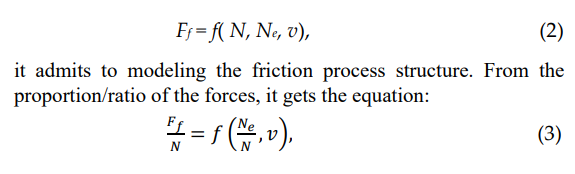
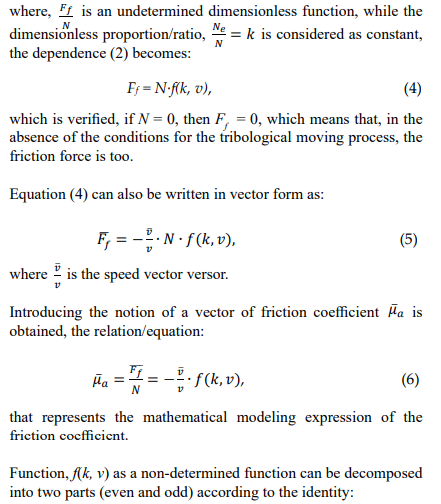
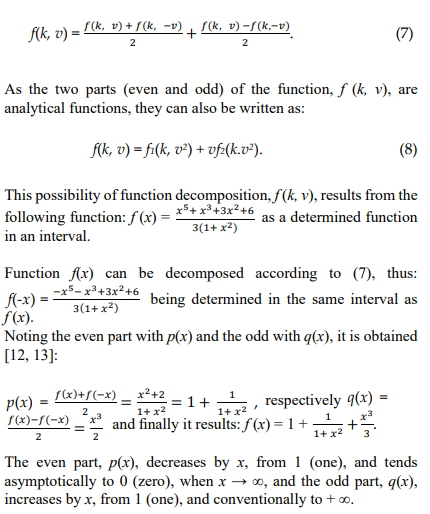
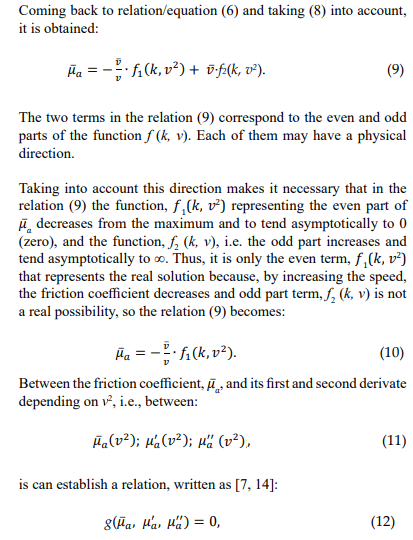
The dependence it admits to modeling the friction process structure. From the proportion/ratio of the forces, it gets the equation:
Discussion
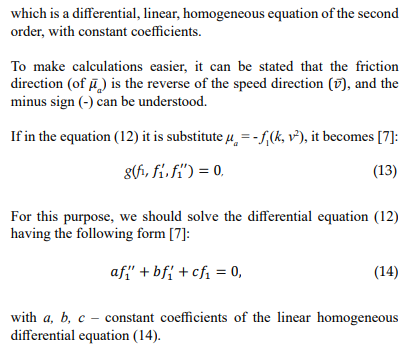
Studying the solutions of these equations (14), it follows that the equation admits particular solutions of the form [7, 14, 15]:
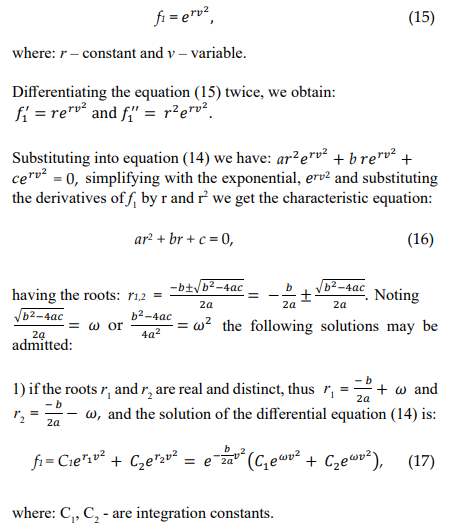
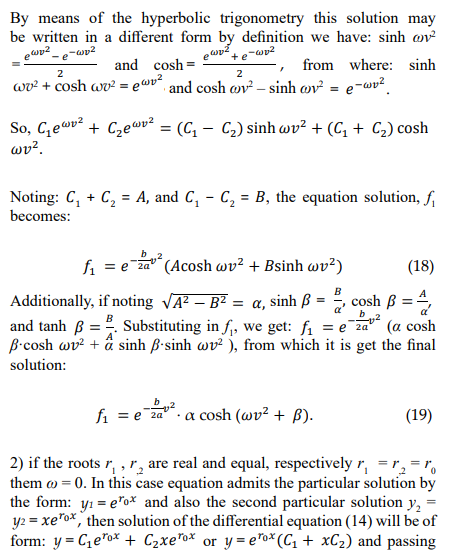
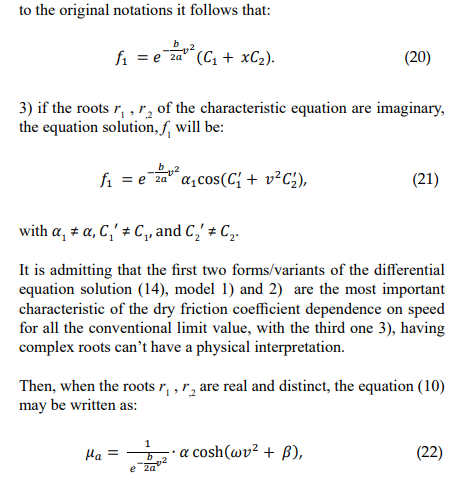
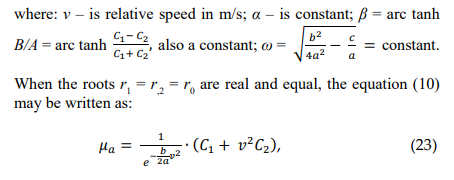
with v in m/s, the values of C1 and C2 are in direct proportional ratio with μa; the coefficient a influences directly, and the b one inversely the friction coefficient μa.
Conclusions
These two solutions of the linear, homogenous differential equation of the second-order model are the most characteristic part of the functional dependence of the dry friction coefficient in comparison with the normal load and speed for all values.
The integration constants and the constant coefficients have physical directions that, if determined, give practical values to the mathematical modeling expressions.
To conclude, we must bear in mind that, even in the case of simplifying hypotheses of the friction process, the mathematical relations, although complicated, do not always offer general solutions
References
- Blau, P. J. (2001). The significance and use of the friction coefficient. Tribology International, 34(9), 585-591
- Pavelescu, D., & Tudor, A. (1987). The sliding friction coefficient—its evolution and usefulness. Wear, 120(3), 321- 336.
- Liu, P., Rui, Y., & Wang, Y. (2024). Study of the Sliding Friction Coefficient of Different-Size Elements in Discrete Element Method Based on an Experimental Method. Applied Sciences, 14(19), 8802.
- Hentschke, R., & Plagge, J. (2021). Scaling theory of rubber sliding friction. Scientific Reports, 11(1), 18306.
- Morgan, D. A. (2007). Differential and Integral Calculus, Ed.Cosimo Classics, ISBN 9781602063792.
- Siretchi G. (1985). Differential and Integral Calculus, vol 2 (in Romanian), Ed. Scientific and Encyclopedic, Bucharest, Romania
- Lia, A., Morozan, T. (1978). Differential and Integral Calculus Problems (in Romanian), 3rd Edition Completed and Revised,Technical Publishing House, Bucharest, Romania.
- Zhang, S., Li, D., & Liu, Y. (2022). Friction behavior of rough surfaces on the basis of contact mechanics: a review and prospects. Micromachines, 13(11), 1907.
- Tudor, A. (1990). Real contact of the friction surfaces. Bucuresti, Editura Academiei Romane (in Rumanian).
- Liang, X. M., Xing, Y. Z., Li, L. T., Yuan, W. K., & Wang,G. F. (2021). An experimental study on the relation between friction force and real contact area. Scientific Reports, 11(1), 20366.
- Johnson, K.L. Contact Mechanics; Cambridge University Press: Cambridge, UK, 1989
- Debnath, P., Srivastava, H. M., Torres, D. F. M., & Cho, Y.J. (2025). Mathematical analysis. In Chapman and Hall/CRCeBooks.
- Horwitz, A. L. A. N., & Ebrahimpour, A. R. Y. A. (2002). Engineering applications in differential and integral calculus. International Journal of Engineering Education, 18(1), 78-88.
- Mahmudov, E. (2013). Single variable differential and integralcalculus. Atlantis Press.
- Mizraji, E. (2014). Differential and integral calculus for logical operations. A matrix–vector approach. Journal of Logic and Computation, 25(3), 613-638.