


Review Article - (2026) Volume 11, Issue 1
Marital Relationships Research: A Narrative Review
Received Date: Dec 15, 2025 / Accepted Date: Jan 06, 2026 / Published Date: Jan 20, 2026
Copyright: ©2026 Tiffany Field. This is an open-access article distributed under the terms of the Creative Commons Attribution License, which permits unrestricted use, distribution, and reproduction in any medium, provided the original author and source are credited.
Citation: Field, T. (2026). Marital Relationships Research: A Narrative Review. Int J Psychiatry, 11(1), 01-08.
Abstract
This narrative review of research on marital relationships research published in 2024-2025 includes papers on positive effects, risk factors for marital dissatisfaction, buffers and interventions. The positive effects include less loneliness, greater intimacy, less cognitive decline, less depression and better quality of life. Other effects include greater activity in older couples but less activity in younger couples, overweight in younger couples and better sleep. The risk factors for marital dissatisfaction include being ultrasensitive, lonely and ambivalent, having marital strain, experiencing stressors especially partner distress and being discordant on alcohol use with one's partner. The buffers include mindfulness, positive humor, cognitive function, sharing work experiences, having friends and affectionate touch. Only three intervention studies appeared including rational-emotive therapy, solutions-focused therapy and teletherapy. Methodological limitations include samples that have combined short-term and long-term marriages and same-sex and different-sex couples that would be expected to differ and the absence of seemingly obvious risk factors like sexual dysfunction and infidelity.
Introduction
Marriage has been defined as a legal and social union typically between two people, creating a formal bond with recognized rights and obligations. Marriage serves various purposes like companionship, procreation and economic stability and is recognized through legal and/or religious ceremonies. The structure and context of marriage vary across cultures and over time. This narrative review summarizes papers that have appeared in the current literature on marriage (2024-2025). A narrative review was selected as opposed to other types of reviews because it’s a general descriptive overview of a topic that summarizes existing literature without a strict methodology. Other types of reviews such as scoping or systematic reviews require more rigorous, less variable research than the research on marriage that was published in 2024-2025.
The papers included in this review were derived from PubMed and PsycINFO by entering the terms marriage, marital relationships and the years 2024-2025. Exclusion criteria for this review included proposed protocols, case studies and non-English language papers. The papers can be categorized as effects of marriage, risks for marital dissolution, buffers for marital satisfaction and interventions. Of the 28 papers that were found, 10 are focused on the effects of marriage, 9 on risks of marital dissatisfaction, 7 on buffers for marriage and only 3 for interventions.
Effects of Marriage
Almost all the papers on effects of marriage have addressed positive effects of marital satisfaction (see table 1). These include psychological effects like less loneliness, greater intimacy, less cognitive decline, less depression, and better quality of life. Physical effects have included greater activity in older couples but less activity in younger couples, overweight in younger couples and better sleep.
|
Effects |
|
First Authors |
|
|
Psychological Effects |
|
|
<loneliness |
|
Pengpid |
|
>intimacy |
|
Sorokowski |
|
<cognitive decline and dementia |
|
Huang |
|
<depression |
|
Nazaro-Acevedo, Pengpid, Cranney |
|
<postpartum depression |
|
Wei |
|
Physical Effects >physical activity in middle-aged and older people Yuan <physical activity in young people Tang >overweight/obesity/>BMI Tang, Quan >sleep Zhang |
||
Table 1: Effects of Marriage (and First Authors)
Psychological Effects
Many of the psychological effects are addressed in comparisons between married and single individuals. Less loneliness has been reported for married individuals, for example, in a study entitled “Marital status, mental transitions, and health behavior”, that was based on data from the Health, Aging and Retirement in Thailand Study (N= 2,863 individuals 45+ years old) [1]. The data analyses suggested that both single men and women had poorer quality of life and less happiness that led to greater loneliness. For women, being single was also associated with underweight and depression.
These data may not generalize to other countries, as marriage is considered a social norm in Thailand where this study took place, but marriage is less prevalent, for example, among young people in the U. S., especially in recent years. That single women were depressed is not surprising given that the prevalence of depression in women is twice that of men. The women being underweight might relate to their loss of appetite as one of the symptoms of depression.
Greater intimacy has also been reported for marriages, especially free marriages in non-western populations [2]. Greater intimacy in free marriages may have related to greater privacy from family members. In some cultures, however, female wives from arranged marriages reported greater intimacy and passion. This may relate to the arranged marriages being shorter-lived, less familiar relationships that were still at the romantic stage featuring greater intimacy and passion.
The duration of these relationships prior to marriage and during marriage is a potentially confounding variable in several of these studies. Also, different age groups have not been compared, although older partners might be expected to experience less passion and intimacy. In addition, the number of previous marriages might be a confounding variable or how soon the current marriage happened following a divorce or the death of a previous spouse.
Marriage has also protected against cognitive decline and dementia, for example, in a cohort from China (N = 24,596) [3]. In this sample, single people were at greater risk than married people for dementia and cognitive decline. Marriage may protect against cognitive decline and dementia by virtue of the opportunity for more verbal and physical interaction with partners and the stress-buffering effects of those interactions.
Less depression has been reported for marriage in at least three studies. In research focused on marriage and depression symptoms among older Hispanic adults in the U.S. (N= 1,012 individuals 51+ years-old), for example, one unit increase in positive marital quality led to a 24% decrease in depression symptoms [4]. In contrast, one unit increase in negative marital quality led to a 24% increase in depression symptoms. As already mentioned, single women were particularly depressed in the sample from the Health, Aging and Retirement Study in Thailand [1]. Depression in single people may relate to several factors including less verbal and physical interaction and greater solitude and loneliness.
In a sample from the National Survey of Drug Use and Health, unmarried adults were three times more likely to be depressed than married adults [5]. This association was explained by those who were never married, which was more prevalent among youth versus divorced or widows in the sample. The unmarried were also at greater risk for suicidal thoughts, plans, and attempts, likely deriving from their greater depression. These results may be more related to the youth factor than the never-married factor, as the prevalence of both depression and suicidal behavior are greater in young people, especially adolescents and young adults. These behaviors have been attributed to excessive social media use and lower financial status.
Postpartum depression has also been less prevalent in married women, for example, in a systematic review and meta-analysis of 19 studies on the relationship between marriage and postpartum depression [6]. A general conclusion about the data from these 19 studies was that marital satisfaction led to a lesser incidence of postpartum depression. Marriage itself would be expected to lead to a lesser incidence of postpartum depression in the women because of the shared parenthood and childcare for the infant by two parents instead of one.
Physical Effects
A few physical effects have been the focus of research on marriage. These include physical activity, overweight/obesity, and better sleep.
Marriage effects on physical activity have been presented in at least two papers in this current literature. One research group addressed the influence of marriage and cohabitation on physical activity among middle-aged and older people (N= 1,113, 49-to-93-years-old) [7]. When non-partnered individuals became partnered, they engaged in more physical activity. The relationship between having a partner and physical activity may relate to physical activity happening more frequently because that activity is more pleasurable with a partner. A negative correlation was reported between disagreements and activity, with activity decreasing as disagreements increased. Partners might not want to exercise with each other if their interactions have been negative. The lack of activity may lead to depression.
Physical activity has been noted to reduce the risk of depression in a sample of women at risk of depression (N= 527) but not men at risk of depression (N=365) [8]. Likely this sample included more women at risk of depression than men at risk of depression because the prevalence of depression in women is twice the rate of depression in men. The moderating effects of physical activity on depression have been frequently reported. Some have related that to the increase in serotonin (the antidepressant neurotransmitter) during and following physical activity [9].
Surprisingly, in a younger married group, exercise decreased after marriage (20-to-30-year-old adults) [10]. No effect of marriage was noted on exercise in the 40-to 50-year-old group. The younger group may have been childbearing/childrearing which would reduce the time and energy available for exercise. The young group also became overweight or obese following a decrease in exercise which is a frequently reported negative effect of decreased exercise [9].
Overweight or an elevated BMI was also noted in another sample based on the China Health and Nutrition Survey [11]. This relationship was reported only for males 18-to-45-years-old who were getting less exercise, possibly because of their heavy work schedule.
Sleep was noted to benefit from marriage in a sample from the Chinese Longitudinal Healthy Longevity Survey (N= 8769) [12]. In this sample, marital satisfaction was related to better sleep. This was likely a reciprocal relationship with marital satisfaction leading to better sleep possibly related to less stress, and better sleep leading to greater marital satisfaction also because of less stress or less sleep deprivation or both.
Risk Factors for Marital Dissatisfaction
Several risk factors for marital dissatisfaction have been addressed in this literature on marriage (see table 2). These include being ultra-sensitive, lonely or ambivalent, experiencing marital strain and stressors, especially a partner’s distress, and being discordant on alcohol use with one's partner.
<img src="https://www.opastpublishers.com/scholarly-images/10132-69d3985c859a3-marital-relationships-research-a-narrative-review.png" width="500" height="300">
Being ultra-sensitive was a risk factor for marital dissatisfaction in a sample of 152 couples [13]. In this research, less marital satisfaction was associated with greater psychological distress, but especially for sensitive individuals. Individuals who are more sensitive would be more aware of marital problems which could lead to marital dissatisfaction and psychological distress.
Loneliness was a risk factor for marital dissatisfaction in at least two studies in this current literature on marriage. In one U.S. sample (N= 1,614 couples), loneliness was a risk factor [14]. Loneliness, surprisingly, led to pro–relational attitudes and behavior, but only when loneliness was moderated (lessened) by forgiveness and gratitude. That loneliness was a risk factor for marital dissatisfaction is consistent with research noted above. Although mediation/moderation analyses are typically based on theoretical models, the theoretical rationale is unclear for including forgiveness and gratitude as moderators in this study.
Romantic loneliness in men and married individuals has predicted hopelessness and sexual distress (N= 854) [15]. These data were based on the Romantic Loneliness Scale which measures the loneliness that is experienced by the lack of romance in the marital relationship (lack of love, intimacy and sexual activity). Married individuals would expect to experience romance in their relationship and without it, they could feel hopeless and sexually distressed. Men versus women, as noted earlier, were more affected by relationship dissatisfaction and might therefore have a greater sense of hopelessness.
Ambivalence may result from loneliness and lead to marital dissatisfaction. In data based on the Partner Ambivalence Scale (N= 390 adults 40+ years), greater ambivalence was associated with less marital satisfaction [16]. That scale measures the extent to which an individual feels torn between simultaneous positive and negative feelings toward their romantic partner. In this sample, a greater number of disagreements was related to greater depression. Greater ambivalence could have related to the greater number of disagreements. Regression analysis or structural equation modeling could have determined the degree to which ambivalence and disagreements contributed to less marital satisfaction and greater depression.
Marital strain was another risk factor for marital dissatisfaction. In research entitled “Marital dynamics and daily memory among aging same-sex and different-sex couples” (N=556 individuals 41 to 71 years-old), a 10-day daily diary was kept by the participants [17]. Marital strain was associated with daily memory failure. This was particularly pronounced in women in different sex marriages. That the women experienced more marital strain was inconsistent with the previously reported data suggesting that men were more stressed by marital problems. The association between marital strain and daily memory failure was likely a reciprocal or a bi-directional relationship.
External stressors have also related to marital instability in a longitudinal study on Chinese newlyweds (N=268, mean age = 30) [18]. In this sample, a bidirectional association was noted between external stressors and marital instability. External stressors at wave one of the research led to external stressors at wave two which, in turn, led to marital instability in wave three. The two different research groups from China have labeled marital dissatisfaction differently as marital strain and marital instability.
Partner distress was a risk factor for marital dissatisfaction in a paper entitled “A tale of two marital stressors: comparing pro¬inflammatory responses to partner distress and marital conflict” (N=102 couples age 25 to 90-years-old) [19]. In this study, blood samples were assayed for pro-inflammatory cytokines and negative mood was rated before and after watching a partner relate an upsetting personal memory. In a visit one to two weeks later, the couple discussed a conflict topic. Pro-inflammatory responses were noted after the partner's disclosure of the upsetting memory. Negative mood also increased during and after the disclosure.
Discordant alcohol use by the partners in married couples was a risk factor in a sample of older couples from the U.S. (N= 4,656 married different-sex couples greater than 50-years-old) [20]. In this sample from the Health and Retirement Study, couples who were discordant on their alcohol use and couples who drank excessively had lower marital survival rates. Unlike the previously discussed research on lower marital satisfaction, this research highlighted a risk factor for lower marital survival. Divorce was, surprisingly, not addressed in this current literature on marriage even though 40-50% of at least first marriages reputedly end in divorce.
Buffers for Marital Satisfaction
Several buffers for marital satisfaction have been the focus of research in this current literature (see table 3). They include mindfulness, humor, cognitive function, sharing work experiences, "me time" for working mothers, having friends, and affectionate touch. Surprisingly, none of these buffers are the opposite of the risk factors just reviewed.
<img src="https://www.opastpublishers.com/scholarly-images/10132-69d39a0eda9dd-marital-relationships-research-a-narrative-review.png" width="500" height="250">
Mindfulness has been a buffer for marital satisfaction (N= 199) [21]. In this sample other buffers included awareness, partner caring, and evaluating their romantic relationships. These other buffers likely confounded the mindfulness effects, but these variables were not entered into a regression or structural equation modeling to determine their relative effects on marital satisfaction.
Positive humor in both partners has buffered marital satisfaction. In research entitled “Humor styles and marital satisfaction: cluster analysis of the relationship”, marital satisfaction was greater when both partners used positive humor (N= 170 couples) [22]. Having a similar sense of humor would seemingly contribute to the initiation of a marriage despite the expression that “opposites attract”. Surprisingly, research on similarities and differences in partner personalities did not appear in this current literature on marriage.
Cognitive function has been currently considered a buffer for marital satisfaction by at least one research group. In their paper entitled “Cognitive function and friendship network characteristics among older couples” (N=2,944 dyads), the dyads had participated in the Health and Retirement Study [23]. Cognitive function was associated with the number of close friends and the frequency of contact with close friends which, in turn, increased marital satisfaction. Interdependence of cognitive function was also noted in the partners. As this was a mediation analysis, the degree to which cognitive function, number of close friends and frequency of contact with close friends contributed to marital satisfaction could not be determined. A regression analysis or structural equation modeling would have been necessary to determine the relative contributions of those variables.
Sharing work-related experiences was a buffer for marital satisfaction in couples from Hong Kong (N= 102) [24]. In this study, couples kept a fourteen-day daily diary and were surveyed one year later. The sharing of both positive and negative work experiences led to greater relationship quality. The simultaneous diary recording by the partners may have facilitated the sharing of their positive and negative work experiences and their reporting greater relationship quality. Participating in research frequently has intervention/therapeutic effects. As for most of the studies in this current literature, self-reporting has questionable reliability issues. “Faking good” has been noted for self-reporting and has been frequently considered a limitation of these studies.
“Having time for oneself” was a notable buffer in research on dual-career couples [25]. In this sample, having time for oneself increased vitality in both the working mothers as well as their husbands (N=79 dyads). The increased vitality in both spouses, in turn, enhanced their marital satisfaction. Vitality usually refers to having energy and being vigorous and active, although energy and activity were not measured in this study.
Affectionate touch has also buffered marital quality in couples (N= 559) [26]. Affectionate touch also enhanced sleep in this sample. Touching has significantly reduced stress, stress hormones and depression and increased serotonin in many studies in other literature [9]. Touching has also enhanced sleep, frequently due to a reduction in stress [9]. Touching has also increased natural killer cells which, in turn, decrease bacterial, viral and cancer cells [9]. These findings highlight the positive effects of touching not only on marital satisfaction but also on psychological and physical health in general.
Interventions/Therapies for Decreasing Marital Dissatisfaction
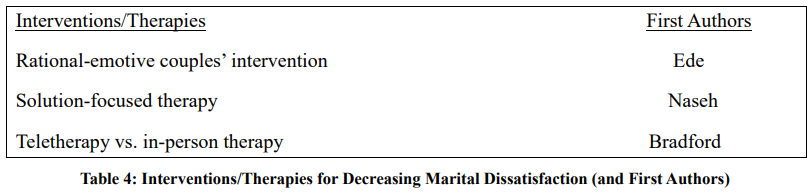
Only three intervention/therapy studies appeared in this current literature on marriages (see table 4). These included interventions called rational–emotive therapy, solutions– focused therapy and teletherapy.
Rational–emotive couples’ therapy was used in a sample of parents seeking divorce (N= 67 parents with marital burnout) [27]. These couples were experiencing marital burnout due to irrational beliefs, which led to their depression and likely their desire for divorce. The therapy decreased the couples’ marital burnout. The measure of irrational beliefs that led to the marital burnout was unclear. These results are tenuous as, unfortunately, this was not a randomized controlled study in which one group received rational-emotive therapy and another group was randomly assigned to a comparison therapy.
In contrast, the positive effects of solution – focused therapy were based on a systematic review of 26 randomized controlled trials [28]. Medium to large effect sizes were noted in improving marital outcomes of couples in Iran including dyadic adjustment, satisfaction and intimacy.
In a group comparison between teletherapy versus in-person therapy for married couples (N= 1,157 clients seeking couples' therapy), improvements were noted for both types of therapy [29]. Teletherapy was as effective as in-person therapy for improving outcomes. However, the “therapeutic alliance” was reputedly improved at twice the rate in the in-person therapy. Some have suggested that teletherapy has the advantage of seeing the facial expressions of participants more closely. However, the nonverbal “body talk” seen during in-person sessions has been thought to contribute more to the “therapeutic alliance” or “therapeutic relationship” between the therapist and the client.
Methodological Limitations of this Current Literature on Marriage
Several limitations can be noted for this current literature on marriage. Both cohabitation partners and those in marital relationships were recruited for some of the studies and often included in the same sample. Seemingly, these two types of relationships would differ on dimensions like duration of their relationships, romantic love and commitment. Short-term relationships, for example, have involved more physical intimacy and less physical intimacy has been reported for long-term relationships. Similarly, same-sex and different-sex couples have been combined in samples of these studies, and they also differed. Women of different-sex couples, for example, had the greatest stress, highlighting gender as a significant variable. Further, only one member of the relationship has typically been surveyed, which may be a biased perspective.
The literature on effects of marital satisfaction was focused primarily on lesser problems including less cognitive decline, loneliness and depression. The positive effects were greater physical activity and intimacy and better sleep. Several of the buffer variables might also be considered positive effects, for example, positive humor, sharing work experiences and affectionate touch. Although several studies focused on risk variables in this literature including ultra-sensitivity, ambivalence and discordant alcohol use, other seemingly obvious risk variables, surprisingly, were not addressed. For example, infrequent sexual activity and infidelity were not studied, nor was divorce except for an intervention study that included parents seeking divorce.
Only a few intervention studies appeared in this literature. Except for a review of solution-focused studies that were randomized controlled trials, the other two intervention papers reported positive effects of rational-emotive therapy and teletherapy, but they were not randomized controlled trials. Despite these limitations of the current literature on marriage, the results of the studies are suggestive of future research on marriage.
References
- Pengpid, S., Peltzer, K., & Anantanasuwong, D. (2024). Marital status, marital transition and health behaviour and mental health outcomes among middle-aged and older adults in Thailand: A national longitudinal study. Archives of Gerontology and Geriatrics, 117, 105196.
- Sorokowski, P., Groyecka-Bernard, A., Kowal, M., Butovskaya, M., Stefanczyk, M. M., Huanca, T., ... & JÄ?dryczka, W. (2025). Love Components in Free-Choice and Arranged Marriages Among Five Non-Western Populations From Africa, Amazonia, and Himalayas. Archives of Sexual Behavior, 54(1), 85-94.
- Huang, X., & Hilal, S. (2024). Marital history and cognition in a Chinese longevity cohort. Journal of Alzheimer’s Disease, 100(2), 675-683.
- Nazario-Acevedo, J. M., Yamashita, T., Bulanda, J. R., & Brown, J. S. (2024). Marital quality and depressive symptoms among older Hispanic adults in the United States. The Journals of Gerontology, Series B: Psychological Sciences and Social Sciences, 79(5), gbae032.
- Cranney, S., & Wilkinson, S. T. (2025). The relationship between marital status and risk for suicidal thoughts, plans, and attempts: Evidence for a growing association. Journal of Affective Disorders, 119862.
- Wei, M., Qin, Y., Niu, X., Niu, S., Mu, F., Yang, L., ... &Liu, Y. (2025). Marriage and postpartum major depressive disorder: A systematic review and meta-analysis of cohort studies. Journal of Psychiatric Research.
- Yuan, S., Elam, K. K., Johnston, J. D., & Chow, A. (2024). The influence of marriage and cohabitation on physical activity among middle-aged and older people. Journal of Applied Gerontology, 43(2), 139-148.
- Ni, R. J., & Yu, Y. (2024). Relationship between physical activity and risk of depression in a married group. BMC public health, 24(1), 829.
- Field, T. (2025). Relationships Research: A narrative review. J Psychol Clin Psychiatry, 16(6), 236-238.
- Tang, F., Pan, Y., & Deng, H. (2024). Effect of marriage on overweight and obesity: evidence from China. BMC Public Health, 24(1), 3591.
- Quan, S., & Zhang, H. (2024). The relationship between marriage and body mass index in China: evidence from the China health and nutrition survey. Economics & Human Biology, 53, 101368.
- Zhang, D. (2024). Spousal health, marital satisfaction, and older Chinese adults’ sleep: the moderating role of psychological resilience. Archives of Gerontology and Geriatrics, 120, 105329.
- Brown, S. M., Rhoades, G. K., Pluess, M., Allen, E. S., & Stanley, S. M. (2024). Genetic and subjective sensitivity, relationship dynamics, and psychological distress in couples. Journal of family psychology, 38(5), 743.
- Leavitt, C. E., Price, A. A., Inman, N. F., Lee, M., Sandridge, A., Harrison, Z., ... & Holmes, E. K. (2025). Loneliness Within a Romantic Relationship: Do Gratitude and Forgiveness Moderate Between Loneliness and Relational and Sexual Well-Being?. Journal of Sex & Marital Therapy, 51(3), 309-322.
- Husain, W., Husain, M. A., Ijaz, F., Farrukh, J., Batool, F.,Tahir, N., ... & Jahrami, H. (2025). The romantic loneliness scale (RomLon scale): the development and validation of a novel and brief measure to assess loneliness stemming from the absence of romance in dating, hookups, and marital relationships. BMC psychology, 13(1), 895.
- Fernandes-Pires, J. A., Márquez-González, M., Garcia-Garcia, L., Pedroso-Chaparro, M. D. S., Cabrera, I., Pillemer, K., & Losada-Baltar, A. (2025). Psychometric properties of the Partner Ambivalence Scale in middle-aged and older adults. Aging & Mental Health, 29(4), 623-630.
- Wang, Y., & Liu, H. (2025). Marital dynamics and daily memory among aging same-sex and different-sex couples. The Journals of Gerontology, Series B: Psychological Sciences and Social Sciences, 80(10), gbaf144.
- Li, T., Li, L. M. W., Sun, Y. Y., Chan, L. Y. C., Law, W., Jiang,D., ... & Wiese, B. S. (2024). Dualâ?earner couples' sharing of workâ?related experiences: Effects on relational and personal wellâ?being. Applied Psychology: Health and Wellâ?Being, 16(4), 2006-2025.
- Wilson, S. J., Syed, S. U., Yang, I. S., & Cole, S. W. (2024).A tale of two marital stressors: Comparing proinflammatory responses to partner distress and marital conflict. Brain, Behavior, and Immunity, 119, 898-907.
- Birditt, K. S., Turkelson, A., Polenick, C. A., Cranford, J. A., Smith, J. A., Ware, E. B., & Blow, F. C. (2024). Alcohol use and mortality among older couples in the United States: evidence of individual and partner effects. The Gerontologist, 64(2), gnad101.
- Park, C., Harris, V. W., & Fogarty, K. (2024). Mindfulness, awareness, partner caring, and romantic relationship quality: Structural equation modeling. Journal of Marital and Family Therapy, 50(2), 290-306.
- Tsai, M. N., Cheng, Y. C., & Chen, H. C. (2024). Humor styles and marital satisfaction: Cluster analysis of the relationship. Psychological Reports, 127(5), 2405-2426.
- Peng, C., Burr, J. A., Mutchler, J. E., & Carr, D. (2025). Cognitive function and friendship network characteristics among older couples. The Journals of Gerontology, Series B: Psychological Sciences and Social Sciences, 80(11), gbaf165.
- Li, Q., Xun, M., Chen, Z., Li, Y., Zhao, C., Ju, X., ... & Fang,X. (2024). Bidirectional or unidirectional? Longitudinal associations between external stressors, perceived spousal support, and marital instability. Family process, 63(3), 1185-1200.
- Cho, E., Allen, T. D., & Meier, L. L. (2025). Is ‘meâ?time’selfish?: Daily vitality crossover in dualâ?earner couples. Applied Psychology: Health and Wellâ?Being, 17(1), e70004.
- Lawrence, C., & Marini, C. M. (2024). Loneliness and Marital Quality as Predictors of Older Adults’ Insomnia Symptoms. The international journal of aging and human development, 98(2), 243-262.
- Ede, M. O., & Okeke, C. I. (2024). Testing the impacts of rational-emotive couple intervention in a sample of parents seeking divorce. Psychological Reports, 127(4), 1652-1677.
- Naseh, M., Badiezadeh, S., Rafieifar, M., Taridashti, S., Reddy, S. M., & Panisch, L. S. (2025). Solutionâ?Focused Brief Therapy for Improving Couple Dyadic Relationships in Iran: A Systematic Review. Journal of Marital and Family Therapy, 51(1), e12758.
- Bradford, A. B., Johnson, L. N., Anderson, S. R., Banford-Witting, A., Hunt, Q. A., Miller, R. B., & Bean, R. A. (2024). Call me maybe? In-person vs. teletherapy outcomes among married couples. Psychotherapy Research, 34(5), 611-625.