



Research Article - (2023) Volume 2, Issue 1
Knowledge Regarding Surgical Site Infection Among Post-Operative Bariatric Surgical Patients in Al Ahsa City
2IPC Specialist, IPC administration, MOH, Hasa, KSA
3RN, BSN, MSN s.specialist Researcher Representative in Prince Saud Bin Jalawi Hospital Hasa, KSA
4RN, BSN, MSN s.specialist ICU Head Nurse in Prince Saud Bin Jalawi Hospital Hasa, KSA
5RN, BSN, MSN s.specialist Deputy Director of Nursing in Prince Saud Bin Jalawi Hospital Hasa, KSA
6RN,Infection Control Coordination, Prince Saud Bin Jalawi Hospital Hasa, KSA
7RN, Infection Control Practitioner, Prince Saud Bin Jalawi Hospital Hasa, KSA
Received Date: Nov 18, 2023 / Accepted Date: Dec 26, 2023 / Published Date: Dec 29, 2023
Copyright: ©Ã?©2023 Al Shaikh Hanan Ahmad, et al. This is an open-access article distributed under the terms of the Creative Commons Attribution License, which permits unrestricted use, distribution, and reproduction in any medium, provided the original author and source are credited.
Citation: Al Shaikh, H. A., Naik, B. R., Alsalameen, A., Al Salman,, B., Al Saleh, A., et al. (2023). Knowledge Regarding Surgi-cal Site Infection Among Post-Operative Bariatric Surgical Patients in Al Ahsa City. J Surg Care, 2(1), 79-86.
Abstract
Patient knowledge of surgical site infection (SSI) is essential for their safety and reduced complications. This study aimed to assess the knowledge and awareness of post-surgical site infections among post-bariatric surgical patients in Al Ahsa City. The research, conducted with 90 participants, revealed that Patient knowledge of surgical site infection is a fair level of knowledge (55.6%), while the remaining 44.4% exhibited a poor level of knowledge. Descriptive analysis provided insights into participants' personal data, education, work, previous surgery, and post- surgical infection. Notably, 65.6% of participants were not employed, and 44 (48.9%) had a history of previous operations, with 13 (14.4%) reporting experiences of post-surgery infections. Participants' knowledge and awareness of SSIs were also evaluated, with a majority demonstrating awareness of various SSI symptoms and preventive measures. Overall, 55.6% of participants exhibited a good level of knowledge and awareness about SSIs. Furthermore, the study highlighted healthcare professionals as the most commonly reported sources of information about post-surgical site infections. These findings emphasize the importance of tailored educational interventions to increase the level of knowledge and enhance patient understanding of SSI symptoms and preventive measures among post-bariatric surgical patients. The study underscores the significance of considering demographic and experiential factors in developing targeted patient education strategies to improve post-surgery infection awareness and promote patient safety and decreased the rate of readmission following bariatric surgery. Future research can explore the educational interventions such as the use of virtual clinic.
Background Patient knowledge of surgical site infection (SSI) is essential for their safety and reduced complications.
Literature Review An infection at the surgical site in a deep or superficial wound within 30 days of the surgery is called a surgical site infection. Emergency surgeries (p=0.0001), American Society of Anesthesiologists high index (47.4%), long duration of surgical procedures, stay in the hospital before surgery for more than 24 hours and age from 18 to 81 years were found to be important contributing factors for SSI in this article by [1].
Surgical site infection is the third most commonest infection in the hospital, found in up to 38% of surgical patients. The rate of mortality is 77%. About 93% of patients have severe infections at the site of operation [2]. Surgical site infections reported by a national survey conducted in England hospitals was 1807 cases among various specialties and procedures [3]. Moreover, 1.7%of 120 patients' surgical site infections in the last 5 years were reported by researchers in Riyadh (Alotaibi et al., 2020). A previous study found that surgical site infection is more common among obese patients undergoing abdominal surgery (p<0.001) [4].
Pseudomonas aeruginosa, Staphylococcus aureus, and coagulase-negative staphylococci were the most frequently isolated organisms in surgical sites (Julius et al., 2018). Surgical site infection is a life-threatening if not managed well. It can lead to various complications such as reoperation (36.2%) and readmission (49.7%). Moreover, SSI correlates with delayed discharge from the hospital by 34.1% [3]. A study done on the economic burden caused by SSI found that the median additional cost attributable to SSI was to the tune of 5,239 GBP in a 2-year study done in an NHS trust hospital [5]. Based on relevant practical guidelines, antimicrobial prophylaxis should be administered before surgical procedures and patients should take complete bath with or without antimicrobial soap. Before making a skin incision, clean the skin with an antiseptic solution. Avoid topical antimicrobial agents at the surgical incision after surgery [6]. Surgical site infection is one of the most commonly acquired infections at hospitals. Determination of knowledge of patients on SSI and symptoms may be useful in improving their awareness and safety after discharge. Therefore, in this study, we will evaluate patients' knowledge of SSI and its symptoms.
Keywords
Surgical Site Infection, Patient and Knowledge
• Aim
The aim of the study is to determine the knowledge regarding surgical site infection among patients who have undergone bariatric surgery.
• Research Questions.
What is the knowledge level of patients on surgical site infection?
• Research Methods Design.
A descriptive cross-sectional design be used in this study through a structured questionnaire.
• Setting and Participants
100 patients will be selected from the surgical unit in Prince Saud Bin Jalawi Hospital (150 bedded hospital) between September 2023 to November 2023. There is no sample size technique and selected used. Keeping in mind the administrative and logistical challenges the sampling is purposive. The data will be collected after the patients give informed consent. Those who agree to participate will be interviewed by one of the researchers to ensure that all survey items are clear and comprehensive. Questions will be electronic designed in Google forms. SPSS for Windows and EpiData will be used for the analysis of data.
• Instrument
The questionnaire consists of demographic data and knowledge of surgical site infection symptoms. The questionnaire will be translated into Arabic and validated in a pilot study before introducing to the patients.
• Ethical considerations
Necessary approval from the Ethical Committee in Al Hasa (Cluster E2) was taken. Informed consent from the patients obtained during data collection.
Data Analysis
The data were collected, reviewed, and then analysed using the Statistical Package for Social Sciences version 21 (SPSS: An IBM Company). All statistical methods used were two- tailed with alpha level of 0.05 considering significance if P value was less than or equal to 0.05. Regarding knowledge and awareness, each correct answer was given a 1-point score. Overall knowledge level regarding post-surgical infection was assessed by summing up discrete scores for different correct knowledge items. The overall knowledge score was categorized as “poor level” if the participants' score was less than 60% of the overall score and a “good level” of knowledge was considered if the participants' score was 60% or more of the overall score. Descriptive analysis was done by prescribing frequency distribution and percentage for study variables including participants' personal data, education, and work. Also, participants' previous surgery and post- surgical infection were tabulated. Participants' knowledge and awareness items and domains for post-surgical infections were tabulated while the overall knowledge level was graphed. Cross tabulation for showing factors associated with participants' knowledge and awareness of post- surgical site infection was carried out with Pearson chi-square test for significance and exact probability test if there were smaller frequency distributions.
Results
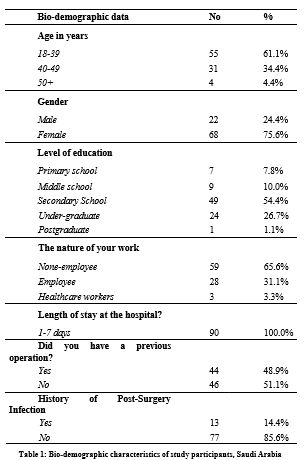
A total of 90 eligible participants completed the study questionnaire—participants aged 18 to over 50 years with a mean age of 25.6 ± 11.8 years old. Exact of 68 (75.6%) participants were females. As for educational level, 49 (54.4%) had a secondary level of education, 24 (were undergraduate, and 16 (17.8%) had a lower level of education. A total of 59 (65.6%) were not employed, 28 (31.1%) were employees and 3 (3.3%) were health care workers. All participants stayed 1-7 days in the hospital and 44 (48.9%) had a previous operation but 13 (14.4%) had of Post-Surgery Infection (Table 1).
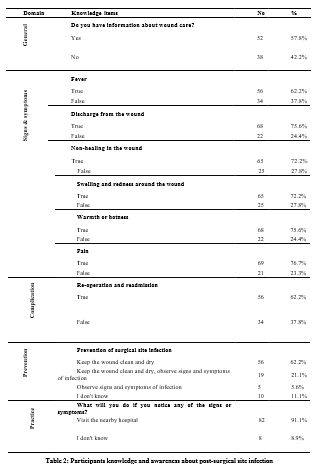
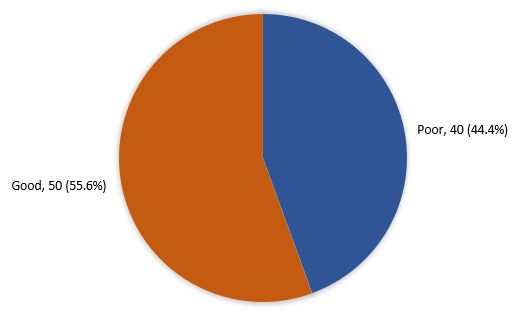
Table 2. Participants' knowledge and awareness about post-surgical site infection. About, 52 (57.8%) participants reported to have information about wound care. As for signs of SSIs, 76.7% knew about pain, 75.6% reported discharge from the wound, followed by feeling of warmth/ hotness (75.6%), 72.2% reported delayed healing in the wound, and 72.2% told about having swelling and redness around the wound. Exact of 56 (62.2%) reported that the need for operation and readmission is a complication for SSI. Regarding prevention of SSI; 56 (62.2%) participants told that the wound should be kept clean and dry, 19 (21.1%) responded as to observe signs and symptoms of infection also in addition to keeping the wound clean and dry, and 5 (5.6%) participants’ response was only to observe signs and symptoms of infection. A total of 82 (91.1%) of the participants knew that they should visit the nearby hospital for SSIs. Figure 1. Overall participants' knowledge and awareness about post-surgical site infection. Exact of 50 (55.6%) participants had an overall good knowledge and awareness about SSIs while 40 (44.4%) had poor knowledge level.
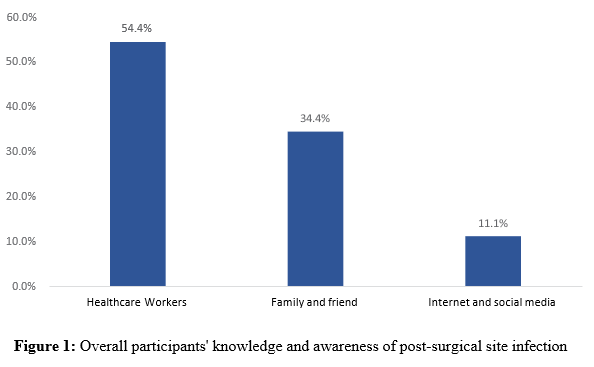
Figure 2. Source of information about post-surgical site infection. The most reported sources were healthcare workers (54.4%), family and friends (34.4%), and internet with social media (11.1%).
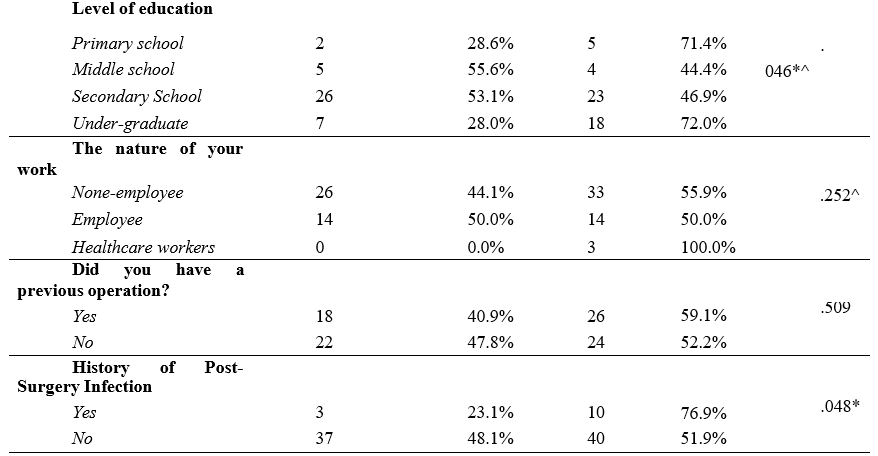
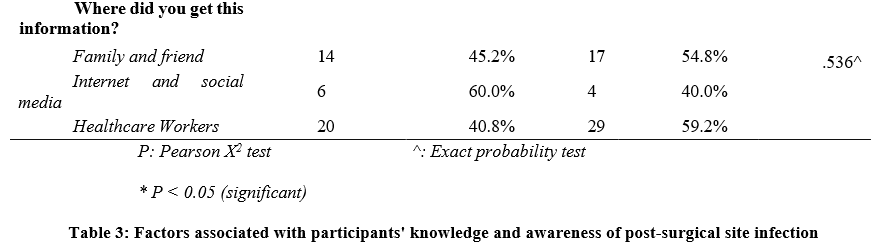
Table 3. Factors associated with participants' knowledge and awareness of post-surgical site infection. The level of education had a significant difference when the participants were assessed for their knowledge regarding SSIs (P=.046). Approximately 76.9% of participants with a History of Post-Surgery Infection had significantly good knowledge compared to 51.9% of the rest of participants. (P=.048). The other factors such as age, gender, nature of work and source of information did not show any significant difference with respect to the level of SSI knowledge among the participants.
Conclusion
This study aimed to assess the knowledge of post-surgical site infections (SSIs) among participants. To the best of our knowledge, this is the first study from Saudi Arabia that has assessed the knowledge of SSI among post bariatric surgery patients. The findings provide valuable insights into the participants' knowledge, demographic factors, sources of information, and implications for patient education and healthcare practices. The results suggest that the level of participant`s knowledge was fair, while a majority of participants demonstrated knowledge of certain aspects of post-surgical site infections, there were notable gaps in knowledge regarding specific signs, symptoms, and preventative measures. For instance, while a high percentage of participants were aware of the need to visit a hospital for SSIs, there was lower awareness of specific signs and symptoms. A previous multi-site cross-sectional study on post-surgical site infections Alsahli et al. (2022) found similar results that revealed fair level of knowledge about SSI. This indicates the potential for targeted educational interventions aimed at improving knowledge and awareness of post-surgical site infections among individuals.
The observed knowledge gaps may be attributed to various factors, including the influence of educational level and previous healthcare experience on participants' understanding of SSIs. Notably, the findings revealed that participants with a higher level of education and those with a history of post-surgical infection demonstrated better overall knowledge levels. This is in accordance with the Nepali Study, the mean score of SSI knowledge was higher in literates than in illiterates and the difference was statistically significant since the p value was<0.05 Additionally, Bajracharya et al. found that the score was higher among participants who had history of previous surgery vis-a-vis those who did not, but the difference was not statistically significant. Another study conducted in Saudi Arabia revealed that 14.4% of study`s population had no history of previous surgeries and infections, in comparison to our study`s results where 48.9% patients reported no history of previous surgeries [7,8]. These results underscore the impact of educational background and personal experiences on knowledge acquisition and retention. As such, future educational interventions could be tailored to address the specific needs of diverse patient populations, taking into account varying levels of education and personal experiences with post-surgical infections.The study's results have significant implications for patient education and healthcare practices.
The high percentage of participants who reported healthcare workers as a major source of information about post-surgical site infections underscores the crucial role of healthcare providers in disseminating information and educating patients. However, in a previous cross- sectional study conducted in Saudi Arabia, only 32.8% of the patients reported that healthcare workers (HCWs) educated them about SSIs [9]. Furthermore, in the USA study, while majority of participants were aware of SSI manifestations and adverse consequences, the source of information was not received during their hospitalization period [10]. This study highlights the need for effective patient-provider communication and education to promote patient empowerment and proactive healthcare decision-making. Moreover, the lower awareness of specific signs and symptoms of SSIs may have implications for early detection and management of these infections. Targeted patient education and healthcare provider interventions could address these gaps, leading to improved patient outcomes and healthcare practices.
Furthermore, the associations between educational level, previous infection history, and overall knowledge and awareness of SSIs have important implications for patient education and healthcare practices. Healthcare providers can leverage these findings to design tailored educational interventions that address the specific needs of diverse patient populations, taking into account varying levels of education and personal experiences with post-surgical infections. This approach aligns with the principles of patient-centered care and may contribute to improved patient outcomes and healthcare practices.
Limitations of the Study
Despite its strengths, the study also exhibits certain limitations that should be acknowledged.
• The use of a purposive sampling technique may limit the generalizability of the findings to a broader population. As such, the results may not be fully representative of other patient populations.
• Furthermore, the reliance on self-reported responses from participants may introduce the potential for response bias.
• Additionally, the study's reliance on a single hospital setting might potentially affect the comprehensiveness of the findings. However, this setting was the only governmental hospital in Eastern region where the bariatric surgery was performed. Future study can assess the knowledge in other regions as well as private hospital settings.
• Some cases were not reachable as the appointments were very far, thus, future studies can explore different modalities of reaching such patients using platforms like virtual clinic.
Implications of the Research
The findings of this research hold important implications for clinical practice, patient education, and public health initiatives. By identifying the knowledge level and associated factors related to post-surgical site infections, the study provides valuable insights that can inform the development of targeted educational interventions and healthcare policies aimed at improving patient awareness and early detection of SSIs. Furthermore, the study's focus on a specific hospital setting underscores the potential for tailored interventions within this context, such as the implementation of educational programs and materials designed to enhance patient knowledge and awareness of post-surgical site infections. These initiatives, informed by the study's findings, could contribute to improved patient outcomes, reduced healthcare costs, and enhanced quality of care within the hospital and similar healthcare settings.
In a broader public health context, the research findings may also inform the development of community-based outreach programs aimed at raising awareness of post-surgical site infections among diverse populations. By leveraging the insights gained from this study, public health initiatives can be tailored to address specific demographic and educational factors that influence knowledge and awareness of SSIs, ultimately contributing to improved health literacy and proactive healthcare decision-making. In conclusion, the results of this study shed light on the knowledge and awareness of SSIs among participants who underwent bariatric surgery and the factors associated with their level of understanding. The findings underscore the need for tailored continuous educational interventions and highlight the crucial role of healthcare providers in equipping patients with essential knowledge about post-operative SSI. By addressing the identified knowledge gaps and leveraging the associations between demographic and clinical factors, healthcare providers can enhance patient education, ultimately, these efforts have the potential to improve patient outcomes.
Acknowledgements
We would like to show our appreciation to the E2 (Eastern Region & Prince Saud Bin Jalawi Hospital for their valuable help in conducting this research.
References
- Ansari, S., Hassan, M., Barry, H. D., Bhatti, T. A., Hussain,S. Z. M., Jabeen, S., & Fareed, S. (2019). Risk factors associated with surgical site infections: a retrospective report from a developing country. Cureus, 11(6).
- Alexiou, K., Drikos, I., Terzopoulou, M., Sikalias, N., Ioannidis, A., & Economou, N. (2017). A prospective randomised trial of isolated pathogens of surgical site infections (SSI). Annals of medicine and surgery, 21, 25-29.
- Wong, J. L. C., Ho, C. W. Y., Scott, G., Machin, J. T.,Briggs, T. W. R., & National Surgical Site Infection Audit Collaborators. (2019). Getting it right first time: the national survey of surgical site infection rates in NHS trusts in England. The Annals of The Royal College of Surgeons of England, 101(7), 463-471.
- Winfield, R. D., Reese, S., Bochicchio, K., Mazuski, J. E., & Bochicchio, G. V. (2016). Obesity and the risk for surgical site infection in abdominal surgery. The American Surgeon, 82(4), 331-336.
- Jenks, P. J., Laurent, M., McQuarry, S., & Watkins, R. (2014). Clinical and economic burden of surgical site infection (SSI) and predicted financial consequences of elimination of SSI from an English hospital. Journal of Hospital infection, 86(1), 24-33.
- Berríos-Torres, S. I., Umscheid, C. A., Bratzler, D. W., Leas, B., Stone, E. C., Kelz, R. R., ... & Healthcare Infection Control Practices Advisory Committee. (2017). Centers for disease control and prevention guideline for the prevention of surgical site infection, 2017. JAMA surgery, 152(8), 784-791.
- Bajracharya, S. L., Maharjan, S., & Shrestha, S. (2014). Knowledge of Surgical Site Infection among Post-operative Patients in Kathmandu University Teaching Hospital Dhulikhel, Nepal. Int J NursRes Pract, 1, 14-7.
- Alsahli, A. M., Alqarzaie, A. A., Alasmari, A. M., AlOtaibi,M. M., Aljuraisi, A. M., Khojah, A. A., ... & Alaqeel, F. (2022). Awareness and knowledge of postoperative surgical site infections in patients from Saudi Arabia: A multi-regional cross-sectional study. Saudi Journal of Medicine & Medical Sciences, 10(3), 243.-252.
- Alzahrani, K., Alanazi, T. B. F., Altowairqi, R. Y., Altidlawi,M. I., Albalawi, R. H., Baeisa, R. S., ... & Terro, K. (2022). Knowledge and Awareness about Wound Infection after Surgery among Population in Saudi Arabia. Journal of Pharmaceutical Research International, 33-40
- Anderson, M., Ottum, A., Zerbel, S., Sethi, A., Gaines,M. E., & Safdar, N. (2013). A survey to examine patient awareness, knowledge, and perceptions regarding the risks and consequences of surgical site infections. American journal of infection control, 41(12), 1293-1295.
- Alotaibi, A., Alghamdi, E., Alkhashlan, N., Khalifa, A., & Almeftah, Z. (2020). The epidemiology and factors associated with surgical site infection among patients in Riyadh, Saudi Arabia. Int J Med Dev Ctries, 4, 1390-6.
- Mwita, J. C., Souda, S., Magafu, M. G., Massele, A., Godman, B., & Mwandri, M. (2018). Prophylactic antibiotics to prevent surgical site infections in Botswana: findings and implications. Hospital practice, 46(3), 97-102.
- NICE. (2019, April 11). Overview | Surgical site infections: prevention and treatment | Guidance | NICE. Nice.org.uk; NICE.