

International Journal of Media and Networks(IJMN)
ISSN: 2995-3286 | DOI: 10.33140/IJMN
Impact Factor: 1.02



Research Article - (2023) Volume 1, Issue 1
Improving Student Learning by Building Infrastructure, Capacities and Competencies: A Multinational e-Learning Partnership and Initiative
2United States International University-Africa, School of Science & Technology, Computing Department, Kenya
3United States International University-Africa, Institutional Research Department, Nairobi, Kenya
4United States International University-Africa, Institutional Research Department, Nairobi, Kenya
Received Date: Nov 07, 2023 / Accepted Date: Nov 27, 2023 / Published Date: Dec 08, 2023
Copyright: ©Â©2023 Paul M. Okanda, et al. This is an open-access article distributed under the terms of the Creative Commons Attribution License, which permits unrestricted use, distribution, and reproduction in any medium, provided the original author and source are credited.
Citation: Okanda, P. M., Okello, G., Olemo, C., Akumu, K. (2023). Improving Student Learning by Building Infrastructure, Capacities and Competencies: A Multinational e-Learning Partnership and Initiative. Int J Med Net, 1(1), 83-91.
Abstract
The COVID-19 pandemic disrupted education systems worldwide, requiring many higher education institutions (HEIs) to make immediate shifts towards online course and program delivery. While leaders simultaneously sought innovative solutions, many lacked the infrastructure to make such time-sensitive and resource-intensive changes. With substantive foundation funding, one private university in Africa partnered with one public university in the United States of America (USA) and co-designed and co- implemented an e-Learning initiative to deliver high-quality, inclusive e-Learning. Using a participatory evaluation approach and an evaluation framework that accounts for structural and institutional inequities in education, researchers representing both universities also co-examined this e-Learning initiative’s impacts, including its successes and challenges, using survey instruments, interviews, and focus groups. In this research paper, the authors provide some background to contextualize the research project, present details on the methodology used to conduct the research project and present the results via four key themes: participants’ experiences, successes, challenges, and implications and recommendations. The paper concludes with a discussion on the key findings of the research project and how they impact theory and practice in e-Learning.
Keywords
E-Learning, Infrastructure, Capacities, Competencies, Challenges, Successes, Experiences
Introduction
Higher education institutions (HEIs) have a fundamental role to play in enhancing the development and nurturing of demand driven digital and technical skills because of their quadruple mission, namely, teaching and learning, research and scholarship, public service and engagement, and innovation and entrepreneurship. The COVID-19 pandemic’s effects on global economies has meant that as with every other sector, higher education institutions face major transformations that require continuous reform to make them better responsive to the unyielding and unpredictable demands of the 21st century societies.
The restructuring of Universities is necessitated by pervasive and escalating digital disruptions mainly driven by the pandemic, rising demands for public service and engagement, changes in the credentialing economy, and escalating imperatives for lifelong and life wide learning. Given the changing nature and future of jobs, today’s youth will not only have multiple jobs but several careers, some of which have not even been invented. Contextualizing these pressures, it is increasingly evident that the traditional instructional methods, modes of knowledge production and consumption, and institutional conceits of exclusivity are no longer tenable if higher education institutions are to remain relevant for Africa’s regeneration. The emerging ecosystem of challenges and opportunities requires African and indeed Kenyan Universities and other tertiary institutions to embrace strategies that are mainly driven by digital considerations that provide support for the use of ICT solutions that enhance support for 24x7 learning beyond traditional geographic physical boundaries just as modern business in increasingly turning to technology to operate on the cutting edge 24x7.
The COVID-19 pandemic has had negative effects on virtually every sector of the global economy and educational institutions have not been spared. Inevitably, Higher Education Institutions (HEIs) have a key role to play towards ensuring the youth are adequately equipped with skills that are relevant to the 21st century’s digital transformation and although HEI leaders have sought innovative solutions, many have found their efforts falling short, lacking the internal resources and infrastructure to make such sudden and drastic changes. While some successfully transformed their modes of instruction to online platforms, allowing access to relatively more continuous education [1], others, particularly in low-income countries, encountered the greatest challenges (i.e., inadequate infrastructure, personnel, and instructional and curricular capacities) [2]. Learning was lost, especially among students in the global south [3,4]. Using funding from and in partnership with a multinational foundation, researchers representing one private university in Africa and one public university in the USA co-designed and co- implemented a large e-learning initiative. This program provided support for ten institutions of higher e-learning in Africa, the Middle East, and Central America.
In this paper, the authors also co-examine the effects of this initiative hoping to provide a program overview and present the key findings they collectively derived after studying the impacts of this initiative. More specifically, researchers representing partner leaders in Africa and the United States of America (USA) present more information about this e-learning initiative, as well as the evaluation framework used to inform program development and evaluation efforts (that accounts for structural and institutional inequities in education, with emphases on the global south); the participatory evaluation approaches and methods used to evaluate this initiative’s impact (e.g. surveys, interviews, and focus groups), at the individual, institutional, and national levels; all the while underscoring key findings regarding the initiative’s successes, challenges, and implications with recommendations for future development and reform.
This paper is organized into four key themes: 1) participants’ experiences, 2) successes, 3) challenges, and 4) implications and recommendations. The researchers describe each of these themes in more detail below using a structured approach which highlights its purpose, perspectives, results and significance. The authors finally conclude by highlighting their thoughts on the overall significance of the study.
Background
The first phase of the e-Learning Initiative had four key program work streams that carried out activities over a period of 18 months as shown in Figure 1 below.
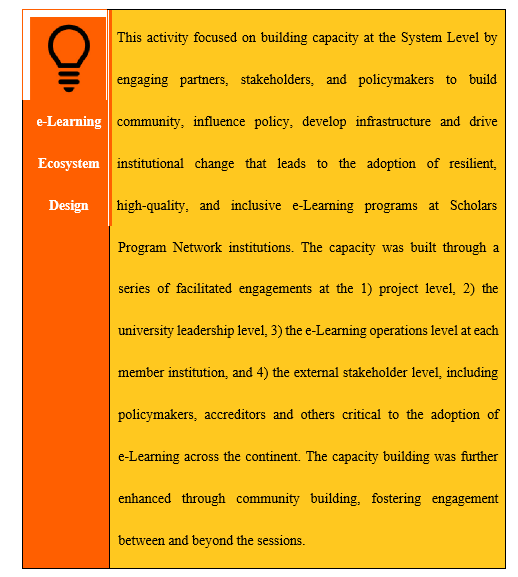
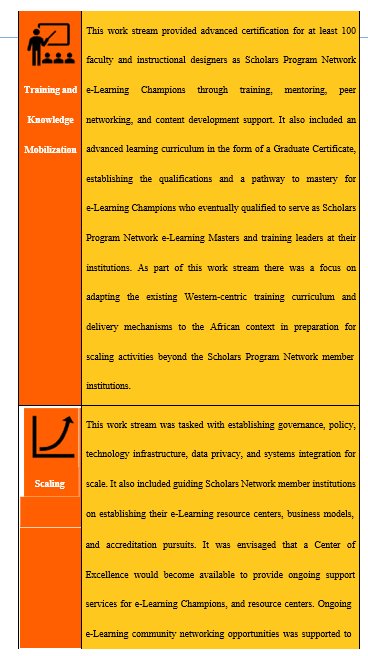
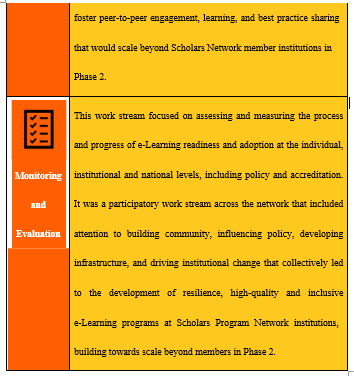
Figure 1: Program Design Key Activities
This paper focuses on feedback from participants regarding their experiences from the training which spanned four main activities namely Master Class, Specialized Coaching, and the Graduate Certificate Program.
Research Methodology
The research methodology that the authors initially adopted involved literature review of documentation from both academia and industry, identification of gaps that would be the starting point for the development of comprehensive design strategies and their subsequent implementation across the higher learning institutions to provide support for e-Learning. An evaluation framework was used to inform program development and evaluation efforts (that accounts for structural and institutional inequities in education, with an emphasis on the global south) and participatory evaluation approaches and methods to evaluate this initiative’s impact. The methods researchers used for data collection for this paper, as per their examinations of participant experiences, included surveys, interviews, and focus group discussions.
It should be noted that the scope of this paper does not cover e-Learning tools and/or human resource requirements or investigation of specific pedagogical approaches; rather, its main focus is on providing a general design framework that can enable participating institutions to progress towards the design and development of more high-quality and inclusive online learning environments.
Results
Participants
Self-Reported Experiences
Purpose This theme focuses on feedback from this e-Learning initiative’s participant experiences. Of primary interest were participants’ self-reported levels of knowledge acquisition and their perceived usefulness of the training programs that spanned the initiative and included, but were not limited to, the initiative’s specialized coaching components and graduate certificate program.
Perspectives
e-Learning is an effective tool for knowledge mobilization and transfer and may have more potential than conventional teaching that, perhaps without the COVID-19 pandemic, may not have been realized. This theme examined e-Learning potential and how the trainings and support activities offered helped participants work and teach online. One of the most dominant shared experiences of e-Learning participants was that e-Learning ensures ease of communication and collaboration between instructors and students, as well as other stakeholders, all the while facilitating instant knowledge sharing, contributing relevant materials and tools in unique and timely ways, and offering quality online learning and add-on supports [5-7].
Results
Researchers discovered that the e-learning initiative’s components equipped participants with the relevant skills, tools, and experiences needed to increase the quality of online learning their students experienced during COVID-19. More specifically, participants reported that the trainings and materials provided to facilitate learning helped them teach and work better online especially within institutions that needed such resources the most given fewer resources and minimal support. Moreover, this initiative equipped participants with technical tools and practices to better support and engage students online. Therefore, this initiative increased participants’ awareness of providing online support to students, and helped them and support staff better understand online pedagogies, practices, and instructional design.
Participants also noted that this initiative provided them with opportunities to connect and interact with colleagues across institutions, the African continent, and beyond, fostering the exchange of knowledge and ideas regardless of geographical boundaries. Their involvement in this initiative further assisted them in creating online knowledge hubs that apart from fast- tracking decision-making processes, enabled participants receive timely feedback. As a result, participants were reportedly more likely to engage with various stakeholders across institutions.
Figure 2 below illustrates the levels to which teaching and non- teaching participants felt the initiative’s activities (Master Class, Specialized Coaching, and Graduate Certificate Program) met their expectations 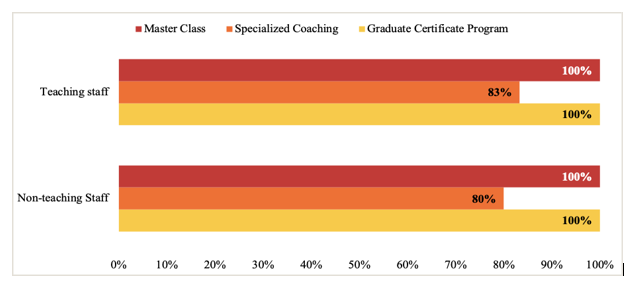
Note. Teaching Staff: Master Class n = 58, Specialized Coaching n = 51, Graduate Certificate Program n = 23; Non-teaching staff: Master Class n = 15, Specialized Coaching n = 10, Graduate Certificate Program n = 7.
Figure 2: Meeting Participation Expectations
Significance
Findings presented in this theme are significant because they will inform others about the beneficial experiences shared by participants in this large, innovative, and global initiative. In addition, findings should further amplify participants’ collective understanding about efficient and effective online learning options, while also serving as a reference point for adoption and implementation efforts elsewhere.
Program Successes
Purpose
This theme delves into the successes of this e-Learning initiative before and after the first year of implementation. Researchers explored individual-, group-, and institutional-level successes noted at each participating institution.
Perspectives
As noted earlier, the COVID-19 pandemic pushed online learning into the mainstream. However, what largely escaped notices was the extent to which many university leaders have not only adopted but stayed with online learning since. Accordingly, e-learning quality has notably improved, whereas a still burgeoning amount of research has demonstrated e-learning activities’ ongoing success and improvements, especially given COVID [8-12]. This theme has enabled researchers to add to this set of literature by demonstrating the successes of this initiative.
Results
The authors discovered that participants self-reported that their beliefs, skills, and competencies substantively improved, given their participation in this initiative. For example, among the teaching staff who participated in the program, the top five competencies they reportedly gained included: 1) attaining adequate training regarding navigating online platforms for teaching; 2) acquiring necessary skills to apply online learning effectively; 3) building efficacy and confidence in knowledge in online learning/teaching, and 4) gaining increased abilities using Integrated Co-Teaching (ICT)-oriented instructional materials and 5) pedagogical and instructional methods.
Other findings had implications on increased knowledge of information technology (IT) support provision; exposure to and help with diverse and interactive features that would augment instruction for example graphics, videos, Flipgrids, Padlets, Quizlets, Kahoots; what might be required to prepare, plan for, and organize courses and course syllabi in more proactive ways; effectively using online learning platforms for instance facilitating online discussions, conducting quizzes, uploading materials on Canvas and Blackboard; appropriately arranging learning materials by scaffolding learning processes and procedures; and choosing and using learning accommodation tools for students with disabilities. As illustrated in Figure 3 below, there is a fairly even spread between four aspects of the Master Class activity that teaching staff found most useful. These aspects undoubtedly all had an effect on the successes achieved by the program as participants gained the competencies mentioned above. 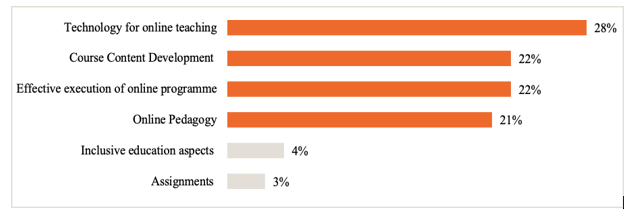
Figure 3: Most Useful Aspects of the Master Class (teaching staff)
Significance
Participants noted several resources about which they learned to further collect data on their students’ learning and to use that which they learned to inform changes in their practices and curricula [13,14]. Participants described opportunities to share practices, ideas, tools, and learning with colleagues, with conversations involving successful approaches, improvement strategies, etc. Participants also reported drawing on what they learned to also offer solutions and alternative approaches to help others, all of which should be relevant to others.
Accordingly, what the authors learned in this theme about programmatic successes can be used to further develop and improve upon that which this large-scale initiative is successfully offering students. Externally, findings might inform similar adoption and implementation elsewhere, with special emphasis on higher education institutions in the global south.
Program Challenges
Purpose
In this theme, researchers examined the challenges faced by the institutions supported by this initiative when implementing and providing online learning. More specifically, researchers unearthed the key challenges at the institutional, program, and individual levels that apparently undermined the delivery of the specific components of the e-learning initiative.
Perspectives
Developing countries are facing numerous challenges in the implementation of e-Learning. These include lack of adequate e-Learning policies, inadequate ICT infrastructure, lack of technical and pedagogical competencies and training for e-tutors and e-Learners, lack of e-Learning theory to underpin e-Learning practice, budgetary constraints and sustainability issues, and negative perceptions towards e-Learning and quality issues, among others [15].
Results
At the institutional level, a sheer lack of resources and inadequate infrastructure to adequately support e-Learning inhibited this initiative. Participants reported lacking or insufficient contemporary software (e.g. a university-wide learning management systems like Canvas and Blackboard), resource centers, online libraries, and hardware such as computers, as also compatible with modern software, video conferencing devices for instance audio and video recorders and sound systems, computer accessories for example High-Definition Multimedia Interface (HDMI), Video Graphics Array (VGA), flash disks, external hard drives and cameras. Participants also reported a lack of technical competencies and a lack of ICT support staff with e-content creation skills, such as designers, videographers, and website developers. These infrastructural challenges included limited bandwidth, unstable internet, and power outages without reliable power backup plans.
At the program level, challenges included courses overloaded with content, language barriers between learners and instructors, lack of appropriate contextualization of the academic content delivered, lack of opportunity for learners to implement and apply what they collectively learned, traditional lecture delivery, and overwhelming and theory-heavy content.
At the individual level, researchers found that the timing of the program initiatives posed a significant challenge to their learners. Timing of the classes offered, for example, conflicted with participants’ previous commitments to or primary roles within their institutions, resulting in significantly longer working hours to keep up with participants’ responsibilities. Participants also reported incurring extra expenses when purchasing mobile data for their online classes due to poor Wireless Fidelity (Wi-Fi) or low bandwidth.
Figure 4 below illustrates aspects of the master class activity that teaching staff felt could be improved. A third of the teaching staff (33%) felt that the Master Class program was fine and that no part/aspect needed to be improved. The main suggestions for improvement were the following: to provide more time for the Master Class sessions (23%, n=14), to be more practical using technology (15%, n=9), to increase access to resources (11%, n=7), to modify the course design (10%, n=6), to diversify modes of communication (5%, n=3), to reduce the workload (2%, n=1), and need for recording and uploading the sessions for future reference (2%, n=1). 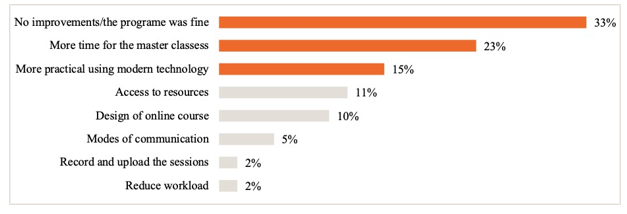
Figure 5 below shows that as far as the non-teaching staff were concerned, the most highlighted useful aspects of the Specialized Coaching training were the development of a course outline, the creation of effective e-Learning assessments to measure online training, and lessons on using online tools for e-Learning. 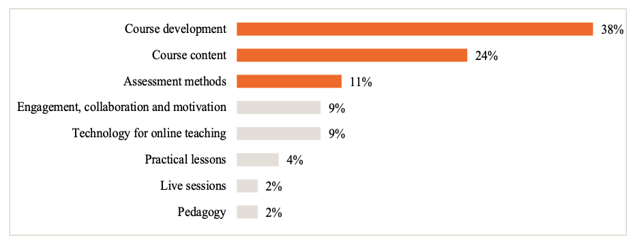
Figure 5: Most Useful Aspects of the Specialized Coaching
Significance
The challenges that researchers identified in this theme are important in that they hampered the successful implementation and realization of the full benefits of this e-Learning initiative, which is important to understand given initiative leaders are working with higher education institutions, especially in the developing world. Unearthing the main challenges that hamper the successful delivery of these and other e-Learning programs across higher learning institutions should help solve and resolve such challenges in future, ultimately enabling more institutional leaders to better meet the needs and expectations of more e-Learners.
Program-Based Recommendations
Purpose
While, as also noted earlier, this initiative started as an emergency response to the COVID-19 pandemic, the implementation of this e-Learning initiative provided insight into the further designing and launching of e-learning programming for higher education. Initiative participants also offered a wide range of recommendations, which researchers organized and present in this theme.
Perspectives
A foundational aspect of effective e-learning implementation must include consideration and assessment of e-infrastructures available within any institution [16]. Student experiences during the COVID-19 pandemic indicated familiarity with online learning through previous online experiences, but students still had considerable difficulties when institutions had to move entirely online [17]. Using this theme, researchers brought forward additional perspectives, especially those of faculty and staff who were also key stakeholders in this e-Learning initiative.
Results
Participants in this initiative recommended that participating institutions assess and further consider the extent to which their university-based infrastructure could be better accessed to help ensure that foundational components for example connectivity, equipment, human capital are in place before additional implementation is carried out.
Participants also noted that e-Learning would better benefit participants if leaders and other personnel set clear roles and responsibilities for all stakeholders involved, including expectations regarding professional workload and time commitment that align with acceptable global best-in-practice benchmarks.
Program deliverers might also consider the learning pathways of different participants for example faculty versus staff and address different disciplinary needs and professional orientations. Additional considerations might pertain to program pacing and scheduling, especially for those with other major work-, time- , and effort-based commitments. Further, program and other e-Learning leaders should reflect on how participants might apply new skills and strategies to make deeper connections to their online learning environments, also as per program content.
Finally, creating a culture of ongoing learning and peer support would further strengthen program implementation and encourage an exchange of best practices across the initiative, again, as per participants’ perspectives. This could include coordinating opportunities for knowledge exchange and sharing across institutions to deepen engagements and interactions across institutions and participants.
Significance
These and other participant-based recommendations provided insight into the lived experiences of faculty and staff within this e-Learning initiative. In addition, the recommendations underscore the foundational components that program leaders should consider for planning for budgets, human capital management systems, university schedules, resource management, etc. in the future.
It is important to note that ultimately, participant recommendations advanced via this part of this study highlight key elements that higher education institutions might consider as they also engage in such digital transformations. While this theme provides unique insight into digital transformation needs, primarily within the African context, recommendations should also inform future funding opportunities, industry support for other e-Learning initiatives, and provide ideas for assessment of readiness.
Conclusion
Digital transformation promises to diversify students beyond the traditional 18–24 age cohort, maximize learning opportunities for students, open new markets, and increase tuition revenues for universities. Blended and online teaching and learning offer much needed flexibility for students, who increasingly find it appealing and convenient for its space and time shifting possibilities. It also offers faculty opportunities to improve educational outcomes by adopting a wider range of learning activities, allowing greater flexibility of study times, space for reflection and a move to a wide range of different forms of learning assessment.
Also, the Covid-19 pandemic has devastated global economies, healthcare systems, and institutions including universities. It has accelerated trends towards the digitalization of economic and social life and the need for digital skills. While previous papers provide significant contributions, this paper informs decision- making on implications of e-Learning with recommendations for future development, focus on infrastructure, capacities, competencies and reforms. The authors envisage that these decisions shall inform the perspectives and practices of others leading or working within other e-Learning initiatives globally. Important to note is that the research team also explored how this initiative influenced community building, new policies and procedures, and infrastructure development. The authors also investigated how this initiative, as per study participants’ perspectives, contributed to institutional changes, minimized learning loss, helped build infrastructure, and improved online learning capacities and competencies. Finally, the findings shared in this paper support the authors’ overall conclusion that this initiative significantly contributes towards enabling participating institutions to progress toward higher quality and inclusive online learning environments.
References
- Ojha, M., & Rahman, M. A. (2021). Do Online Courses Provide an Equal Educational Value Compared to In-Person Classroom Teaching? Evidence fromU. S. Survey Data using Quantile Regression. Archivos Analíticos de Políticas Educativas= Education Policy Analysis Archives, 29(1), 92.
- Ali, W. (2020). Online and remote learning in higher education institutes: A necessity in light of COVID-19 pandemic. Higher education studies, 10(3), 16-25.
- Mbambo-Thata, B. (2021). Responding to COVID-19 in an African university: the case the National University of Lesotho library. Digital Library Perspectives, 37(1), 28-38.
- Reimers, F. M. (2022). Learning from a pandemic. The impact of COVID-19 on education around the world. Primary and secondary education during Covid-19: Disruptions to educational opportunity during a pandemic, 1-37.
- Kim, K. J., & Bonk, C. J. (2006). The future of online teaching and learning in higher education. Educause quarterly, 29(4), 22-30.
- Huang, J., & Duangekanong, S. (2022). Factors impacting the usage intention of learning management system in higher education. AU-GSB e-JOURNAL, 15(1), 41-51.
- Babu, G. S., & Sridevi, K. (2018). Importance of E-learning in Higher Education: A study. International Journal of Research Culture Society, 2(5), 84-88.
- Al-Fraihat, D., Joy, M., & Sinclair, J. (2017, June). Identifying success factors for e-learning in higher education. In International conference on e-learning (pp. 247-255). Academic Conferences International Limited.
- Al-Fraihat, D., Joy, M., & Sinclair, J. (2020). Evaluating E-learning systems success: An empirical study. Computers in human behavior, 102, 67-86.
- Cidral, W. A., Oliveira, T., Di Felice, M., & Aparicio,M. (2018). E-learning success determinants: Brazilian empirical study. Computers & education, 122, 273-290.
- Eom, S. B., & Ashill, N. J. (2018). A system's view of eâ? learning success model. Decision Sciences Journal of Innovative Education, 16(1), 42-76.
- Mohammadi, H. (2015). Investigating users’ perspectives on e-learning: An integration of TAM and IS success model. Computers in human behavior, 45, 359-374.
- Gikandi, J. W., Morrow, D., & Davis, N. E. (2011). Online formative assessment in higher education: A review of the literature. Computers & education, 57(4), 2333-2351.
- García-Peñalvo, F. J., Corell, A., Abella-García, V., & Grande-de-Prado, M. (2020). Recommendations for mandatory online assessment in higher education during the COVID-19 pandemic. In Radical solutions for education in a crisis context: COVID-19 as an opportunity for global learning (pp. 85-98). Singapore: Springer Singapore.
- Kibuku, R. N., Ochieng, D. O., & Wausi, A. N. (2020). e Learning Challenges Faced by Universities in Kenya: A Literature Review. Electronic Journal of e-Learning, 18(2), pp150-161.
- Agormedah, E. K., Henaku, E. A., Ayite, D. M. K., & Ansah, E. A. (2020). Online learning in higher education during COVID-19 pandemic: A case of Ghana. Journal of Educational Technology and Online Learning, 3(3), 183- 210.
- Paschal, M. J., & Mkulu, D. G. (2020). Online classes during COVID-19 pandemic in higher learning institutions in Africa.