



Review Article - (2026) Volume 11, Issue 1
Housing Neuroscience and Diversity. Breathing Health
Received Date: Dec 09, 2025 / Accepted Date: Jan 09, 2026 / Published Date: Jan 19, 2026
Copyright: ©2026 Berta Brusilovsky Filer. This is an open-access article distributed under the terms of the Creative Commons Attribution License, which permits unrestricted use, distribution, and reproduction in any medium, provided the original author and source are credited.
Citation: Filer, B. B. (2026). Housing Neuroscience and Diversity. Breathing Health. J Nur Healthcare, 11(1), 01-07.
Abstract
Housing has been extensively studied from economic and technical perspectives. It's time to put people first and ask them how they want to live. And if they can't answer, we should use alternative means to improve their safety and the climate of their daily lives: how to navigate better, even in their personal space: indoor and outdoor spatial security and other topics, which it's time to develop and share. Understanding residential architecture as " the design of the house (and the home comes later) " is a design approach lacking in innovation. Incorporating the sensibilities, needs, and variables of neurodiversity opens our eyes and broadens our horizons. The complex variety of situations that must be resolved and the multiplicity of solutions that can be found are surprising.
Introduction
Housing has been extensively studied from economic and technical perspectives. It's time to put people first and ask them how they want to live. And if they can't answer, we should use alternative means to improve their safety and the climate of their daily lives: how to navigate better, even in their personal space: indoor and outdoor spatial security and other topics, which it's time to develop and share. Understanding residential architecture as " the design of the house (and the home comes later) " is a design approach lacking in innovation. Incorporating the sensibilities, needs, and variables of neurodiversity opens our eyes and broadens our horizons. The complex variety of situations that must be resolved and the multiplicity of solutions that can be found are surprising.
This article introduces innovative concepts related to residential spaces and neurodiversity that are part of the book published in Spain by INCIPITE Editorial in Spanish and English under the title: "Housing, Neuroscience, and Diversity. Breathing Health." For this article, we selected those that seemed most original and that are unlikely to be found in other publications on home or house design. These concepts can be extrapolated to other living spaces: nursing homes, hospitals, and facilities. We will discuss situations in which housing must provide security, protection, and a comfortable welcome with its surroundings. These characteristics can be summarized in virtues that, beyond their traditional definition as residence, domicile, and home, provide an extra level of adaptation that makes everyday life more satisfying and appropriate. Therefore, although topics based on physical and sensory disabilities (hearing and vision) and the accessibility requirements arising from these cases are introduced, those that have not been addressed until now in architectural or housing texts are explored in depth: functional and sensory organization, taking into account brain functions that influence mobility and spatial behavior, because emotions and feelings of protection must be present in every corner and perspective, both exterior and interior, of the home. Although it is necessary to know what neurodiversity requires in each particular case as a human identity, important characteristics have been considered that are common, structural or functional, to favor the creation of environmental adjustments for groups or groups with physical-motor, sensory, perceptual and cognitive similarities.
More than Housing Cases
The cases of neurodiversity cited in the text and their determinants can be reproduced in other activities: education, employment, sports, etc., especially because many of them are not studied in relation to spatial behaviors. But especially in homes shared by people with disabilities or mental health problems, the elderly, etc.
How to Identify Cases in the Text
When the letters below correspond to each specific case studied, it is because the solutions are excellent for those cases. But from a global perspective, they will always have positive effects on all people with and without neurodiversity:
These sets, which are not intended to be all inclusive, are the following:
• Intellectual or developmental disabilities: ID
• Autism spectrum disorder: ASD
• Mild cognitive impairment: MCI
• Dementias in general: Dg
• Early-onset Alzheimer's: EOA
• Late-onset Alzheimer's: LOA
• Parkinsons: Pa
• Mental health: MH
• Cerebral palsy: CP
• Rare diseases: RD
• Hearing impairments: HI
• Attention deficit disorder ADD
• Attention deficit hyperactivity disorder ADHD
References throughout the Article:
1. When there is no reference to a group: this is a topic that applies to all groups.
2. When the theme is a dominant characteristic of some of the previous groups, it will appear referring to that particular one, including the lyrics that characterize it.
Organization of Activities in the House
The floor plan—and the relationships between different rooms— has an impact on people's autonomy and behavior: isolation and closeness define these relationships between all cohabitants. Although the layout reflects a frequent and traditional use of spaces or everyday activities—a shared living room, kitchen, bedrooms, and restrooms—the relationships between these spaces can determine positive or negative reactions that impact everyone's well-being. The goal is to achieve a layout that positively impacts their personality and adaptability for comfortable living. Positive and negative considerations of home layouts in relation to natural light are also presented, and some concepts that have been developed with greater specificity in the aforementioned book are introduced.
Functional Organization
Organization is a basic condition for physical and emotional safety: the systematization that is necessary for anyone—but especially those with disabilities or cognitive impairments— should be reflected in the spatial-visual-auditory structure in all its components: structure, function, form, color, and physical and sensory relationships.
The layout of the floor plans—horizontally and vertically—should develop a formal and functional sequence without gaps, meaning routes, connections between different spaces, and the activities of the sectors and rooms should be clearly identified.
Considering the affective-pleasant content, so that emotional responses are as satisfactory as possible and physical responses are as unaffected as possible. The home will have all the necessary spaces, including those specific to the type of need arising from the condition or situation. Also, for the family and for the person. The last objective Is the autonomy for both of them.
Separations
Physical Security ASD- Dg-LOA The interior layout will consider that without creating physical boundaries or barriers, the layout can be maintained to maintain people's safety:
• Entrance hall semi-closed to the rest of the spaces when there is a danger of escape or flight.
• Restrooms/bathrooms and kitchens will not have direct views of the lobby where the entrance door is located.
• Where the hallway and bathroom connect, a seclusion or transition area can be created to ensure privacy.
Transition spaces from one room to another or from one circulation area to another must be free of elements such as niches in walls, beams or suspended elements, exposed cables, furniture, signs, wall coverings with reliefs or floors with designs and colors, among others, leaving the space free of possible distortions and unoccupied, without barriers of any kind.
Psychological Safety ASD-MH
Probably they need to have a room of their own. It may be important to assign him or her a bedroom not shared with another inhabitant of the house.
Transitional spaces ASD-ADD-ADHD-MH
Although they should be a functional part of the enclosure, they are interested in highly sensitive cases: because they can be easily distracted and need their own space without feeling isolated behind walls and doors. They are an important part of the fabric, laid out in plan and studied in sections and elevations, where the person can be alone, rest, and relax in a peaceful environment. Includes comfortable, spacious furniture, light and sound control options for pain relief or relaxation of emotions and stress.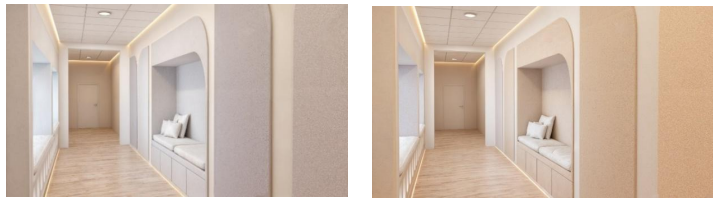

Figures 1.1, 1.2, 1,3: “Synaptic Interface or Transitional Interweaving” Integrated into the Structure for Relaxation in the Family Area
Collaboration of Sofía Ossa Zuain, Architect. Wide Hallway and Corners with Natural Light and Blackout Elements. Collaboration of Sofía Ossa Zuain, Architect [1].
Natural Lighting
Circadian rhythms are the physical and mental changes that occur in the body throughout the day. They are part of the physiology of living beings and are controlled by the hypothalamus, a region of the brain. Natural lighting should be prioritized so that the sun's path can be perceived from interior spaces, providing a sense of space and time from within the home, and if not possible, from common spaces where available. Time is an abstract concept that is best recognized when natural and artificial light are part of the design.
Potential of Interior Courtyards
The main circadian synchronizers occur thanks to the light-dark cycle during daily activities. The treatment of changes from day to night, the movement of the sun, light and darkness focuses on the structure of courtyards, which allows us to work with the passage of time, light and darkness: from where to identify these changes through the different hours of the day: courtyards, living room, bedroom. Preferential relationships will be established between the rooms with the orientation of the home during the morning or afternoon hours, and the creation of interior patios that facilitate the entry of light and sunlight: interior homes should not be developed without the entry of light and sunlight at some point during the day in the main rooms.
Varied orientation: to have rooms facing east and west, which will allow the presence/absence of natural light to be perceived in the morning or afternoon. Those facing interior courtyards will have windows of adequate dimensions to allow the entry of light and sunlight. The surface elements of interior courtyards must be carefully considered so that they are not mere mute, cold walls that darken over time. They should have a green roof visible from the windows and should be properly cared for and maintained.
Clotheslines
If there is a patio, a clothesline should be installed to wick away moisture from clothes and prevent the formation of musty odors that can cause bacteria in clothing. If there isn't one, a clothesline should be placed on a window or balcony, as long as it doesn't affect the exterior facade.
Sun Protection
Ensure that windows are equipped with UV-protective glass to reduce exposure to harmful sunlight and provide greater visual comfort. Provide shade areas on patios, decks, or gardens to allow the person with albinism to enjoy outdoor spaces without worrying about excessive sun exposure. The use of awnings, umbrellas, or covered areas can be beneficial.
Gardens and Plants
The effect of “green” as decorative vegetation, an area of the senses and always a source of health is beyond doubt: no matter how small the dimension of this area, its effects always surpass everything calculated.
From the patio, the balcony, and inside, seeing them and feeling them grow, accompanying life in interior spaces, provides sensations that are expressed beyond words: they produce oxygen, purify the air by eliminating toxins, keeping the air in the house oxygenated and improving its quality, regulate and increase humidity, and contribute to the stability of the indoor climate.
• You just have to count on people to keep them going.
• Being very careful in cases where there are problems with geophagia, a characteristic possessed by people who need to eat dirt [1].
Sensory Organization
They are particularly important if a person with high sensory sensitivity, such as autism or dementia, will live in the home. But they are also important in cases of dementia
Routines and Changes ASD
Some people's worlds can develop their own psychological and behavioral support: utilizing stereotyped behaviors is one of them; it provides a sense of security. Drawing boundaries, circles, and border lines serves to protect them from the outside world. Therefore, establishing routines helps improve their external experience, unless they become intransigent. That's why structuring your home more creatively than usual -the entrance, common areas, hallway, and private areas- can prevent excessive routines. It's based on making:
• The routes for interior use to the home, splitting, if any, the circulation axes/corridors,
• Create different rooms for the same activity or more frequent use.
Alternative routes improve learning and encourage flexibility without requiring consistency. This impacts on the overall well- being of individuals, especially those with autism. The entry of light from all four directions allows us to differentiate what is happening throughout the day in each orientation: with the different light sources of morning, afternoon, and night. Markings of different colors according to the corridor: they indicate where each one begins to facilitate the selection of the path and directional references.
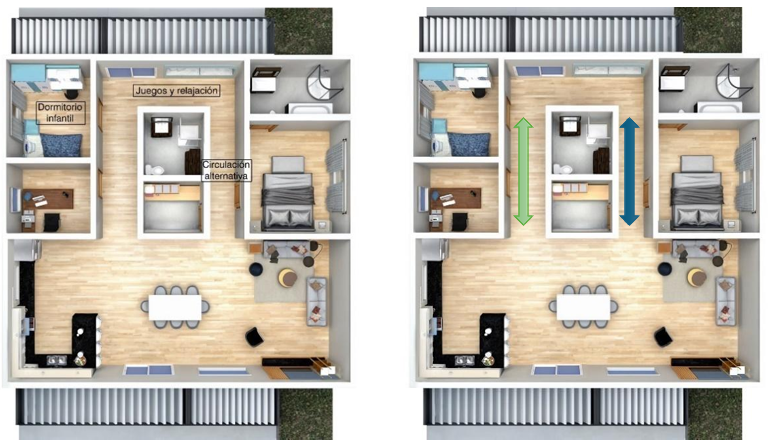
Figures 2.1 and 2.2: Alternative Routes with Activities Compatible with Circulation Areas. “Interweaving” Integrated into the Structure as a Moderating (Relaxation) interface in the Family area. Colored lines Indicate the Origin of the Corridors with Different Colors: Green and Blue in this case. Collaboration of Sofía Ossa Zuain. Architects.
In single-family homes, a ground floor can be designed specifically for people with ASD, and an upper floor can be added with bedrooms, as needed.
Stimulus Control
It is the approach that seeks to eliminate stimulus that can provoke behaviors or situations that are not desired because they disrupt the lives of all members. Stimulus control or limitation: furniture, objects, and clutter around the areas where a person with ADHD sits, plays, or studies. ADHD reduces difficult behaviors that otherwise cause discomfort to the person and the family.
This way you can also control the distribution of objects that belong to him or her to prevent them from losing them or not knowing where they have left them. ones, especially if they occur simultaneously: excessive noise and lighting. Avoiding these benefits, the entire family and promotes better coexistence.
Other Cases
Excessive light (natural and artificial) and noise can also affect people with symptoms of Meniere's disease - or trigger it - linked to stress problems.
• Minimizing background noise and improving visual communication improves communication not only for people with sensory sensitivity but also for those who are signatories.
• Use sound-absorbing materials, such as carpets, curtains, and acoustic panels, to reduce reverberation and improve hearing clarity during conversations.
• Perceptual distortions ASD-MH-Dg
• Shadows in hallways
• Lighting will be natural or a very good artificial light so that it doesn't become "the dark place in the house" or where shadows form.
• Apperceptive agnosias
• Avoid creating rooms with heights lower than two meters, which could lead to perceptual distortions, even in single- family homes where regulations allow for lower spaces following the decreasing roof height.
Adjustments and improvements
Dimensions and shapes:
• Increase the dimensions of the corridors so that they can be used simultaneously by several people, all of whom are signers, and avoid communication distortions.
• Lighting hallways with good natural or artificial light is extremely important.
• Hallway corners can be a source of conflict, as deaf people cannot hear others walking in the opposite direction, and collisions can occur, which, although not like traffic collisions, can create unrest among cohabitants.
• Rounding the corners makes it easier to see in both directions1.


Figure 3,4: Deaf space with sign language communication. Figure. Dangermond Keane schemes (taken from Bravo V. page 16) [2]
Special Conditions
Sanitary
Bathrooms and toilets must be accessible and safe. Consider installing a walk-in shower to facilitate access and avoid raised edges. Installing toilet accessories:
• Mirror at user height if using a wheelchair
• No mirrors will be placed, or each case will be studied (neurological diseases)
• Have all the accessories at hand: towels of different sizes
• Use of contrasting colors and materials in appliances such as toilet seats and handrails.
Spaces Activating Body and Mind
Exercise2 or physical therapy generally plays an essential role in keeping a person healthy and able to participate in activities that cannot be completed without this physical effort. Exercises that test and strengthen a person's balance, combat axial stiffness, and improve flexibility are ideal. These helps maintain postural stability and the mobility necessary to prevent falls. These exercises also enhance self-awareness about the location of one's body center, which can improve balance. Multifaceted exercises that involve attention, concentration, and focus on activity and movement— may not only be beneficial for balance, but also neuroprotective, meaning they may slow, halt, or reverse the progression of diseases. When you have a dedicated space, installing a “mini gym” is ideal to increase the time spent on these forms of physical and mental fitness. If there isn't enough space: They can be done in common rooms and hallways, if there are any, by installing handrails or any element that, without creating a barrier to mobility and with a secure grip, can increase walking speed in both directions.
Handrails or other similar elements that do not hinder mobility and can increase walking speed both ways. Play elements for swinging, such as hanging bags, are very soft and safe. Appliances that are placed in corners or those that fold up and are stored in closets.
If there is no space: They can be installed in common rooms and hallways, if they are of appropriate dimensions, by installing handrails or any other element that, without creating a barrier to mobility and with a secure grip, can increase walking speed in both directions.

Figure 5: Swing in Common Spaces or Circulations
Objects like the one in the figure above are important for neurodiverse children because they are not often seen displayed in outdoor areas.
An Innovative Look at Humanity
There is still much to be said and much to improve regarding housing for all. But every step forward is another step towards a quality of life unthinkable ten years ago, when we all saw ourselves as equals, as if the "modulor" could be applied to all bodies and minds. Nothing could be further from the truth than a society that accepts the differences and uniqueness that enrich the human species [3-18].

Figure 6: Green life in Houses Common Areas
References
- Antonovsky, A. (1987). Unraveling the Mystery of Health- How People Manage Stress and Stay Well. San Francisco: Jossey-Bass Publishers.Arquitectura sana.
- Asociación Navarra de Autismo (2016). 4 pasos para abordarproblemas sensory en casa (4 steps to tackle sensory problems at home).
- Asociación Tajibo. Dona Williams. Autismo en primera persona (Autism in first person).
- Bravo, V. (2021). Accesibilidad auditiva en espacios universitarios (Auditory accessibility in university spaces).
- Brusilovsky, F. B. y Quevedo, R. (2024). Soluciones de luz para la accesibilidad cognitiva y la integración sensorial (Light solutions for cognitive accessibility and sensory integration). Lamp.
- Brusilovsky, F. B. (2023). Arquitectura del juego, estímulo sensorial y cognitivo desde la childhood hasta la adolescencia (Architecture of play, sensory and cognitive stimulation from childhood to adolescence). Incipit Editores.
- Brusilovsky, F. B. (2021). Accesibilidad cognitiva, arquitectura y autistic spectrum. Claves para el diseño (Cognitive accessibility, architecture and autistic spectrum. Keys to design). Incipit Editores.
- Brusilovsky, F. B. (2020). Seguridad espacial cognitiva: Arquitectura Cerebro y mente (Cognitive spatial safety: Architecture Brain and mind). Incipit Editores.
- Brusilovsky ,F. B. (2020). Edificios vivenciales y terapéuticos para mayores (Experiential and therapeutic buildings for senior citizens). Incipit Edito- res.
- Gabbatis, J. (2016). “Geophagy: why some people can’t stop eating soil”, on BBC World News.
- Ministerio para la Transition ecológica. Estrategia Nacional contra la Energy poverty 2019- 2024 (Ministry for EcologyTransition. National Strategy against Energy Poverty 2019- 2024).
- LAMP (2025). Light solutions for cognitive accessibility and sensory integration.
- Monika Hencová, M. y Kotradyová, V. (2023). Colour in the environment for older adults. Architec- ture papers of the faculty of architecture and design stu.
- Nogueras, A. ConsumoClaro. 27 February 2024.
- O’Keefe, J. y Nadel, L. (1978). The hippocampus as a cognitive map. Clarendon Press Oxford. Pasquíneli, C. (2007). Vértigo del Orden: La relación entre el yo y la casa (The Vertigo of Order: the Relationship between the Self and the Home). Libros de la Araucaria. Sarráis, F. (2016). Psicopatología (Psychopathology). Edit. EUNSA, Navarra.
- Spence, Ch. y otros (2022). Exploring the Links between Colours and Tastes/Flavours.
- Williams, D. (1992). Si on me touche, je n’existe plus. Le témoignage exceptionnel d’une jeune autiste, Robert Laffont, Paris.
-
Williams, D. (2012). Alguien en algún lugar. Diario de una victoria contra el autismo (Someone somewhere: Diary of a Victory against Autism). Need ediciones, Barcelona.