

World Journal of Forest Research(WJFR)
ISSN: 2994-5569 | DOI: 10.33140/WJFR



Research Article - (2026) Volume 5, Issue 2
“Global Coastal Environmental Management Master Plan”, Embracing Environmental Mechanisms, for Protection, Care and Maintenance of our Planet
Received Date: May 18, 2026 / Accepted Date: Jun 23, 2026 / Published Date: Jul 03, 2026
Copyright: ©2026 Robert Kempton. This is an open-access article distributed under the terms of the Creative Commons Attribution License, which permits unrestricted use, distribution, and reproduction in any medium, provided the original author and source are credited.
Citation: Kempton, R. (2026). âGlobal Coastal Environmental Management Master Planâ, Embracing Environmental Mechanisms, for Protection, Care and Maintenance of our Planet. World J Forest Res, 5(2), 01-17.
Abstract
Two spheres of Influence embracing ‘Earth’s Environmental Mechanisms’ are identified as the surface area, and the surrounding atmospheric elastic fluids which are devoid of boundary conditions within their circumferential mass, unlike set boundary conditions around the planet’s surface. A global atmospheric organizational plan proposes embracing Man’s Science’s ‘Fluid Mechanics’ to manage elastic fluids without boundary conditions, within Earth's Atmosphere. Legislation, must be continent based to regulate air pollution between land masses, enabling effective legal processes. The framework to be governed through Transitional Coastal Plan Zones of the five main Continents—two in the northern hemisphere and three in the southern hemisphere. The importance of the Coastal Transition Zone boundary conditions is paramount for anthropogenic reasons, to allow mankind to perceive a ‘boundary state’ tool able to monitor / record / control movement of elastic fluids in Earth’s atmosphere, and the main continents may be used for part of a ‘total environmental management plan’. The concept for integrated Coastal Zone Management (ICZM) was first introduced at the national policy scale in the Coastal Zone Management Act (CZMA) enacted by the Congress of the United States in 1972. Master Plans for regional coastal management frameworks to be structured and developed around the world. A ‘Global Coastal Environmental Management Plan Model’ is now required for our unique planet, to embrace, develop and manage several important tasks including, Global Atmospheric Pollution / Oceans Plastics Pollution / Ocean Total Renewable Energy facilities / Man’s anthropogenic environmental mechanism named ‘Climate Change’, as well as the Beaches, Rivers & associated Agricultural Pollution and Coastal areas, identified under earlier Coastal Zone Management initiatives.
Keywords
Global Coastal Environmental Management, Atmospheric Elastic Fluids, Environmental Mechanisms, Coastal Transition Zones, Fluid Mechanics, Ocean Energy, New Environmental Legislation
Introduction
Earth’s ‘environmental balance mechanism’ is defined within boundary conditions and founded on Man’s perceived ‘Laws of Science’. Earth’s perceived system which embraces geology and chemistry pertains in part to the movement and transformation of chemical elements and their compounds between ‘living organisms’, known as the biogeochemical cycle, which involves ‘fluxion’ boundary conditions through anthropogenic boundaries and land matter conditions. A good example is photosynthesis .
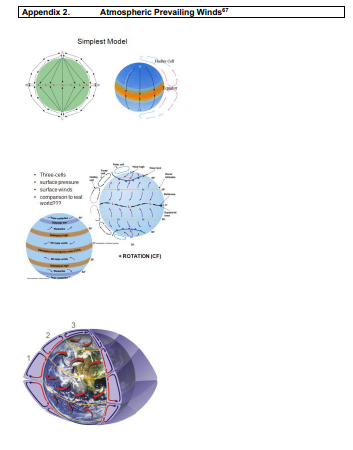
The energy from the Sun heats the atmospheric matter, which rotates in unison with Earth and is responsible for creating the circulation of all ‘elastic fluidised’ matter. The curvature of Earth creates the variation of heat between the equator and the poles, producing two atmospheric (Hadley) cells; less dense air at the equator rises creating low pressure, and cold dense air falls at the poles.
The environmental mechanism on earth allows the air to rise at the equator and flow to the 30O latitudes, creating three cells for each hemisphere, namely, Hadley / Ferrel / Polar, Appendix 2 .
The fragmented progress of Air Pollution legislation has lacked structure and remains incomplete lacking any unified co-ordinated directive from the global stage. It is now essential to restructure an intelligent approach towards setting out a structured framework for ‘air pollution’ controls founded around ‘common but differential responsibility’.
The importance of the boundary condition, Coastal Transition Zone, is paramount for anthropogenic reasons, to allow mankind to perceive a boundary condition tool able to monitor / record / control the movement of elastic fluids in Earth’s atmosphere, and the main continents may be used for this environmental management plan.
Environmental Mechanisms
Oceans’ Surface, [70+%]
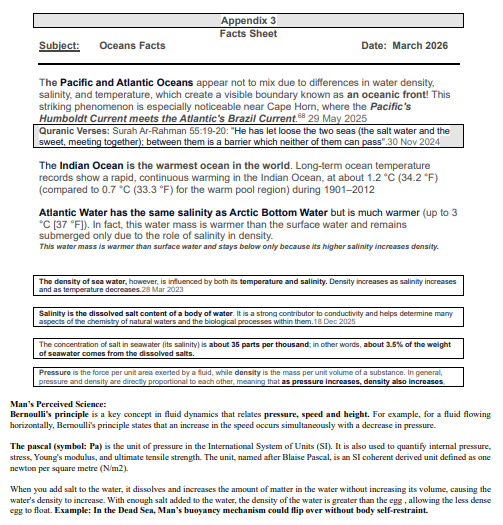
The Pacific and Atlantic Oceans appear not to mix due to differences in water density, salinity, and temperature, which create a visible boundary known as an oceanic front! This striking phenomenon is especially noticeable near Cape Horn, where the Pacific's Humboldt Current meets the Atlantic's Brazil Current. 29 May 2025.
The Indian Ocean is the warmest ocean in the world. Long-term ocean temperature records show a rapid, continuous warming in the Indian Ocean, at about 1.2 °C (34.2 °F) (compared to 0.7 °C (33.3 °F) for the warm pool region) during 1901–2012.
The Atlantic Water has the same salinity as Arctic Bottom Water but is much warmer (up to 3 °C [37 °F]). In fact, this water mass is warmer than the surface water and remains submerged only due to the role of salinity in density. This water mass is warmer than surface water and stays below only because its higher salinity increases density.
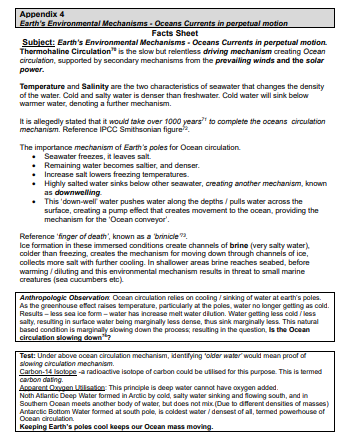
The Earth’s Oceans are in perpetual motion, because of several natural based environmental mechanisms. This is Earth’s natural 24/7 Energy and its analysis is beyond the scope of this paper . Temperature and salinity are two distinct characteristics of seawater that changes the density of the water, see Appendix 4 .
The Sun’s energy is directly responsible for the stratification process to earth’s oceans, which creates the environmental mechanisms to produce layers of transition boundaries through the ocean’s depths, vital for all marine life, as we know and understand it . In Lakes and small bodies of water, the warm surface layer is less dense and forms a thermocline boundary condition, above which is the ‘epilimnion’, with the cooler water disconnected below as the ‘hypolimnion’.
It is allegedly stated that it would take earth’s environmental mechanisms over 1000 years to complete the oceans circulation of the planet .
Atmospheric Elastic Fluids
The earth ‘s rotation on a tilted axis, produces perpetual motion of the oceans in the southern hemisphere, while there is a greater land mass in the northern hemisphere.
This creates complex global weather patterns across the six cells around the planet.
The dynamic of combined mechanism switching between temperature and pressure, drives the movement of air masses, influencing weather patterns and climatic zones.
The atmospheric mechanisms also facilitate the distribution of moisture, shaping ecosystems and weather systems across the planet, including atmospheric pollution .
Anthropology defines the Coriolis effect, resulting from earth’s rotation, as the pattern of deflection taken by objects not firmly connected to the ground as they travel long distances around earth, and which is responsible for many of the critical weather patterns. At the equator a maximum distance is travelled in one day, approaching 1,000 miles , while the distance travelled at the poles, approaches zero travel. In the northern hemisphere the motion is to the east, while in the southern hemisphere it is to the west. The build-up of trade winds and cyclones are examples of the Coriolis effect .
Global Coastal Environmental Management Transition Zone
Earth is a coastal planet. It comprises 361.13 million km2 of water (71% of total planet surface) and 148.94 million km2 of land area (29% of total planet surface).
The coastline of the world is so long that if we could stretch it, it would go 402 times around the equator. Furthermore, 84% of the countries of the world have a coastline either with the open oceans, inland seas or both .
A ‘Global Coastal Environmental Management Structure Plan Model’ is required, to combat ‘Man’s induced environmental mechanism, ‘climate change’, and other harmful anthropological effects, which cause serious harm to the footprints of the ‘continental shelves, their margins’, and the less saline coastal waters .
‘Boundary zone’ is the transition (separation) term for ‘coast’. This definition strictly refers to that part of an island or continent that borders an ocean or its saltwater tributaries. Some authors refer to the coast as the “area where aquatic and terrestrial ecosystems interact” . A legal definition is given under UNCLOS, ‘United Nations Convention on the Law of the Sea’, Part VI, Continental Shelf, Articles 76- 85 , See Figure 1.
The concept for ‘Integrated Coastal Zone Management’ (ICZM) was first introduced at the national policy scale in the Coastal Zone Management Act (CZMA), enacted by the Congress of the United States in 1972. A Master Plan for global coastal management to be developed, which should embrace ecosystem-based management, EBM, aimed at conserving and sustaining ecosystem services to benefit current and future human generations.
Sustainability and reliance to be considered with reference to: Independent World Commission on the Oceans (IWCO) workshop, which covers several Principles for Sustainable Governance of the Oceans, Example, earlier coastal disasters, such as the Indonesian Tsunami (2004) and Hurricanes Katrina and Rita (2005)
New International Laws must lead this approach to tackle climate change. It is important to embrace new legislation to the ‘Regional High Seas’, covering the agreement under UNCLOS, on ‘Conservation and sustainable use of Marine Biological Diversity of areas beyond National Jurisdiction (BBNJ)’, in force in January 2026.
A structured framework is necessary, embracing important limbs: Environment / Total Renewable Energy / multi-national Legislative regulatory powers, to embrace headings: coastal erosion, flooding, pollution (beach/rivers discharges), shoreline management (SMPs), ecology, habitats, climate change, coastal adaptation (linked to potential energy tidal projects). The Approach is to adopt 2 separate strategies embracing: Earth’s, Surface / Atmosphere.
A. Example: In UK, Coastal resource management (CRM) is one of the major strategies to address the varied, wide-ranging and often interconnected issues that impact coastal areas. One such strategy around the UK coastal area is termed a Shoreline Management Plan (SMP), and England alone has twenty 89 SMPs.
B. A Global Atmospheric Structure Plan Organisation, founded on Earth’s 5 main continents , is required to manage and control the atmosphere’s elastic fluids spinning in unison with the planet.
<img src="https://www.opastpublishers.com/scholarly-images/10924-6a5751a69d1f3-global-coastal-environmental-management-master-plan-embracin.png" width="300" height="200">
UNCLOS, Article 76, Definition: Continental Margin Defined as, Continental Shelf / Continental Slope / Continental Rise. 200 Nautical Miles up to 350 nm Limits
Figure 1
It should be mentioned, the incompleteness of the environmental impact analysis (EIA) procedures needs expansive measures to action all areas of Vulnerability related to ‘coastal management’, to embrace the complete ecosystem of the International Coastal footprint embracing coastal waters.
Main Global Coastal Management Plan Tasks [(Coastal Resource Management (CRM)]: Global Atmospheric Pollution
A ‘global atmospheric organizational plan’ proposes embracing Mans Science’s Fluid Mechanics to record flow of elastic fluids without boundary conditions in Earth's atmosphere.
Legislation must be continent based to regulate air pollution between land masses, enabling effective legal processes. The framework to be governed through transitional coastal plan zones of the five main continents—two in the northern hemisphere and three in the southern hemisphere.
The earth’s wind pattern forces change, North / South, at 30o and 60o latitudes along ‘fronts’, while rotational deflections travel great distances around East / West hemispheres in what is called the ‘Coriolis’ effect over the surface, spreading man’s pollution. Careful global organization from all cultures is now urgently required .
A ‘World Atmospheric Structure Plan’ is required to measure, Earth’s Atmosphere to monitor and record the movement of the globe’s elastic fluid masses, and to be based on the planet’s natural surface boundaries, namely the coastal regime.
Worldwide ‘Coastal Zone Transition’ configurations allow multiple scenarios to identify preferred boundary choices, while the globe’s primary ‘environmental mechanism’ (ocean current circulation) present a natural solution for the ‘five Continents’ scenario, two in the northern hemisphere and three in the southern hemisphere. The Oceans’ global circulation mechanism, allied to the unique separation of the two southern hemisphere currents, concludes, Antarctica as a foundation Continent, under the stewardship of Australia / New Zealand.
Ocean Total Renewable Energy Capabilities
Total Renewable Energy capabilities are beyond the scope of this ‘particular paper’, except to mention that it belongs to the open research work gleaned from a Model for a ‘UK Environmental Energy Master Plan’ prepared early in 2023, from which a trilogy of papers was published by ‘SSRN’ , in 2024
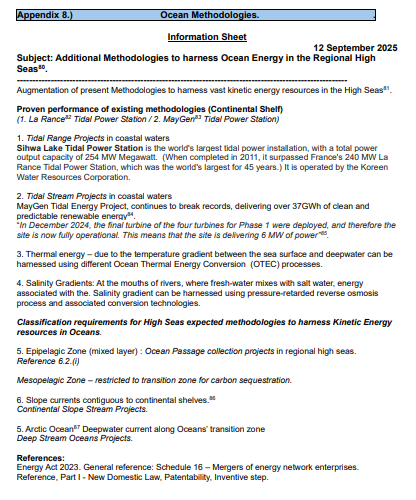
In 2025, a further paper identifies several additional Methodologies to harness Ocean Energy . Reference Appendix 8.
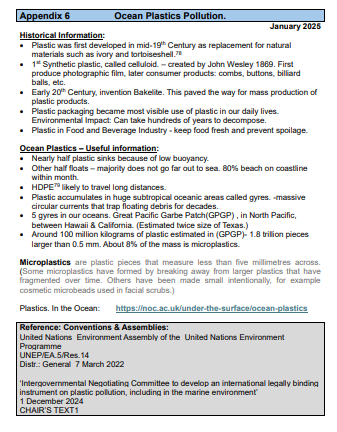
Oceans’ Plastics Pollution
The ‘Resolution adopted by the United Nations Environment Assembly’ on 2 March 2022, to ‘End plastic pollution’ , recalled the United Nations Environment Assembly resolutions 1/6, 2/11, 3/7, 4/6, 4/7 and 4/9.
They affirmed the urgent need to strengthen global coordination, cooperation and governance to take immediate action towards the long-term elimination of plastic pollution in marine and other environments, and to avoid detriment from plastic pollution to ecosystems and the human activities dependent on them .
“The Intergovernmental Negotiating Committee to develop an internationally legally binding instrument on plastic pollution including the marine environment”, noted with concern the high and rapidly increasing levels of plastic pollution.
Plastic accumulates in huge subtropical oceanic areas called gyres – massive circular currents that trap the floating plastic for decades, if not centuries.
There are five gyres in our oceans. The most polluted – and best-studied – is the infamous Great Pacific Garden Patch , located in the North Pacific Ocean, between Hawaii and California.
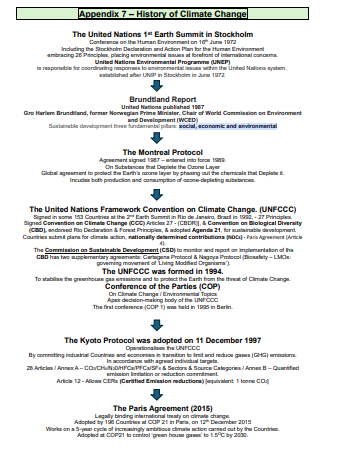
Man’s Anthropogenic Environment Mechanism Termed ‘’Climate Change
Over a decade ago, the UK put into force the Climate Change Act (CCA) 2008 , setting targets for a reduction of Greenhouse Gases by 2050, to provide for a system of carbon budgeting for the purpose of limiting GHG from the atmosphere. The Act established ‘The Committee on Climate Change’ (CCC) to assist in ‘carbon management’, to monitor, advise and report with ‘carbon budgets’ and on ‘monitoring / control’ procedures towards the ‘2050 target’ for reduction of GHG. See Appendix 7 – History of Climate Change.
Under general ancillary powers the committee may exercise its duties to take action to ensure it carries out its functions under the guidance of National Authorities and the Secretary of State. The British Standards Institute (BSI) fast tracked their Specification for ‘Carbon management in Infrastructure’ in May 2016, to enable accuracy, transparency, consistency, relevance and completeness of carbon management and GHG emissions quantification. The scope of PAS 2080 is about Carbon management as part of wider climate change mitigation; it is not about wider environmental or sustainability issues .
Under the specification the management of ‘whole life carbon’ in UK infrastructure is defined as embracing the ‘transport’, ‘energy’, ‘water’, ‘waste’’ and ‘communication’ sectors , and the management services covers the assessment, removal and reduction of GHG emissions measured as ‘carbon dioxide equivalent’, which relates and covers for the 6 gases quoted in the Kyoto protocol .
Responding to the fact that the built environment is responsible for most UK carbon emissions, it was updated in April 2023, retitled – ‘Carbon Management in buildings and infrastructure ’. Its guidance was revised to set out how the sector can transition to net zero by 2050, by managing and reducing whole life carbon in buildings and infrastructure.
Main Shoreline Management Plans Tasks (CRM)
In 2017, the United Nations estimated that around 40% of the world’s population, 2.4 billion people, live within 100 km of the coast, and 10%, 600 million people live at or below 10 masl . In 2019, and beyond, extreme wildfires, droughts, floods, and extreme rainfall events occurred worldwide, affecting many cities and settlements close to the coastlines.
Damaging and worsening anthropogenic conditions in coastal areas, now demands a Master Plan for a Global ‘Coastal Management’ framework embracing the main Continents. The Coastal footprint must include the beaches, continental shelves, their slopes and margins, and the contiguous regional high seas. Environmental Impact Analysis tools, based on strategy plans and programmes, must target longer term stability over the next 100 years, to be linked to ‘climate change’.
The main shoreline management tasks embrace Beaches and comprehensive Pollution Control procedures, relating to Estuaries and Rivers discharges, into the Oceans.
Present UK water pollution control, and indeed Global legislation, remains fragmented, unclear, inefficient, and compounded by extremes relating to agriculture pollution effects, and discharging of poorly treated / untreated sewage, into rivers and their coastal areas.
The Water Framework Directive (WFD) regulatory controls, transposed in 2003 and updated in 2017 , focused target performance for member states to undertake to achieve ‘good status’ , whereas regulatory controls based on specification standards, to harness nutrient controls, appears to be the preferred choice for ‘protecting the water, soil and air’ . This is covered in (DEFRA) ‘A Code of Good Agricultural Practice’ in 2009.
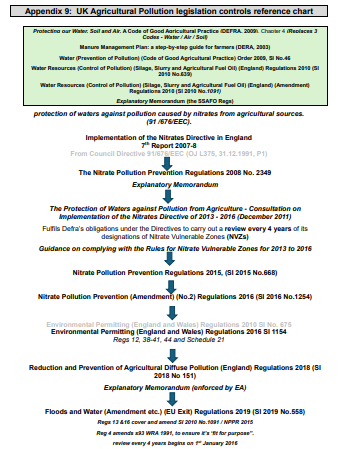
After Brexit there was an opportunity for UK policy and regulatory control to give greater emphasis to specification and process standards, followed by performance targets, through a clearer programme of measures for ‘River Basin Management Plans’ (RBMP) for nutrient control defined standard levels. A comprehensive updated co-ordinated planned framework is required to embrace the ‘UK Implementation of the Nitrates Directive in England’. This, with the follow up ‘Explanatory Memorandum’ of NPPR 2008 and ‘Consultation Guidance’ , together with ‘several important Nitrate Pollution Regulations' (NPPR 2016 , RPADPR 2018 , FW (EU Exit) R 2019 ).
Following exit from the EU, an approach to reference these important pieces of legislation in a ‘reference Chart for environmental legislation towards an agricultural nutrient controls chart’ is now a necessary task. This would create a useful reference tool, see, Appendix 9 . This coordinated structure plan approach requires as a starting point a particular ‘environmental impact analysis tool mechanism for managing UK Water Pollution’ which would embrace a UK Common Agricultural Policy (CAPUK), good agricultural and environmental conditions for UK farms (GAECUK) and to be a part of a suite of Impact Analysis reference books for adoption after Brexit. This must transition to the Global Environmental Coastal Plan
Summary
Global ‘Coastal Environmental Management Master Plan’
The principal tasks required to embrace, develop and manage the global Framework for regional coastal zones are Oceans Plastics Pollution / Atmospheric Pollution / Ocean Total Renewable Energy facilities / ‘Climate Change’ / Beaches / Rivers / Estuaries / Agricultural Pollution, together with a Master Framework for global regional Coastal Infrastructure.
A ‘World Atmospheric Structure Plan’ (WASP)
(WASP) to be set up to enable effective monitoring, recording and control procedures of the atmospheric pollution around the globe. This to identify pollution risks spreading beyond boundary demarcation borders for all regional zones / continents.
Region / Continent complete blanket cover to be adapted to identify regional unrest between neighbouring Countries and beyond, to track and contain unrest, and for effective Global control of atmospheric nuclear pollution across and beyond Continents.
Global Shoreline Management Framework
Important water pollution control measures are paramount to mitigate dangerous and poisonous increases of substances from Rivers and Estuaries discharges, into the World’s Oceans.
A Worldwide structured framework needs to be given priority, to set out and restrict nutrient-controlled levels from poorly regulated global agricultural methods, embracing worldwide Nitrate pollution regulations for all Continents rivers and estuaries.
Oceans Plastic Pollution Waste Disposal Approach
A Worldwide recovery for all ocean plastic pollution needs urgent attention to tackle the five main oceanic Gyres. A global structured co-ordinate plan / programme to be developed to recover, collect, and transfer to a defined number of shoreline Plastic Waste Plants for storage / treatment / recycling.
The Great Pacific Garbage Patch located in the North Pacific would demand several such Plants located around this massive area. Details of a global feasibility study are beyond the scope of this paper.
New Environmental Legislation
Regional High Seas: Amendment to Article 76 of the ‘United Nations Convention on the Law of the Seas’ of 10 December 1982, to modify the definition of the Continental Shelf, to include for the Regional High Seas, with an amendment to PART VII. High Seas [Articles 86–120].
A New framework of Environmental regulations to be structured, to embrace Earth’s particular ‘environmental mechanisms’, such as in the Paris Agreement, the legally binding international treaty for ‘climate change’ in 2015, and the earlier highly successful Montreal Protocol, which entered into force in 1989 and protected Earth’s Ozone layer by phasing out chemicals that depleted it
Global Coastal Transition Zone for Near Future
The importance of the boundary condition, Coastal Transition Zone, is paramount for anthropogenic reasons, to allow mankind to perceive a boundary condition tool able to monitor / record / control the movement of elastic fluids in Earth’s atmosphere, and the main continents may be used for this environmental management plan.


Foot notes
1. Expression used by Sir Issac Newton to explain boundary condition.
2. Photosynthesis, Appendix 1.
3. Hughes D et al, Environmental Law, fourth edition, Reference to Chapter 17, Atmospheric pollution, pages 543-578
4. Glossary of Archaic Chemical Terms, Part II (C-F), elastic fluid definition.
5. National Weather Service (.gov) https://www.weather.gov › winds › Flight Environment, Prevailing Winds.
6. UNFCCC, The Rio Declaration on Environment and Development, June 1992, reference only is mentioned in Principles 6 and 7.
7. Appendix 3: Facts Sheet - Ocean Facts, March 2026
8. “Approach Towards a Total UK Environmental Energy Master Plan for Clean Renewable Energy, Reviewing the Incompleteness of The British Energy Security Strategy After Brexit, and Embracing Tidal Waters and other Innovative Sources”, Journal of Environmental Dynamics and Geo-Sciences, Research Article, Vol 1, Issue 1, 02 December 2025, GLINT Open Access.
9. Appendix 5 - Salinity
10. Appendix 4: Facts Sheet: Earth’s Environmental Mechanisms – Ocean Currents in perpetual motion.
11. A Concept of Energy, Embracing Earth’s Environmental Mechanisms, Journal of Rehabilitation Research Current Updates, PrimeOpen Access, Research Article, 18 August 2025
12. Circulatory path of Earth’s Oceans current, https://ocean. si.edu/planet-ocean/tides-currents/currents-waves-and-tides
13. Bell S et al, Environmental Law, Ninth Edition, 2017, Air and atmospheric pollution, p 530-538
14. National Geographic, Education, The Coriolis Effect: Earth’s Rotation and its Effect on Weather.
15. A Concept of Energy, Embracing Earth’s Environmental Mechanisms, Journal of Environmental Dynamics and Geo-Sciences ISSN: 3069-8340, Research Article, 9 February 2026, Atmosphere, 4th para., page 2.
16. Martínez, M.L.; Intralawan, A.; Vázquez, G.; Pérez-Maqueo, O.; Sutton, P.; Landgrave, R., The coasts of our world: Ecological, economic and social importance. Ecol. Econ. 2007, Introduction, para1.
17. Martínez, M.L. et al, The coasts of our world: Ecological, economic and social importance. Ecol. Econ. 2007, 63, 254– 272.
18. Ibid, Introduction, para 6 (Carter, 1988).
19. UNCLOS, Continental Margin defined as, Continental Shelf / Continental Slope / Continental Rise. Figure 1.
20. UNEP, https://www.unep.org/resources/report/taking-steps-toward-marine-and-coastal-ecosystem-based-management-introductory Ecosystem based management, -Michael Sissenwine, former Chief Science Advisor, National Marine Fisheries Service, USA.
21. Duxbury J, Dickinson S, Principles for sustainable governance of the coastal zone: In context of coastal disasters, 29 January 2007.
22. Figure 1.
23. North America / South America / Euro Asia / Africa / Antarctica.
24. Preston, B.L.; Yuen, E.J.; Westaway, R.M. Putting vulnerability to climate change on the map: A review of approaches, benefits, and risks. Sustain. Sci. 2011, 6, 177–202.
25. Continental Margin – footprint sketch. – [UNCLOS], United Nations Convention on the Law of the Sea, PART VI, Article 76, Definition of the Continental Shelf – Addendum Sketch
26. A Concept of Energy, embracing Earth’s Environmental Mechanisms, pages 8-9, Summary, penultimate para / Appendix 1, Fluid Mechanics, Research Article, Journal of Environmental Dynamics and Geo-Sciences, GLINT Open Access, 9 February 2026
27. Ocean Energy with Linkages to Earth’s Environmental Mechanisms and Approach to a Total Renewable Energy Structure Plan, Research Article, page 3 Fluid Mechanics, penultimate paragraph, ‘gaseous elastic fluids, and Appendix 1, Fluid Mechanics, pages 5-6, World Journal of Forest Research, ISSN: 2994-5569, 17 October 2025
28. 5 Continents: North America / South America / Euro Asia / Africa / Antarctica. [ Northern Hemisphere 2 / Southern Hemisphere 3]
29. Weather, Government Webpage, Flight Environment, Prevailing Winds, Hemispheric Prevailing Winds. https:// www.weather.gov/source/zhu/ZHU_Training_Page/winds/ Wx_Terms/Flight_Environment.htm#:~:text=The%20 pressure%20gradient%20causes%20the,flow%20 parallel%20to%20the%20isobars.
30. National Geographic, Learn with us. The Coriolis Effect: Earth’s Rotation and Its Effects on Weather https://www. nationalgeographic.org/encyclopedia/coriolis-effect/
31. New Global Environmental Organization, to Head United Nations, and Embrace Present Failings, for Protection, Care and Maintenance of our Planet, World Journal of Forest Research, ISSN: 2994-5569, 3.3 Environmental Harm, 3.31 Air Pollution, sub para 6, The earth’s wind patterns, page 4, 6 April 2026.
32. SSRN Trilogy of Papers, https://papers.ssrn.com/sol3/papers. cfm?abstract_id=4647130 ,
33. “Ocean Energy with linkages to Earth’s Environmental Mechanisms, and Approach to a Total Renewable Energy Structure Plan”, World Journal of Forest Research, OPAST, 17 October 2025, page 4, 4.2 Ocean Methodologies & Legislation, / Appendix 2, Ocean Methodologies, page 7.
34. UN Environment Assembly of the United Nations Environment Programme, 7 March 2022, UNEEP/EA.5/ Res.14, Resolution adopted by the United Nations Assembly on 2 March 2022.
35. Ibid, 5/14, End plastic pollution: recalling UNEA resolutions, front page
36. Intergovernmental Negotiating Committee to develop an international legally binding instrument on plastic pollution, including in the marine environment, 1 December 2024, Chair’s Text, Preamble.
37. The Ocean Clean-up, https://theoceancleanup.com/ocean- plastic-pollution-explained/
38. Climate Change Act 2008, UK Public General Acts, 2008, c 27
39. ibid, Part 1, Carbon Budgeting, regs, 4-10
40. ibid, Part 2, The Committee on Climate Change, regs (32((33) (34)(35)(36)(37)(38)(39)(40)(41)(42) (43).
41. ibid, Part 1, Carbon Targeting and budgeting, The target for 2050, s1
42. ibid, Part 6, General supplementary provisions, regs (89)(90) (91)(92)(93)(94)(95)(96)(97)(98)(99) (100) (101)
43. PAS 2080:2016, British Standard Institute Publicly Available Specification, Carbon Management in infrastructure, Construction Leadership Council, The Green Construction Board, 31 May 2016
44. Ibid, 1 Scope, Table 1, The scope of PAS 2080
45. Ibid, 1 Scope, lines 1-2
46. Ibid, 3.17 greenhouse gases (GHGs), NOTE 2.
47. Institution of Civil Engineers, ICE, what is PAS? https:// www.ice.org.uk/news-views-insights/inside-infrastructure/ what-is-pas-2080-2023-version
48. Percentage of Total Population Living in Coastal Areas, Welcome to the United Nations, https://www.un.org/esa/ sustdev/natlinfo/indicators/methodology_sheets/oceans_ seas_coasts/pop_coastal_areas.pdf
49. “Directive 2000/60/EC of the European Parliament and the Council establishing a framework for the Community action in the field of water policy” 23 October 2000, L327/1; EU Water Framework Directive (WFD)
50. Water Environment (Water Framework Directive) (England and Wales) Regulations 2003, SI 2003 No. 3242
51. Water Environment (Water Framework Directive) (England and Wales) Regulations 2017, SI 2017, No. 407
52. Sam Boyle, The Case for Regulation of Agricultural Water Pollution, Performance standards under the Water Framework Directive, lines 1-2 7
53. Stuart Bell et al, p 627, para 2, line 6.
54. Department of Environment food and rural affairs (Defra), Code of Good Agriculture Practice, 1st published 2009 ISBN 978 0 11 243284 5
55. The Water Environment (Water Framework Directive) (England and Wales) Regulations 2017, UK Statutory Instruments 2017, No. 407, Part 6, ss 26-33
56. Implementation of the Nitrates Directive in England, 7th Report 2007-8, from Council Directive 91/676/EEC (OJ L375, 31.12.1991, P1)
57. The Nitrate Pollution Prevention Regulations 2008 No. 2349
58. The Protection of Waters against Pollution from Agriculture - Consultation on Implementation of the Nitrates Directive (Dec’ 2011)
59. Nitrate Pollution Prevention (Amendment)(No.2) Regulations 2016 (SI No. 1254)
60. Reduction and Prevention of Agricultural Diffuse Pollution (England) Regulations 2018 (SI 2018 No. 151)
61. Floods and Water (Amendment etc.) (EU Exit) Regulations 2019 (SI 2019 No. 558)
62. Ref. Appendix 9 - UK agricultural legislation controls reference chart. – Reference tool for Agricultural pollution control procedures.
63. Cross-Compliance under the Common Agricultural Policy: A possible mechanism for stronger standards
64. SSRN, posted 30 March 2026, https://doi.org/10.2139/ ssrn.6379419 , World Journals: OPAST – World Journal of Forest Research, 6 April 2026 // GLINT – Journal of Environmental Dynamics and Geo-Sciences, ISSN: 3069-8340, 25 March 2026, // PRIME, OPEN ACCESS, Journal of Rehabilitation Research Current Updates, 30 April 2026.
65. Overview Of Photosynthesis / A Level Notes, alevelbiology. co.uk https://alevelbiology.co.uk/notes/overview-of-photosynthesis/
66. Photosynthesis is one of Earth’s Environmental Mechanisms, Ref: A concept of Energy, embracing Earth’s Environmental Mechanisms, GLINT Oen Access, Jor Environ Dyn Geo-Sci, 2(1), ISSN: 3069-8340, Abstract, Research Article , 09 February 2026.
67. https://www.weather.gov/source/zhu/ZHU_Training_Page/ winds/Wx_Terms/Flight_Environment.htm
68. bigfish.mx, https://www.bigfish.mx/en/news/Why-Do-the-Pacific-and-Atlantic-Oceans-Seem-Not-to-Mix-20251009-0006.html#:~:text=The%20Atlantic%20 Ocean%20tends%20to,in%20both%20color%20and%20 behavior.
69. Potato Float, Aquarius – Education and Public Outreach.
70. https://oceangeneration.org/what-is-ocean-circulation-and-why-does-it-matter/
71. Ibid, ‘What is Ocean circulation?’
72. Ibid, Intergovernmental Panel on Climate Change.
73. Ibid, BBC Earth figure illustration.
74. Ibid, Is Ocean circulation slowing down?
75. EPA United States Environmental Protection Agency, https:// www.epa.gov/national-aquatic-resource-surveys/indicators-salinity#:~:text=What%20is%20salinity%3F,the%20 biological%20processes%20within%20them.
76. NASA - Salinity, https://salinity.oceansciences.org/science-salinity.htm
77. Aquarius – Education and Public Outreach – POTATO FLOAT
78. orders@plasticonline.com.au
79. HDPE, High Density Polyethylene.
80. Kempton, Robert, Approach Towards a Total UK Environmental Energy Master Plan for Clean Renewable Energy, Reviewing the Incompleteness of the British Energy Security Strategy after Brexit, and Embracing Tidal Waters and other Innovative Sources (May 17, 2024). Available at SSRN: https://ssrn.com/abstract=4831998 or http://dx.doi. org/10.2139/ssrn.4831998
81. Ibid, Reference to, Appendix 4 – Information Sheet, MayGen tidal power project, footnote 69.
82. Ibid, Appendix 3, Facts Sheet – La Rance Tidal Power Station
83.Ibid, Appendix 4, Information Sheet – MayGen Tidal Power Project
84. Tethys, https://tethys.pnnl.gov/project-sites/meygen-tidal-energy-project
85. https://tethys.pnnl.gov/
86. Japan’s Kuroshio currents (hindered by unstable Teutonic plate conditions