

International Journal of Forensic Research(IJFR)
ISSN: 2767-2972 | DOI: 10.33140/IJFR
Impact Factor: 1.9

Case Study - (2020) Volume 1, Issue 1
Forensic Investigation of Suicidal Hanging in Lavatory of Custody Cell and Some Remedial Steps-A Case Study
2Ex-Joint Director, Regional Forensic Science Laboratory Gwalior M. P, India
Received Date: Nov 05, 2020 / Accepted Date: Nov 11, 2020 / Published Date: Nov 18, 2020
Copyright: ©Copyright: ©2020 Dr Vinod Dhingra. This is an open-access article distributed under the terms of the Creative Commons Attribution License, which permits unrestricted use, distribution, and reproduction in any medium, provided the original author and source are credited.
Abstract
Custodial death refers to the death of a person in the police custody/ lockup or in the prison. Death in custody is usually associated with apprehension and community concern, and raises the suspicion of violation of human rights. Studies conducted in few countries have shown that people in custody have increased rate of morbidity and mortality than those not in custody. In the present study, a person had committed suicide by hanging in the lavatory while kept in police station cell. In this case, the blanket available in the cell is used as ligature material for hanging. This incidence highlights the need to prevent any loose material present in the cell that may be a possible means of suicide. The present custodial death is presented with a view to provide information which will help for effective remedial steps and the establishment of better preventive strategies to prevent such incidence in the custody in future.
Keywords
Custodial Death, Suicide, Hanging, Prevention, Human Rights.
Introduction
The motto of the National Human Rights Commission is happiness and health for all. Custodial death is one of the key sensitive issues with respect to human rights violation. Sudden and unexpected death in custody is commonly associated with allegations of police misconduct, media speculation, rumors, and intense community concern. It is also recognized that law enforcement misdemeanors do occur, hence thorough and objective investigation by the forensic scientist and pathologist to provide indisputable facts regarding the cause of death. As per the national human right commission guidelines, all custodial deaths are to be reported within 24 hrs and post-mortem examination is to be conducted by a panel of doctors and videography has been made mandatory. As per national human right commission reports showed an increase in custodial deaths all over India in last couple of years though majority of the cases in custody death due to natural causes, but issues such as negligence in medical aid or improper health care facilities and faulty design of cell cannot be ruled out. Sudden and unexpected death in custody is commonly associated with allegations of torture against law enforcement agencies. Delay in providing basic medical care is one of the commonest allegations by the relatives against jail authorities [1-4]. Death in custody is one of the most embarrassing situations for the law enforcement agencies and medico legal experts. It increases the public interest and attracts the attention of the electronic media. The death of the prisoner usually occurs due to natural cause either in the prison or in the hospital while admitted for terminal illness; and rarely due to violent cause like suicide by hanging in the prison. However violent cause in custodial deaths is more common in police cell.
Case Study
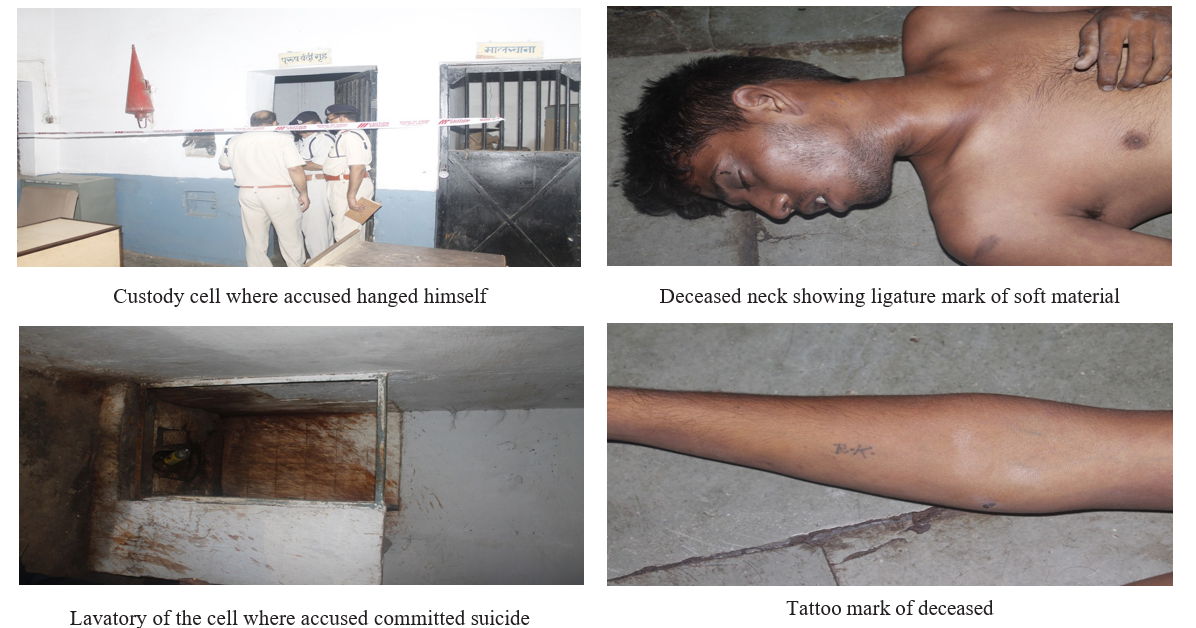
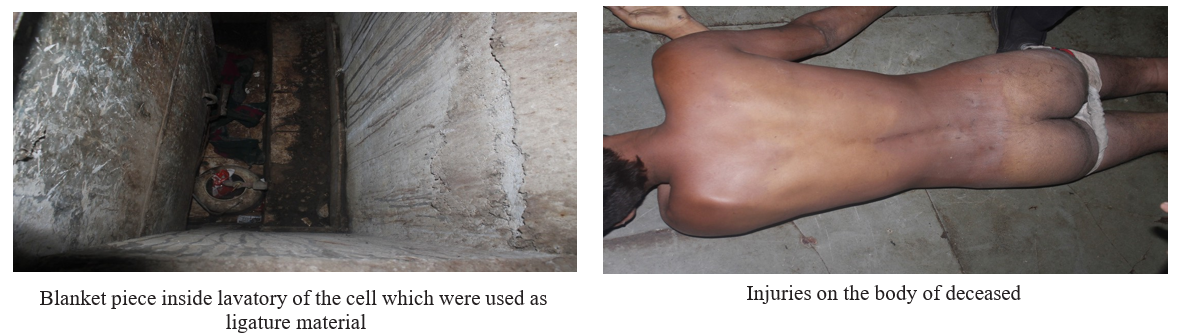
A person Mr Dinesh alias Rahul Karosia was arrested by police in connection of bike theft complaint. In noon hours, after routine inspection on duty staff kept them in cell but after half an hour his body was found in the toilet of the cell in partial hanging position. The body was sent to hospital for preliminary investigation and treatment where on duty staff declared them dead and body sent to mortuary for autopsy. On external examination, the ligature mark was present encircling the neck at the level above thyroid cartilage, tied by running noose at right mastoid of neck. Stock and glove type of lividity was present. There was congestion of face. Ligature mark of soft ligature type was present around neck of size 13 inches. The mark was present at the level above thyroid cartilage and was running obliquely upwards and towards right mastoid.

Police station where incident took place
Discussion
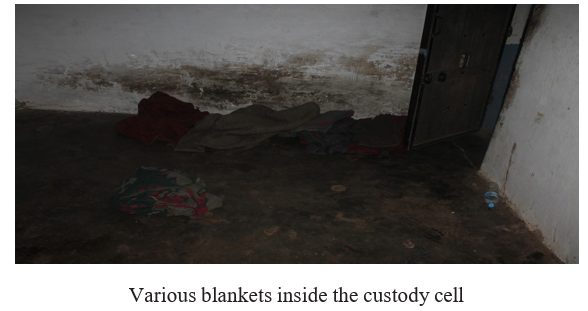
The Article 21, which is one of the luminary provisions in the Constitution of India, also lays emphasis on the fact that no person shall be deprived of his life and personal liberty except according to the procedure established by law. Generally, though inquest proceedings in all custodial deaths to be conducted under 176 CrPC. Suicide in custody cell causes an enormous degree of distress to staff and of course, to the inmate’s family and friends outside. The suicide in custody is worrisome and suggests lack of preventive effort by the authorities. As per the guidelines of national human right commission, the government and the concerned authorities are taking all necessary precautions to prevent custodial death. However, the prisoner who wants to commits suicide finds one or other new ways to end their life as happened in this case where a blanket piece found in lavatory was the part of the blanket recovered from outside the lavatory in custody cell.
Suggestions and Conclusions
Each year, however, many people die in custody though majority of these deaths are due to natural causes, but improper medical facilities and safety issue could be an important aggravating factor. Custodial deaths are among the most difficult and contentious deaths for investigation. The Magistrate inquest is conducted for all deaths in custody and is the only means of inquiry available to obtain information. Some remedial measures for prevention of such incidents are given below:
1. Providing best health care facilities, is one of the most important remedial measures.
2. The prison authorities should have detailed history of the inmate along with treatment record, follow-up record, investigations, any operative measures taken etc.
3. History regarding alcohol dependence/drug abuse, psychiatric illness recorded in the custody invantory form at initial medical evaluation should be under taken.
4. Precautions and standards regarding the type or placement of the loose materials used for the sleeping purpose of the prisoner within the cell. Precaution should be taken not to have free access to any loose material like bandage, dupatta, bed sheet, cord, water pipes, etc. available in the police station cell that may be used for committing suicide.
5. During constructing ward/ rooms in the police station should be devoid of anchor hooks etc.
6. The prisoner should be under direct observation through closed circuit camera. The concerned authorities should adopt all necessary measure to avoid such incidence in the custody cell and adopt 24x7 CCTV surveillance.
7. Developing good practice standards on training; reviewing recommendations from national human right commission, and monitoring progress in their implementation
8. Improper medical facilities and inability to provide timely medical aid are the major areas and the prison administration and health care needs to work on this aspect.
9. The custody cell conditions need improvement relating to the design and structure.
10. Decongestion of the cells is needed as and where needed.
11. The dietary plan for the prisoners as per illness should be considered.
12. Commissioning research and interdisciplinary help is the need of the hour.
13. The people related with custodial responsibilities should be properly trained for providing primary aid and to recognize when medical intervention is required.
Acknowledgments
Authors are thankful to Director FSL Sagar for motivation and encouragement. Shri M. K. Dudharia SSO RFSL Gwalior and Mr Khemchand Rana LA RFSL Gwalior for help rendered.
References
- Bansal YS, Murali G, Singh D (2010) Custodial deaths – an overview of the prevailing health care scenario. J. Indian Acad. Forensic Med 32: 315-317.
- Bardale R, Shrigiriwar M, Vyawahare MS, Dixit PG, Tayade SN (2005) Death behind bars: A five-year study of custodial deaths. Medicolegal Update 5: 10-12.
- Vinod D, Sarthak J (2017) Importance of Medico Legal Expert at Scene of Crime Related to Death. J Forensic Sci & Criminal Inves 6: 555-682.
- Vinod D (2018) The Importance of Forensic Toxicologist in Drug related crime scene Investigation. BAOJ Toxicology 1: 002.