

Journal of Applied Language Learning(JALL)
ISSN: 3068-1332 | DOI: 10.33140/JALL


Research Article - (2025) Volume 2, Issue 2
Deciphering China's Egyptian Code: The Origins of the Xia Dynasty and Chinese Characters
Received Date: Dec 15, 2025 / Accepted Date: Nov 28, 2025 / Published Date: Dec 01, 2025
Copyright: ©2025 Guangbao Liu. This is an open-access article distributed under the terms of the Creative Commons Attribution License, which permits unrestricted use, distribution, and reproduction in any medium, provided the original author and source are credited.
Citation: Liu, G. (2025). Deciphering China's Egyptian Code: The Origins of the Xia Dynasty and Chinese Characters. J App Lang Lea, 2(2), 01-14.
Abstract
This study, as the first part of a series, systematically argues for a profound, transcultural connection between early Chinese civilization and ancient Egypt. Employing scientific induction, we demonstrate that fundamental Chinese characters—including those for core cultural concepts, royal titles, and clan names—derive directly from Egyptian hieroglyphic prototypes. Concurrently, a comparative analysis of king lists and genealogical records establishes that the foundational period of the semi-legendary Xia Dynasty, from the Five Emperors to its early kings, finds its counterpart in the sequence of Egyptian rulers from the Naqada III/Dynasty 0 period through the Old Kingdom. The multi-faceted correspondences across linguistic, genealogical, and symbolic domains presented here significantly mitigate the likelihood of coincidence. This cumulative evidence for the early phase posits that the foundational narrative of the Xia Dynasty constitutes a preserved Chinese record of early Egyptian civilization, laying the groundwork for a subsequent analysis that will extend this comparison to the Middle and New Kingdoms.
Keywords
Origin of Chinese Characters, Xia Dynasty, Ancient Egypt, Egyptian Hieroglyphs, King List Correlation, Sino-Egyptian Historiography, Cultural Migration, Genealogical Analysis
Introduction
Chinese archaeology has yet to conclusively verify the historicity of China's first dynasty, the Xia. Nonetheless, numerous ancient texts preserve records of its prominent figures, royal genealogies, and significant historical events.
<img src=" https://www.opastpublishers.com/scholarly-images/10002-693f90ea8c740-deciphering-chinas-egyptian-code-the-origins-of-the-xia-dyna.png" width="500" height="200">
This paper further demonstrates that ancient Egyptian hieroglyphs served as prototypes for Chinese characters, with the divergence between oracle bone script and hieroglyphs potentially reflecting only a single evolutionary step. Additionally, it argues that Chinese historical texts contain narratives corresponding to the history of Ancient Egypt prior to the 19th Dynasty.
Methodology
We applied the principle of scientific induction to analyze parallels across three domains:
• Linguistic correspondence: Comparing structural, phonetic, and semantic features of Chinese characters and Egyptian hieroglyphs
• Historical alignment: Matching king lists, royal genealogies, and significant events
• Cultural symbolism: Identifying shared motifs in religion,
royalty, and cosmology
Primary sources included Egyptian archaeological records, Chinese classical texts (Shi Ji, Shan Hai Jing, Guo Yu), and etymological databases.
Chinese Characters as Descendants of Egyptian Hieroglyphs
Foundational Cultural Terms
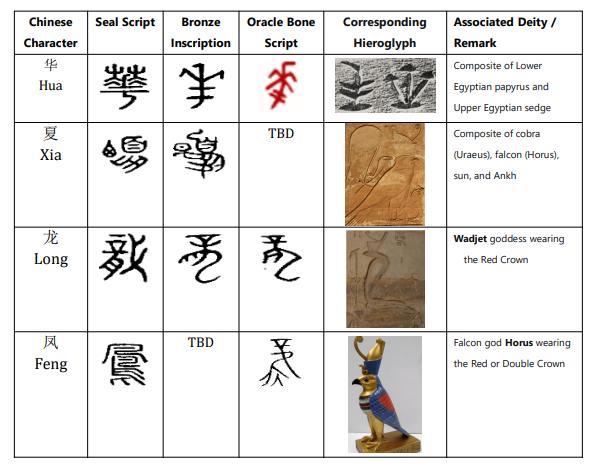

Table 1: Comparison Between Chinese Characters and Egyptian Hieroglyphs
Homology of the Title and Nomenclature System
While cultural similarities may suggest contact between ancient Chinese and Egyptian civilizations, they are insufficient to conclusively identify Ancient Egypt as the Xia Dynasty. To establish this connection more definitively, this study turns to a comparative analysis of royal genealogies. By examining the recorded names of Xia Dynasty kings alongside the archaeologically-established king list of Ancient Egypt, it is possible to decipher a more coherent history of the Xia. This comparison reveals that the narrative of the Xia Dynasty, as preserved in ancient Chinese texts, aligns fundamentally with the historical sequence of Ancient Egypt.
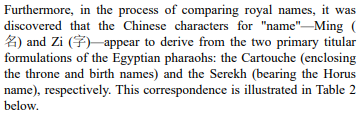
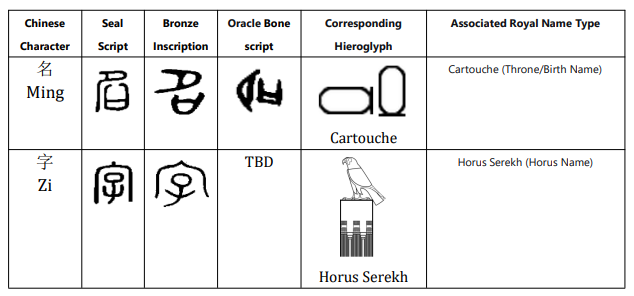
Table 2: Comparison Between the Chinese Characters for "Name" (Ming and Zi) and Egyptian Hieroglyphs
In ancient Egyptian tradition, pharaohs typically held a fivefold royal titulary. Among these titles, the Horus name—initially paramount—was gradually superseded in significance by the throne name from the late Old Kingdom onward. Beyond the Horus name, the Nebty (“Two Ladies”) name is identified here as the prototype for the Chinese character  (Sì), the clan name associated with Yu the Great, founder of the Xia Dynasty. Similarly, the prominence of the Nebty name was later succeeded by the birth name.
Furthermore, both the Golden Horus name and the throne name correspond structurally to the Chinese character  (Jun), denoting “sovereign” or “ruler.” Finally, the birth name, which explicitly designates the king as the “son of the sun god,” appears to be the origin of the character
  (Zhèn)—a first-person pronoun reserved exclusively for the emperor in classical Chinese usage. These proposed correspondences are systematically presented in Table 3 below

Table 3: Correspondence Between Ancient Egyptian Royal Titulary and Chinese Characters
The Xia Dynasty in Egyptian Historical Records
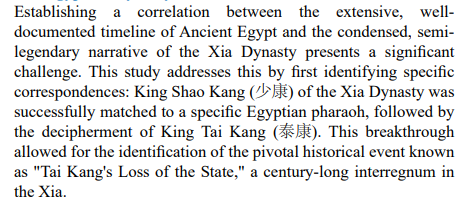
Using this established benchmark, a systematic comparison was undertaken between the king list of the Xia Dynasty and the archaeological king list of Ancient Egypt. The analysis revealed that the purported figures of all recorded Xia kings find their counterparts within the sequence of Egyptian dynasties. The degree of consistency extends beyond the mere sequence of rulers to include identical familial relationships—such as those between husbands and wives, and parents and children—as well as shared names for specific kings. Such a comprehensive and multi-faceted correspondence is highly unlikely to be coincidental.
According to the principle of complete scientific induction, the cumulative evidence substantiates the proposition that Ancient Egypt was, in fact, the Xia Dynasty. This correlation furthermore provides a framework for analyzing and reconciling discrepancies in both Chinese historical records and Egyptological interpretations. The detailed methodology underlying the decipherment of character origins and the identification of historical figures is elaborated in the author's monograph, Discovering the Xia Dynasty (published in 2017) [1]. Nevertheless, questions regarding the mechanisms and routes of migration remain subjects for future research.
The Naqada culture represents the predynastic civilization of ancient Egypt. The Naqada I and II phases, spanning approximately
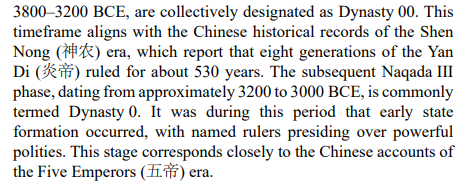
The king list of Dynasty 0 in Egypt shows strong consistency
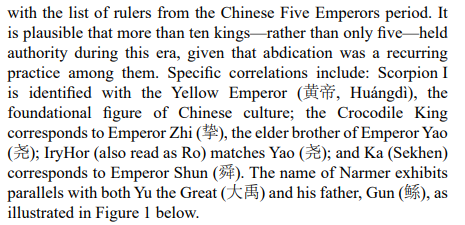
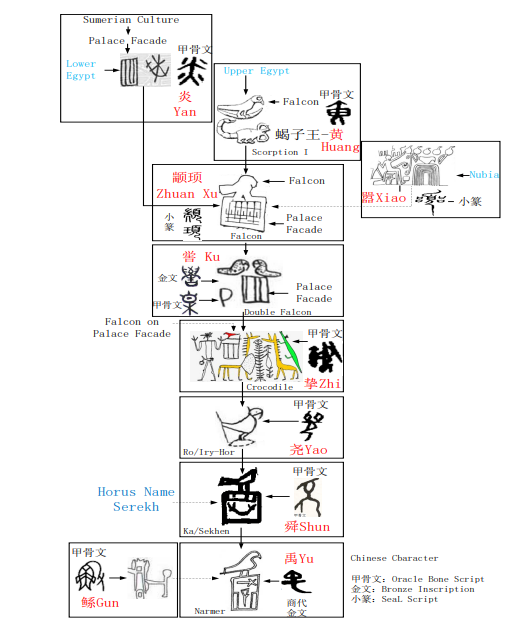
Figure 1: Comparison of the King List from the Chinese Five Emperors Era with the Rulers of Egyptian Dynasty 0
The Founding of the Xia and the Egyptian First Dynasty
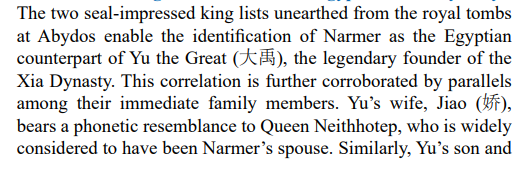
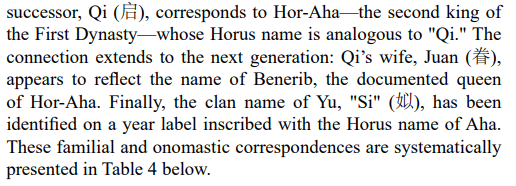

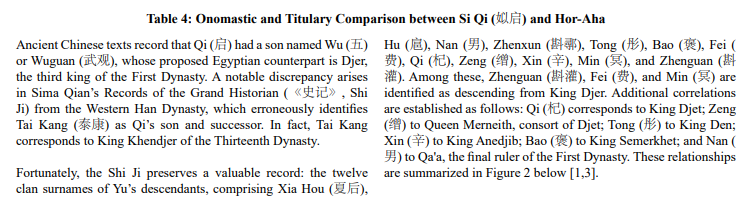
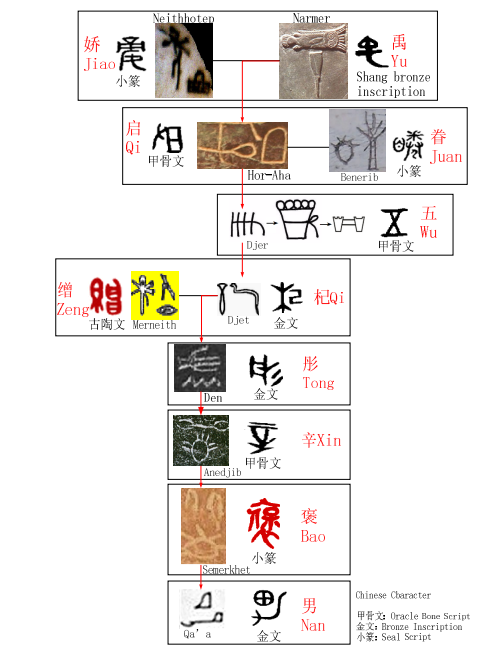
Figure 2: Deciphering a Transcivilizational Genealogy: The Twelve Clans of Yu's Descendants and Their Proposed Correlations with the First Dynasty of Egypt
The Egyptian Prototypes of Later Chinese Dynastic Ancestors
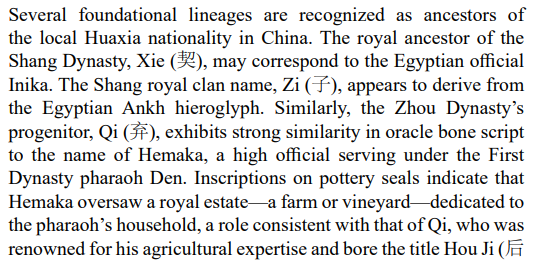
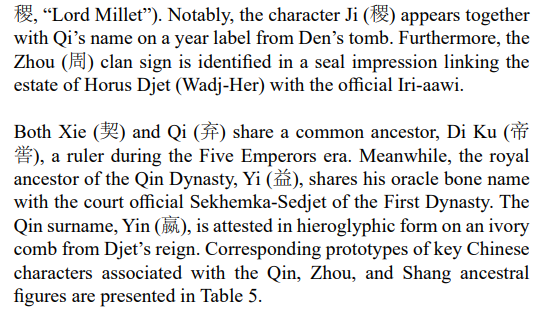
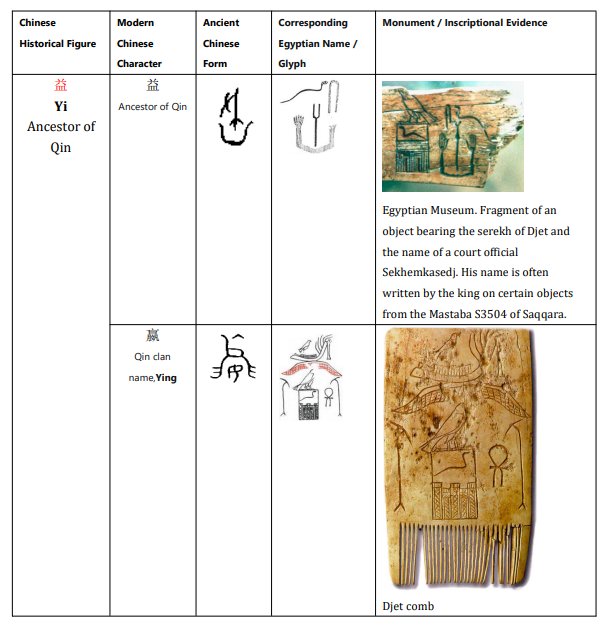
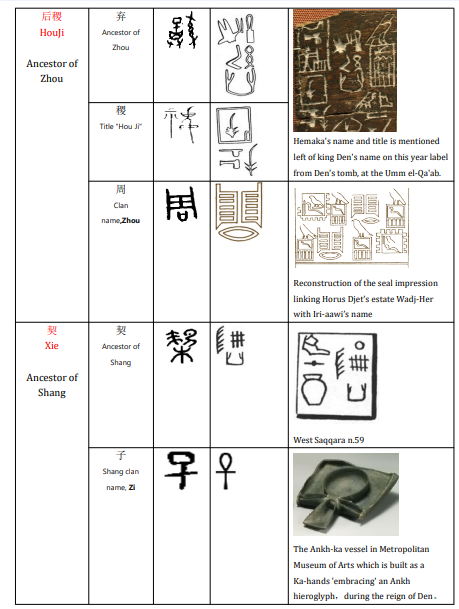
Table 5: Comparison of Proposed Egyptian Prototypes for the Ancestral Figures of the Qin, Zhou, and Shang Dynasties
Cross-Dynastic Genealogical Integration



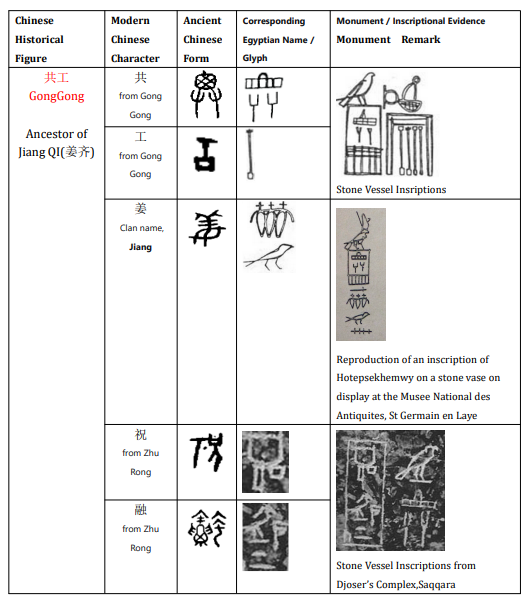
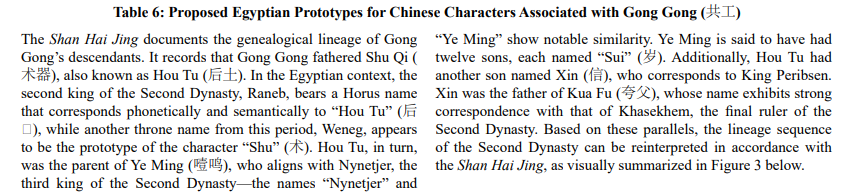
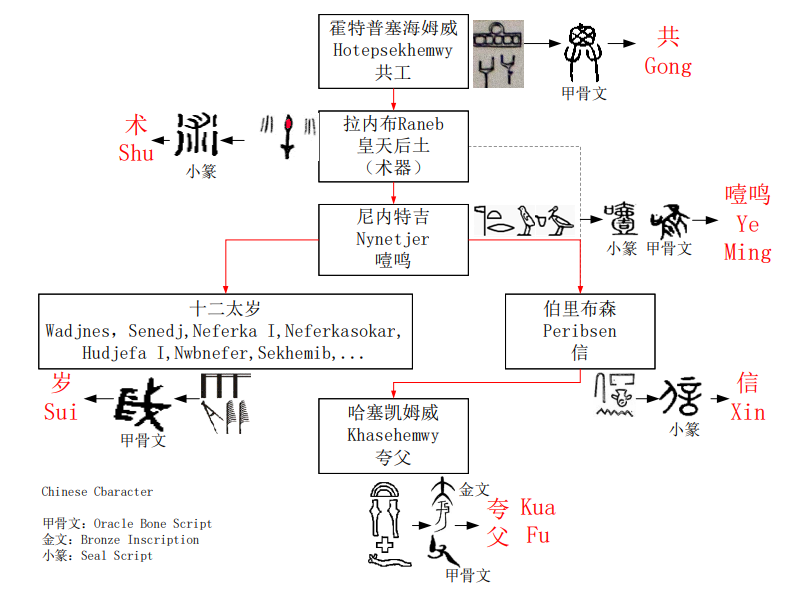
Figure 3: Realignment of the Second Dynasty Egyptian Sequence according to the Genealogical Descent Recorded in the Shan Hai Jing
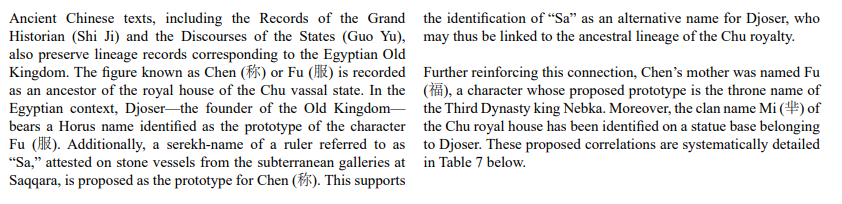
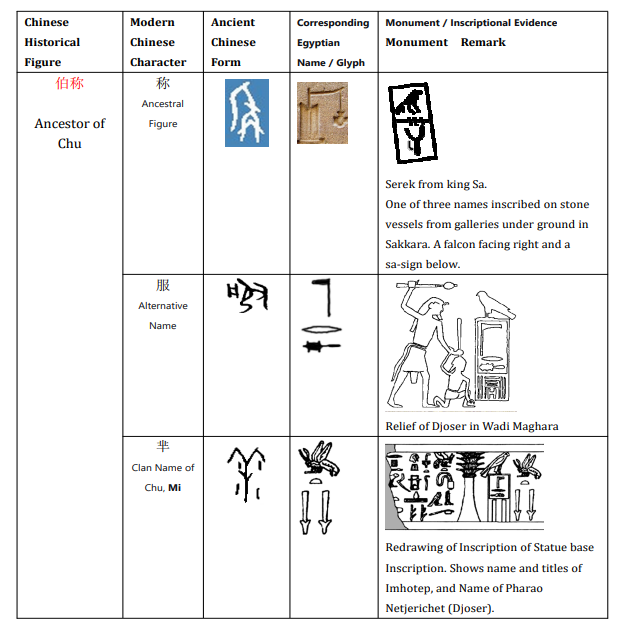
Table 7: Proposed Egyptian Prototypes of Key Figures and Terms Associated with the Ancestral Lineage of Chu
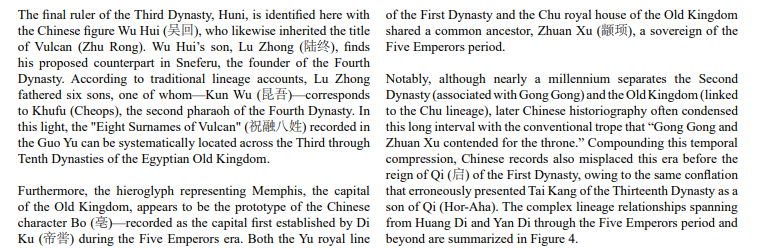
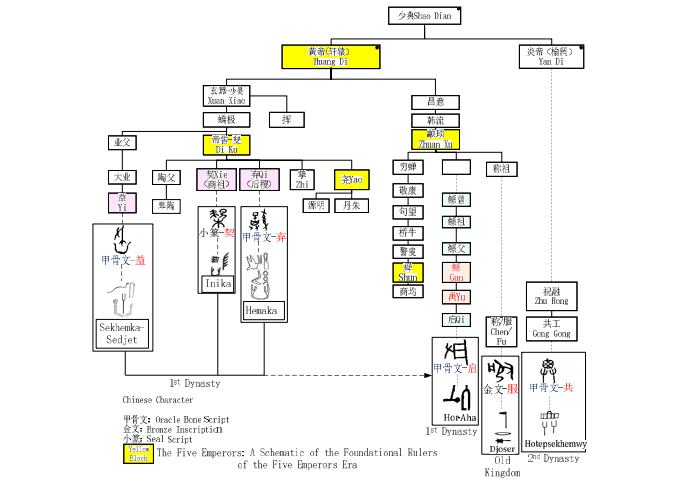
Figure 4: A Comparative Genealogy of Huang Di and Yan Di: Tracing a Transcivilizational Lineage from the Five Emperors Era through the First Xia and Old Kingdom Rulers
Synthesis and Conclusion
As the inaugural part of a broader investigation, this study has assembled a systematic body of evidence positing that Chinese characters originated from Egyptian hieroglyphs, and that the foundational narrative of China's first dynasty—the Xia, encompassing the era of the Five Emperors and its initial lineage— corresponds to the history of Ancient Egypt from its predynastic era (Naqada III/Dynasty 0) through the Old Kingdom. The consistency of correspondences across linguistic, genealogical, and cultural domains substantially diminishes the possibility of coincidence. The identification of Egyptian prototypes for Chinese characters representing basic concepts, core cultural symbols, royal titles, and clan names indicates a profound and systematic connection that transcends superficial similarity. This framework, furthermore, resolves key anomalies in Chinese historiography: the misplacement of Tai Kang (a 13th Dynasty pharaoh) as Qi's son, and the trope of "Gong Gong and Zhuan Xu contending for the throne," which appears to be a literary condensation of nearly a millennium of Egyptian history.
Through comparative analysis of cultural symbols, royal titulary, king lists, and genealogical records, multi-layered parallels have been identified across the Naqada/Dynasty 0, Early Dynastic, and Old Kingdom periods. The cumulative weight of this evidence demonstrates that the early narrative of China's recorded history— from the Five Emperors to the initial Xia Dynasty—aligns precisely with the Egyptian record from Dynasty 0 through the Old Kingdom, suggesting that the foundational chapters of Chinese civilization constitute a preserved and adapted account of early Egyptian civilization.
Consequently, these findings compel a fundamental re-evaluation of early Chinese history. The evidence strongly suggests that the roots of Chinese civilization may be traced, at least in part, to the Nile Valley, challenging the paradigm of an exclusively autochthonous development in the Yellow River basin. While questions regarding the precise mechanism and chronology of cultural transmission remain, the forthcoming continuation of this research will extend the comparison to the Egyptian Middle and New Kingdoms, aiming to complete the correlation with the full span of the recorded Xia Dynasty. Future studies should also prioritize detailed comparisons of archaeological assemblages and the investigation of potential migration routes and contact mechanisms [4].
References
- Liu, G. B. (2017). Discovering the Xia Dynasty. China Development Press.
- Luo, L. J. (2012). Karma over Three Thousand Years. Contemporary China Press.
- Jarus, O. (n.d.). Early Egyptian Queen Revealed in 5,000-Year- Old Hieroglyphs. Live Science.
- Chang, F. Z. (2013, December 20). Cang Jie and Seshat-Thoth [Blog post].
Acknowledgements
The author acknowledges the use of archaeological data from Wikipedia, Francesco Raffaele's Late Predynastic and Early Dynastic Egypt website, and Richard Sears' Chinese Etymology database for character analysis.The analysis of ancient Chinese character forms benefited from the etymological data provided by Richard Sears' "Chinese Etymolo gy" website, a key tool for researching the evolution of Chinese script.