

International Journal of Media and Networks(IJMN)
ISSN: 2995-3286 | DOI: 10.33140/IJMN
Impact Factor: 1.02



Research Article - (2024) Volume 2, Issue 8
Decentralized Development: Impact of Autonomous Councils in the Development of Assam
Received Date: Jun 18, 2024 / Accepted Date: Jul 20, 2024 / Published Date: Aug 05, 2024
Copyright: ©Â©2024 Ranjan Das. This is an open-access article distributed under the terms of the Creative Commons Attribution License, which permits unrestricted use, distribution, and reproduction in any medium, provided the original author and source are credited.
Citation: Das, R. (2024). Decentralized Development: Impact of Autonomous Councils in the Development of Assam. Int J Med Net, 2(8), 01-05.
Abstract
In regions with distinct cultural and linguistic identities, autonomous district councils (ADCs) in India serve as exceptional examples of decentralized governance. In Assam, part of India's northeast where numerous tribal communities have historically been marginalized and endured social, political, and economic isolation, ADCs have been established. This innovative system for local self-governance and decision-making has contributed to promoting inclusive development and empowering indigenous communities in Assam. However, the effectiveness of ADCs in Assam is influenced by various factors, including the degree of autonomy granted to the councils, the strength of regional institutions, and the accessibility of resources. This essay aims to provide a comprehensive examination of the formation of ADCs in Assam, their institutional structure, and their role in advancing social justice, democratic governance, and inclusive development. Additionally, the challenges faced by ADCs in Assam, such as the need for greater financial and administrative autonomy, the difficulties in building local institutional capacity, and the potential for political interference, will be discussed.
Keywords
Decentralized, ADCs, Autonomy, Inclusive Development
Tribe and State: History Behind
The Sixth Schedule the Autonomous District Councils (ADCs), governed by the twenty-one-article, twenty-page Sixth Schedule to the Indian Constitution, often referred to as a “miniature constitution,” exemplify a comprehensive application of the integrationist approach to Indian national incorporation. ADCs were designed to address the unique needs of tribal groups in Northeast India, whose historical relationship with governance institutions under the British Raj was fragmented and indirect. In regions governed by ADCs, nearly 80 percent of the population is tribal, in stark contrast to the 30-35 percent tribal population in central Indian "tribal belt" areas like Jharkhand or Chhattisgarh. ADCs were intended to support distinct tribal practices while integrating these communities into individual- oriented political institutions. As independence neared in 1946, British Prime Minister Attlee sent a final Cabinet delegation to India to craft effective post-British governance institutions. This delegation proposed the formation of an Advisory Committee on the rights of citizens, minorities, and tribal and excluded areas. This committee, headed by Sardar Vallabhbhai Patel and subcommittees led by A.V. Thakkar and G.P. Bardoloi, toured Northeast India to gather insights from local leaders, except in areas like the Naga Hills and Garo Hills due to insurgency and rains, respectively. The Bardoloi committee concluded that while incorporating all Indians into a single representative system was ideal, substantial district-level autonomy in tribal areas would be a beneficial compromise, balancing the desire for independence among some north-eastern communities. The Bardoloi subcommittee's report included detailed provisions for ADCs in Assam's formerly "excluded areas." The Sixth Schedule, presented to the Constituent Assembly in 1949, was ratified with minimal changes after debates among various factions with differing views on autonomy and assimilation. The final form of the Sixth Schedule included elements from all factions, reflecting a balanced integrationist approach. ADCs were designed with five key characteristics. First, each of the six major tribal groupings was given an autonomous district, with provisions for regional councils to align with tribal territories.
This was the first and perhaps only instance of the Indian government assigning governmental boundaries based on social identities. Second, ADCs were empowered to legislate on subjects ranging from land use to social customs, with the caveat that all legislation required the governor's assent, ensuring consistency with broader Indian legal standards and secular values. Third, ADCs were tasked with administering justice through district and regional courts, although the governor could also direct state high courts to perform these functions. Fourth, ADCs were responsible for managing primary education, healthcare, markets, and infrastructure, ensuring that these services were responsive to tribal needs. Lastly, ADCs had the authority to assess and collect certain taxes and manage funds from central and state governments, providing them with financial autonomy to pursue their developmental priorities. The Sixth Schedule attempted to give ADCs the legislative, judicial, administrative, and financial capacity to establish and enforce their own social and developmental priorities within the broader Indian constitutional framework. This approach recognized the role of communities in political life, leading to a constitution that, while complex, aimed to be more effective in addressing the needs of India's diverse population.
The Autonomous Council
An Autonomous Council refers to a governing body that is granted a certain degree of self-governance and autonomy to administer specific areas, particularly regions predominantly inhabited by tribal communities. These councils are designed to enable local governance and ensure that the development needs and cultural identities of these communities are preserved and promoted.
There are two types of Autonomous councils in North East India in terms of the status granted by the Central and State Government. In the first category, are the Autonomous District Councils established by the Central government under the Sixth schedule of the Constitution, while the second category consists of the Autonomous District Council established by the State Legislature. The ADCs granted by the State Legislature do not enjoy the provisions under the Sixth Schedule (Report of the High Level Committee on the Socio-Economic, Health and Educational Status of the Tribal Communities of India, Ministry of Tribal Affairs, 2014). The list of ADCs under the Sixth Schedule is:
|
State |
Autonomous District Councils/ Year of Formation |
|
Assam |
Bodoland Territorial Council (BTC)/ 2003 KarbiAnglong Autonomous Council (KAAC)/ 1951; 1976 Dima Hasao District Autonomous Council (DHDAC) 1951;1970;2014 |
|
Meghalaya |
Khasi Hills Autonomous District Council (KHADC)/ 1972 Garo Hills Autonomous District Council (GHADC)/1972 Jaintia Hills Autonomous District Council (JHADC)/1972 |
|
Tripura |
Tripura Tribal Areas Autonomous District Council (TTAADC)/1982 |
|
Source: Actionaid India, 2016 |
|
Table 1: List of Autonomous Councils in North East India
On the other hand, the administrative structure operational in the other three North Eastern States with majority tribal population are as follows:
|
State |
Administrative Structure |
|
Arunachal Pradesh |
Panchayati Raj Institutions |
|
Manipur |
Hill Village Authority Act and Manipur Hill Areas District Council |
|
Nagaland |
Village Councils |
Table 2: ADC’s in the Tribal Areas and their Administrative Structure
There are two main types of Autonomous Councils in Assam:
1. Territorial Councils under the Sixth Schedule of the Constitution of India: These councils are provided with significant legislative, administrative, and financial powers to manage their affairs. The Sixth Schedule aims to protect the interests of the tribal populations through self-governance and to preserve their traditional practices and customs. In Assam, the three main councils under this category are:
 Bodoland Territorial Council (BTC): Administers the Bodoland Territorial Region.
Dima Hasao Autonomous District Council (NCHAC): Governs the Dima Hasao district.
Karbi Anglong Autonomous District Council (KAAC): Manages the Karbi Anglong district.
2. Statutory Autonomous Councils Constituted Under State Act
These councils are established by the state government to promote the social, economic, educational, ethnic, and cultural advancement of specific communities. They have executive powers over various subjects, enabling them to tailor development initiatives to the needs of their communities. Examples include:
Rabha Hasong Autonomous Council
Mising Autonomous Council -
Tiwa Autonomous Council
Deori Autonomous Council -
Thengal Kachari Autonomous Council
Sonowal Kachari Autonomous Council
The purpose of establishing Autonomous Councils is to decentralize power and allow local communities greater control over their development processes. This approach fosters inclusivity, ensures that policies and programs are more closely aligned with the specific needs of the communities, and promotes the preservation of their unique cultural heritage. Through these councils, the Government of Assam aims to empower tribal communities, enhance their participation in governance, and address their socio-economic challenges more effectively.
Structure of Autonomous Council
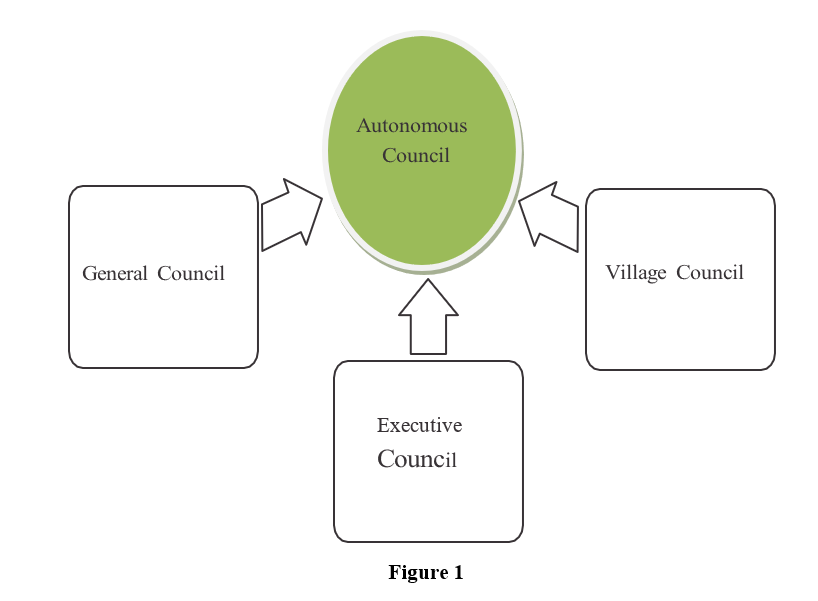
Autonomous Councils are structured with a General Council, an Executive Council, and Village Councils. The General Council, with a 5-year term, consists of 40 members: 36 elected by residents and 4 nominated by the government. It holds executive powers over various subjects in the council area.
Autonomous Councils in Assam
The Government of Assam has been actively working to accelerate the development process for the welfare of Scheduled Tribe (ST) communities in the state through democratic decentralization of power. This approach aims to empower the ST communities by involving them in the planning, monitoring, and implementation of Tribal Sub Plan (TSP) schemes at the grassroots level. To achieve this, the government has established various Territorial Councils, Autonomous Councils, and Development Councils for different ST communities in the state. The Autonomous Councils in Assam are categorized under different heads, including Territorial Councils under the Sixth Schedule of the Constitution of India and Statutory Autonomous Councils constituted under state law. These councils are granted varying degrees of autonomy within the state legislature, allowing them to manage their own affairs to a significant extent. This decentralization ensures that the specific needs and aspirations of the ST communities are addressed more effectively and inclusively.
Bodoland Territorial Autonomous District Council (BTADC)
The Bodo movement in Assam has evolved through various socio-cultural and political organizations, including Boro Chatra Sanmiloni (BCS), Bodo Sahitya Sabha (BSS), All Bodo Students' Union (ABSU), Bodo Peoples Action Committee (BPAC), Plains Tribal Council of Assam (PTCA), Bodo Liberation Tiger Force (BLTF), and National Democratic Front of Boroland (NDFB). Before 1967, the movement was non-political, focusing on the socio-cultural and economic upliftment of the Bodo community. Activities were limited to petitions and memorandums for minimal demands like representation in law-making bodies. In 1967, following the reorganization of Assam by Indira Gandhi, the All Bodo Students' Union (ABSU) and the Plains Tribal Council of Assam (PTCA) were formed. A memorandum was submitted to President Zakir Hussain, demanding full autonomy for tribal areas. By 1973, this demand escalated to the call for a "Union Territory." However, the focus shifted to adopting the Roman script for the Bodo language during the Emergency in 1975, resulting in the imposition of Devanagari script against their will. In 1978, PTCA and the Janata Party formed a coalition government. PTCA later shifted its demand back to an Autonomous Council, causing internal splits.
In 1986, under ABSU leadership, a 92-point charter of demands was submitted, primarily calling for the creation of a separate state "Bodoland," setting up district councils south of the Brahmaputra, and including Bodo Kacharis of Karbi Anglong under the Sixth Schedule of the constitution. The demand for a separate state began in 1987 with the slogan "Divide Assam 50-50" but turned violent against PTCA members and non-Bodo officials. According to Sanjib Baruah, the main barriers were that Bodos comprised only 11.5% of the population north of the Brahmaputra, there was a lack of contiguous Bodo-majority areas, and it was difficult to further split Assam without the State Assembly's consent. In February 1993, ABSU and BPAC signed the Bodo Accord with the central and state governments, ending the violent movement. The Accord promised the formation of the Bodo Autonomous Council (BAC), including contiguous areas between the rivers Sankosh and Mazbat/Pasnoi. Villages with 50% or more Bodo population were included, and even some with less than 50% were considered to create a contiguous BAC area.
Karbi Anglong Autonomous Council (KAAC)
The history of the Karbi Anglong Autonomous Council (KAAC) dates back to 1940 when the Karbi Adurbar was formed to preserve the political and traditional identity of the Karbi tribe. On October 28, 1940, Sir Robert Reid, Governor of Assam, visited the Mikir Hills, where Karbi leaders submitted a memorandum demanding political identity for the Mikir people. This demand continued, and on May 18, 1947, it was presented to the Bordoloi Committee, stressing the need for a local council with legislative and judicial functions.
In 1951, the Government of India passed a bill creating the United Mikir and North Cachar Hills District, which was assented to by President Rajendra Prasad. In 1970, the district was divided into Mikir Hills and North Cachar Hills. The Mikir Hills district was renamed Karbi Anglong District on October 14, 1976, with its headquarters in Diphu. It enjoys autonomy under the Sixth Schedule of the Indian Constitution and is the largest district in Assam, covering 10,434 square kilometers.
In the early 1990s, political developments led to the signing of a Memorandum of Understanding (MoU) on April 1, 1996, granting greater autonomy to the district council, which was renamed the Karbi Anglong Autonomous Council (KAAC). This change, enacted by the Sixth Schedule to the Constitution (Amendment) Act, 1995, included additional departments and welfare schemes. On August 15, 2015, the district was bifurcated into Karbi Anglong and West Karbi Anglong. The current Karbi Anglong Autonomous Council (KAAC) now has jurisdiction over both districts.
Major Achievements of the Karbi Anglong Autonomous Council (KAAC)
• Increased Political Representation: The council's seats were expanded from 30 to 50, including six nominated by the Governor, enhancing political inclusivity.
• Renaming and Reorganization: The council was renamed the Karbi Anglong Autonomous Territorial Council (KAATC), reflecting its enhanced status.
• Strengthened Local Governance: Village councils were established to bolster grassroots democracy.
• Legislative and Executive Powers: The Assam government transferred 39 additional subjects to the council, granting significant legislative and executive authority.
• Development Initiatives: Measures were introduced for socio- economic, educational, health, and cultural development, including improved infrastructure for roads, water, and power.
• Rehabilitation of Former Insurgents: Provisions were made for the rehabilitation of UPDS cadres, facilitating their integration into society.
• Educational Infrastructure: The district boasts 2,517 schools, managed by the District Primary Education Department, supporting primary education in multiple languages.
Dima Hasao District Council Autonomous Council (DHDAC)
The Dimasa, an ethnic group in Assam, initiated a movement for a separate state called "Dimaraji," representing Dimasa-inhabited regions in Northeast India. The North Cachar Hills (now Dima Hasao) district was formed in 1951 under the Sixth Schedule to promote the socio-economic and cultural development of hill tribes. This district was bifurcated from the United Mikir and North Cachar Hills District in 1970. Over time, Dimasas felt neglected by the state, leading to armed movements demanding autonomy.
In 2012, two factions of the Dima Halom Daogah (DHD), led by Dilip Nunisa and Jewel Garlosa, signed a tripartite agreement with the Central and State Governments. This agreement reorganized the North Cachar Hills Autonomous Council into the Dima Hasao Autonomous Territorial Council, granting it greater financial and administrative powers. Structure of Dima Hasao Council
• Members: 27 (23 elected, 4 nominated)
• Executive Committee: Chief Executive Member + 9 Council Members
Achievements Under the Autonomous District Councils (ADCs)
The literacy rate among tribal communities in Assam is 72.1%, comparable to the state average and above the national average. However, there is a notable gender disparity, with male literacy at 79% and female literacy at 65% (Census, 2011). Economically, tribal households are similar or slightly better off than average households, with only 18.6% lacking durable assets, which is 5% lower than the state average. However, access to banking services and grid electricity remains limited.
Human Development Index Comparison
A comparison of Human Development Indices (HDI) shows significant disparities between Kamrup (M) district, the highest in Assam, and districts under the ADCs: Comparison of BTC, KAAC, and Funding - The Bodoland Territorial Council (BTC) receives funds based on population, including an additional Rs 500 crores from the Government of India, released in two half- yearly installments by the State Government. These funds are untied, and BTC allocates them district-wise. - Compared to BTC, the Karbi Anglong Autonomous Council (KAAC) and the North Cachar Hills Autonomous Council (NHDC) have smaller funding sizes.
Representation and Powers - BTC reserves a few seats for non- tribals, unlike KAAC and NHDC, which have no non-tribal representation. BTC also has more seats (50) compared to KAAC (30) and NHDC (27). - BTC's jurisdiction extends over four districts, and the "Divisional Cadres" of line departments have been transferred to the Council.
Conclusion
The establishment of Autonomous District Councils (ADCs) in Assam has been a significant step toward decentralized development, promoting inclusive growth and empowering indigenous communities. The Bodoland Territorial Council (BTC), Karbi Anglong Autonomous Council (KAAC), and Dima Hasao District Autonomous Council (DHDAC) are notable examples of how ADCs function to preserve cultural identities and enhance socio-economic development. Despite these advancements, the effectiveness of ADCs in Assam is contingent upon several factors, including the degree of autonomy, institutional capacity, and resource accessibility. Challenges such as financial constraints, administrative limitations, and political interference need to be addressed to fully realize the potential of ADCs. Continuous efforts to strengthen local governance structures, ensure equitable resource distribution, and enhance political representation are essential for fostering sustainable and inclusive development in Assam's tribal regions [1-8].
References
- Actionaid India. (2016). Report on Autonomous Councils in North East India.
- Borah, K. (2013). Satellite Autonomous Councils of Assam & Tribal Law (s). Advanced Law & Allied Publishers Group.
- Stuligross, D. (1999). Autonomous councils in Northeast India: theory and practice. Alternatives, 24(4), 497-526.
- Das, D., & Saikia, A. (2011). Early twentieth century agrarian Assam: A brief and preliminary overview. Economic and Political Weekly, 73-80.
- Chachra, S. (n.d.). Functioning of autonomous councils in sixth schedule areas of north eastern states. In ActionAid India.
- Samvaad, D. (n.d.). Ministry of Tribal Affairs, Governmentof India.
- Karbianglong
- Dima Hasao. (2022).