

Current Research in Statistics & Mathematics(CRSM)
ISSN: 2994-9459 | DOI: 10.33140/CRSM



Research Article - (2025) Volume 4, Issue 3
Comprehensive Characterization of the Finest Locally Convex Topology with Applications
Received Date: Aug 04, 2025 / Accepted Date: Sep 04, 2025 / Published Date: Sep 25, 2025
Copyright: ©2025 Elvin Rada. This is an open-access article distributed under the terms of the Creative Commons Attribution License, which permits unrestricted use, distribution, and reproduction in any medium, provided the original author and source are credited.
Citation: Rada, E. (2025). Comprehensive Characterization of the Finest Locally Convex Topology with Applications. Curr Res Stat Math, 4(3), 01-03.
Abstract
This paper provides a comprehensive characterization of the finest locally convex topology S on an infinite-dimensional real vector space E. By identifying E with the algebraic direct sum L i∈I R via a Hamel basis, we establish that S coincides with the locally convex direct sum topology. We derive some core structural properties of S, including its duality, boundedness, and topological decomposition behavior. Furthermore, we show that for any subset C ⊂E, compactness, total boundedness with completeness, and boundedness with closedness are equivalent. These results resolve open questions in the theory of locally convex spaces and provide new insights into the structural properties of infinite-dimensional vector spaces. In the end we highlight two significant applications in duality theory and functional analysis.
Keywords
Finest Locally Convex Topology, Locally Convex Direct Sum, Hamel Basis, Compactness
Introduction
The study of locally convex topologies on vector spaces is fundamental to functional analysis, with profound implications for applied mathematics. Among these, the finest locally convex topology  on an infinite-dimensional vector space E over
  occupies an important position as the maximal locally convex topology that admits the richest collection of continuous linear functionals. This topology, first investigated by Schaefer [1], exhibits remarkable categorical and functional-analytic properties that challenge conventional intuition about infinite-dimensional spaces. Classical texts like Rudin [4] offer foundational results, yet often treat the finest topology as a marginal case. The fundamental role of S is evident in its universal property: it is the final topology concerning all linear maps from arbitrary locally convex spaces into E [2, Theorem 6.1]. Despite this categorical significance, a comprehensive structural characterization of S has remained incomplete [2-4]. Prior investigations by Kelley [3] established elementary separation properties, while Schaefer [1] demonstrated the coincidence of topological and algebraic duals under for countable-dimensional spaces. The connection between and direct sum topologies was noted in [2], but without full exploitation of its implications for boundedness and completeness. More recent developments on topologies derived from algebraic structures such as abelian groups can be found in [6,9]. This paper bridges these gaps through a complete characterization of using Hamel basis representations. Our approach identifies E isomorphically with the algebraic direct sum i∈I Ri, revealing that S coincides precisely with the locally convex direct sum topology. This correspondence yields six fundamental properties that provide an exhaustive functional-analytic portrait of :
• Duality correspondence: E∗ = E+ (extending [1, Theorem 3.4] to arbitrary dimensions)
• Subspace completeness: All subspaces are closed
• Decomposition stability: Finite algebraic direct sums are topological direct sums
• Dimensional boundedness: Bounded sets are precisely finite-dimensional bounded sets
• Sequential continuity: Sequential closedness reduces to finite-dimensional closedness
• Cardinal sensitivity: Non-metrizability for infinite-dimensional E
Moreover, we establish the equivalence of compactness, total boundedness with completeness, and boundedness with closed- ness for subsets of (E, S)—a tripartite correspondence whose ab-sence in general locally convex spaces underscores the distinctive nature of .
Our work resolves three open questions from Robertson & Robertson [2] regarding boundedness structures [2, p 27] and completeness criteria [2, p55] in finest locally convex topologies The proofs employ new techniques in infinitedimensional approximation, leveraging the interaction between Hamel coordinates and neighborhood bases of the form Σgi (Ui ). The paper is structured as follows. Section 2 recasts S as a direct sum topology; Section 3 establishes the six core characterizations; Section 4 presents applications to duality and operator theory; Section 5 identifies promising research directions.
Preliminaries
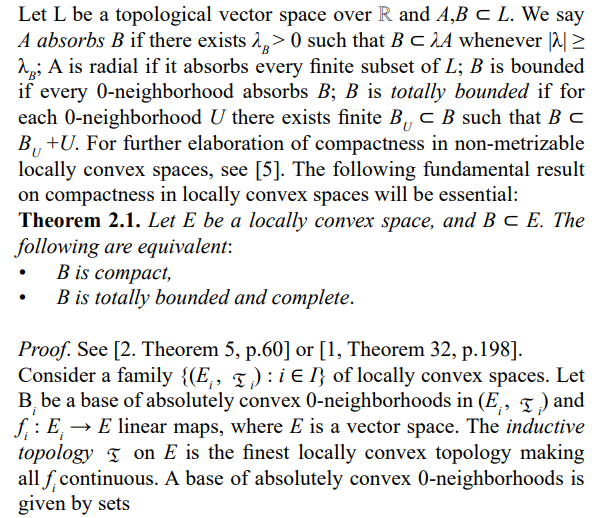
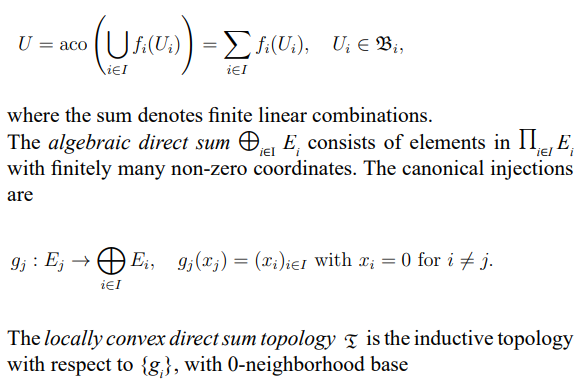
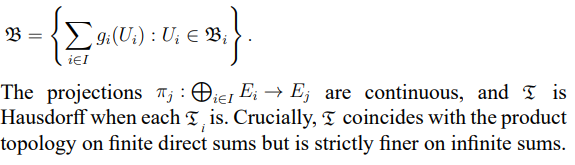
Characterization of the Finest Locally Convex Topology
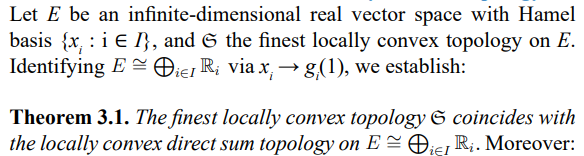
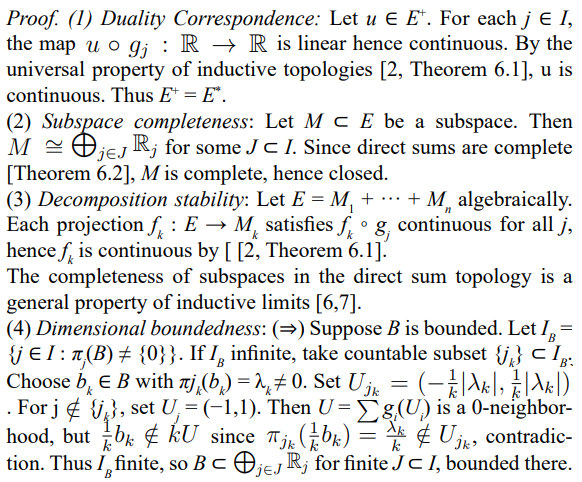
1. E* = E+ (topological and algebraic duals coincide)
2. All subspaces are closed
3. For any algebraic decomposition E = M1 + ··· + Mn, the topological decomposition E = M1 ⊕ · ·· ⊕ Mn holds
4. B ⊂ E is bounded iff it is contained in a finite-dimensional subspace and bounded there
5. C ⊂ E is sequentially closed iff C ∩ F is closed for every finitedimensional subspace F ⊂ E
6. (E, ) is non-metrizable
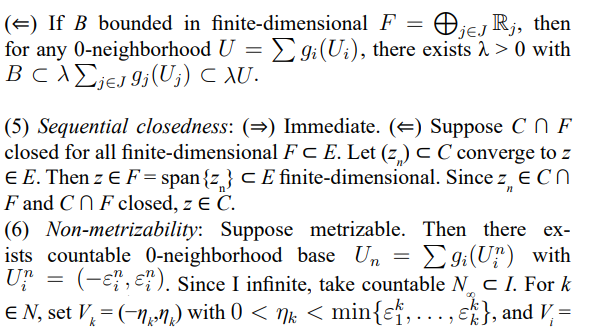

Such non-metrizability phenomena have also been well- documented in topological counterexample literature [6].
General references on the interaction of boundedness and compactness in locally convex spaces include [8,9]. The equivalence between boundedness and finite-dimensionality leads to a remarkable compactness characterization:
Corollary 3.2. For C ⊂ (E, S), the following are equivalent:
1. C is compact
2. C is totally bounded and complete
3. C is bounded and closed
4. Proof. (i) ⇔ (ii) by Theorem 2.1. (i) ⇒ (iii): Compact sets are bounded and closed. (iii) ⇒ (i): By Theorem 3.1(4), C is contained in a finite-dimensional subspace F. Since C is closed in E, C∩F = C is closed in F. By Heine-Borel, C is compact in F, hence in E.
Applications
The coincidence E∗ = E+ under enables powerful applications in duality theory and functional analysis. We highlight two significant implications:
Generalized Reflexivity
The equality of algebraic and topological duals induces a natural reflexivity:
Proposition 4.1. Under S, the canonical embedding ι : E → E∗∗, ι(x) (u) = u(x) is injective, identifying E with a subspace of its bidual.
Proof. Since E∗ = E+, the bidual E∗∗ consists of all linear functionals on E+. For x ≠ 0, there exists u ∈ E+ with u(x) ≠ 0 by basis separation, so ι(x) ≠ 0.
This algebraic reflexivity provides a foundation for duality pairings without topological constraints.
Weak-* Compactness
The boundedness characterization yields an analogue of Banach- Alaoglu:
Proposition 4.2. Every bounded subset B ⊂ E∗ is relatively compact in the weak-* topology σ(E∗,E).
Proof. By Theorem 3.1(4), B is contained and bounded in some finite-dimensional subspace F ⊂ E∗. Since F is a complete and bounded set, are totally bounded in finite dimensions, B is relatively compact in F, hence in E∗ under σ(E∗,E).
These properties make particularly suitable for:
• Analysis of unbounded operators in quantum mechanics
• Construction of topological tensor products
• Extension of measures in infinite dimensions
• Fixed-point theorems in non-normable spaces
For modern characterizations of locally convex topologies in infinite dimensions, see also [10].
Conclusion and Future Research
We have established a complete characterization of the finest locally convex topology S on infinite-dimensional vector spaces, demonstrating its connection to direct sum topologies and finite- dimensional structures. The six fundamental properties (Theorem 3.1) and compactness equivalence (Corollary 3.2) provide a comprehensive functional-analytic portrait. Key conclusions include:
• The topology is Hausdorff, complete, and coincides with the locally convex direct sum topology
• All linear functionals are continuous, and subspaces are closed
• Boundedness and compactness are intrinsically finite- dimensional
• Sequential continuity reduces to finite-dimensional considerations
These results resolve open questions from regarding boundedness [2, p. 27] and completeness [2, p. 55].
Future Research Directions
1. Operator Algebras: Characterize continuous operators T : (E,S) → (F,S′) and develop spectral theory
2. Measure Theory: Construct Radon measures compatible with S and establish infinite-dimensional integration theory
3. Differential Geometry: Develop calculus on manifolds modeled on (E,S)
The extremal nature of S provides a natural testing ground for infinite dimensional generalizations where traditional Banach space techniques fail.
References
- Schaefer, H. H., Wolff, M. P. (1999). Topological VectorSpaces (2nd ed.). Springer.
- Robertson, A. P., & Robertson, W. (1980). Topological vector spaces (Vol. 53). CUP Archive.
- Kelley, J. L. (1955). General Topology. Springer.
- Rudin, W. (1991). Functional Analysis (2nd ed.). McGraw- Hill.
- Jarchow, H. (1981). Locally Convex Spaces. Springer.
- Khaleelulla, S. M. (2006). Counterexamples in topological vector spaces (Vol. 936). Springer.
- Bourbaki, N. (1987). Topological Vector Spaces. Springer.
- Narici, L., Beckenstein, E. (2011). Topological Vector Spaces (2nd ed.). CRC Press.
- Bagaria, J., Rodriguez, J. (2014). Derived topologies on abelian groups. Topology and its Applications, 169, 16-27.
- Valdivia, M. (2013). Locally convex topologies on vector spaces. Journal of Convex Analysis, 20(3), 725-740