

Space Science Journal(SSJ)
ISSN: 2997-6170 | DOI: 10.33140/SSJ


Commentry - (2025) Volume 2, Issue 4
Comment On ‘Lorentz-Invariance and Gauge-Invariance of the Aharonov–Bohm Phase’
Received Date: Sep 29, 2025 / Accepted Date: Oct 23, 2025 / Published Date: Oct 31, 2025
Copyright: ©2025 Peter M. Enders. This is an open-access article distributed under the terms of the Creative Commons Attribution License, which permits unrestricted use, distribution, and reproduction in any medium, provided the original author and source are credited.
Citation: Enders, P. M. (2025). Comment On â??Lorentz-Invariance and Gauge-Invariance of the Aharonovâ??Bohm Phaseâ??. Space Sci J, 2(4), 01-04.
Abstract
I present an axiomatic foundation of non-integrable phases of quantum wave functions like the Aharonov–Bohm phase and show the gauge invariance of the phase difference in the Aharonov–Bohm setup in a much simpler manner than in that article by Kholmetskii et al.
Keywords
Aharonov-Bohm Phase, Dirac Phase, Gauge Invariance, Lorentz Invariance, Non-Integrable Phase
Introduction
In the recent article mentioned in the title [1], the Lorentz invariance as well as the gauge invariance of the Aharonov–Bohm phase in the strong relativistic limit have been shown using the principle of superposition of quantum phases. Here, I will add an axiomatic foundation of the case of non-integrable phases of quantum wave functions which are linear in the vector potential and analogous quantities. Following Dirac [2], Aharonov & Bohm’s Lorentz-invariant formula for the phase shift ([3] p. 486 I) will be shown to be gauge invariant, too, and that in a most simple manner.
Axiomatic Foundation of Non-Integrable Phases of Quantum Wave Functions
Relationships Between Interactions and Conserved Quantities According to and Beyond Helmholtz
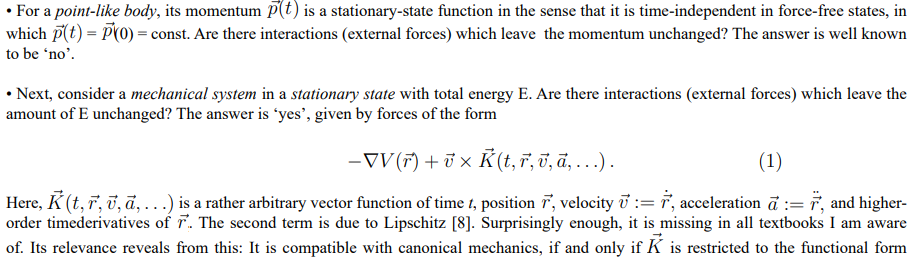
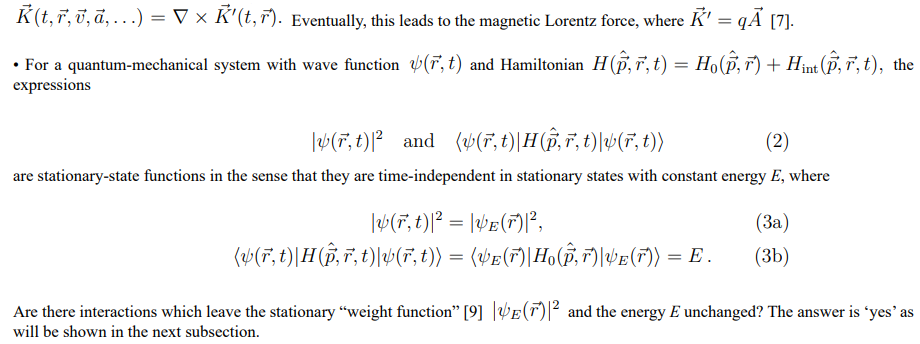
Helmholtz’s explorations on the relationships between mechanical forces and conservation of energy [4,5] can be generalized as follows [6,7].



Non-Integrable Phase
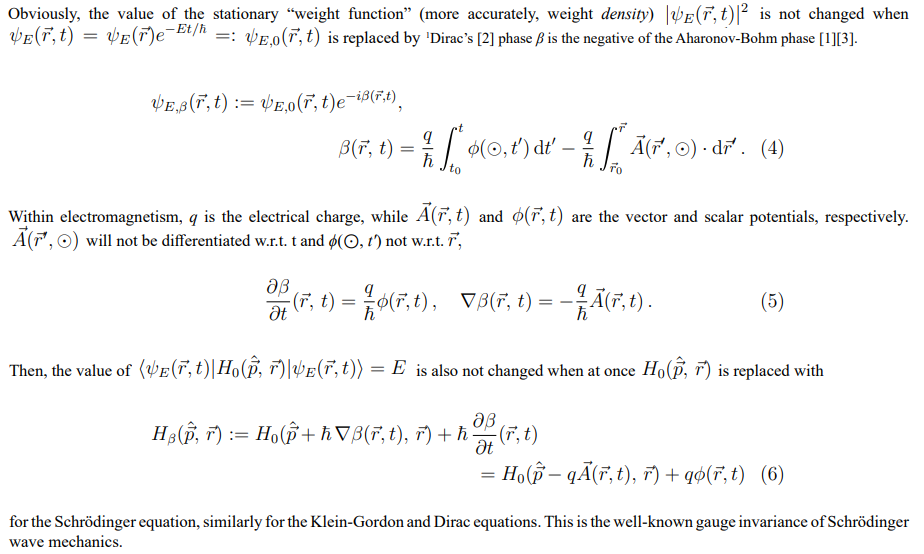
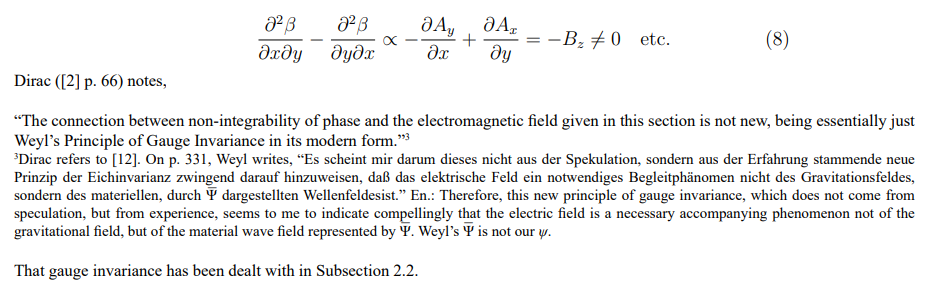
Before doing so, let us notice the following. The phase (4) is non-integrable, if
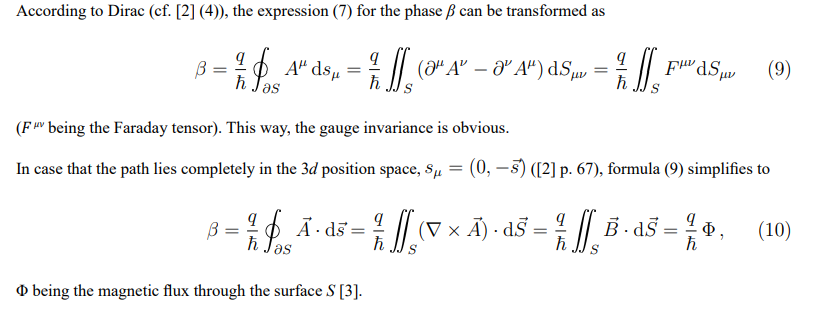
Gauge Invariance of the Phase β (7)
Summary and Conclusions
Generalizing Helmholtz’s explorations of the relation between forces and energies [4,5], I have presented an axiomatic foundation of the Aharonov Bohm phase [3] and related it to Dirac’s nonintegrable phase [2]. The phase factors (not the phases β themselves) uniquely determine the electromagnetic field [13].
Using results of Dirac’s 1931 pioneering work on non-integrable phases and magnetic monopoles [2], I have shown that Aharonov & Bohm’s formula (7) for the phase shift is not only Lorentz invariant but also gauge invariant, and that in a much simpler manner than in [1].
Admittedly, in this treatment, the Aharonov-Bohm phase  AB is a semi-classical, non-relativistic, and linear (low-field limit) functional of the scalar and vector potentials as given in Aharonov & Bohm’s original article [3]. Within Schrödinger wave mechanics, the more general expression

(after [1] (2), where â? = 1) is non-linear in the vector potential. However, a non-linear and fully quantised description of the (Ehrenberg- Siday-)Aharonov-Bohm effect as well as its description for non-closed paths (for references, see [1]) are far beyond the scope of this comment.
Acknowledgement
I feel highly indebted to Hassan Bolouri, Jan Helm, Axel Kilian, Rudolf Germer, and Bernd Steffen for helpful discussions. The translations have been done using DeepL Pro.
Statements and Declarations
There are no competing interests.
Data Availability Statement
No data associated in the manuscript
References
- Kholmetskii, A. L., Missevitch, O. V., & Yarman, T. (2025). Lorentz-invariance and gauge-invariance of the Aharonov–Bohm phase. The European Physical Journal Plus, 140(2), 140.
- Dirac, P. A. M. (1931). Quantised singularities in the electromagnetic field. Proceedings of the Royal Society of London. Series A, Containing Papers of a Mathematical and Physical Character, 133(821), 60-72.
- Ankersmit, F. (2012). Meaning, truth, and reference in historical representation. Cornell University Press.
- Aharonov, Y., & Bohm, D. (1959). Significance of electromagnetic potentials in the quantum theory. Physical review, 115(3), 485.
- Helmholtz, H. (1982). Über die Erhaltung der Kraft (Vol. 1). Walter de Gruyter GmbH & Co KG.
- von Helmholtz, H. (1898). Vorlesungen über die Dynamik discreter Massenpunkte (Vol. 1). Verlag von Johann Ambrosius Barth.
- Enders, P. (2019). Classical Mechanics and Quantum Mechanics: An Historic-Axiomatic Approach. Bentham Science Publishers.
- Enders, P. (2009). Towards the Unity of Classical Physics. Apeiron, 16(1), 22.
- Schrodinger, E. (1926). Quantisierung als Eigenwertproblem,(Dritte Mitteilung: Storungstheorie, mit Anwendung auf denStrakeffekt der Balmerlinien. Ann. Phys., (4), 470-471.
- Ehrenberg, W., & Siday, R. E. (1949). The refractive index in electron optics and the principles of dynamics. Proceedings of the Physical Society. Section B, 62(1), 8.
- Aharonov, Y., & Bohm, D. (1961). Further considerations on electromagnetic potentials in the quantum theory. Physical Review, 123(4), 1511.
- Weyl, H. (1986). Elektron und gravitation. I. Surveys in High Energy Physics, 5(3), 261-267.
- Wu, T. T., & Yang, C. N. (1975). Concept of nonintegrable phase factors and global formulation of gauge fields. Physical Review D, 12(12), 3845.