Journal of Applied Language Learning(JALL)
ISSN: 3068-1332 | DOI: 10.33140/JALL

Research Article - (2026) Volume 3, Issue 2
Cognitive Misalignment and Categorical Reconstruction of Qi in English Translation
Received Date: Jun 05, 2026 / Accepted Date: Jun 30, 2026 / Published Date: Jul 06, 2026
Copyright: ©2026 Ting Zhang, et al. This is an open-access article distributed under the terms of the Creative Commons Attribution License, which permits unrestricted use, distribution, and reproduction in any medium, provided the original author and source are credited.
Citation: Zhang, T., Yu, Z. (2026). Cognitive Misalignment and Categorical Reconstruction of Qi in English Translation. J App Lang Lea, 3(2), 01-10.
Abstract
The translation of culture-specific items is difficult not merely because of lexical gaps, but because languages often organize experience through different underlying cognitive categories. This study examines the Chinese core concept qi (Gas), a radial category rooted in embodied experience and centered on the prototype of vital energy, and explains why it is frequently fragmented in English translation. A bilingual database of 49 high-frequency qi-compounds was built from the Chinese Proficiency Grading Standards for International Chinese Language Education and checked against the Modern Chinese Dictionary and Oxford Learner's Dictionaries. The static morphological comparison was then supplemented by qualitative analysis of authentic translations from medical classics, philosophy, literary theory, ethical discourse, and fiction. The results show a systematic mismatch: Chinese organizes the qi-word family through a shared morpheme and modifier-head construction, with 34 of 49 items placing qi in final position and 37 of 49 exhibiting modifier-head structure. By contrast, English renders these items through morphologically unrelated simplexes, derivatives, phrases, and one compound, thereby distributing a continuous Chinese category across discrete lexical domains such as air, strength, anger, courage, integrity, and atmosphere. Translation examples further reveal metaphorical rupture when the force, container, and flow schemas of qi are replaced by static English entities. To address this problem, the study proposes a cognitive compensation framework consisting of category transplantation, semantic compensation, category re-implantation, and context-sensitive modulation. The framework contributes to cognitive translation studies and offers practical implications for translating and teaching culturally dense Chinese key concepts in applied language-learning contexts.
Keywords
Qi, Culture-Specific Items, Radial Category, Cognitive Translation Studies, Metaphor Translation, Category Reconstruction
Abbreviations
CSI - Culture-Specific Item
CTS - Cognitive Translation Studies
ECMT- Extended Conceptual Metaphor Theory
Introduction
Culture-specific items (CSIs) have long been a central concern in translation studies [1]. Traditional discussions often treat the translation difficulty of such items as a matter of lexical absence, image difference, or a choice between domestication and foreignization. From the perspective of cognitive translation studies, however, the problem is deeper: translation becomes difficult when source and target languages activate different cultural scripts and different modes of categorizing experience [2,3]. Mandelblit's cognitive translation hypothesis similarly argues that meaning transfer is blocked when two languages recruit incongruent cognitive domains for apparently comparable expressions [4].
The Chinese concept qi (gas) provides a revealing case for examining this category-level problem. In Chinese philosophy, medicine, literature, and everyday discourse, qi is not a single isolated lexical item but a coherent cognitive schema. The early gloss in Shuowen Jiezi associates qi with cloud-like vapor; later cultural use expands the term into a semantic network that covers physical, physiological, psychological, ethical, aesthetic, and cosmological dimensions [5,6]. In this sense, qi illustrates the cognitive-linguistic claim that metaphor is not an ornamental device but a basic structure of thought [7]. Its cross-domain extensions also embody the holistic categorization often associated with the Chinese cultural ideal of continuity between Heaven, human beings, and the natural world.
When this highly integrative radial category enters English, which normally assigns distinct lexical labels to distinct experiential domains, the continuity of the source concept is easily lost. A Chinese word family unified by the morpheme qi may be translated into English as air, gas, strength, anger, temper, courage, integrity, atmosphere, or popularity. These translations may be locally accurate, but together they fragment a category that remains cognitively continuous in Chinese. This is the mechanism that this study calls cognitive misalignment: the source language organizes meanings through radial extension from a prototype, while the target language tends to reclassify the same meanings into discrete entities [8,9].
This study asks three questions. First, what semantic and morphological evidence do the English equivalents of Chinese qi-compounds provide for a structural mismatch between Chinese and English categories? Second, how does this mismatch reflect different cultural scripts and different logics of conceptual construction? Third, how do translators repair or reconstruct these ruptured concepts in medical, philosophical, literary, ethical, and fictional contexts?
To answer these questions, the study combines a small-scale bilingual morphological database with discourse analysis of authentic translation examples. Forty-nine qi-compounds were extracted from the Chinese Proficiency Grading Standards for International Chinese Language Education (GF0025-2021), and their meanings and English equivalents were checked against the Modern Chinese Dictionary and Oxford Learner's Dictionaries [10-12]. The following sections first review the relevant theoretical background, then describe the data and method, quantify the static categorical mismatch, and finally analyze the dynamic strategies by which translators reconstruct the cognitive logic of qi in English.
Theoretical Background: Cross-Linguistic Misalignment and Category Reconstruction
Previous studies on the English translation of qi have often been field-specific. In the translation of traditional Chinese medicine, researchers have discussed when to use domestication, foreignization, transliteration, or explanatory annotation [13]. In classical literary theory, attention has been given to how the aesthetic resonance of terms such as wenqi can be conveyed or transformed [14]. Because a single English word seldom preserves the full conceptual load of qi, transliteration with annotation has increasingly been treated as a preferred solution for contexts where conceptual integrity matters [15].
More recent work has extended the discussion from local translation technique to sociological and communicative conditions. Translator decisions are shaped by target readers, publication purpose, institutional norms, and the degree to which a target culture is ready to accept a non-Western concept [16]. Translation also has a social-constructive function: when a concept crosses language, it is not merely renamed but reinserted into a new social knowledge system [17]. From this perspective, the English translation of qi is difficult not only because English lacks a direct equivalent, but because a holistic Eastern conceptual model is being relocated into a discursive environment shaped by analytical and disciplinary distinctions.
At the cognitive level, translation can be understood as category transformation. Wen and Si argue that translation involves embodied cognition, iconicity, and the conversion of categories between languages [18]. Zhou's discussion of poetic images also shows that the cultural properties of a concept directly shape the limits of translatability [19]. Unschuld's warning about the medical term qi is particularly important: qi should not simply be equated with English energy, because it names a relational process rather than a measurable substance [20]. Once this processual and relational concept is forced into an entity-centered framework, its original epistemic independence is weakened.
Metaphor theory further explains why this weakening occurs. Extended Conceptual Metaphor Theory emphasizes that metaphor emerges from specific physical and cultural contexts rather than from abstract universal mappings alone [21]. Once a metaphor is detached from its source cultural environment, cross-linguistic transfer may produce rupture rather than equivalence [22]. For example, the Mencian phrase haoran zhi qi (Noble Spirit, Vast, Righteous Energy, Awe-Inspiring Righteousness) makes moral force imaginable as a vast, flowing substance. Rendering it simply as spirit preserves part of the moral meaning but suppresses the fluid and force-dynamic image that structures the Chinese expression.
In cultural semantics, key words organize shared cultural scripts [3,23]. The Chinese qi network links macrocosmic order, bodily vitality, emotional movement, moral cultivation, and social atmosphere. Its prototype is not a bounded physical object but an embodied experience of vital movement. When this network is mapped onto English words with clearer domain boundaries, such as energy, atmosphere, temper, and integrity, its radial unity is often dissolved. Existing scholarship has identified the cultural distinctiveness of qi and the social conditions of its translation, but it has not yet provided enough systematic evidence for the morphological and categorical divergence between the Chinese and English systems. The present study addresses this gap.
Materials and Methods
The study uses a mixed qualitative and descriptive approach. The quantitative component is a morphology-based comparison of a bounded bilingual word list; the qualitative component is a cognitive-discourse analysis of selected translations from major semantic domains. The purpose is not to claim exhaustive coverage of all qi expressions, but to identify recurring mechanisms by which a Chinese radial category is split or reconstructed in English.
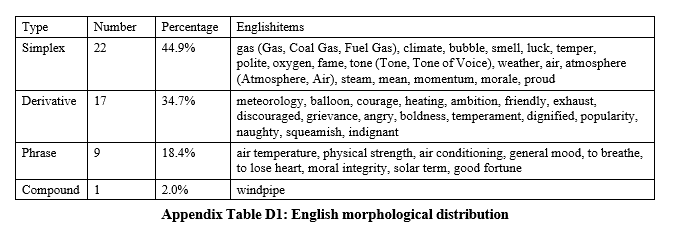
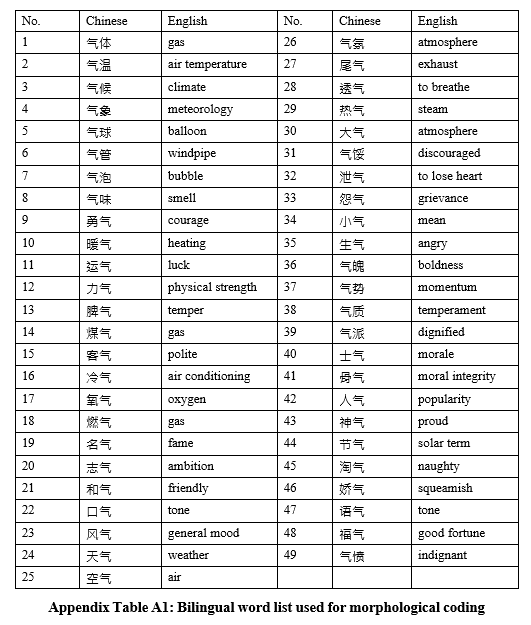
The first data set consists of 49 words containing the morpheme qi that were extracted from the Chinese Proficiency Grading Standards for International Chinese Language Education. These items are pedagogically relevant because the standard represents high-frequency vocabulary for international Chinese education. Their Chinese meanings were checked against the Modern Chinese Dictionary, and their preferred English equivalents were checked against Oxford Learner's Dictionaries [10-12]. For the Chinese side, each item was coded for the position of the morpheme qi and for word-formation type. For the English side, each equivalent was coded as a simplex, derivative, phrase, or compound.
The second data set consists of authentic translation examples from five domains in which qi plays a central role: traditional Chinese medicine, philosophy, literary theory, social ethics, and everyday literary narration. These domains were selected because they represent the physical, physiological, psychological, ethical, aesthetic, and philosophical extensions of the category. Each example was analyzed for its underlying image schema, its metaphorical mapping, and the strategy used to compensate for category mismatch in English. Table 1 Summarizes the Analytical Design.
|
Analytical layer |
Data / procedure |
Purpose |
|
Static lexical level |
49 qi-compounds; dictionary-checked English equivalents |
Reveal morphological and categorical divergence |
|
Chinese morphological coding |
Position of qi; construction type |
Identify the radial construction of the Chinese word family |
|
English morphological coding |
Simplex, derivative, phrase, compound |
Identify the discrete lexicalization pattern of English equivalents |
|
Dynamic discourse level |
Published translations across five domains |
Observe category reconstruction and metaphorical compensation |
Table 1: Data and Analytical Procedures
Results: Divergent Morphological and Categorical Pathways
Chinese Radial Word Formation and Schematic Networking
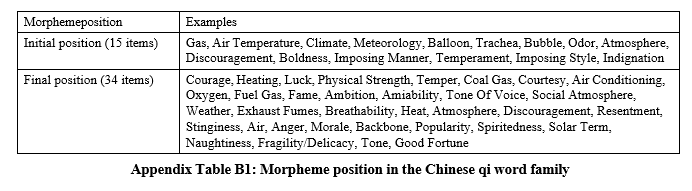
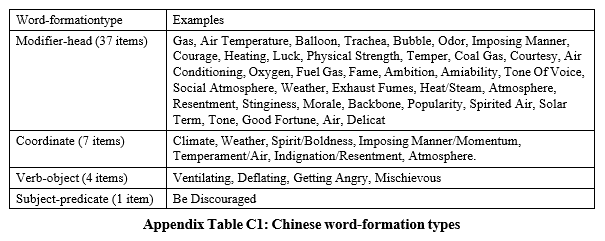
The 49-item word list shows a strong tendency toward morphological continuity in Chinese. In 34 items, or 69.4% of the total, qi appears as the final morpheme. In 37 items, or 75.5%, the word-formation type is modifier-head. In other words, Chinese frequently preserves qi as the conceptual head while using a preceding morpheme to specify the domain or value of the concept. This pattern allows the same central morpheme to connect physical, physiological, psychological, social, moral, and aesthetic experiences.
The physical prototype is visible in words such as qiti (Gas), kongqi (Air), and reqi (Steam). With modifiers such as li (Force) or yuan (Origin), the category extends into the physiological domain, as in liqi (Physical Strength) and yuanqi (Original Vitality). With emotional modifiers such as pi (Spleen) and nu (Anger), it enters the psychological domain, as in piqi (Temper) and nuqi (Anger). With ethical or characterological modifiers such as yong (Courage) and gu (Bone), it becomes a marker of moral force, as in yongqi (Courage) and guqi (Moral Integrity). With words such as fengqi (General Mood) and renqi (Popularity), it expands into social atmosphere and collective evaluation.
This network is motivated by embodied experience. Johnson's image-schema theory explains how abstract concepts are built from recurrent bodily interactions with the environment [24]. The category qi relies particularly on two schemas. The first is a force or dynamic schema, derived from the bodily perception of wind, breath, and moving air. It makes qi intelligible as something that has direction, intensity, accumulation, release, and exhaustion. The second is a container schema, because an invisible and formless force must be imagined as being held, blocked, filled, or regulated within a body, vessel, space, or world [25-27]. Chinese traditional thought further reinforces this structure through a non-dualistic view of body and mind.
These schemas allow qi to form a radial category rather than a classical category with fixed and necessary conditions. The different senses of qi are not identical, but they are linked by family resemblance: breath, vapor, vitality, emotion, moral force, style, and atmosphere are all construed as variations of animated movement. Figure 1 visualizes this radial network.

Figure 1: Radial Extension Network of the ChTable 2 Presents the Main Descriptive Results
|
Feature |
Number |
Percentage |
Illustration |
|
Chinese: qi as initial morpheme |
15 |
30.6% |
Items such as Gas, Air Temperature, Climate, Meteorology |
|
Chinese: qi as final morpheme |
34 |
69.4% |
Items such as Courage, Strength, Temper, Backbone |
|
Chinese: modifier-head structure |
37 |
75.5% |
The most frequent Chinese word-formation pattern |
|
Chinese: coordinate structure |
7 |
14.3% |
Climate, Weather, Boldness of Spirit, Imposing Manner, Temperament, Indignation, Atmosphere |
|
Chinese: verb-object structure |
4 |
8.2% |
Breathable, Deflating, Getting Angry, Mischievous |
|
Chinese: subject-predicate structure |
1 |
2.0% |
Be Discouraged |
|
English: simplex |
22 |
44.9% |
gas, air, climate, luck, temper, tone, weather |
|
English: derivative |
17 |
34.7% |
courage, heating, ambition, discouraged, popularity |
|
English: phrase |
9 |
18.4% |
air temperature, physical strength, general mood |
|
English: compound |
1 |
2.0% |
windpipe |
Table 2: Morphological Distribution of Chinese Qi-Compounds and their English Equivalents
English Discrete Lexicalization and Entity-Oriented Construal
The English equivalents show the opposite tendency. Simplexes account for 44.9% of the equivalents, derivatives for 34.7%, phrases for 18.4%, and compounds for only 2.0%. More importantly, these English items do not share a common stem. Words such as air, gas, strength, anger, temper, courage, integrity, atmosphere, fame, morale, and popularity are morphologically unrelated. Experiences that are linked by one Chinese morpheme are therefore redistributed into several independent English lexical categories.
This redistribution reflects a cognitive preference for domain-specific classification. English normally treats air or gas as physical matter, strength as a bodily capacity, anger and temper as psychological states, courage and integrity as moral qualities, and atmosphere as a social or environmental condition. Such classifications are not erroneous; they are appropriate within English. Yet they replace the Chinese continuum with a set of bounded lexical entities. The translator must therefore choose between local semantic accuracy and preservation of the source category's internal coherence.
The English tendency toward entity-like construal can be explained through cognitive grammar. Langacker notes that languages can reify dynamic processes into nominal or adjectival entities [28]. In Chinese, emotional tension or moral vitality is often conceptualized as a movement or accumulation of qi; in English it tends to become a label such as anger, courage, or integrity. This difference also has a broader intellectual history. Western classical categorization and later Cartesian dualism encouraged the separation of mind and body, spirit and matter, subject and object. Although Greek pneuma and Latin spiritus once combined breath, life, and spirit, modern English has distributed similar experience across specialized vocabularies shaped by philosophy, theology, science, and psychology [29].
The static evidence thus supports the central claim of this study: Chinese organizes the qi family as a radial category with morphological continuity, whereas English typically renders it through discrete lexicalization and entity-oriented interpretation. The next section examines how translators respond to this mismatch in actual discourse.
Dynamic Repair of Metaphorical Rupture in English Translations of Qi
The following examples show that the translation of qi goes beyond lexical equivalence. Each domain activates a different part of the radial category, and each translation strategy either preserves, reduces, or reconstructs the source category's cognitive logic.
Medical Classics: Category Transplantation
In traditional Chinese medicine, conceptual integrity is essential because qi functions as a systemic category. Early or transitional translations often adapted qi to target-language categories, but contemporary academic translations increasingly retain the transliterated stem qi. This strategy directly transplants the source category into English and allows modifiers to reconstruct the Chinese modifier-head pattern.
Source: When pathogenic factors are excessive, there is excess; when vital energy is depleted, there is deficiency. (Suwen, “A General Discussion of Repletion and Vacuity”)
Example 1: Predominance of pathogenic qi is defined as excess, whereas insufficiency of essential qi is deficiency [30].
Example 2: Evil qi being excessive is called the excess and essence qi being depleted is called deficiency [31].
Both translations preserve qi as a core term and attach English modifiers to it: pathogenic / essential and evil / essence. This method avoids splitting xieqi (Pathogenic factor; evil influence; sinister aura) and jingqi (Vital Essence) into unrelated English entities such as pathogen and essence. Instead, it retains a shared energetic category that can include pathogenic influence and vital basis within one medical system. In terminological translation, such consistency is crucial because core terms construct the target-language representation of an entire knowledge system [32].
Philosophical Discourse: Semantic Compensation
In philosophical discourse, qi often carries moral, spatial, and dynamic meanings simultaneously. The Mencian expression haoran zhi qi (Noble Spirit, Vast, Righteous Energy, Awe-Inspiring Righteousness) is especially difficult because haoran evokes vastness and expansive flow, while qi evokes vital and moral force.
Source: I am adept at cultivating my vast, noble spirit. (Mencius, “Gongsun Chou I”)
Example 3: I am skilful in nourishing my vast, flowing passion-nature [33].
Example 4: I am adept in the cultivation of the ‘greater physical vigour’ [34].
Legge attempts to compensate for the fluid image by adding vast and flowing, but his compound passion-nature reifies the concept and may burden the English reader. Dobson's greater physical vigour is clearer as English, but it reduces the phrase to bodily strength and weakens its moral and cosmological dimensions. Neither version fully preserves the source metaphor of moral vitality as a vast, cultivable flow. A cognitively compensated rendering might be: I am skilled at nurturing my vast, flowing moral qi. This version retains the category through qi while using vast, flowing, and moral to guide the target reader toward the source image schema. Such compensation is important because the cross-cultural reception of Chinese classics depends heavily on the accurate mediation of core philosophical concepts [35].
Literary Theory: Category Re-Implantation
In classical Chinese literary theory, qi commonly refers to the inner vitality, momentum, and stylistic force of writing. Cao Pi's famous statement illustrates the problem clearly.
Source: In writing, qi (vital energy) is paramount; the clarity or turbidity of this qi is inherent to one's nature and cannot be achieved through forced effort. (Dianlun: Lunwen)
Example 5: What is of the greatest importance in literature is the ‘Great Vital Breath’ [qi] [36].
Example 6: Literary writing is governed by qi... [37].
Wong's version uses Great Vital Breath to retain movement and vitality, and the added [qi] alerts readers to the cultural specificity of the concept. Yet breath remains primarily physiological in English and does not fully carry the aesthetic and spiritual dimensions of wenqi. The later national-level translation project directly uses qi. This is not merely foreignization at the word level; it is category re-implantation. It invites English readers to suspend the familiar division between bodily breath, mental force, and literary style, and to accept a source-culture category that combines all three.
Social Ethics: Dual Cognitive Loss
In social and ethical discourse, metaphorical rupture is often more visible because qi combines bodily image and moral evaluation. The word guqi (Backbone) joins gu (Bone) and qi, thereby construing moral integrity as a vital force held in or supported by the body.
Source: We Chinese people have backbone.
Example 7: We Chinese have backbone [38].
Example 8: We Chinese have moral integrity [39].
Backbone preserves the bodily support image and works idiomatically in English, but it does not preserve the dynamic energy of qi. Moral integrity conveys the ethical meaning, but it deletes the embodied basis almost completely. The two translations therefore divide what Chinese unites: physical structure and moral vitality. A context-sensitive rendering such as moral backbone may be suitable when idiomatic force is more important than conceptual transparency; a note explaining guqi may be necessary when the text aims to teach or analyze Chinese cultural concepts.
Everyday Literary Narration: Entity-Oriented Modification
In everyday or fictional contexts, translators often choose fluency over category preservation. This is understandable, but it also shows the English tendency to turn dynamic qi-based emotion into static psychological labels.
Source: Please, Madam, do not be Angry. If others were to Notice, there is No Guarantee the Old Matriarch Wouldn'T Find Out. It is Best to Remain Calm and Investigate Discreetly; Only then can you Get to the true facts of The Matter. (Hongloumeng)
Example 9: The first thing to do is to try not to be so upset... If we can remain cool and carry out our investigations in secret [40].
Example 10: Don't be angry, madam... We must calm down and investigate this on the quiet... [41].
In Chinese cognition, shengqi (Angry) treats anger as a generated and potentially released force, while pingxin jingqi (Calmly) suggests the calming or settling of that force. Minford's upset and remain cool and the Yangs' angry and calm down both produce fluent English, but both turn a process of energetic regulation into emotional states. This strategy is appropriate for narrative readability, yet it confirms the underlying category mismatch: English makes the emotion legible by recoding it as a bounded psychological entity. Table 3 Summarizes the Translation Strategies Observed in the Examples.
|
Domain |
Main problem |
Observed strategy |
Cognitive effect |
|
Medicine |
Need to preserve a systemic concept |
Category transplantation: modifier + qi |
Maintains the source category in English |
|
Philosophy |
Moral force, vastness, and flow overlap |
Semantic compensation through adjectives and/or qi retention |
Partly restores the fluid-force schema |
|
Literary theory |
Aesthetic vitality lacks an English equivalent |
Category re-implantation: direct qi |
Invites readers to accept the source cultural category |
|
Ethics |
Bodily support and moral force are fused |
Idiomatic rendering or abstract ethical term |
Preserves one layer but often loses another |
|
Fiction / everyday speech |
Dynamic emotion becomes a static state |
Contextual modulation for fluency |
Improves readability but weakens the qi schema |
Table 3: Translation Strategies and Cognitive Effects in Five Domains
Discussion: A Cognitive Compensation Framework
The evidence above shows that the translation of qi is not a problem of finding a better English word. It is a problem of moving a radial category into a language that lacks the same category. The translator must therefore reconstruct part of the source cognitive logic rather than simply replace a sign with another sign. This study proposes four complementary strategies.
First, category transplantation is appropriate when the source concept functions as a technical or systematic term. In medical and philosophical contexts, retaining qi allows the target text to build a conceptual network rather than reduce each occurrence to an English approximation. Modifiers can then specify subcategories, as in pathogenic qi, essential qi, moral qi, or literary qi. This strategy is particularly useful for specialist readers and for teaching contexts in which conceptual literacy matters.
Second, semantic compensation is needed when transliteration alone is too opaque. English modifiers such as vital, flowing, moral, cosmic, pathogenic, or cultivated can guide the reader toward the image schemas that motivate the Chinese term. Compensation should not be random explanation; it should restore the lost force, container, flow, or vitality schema that underlies the source expression.
Third, category re-implantation can be used in texts where qi recurs as an organizing concept. A translator may introduce qi with a short explanation at first occurrence and then reuse it consistently. This strategy gradually trains the target reader to process qi as an English-accessible cultural category. It also has implications for applied language learning: learners of Chinese can better understand culture-specific vocabulary when vocabulary teaching moves beyond word lists and explains the radial networks behind key morphemes.
Fourth, contextual modulation remains necessary. In narrative dialogue or idiomatic everyday speech, preserving the full category may overburden the translation. A fluent rendering such as angry or calm down may be justified when conceptual continuity is not the communicative priority. The key is not to reject domestication,but to use it consciously: translators should know what cognitive material is being sacrificed and decide whether the target context can tolerate that loss.
The framework also clarifies why the problem of qi is not unique. Other cultural key words, such as German Geist, which combines reason, spirit, and historical ethos, or Japanese amae, which combines emotional dependence and social tolerance, also become fragmented when translated into modern English [42]. In each case, translation involves the reconstruction of a culturally situated category. Thus, cognitive category analysis can supplement sociological translation studies by showing how social acceptance and conceptual structure interact.
Conclusion
This study has argued that the English translation of qi is difficult because Chinese and English organize the relevant experience through different cognitive categories. Chinese uses the morpheme qi to maintain a radial network centered on embodied vital movement. English, by contrast, tends to distribute the same experience into unrelated lexical domains such as physical matter, bodily capacity, emotion, moral character, social atmosphere, and reputation.
The morphological analysis of 49 qi-compounds demonstrates the static basis of this mismatch: Chinese shows high morphological continuity through final-position qi and modifier-head word formation, while English shows high lexical discreteness through unrelated simplexes, derivatives, phrases, and one compound. The translation examples demonstrate the dynamic response to this mismatch: translators either transplant the category, compensate for lost metaphors, re-implant the concept in the target discourse, or modulate it for contextual fluency.
The main contribution of the study is therefore twofold. Theoretically, it explains the translation of qi as category reconstruction rather than lexical substitution. Practically, it provides a cognitive compensation framework that can be used in translation, bilingual lexicography, and Chinese language pedagogy. Future research may expand the database, compare different English translations across larger corpora, and test how target readers understand transliterated and compensated forms of qi in language-learning contexts.
Declarations
Funding
This work was supported by the General Program of the National Social Science Fund of China, "An empirical contrastive study of tones in Chinese and African languages from a typological perspective and its interdisciplinary applications" (Grant No. 25BYY063).
Conflict of Interest
The authors declare no conflicts of interest.
Ethics Approval
Not applicable. This study analyzes published texts, dictionaries, and publicly available language data.
Data Availability
The word list and coding results used in the study are included in the appendices. Additional examples are drawn from published translations cited in the references.
Author Contributions
Zihan Yu: Writing - original draft, Investigation, Data curation. Ting Zhang: Conceptualization, Methodology, Investigation, Formal analysis, Resources, Supervision, and Writing - review and editing. All authors contributed to the article and approved the submitted version.
References
- Aixelá, J. F. (1996). Culture-specific items in translation. In R. Álvarez & M. C. Á. Vidal (Eds.), Translation, Power, Subversion (pp. 52-78). Multilingual Matters.
- Rojo, A., & Ibarretxe-Antuñano, I. (Eds.). (2013). Cognitive Linguistics and Translation: Advances in Some Theoretical Models and Applications. De Gruyter Mouton.
- Wierzbicka, A. (2006). English: Meaning and culture. Oxford University Press.
- Mandelblit, N. (1995). The cognitive translation hypothesis: A study of cognitive topology and transferences of metaphorical expressions. Translation and Meaning, 3, 482-495.
- Li, C. S. (2006). Distinctions among several levels of meaning in the concept of qi. Philosophical Research, 9, 34-41. (in Chinese)
- Zheng, M. H. (2015). Nature, human beings, and literature: The multidimensional semantic chain of qi as a rhetorical sign in ancient literature. Journal of Fujian Normal University (Philosophy and Social Sciences), 3, 58-63. (in Chinese)
- Lakoff, G., & Johnson, M. (1980). Metaphors We Live By.University of Chicago Press.
- Lakoff, G. (2008). Women, fire, and dangerous things: What categories reveal about the mind. University of Chicago press.
- Halverson, S. L. (2003). The cognitive basis of translation universals. Target. International Journal of Translation Studies, 15(2), 197-241.
- Ministry of Education of the People's Republic of China, & State Language Commission. (2021). Chinese Proficiency Grading Standards for International Chinese Language Education (GF0025-2021). Beijing Language and Culture University Press. (in Chinese)
- Institute of Linguistics, Chinese Academy of Social Sciences. (2016). Modern Chinese Dictionary (7th ed.). Commercial Press. (in Chinese)
- Oxford University Press. (n.d.). Oxford Learner's Dictionaries.
- Wang, N. L., Yu, H. F., & Shi, H. Y. (2021). A study on the English translation of qi-related terms in Compendium of Materia Medica. Lishizhen Medicine and Materia Medica Research, 8, 1966-1967. (in Chinese)
- Dai, W. J. (2020). The English translation and variation of the meta-category qi in Wenxin Diaolong. Journal of Jinan University (Philosophy and Social Sciences), 8, 28-39. (in Chinese)
- Li, S. (2015). On the English translation of qi. Journal of Binzhou University, 1, 89-92. (in Chinese)
- Ren, H. (2024). Decision-making in the translation of proper-name allusions: Translation strategies in both directions between English and Chinese. Babel, 70(3), 381-414.
- Fu, J., Zhang, K., & Yu, X. (2025). The socialness of translation and the translationality of society. Babel, 71(5), 658-678.
- Wen, X., & Si, W. G. (2020). Embodied cognition, iconicity and category transformation in translation. Shanghai Journal of Translators, 3, 1-6. (in Chinese)
- Zhou, H. M. (2019). Cultural attributes and limits of translatability of Chinese poetic images from a cognitive perspective. Foreign Language Research, 4, 74-79. (in Chinese)
- Unschuld, P. U. (2003). Huang Di Nei Jing Su Wen: Nature, Knowledge, Imagery in an Ancient Chinese Medical Text. University of California Press.
- Kövecses, Z. (2020). Extended conceptual metaphor theory.Cambridge university press.
- Liu, X., & Li, Y. (2024). Effects of extended conceptual metaphor theory on tourism translation. Cogent Arts & Humanities, 11(1), 2429203.
- Levisen, C., & Ye, Z. (Eds.). (2024). The cultural pragmatics of danger: Cross-linguistic perspectives (Vol. 346). John Benjamins Publishing Company.
- Johnson, M. (2013). The body in the mind: The bodily basis of meaning, imagination, and reason. University of Chicago press.
- Ye, H. S. (2010). Embodied cognition: A new orientation in cognitive psychology. Advances in Psychological Science, 18(5), 705-710. (in Chinese)
- Wen, X., & Jiang, X. (2001). Categorization: Cognition in language. Foreign Language Education, 4, 15-18. (in Chinese)
- Xie, J., & Jia, C. H. (2012). Container metaphor in language of Chinese medicine from a cognitive perspective. Acta Chinese Medicine and Pharmacology, 40(2), 1-4. (in Chinese)
- Langacker, R. W. (1987). Foundations of cognitive grammar: Volume I: Theoretical prerequisites (Vol. 1). Stanford university press.
- Blumczynski, P. (2023). Experiencing translationality:Material and metaphorical journeys. Routledge.
- Li, Z. G., Wu, Q., & Xing, Y. R. (2018). Key Concepts in Chinese Medicine and Culture. Foreign Language Teaching and Research Press. (in Chinese and English)
- Yang, M. S. (Trans.). (2015). A New Translation of Huangdi Neijing Suwen. Fudan University Press. (in Chinese and English)
- Jiang, J. B., & Qi, X. H. (2023). On practical paths for standardizing translation of traditional Chinese medicine terminology. Foreign Language Research, 6, 89-94. (in Chinese)
- Legge, J. (1895). The Works of Mencius. Oxford University Press.
- Dobson, W. A. C. H. (1963). Mencius: A New Translation Arranged and Annotated for the General Reader. University of Toronto Press.
- Yang, Y., & Xiao, H. (2023). An empirical study of overseas dissemination effects of English translations of The Analects from the perspective of cultural adaptation. Foreign Language Research, 6, 78-85. (in Chinese)
- Wong, S. K. (1983). Early Chinese Literary Criticism. Joint Publishing Company.
- Editorial Board of Key Concepts in Chinese Thought and Culture. (2015). Key Concepts in Chinese Thought and Culture (Vol. 1). Foreign Language Teaching and Research Press.
- Mao, Z. (1977). Selected works of Mao Tse-tung (Vol. 5).Franklin Book Company.
- English Department Dictionary Group, Beijing Foreign Studies University. (1995). A Chinese-English Dictionary (Rev. ed.). Foreign Language Teaching and Research Press.
- Cao, X., & Gao, E. (1982). The Story of the Stone, Vol. IV: The Debt of Tears (J. Minford, Trans.). Penguin Classics.
- Cao, X. (1978). A Dream of Red Mansions (X. Yang & G. Yang, Trans.). Foreign Languages Press.
- Wierzbicka, A. (1997). Understanding cultures through their key words: English, Russian, Polish, German, and Japanese (Vol. 8). Oxford University Press.
Appendix A. Qi Word Family and Preferred English Equivalents
Appendix B. Position of the Morpheme Qi in Chinese Compounds
Appendix C. Chinese Word-Formation Types
Appendix D. Morphological Distribution of English Equivalents