

Plant Biology Soil Health Journal(PBSHJ)
ISSN: 2996-2609 | DOI: 10.33140/PBSHJ


Research Article - (2023) Volume 1, Issue 1
Characterization of Partially Purified Phospholipase A2 Enzyme of Naja Katiensis Venom
2Department of Microbiology, Bayero University Kano, Nigeria
Received Date: Jul 14, 2023 / Accepted Date: Aug 05, 2023 / Published Date: Aug 17, 2023
Copyright: ©©2023 Hassan AU, et al. This is an open-access article distributed under the terms of the Creative Commons Attribution License, which permits unrestricted use, distribution, and reproduction in any medium, provided the original author and source are credited.
Citation: Hassan, A.U., Egbe, N. E., Ugochukwu, O. O., Onuh, K., Kereakede, E., et al. (2023). Characterization of Partially Purified Phospholipase A2 Enzyme of Naja Katiensis Venom. Plant Biol Soil Health J, 1(1), 34-40.
Abstract
Snake bite issues has been for long a neglected public health concern in Nigeria and other African countries, causing high number of human fatalities annually. It however remains a serious medical and economic problem. This research is aimed at the characterization of partially purified Phospholipase A2 (PLA2 ) enzyme of Naja katiensis venom. The enzyme is extracted using a two way purification step (Gel filitration using G-75 and ion exchange chromatography on CM- Sephadex). The molecular weight of the enzyme is determine using Sodium Dodecyl-Sulphate Electrophoresis (SDS- Page). The extracted enzyme kinetic parameters were also determine, after which its relative optimum affinity/activity were also determine with related to different ranges of temperature, pH, metal ions and salts. The partially purified PLA2 gave a total enzyme activity of 3.11 μmol/min and an estimated extrapolated molecular weight of 17.5 KDa. Initial velocity data of the enzyme was used to compute the kinetic parameters of the enzyme, where the Km and Vmax of the enzyme was estimated to be 12.6 mg/ml and 3.32 μmoles/min respectivily. The enzyme optimum temperature and pH was found to be 35oC and 7.0. Ca2+ ions was revealed to increase the enzyme activity and affinity. This revealed data could provide an alternative natural way of producing a more friendly pharmaceutical formulation for the management and treatment of snake envenomation.
Keywords
Venom, Envenomation, Antiserum, Kinetic, Naja Katiensis, Chromatography
Introduction
Snake bite envenomation is of serious detrimental public health concern as it normally results in mortality and chronic morbidi¬ty, especially among people from the rural areas. It is also of bio¬medical importance with social economic impact on developing regions around the world [1]. Snake bite is one of the most hu¬man serious health concern up to date as venom-treatment spec¬ificity is always a problem when it comes to the management and treatment of envenomation by snakes [2]. Another serious fact is the present treatment storage requirements, which are not really available in most remotes areas in developed and develop¬ing countries. Understanding the velocity, nature and contents of snakes’ venom is one of the best starting point-way towards see¬ing an end to this medical and social paradox [3]. Naja katiensis is one of the most poisonous predominant kinds of snakes found in the northern Nigeria [4]. The venoms released by snakes af¬ter a bite usually composed of complex mixture of active sub¬stances, which includes; mainly peptides and proteins (mainly enzymes), which are able to interfere with the natural course of several biological processes including thrombosis by affecting platelet aggregation and blood coagulation [5]. Some of these proteins include enzymes like phospholipase A2, metalloprote-ase, hyaluronidase, L-amino oxidase and phosphodiesterase [6]. Snakebite detrimental hemostatic effects were shown to been directly involved in proteolytic events caused by the protease and phospholipase A2 enzymes present in snake venom, which subsequently results in blood coagulation, fibrinolysis and plate¬let aggregation among others. Snake venom proteolytic enzymes interfere with many other biological processes, immune system and organs inflammation among others [7].
Phospholipase A2 also known as lecithinase, is the most wide¬spread of all snakes venom enzymes, basically found in all snake venoms [8]. It usually acts by damaging the body cellular mito¬chondria, red blood cells, leucocytes, platelets, peripheral nerve endings, skeletal muscle, vascular endothelium and other mem¬branes [9]. Its activity normally produces a kind of presynaptic neurotoxic activity, opiate-like sedative effects which leads to an autopharmacological release of histamine and anti-coagulation [10]. Envenomation by snake is also seen as one of the most neglected public health problems, in Nigeria, Causing around 100,000 human deaths annually [4]. It however remains a se¬rious economic, social and medical problem in Nigeria and the entire African continent.
Materials and Method
Partial-purification of PLA2 from Naja katiensis venom
Preparation of Crude Venom: - About 30 mg of the Naja katien- sis lyophilized crude venom was dissolved in phosphate buffer (20Mm, pH 7.60), mixed and immediately centrifuged at 3000 xg for 10 minutes and stored at 4ºC until needed [11].
Gel-filtration on sephadex G-75: - The gel was prepared by dis-solving 2g of sephadex G-75 in 50ml ammonium acetate buffer, pH 7.4 for 24 hours at room temperature and mixed with a glass rod. The gel was then poured into a column packed with glass wool at the bottom. The column was first equilibrated with am¬monium acetate buffer, pH 7.4, before the sample was applied. Thirty fractions at a flow rate of 3ml per minute were collected and analyzed for total protein and enzyme activity. The fractions showing high activity were pooled together and further purified by ion exchange chromatography.
Ion-exchange chromatography on CM Sephadex: - The an-ion-exchanger was prepared by dissolving 2g of C-50 sephadex in 50 ml of Tris buffer, pH 8.2. The gel was then poured into a column. The fractions obtained from the gel-filtration step were pooled together and the sample (3ml) was loaded onto the col¬umn and eluted with a linear gradient of sodium chloride solu¬tion (0.00, 0.01, 0.15, 0.20, 0.25, and 0.30). Thirty fractions were collected 5ml for each concentration, at a flow rate of 5ml/5 min¬ute and analyzed for total protein and enzyme activity. The most active fractions were collected and pooled together [9].
Determination of PLA2 Activity
Briefly, 25uL of 1g /ml L α-lecithin was incubated with 10uL of the partially purified enzyme from Naja Katientsis venom for 10 mins at 370C. The reaction was then terminated by immersing the tube in water bath for 2mins and the amount of released free fatty acid measured titrimetrically at pH 8.0 using 20mM NaOH and phenolphthaline indicator. The activity of phospholipase A2 was defined as the amount of enzymes that hydrolises 1umol of L α-lecithin per minute under standard conditions.
Determination of Total Protein Content
Content of the protein in the clear supernatants was determined according to Bradford method using Serum Bovine Albumin (BSA) as standard and the concentration was expressed in milli¬gram per milliliter (mg/ml) [12].
Characterization of Partially-purified PLA2 from Naja KatiensisVenom
Effect of Temperature
The effect of temperature on the activity of partially purified PLA2 was measured at various temperatures (20°C to 60°C). Briefly,L-α Lecithin was incubated for 15mins at different tem-perature,and the reaction was terminated by immersing the tube in a boiling water bath for 2 mins.The amount of released free fatty acid was measured titrimetrically at pH 8.0 using 20mM sodium hydroxide and phenolphthalein indicator , after centrif¬ugation at 1,600g for 10mins, the absorbance of the supernatant was measured at 280nm [13].
Effect of pH
The effect of pH on the activity of partially purified PLA2 was measured at various pH (2, 4, 6, 8 and 10). Briefly, L-α Leci-thin was incubated for 15mins at different pH mention above. The reaction was terminated by immersing the tube in a boiling water bath for 2 mins and the amount of released free fatty acid measured titrimetrically at pH 8.0 using 20mM sodium hydrox¬ide and phenolphthalein indicator. After centrifugation at 1,600g for 10mins, the absorbance of the supernatant was measured at 280nm [14].
Initial Velocity Studies
The sample was assayed using various L-α Lecithin concentra¬tions (1% to 5%). Briefly, 100µL of the enzyme were added to the buffer solution. 0.1M Tris-HCl, pH 9.0 and the final volume was adjusted to 250µL, followed by 750µL Of L-α Lecithin (1% to 5%) and incubated for 15mins at different temperature men¬tion above, the reaction was terminated by adding 1.5ml of 30% TCA, after centrifugation at 1,600g for 10mins, the absorbance of the supernatant was measured at 280nm. The Lineweav-er-Burk plot was used to determine the kinetic parameters Km and Vmax [4].
Effect of Some Metal Ions on Partially-purified PLA2 Ac¬tivity
Various metals were dissolved in deionized water and about 1ml of sample added to 1ml of each metal. This was incubated for 20 minutes at room temperature before determining the activity of serine protease [15].
Sodium Dodecyl Sulphate-Polyacrylamide Gel Electro¬phoresis (SDS-PAGE)
SDS page electrophoresis was done using a 12.5% polyacryl-amide slab gel with a Tris-HCl buffer at pH 8.9. A 0.1% SDS-14% polyacrylamide slab gel is used, following the method of Laemmili. The gel was then stained with 0.1% coomassie Bril¬liant blue R-250 in 50% methanol 7% acetic acid and the back¬ground of the gel was de-stained with 7% acetic acid [16].
Result
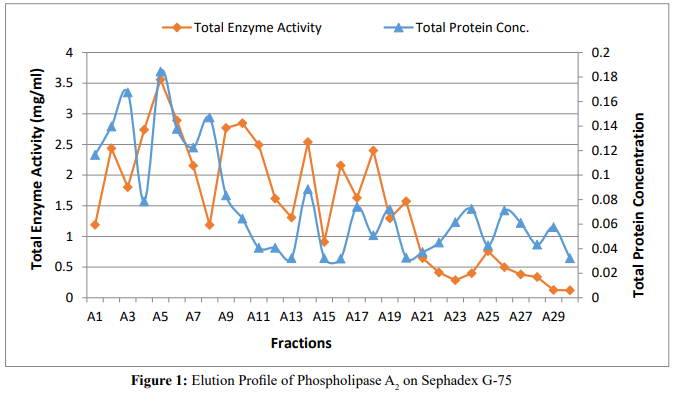
Phospholipase A2 enzyme was partial purification from the ven¬om of Naja Katiensis using a two way purification step; Gel filitration using G-75 and ion exchange chromatography using CM-Sephadex (Figure 1 & 2). The crude venom was found to have a specific activity 12.20 mol/min/mg at 100% yield. Af¬ter gel filitration, it was 21.94 µmol/min/mg at 93% yield. On further purification the specific activity decrease to 34.56 µmol/ min/mg at 86% yield with a purification fold of 2.05 (Table 1). Thirty fractions were collected at a flow rate of 1ml/108sec at 25oC from the gel-filtration chromatography. Fraction 5 & 6 were found to have the highest enzyme activity, which were then pooled and subjected to an ion-exchange chromatography on CM-Sephadex eluted with 90ml of NaCl gradient 0.1-1.2M, at a flow rate of 1ml/120sec at 25oC (Figure 2).
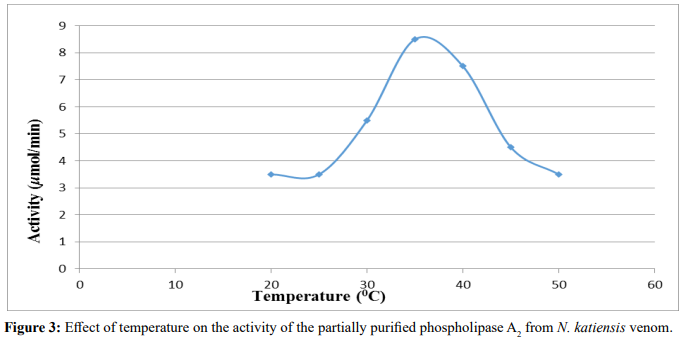
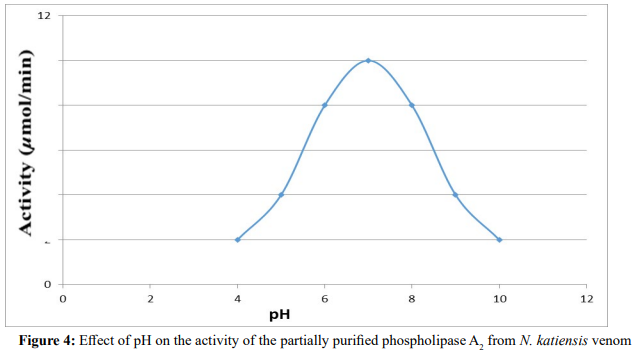
Characterization of the extracted enzyme reveals the activity of the partially purified phospholipase A2 enzyme, increased as temperature increased, up to an optimum temperature of 35oC. Above this temperature, activity decreased as temperature in¬creased (Figure 3). Moreover the activity of purified Phospholi- pase A2 increased with increasing pH up until an optimum pH of 7, where the activity was highest, after which increases in pH resulted in further decrease in in the enzyme activity (Figure 4). Initial velocity data of the enzyme was used to compute the kinetic parameters of the enzyme, where the Km of the partially purified PLA2 enzyme was estimated to be 12.6 mg/ml, while it Vmax is 3.32 μmoles/min. SDS-PAGE Electrophoresis done on the partially purified Phospholipase A2 from Naja katiensis venom estimate its molecular weight is shown on lane 3, with an extrapolated weight of 17.5 kDa (Figure 5). Meanwhile effects of different kinds of metal ions and salt was ascertain as shown in table 2.
|
Enzyme |
Step |
Total Protein (mg/ml) |
Total Enzyme Activity (µmol/ min) |
Specific Activity (µmol/min/ mg) |
Purification Fold |
Yield (%) |
|
PLA2 |
Crude |
0.35 |
4.27 |
12.20 |
1.00 |
100 |
|
Gel filtration on sephadex G-75 |
0.18 |
3.95 |
21.94 |
1.70 |
93 |
|
|
Ion exchange on CM-Sephadex |
0.09 |
3.11 |
34.56 |
2.05 |
86 |
Table 1: Purification table of phospholipase A2 from Naja katiensis venom
|
Ions (10mM) |
PLA2 Activity |
|
|
Control |
Activity |
|
|
Ca2+ |
3.03 µmol/min |
5.28 µmol/min |
|
Mg2+ |
1.63 µmol/min |
|
|
Cd2+ |
0.37 µmol/min |
|
|
Zn2+ |
3.12 µmol/min |
|
|
Mn2+ |
2.12 µmol/min |
|
|
Ba2+ |
1.50 µmol/min |
|
Table 2: Effect of Some Metal Ions and salt on Partially-purified PLA2 Activity
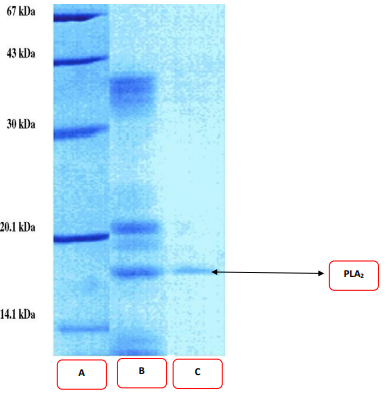
KEY: Lane A = Molecular weight marker, Lane B = Crude Venom Lane C = Extracted Phospholipase A2 (extrapolated to be 17.5
kDa)
Figure 5: SDS-PAGE of Partially Purified Phospholipase A2 of N. katiensis venom
Discussion
Envenomation by snakes has become serious global detrimental issue, especially with the numerous counts of antiserum treat¬ment specificity, storage and availability issues [17]. the only treatment available so far is only the polyvalent antiserum which binds to the components of the venom and neutralizes them but does not have any effects on the damages
already caused by the venom [18]. Another issue with snake an-tivenom is the fact that it is expensive, high specie-venom spec¬ificity, ideal storage condition and facilities, which are really not available especially in rural and even some developed areas of Nigeria and other African countries [4]. Having more informa¬tion about snake venom enzymes, their features and bio-gram profile is the best and foremost starting focal point of developing other more suitable pharmaceutical formulations that will serve as a better alternative to the current snake antisera.
N. katiensis is one of the most dangerous venomous snakes in Nigeria responsible for maximum deaths. In this study the char¬acterization of Partially Purified Phospholipase A2 Enzyme of Naja Katiensis Venom was done. The presence of PLA2 enzyme has been described in several human tissues, animal venoms, pathogenic organism and cancers cells [19]. It however has been shown to be present N. katiensis venom use in this study. PLA2 being one of the most predominant enzyme in snake venom aids in damaging mitochondria, red blood cells, leucocytes, platelets, peripheral nerve endings, skeletal muscle, vascular endothelium and other membranes, hence produces presynaptic neurotoxic activity, opiate-like sedative effects [20]. In this study enzyme Phospholipase A2 was partial purification using a two-step pu¬rification, where the most active fractions from the first step are pooled together and applied to the second step under NaCl gra¬dient. The partially purified PLA2 was active on lecithin, with an activity of 3.11 µmol/min and a purification yield of 86%, which shows that a relatively higher relative extraction was achieved. This correspond with the study of Nwune et al. 2016 and Hassan et al. 2020 on different isolated snake venom PLA2 enzymes [21].
Kinetic of enzyme inhibition help to show the various kinetics parameters for an enzymes in the presence and absence of an inhibitor. The relative enzyme kinetics study shows that the Km and Vmax value of the enzyme was 12.6 mg/ml and 3.32 μmoles/ min respectively. Characterization studies done shows that the enzyme has an optimum temperature and pH of 35 oC (Figure 3) and 7.0 (Figure 4) respectively. However adjustment of these parameters proof lethal to the venom enzyme. This correspond with a similar snake venom research report by Abdullahi [22]. This enzyme characterization study shows that increasing the biosystem temperature also increased, the enzyme affinity up to an optimum temperature of 35oC as stated above, however higher increase of temperature above this, also decreased the en¬zyme activity. The same scenario was seen as per pH increase and decrease. Berg et al (2007) also reported similar findings as regards to snake venom enzymes kinetics and affecting factors [23]. SDS-PAGE Electrophoresis done on the partially purified Phospholipase A2 from Naja katiensis venom extrapolated its molecular weight to be of about 17.5 kDa (Figure 5). In a related research done by Marunak et al. (2007) reported that the PLA2 isolated from snake venom has molecular weight of 15.6KDa, similar to the one isolated from B. Jararacussu from Brazil 16.7KDa and Ketelhut et al. (2003) revealed that PLA2 isolated has 15 KDa molecular mass [24, 25].
Meanwhile effects of different kinds of metal ions and salt was ascertain as shown in table 2, where the study reveals that most of the metal ions has detrimental effects on the isolated enzyme, with the exception of Ca2+ ions which tends to be increasing the enzyme activity and affinity. However
Ba2+ and Cd2+ metal ions has the highest recorded inhibitory effects on the isolated enzyme. This study was compare to the study by Chinyere et al 2016 on the effects of aqueous root ex¬tract of Annona senegalensis on Bitisarietans venom protease and phospholipase A2 activities. This research also report sim¬ilar findings with our research even though it involves different kinds of snake venoms.
Conclusion
Higher or lower temperature (above 60 oC or below 20 oC) and pH above or below 7.0, plus presence of some heavy metal ions and salt can be used against the activity and affinity of Naja Ka¬tiensis PLA2 venom. The data from this research can also aid in formulation of a friendlier therapeutically agent for the treat¬ment and management of snake envenomation.
References
- Mukherjee, A. K., & Mackessy, S. P. (2021). Prevention and improvement of clinical management of snakebite in Southern Asian countries: a proposed road map. Toxicon, 200, 140-152
- Habib, A. G. (2013). Public health aspects of snakebite care in West Africa: perspectives from Nigeria. Journal of venomous animals and toxins including tropical diseases, 19, 1-14.
- Bocian, A., & Hus, K. K. (2020). Antibacterial properties of snake venom components. Chemical Papers, 74, 407-419.
- Hassan, A. U., Makeri, M. S., Ozojiofor, U. O., & Alhassan,J. (2020). Effects of Ficus sycomorus phenolic extracts on the activity of hyaluronidase and phospholipase A2 enzymes of Echis ocellatus Venom. Asian Journal of Biotechnology and Genetic Engineering, 3(4), 24-33.
- Kang, T. S., Georgieva, D., Genov, N., Murakami, M. T., Sinha, M., et al. (2011). Enzymatic toxins from snake venom: structural characterization and mechanism of catalysis. The FEBS journal, 278(23), 4544-4576.
- Kadir, M. F., Karmoker, J. R., Alam, M. R., Jahan, S. R., Mahbub, S., et al. (2015). Ethnopharmacological survey of medicinal plants used by traditional healers and indigenous people in Chittagong Hill Tracts, Bangladesh, for the treatment of snakebite. Evidence-Based Complementary and Alternative Medicine, 2015.
- Abid, I., Jemel, I., Alonazi, M., & Ben Bacha, A. (2020). A New Group II Phospholipase A2 from Walterinnesia aegyp-tia Venom with Antimicrobial, Antifungal, and Cytotoxic Potential. Processes, 8(12), 1560.
- Sallau, A. B., Ibrahim, M. A., Salihu, A., & Patrick, F. U. (2008). Characterization of phospholipase A2 (PLA2) from Echis ocellatus venom. African journal of biochemistry research, 2(4), 98-101.
- Hassan, A. U., Makeri, M. S., Ozojiofor, U. O., & Alhassan,J. (2020). Effects of Ficus sycomorus phenolic extracts on the activity of hyaluronidase and phospholipase A2 enzymes of Echis ocellatus Venom. Asian Journal of Biotechnology and Genetic Engineering, 3(4), 24-33.
- Nasio, N. A. (2016). Snake bites: a forgotten menace in Kenya. International Journal of Scientific Research and Innovative Technology, 3(7), 1-7.
- Denegri, M. E. G., Maruñak, S., Todaro, J. S., Ponce-Soto,L. A., Acosta, O., et al. (2014). Neutralisation of the pharmacological activities of Bothrops alternatus venom by an-ti-PLA2 IgGs. Toxicon, 86, 89-95.
- Gasanov, S. E., Dagda, R. K., & Rael, E. D. (2014). Snake venom cytotoxins, phospholipase A2s, and Zn2+-depen-dent metalloproteinases: mechanisms of action and pharmacological relevance. Journal of clinical toxicology, 4(1), 1000181.
- Chérifi, F., Namane, A., & Laraba-Djebari, F. (2014). Isolation, functional characterization and proteomic identification of CC2-PLA 2 from Cerastes cerastes venom: a basic platelet-aggregation-inhibiting factor. The protein journal, 33, 61-74.
- Chinyere, N. H., Milala, M. A., & Zannah, H. (2016). Effects of aqueous root extract of Annona senegalensis on Bitisarietans venom protease and phospholipase A2 activities. Journal of Pharmaceutical and Biomedical Sciences, 6(8).
- Sutti, R., Tamascia, M. L., Hyslop, S., & Rocha-e-Silva, T.A. A. (2014). Purification and characterization of a hyaluronidase from venom of the spider Vitalius dubius (Araneae, Theraphosidae). Journal of Venomous Animals and Toxins including Tropical Diseases, 20, 1-7.
- Laemmli, U. K. (1970). Cleavage of structural proteins during the assembly of the head of bacteriophage T4. nature, 227(5259), 680-685.
- Puzari, U., & Mukherjee, A. K. (2020). Recent developments in diagnostic tools and bioanalytical methods for analysis of snake venom: A critical review. Analytica Chim-ica Acta, 1137, 208-224.
- Murakami, M., Sato, H., & Taketomi, Y. (2020). Updating phospholipase A2 biology. Biomolecules, 10(10), 1457.
- Vineetha, M. S., Janardhan, B., & More, S. S. (2017). Biochemical and pharmacological neutralization of Indian saw-scaled viper snake venom by Canthium parviflorum extracts.
- Deshwal, A., Phan, P., Datta, J., Kannan, R., & Thallapura-nam, S. K. (2021). A meta-analysis of the protein components in rattlesnake venom. Toxins, 13(6), 372.
- Chinyere, N. H., Milala, M. A., & Zannah, H. (2016). Effects of aqueous root extract of Annona senegalensis on Bitisarietans venom protease and phospholipase A2 activities. Journal of Pharmaceutical and Biomedical Sciences, 6(8).
- Abdullahi, Z. U., Musa, S. S., Abu-Odah, H., Ahmed, A., Lawan, A. A., et al. (2023). Bactericidal Effects of Snake Venom Phospholipases A2: A Systematic Review and Analysis of Minimum Inhibitory Concentration. Physiologia, 3(1), 30-42.
- Berg, J. M., Tymoczko, J. L., & Stryer, L. (2007). Biochemistry (Loose-Leaf). Macmillan.
- Maruñak, S. L., Leiva, L., García Denegri, M. E., Teibler, P., & Acosta De Pérez, O. (2007). Isolation and biological characterization of a basic phospholipase A2 from Bothrops jararacussu snake venom. Biocell, 31(3), 355-364.
- Ketelhut, D. F. J., De Mello, M. H., Veronese, E. L. G., Esmeraldino, L. E., Murakami, M. T., Arni, R. K., Et al. (2003). Isolation, characterization and biological activity of acidic phospholipase A2 isoforms from Bothrops jararacussu snake venom. Biochimie, 85(10), 983-991.