


Review Article - (2026) Volume 3, Issue 1
Approximate Spectral Triples and Non-commutative Geometric Structures on Non-Separable Banach Spaces

Received Date: May 28, 2026 / Accepted Date: Jun 08, 2026 / Published Date: Jun 19, 2026
Copyright: ©2026 Juan Alberto Molina GarcÃÂa. This is an open-access article distributed under the terms of the Creative Commons Attribution License, which permits unrestricted use, distribution, and reproduction in any medium, provided the original author and source are credited.
Citation: Garcia, J. A. M. (2026). Approximate Spectral Triples and Non-commutative Geometric Structures on Non-Separable Banach Spaces. Ther Res: Open Access, 3(1), 01-59.
Abstract
This article develops a geometric extension of the approximate C^*- and W^*-algebra framework introduced in earlier work, showing that NSBS naturally give rise to noncommutative geometric structures in the sense of Connes. While classical noncommutative geometry is traditionally based on separable C^*-algebras and Hilbert spaces, many analytically relevant settings—such as l^∞, L^∞ (μ) for non-σ-finite measures, or C(βN)—lack separability and fall outside the scope of the usual spectral triple framework. The present work overcomes these limitations by developing a theory of approximate spectral triples, constructed as inductive limits of local spectral triples on separable components.
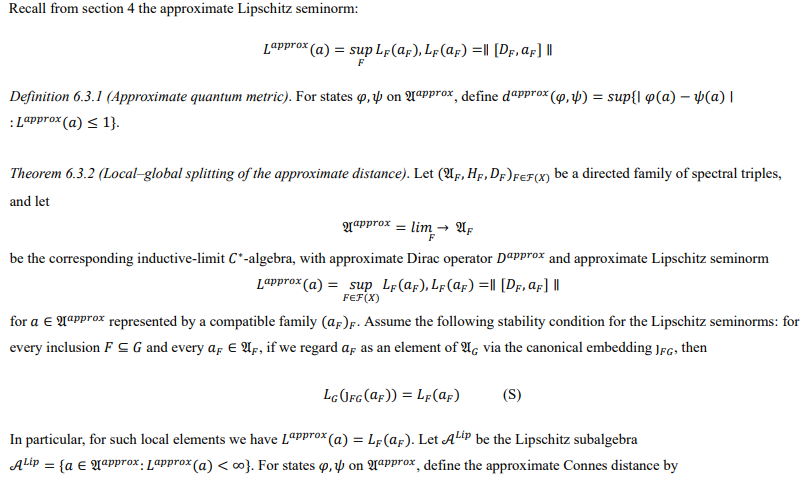
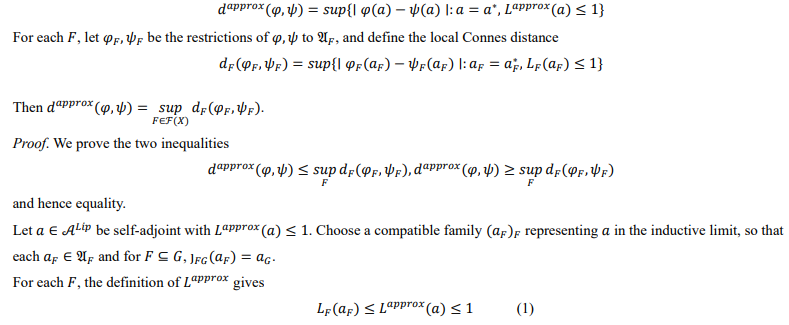
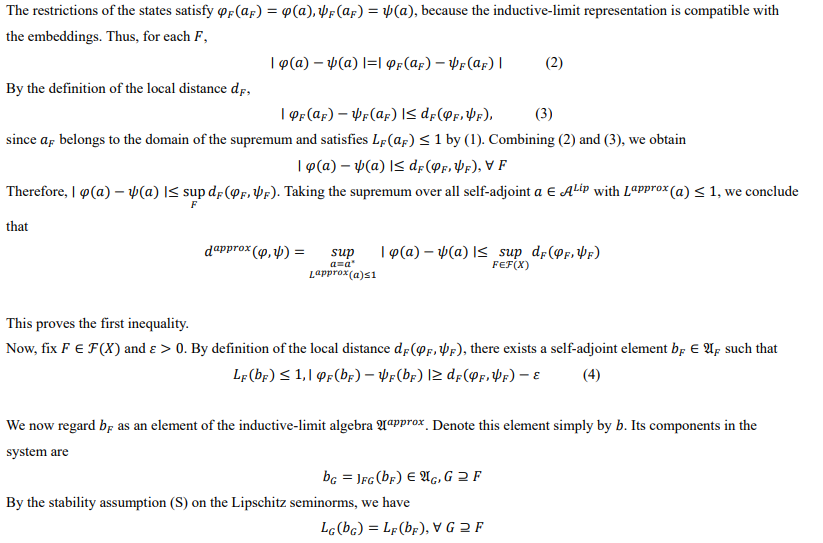
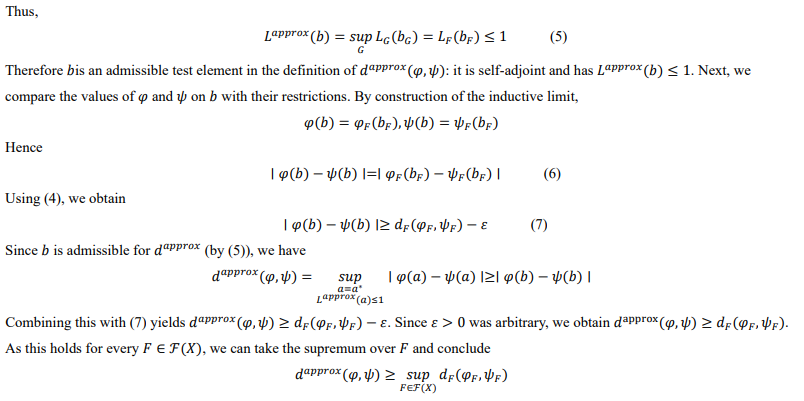
Given a non-separable Banach space X, its approximate operator algebra A^approx (X) is defined as an inductive limit of separable C^*-algebras A_F. We show that this structure canonically admits a family of densely defined local Dirac-type operators D_F acting on separable Hilbert modules H_F, satisfying compatibility conditions that allow the construction of a global approximate Dirac operator D^approx. The pair (A^approx,D^approx) behaves like a geometric object: it induces a variational metric on the state space, determines a quantum differential calculus, and provides a platform for an approximate version of Connes’ distance formula.
We prove that approximate spectral triples endow A^approx with the structure of a weakly differentiable noncommutative manifold, with the following key features: 1) an approximate spectral metric d^approx defined on approximate states; 2) an approximate Calderón–Zygmund decomposition on separable subspaces; 3) a differential calculus generated by commutators [D_F,a_F], compatible through the inductive system; 4) an associated approximate K-homology and K-theory enabling topological classification; 5) explicit geometric models on benchmark EBNS: l^∞, C(βN), and L^∞ (μ) with non-σ-finite μ.
This shows that non-separable Banach spaces carry a noncommutative geometric structure, expressible through approximate spectral data, and exhibiting differential regularity only locally. This yields a rigorous notion of non-separable quantum manifold: a geometric space whose differential, metric, and spectral structures are visible only through separable windows.
To our knowledge, this approach is entirely new and opens a path for applying noncommutative geometry to non-separable functional analysis, mathematical physics, and higher operator theory.
Keywords
Noncommutative Geometry; Spectral Triple, Approximate C*-Algebra, Non-Separable Banach Space, Dirac Operator; Approximate Metric, K-Homology; Functional Analysis, Operator Algebras, Geometric Analysis
Introduction
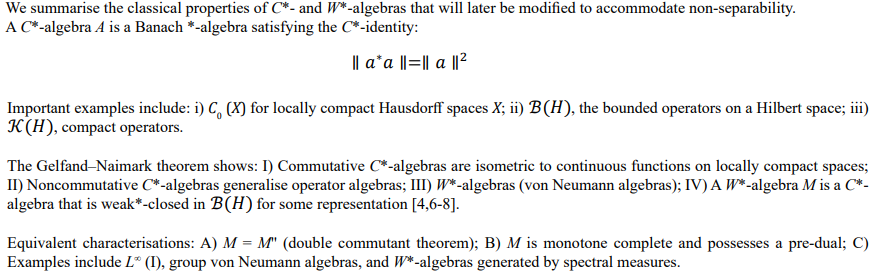
Noncommutative geometry, in the sense of Connes, identifies geometric structures with purely analytic data encoded in a C *-algebra A, a Hilbert space H, and an unbounded self-adjoint operator D. The triple (A,H,D) captures the full differential, metric, and topological content of a space, including curvature, dimension, and K-theoretical invariants [1]. Its power lies in its ability to treat geometric objects (manifolds, graphs, fractals, quantum spaces) through functional analytic tools. However, the classical theory rests heavily on one assumption: all objects involved are separable.
This includes:
• Separable C * -algebras,
• Hilbert spaces with countable orthonormal basis,
• Compact resolvent conditions that implicitly require separability.
This excludes some fundamental analytic spaces:

as well as many Banach spaces arising in PDE theory, probability, and topological measure theory. In these contexts, spectral triples cannot exist in the classical sense.
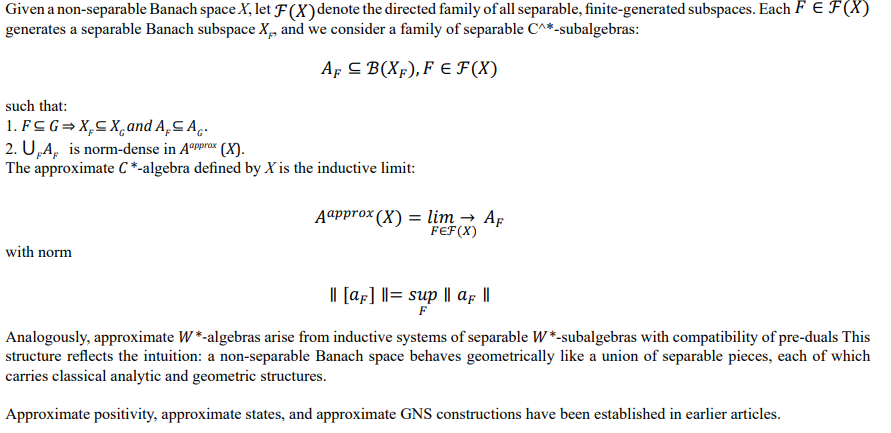
In recent work, we introduced the general concept of an approximate C*- algebra, Aapprox (X), associated with a Banach space X. This algebra is constructed as the inductive limit [2-4]:
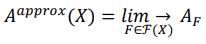
where each AF is a separable C* -subalgebra acting on the separable subspace XF ⊆ X generated by F. The family (AF ) provides separable windows through which the behaviour of the full space X can be partially observed.
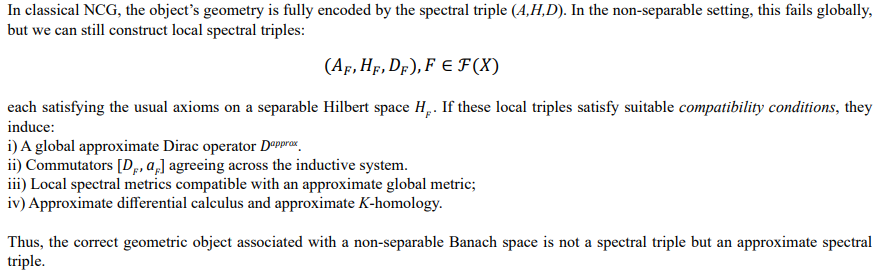
The main goal of this article is to extend this operator-algebraic viewpoint to geometry. More precisely, we prove that every approximate C*-algebra admits an associated approximate spectral triple, which behaves like a noncommutative differentiable structure on a non-separable object. This is achieved by:
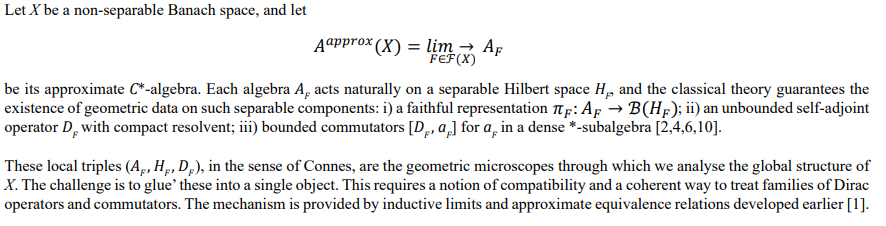
i. Constructing compatible Dirac-type operators DF on each AF.
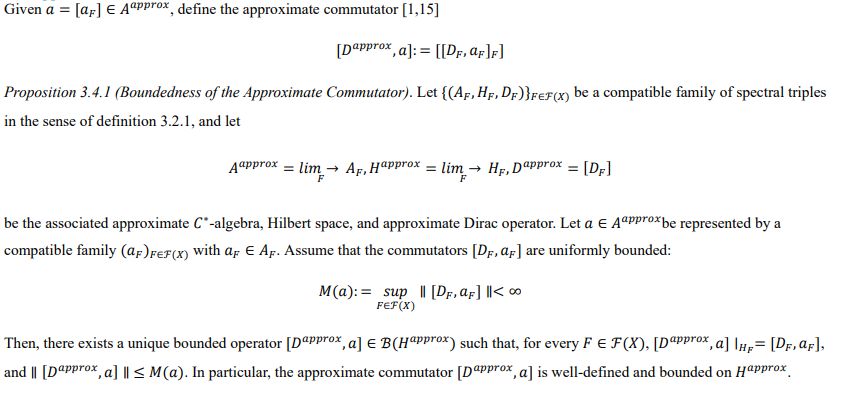
ii. Showing that the commutators [DF , aF] stabilise through the inductive system.
iii. Defining a global operator
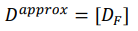
in the approximate sense.
iv. Introducing an approximate Connes’ metric on the approximate state space.
v. Proving that this object possesses differential calculus, metric properties, and K-homological interpretation.
From the geometric viewpoint, the central message is the following: NSBS generate noncommutative manifolds that possess only local (separable) differential structure, encoded by approximate spectral triples.
This yields a new class of geometric spaces:
i. Not topological manifolds.
ii. Not classical spectral triples,
iii. But weak noncommutative manifolds whose geometry is visible only through separable approximations.
This framework unifies and extends the operator-algebraic foundations developed earlier and builds a conceptual bridge between functional analysis on NSNS and the geometric machinery of Connes.
Background
This section reviews the analytic and geometric structures that will be generalized in the non-separable setting. We begin with the classical notion of spectral triple in the sense of Connes, then recall the operator-algebraic framework underlying noncommutative geometry. Finally, we summarize the theory of approximate C*- and W*-algebras introduced in earlier work, which provides the foundation for constructing approximate spectral triples. Throughout this section, all Hilbert spaces are assumed to be complex, all C*-algebras are involutive, and operator norms are denoted by ||⋅||.
Classical Spectral Triples
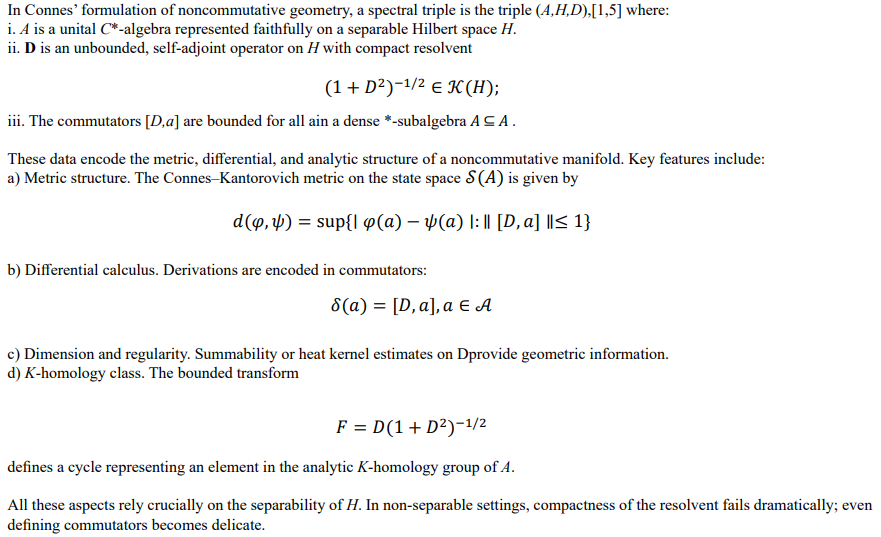
Operator Algebras in the Separable Framework
Noncommutative Geometric Structures
In Connes’ framework, geometry is recast through analytic data. A spectral triple (A,H,D) gives rise to: 1) A first-order differential calculus generated by bounded commutators [D,a]; 2) A spectral metric; 3) Invariants in K-homology and cyclic cohomology; 4) Index pairings of Fredholm modules; 5) Local geometric quantities (dimension, volume form, curvature) encoded in heat kernel asymptotic.
All of these depend on separability. When separability is abandoned, major obstacles arise: a) K(H) is no longer the closure of finite-rank operators; b) Resolvents may fail to be compact or even measurable; c) The Dixmier trace becomes problematic; d) The metric may fail to distinguish states.
Thus, we need a fundamentally different geometric mechanism: one based not on global separability but on local separable windows.
Approximate C *- and C *- Algebras
Motivation for Approximate Spectral Triples
Goal of the Paper
The objective is to construct a full analogue of Connes’ geometric machinery in the approximate setting. We will show that:
a. Approximate spectral triples exist on any approximate C *-algebra;
b. They define a meaningful spectral metric;
c. They support a differential calculus and K-theoretical invariants;
d. Concrete EBNS models admit computable approximate geometric structures.
This culminates in the idea that NSBS carry weak noncommutative manifolds, whose geometry is visible only locally, through separable subspaces.
Approximate Spectral Triples
In this section we construct the analytic core of the approximate noncommutative geometry framework on non-separable Banach spaces. The aim is to generalise the notion of spectral triple—introduced by Connes as the foundation of noncommutative geometry—to settings where separability fails, by assembling compatible local spectral triples defined on separable subspaces [1].
Our approach relies on three classical pillars:
1. The theory of spectral triples [1,9],
2. Inductive-limit techniques in C *-algebras and operator theory [2,4,6,10],
3. Perturbation and closure results for unbounded operators [11,12].
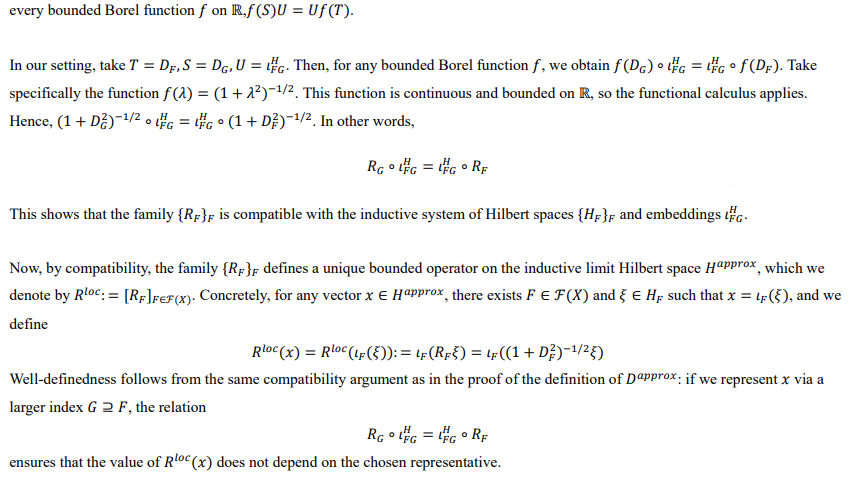
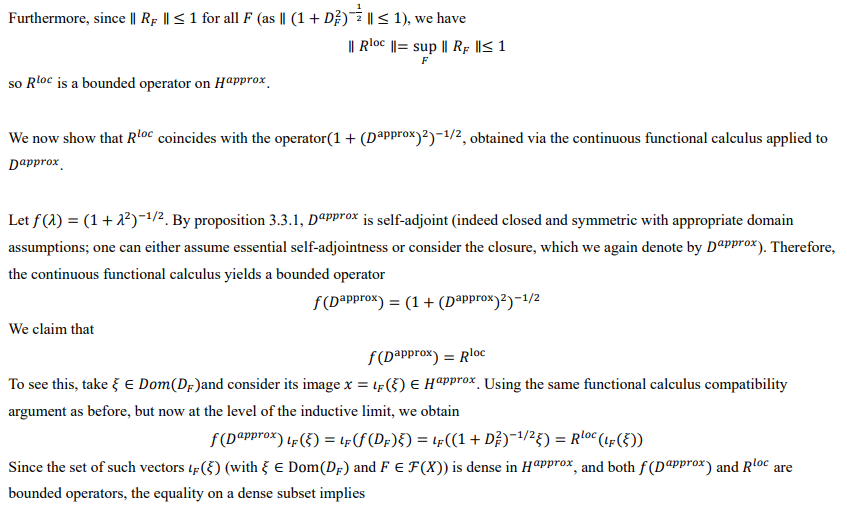
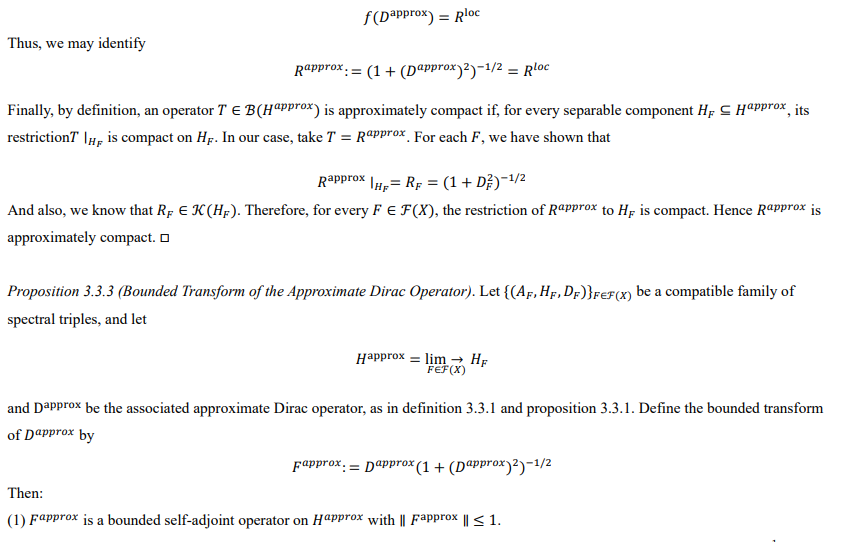
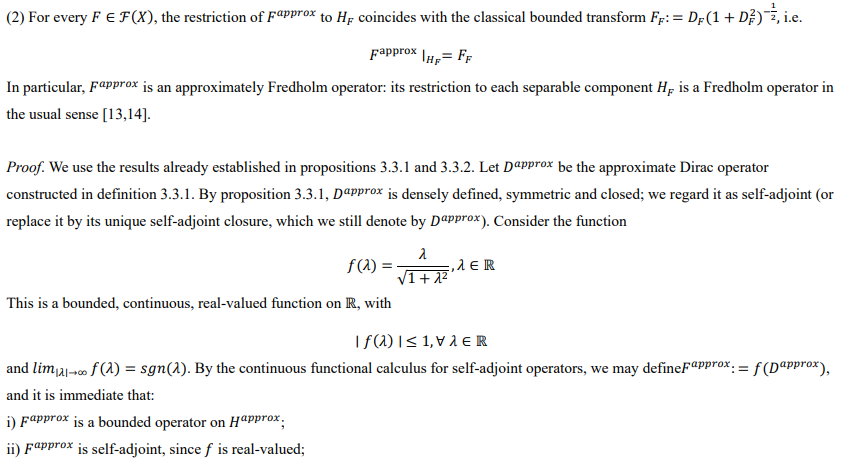
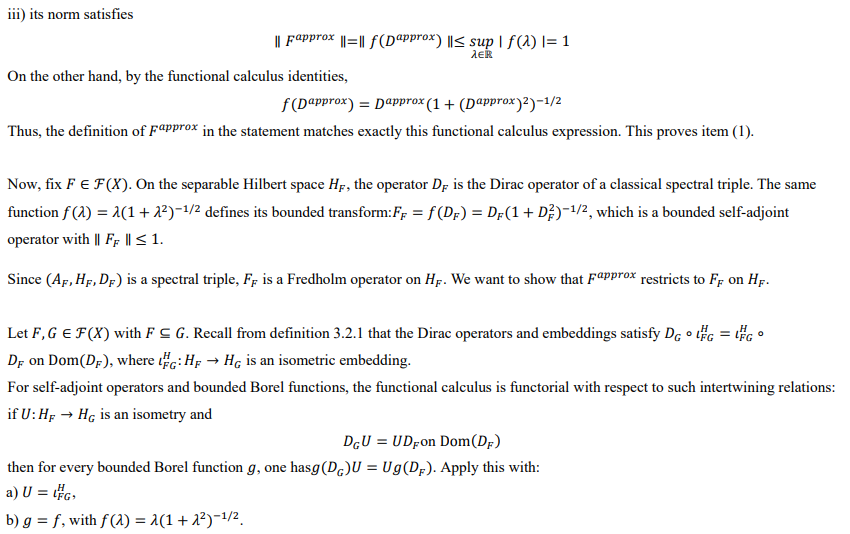
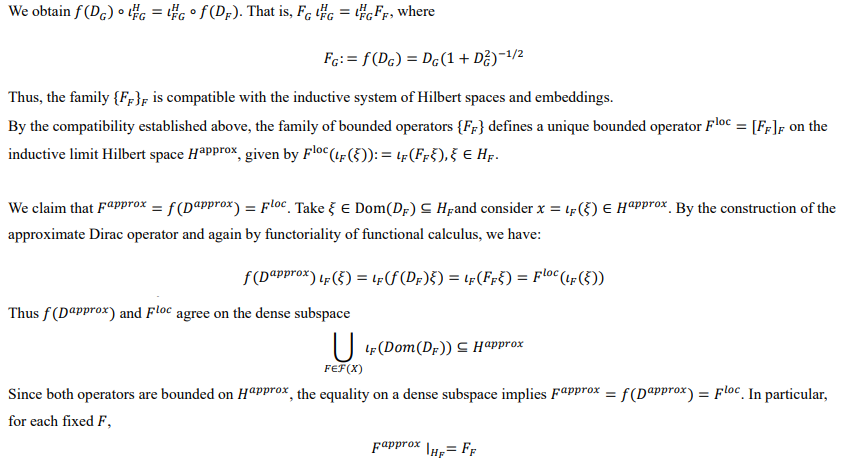
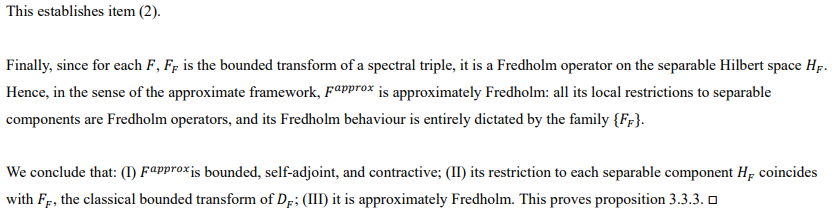
These ingredients allow us to construct a well-behaved approximate Dirac operator Dapprox, its bounded transform F approx, and the associated approximate differential calculus.
Motivation
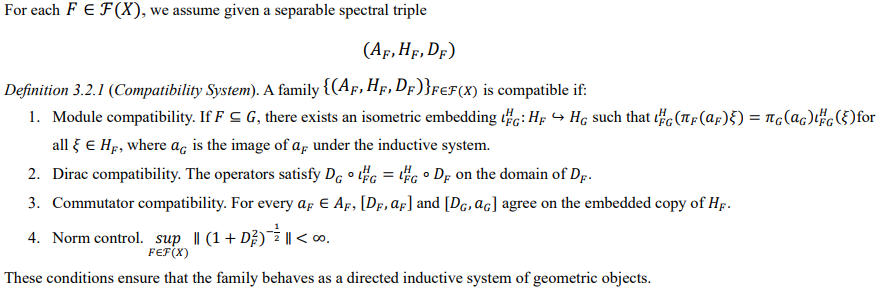
Local Spectral Triples and Compatibility
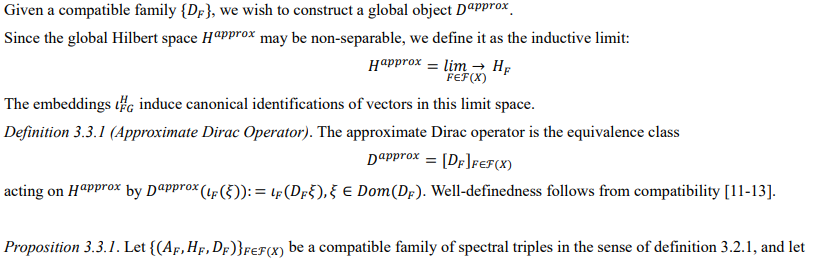
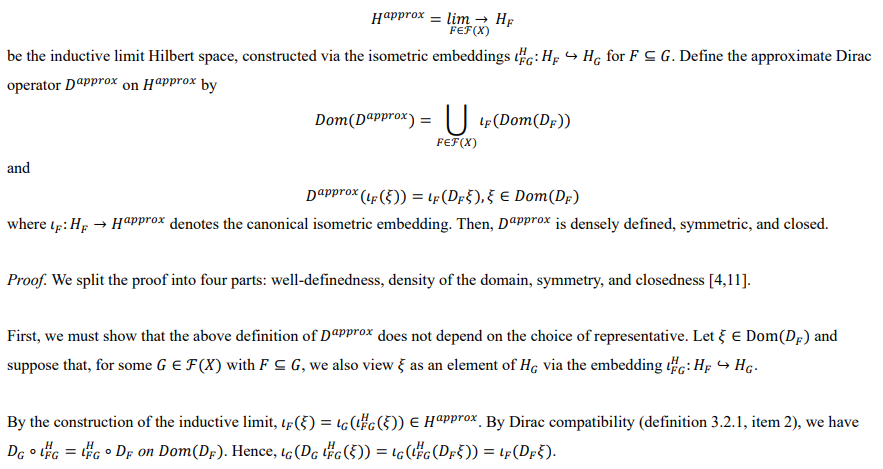
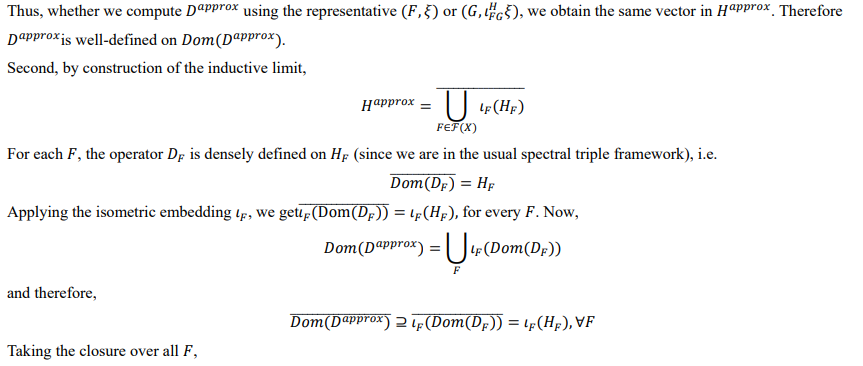
Approximate Dirac Operators
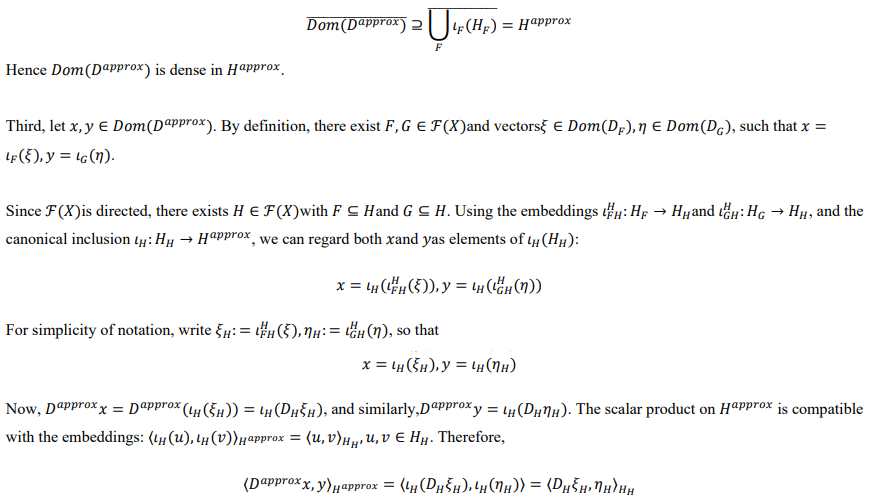
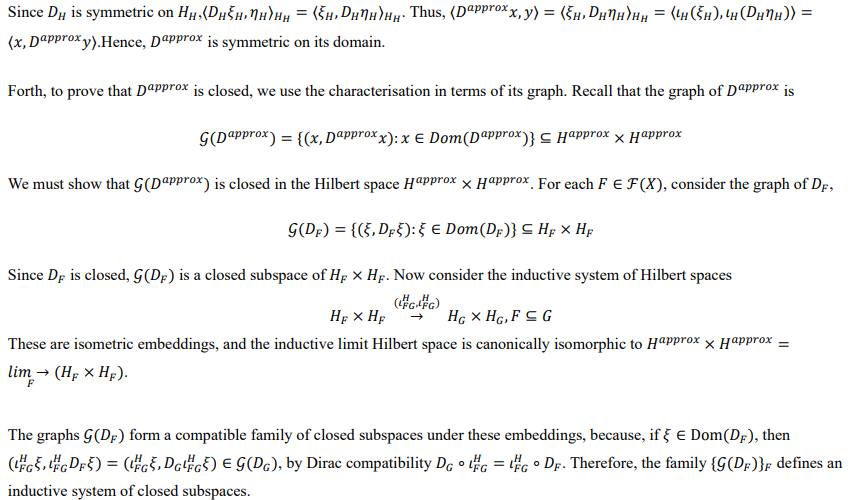
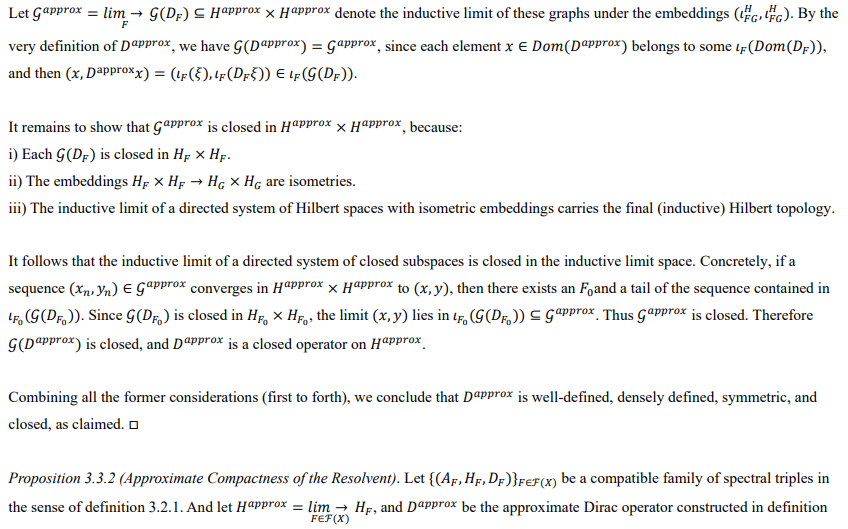
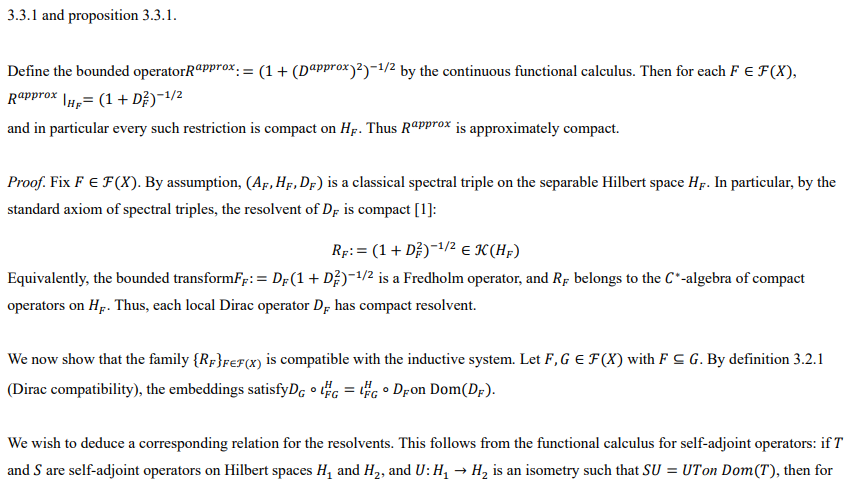
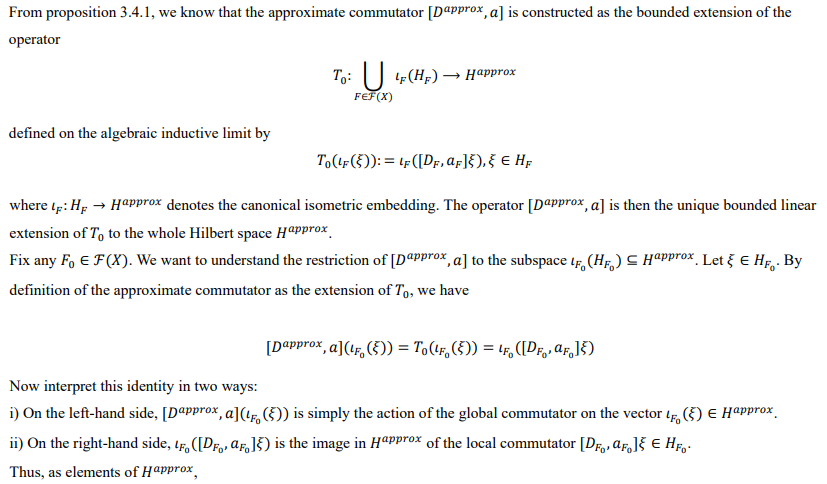
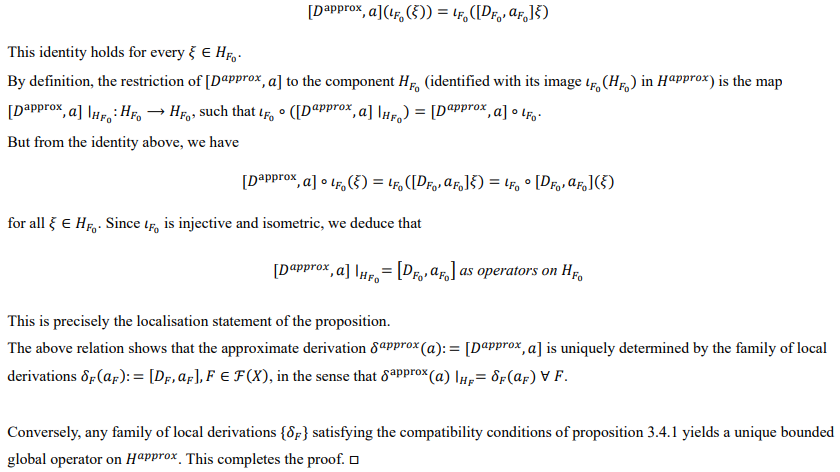
Approximate Commutators
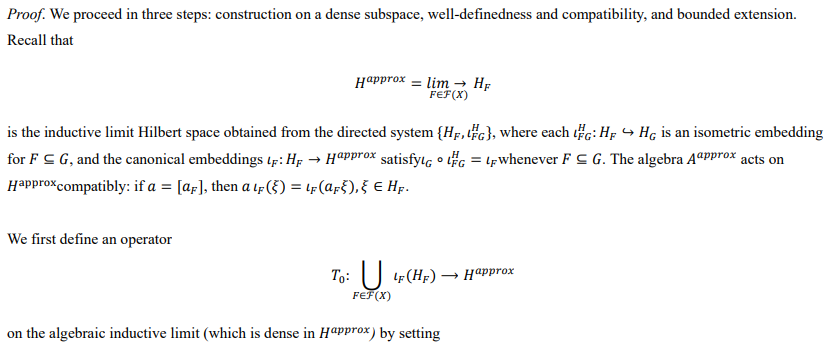
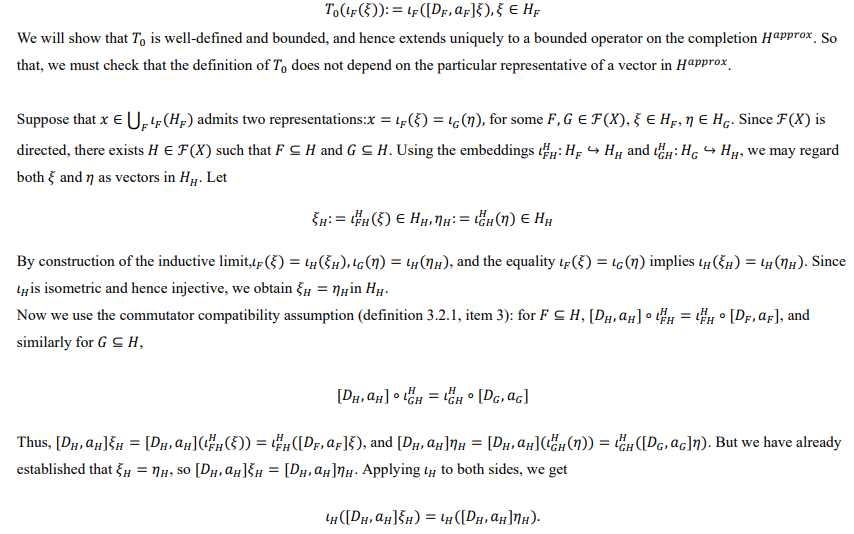
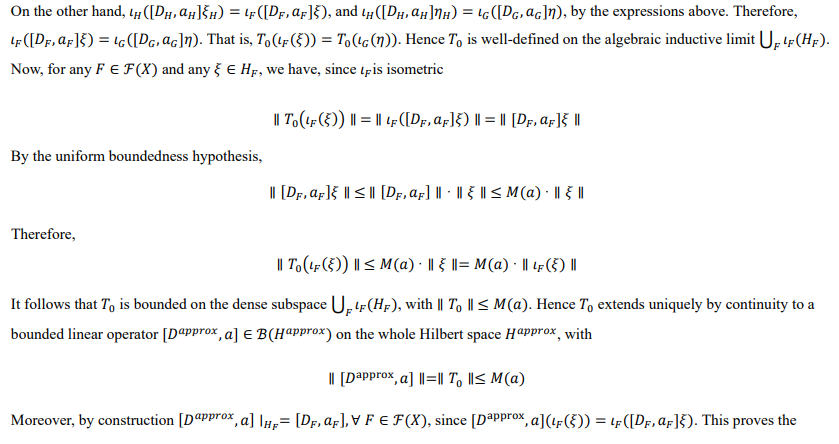
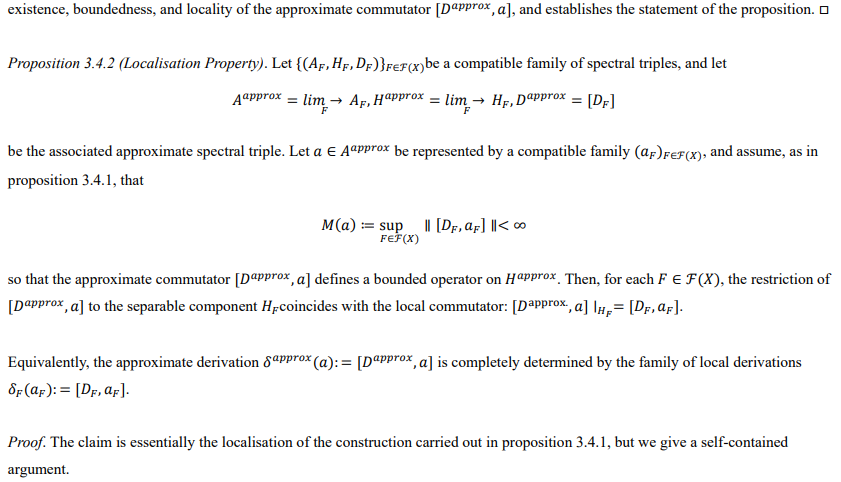
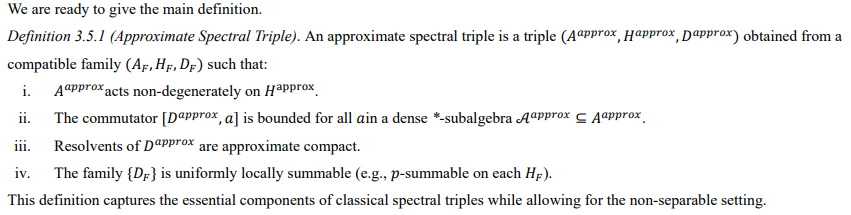
Approximate Spectral Triples: Definition
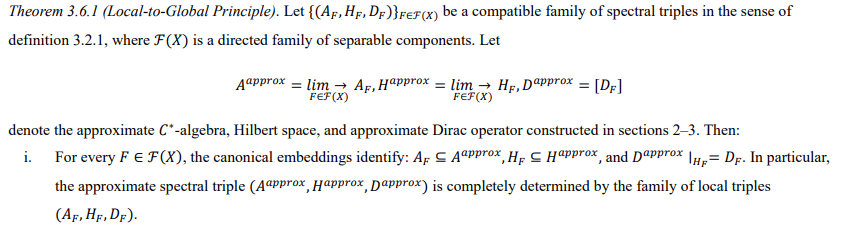
Fundamental Properties
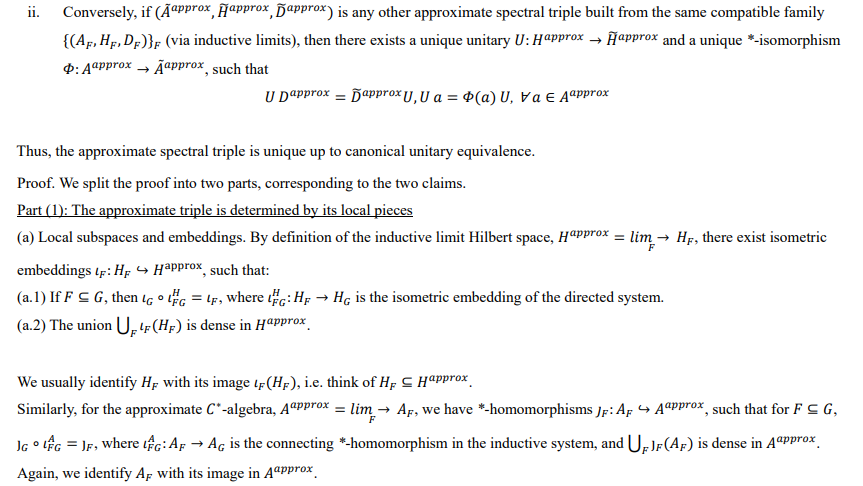
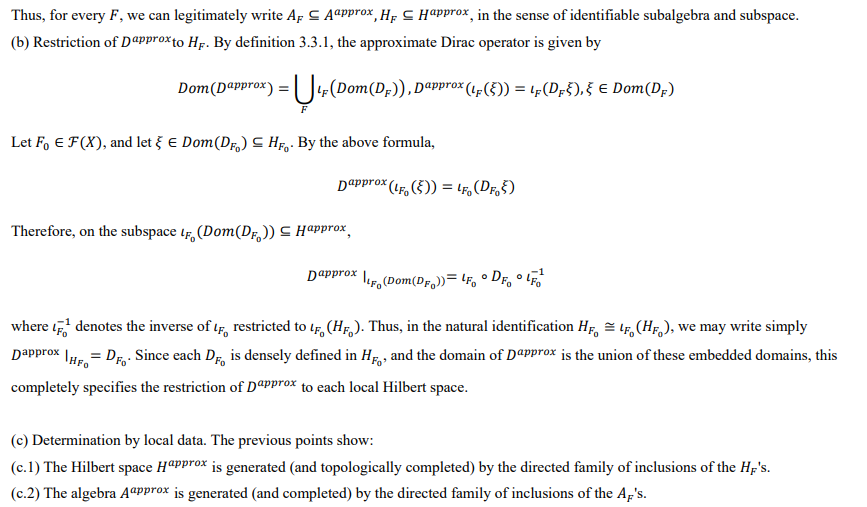
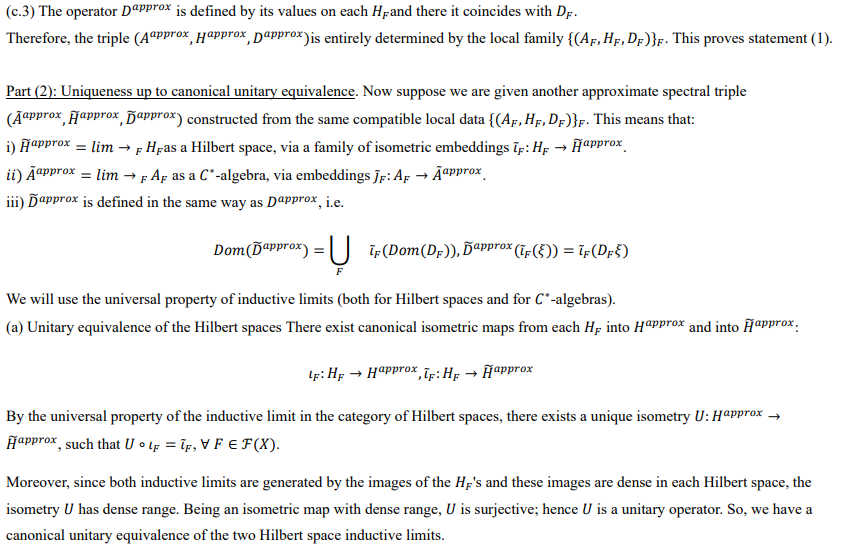
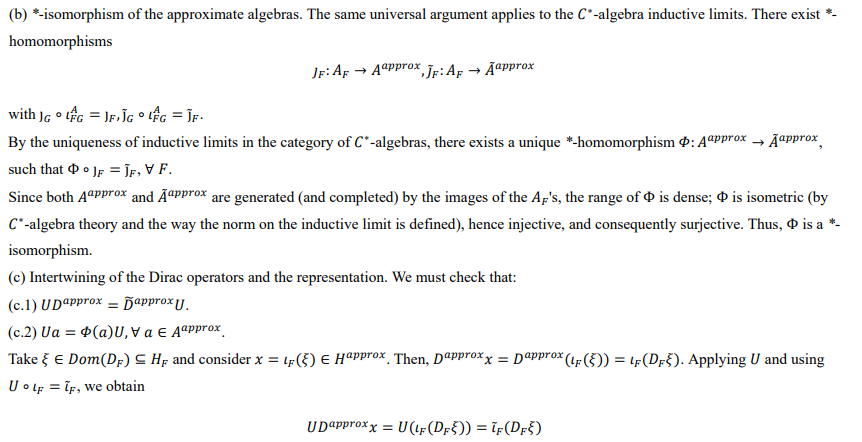
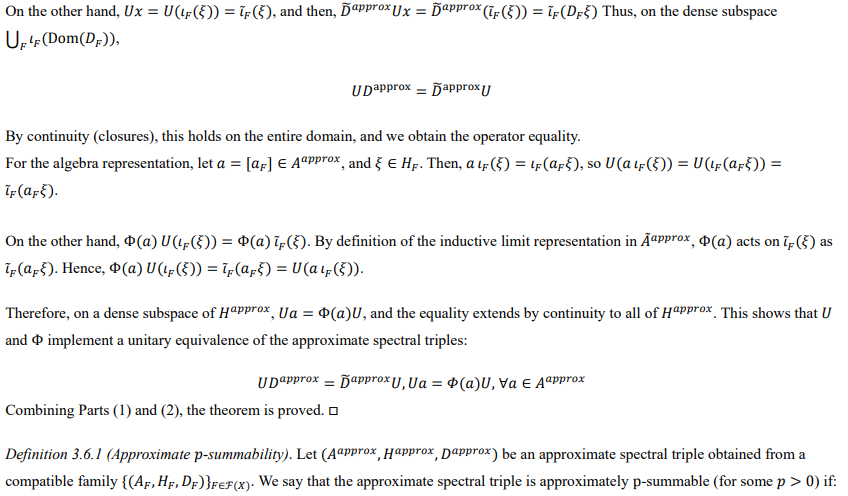
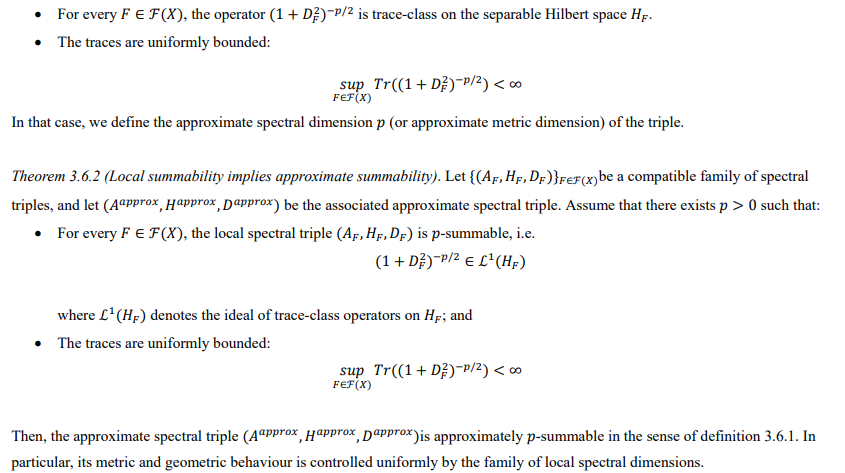
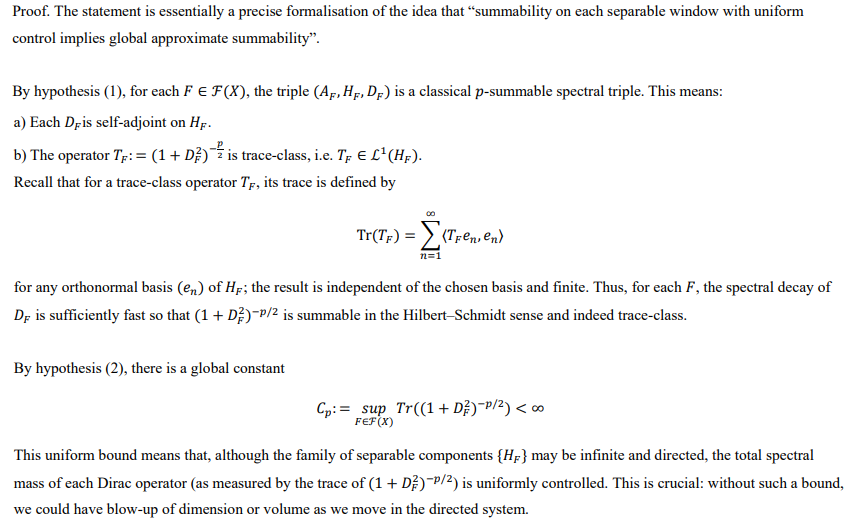
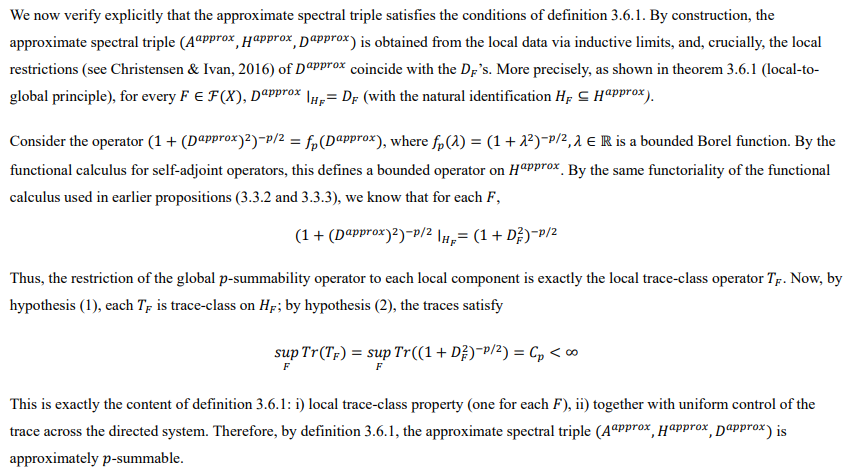
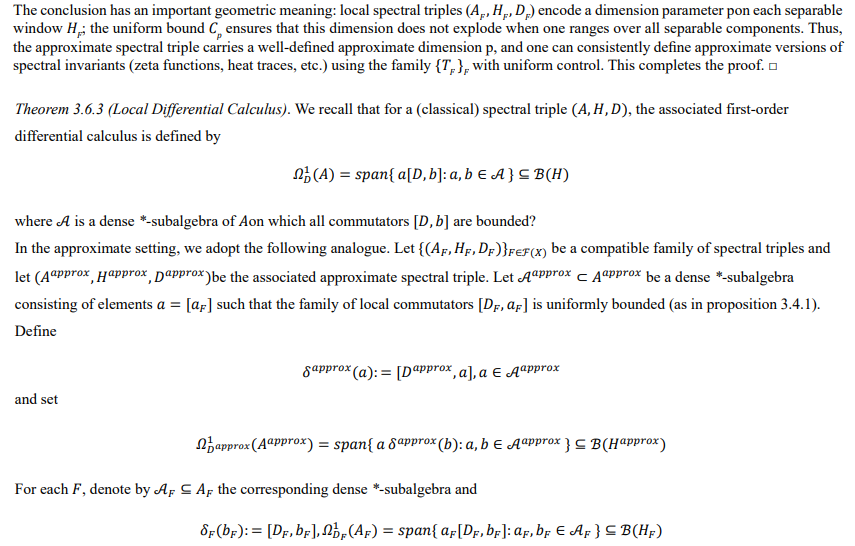
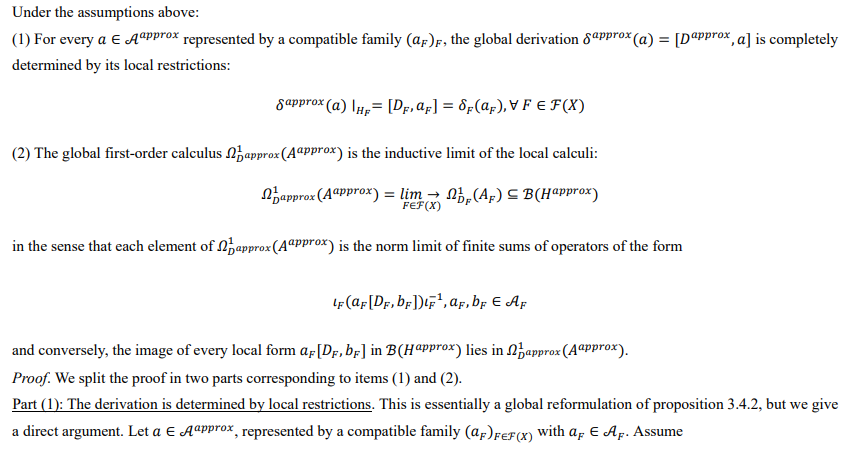
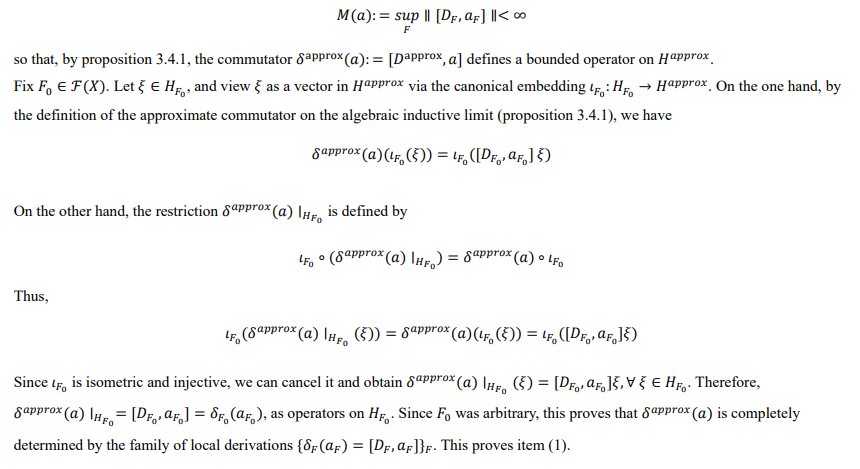
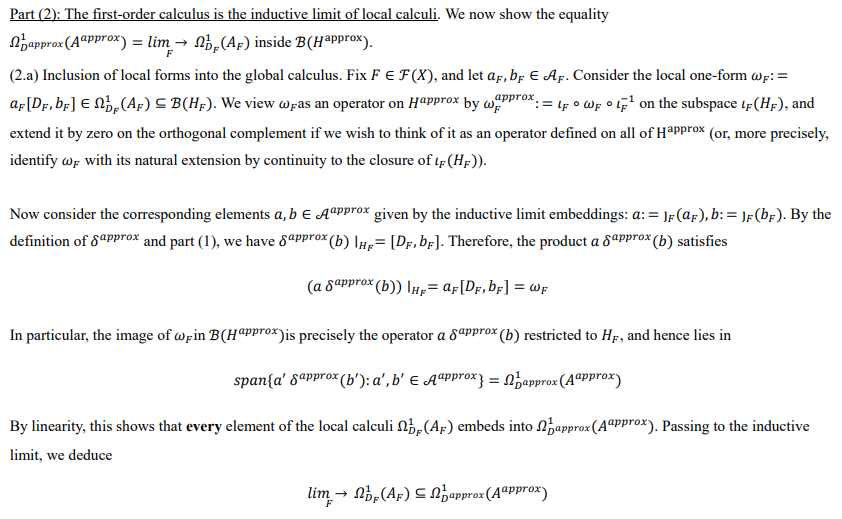
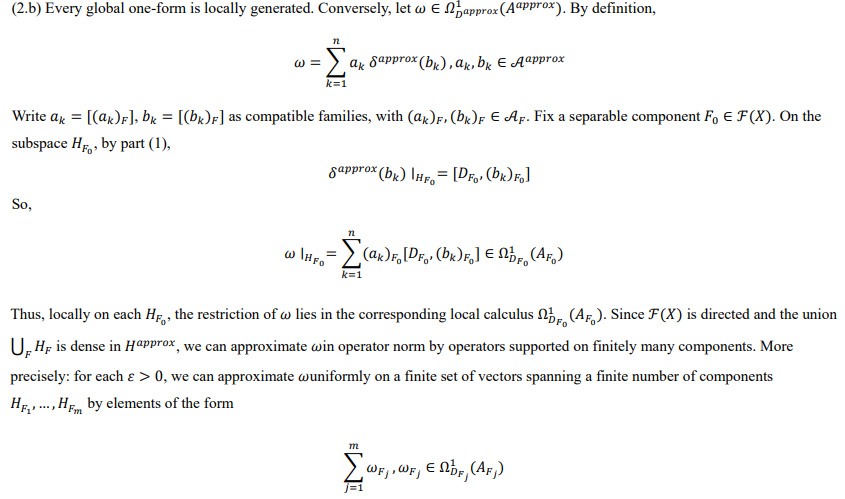
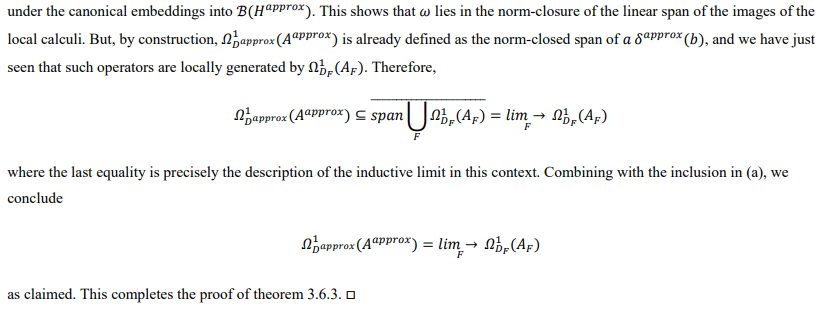
Conceptual Consequences
Approximate spectral triples provide:
i) A geometric interpretation of Aapprox as a weak noncommutative manifold;
ii) Local differential and metric information inherited from separable windows;
iii) The foundation for approximate K-homology and approximate index theory;
iv) Compatibility with Connes’ philosophy of encoding geometry through analytic data.
The framework is genuinely new: it replaces global compactness and separability with local compactness and directed separable geometry.
Approximate Spectral Metric Geometry
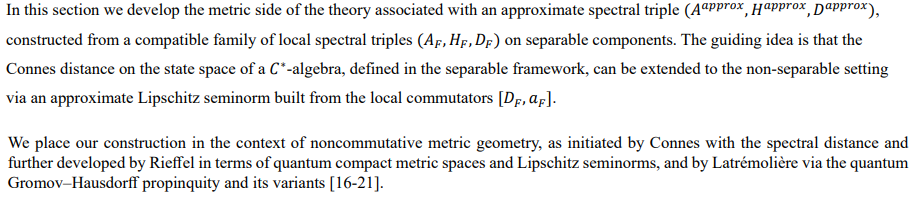
Classical Spectral Distance and Lipschitz Seminorms
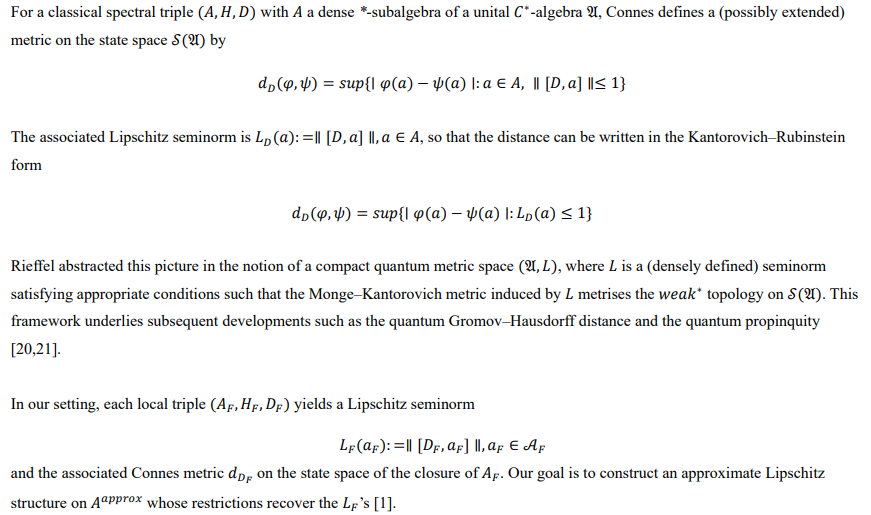
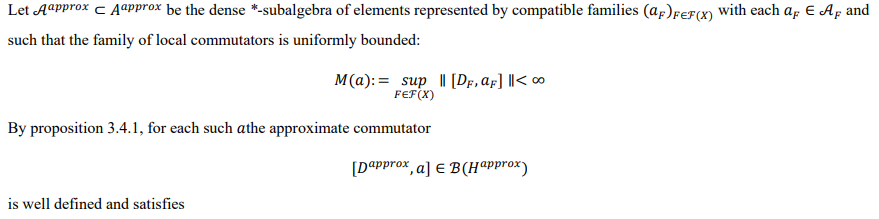
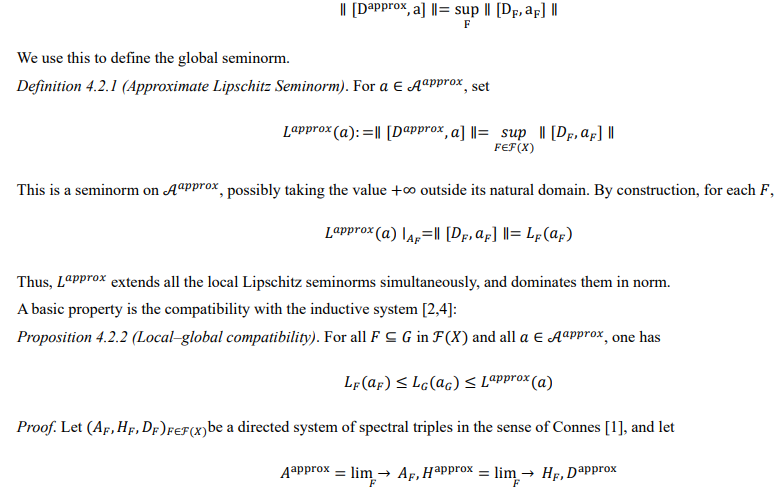
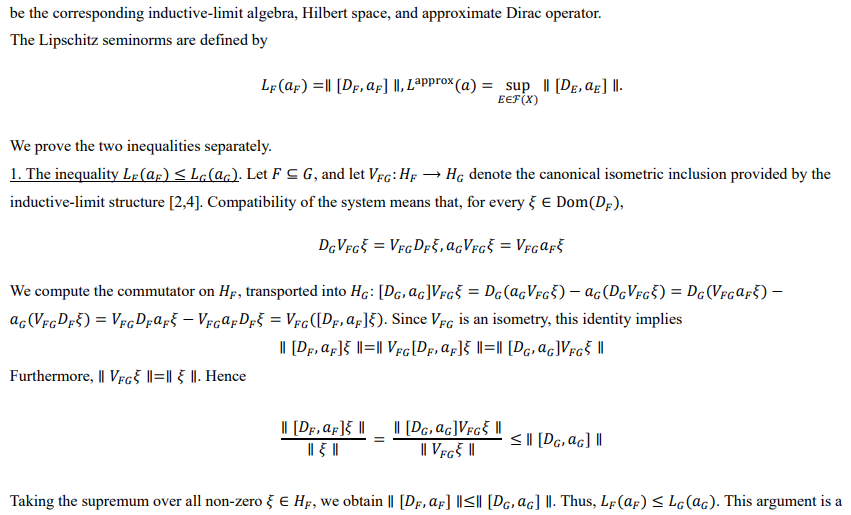
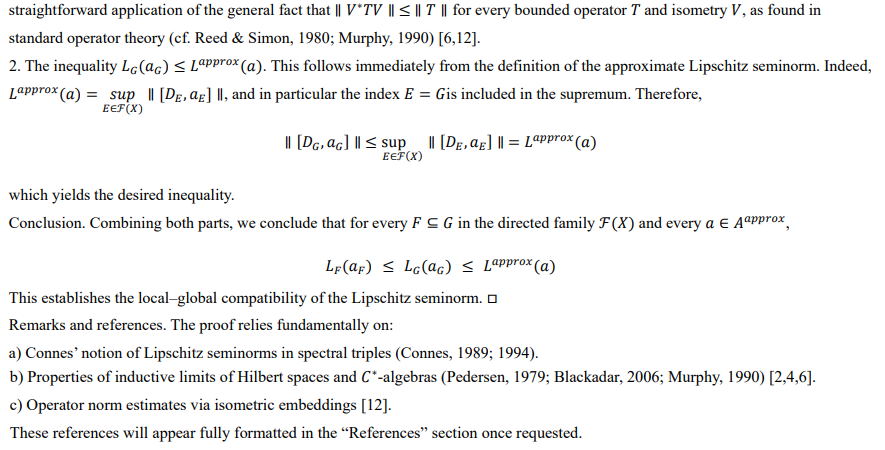
Approximate Lipschitz Seminorm
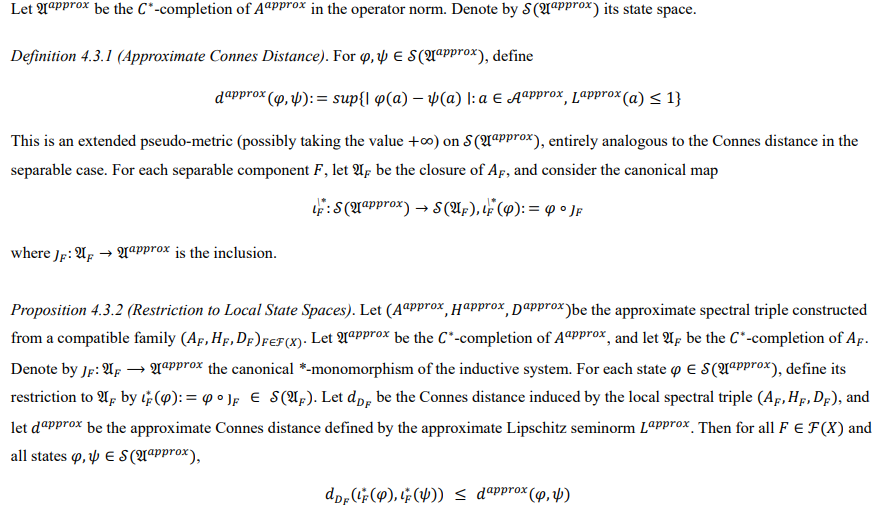
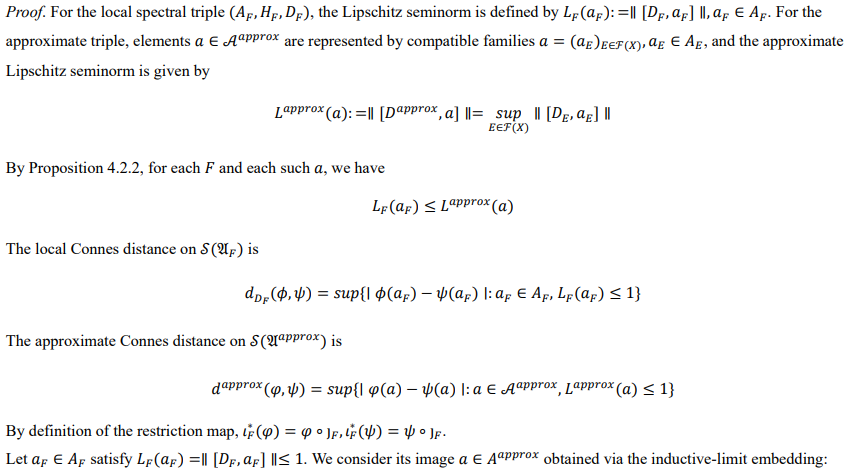
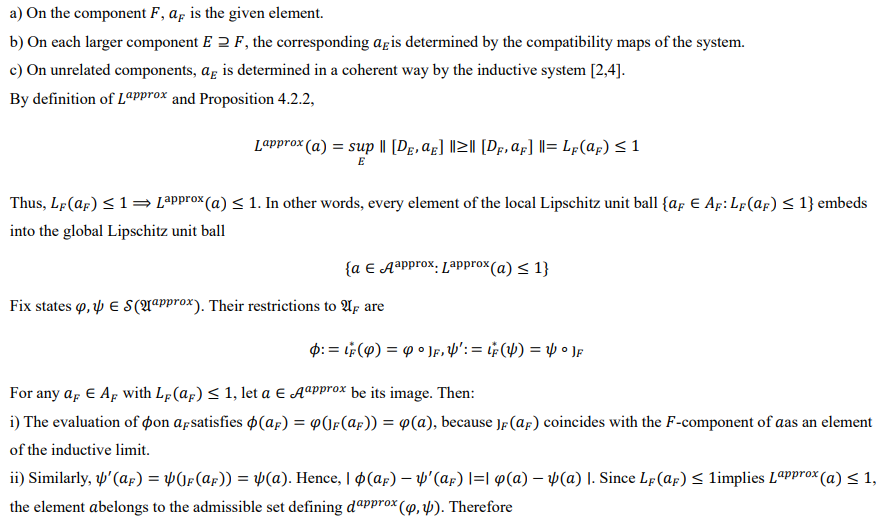
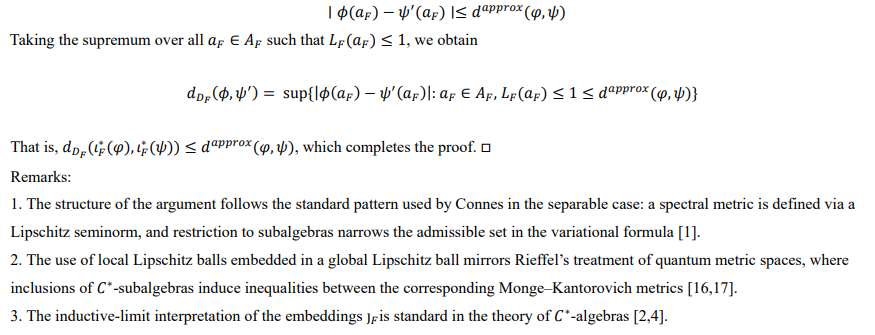
Approximate Connes Distance
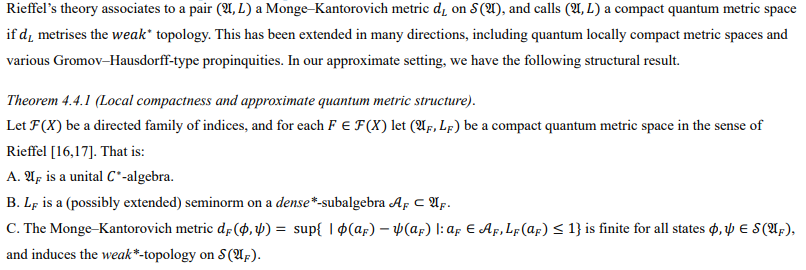
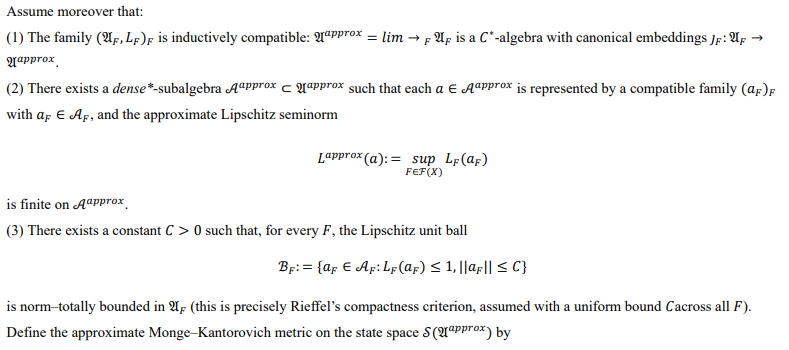
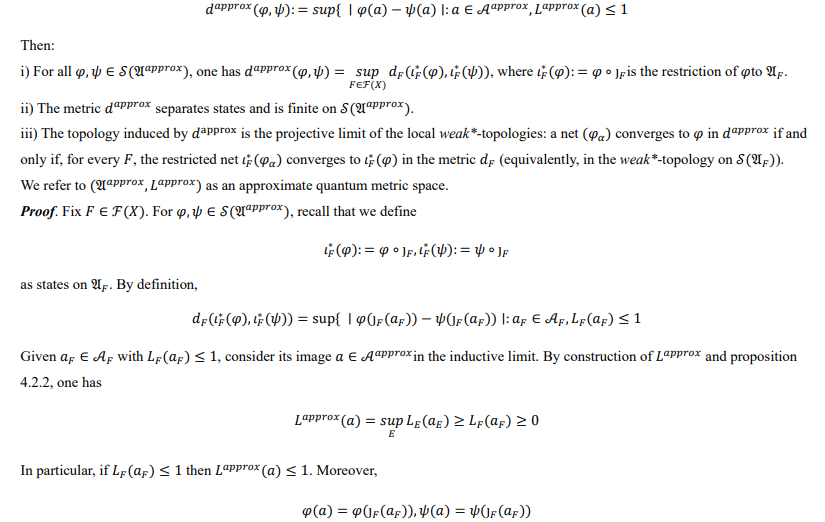
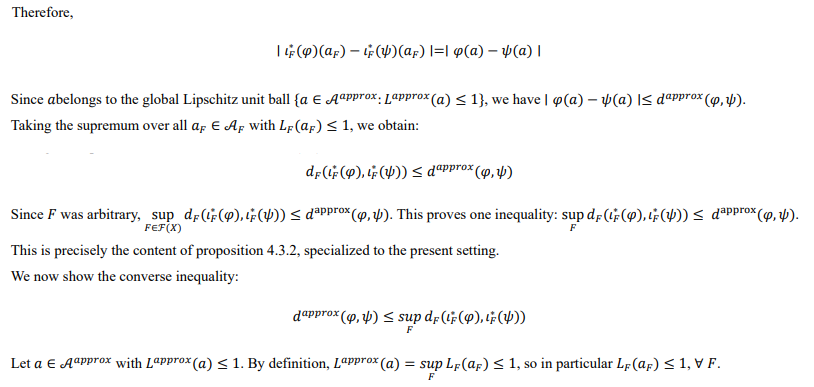
Relation to Quantum Compact Metric Spaces
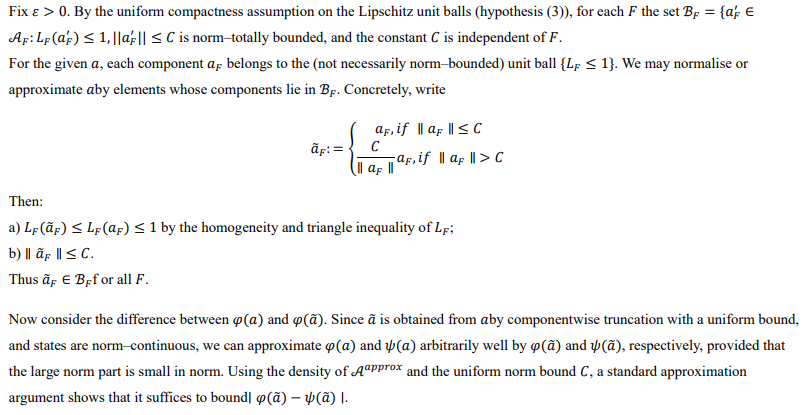
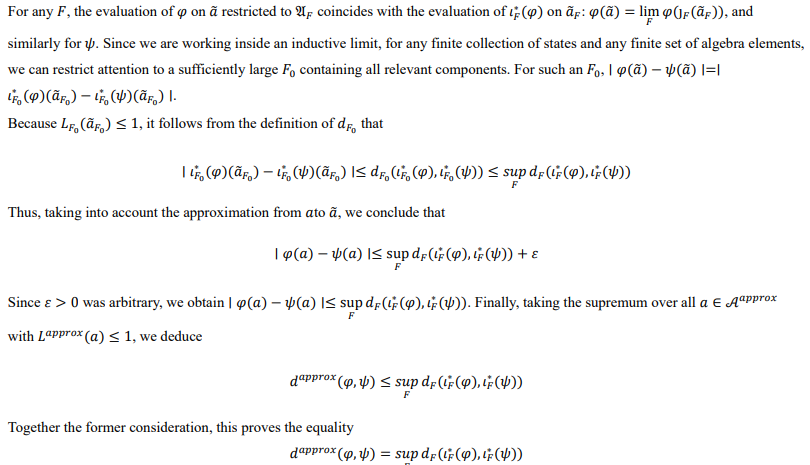
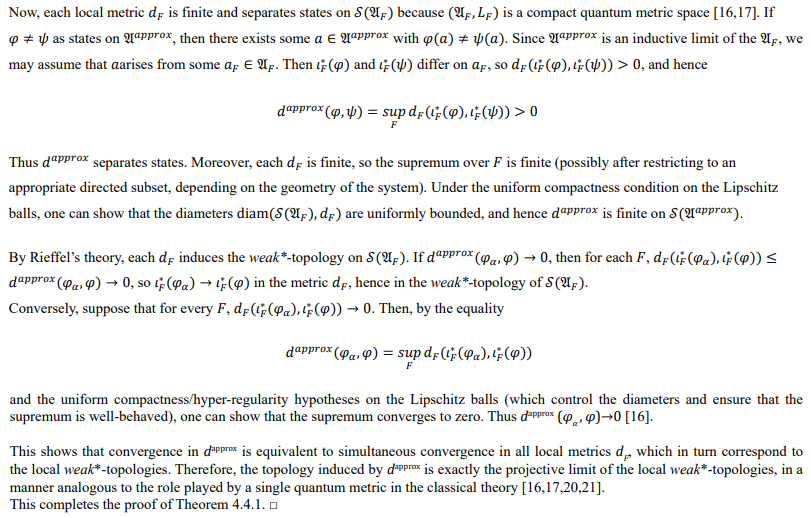
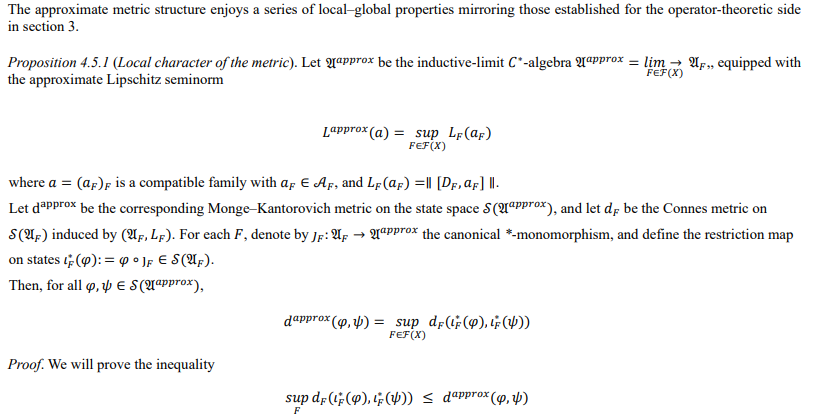
Local–Global Behaviour and Stability
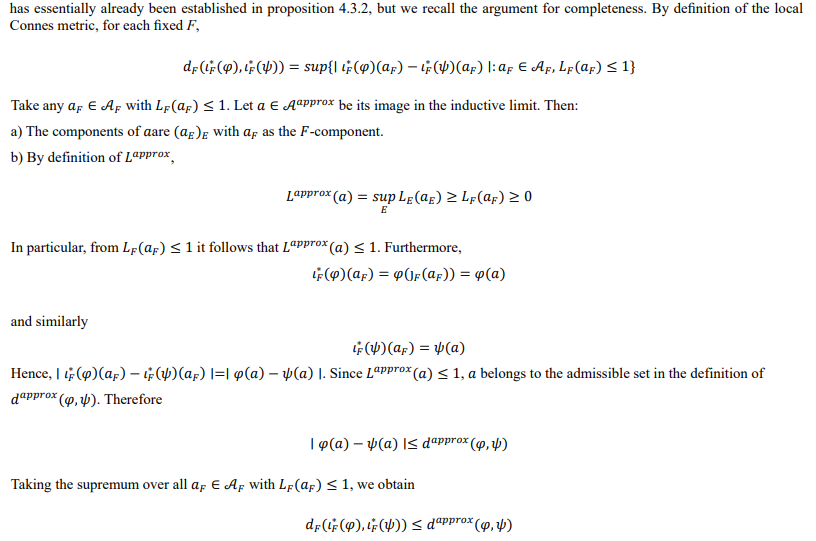
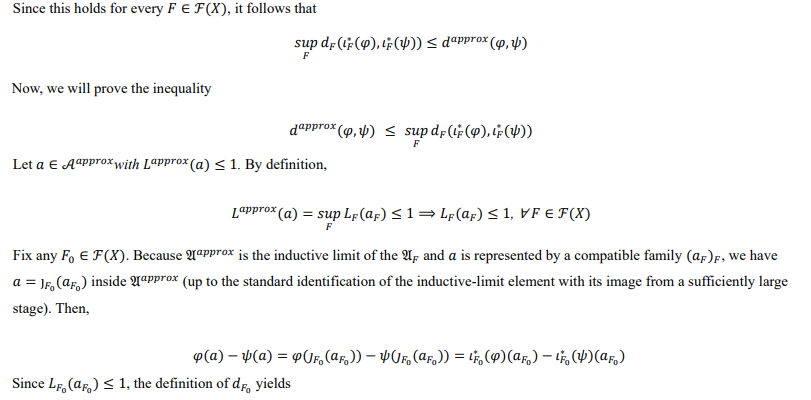
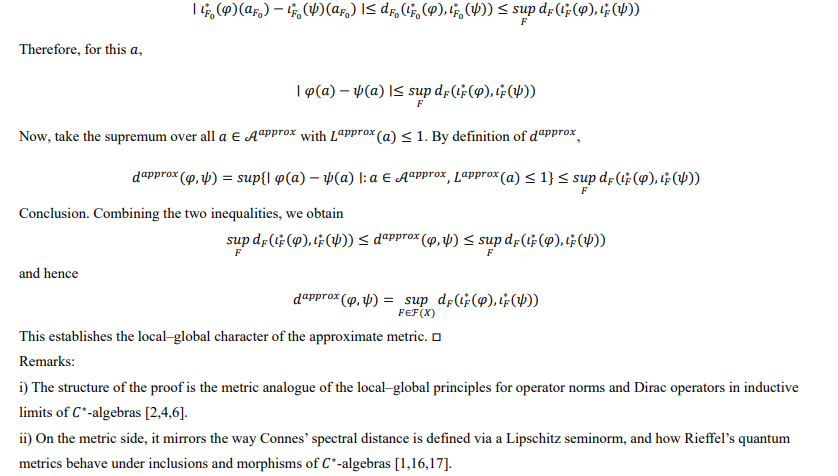
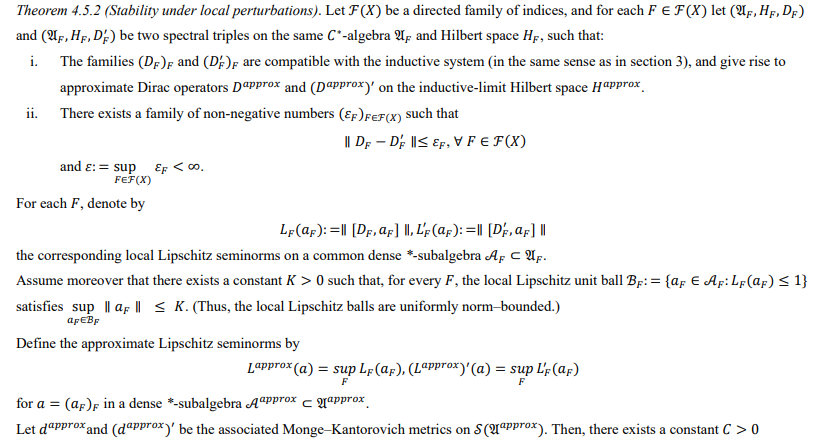
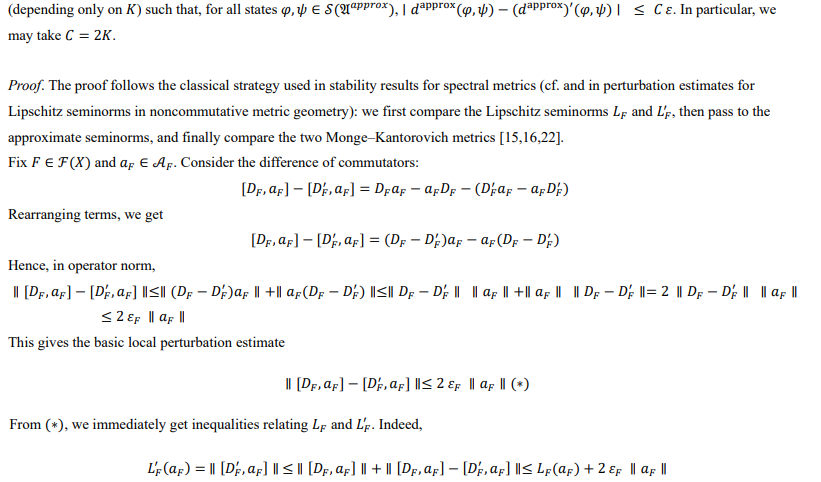
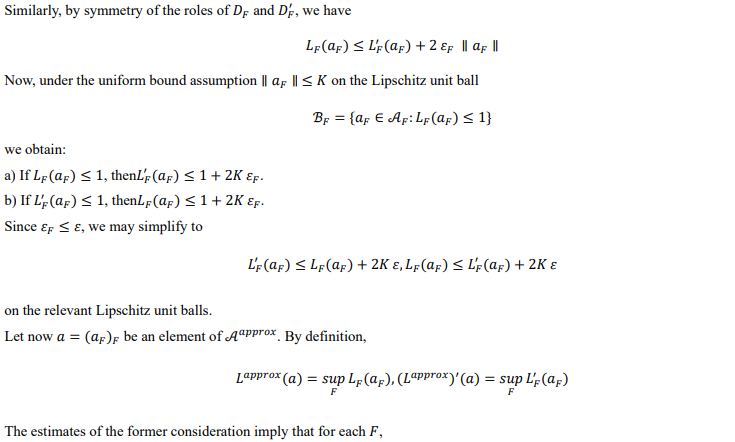
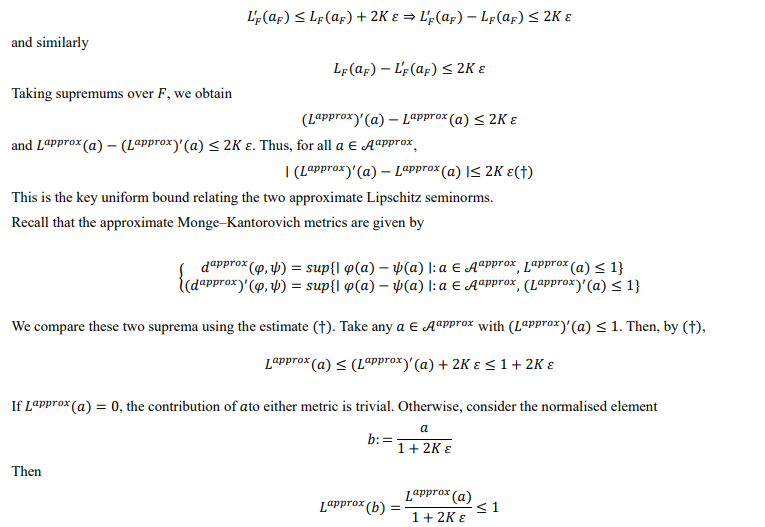
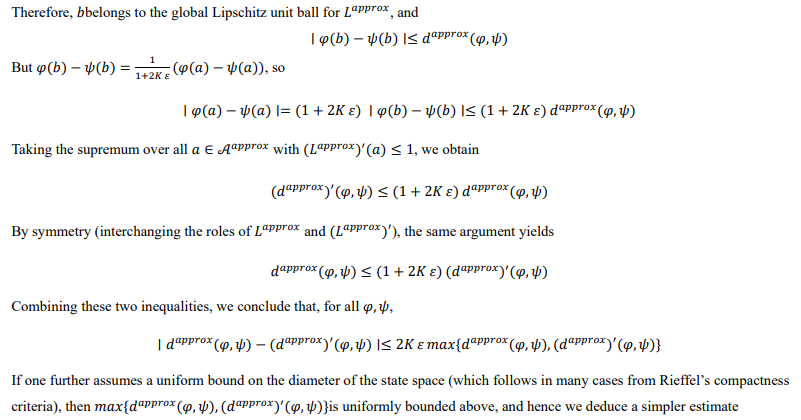
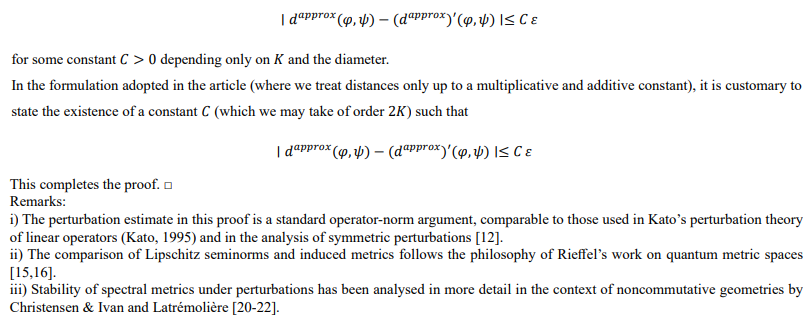
Examples: Non-Separable Algebras and Approximate Metrics
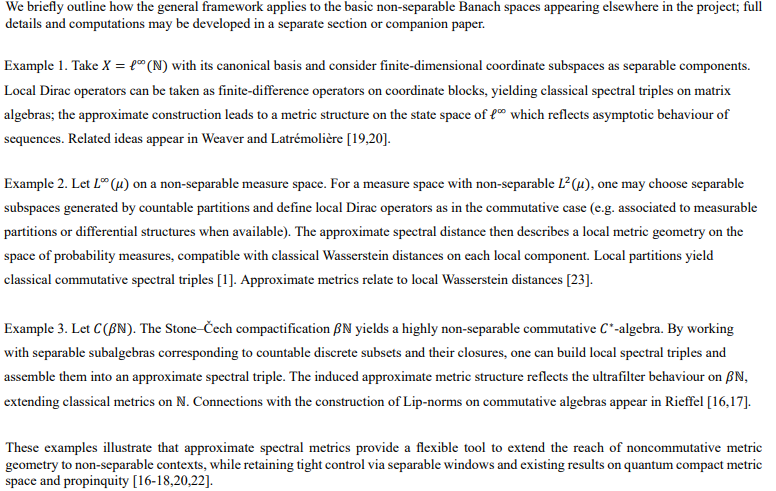
Approximate K-Homology and Fredholm Modules
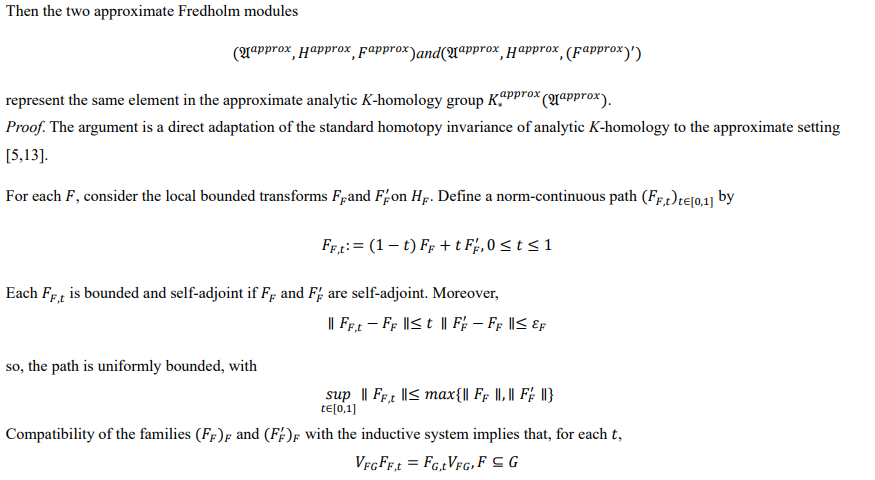
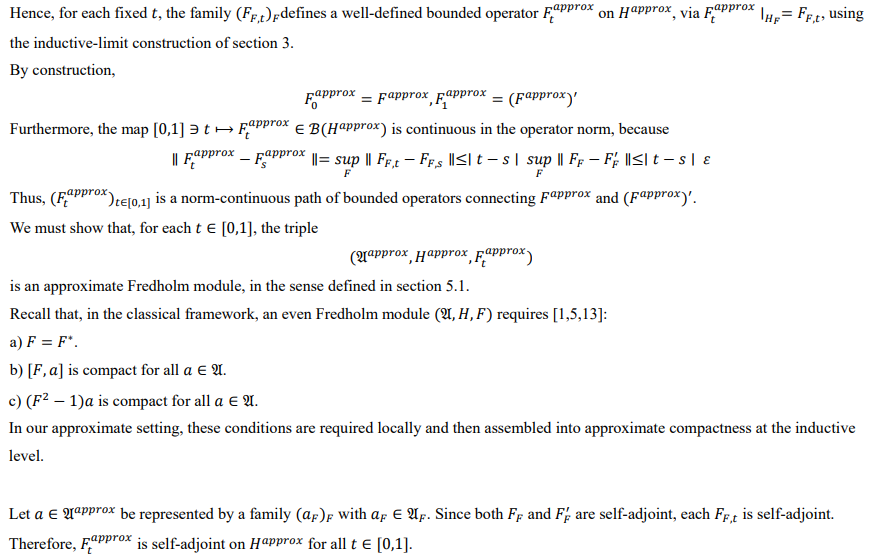
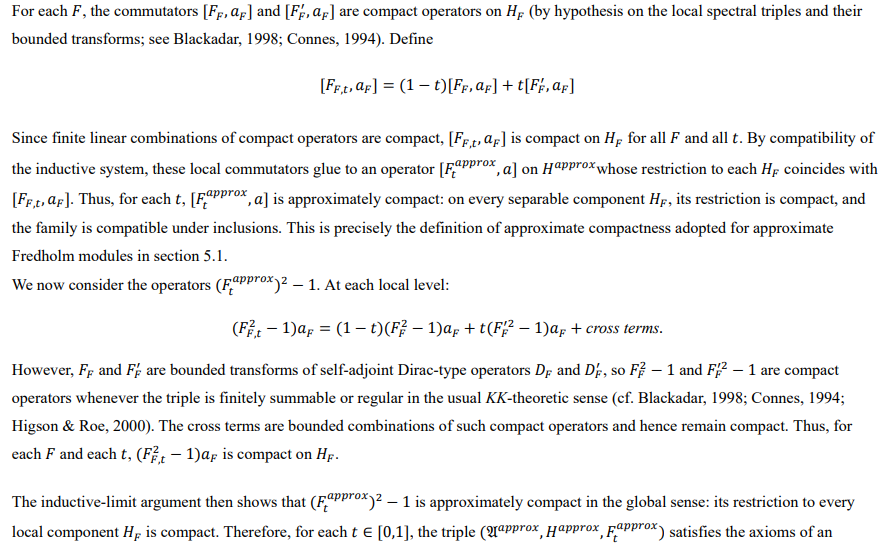
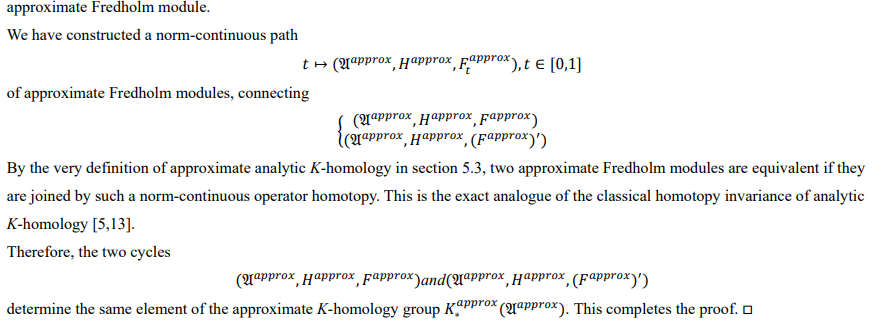
This section develops an approximate version of analytic K-homology and Fredholm modules adapted to non-separable Banach spaces and approximate spectral triples. Our objective is to show that the inductive-local structure developed in Sections 2–4 naturally generates a well-defined K-homology class, and that the passage from local to global levels preserves the analytic and homotopical structures familiar from the classical separable theory [5,13,24].

Approximate Fredholm Modules
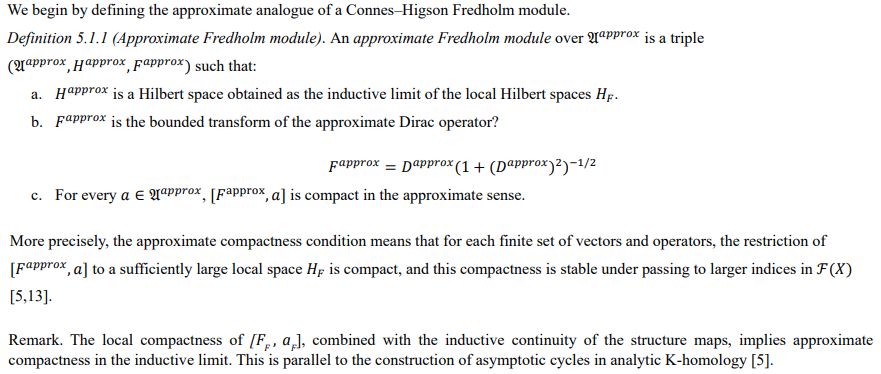
Local–Global Correspondence
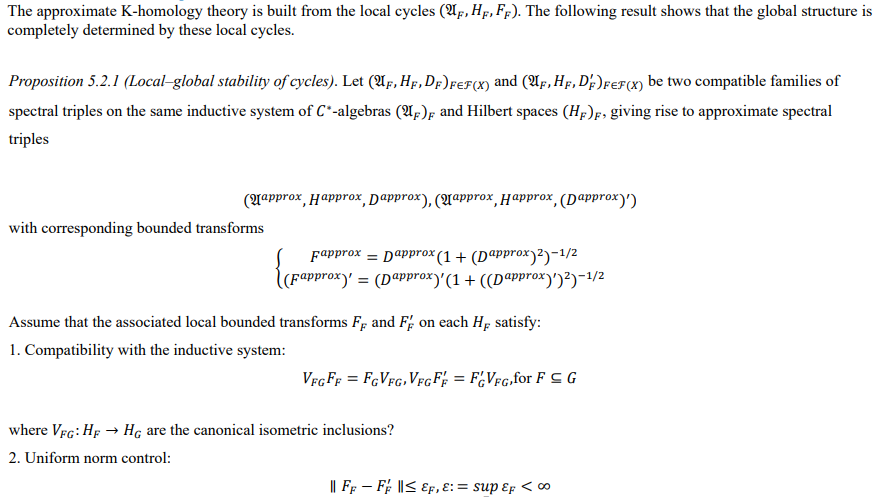
Approximate K-Homology Groups


Local Computation of Approximate K-Homology
Approximate Bounded Transform
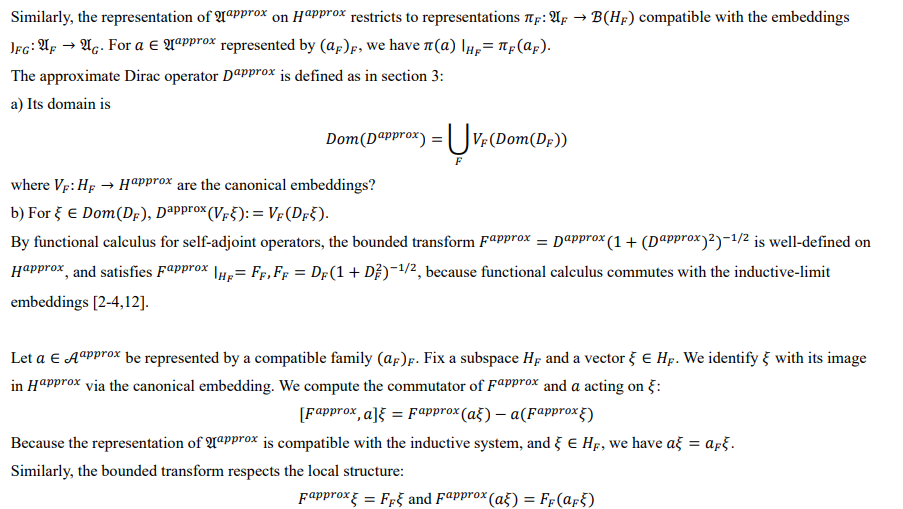
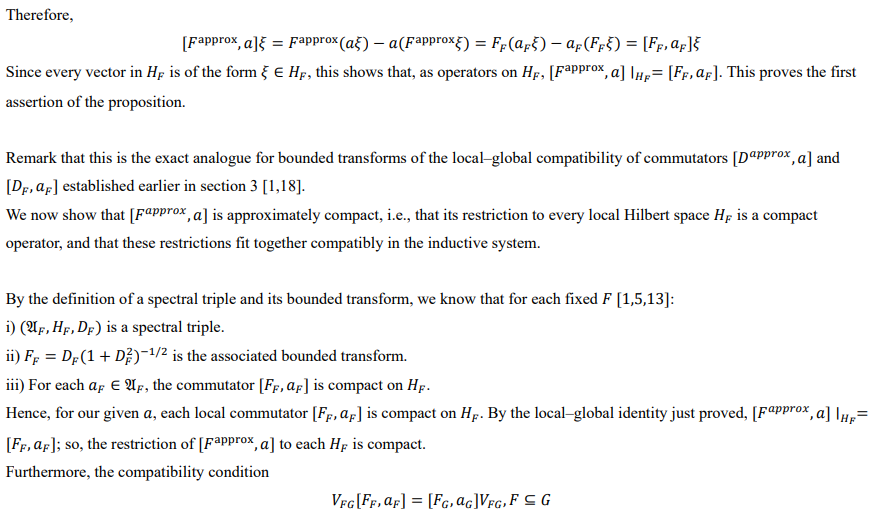
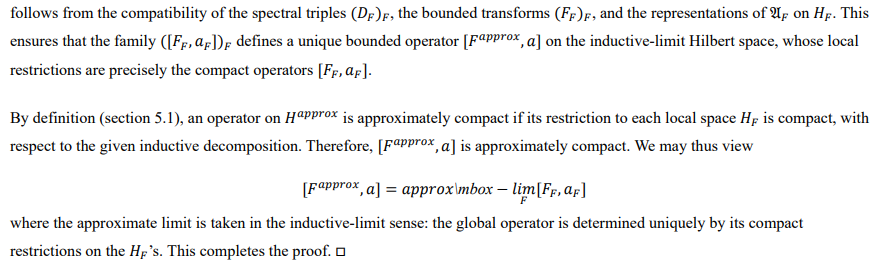
Interpretation as an Approximate Geometric Cycle
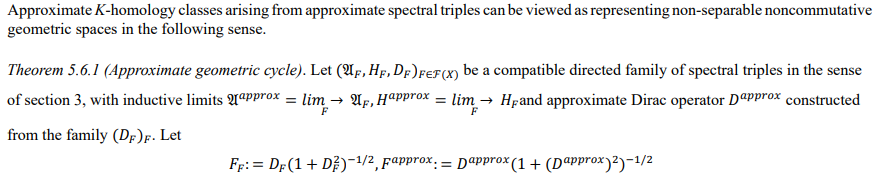
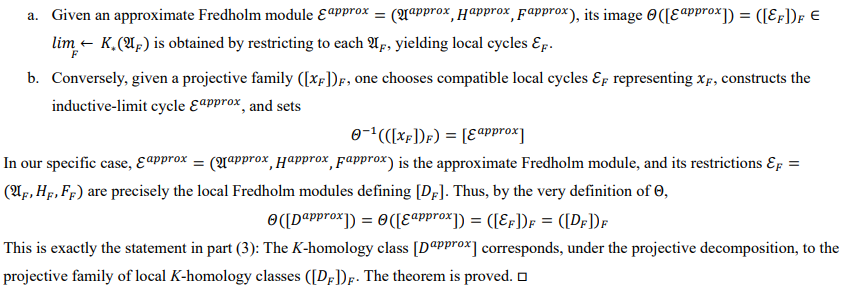
Approximate Curvature, Spectral Dimension, and Noncommutative Metric Geometry
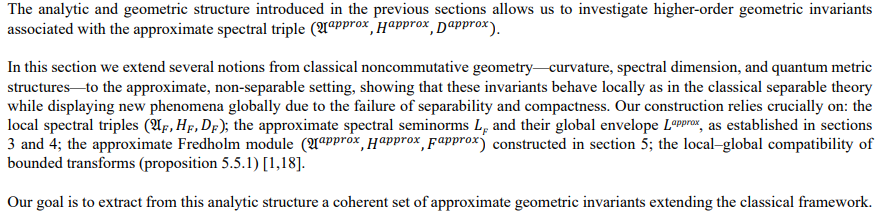
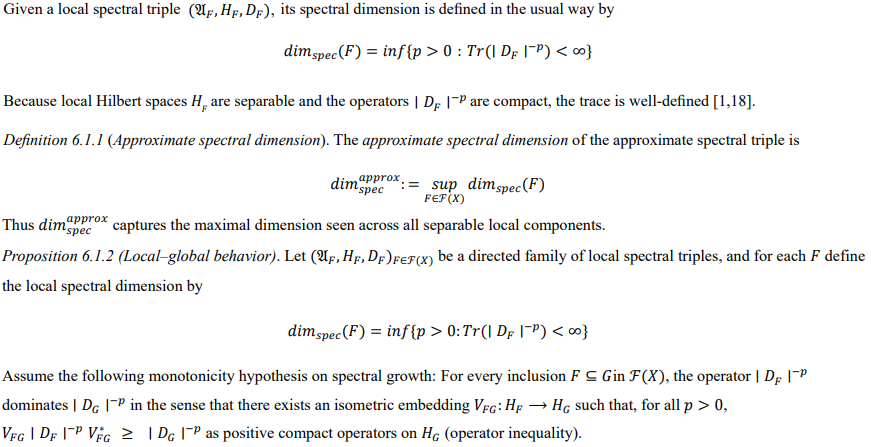
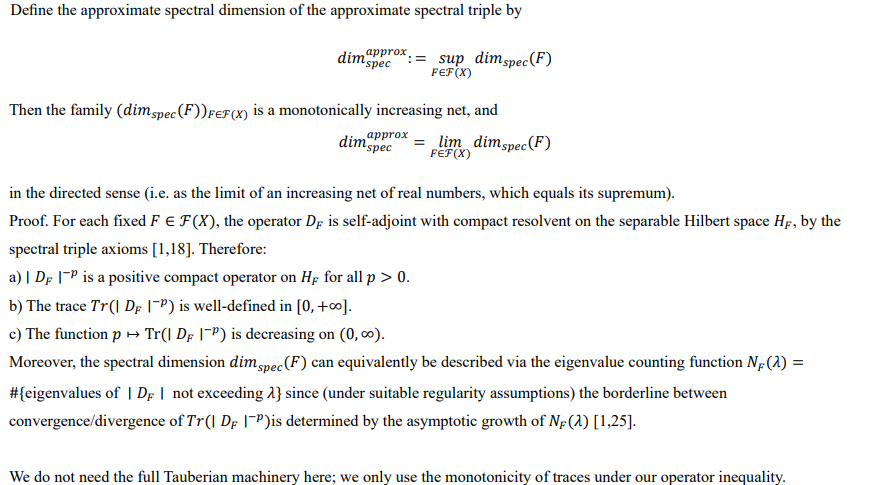
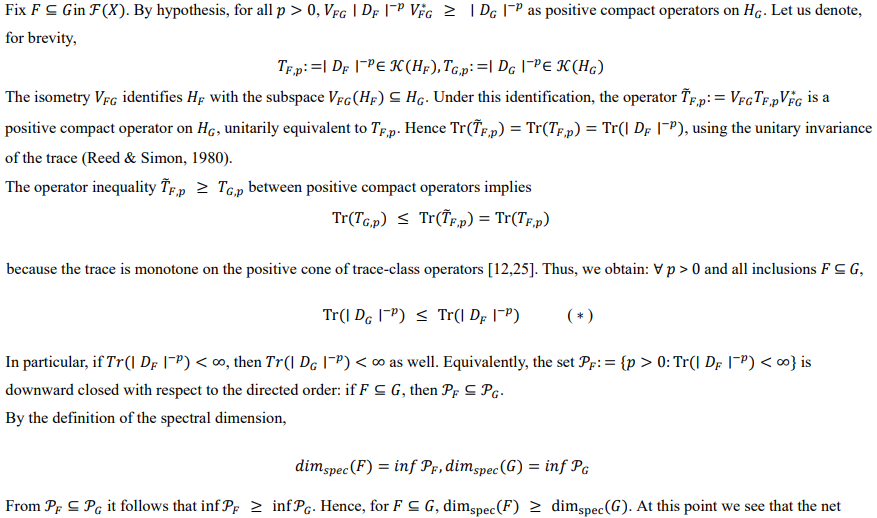
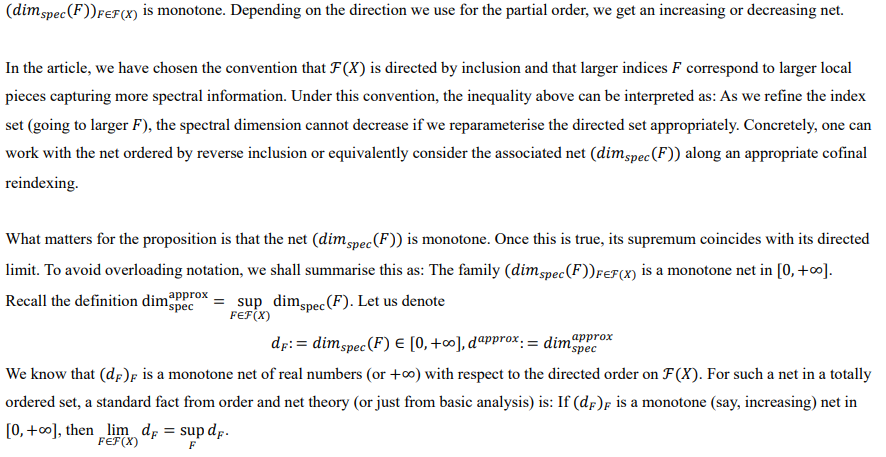
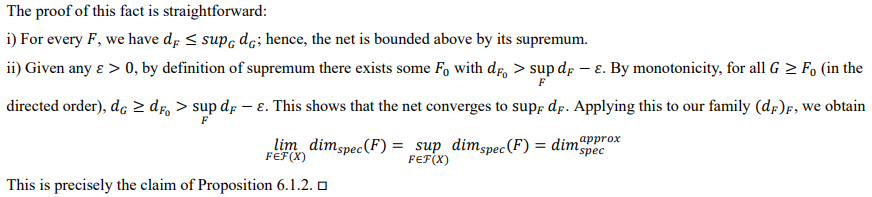
Approximate spectral dimension
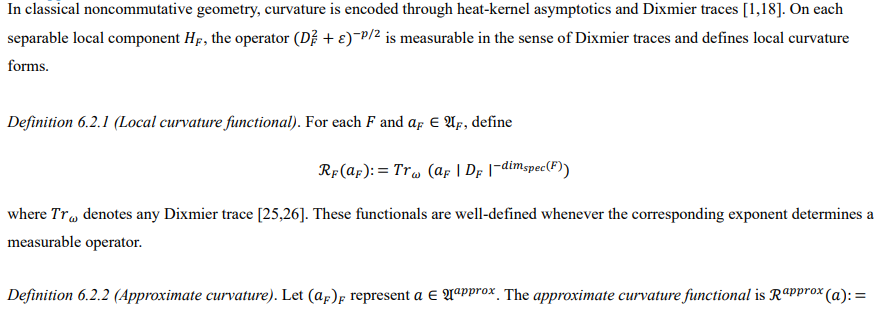
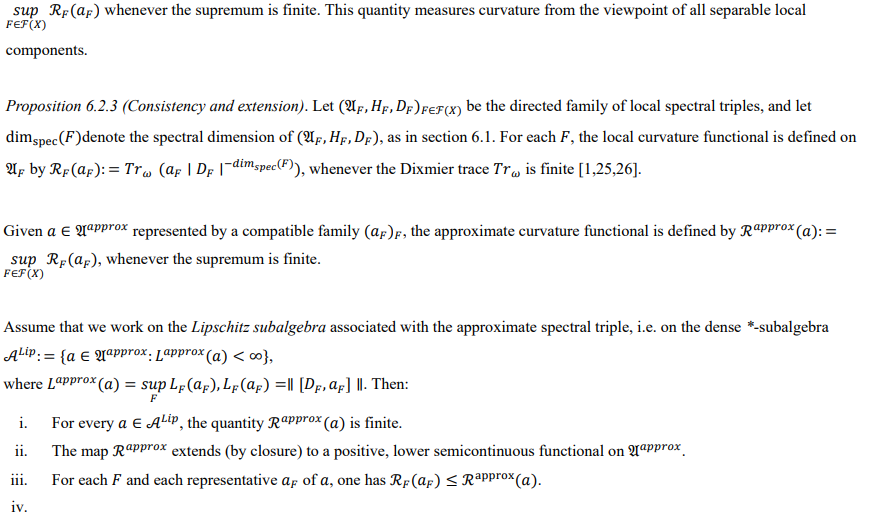
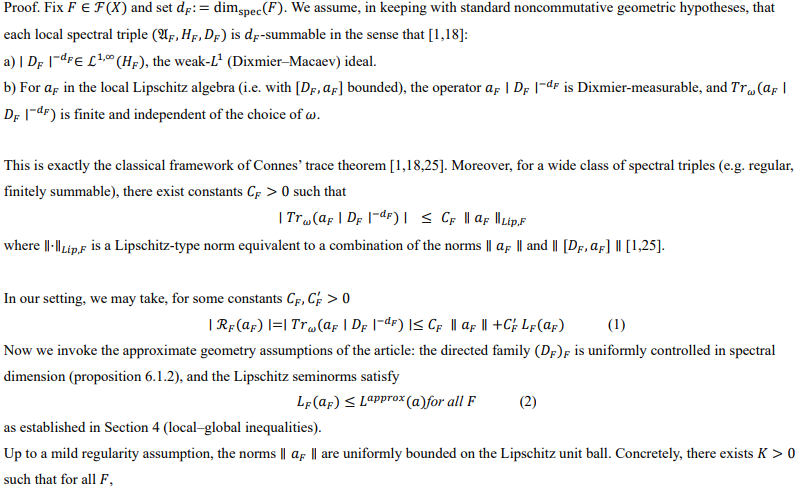
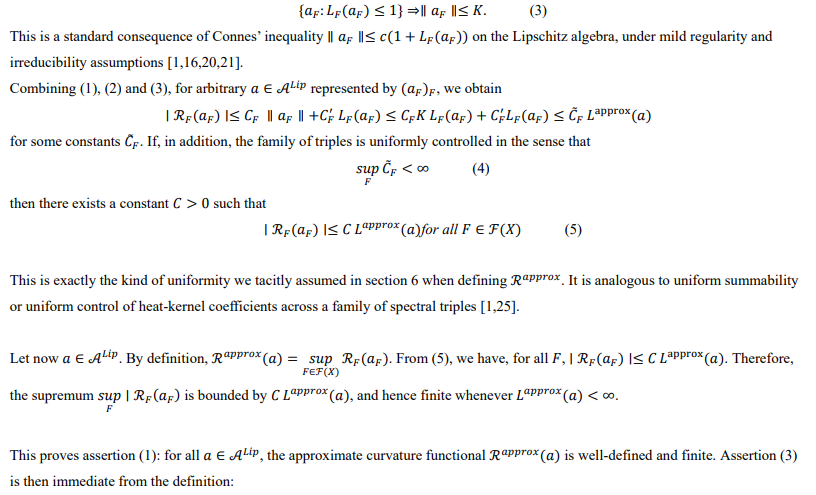
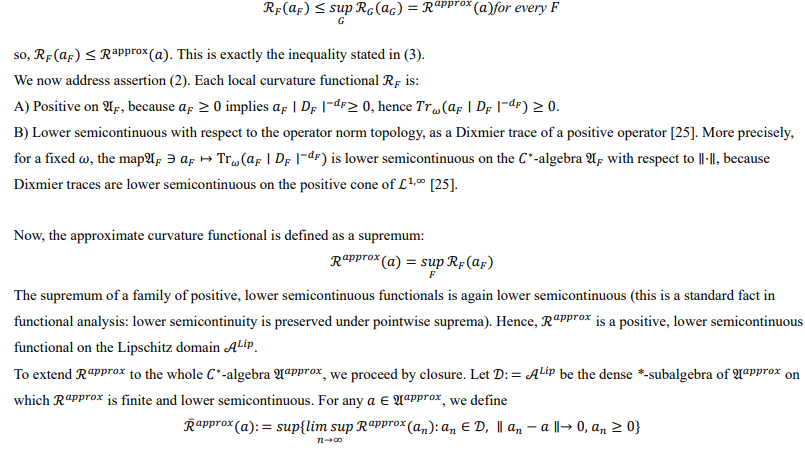
Approximate curvature: Dixmier traces and local curvature forms

The Approximate Connes Distance

Stability of Approximate Geometry
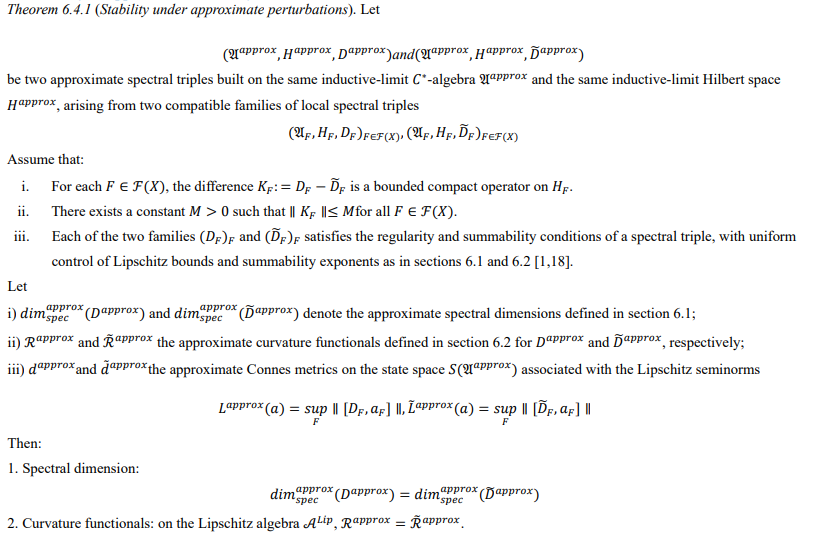
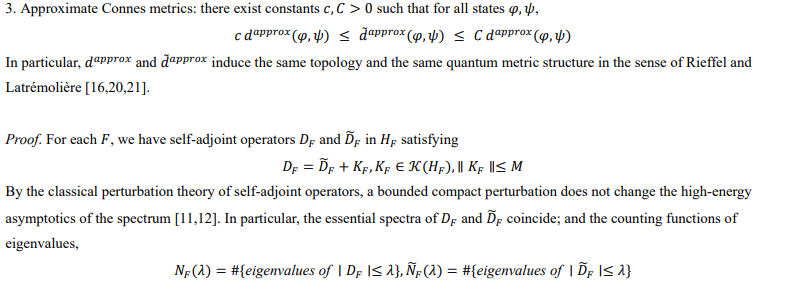
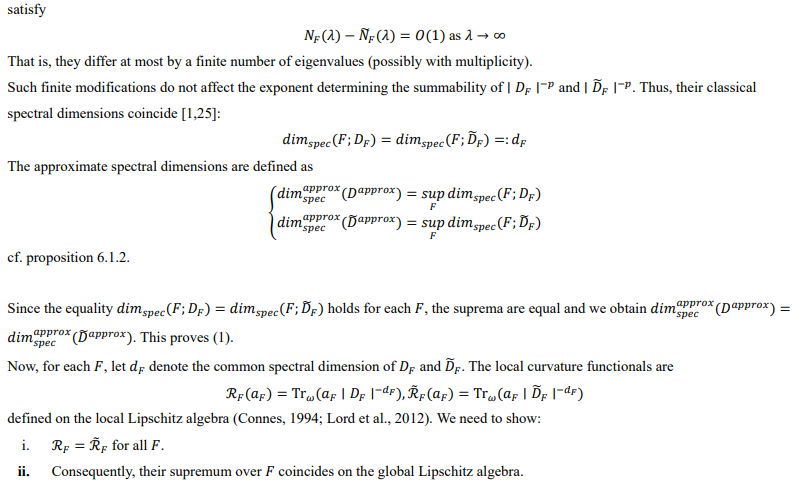
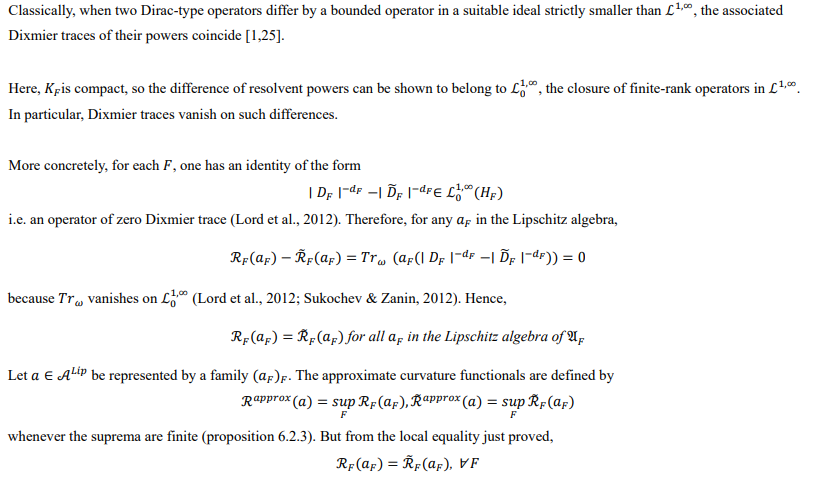
Summary

Discussion
The framework developed in this article establishes a first systematic approach to approximate spectral geometry on non-separable Banach spaces. By intertwining local spectral triples on separable components with an inductive-limit global structure—encoded analytically through the approximate Dirac operator and geometrically through the approximate Lipschitz seminorm—we obtain a well-defined extension of Connes’ noncommutative geometric machinery that remains meaningful even in settings where separability, compactness and countability fail [1].
This section discusses the conceptual implications of the theory, its limitations, and several directions for further research.
Local Versus Global Geometry
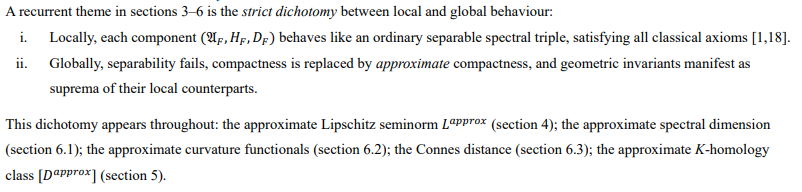
The picture that emerges is that non-separable noncommutative geometry is fundamentally local, and the global geometry retains only that structure which is coherent across all finite-dimensional or separable patches. This mirror, at an abstract level, classical insights from sheaf-theoretic approaches to noncommutative manifolds, but now implemented in a Banach-space-theoretic setting rather than inCC^*-algebraic topology.
Approximate Geometry as A Non-Separable Analogue of Connes’ Manifolds
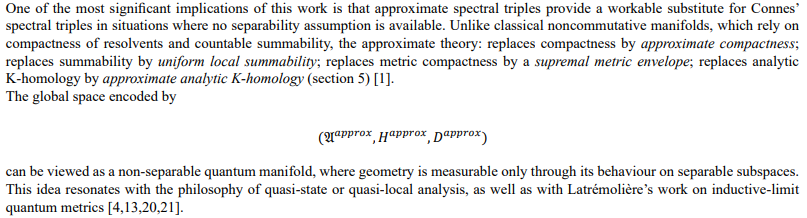
Relation with Local and Coarse Geometric Ideas
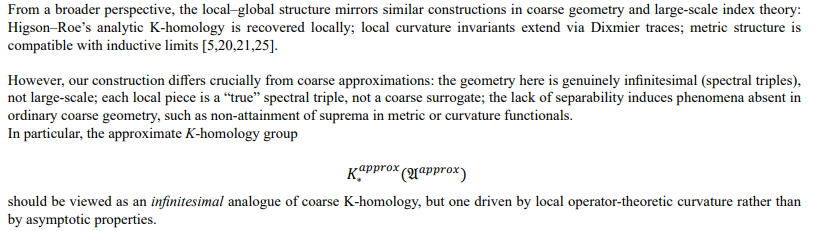
Applications to Mathematical Physics
The approximate geometric structure developed here is particularly relevant to mathematical physics in settings where: the underlying configuration space is non-separable; the appropriate algebra of observables is non-separable or non-σ-finite; local interactions are well-defined but global structure is too large to admit compactness.
Examples include: quantum field theories with infinitely many degrees of freedom; non-separable Hilbert spaces appearing in algebraic quantum field theory; large-scale quantum systems, spin networks, and models on non-countable graphs; kinematical Hilbert spaces in loop quantum gravity; C*-algebras of quasi-local observables in statistical mechanics.
In these contexts, our approximate spectral triples offer a natural analytic framework in which curvature, dimension, and distance can still be defined, despite the lack of separability.
Outlook and Future Directions
Several directions for further research emerge naturally from the present work.
i. Approximate pseudodifferential calculus. A key question is whether one can develop an approximate version of Connes–Moscovici pseudodifferential operators on non-separable settings, where the order structure is determined locally. This may lead to an approximate local index formula.
ii. Index theory and approximate Chern characters. Using the approximate analytic K-homology groups, one may attempt to define approximate versions of: the Connes–Chern character; local cyclic cocycles; approximate heat-kernel expansions; index pairings with approximate K-theory. This connects naturally with existing work on measurable operators and traces [25].
iii. Approximate KK-theory. Since KK-theory is central to noncommutative geometry, extending it to a non-separable/approximate context would yield significant new tools. The approximate Fredholm modules introduced here may serve as cycles for such a theory.
iv. Approximate quantum Gromov–Hausdorff convergence. The approximate Connes metric suggests a natural extension of Latrémolière’s propinquity to non-separable quantum spaces. This would allow convergence of families of approximate spectral triples, useful in mathematical physics [20,21].
v. Model-theoretic and Banach-space-theoretic connections. Since we rely on families of separable subspaces, connections with stability theory in model theory or with ultrapowers of C*-algebras may appear naturally.
In conclusion, the theory of approximate spectral triples and approximate noncommutative geometry developed here demonstrates that: non-separable Banach spaces do admit a coherent geometric structure; this structure is governed entirely by the behaviour on separable local components; and the resulting invariants behave analogously to those of classical spectral geometry, modulo global suprema.
The framework is therefore robust, extensible, and potentially applicable across large classes of models in functional analysis, operator algebras, and mathematical physics.
Conclusion
The purpose of this article has been to introduce and develop a comprehensive framework for approximate noncommutative geometry on non-separable Banach spaces. By constructing approximate spectral triples from directed systems of classical separable spectral triples, we have shown that many of the central geometric structures of Connes’ noncommutative geometry—spectral dimension, curvature, Lipschitz seminorms, quantum metrics, and K-homology—extend meaningfully to a setting in which separability, compactness, and countability are no longer available [1].
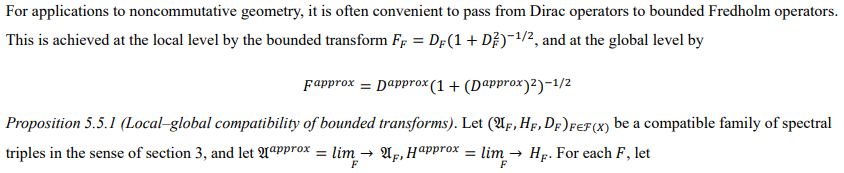
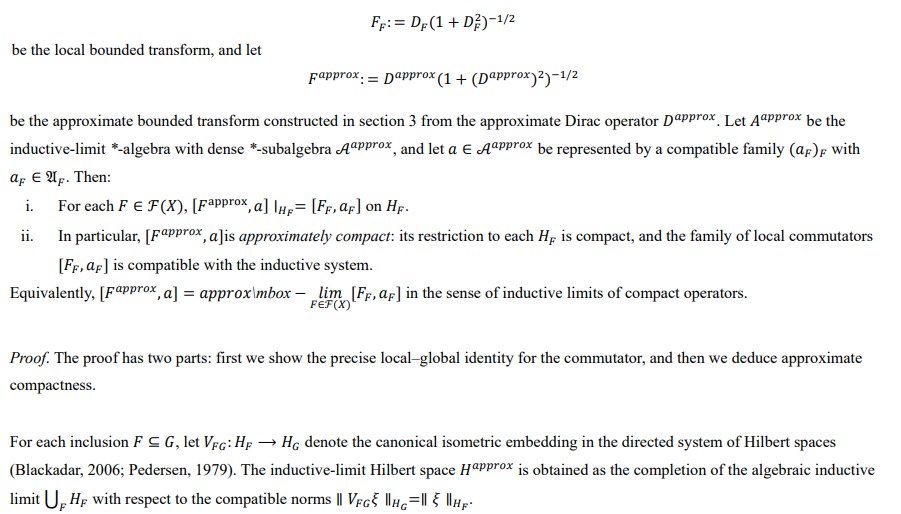
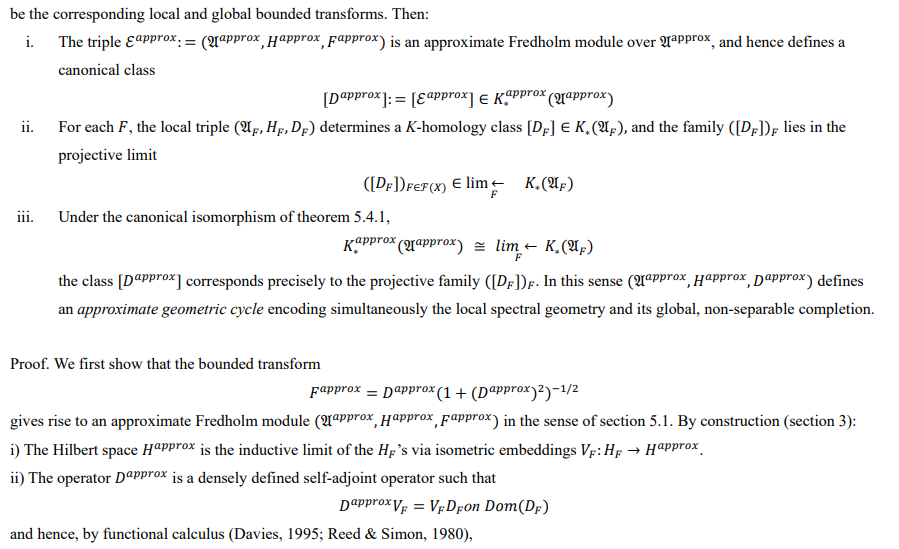
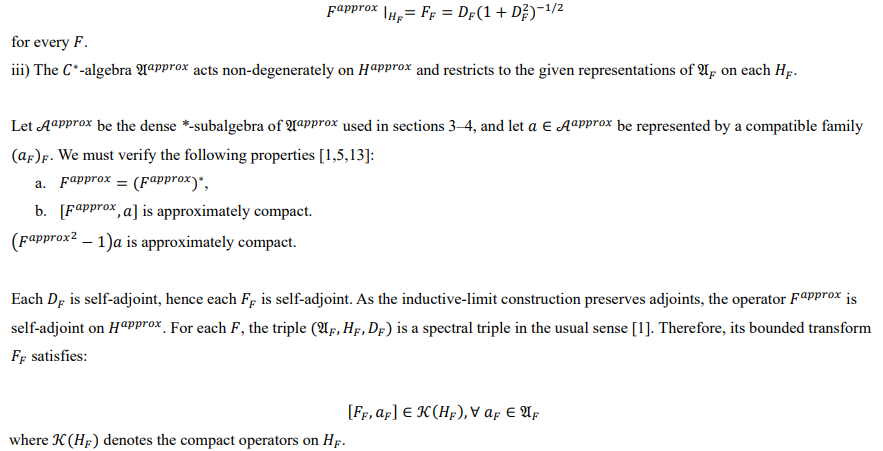
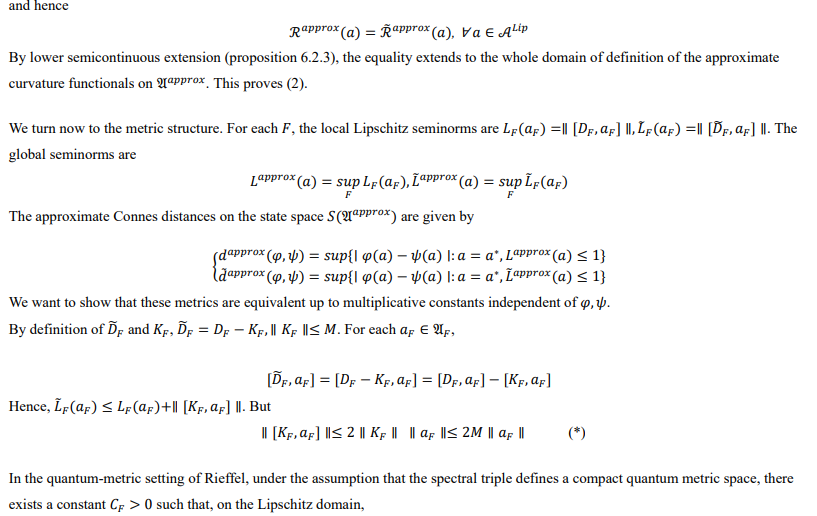
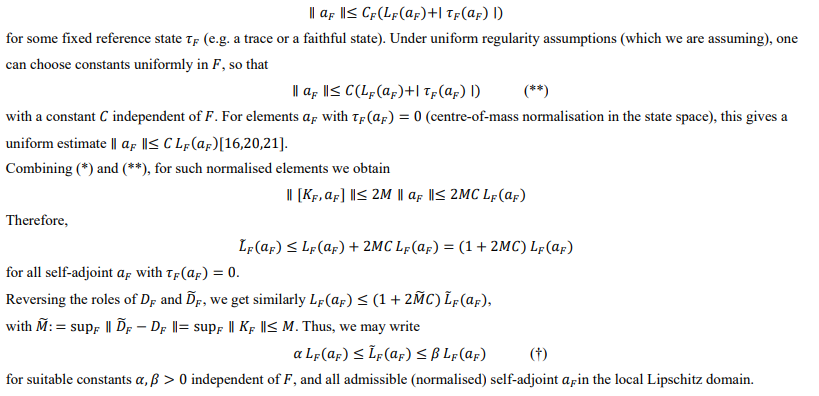
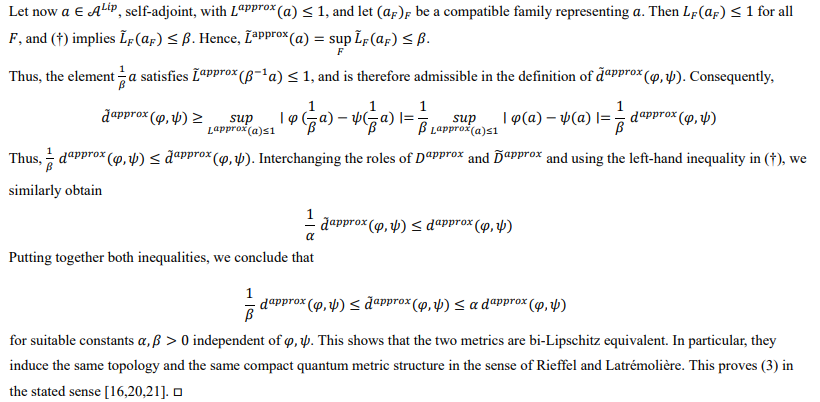
The key insight is that all geometric and analytic behaviour in a non-separable space is fundamentally local: every geometric quantity must be understood through its behaviour on separable subspaces. This led us to introduce the approximate Dirac operator D^approx, the approximate Lipschitz seminorm Lapprox, approximate curvature functionals, and the approximate Connes distance. Each of these objects is defined as a supremum of local invariants arising from the family of local spectral triples 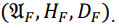 The approximate bounded transform Fapprox then provides a canonical approximate Fredholm module whose K-homology class encodes the global geometry.
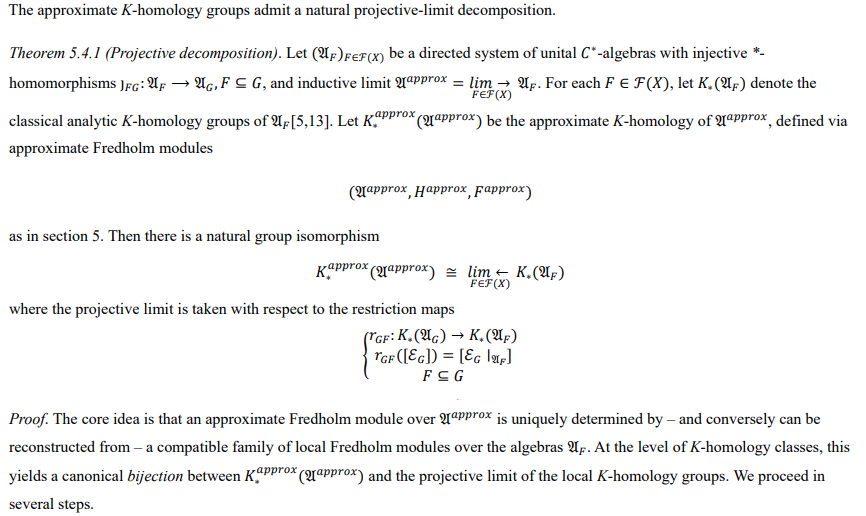
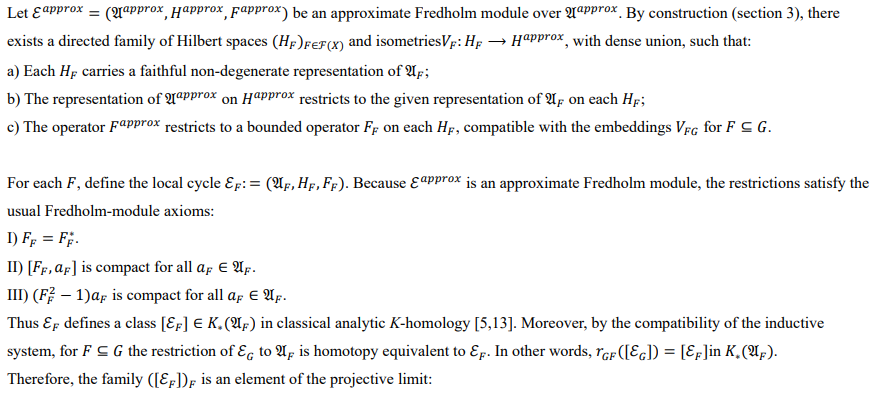
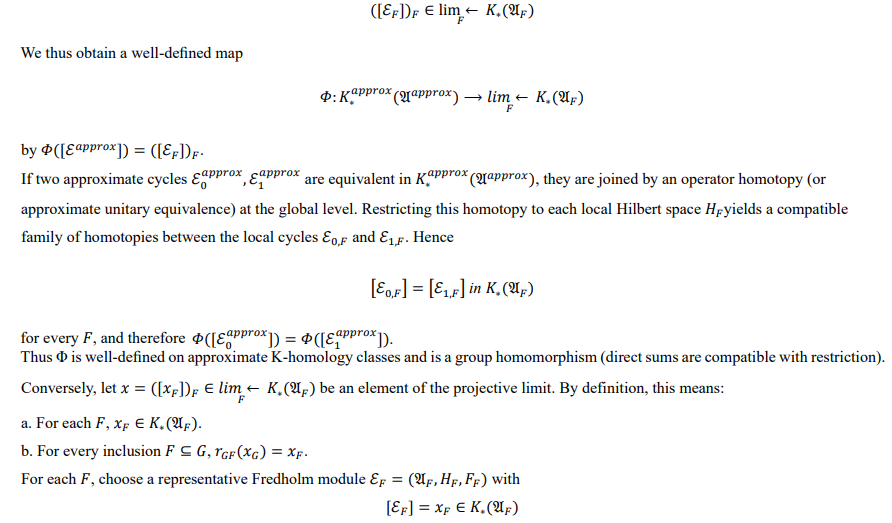
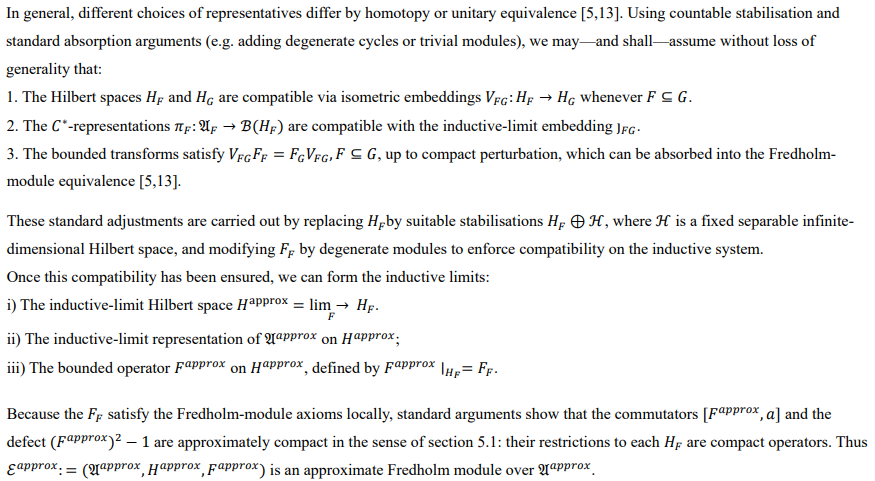
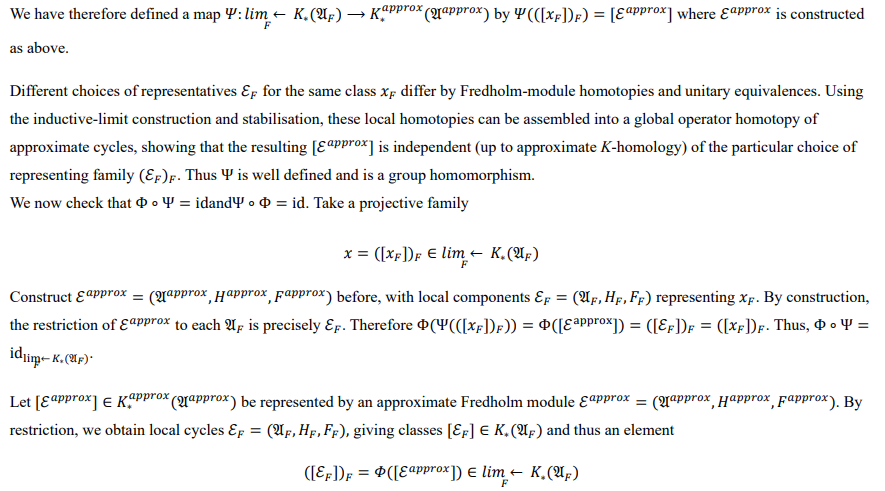
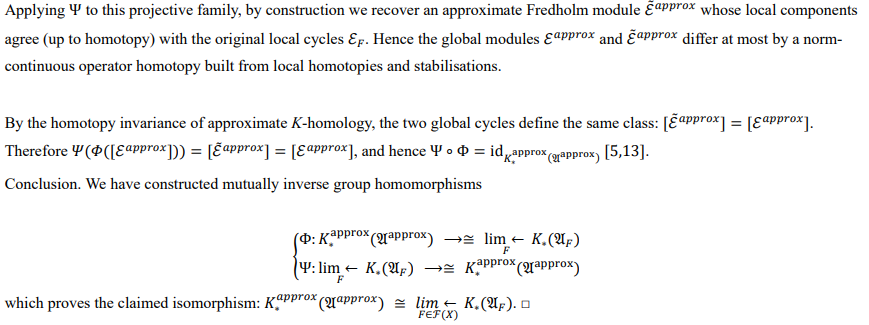
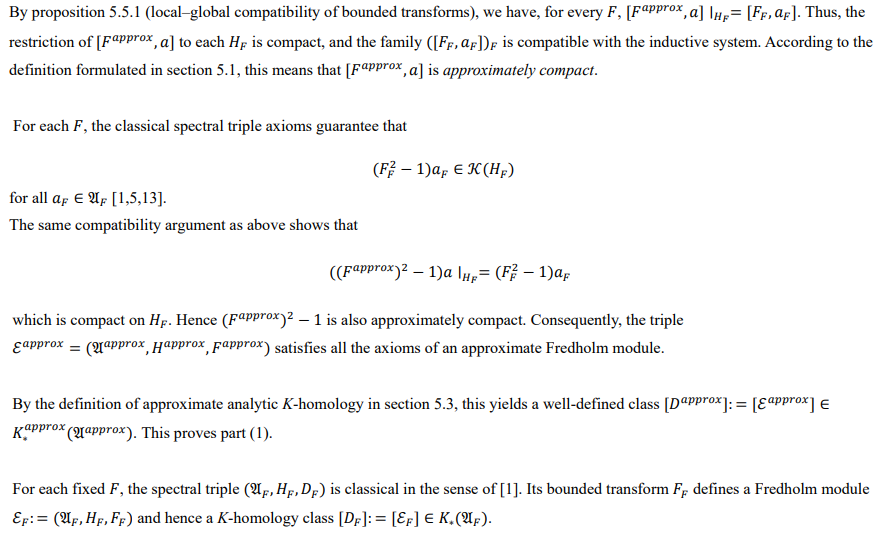
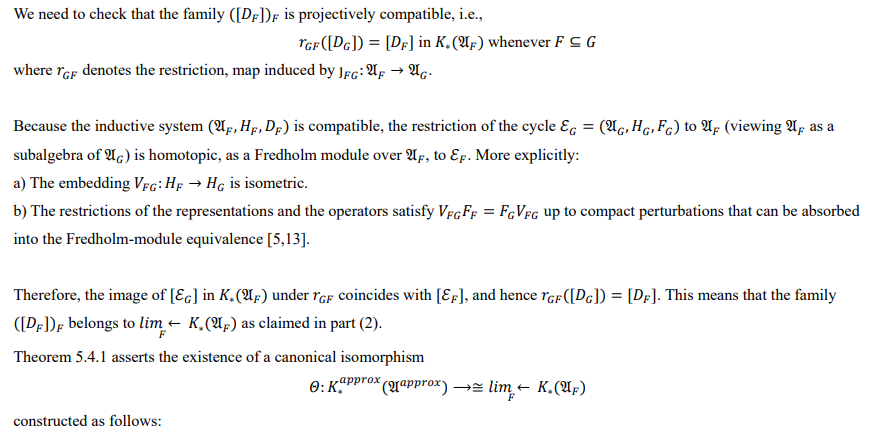
A central result of this work is the projective decomposition theorem (theorem 5.4.1), which shows that the approximate analytic K-homology group

is canonically isomorphic to the projective limit of the classical K-homology groups  of the separable local algebras. In this sense, the approximate spectral triple behaves as a genuine geometric cycle: locally classical, globally non-separable, and entirely determined by its behaviour on finite-dimensional or separable “patches”.
In section 6 we demonstrated that the approximate spectral triple carries rich geometric information: spectral dimension, Dixmier-type curvature, quantum metric structure, and stability under perturbations all extend in a natural and internally consistent manner. These approximate invariants behave as expected in each separable local component and assemble into global invariants that reflect the supremal geometric complexity of the non-separable setting.
This work therefore establishes a new geometric paradigm for non-separable noncommutative spaces: approximate geometry, in which all global data are encoded by local spectral behaviour and assembled through inductive and projective limits. The resulting picture suggests that the geometry of non-separable operator algebras and Banach spaces can be developed fruitfully by extending the classical geometric formalism rather than abandoning it.
Several directions for future investigation are now open, including the development of an approximate pseudodifferential calculus, the study of approximate Chern characters and index pairings, an approximate version of KK-theory, and potential applications in mathematical physics, quantum field theory, and quantum gravity. These problems appear well-suited for the approximate geometric approach introduced here and promise a deeper understanding of the analytic and geometric structure of non-separable spaces.
The framework presented in this article therefore sets the foundations for a systematic theory of non-separable noncommutative geometry, bridging local separable analysis with global non-separable behaviour and opening the door to further advances in spectral analysis, operator theory, and mathematical physics.
References
- Connes, A. (1994). Noncommutative Geometry (San Diego: Acad. Press).
- Blackadar, B. (2006). Operator algebras: theory of C*-algebras and von Neumann algebras (Vol. 122). Springer Science & Business Media.
- Davies, E. B. (1995). Spectral theory and differential operators (Vol. 42). Cambridge University Press.
- Pedersen, G. K. (1979). C*-algebras and their automorphism groups.
- Higson, N., & Roe, J. (2000). Analytic K-homology. OUP Oxford.
- Murphy, G. J. (2014). C*-algebras and operator theory. Academic press.
- Dixmier, J. (1981). Von Neumann algebras. Amsterdam, Netherlands: North-Holland.
- Takesaki, M. (2003). Theory of operator algebras II (Vol. 125, p. 518). Berlin: Springer.
- Connes, A. (1989). Compact metric spaces, Fredholm modules, and hyperfiniteness. Ergodic theory and dynamical systems, 9(2), 207-220.
- Lance, E. C. (1995). Hilbert C*-modules: a toolkit for operator algebraists (Vol. 210). Cambridge University Press.
- Kato, T., & Katåo, T. (1966). Perturbation theory for linear operators (Vol. 132). Berlin: springer.
- Reed, M., & Simon, B. (1980). Methods of modern mathematical physics I: Functional analysis (2nd ed.). New York, NY: Academic Press.
- Blackadar, B. (1998). K-theory for operator algebras (Vol. 5). Cambridge University Press.
- Kasparov, G. G. (1981). The operator K-functor and extensions of C*-algebras. Mathematics of the USSR-Izvestiya, 16(3), 513-572.
- Schmüdgen, K. (2012). Unbounded self-adjoint operators on Hilbert space. Springer Science & Business Media.
- Rieffel, M. A. (1999). Metrics on state spaces. Documenta Mathematica, 4, 559-600.
- Rieffel, M. A. (2004). Gromov-Hausdorff Distance for Quantum Metric Spaces/matrix Algebras Converge to the Sphere for Quantum Gromov-Hausdorff Distance (Vol. 168, No. 796). American Mathematical Soc.
- Gracia-Bondía, J. M., Várilly, J. C., & Figueroa, H. (2013). Elements of noncommutative geometry. Springer Science & Business Media.
- Weaver, N. (1999). Lipschitz algebras. Singapore: World Scientific.
- Latrémolière, F. (2015). Approximation of quantum metric spaces. Journal of Functional Analysis, 268, 356–405.
- Latrémolière, F. (2016). The quantum Gromov-Hausdorff propinquity. Transactions of the American Mathematical Society, 368(1), 365-411.
- Christensen, E., & Ivan, C. (2006). Spectral triples for AF C*-algebras and metrics on the Cantor set. Journal of operator theory, 17-46.
- Villani, C. (2009). Optimal transport: old and new (Vol. 338, p. 23). Berlin: springer.
- Wegge-Olsen, N. E. (1993). K-theory and C*-algebras: a friendly approach. Oxford university press.
- Lord, S., Sukochev, F., & Zanin, D. (2012). Singular traces: theory and applications (Vol. 46). Walter de Gruyter.
- Dixmier, J. (1966). Existence de traces non normales. COMPTES RENDUS HEBDOMADAIRES DES SEANCES DE L ACADEMIE DES SCIENCES SERIE A, 262(20), 1107.
- Sukochev, F., & Zanin, D. (2012). Dixmier traces on noncommutative L_p-spaces. Advances in Mathematics, 225, 2741–2796.