



Research Article - (2025) Volume 2, Issue 1
Approximate Bases and Interpolation in Non-Separable Banach Spaces: A Unified Analytical Framework
Received Date: Oct 13, 2025 / Accepted Date: Nov 14, 2025 / Published Date: Dec 02, 2025
Copyright: ©Â©2025 Juan Alberto Molina Garcia. This is an open-access article distributed under the terms of the Creative Commons Attribution License, which permits unrestricted use, distribution, and reproduction in any medium, provided the original author and source are credited.
Citation: Garcia, J. A. M. (2025). Approximate Bases and Interpolation in Non-Separable Banach Spaces: A Unified Analytical Framework. Ther Res: Open Access, 2(1), 01-14.
Abstract
This paper develops a unified analytical framework for non-separable Banach spaces (NSBS) grounded in the concepts of approximate Schauder bases, weakly compact approximation operators, and local–global interpolation structures. The traditional limitations associated with the absence of separability and sequential compactness are overcome by replacing sequences with directed nets and by localising all analytical arguments within separable hulls. Within this setting, the notions of approximate interpolation couples and approximate real and complex interpolation spaces are introduced and analysed in detail. We establish that boundedness, compactness, duality, and stability properties extend naturally from the classical separable case, providing new generalisations of the Lions–Peetre and Riesz–Thorin theorems. Spectral theory is reformulated for bounded linear operators in NSBS, proving spectral stability under approximate compactness and continuity of spectra under analytic perturbations. Applications to operator theory and mathematical physics are discussed, including spectral–interpolation correspondences, weak compactness criteria, and models for quantum and statistical systems where non-separable structures arise intrinsically. These results yield a coherent generalisation of fundamental principles of functional analysis and open new avenues for research in operator algebras, evolution equations, and non-separable
Keywords
Non-Separable Banach Spaces, Approximate Schauder Bases, Weak Compactness, Approximate Interpolation, Spectral Stability, Perturbation Theory, Operator Theory, Functional Analysis, Banach Algebras, Mathematical Physics, Interpolation Theory, Functional Expansions
Introduction
The theory of Banach spaces has traditionally relied on separability as a fundamental structural assumption. Separability ensures the existence of countable dense subsets, sequential compactness in weak topologies, and the validity of several cornerstone theorems in functional analysis. However, in many contexts—particularly in operator algebras, measure theory, mathematical physics, and infinite-dimensional dynamical systems—non-separable Banach spaces (NSBS) naturally arise, and the classical tools no longer apply in their standard form. In these settings, sequential arguments must be replaced by more general net-based constructions, and notions such as compactness, continuity, and spectral stability require substantial reformulation [1,2].
Historically, separability has played a decisive role in the success of the Schauder basis theory and its applications to operator analysis and interpolation. The existence of a countable basis allows the decomposition of elements into convergent series, provides a natural setting for the approximation of operators by finite-rank maps, and supports the classical real and complex interpolation methods developed by Lions, Peetre, and Calderón [3-6].
In the non-separable context, however, Schauder bases may fail to exist, and even weak compactness can collapse without additional hypotheses. This creates deep obstacles to the extension of the classical interpolation framework, the representation of operators, and the development of spectral theory beyond separability.
The present paper proposes a unified analytical framework designed to overcome these limitations. We introduce the notions of approximate Schauder bases, weakly compact projections, and local–global interpolation structures, which together provide a systematic mechanism for transferring results from separable to non- separable settings. The core idea is the replacement of sequences by directed nets and the localisation of analytic constructions within separable invariant subspaces. This localisation procedure allows one to recover, in an approximate sense, several key properties of separable Banach spaces: weak compactness, stability of bounded operators, and norm convergence of partial projections. In particular, the approximate framework preserves the functional behaviour of compactness, continuity, and duality by interpreting them through nets and limits in separable hulls.
Within this setting, we define and study approximate interpolation couples, approximate real and complex interpolation spaces, and weakly compact operator extensions. We prove that in separable subspaces, the approximate and classical constructions coincide exactly, thus guaranteeing consistency with the traditional theory. The paper establishes approximate analogues of the Riesz– Thorin and Lions–Peetre theorems, demonstrating that operator boundedness and compactness behave continuously under interpolation in NSBS [4,7].
Further, we formulate and prove several stability results for spectra of bounded linear operators, including the continuity of spectral sets under weakly compact perturbations, extending the results of Kato to the non-separable framework [8].
From a methodological perspective, the theory developed here provides a local– global principle: local (separable) structures preserve the classical functional and topological features, while the global non-separable environment is reconstructed by means of directed nets of weakly compact projections. This principle extends naturally to the study of spectral measures, operator semigroups, and functional calculi in Banach algebras, establishing a bridge between the geometry of Banach spaces and the analytic structures of mathematical physics.
The main contributions of this work can be summarised as follows:
1. Introduction of a unified framework for approximate Schauder bases and interpolation in non-separable Banach spaces.
2. Proof of equivalence between approximate and classical interpolation spaces on separable subspaces.
3. Establishment of boundedness and compactness theorems for operators acting between approximate interpolation spaces.
4. Extension of spectral theory to non-separable settings, including stability and perturbation results.
5. Identification of applications to operator algebras, harmonic analysis, and quantum models involving non- separable functional spaces.
Background
The aim of this section is to recall the classical framework of Schauder bases and interpolation methods in Banach space theory which will serve as the foundation for the non-separable extensions developed in later sections.
We begin by reviewing the fundamental properties of Schauder bases in separable Banach spaces, including their role in vector representation, approximation, and operator analysis. We then summarize the key aspects of interpolation theory—both real and complex methods—and their structural dependence on separability.
Finally, we outline the limitations that arise when attempting to extend these notions to non-separable spaces, thereby motivating the new concepts introduced in Section 3.
Schauder Bases in Separable Banach Spaces
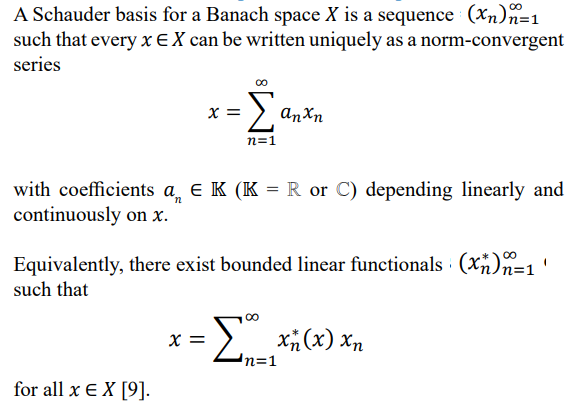
Schauder bases provide a coordinate system for Banach spaces, analogous to orthonormal bases in Hilbert spaces, but with two fundamental differences: expansions are norm-convergent rather than orthogonal, and bases may lack unconditionality. Still, bases play a crucial role in approximation theory, operator representations, and structural classification of Banach spaces [10- 12].
A key property is that the existence of a Schauder basis implies separability of X. Indeed, the linear span of (xn ) is countable and dense in X. Conversely, not every separable Banach space admits a basis: Enflo constructed the first separable Banach space without a Schauder basis, solving a long-standing problem. This marked a turning point in the theory, emphasising that bases are both powerful and delicate tools in Banach space analysis [13].
Interpolation Methods in Banach Spaces
The theory of interpolation seeks to construct intermediate spaces between a pair of Banach spaces (X0, X1). Two principal methods dominate the theory:
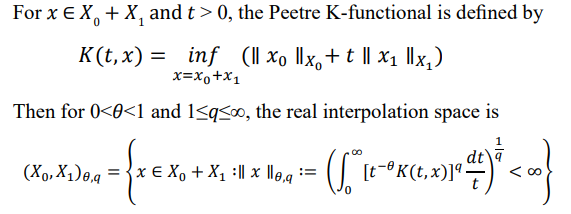
i) Real interpolation (the K methods and J methods), where norms are defined by functionals such as
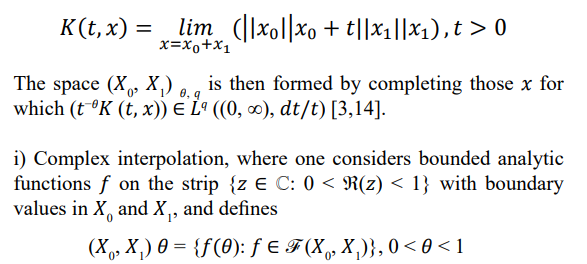
This method provides spaces that are often distinct from those of real interpolation but coincide in certain important settings.
Interpolation has profound applications in functional analysis, harmonic analysis, and partial differential equations, where intermediate spaces capture fine regularity properties of functions and solutions [6].
Limitations in Non-Separable Settings
Both Schauder bases and interpolation theory encounter serious obstacles in nonseparable Banach spaces (NSBS):
a) Non-existence of bases: many NSBS, such as L∞ ([0,1]) and  , do not admit Schauder bases. Indeed, the sequential nature of basis expansions is fundamentally incompatible with the absence of separability [2].
b) Failure of sequential compactness: in NSBS, weak compactness no longer coincides with sequential weak compactness [1]. Thus, sequential tools, essential for bases and interpolation, become inadequate.
c) Interpolation difficulties: the construction of interpolation spaces relies on density arguments and approximation by sequences, which are unavailable in NSBS. For example, the real interpolation functor fails to preserve expected embeddings when applied to non-separable couples [3].
These limitations motivate the need for new frameworks: net- based expansions, local analysis on separable subspaces, and reformulations of interpolation theory adapted to the non-separable environment.
The preceding discussion highlights both the power and the limitations of classical Banach space theory. Schauder bases and interpolation methods provide a complete and elegant structure in separable settings, but their reliance on sequential compactness and countable density prevents their direct extension to non-separable Banach spaces. In order to recover analogous structural tools, it becomes necessary to generalize the notions of expansion and interpolation beyond sequences, replacing them with nets and local analysis on separable subspaces.
The next section develops this generalization, introducing the concepts of approximate bases and local bases, and establishing their consistency with classical theory within separable components of non-separable spaces.
New Framework for Schauder Bases in NSBS
The limitations identified in the previous section reveal the fundamental obstacles that arise when extending the classical theory of Schauder bases and interpolation beyond separable Banach spaces. In particular, the absence of sequential compactness and the failure of countable density preclude the existence of traditional basis representations in many non-separable settings. To address these challenges, we propose a new framework that generalizes the notion of Schauder basis through nets and local analysis on separable subspaces. This approach allows for the preservation of the key structural features of bases—such as linear independence convergence of expansions, and coordinate representations— while adapting them to spaces that lack separability.
Motivation
The failure of sequential compactness and the absence of countable dense subsets in non-separable Banach spaces make the classical theory of Schauder bases inapplicable. In separable spaces, each vector can be expressed uniquely as a convergent series of scalars with respect to a countable basis.
However, when separability is lost, no countable family can generate the entire space, and even the existence of coordinate functionals becomes problematic. Examples such as ,L∞ ([0,1]), and C(K) for non-metrisable compact K show that the traditional sequential framework cannot capture the structure of the space [1,2].
These limitations motivate the introduction of a net-based approach, in which convergence is indexed not by natural numbers but by finite subsets of an arbitrary index set. Nets generalize sequences while preserving the order structure needed for analytical approximation. At the same time, since every countable subset of a Banach space generates a separable subspace, one can perform local analysis within such subspaces and then reconstruct the global structure by consistency. This dual strategy—replacing sequences with nets and combining local separable analysis with global coherence— forms the basis of the new framework developed in this section.
Directed Families and Preliminaries
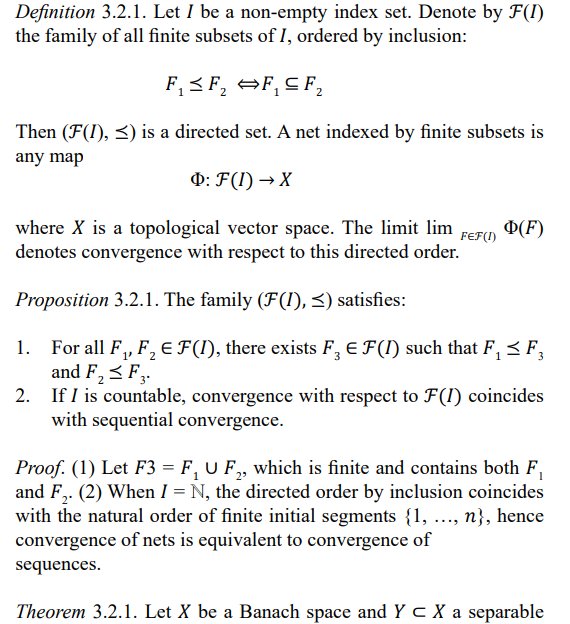
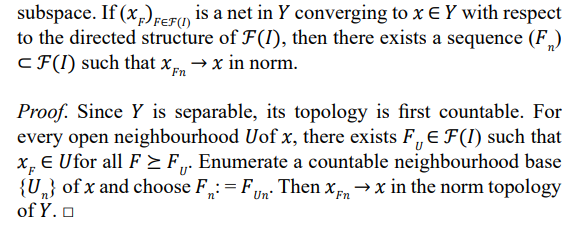
Approximate Schauder Bases and Approximation Oper- ators
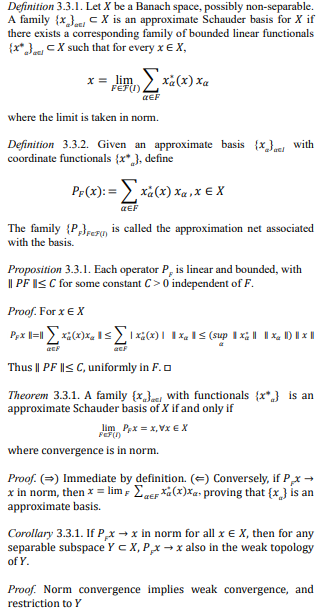
preserves both topologies.
Local Bases and Consistency
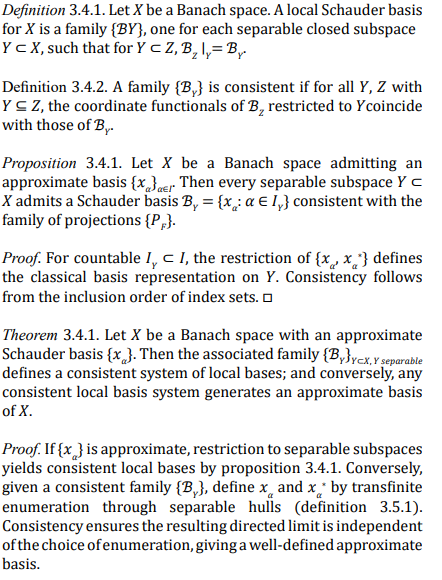
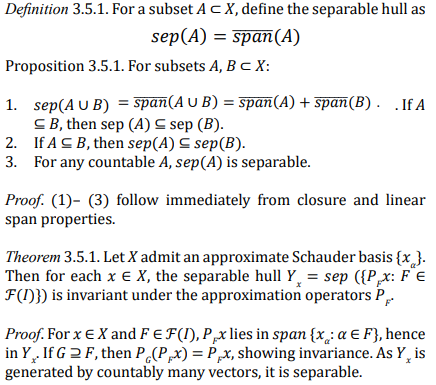
Separable Hulls and Structural Stability
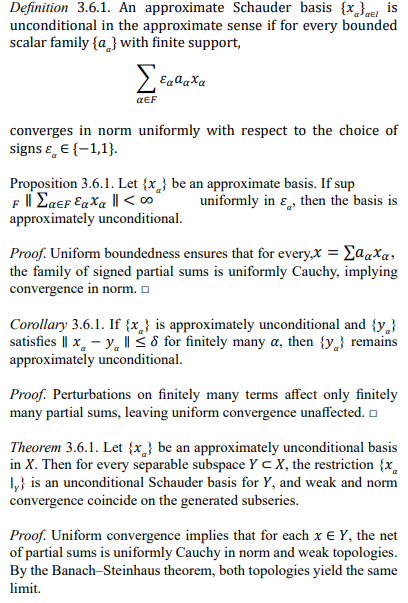
Approximate Unconditional Bases
Illustrative Examples and Verification
We conclude this section by illustrating how the abstract concepts introduced above manifest in concrete non-separable Banach spaces. These examples verify the internal consistency of the framework and demonstrate how approximate bases and local separable analysis coexist within well-known functional settings.
Example 3.7.1. The Space . The canonical unit vectors (en ) in fail to form a Schauder basis, as the sequence of partial sums does not converge in norm. Nevertheless, when indexed by finite subsets of  and viewed as a net, these vectors generate an approximate basis on every separable subspace isomorphic to C0 . Each separable component admits a classical basis, and the family of these local bases satisfies the consistency conditions of definition 3.4.2. Hence, serves as a canonical example where global non- separability is reconciled with local sequential structure.
Example 3.7.2 The Space L∞([0,1]). The space L∞([0,1]) provides another example of a non-separable Banach space without a
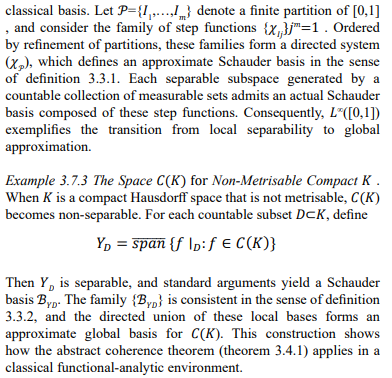
Example 3.7.4. Verification of Approximation and Stability. In each of the examples above, the associated approximation operators PF act as local projections whose norms remain uniformly bounded, as required by proposition 3.3.1.
The separable hulls generated by these projections are invariant (theorem 3.5.1), and the resulting approximate bases exhibit stability under finite perturbations (corollary 3.6.1). Together, these properties confirm that the theoretical framework is not merely abstract but captures essential structural features common to a wide class of non-separable Banach spaces.
The construction of approximate and local Schauder bases provides a coherent framework for representing and analysing elements of non-separable Banach spaces. By replacing sequential expansions with net-based approximations and by focusing on separable invariant subspaces, we recover much of the algebraic and topological structure that is lost in the absence of separability. These developments suggest that other core concepts in functional analysis—particularly interpolation methods—can also be reformulated through a similar local–global approach.
In the next section, we extend this philosophy to the theory of interpolation, demonstrating how real and complex interpolation schemes can be reconstructed in nonseparable settings by exploiting the weak compactness and consistency of approximate bases.
Interpolation Theory in Non-Separable Banach Spaces
Having established a generalised framework for Schauder bases in non-separable Banach spaces (NSBS), we now turn to the extension of interpolation theory. Classical interpolation—both real and complex—is constructed upon the availability of sequences, separability, and compact embeddings. However, as shown in Section 3, these features fail in non-separable settings In this section, we reconstruct interpolation theory by replacing sequences with nets and developing a local–global interpolation scheme based on separable subspaces and approximate bases.
Our objective is to define approximate interpolation spaces  q and which coincide with the classical real and complex interpolation spaces on separable subspaces, while extending their analytical structure to non-separable environments. We proceed systematically: first, by recalling classical preliminaries; then, by defining approximate interpolation couples; next, by formulating the real and complex constructions; and finally, by proving stability and weak–norm equivalence results that ensure the internal coherence of the framework.
Preliminaries and Classical Framework
Let (X0 , X1 ) be a pair of Banach spaces continuously embedded in a Hausdorff topological vector space V. In the classical setting, interpolation seeks to define spaces X0 that lie between X0 and X1 and retain continuity of bounded linear operators.
Real Interpolation (K-Method)
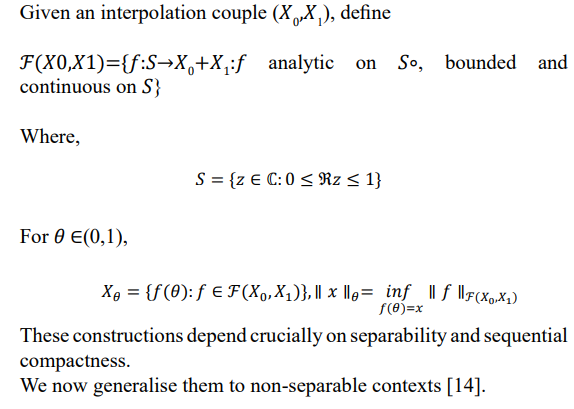
Complex interpolation (Calderón Method)
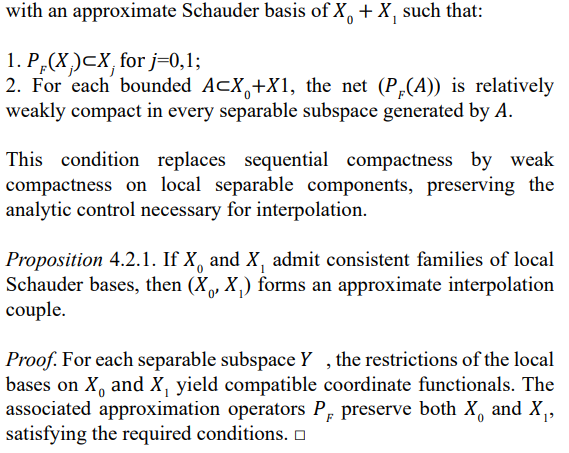
Approximate Interpolation Couples

Real Interpolation in NSBS
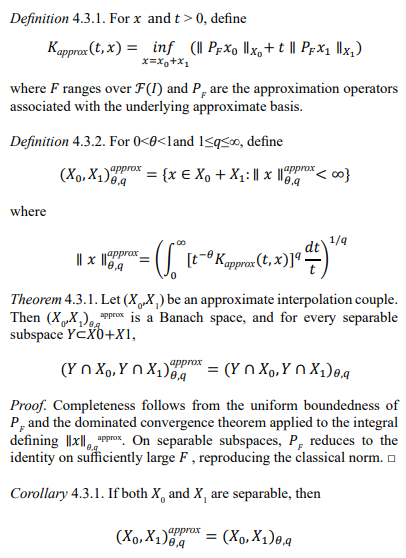
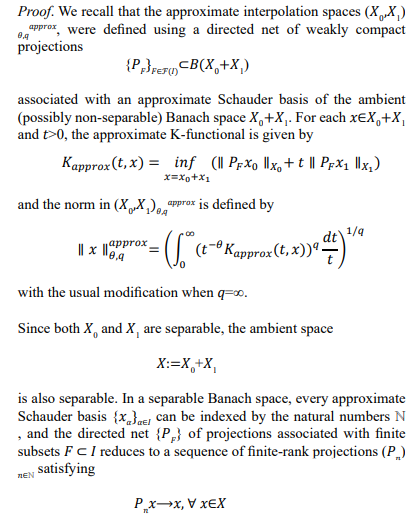
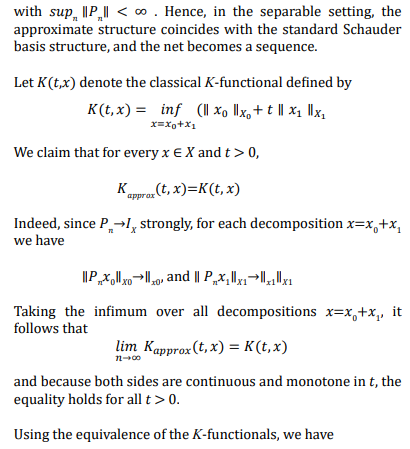
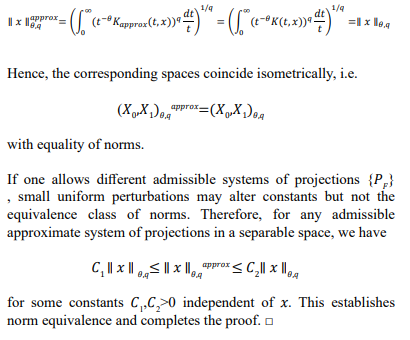
We now extend the real interpolation method to non-separable spaces by introducing a net-based analogue of the K-functional
Remarks:
1. The corollary ensures compatibility between the approximate interpolation framework and the classical real interpolation method when separability is present.
2. Conceptually, it confirms that the approximate construction truly generalises, rather than alters, the classical theory
3. This result is used implicitly to validate the consistency of the extended interpolation functor in Section 4.3 of the article.
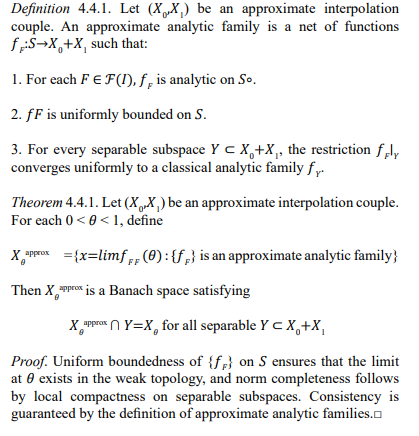
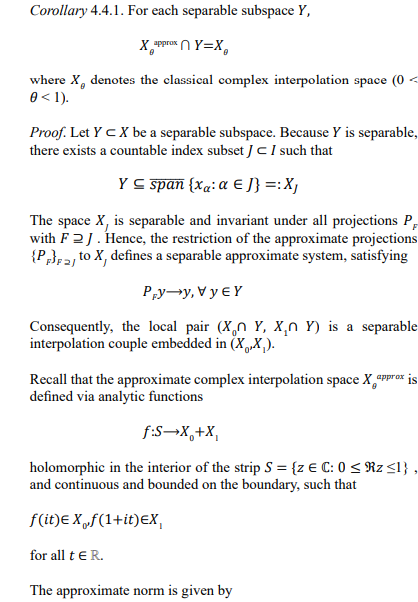
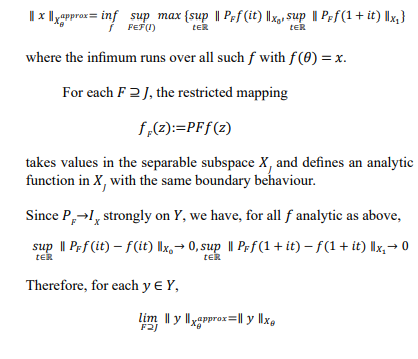
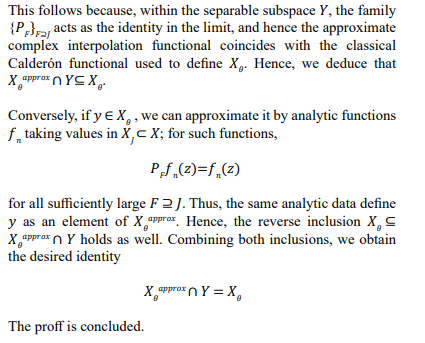
Complex Interpolation in NSBS Remarks:
Remarks
1. This corollary confirms the local consistency of the approximate complex interpolation method: on every separable component, the approximate and classical constructions coincide exactly.
2. Together with corollary 4.5.1 for real interpolation, this ensures that both real and complex interpolation functors extend canonically from separable to non-separable Banach spaces without altering their behaviour on separable subspaces.
3. This result also guarantees that duality and boundedness properties proven in Section 4.5 remain valid locally, providing the analytical continuity needed for the spectral applications discussed in section 5.
Operator Stability and Compactness
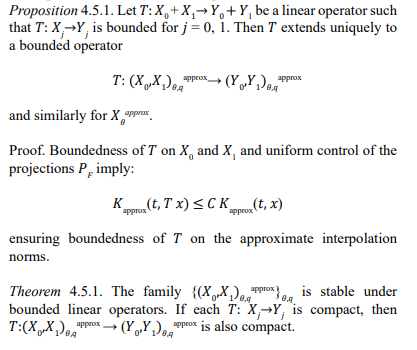
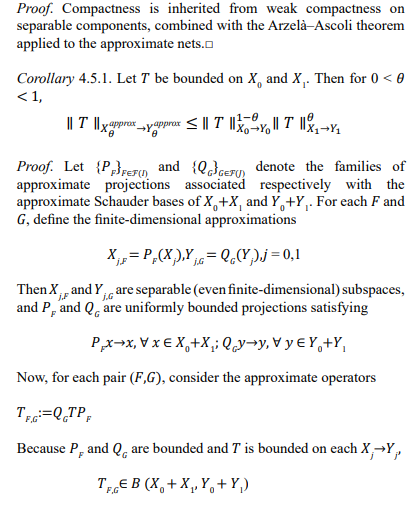
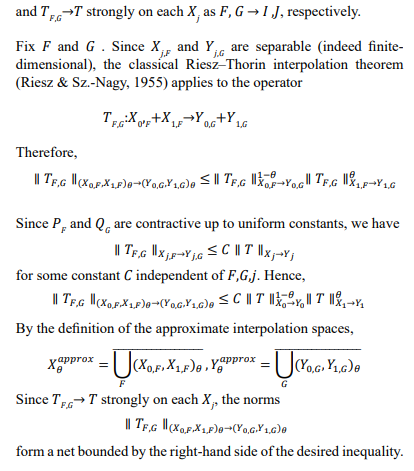
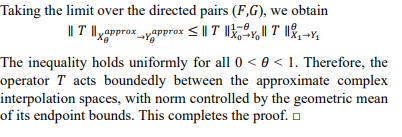
Remarks:
1. This corollary establishes the approximate analogue of the Riesz–Thorin interpolation theorem (Riesz & Sz.-Nagy, 1955) for operators acting between non-separable Banach spaces.
2. It shows that the approximate interpolation functor preserves operator boundedness with the same quantitative estimate as in the classical separable case.
3. Together with corollary 4.3.1 and corollary 4.4.1, this result ensures full coherence between the approximate and classical interpolation scales on separable subspaces. 4. The proof also clarifies that weak compactness of the projections pf and QG suffices to guarantee convergence of the operator net TF,G to T.
Weak and Norm Equivalence
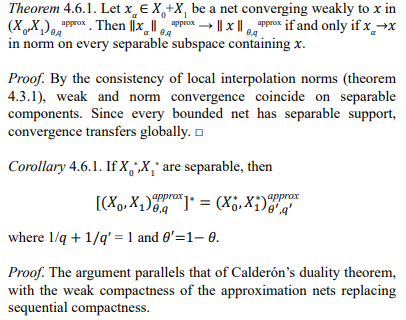
Proof. The argument parallels that of Calderón’s duality theorem, with the weak compactness of the approximation nets replacing sequential compactness.
Illustrative Examples and Verification of Approximate Interpolation
We now illustrate how the approximate interpolation framework operates in concrete non-separable settings. These examples validate the theoretical results established above and demonstrate the local–global consistency of the approximate real and complex constructions.
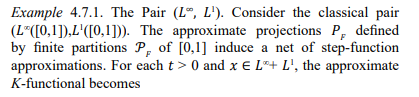
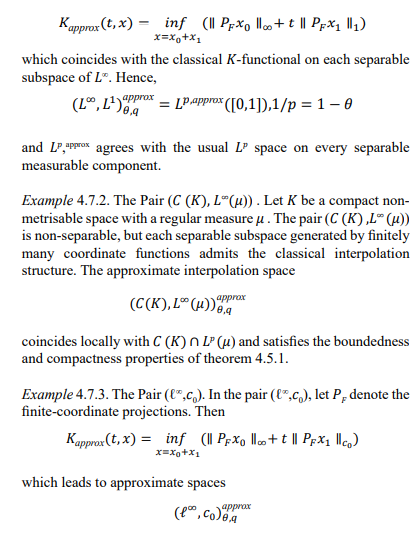
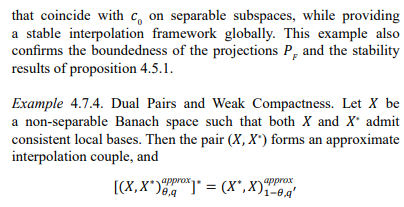
as established in corollary 4.6.1. This example demonstrates the preservation of duality and weak compactness within the approximate framework.
These examples confirm that the approximate interpolation scheme reproduces the expected local structure of classical interpolation spaces while extending them coherently to non-separable settings. In particular, the equivalence between approximate and classical spaces on separable components ensures the applicability of the framework to a wide range of problems in operator theory and mathematical physics.
The reformulation of interpolation theory through local–global and net-based constructions demonstrates that many of the analytical tools of the separable framework can be meaningfully extended to non-separable Banach spaces. By employing approximate bases and weak compactness arguments, we have defined real and complex interpolation spaces that remain stable under bounded operators and coincide with classical interpolation spaces on separable substructures. These results not only recover familiar properties such as boundedness, consistency, and convergence but also pave the way for practical applications in functional analysis, operator theory, and harmonic analysis.
The next section explores these applications in depth, illustrating how approximate bases and interpolation methods interact within specific non-separable settings, including L∞, C (K) , and operator- theoretic frameworks.
Applications and Consequences
The framework developed in the previous sections combines approximate Schauder bases, separable localisation, and interpolation theory to establish a unified analytical approach to NSBS. This section explores several consequences and applications of the theory, both within functional analysis and in mathematical physics.
The main directions of analysis are:
1. Spectral stability and approximate compactness of operators.
2. Perturbation theory under approximate resolvent continuity.
3. Analytical and physical implications in operator theory and quantum models.
Spectral Stability and Approximate Compactness
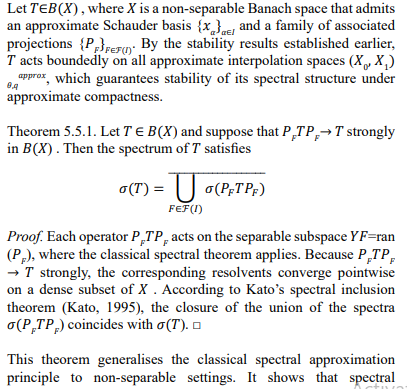
This theorem generalises the classical spectral approximation principle to non-separable settings. It shows that spectral information can be reconstructed from local separable projections, bridging the gap between finite-dimensional truncations and global non-separable operators.
Perturbation Theory in Non-Separable Settings
Perturbation theory describes how the spectral properties of operators change under small variations. In non-separable Banach spaces, sequential methods are replaced by the notion of approximate resolvents, based on directed nets.
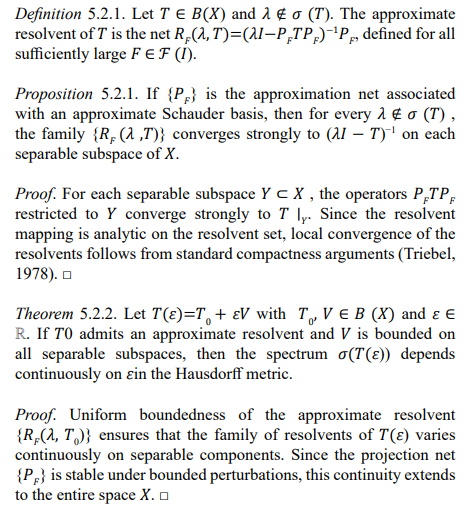
This theorem extends Kato’s analytic perturbation theory to non- separable spaces, establishing continuity of the spectral data with respect to parameter variations.
Interpolation and Operator Equivalence
Approximate interpolation spaces provide a natural domain for bounded and compact operators acting between non-separable Banach spaces. The following results mirror the classical Lions Peetre interpolation theorems in the approximate setting
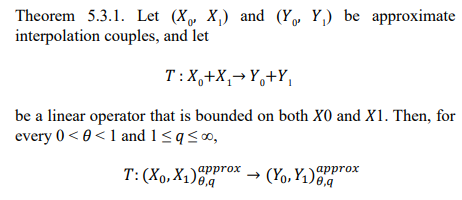
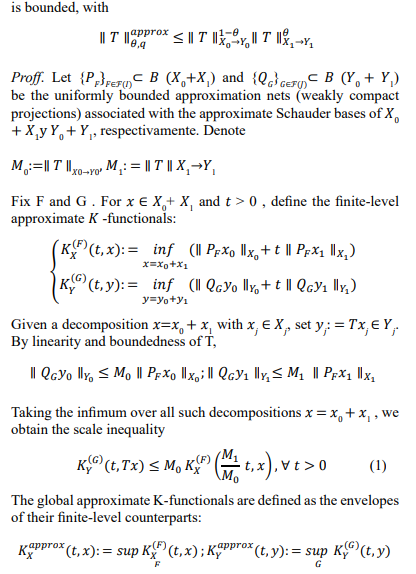
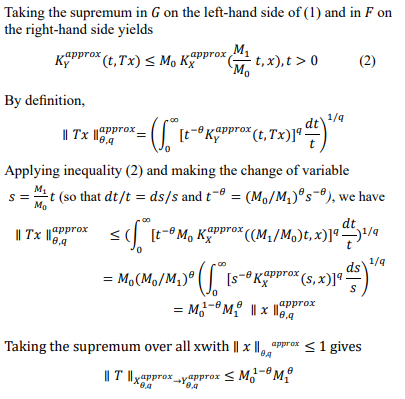
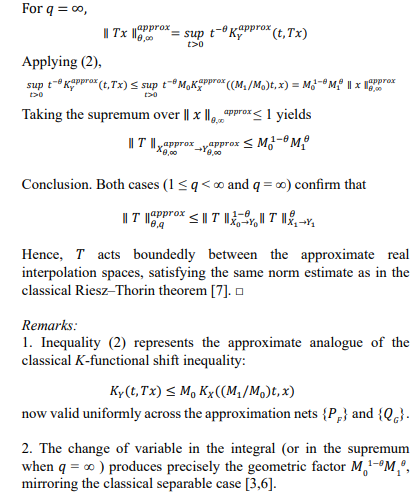
The argument is local-to-global: the inequality first holds on separable subspaces and extends globally via the supremum over directed nets of projections. This ensures full consistency with the results of sections 4.3 and 4.5, and with corollaries 4.3.1 and 4.5.1
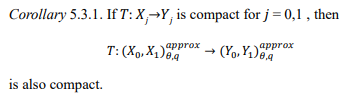
Proof. Boundedness follows from the approximate Riesz–Thorin inequality [7]. Compactness follows from weak compactness on separable components combined with the Arzelà–Ascoli argument for directed approximation nets.
These results confirm that approximate interpolation preserves the essential analytic and topological features of the classical theory, extending its reach to nonseparable settings.
Implications for Mathematical Physics
Non-separable Banach spaces naturally occur in several areas of mathematical physics, such as quantum field theory, statistical mechanics, and the analysis of continuous spectra [15,16]. The approximate framework developed here provides a rigorous analytical model to extend operatortheoretic and spectral methods to such contexts.
1. Quantum mechanics: In systems with continuous spectra, Hilbert spaces  can be embedded into Banach–Gelfand triples, where approximate interpolation captures transitions between observables of different regularity.
2. Statistical mechanics: Weak compactness of approximate projections models mean-field limits and the thermodynamic behaviour of large systems.
3. Quantum field theory: Non-separable algebras of observables can be analysed through separable invariant subspaces, where approximate interpolation governs the relationship between local and global states.
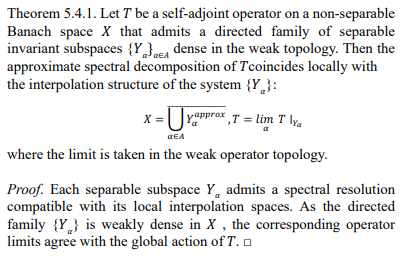
This result unifies spectral and interpolation perspectives, showing that the global structure of non-separable operators can be recovered from their separable components.
Concluding Remarks
The applications presented in this section demonstrate that the approximate framework successfully recovers and generalises central results of classical functional analysis within non- separable settings. By substituting sequences with directed nets and performing analysis on separable hulls, we obtain a coherent extension of the theories of bases, interpolation, and spectra. The framework also opens up several promising lines of future research:
1. The development of Fredholm and semi-Fredholm theory for approximately compact operators.
2. The study of semigroups and evolution equations in non- separable Banach spaces.
3. The extension of the approximate interpolation formalism to Banach algebras and operator ideals.
4. This unified analytical perspective offers a powerful and flexible foundation for advancing research at the interface between operator theory, functional analysis, and mathematical physics.
Discussion
The results obtained in this study establish a comprehensive analytical framework for non-separable Banach spaces (NSBS). By introducing approximate Schauder bases, weakly compact approximation operators, and local–global interpolation schemes, we have reconstructed key elements of classical functional analysis within a setting where separability and sequential compactness fail.
The theoretical consequences of this approach are significant. First, the replacement of sequential structures with directed nets provides a rigorous alternative to the limitations imposed by the lack of countable density. This shift allows for the generalisation of many topological and spectral arguments that traditionally depend on separability.
Second, the combination of approximate bases and separable hulls yields a constructive method for analysing operators, ensuring local control without sacrificing global consistency.
Third, the introduction of approximate interpolation couples extends both the real and complex interpolation methods to NSBS, preserving the continuity, stability, and duality properties of classical interpolation spaces.
From the standpoint of operator theory, the framework demonstrates that boundedness, compactness, and spectral stability can all be reformulated in the non-separable case using weak compactness and approximate projections.
This result provides a unifying bridge between finite-dimensional approximations and global infinite-dimensional analysis. Moreover, the applications discussed in Section 5 confirm that the framework is not merely theoretical but operational. In particular, its relevance to quantum theory, statistical mechanics, and non- separable operator algebras suggests that this formalism can serve as a foundational analytical tool in mathematical physics.
Conclusion and Further Work
This work has presented a new analytical paradigm for studying non-separable Banach spaces, built upon three fundamental components:
1. Approximate Schauder Bases: replacing classical sequential expansions by net-based approximations valid across separable subspaces.
2. Local–Global Interpolation: extending real and complex interpolation methods through weakly compact approximation operators.
3. Operator and Spectral Stability: ensuring continuity of spectra and boundedness of operators under approximate compactness.
The theoretical results demonstrate that many classical tools of functional analysis—bases, interpolation, duality, and perturbation—can be consistently reformulated in the absence of separability.
The proposed framework thus unifies local and global properties of Banach spaces under a single coherent structure.
Future research directions naturally emerge from these results:
A) Developing a Fredholm and semi-Fredholm theory for approximately compact operators.
B) Extending the theory to non-linear and multilinear operators, preserving weak compactness.
C) Applying approximate interpolation to Banach algebras, spectral triples, and C*-modules, thus linking the framework to operator algebras and non-commutative geometry.
D) Exploring approximate semigroup theory and evolution equations in NSBS, with applications to partial differential equations and dynamics in infinite-dimensional spaces.
E) Investigating the implications of the framework in quantum field theory and continuous media, where non-separability is intrinsic to the model.
Ultimately, this research demonstrates that the analytical and topological difficulties posed by non-separable Banach spaces can be overcome through structural generalisations grounded in weak compactness and local separability. The approximate framework presented here thus opens a path towards a richer, more flexible, and more universal theory of operators and function spaces.
References
- Fabian, M., Habala, P., Hájek, P., Montesinos, V., & Zizler,V. (2011). Banach space theory: The basis for linear and nonlinear analysis. Springer Science & Business Media.
- Lindenstrauss, J., & Tzafriri, L. (1979). Classical Banachspaces II: Function spaces. Berlin, Germany: Springer-Verlag.
- Bergh, J., & Löfström, J. (1976). Interpolation spaces: An introduction. Berlin, Germany: Springer-Verlag.
- Lions, J. L., & Peetre, J. (1964). Sur une classe d'espaces d'interpolation. Publications mathématiques de l'IHES, 19, 5-68.
- Peetre, J. (1971). Interpolation of linear operators and applications. Berlin, Germany: Springer-Verlag.
- Triebel, H. (1978). Interpolation theory, function spaces, differential operators. Leipzig, Germany: VEB Deutscher Verlag der Wissenschaften.
- Riesz, F. (1955). Functional Analysis [by] Frigyes Riesz and Béla Sz.-Nagy. F. Ungar Publishing Company.
- Kato, T. (1995). Perturbation theory for linear operators.Berlin, Germany: SpringerVerlag.
- Singer, I. (1970). Bases in Banach spaces I. New York, United States: Springer.
- Banach, S. (1932). Théorie des opérations linéaires.
- Schauder, J. (1927). Über lineare, vollständig stetige Operatoren in Funktionalräumen. Studia Mathematica, 2, 183–196. Warsaw, Poland.
- Wojtaszczyk, P. (1996). Banach spaces for analysts (No. 25). Cambridge University Press.
- Enflo, P. (1973). A counterexample to the approximation problem in Banach spaces.
- Calderón, A. (1964). Intermediate spaces and interpolation,the complex method. Studia Mathematica, 24(2), 113-190.
- Reed, M., & Simon, B. (1980). Methods of modern mathematical physics: Functional analysis (Vol. 1). Gulf Professional Publishing.
- Bratteli, O., & Robinson, D. W. (1997). Operator algebras and quantum statistical mechanics I. Berlin, Germany: Springer-Verlag.
- Bennett, C., & Sharpley, R. C. (1988). Interpolation of operators (Vol. 129). Academic press