

International Journal of Media and Networks(IJMN)
ISSN: 2995-3286 | DOI: 10.33140/IJMN
Impact Factor: 1.02



Short Commentary - (2024) Volume 2, Issue 7
Adilights: A Novel Automotive Lighting System for Enhanced Safety
Received Date: Jun 11, 2024 / Accepted Date: Jun 30, 2024 / Published Date: Jul 04, 2024
Copyright: ©Â©2024 Chetan Badgujar. This is an open-access article distributed under the terms of the Creative Commons Attribution License, which permits unrestricted use, distribution, and reproduction in any medium, provided the original author and source are credited.
Citation: Badgujar, C. (2024). Adilights: A Novel Automotive Lighting System for Enhanced Safety. Int J Med Net, 2(7), 01-05.
Abstract
The increasing complexity of vehicular traffic and the prevalence of accidents, particularly rear-end collisions, necessitate enhancements in automotive safety technologies. Adilights, an innovative automotive lighting system, addresses this need by introducing a dynamic visual communication method between vehicles. This system features a novel design that employs variable-intensity brake lights configured in an upside-down "U" shape to indicate braking severity. The intensity and pattern of the lights change in response to the pressure applied to the brake pedal, providing clear and immediate feedback to following drivers. This design not only improves the perceptibility of braking signals, particularly in dense traffic and poor visibility conditions but also aims to reduce the frequency of rear-end collisions significantly. The paper details the development and testing of Adilights, discusses its integration with current vehicular systems, and evaluates its effectiveness through simulated scenarios. The introduction of Adilights marks a step forward in the use of adaptive lighting systems for enhanced vehicular communication and road safety [1].
Keywords
Automotive Lighting, Safety Technology, Brake Lights, Vehicle Communication, Adaptive Cruise Control
Introduction
The introduction of Adilights into the automotive industry aims to bridge the safety gaps present in current vehicle lighting systems, particularly in the context of automated and adaptive cruise-controlled vehicles.
Background
Problems with Current Technologies
Current technology still witnesses a high frequency of car accidents daily, most of which are rear-end collisions. Despite advancements in self-driving cars and adaptive cruise control systems, many vehicles lack these safety features. This discrepancy means that even if one car has the latest safety features, it could still be involved in an accident with a less equipped vehicle. Adilights aims to close this safety gap by enhancing decision-making for all drivers, potentially reducing incidents of insurance fraud through clearer communication of braking intent [1].
Additionally, this invention addresses potential future issues. For example, drivers following person with adaptive cruise control (ACC) might become desensitized to braking cues due to constant automatic braking for small speed adjustments. Adilights counters this by making every braking action noticeable.
Design of Adilights
Adilights introduces U-shaped lights, which operate at lower speeds (40 to 50 MPH) to reduce "traffic snakes" and enhance the flow of traffic by displaying the intensity of the gas pedal pressure. These lights extend downwards from two tail lights adjacent to both blinkers and illuminate progressively closer until they meet in a "U" shape. This feature provides a novel solution that ACC systems alone cannot offer, particularly in stop-and-go traffic conditions. This allows drivers without ACC systems to better understand and visually see forward drivers intentions regardless if they are equipped with ACC or not.
Solution Offered by Adilights
Adilights revolutionizes braking lights with a design that integrates traditional functionality with innovative, variable lights shaped like an upside-down "U." These lights enhance visibility and communication by illuminating more sections of lights as braking pressure increases. Key components include new brake light shapes, sensors at the brake and accelerator pedals, and variations sub-section in the lights for different braking intensities.
Summary of the Invention
The invention, Adilights, will be a new type of variation braking lights. It will be mostly shaped like an upside-down “U” letter. These lights will also have our traditional braking lights in them along with variation lights which will keep lighting upwards from 2 tail lights (which are next to both blinkers) in both directions as the brake pressure increases until both lights meet in the middle or both of them make contact with the tail light.
Key component of these lights will be a new shape for brake lights, sensors at the brake pedal and accelerator pedal, and one more similar shape of new brake lights but with different colours like green or yellow and upside down like U-shaped.
Detailed Description of the Invention
Design and Functionality
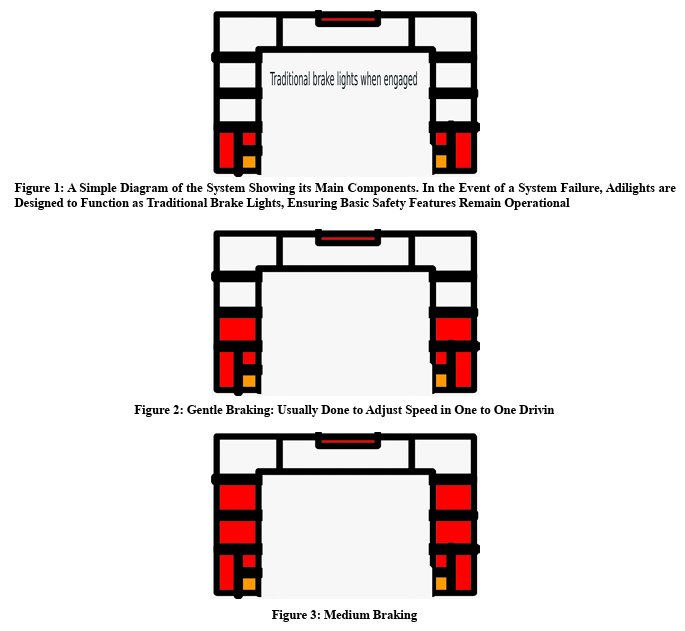
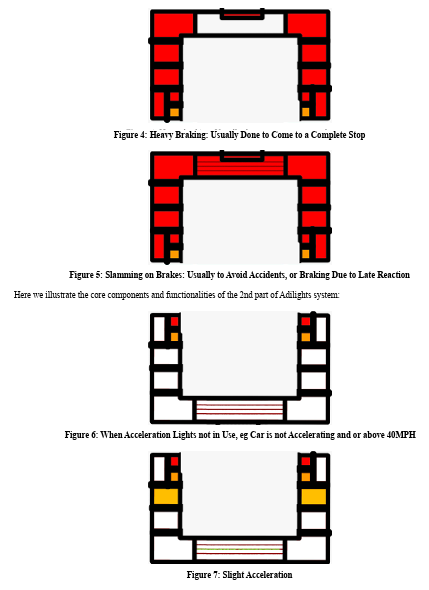
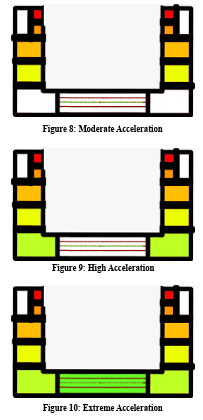
The invention operates with a dynamic lighting system that utilizes variable-intensity brake lights. These lights create patterns in the shapes of "U" or "n" to represent acceleration and braking respectively. The system employs red lights for braking, with increased illumination completing the "n" shape from the bottom to the top. A full "n" or "u" pattern occurs only under intense braking or acceleration. For minor adjustments, such as a gentle tap on the brake by adaptive cruise control (ACC) or the driver, the lights mimic traditional brake lights. Moderate braking results in the illumination of two parallel lines, with the upper section intensifying based on the brake pressure. Sensors at both the brake and accelerator pedals measure the extent of pedal depression to adjust the light intensity accordingly, providing a potential safety net through customization. Additionally, for enhanced rear driver communication during acceleration, the system can employ green and yellow lights to form a "U" shape, indicating the degree of acceleration. Sensors on the accelerator pedal, RPM gauge, and speedometer further refine this functionality. The lights also utilize lidar sensors to gauge the distance from surrounding vehicles, adjusting the light display whether the vehicle is accelerating or decelerating.
Diagrams
Here we illustrate the core components and functionalities of the Adilights system:
Variations and Alternatives
As previously mentioned, the system can integrate either lidar sensors or traditional radar cruise control (ACC) to enhance visual safety cues. The technology is adaptable for trucks, providing visual feedback tailored to the vehicle’s weight—lighter trucks with quicker stop times and heavier trucks correspondingly slower. This adaptability extends to installing additional light sets in heads-up displays, facilitating better communication between automated and manually driven vehicles. This capability enables drivers to make rapid decisions to avoid collisions, essential for integrating self-driving cars more seamlessly into current traffic systems.
Examples
During braking, the system illuminates small sections above the tail lights or blinker lights for mild braking applications. More intense braking or acceleration activates the "U" or "n" shaped lights, which vary in color and intensity depending on the vehicle’s speed change. In congested traffic or at stops, the forward visibility of "U" shaped green lights can prompt the following drivers to accelerate more promptly, reducing overall reaction times and improving traffic flow. Ideally, mandating this system in all vehicles could simplify implementation and reduce costs compared to retrofitting cars with advanced cruise control systems. This standardization might also stimulate the automotive industry by introducing essential safety features as standard rather than luxury upgrades. The potential for integrating infrared lights, invisible to the human eye but detectable by sensors, could provide redundancy in autonomous driving systems, acting as a fail-safe in the event of system failures.
Real-life Implementation
The practical application of this technology may require extensive testing and could involve various modifications tailored to local regulatory requirements. While it may not offer a panacea for all vehicular challenges, this invention undoubtedly serves as a critical bridge between human-operated vehicles and their semi-autonomous or fully autonomous counterparts. In the interim period before the widespread affordability and reliability of autonomous vehicles are achieved, this technology offers a significant benefit: it allows human drivers to visually comprehend what autonomous systems perceive [2].
An additional advantage of this invention lies in its potential implementation using infrared lights or similar technologies that are invisible to the human eye but detectable by sensors. Assuming widespread adoption, this system could provide an auxiliary "set of eyes" to traditional adaptive cruise control (ACC) systems and autonomous vehicles, enhancing collision avoidance capabilities. For instance, should primary systems such as LIDAR or ACC radar experience failure, vehicles could still rely on the infrared signals emitted by preceding vehicles to adjust their speed accordingly. This layering of safety mechanisms not only increases the overall robustness of vehicle safety systems but also minimizes the likelihood of accidents by requiring multiple failures before a mishap occurs. Utilizing infrared lights would also prevent driver distraction, benefiting solely the sensor-based navigation of autonomous and semi- autonomous vehicles.
Automobile manufacturers might find this technology appealing as an additional feature for newer vehicle models, enhancing their marketability. With sufficient validation, this lighting system could potentially be mandated by state laws as a standard feature in vehicles equipped with self-driving or ACC capabilities and as a state inspection. Although not immediately essential, such regulatory measures could become imperative over the next decade as the number of autonomous and ACC-equipped vehicles on the roads increases, interacting increasingly with manually driven cars.
This invention not only honors the legacy of the infrastructural advancements made by previous generations but also significantly contributes to the evolving dynamics of human- machine cohabitation on our roads. By potentially reducing rear-end collisions and alleviating traffic congestion, it marks a pivotal step towards harmonious roadway integration, reflecting a profound commitment to enhancing road safety in an era of technological transition.Either ways, this might get the domino effect started for us to take steps towards visually communicating with other drivers on roads.
Conclusion
This invention not only aims to reduce traffic congestion and minimize rear-end collisions but also promotes a more integrated approach to human and autonomous vehicle interaction. By enhancing traditional brake light systems with advanced communication capabilities, it establishes a new standard of vehicular communication that could greatly increase road safety. The simplicity of implementation and the broad scope for customization make this system adaptable to various regulatory environments, potentially easing the integration of autonomous vehicles into the mainstream.
Acknowledgments: The authors would like to acknowledge the assistance of ChatGPT, an AI language model developed by OpenAI, which was used to help format this document and improve the sentence structure and flow of the paragraphs.
Acronym
Adaptive Cruise Control (ACC)
References
- Lee, S. E., Llaneras, E., Klauer, S., & Sudweeks, J. (2007). Analyses of Rear-End Crashes and Near-Crashes in the 100- Car Naturalistic Driving Study to Support Rear-Signaling Countermeasure Development: Report No. DOT HS 810 846. NHTSA.
- By 2030, One in 10 Vehicles Will Be Self-Driving Globally. Accessed: 2024-05-08.