



Case Report - (2026) Volume 11, Issue 1
Wild (Mad) Honey Poisoning: A Case Report from Nepal
2MS, General Surgeon, Pashupati Chaulagain Memorial Hospital, Dolakha, Nepal
3MBBS Dhading Hospital, Dhading, Nepal
Received Date: Aug 21, 2025 / Accepted Date: Jan 23, 2026 / Published Date: Feb 10, 2026
Copyright: ©2026 Aashish Neupane, et al. This is an open-access article distributed under the terms of the Creative Commons Attribution License, which permits unrestricted use, distribution, and reproduction in any medium, provided the original author and source are credited.
Citation: Neupane, A., Shrestha, G., Neupane, A., Neupane, P., Magar, B. T. (2026). Wild (Mad) Honey Poisoning: A Case Report from Nepal. Cardio Open, 11(1), 01-03.
Abstract
Introduction and Importance: Ingestion of honey that has a toxin called as grayanotoxin causes wild or mad honey poisoning. This can lead to nausea, vomiting, dizziness, sweating, altered consciousness, hypotension, bradycardia, cardiac rhythm abnormalities like first-, second-, and third -degree AV block, asystole and sinus bradycardia.
Case History: A 40 years old man presented to emergency room with complaints of multiple episodes of vomiting, dizziness, impaired consciousness for 30 minutes following consumption of wild honey with low blood pressure and pulse rate. He was treated with IV fluids and intravenous atropine with no complications.
Discussion: Consumption of wild honey made by bees from few species of rhododendron like Rhododendron luteum, R. Ponticum, R. Simsii leads to wild (mad) honey poisoning. Wild honey is considered as alternative medicine in treatment of hypertension, acid peptic disease, arthritis, sexual dysfunction, coronary artery disease, diabetes and bowel disorder. Grayanotoxin increases sodium channel permeability by attaching to sodium channels on the cell membrane thus inhibiting repolarization. Diagnosis requires high index of clinical suspicion and history of ingestion of honey along with symptoms is particularly important for diagnosis.
Conclusion: Wild honey poisoning is rare but can occur in specific geographical location like hilly region of Nepal. Most poisoning are not fatal and it does not last more than 24 hours thus such cases requires monitoring for 24 hours duration.
Keywords
Wild Honey, Poisoning, Bradycardia, Hypotension, Atropine
Introduction
Ingestion of honey that has a toxin called as grayanotoxin causes wild or mad honey poisoning. This toxin is also known as rhodotoxin as it is found in nectar of some rhododendron species mainly found in the mountains of Bhutan, India, Nepal and Turkey [1]. It acts on sodium channel and increases parasympathetic effect [2]. This can lead to nausea, vomiting, dizziness, sweating, altered consciousness, hypotension, bradycardia, cardiac rhythm abnormalities like first-, second-, and third -degree AV block, asystole and sinus bradycardia [3,4]. Wild honey is being used as alternative medicine to treat hypertension, diabetes, peptic ulcer disease, bower disorder, arthritis, flu and as sexual stimulant [5]. We present a case report of wild honey poisoning who presented to emergency with bradycardia and hypotension.
Case History and Examination
A 40 years old man presented to emergency room with complaints of multiple episodes of vomiting, dizziness, impaired consciousness for 30 minutes. Further history revealed the patient developed these symptoms 15 minutes following consumption of 10 ml of wild honey which he took to get relieved of his gastritis and arthritis. There was no any significant past medical and surgical history.
On presentation to emergency, he was oriented to time, place and person, GCS was 15/15, pupil was bilateral round, regular and reactive and GRBS was 150mg/dl. Further examination revealed blood pressure of 60/40 mmHg, pulse rate of 38bpm, respiratory rate of 16 breaths per minute, temperature of 98 F and his saturation was 96 % in room air.
Methods (Differential Diagnosis, Investigations and Treatment)
12 lead Electrocardiogram was done which showed sinus bradycardia with heart rate of 41 bpm as shown in figure 1. He was immediately resuscitated with intravenous fluids (two pint of normal saline) and hydrocortisone 200 mg intravenously. On re- examination of patient there was no improvement in his symptoms, blood pressure and pulse rate. Hence, he was treated with 0.6 mg of atropine intravenously, one pint of 0.9 % sodium chloride (normal saline) along with intravenous injection of ondansetron 4mg. Ten minutes later he showed some improvement in his symptoms, blood pressure was 90/60 mmHg and pulse rate were 76bpm. Blood investigations report did not show any abnormality as shown in Table.
|
Blood Tests |
Values |
|
Hemoglobin (13-18 gm%) |
14.8gm% |
|
Serum Urea (15-45 mg/dl) |
24 mg/dl |
|
Serum Creatinine (0.4-1.4 mg/dl) |
0.8 mg/dl |
|
Serum Sodium (135-147 mEq/dl) |
140.5 mEq/dl |
|
Serum Potassium (3.5-5 mEq/dl) |
3.8 mEq/dl |
|
Serum Calcium ((8.5–11 mg/dl) |
9.4 mg/dl |
|
TSH (0.4–4.2 mIU/L) |
3 mIU/L |
Table: Blood Investigations
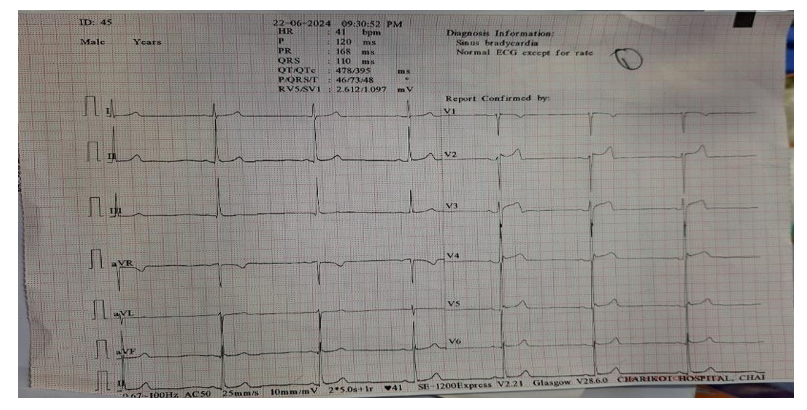
Figure: 12 Lead Electrocardiogram of Patient Done in Emergency Room Showing Sinus Bradycardia
He was admitted in Intensive Care Unit (ICU) under continuous cardiac monitoring, IV hydrocortisone 100 mg three times a day, maintenance IV fluids and intravenous atropine 0.6 mg (if pulse rate less than 40bpm).
Discussion
Consumption of wild honey made by bees from few species of rhododendron like Rhododendron luteum, R. ponticum, R. simsii leads to wild (mad) honey poisoning [6]. These are found in some hilly areas of Turkey, Japan, Brazil, North America and in mountains of Nepal [7]. Pollen of Rhododendron has the toxin called as grayanotoxin. Out of 18 types of grayanotoxin, grayanotoxin 1 and 2 are found in honey, leaves and flowers of Rhododendron and these are the most effective form of toxins [1]. Wild honey is considered as alternative medicine in treatment of hypertension, acid peptic disease, arthritis, sexual dysfunction, coronary artery disease, diabetes and bowel disorder [5]. Grayanotoxin increases sodium channel permeability by attaching to sodium channels on the cell membrane thus inhibiting repolarization. It causes cell membrane depolarization thus leading to weakened action potential. This decreased or weakened action potential in sinoatrial node and vagal stimulation leads to bradycardia and hypotension [8,9].
Systematic review done in mad honey poisoning among 1199 cases showed hypotension as the most common presentation occurring in 19.75 % and sinus bradycardia as the most common ECG finding seen in 79.58% [10]. Wild honey poisoning is rarely fatal and it does not last more than 24 hours. It can lead to dizziness, weakness, salivation, sweating, vomiting, hypotension, syncope, bradycardia, atrioventricular block [2]. Psychiatric symptoms like visual hallucinations and neurological symptoms like blurring of vision, ataxic gait, peripheral numbness have been reported in mad honey poisoning in Nepal [11]. Diagnosis requires high index of clinical suspicion and history of ingestion of honey along with symptoms is particularly important for diagnosis. Most cases require symptomatic treatment as these poisoning resolves in itself. Cardiac complications like hypotension, bradycardia can be appropriately managed with IV fluids and atropine and rarely transcutaneous cardiac pacing is required [5]. Since the poisoning occurs in specific geographic location more study needs to be done to enhance our knowledge in this poisoning.
Results and Conclusion
Twelve hours later he showed marked improvement in his symptoms and his blood pressure was 120/80 mmHg and pulse rate were 80bpm. Subsequently, he was admitted for another 24 hours with cardiac monitoring and his vitals were stable throughout admission and his symptoms got relieved hence he was discharged without any complications. This case report has been reported in line with the SCARE Criteria [12].
Ethical Clearance
Our centre does not have ethical boards as it is a very small health centre located in a rural area of Nepal.
References
- Shilpakar, O., Rajbhandari, B., & Karki, B. (2019). Wild honey poisoning: a case report. Nepal Medical Journal, 2(1), 86-88.
- Gunduz, A., Turedi, S., Uzun, H., & Topbas, M. (2006). Mad honey poisoning. The American journal of emergency medicine, 24(5), 595-598.
- Yilmaz, O., Eser, M., Sahiner, A., Altintop, L., & Yesildag,O. (2006). Hypotension, bradycardia and syncope caused by honey poisoning. Resuscitation, 68(3), 405-408.
- Shah, B., Ojha, I., Pandey, K., Bhandari, A., Dahal, P., & Dahal,K. (2017). Bradycardia and hypotension after consumption of wild honey: case reports of two patients from the eastern Nepal. J Nutr Food Sci, 7(626), 2.
- Ullah, S., Khan, S. U., Saleh, T. A., & Fahad, S. (2018). Mad honey: uses, intoxicating/poisoning effects, diagnosis, and treatment. RSC advances, 8(33), 18635-18646.
- Yavuz, H., Özel, A., Akkus, I., & Erkul, I. (1991). Honeypoisoning in Turkey. The Lancet, 337(8744), 789-790.
- YEGEN, B. (1991). Mad honey poisoning in man and rat.
- SEYAMA, I., YAMAOKA, K., YAKEHIRO, M., YOSHIOKA, Y., & MORIHARA, K. (1985). Is the site ofaction of grayanotoxin the sodium channel gating of squid axon?. The Japanese journal of physiology, 35(3), 401-410.
- Jansen, S. A., Kleerekooper, I., Hofman, Z. L., Kappen, I. F., Stary-Weinzinger, A., & van der Heyden, M. A. (2012). Grayanotoxin poisoning:‘mad honey disease’and beyond. Cardiovascular toxicology, 12(3), 208-215.
- Silici, S., & Atayoglu, A. T. (2015). Mad honey intoxication: a systematic review on the 1199 cases. Food and chemical toxicology, 86, 282-290.
- Shrestha, T. M., Nepal, G., Shing, Y. K., & Shrestha, L. (2018). Cardiovascular, psychiatric, and neurological phenomena seen in mad honey disease: a clinical case report. Clinical Case Reports, 6(12), 2355.
- Sohrabi, C., Mathew, G., Maria, N., Kerwan, A., Franchi, T., & Agha, R. A. (2023). The SCARE 2023 guideline: updating consensus Surgical CAse REport (SCARE) guidelines. International Journal of Surgery, 109(5), 1136-1140.