

Advances in Theoretical & Computational Physics(ATCP)
ISSN: 2639-0108 | DOI: 10.33140/ATCP

Review Article - (2026) Volume 9, Issue 3
Vector Description of Accelerating Longitudinal Vortex Using Open Vortex Theory

Received Date: May 28, 2026 / Accepted Date: Jul 15, 2026 / Published Date: Aug 10, 2026
Copyright: ©2026 Valentina Markova. This is an open-access article distributed under the terms of the Creative Commons Attribution License, which permits unrestricted use, distribution, and reproduction in any medium, provided the original author and source are credited.
Citation: Markova, V. (2026). Vector Description of Accelerating Longitudinal Vortex Using Open Vortex Theory. Adv Theo Comp Phy, 9(3), 01-12.
Abstract
The author considers an Accelerating longitudinal vortex with parameter φ≈1.62. This topic is developed in detail in the Theory of Open Vortices by the same author. It contains 2 Axioms and 8 Laws. In the present work, only 1 Axiom and 3 Laws are used. The Accelerating longitudinal vortex has unique properties. First, it sucks in transverse free Primary vortices in a direction perpendicular to the motion, generating nonlinearly arranged Accretion disks (from outside to inside). Second, it arranges and sucks in the free transverse Primary vortices in direction of motion, generating a suction Tunnel (from bottom to top).
The vector description shows that the Accelerating longitudinal vortex which has (n) number of turns, the angular velocity and radius decrease φ times, while the longitudinal velocity increases φ times with each turn. At the end, the Accelerating longitudinal vortex unravels and acquires only longitudinal velocity. All this is confirmed by Law 6 of the Theory of Open Vortices.
The Accelerating longitudinal vortices are attracted by suction and form an Accelerating Funnel. If the Accelerating Funnel includes (N) number of Accelerating longitudinal vortices, then the final acceleration increases (from the initial acceleration multiplied by φ to the power n) to the power (N) .
Vector analysis shows that this acceleration becomes many times greater than the acceleration due to Gravity of Earth. All this is confirmed by applying Law 6. In the presence of positive acceleration, an initial acceleration and a certain type and volume of the fluid, Law6 calculates what weight such an Acceleration Funnel can lift up. But the independent operation of such an acceleration Funnel is unrealistic and cannot be executed. It is impossible to implement such successfully working Device.
That is why the author proposes a Device for successful generation an Accelerating longitudinal vortex which even increases efficiency increases the efficiency many times.
This Device includes an Accelerator, which is performed by a Volumetric Resonator in Space and Time. It is proved by Law 1 from Open Vortex Theory. According Law1, a Decelerating longitudinal vortex, wound transversely in plane, along a tube with a parameter φ, generates in the center of Gravity of the formed Volumetric Resonator inside the tube, an Accelerating longitudinal vortex in a direction perpendicular to the plane of the transverse tube.
Open Vortex Theory
Axiom1: The movement of vector E with monotone-decreasing or monotone-increasing velocity (V) becomes along an Open vortex:
div (VorE) ≠ 0: The new Axiom1 states that if velocity is uneven (V ≠0) the vortex is Open. Thus if there is an Open vortex, it is unevenly, or velocity is accelerating or decelerating (Figure 1b,c,e) [1,2]:
div (Vor E) > 0-accelerating, div (Vor E) <0 -decelerating.
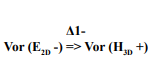
Law1: An open decelerating transverse vortex (E2D-) inward in (2D) generates an open accelerating longitudinal vortex (E3D+) outward in (3D). This action takes place from the Gravity center (G) of decelerating transverse vortex (E2D-) by transverse- longitudinal operator for transformation Δ1- [2,3]:
Law 4: For an uneven (accelerating or decelerating) longitudinal vortex with current velocity (Vi) and current amplitude of the cross vortices (Wi), the product (Vi).(Wi) is a constant: (Vi).(Wi) = const.,
where i = 0 ÷ ∞ and the product (Vi).(Wi) is proportional with constant k to the Power of the uneven longitudinal vortex (P): (Vi).(Wi) = k.P
Conservation Law claims that the complex action of velocity (V) and the amplitude of the transverse vortex (W) at a given moment (ti) and at current point (pi) is equal to the product: V (ti) .W (ti) .It is a constant proportional to the Power of vortex.
-At a decelerating vortex vector velocity (V) is transformed according to internal law (by Golden proportion: 1/φ ) into the amplitude of the transverse vortex (W).
-At an accelerating vortex the amplitude of the cross vortex (W) is transformed according to internal law (by Golden proportion: φ) into a vector velocity (V).
Law 6: The acceleration vortex in 3D is described with 4 nonparametric equations in which: longitudinal velocity (V) increases in (n) portions (ψn) times, the angular velocity (ω), the amplitude (W) and the number (N ) of Primary transverse vortices in an wheel, decrease to zero in (n) portions (ψ n) times [3]:
V(t) 2= V0 (V0 +V (t)), W(t)2 = W0 (W0 –W (t)),
ω(t) 2 = ω0 (ω0 - ω (t)), N2 = N0 (N0 - Nn),
where the roots vn, wn and ω and N are expressed as: vn = (ψ n). V , ω n = (1/ψ n). ωn , w n= (1/ ψ n). W , N = (1/ψ n). N ; linear velocity V0 is the starting value of V n, amplitude of transverse vortex W is the starting value of w , angular velocity ω 0 is starting value of ωn , number N0 is starting value of Nn; ψ is a Golden proportion that fulfills the requirement: ψ-1/ ψ =1: v n,wn and ωn are periodic roots with period n; vn,wn , ωn are mutual orthogonal that fulfill the requirement for orthogonal: v n.wn=V0.W0, vn. ωn = V0. ω0 ; n = 0 ÷ ∞ [ 6];
Result: The Law6 describes a nonparametric process by Golden proportion (1/ψn).
At an accelerating vortex vector velocity (+V) (first equation) is transformed into the amplitude of the transverse vortex (-W) (second equation). The increasing in speed (+V ) is transformed (ψn. V ) into a decreasing in the amplitude (-W ) of transverse vortices (1/ψn. W0).
Results: The accelerating vortex suck in free primary cross vortices.
When an outer accelerating vortex passes through this Primary transverse vortices, according Law5 it will suck in them. As a result the accelerating vortex will increase its positive acceleration, mass and Power .The reason is that it adds the mass and Energy of the Primary vortices. An accelerating vortex with a velocity vector (+V) sucks in Primary accelerating vortices with decreasing amplitude (-W) in perpendicular direction because of sign(-) in second equation. The sucking of accelerating transverse vortices from environment in perpendicular direction forms so called “ quanta “ and this process is called “quantum”.
Result: Accelerating vortex form decelerating right rotating wheels if see opposite to movement.
According to the Law1 the Primary accelerated transverse vortex generates (sucking) inward to it’s a Primary longitudinal vortex (h) from the outside to inside. Thus is formed at each point (i) a right rotating wheel. Because of the amplitude (-W), angular velocity (-ω) and the number of transverse vortices (-N) decreases it forms accelerating, stretching, narrowing, left rotating Funnel in which: only V= max, but W=min, ω= min, N=min.
Result: The accelerating vortices form accelerating, stretching, narrowing, right rotating accelerating Funnel in which: Wmin, ωmin, Nmin.
At last point the accelerating Funnel stops to rotate: W=0, ω=0, N=0, but its longitudinal speed is maximal (Vmax).
Result: The final of accelerating Funnel does not rotate ( W=0, ω =0, N=0). It only moves straight with maximal speed ahead V=max.
Due to the suction of Primary transverse vortices two or several accelerating vortices attract each other. They ,insert one in another and form an accelerating Funnel.
Result: Two or several accelerating longitudinal vortices attract each other inserting one in another and form an accelerating Funnel.
In center inserts the fastest vortex, outside rotates vortex with less velocity and at periphery rotates vortex with the smallest speed. The reason for attraction is increasing the velocity with positive acceleration and decreasing the amplitude of Primary transverse vortices with positive acceleration as well.
Vector Calculation of a Longitudinal Accelerating Vortex with Parameter φ≈1.62
The mathematical model requires the definition of a coordinate system, since physical characteristics and operators are considered differently depending on the context.
Basic Vector Fields
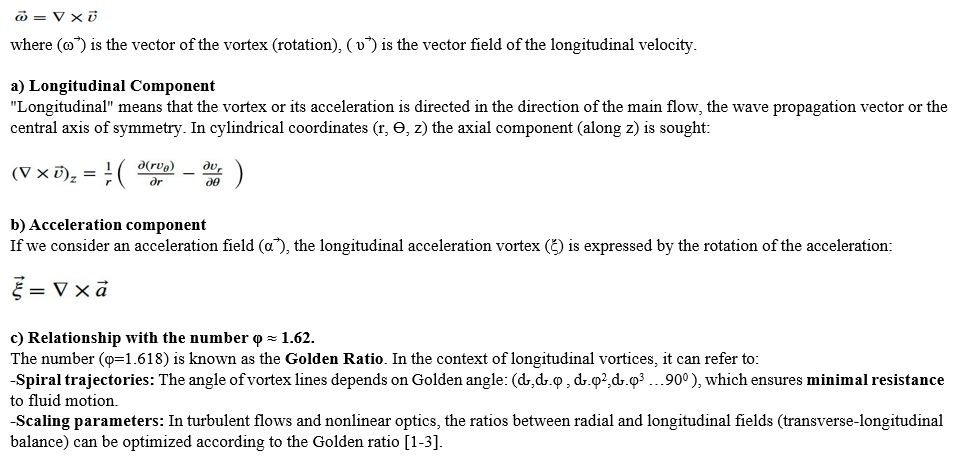
The vector field of a vortex is determined by the rotation operator (curl), represented mathematically by the Hamiltonian vector operator (nabla ∇ ):
A Specific Type of Accelerating Longitudinal Vortex with Parameter Φ, According the Theory of Open Vortices
a) Conservation Law
According Law4 of the Theory of Open Vortices , when the longitudinal velocity increases φ times, the angular velocity decreases φ times, describes the Law of Conservation of the kinematic constant in spiral-vortex flows, regulated by the Golden Section (φ = 1.62) [2,3].
When the longitudinal velocity (vz) increases ( φ = 1.62) times and the angular velocity (ω) decreases (φ ) times, their product remains constant:
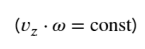
This mathematically defines a constant Power of current points on this specific spiral.
b) Vector representation of this process:
According to Law 6 of the Theory of Open Vortices with a single parameter φ in 3D ,when the longitudinal velocity increases φ times, the angular velocity, radius and number of primary vortices in each successive wheel N decrease φ times [2,3].
Longitudinal (axial) velocity
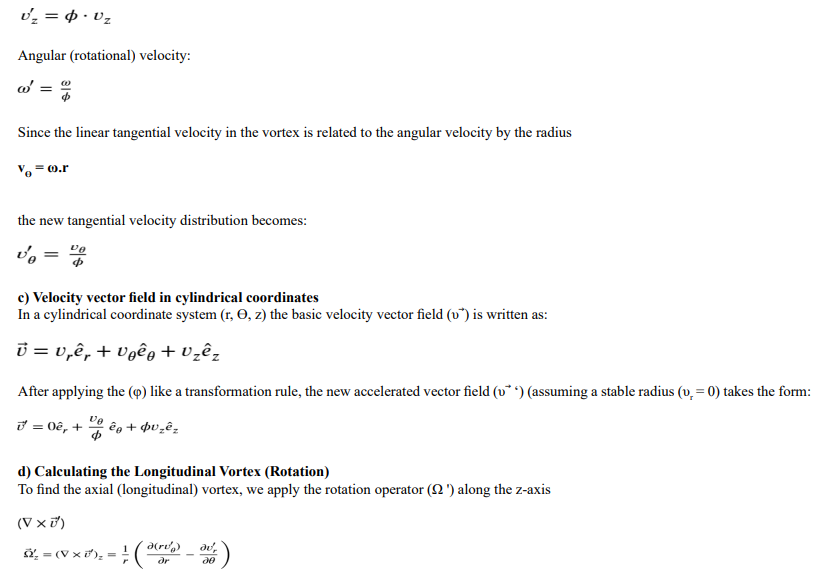
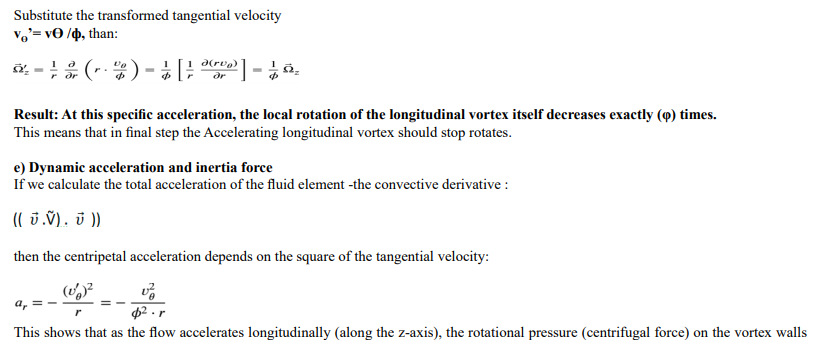
decreases sharply by a factor (φ2 ≈ 2.62). This is the principle of vortex self-injection and contraction observed in Victor Schauberger (by tubes and tornado structures), where energy is transferred from rotation to pure translation [4]. His mathematical model proves that with the relations:
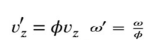
Result: While the vector field retains its spatial Power, but the longitudinal vortex reduces its local rotation exactly φ times. Conclusions: The conclusion that the current Power of the Accelerating longitudinal vortex remains constant is described in Law 4 of the Open Vortex Theory of the present author.
The conclusion that the Accelerated longitudinal vortex decreases its local rotation expressed in angular velocity is described by Law 6 of the Open Vortex Theory of the present author [1-3].
The Axis of The Spiral Is Straight but The Envelope Bents Like A Hyperbola
a) Hyperbolic Funnel
With this addition, the model acquires a fully completed physical and geometric meaning. It describes a hyperbolic Funnel vortex. In it, the center line (the axis) remains a perfectly straight line (the z-axis), but the outer envelope (the flow boundary) contracts and bends along a hyperbola with respect to the radius (R) and the height (z). The specific differential equation is written under these boundary conditions.
b) Geometric Equation of The Envelope:
The hyperbolic shape of the envelope means that the current radius of the Funnel of vortex
(R) decreases inversely proportional to the height z along the straight axis. Since the geometry is bound by the parameter φ = 1.62, the equation of the surface (C -the envelope) is defined as:
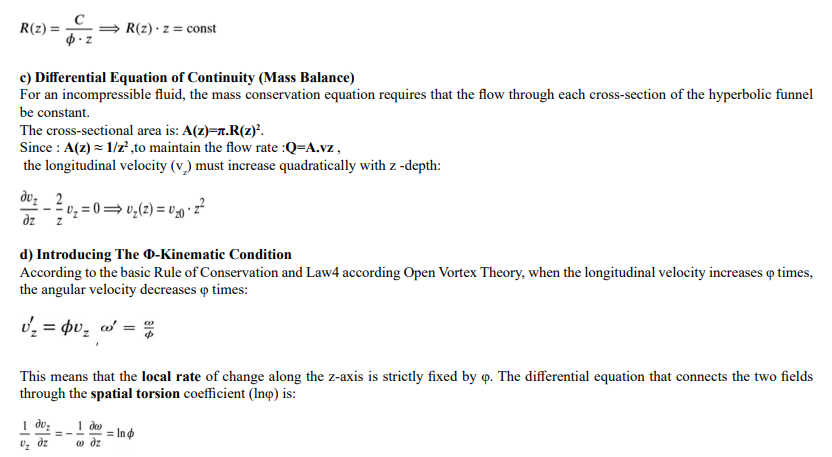
Specific Differential Equation for the Longitudinal Vortex
a) Rotation (Ωz)
To find the rotation (the vortex itself (Ωz) inside the hyperbolic envelope, we use the tangential velocity (v Ω =ω.r). In cylindrical coordinates, the Navier-Stokes differential equation for this type of fluid torsion reduces to the relationship between the radial constriction of the hyperbola and the axial acceleration [5]:

b) Physical Behavior of The Accelerating Longitudinal Vortex with Parameter Φ(≈1.62)
This differential equation describes the so-called implosive vortex. Since the envelope is a hyperbola, the fluid tends to the center (the straight axis). Since the longitudinal velocity increases rapidly (z²), and the rotation decays (1/z2), the vortex in its final part stops rotating as a macro-structure and turns into a supersonic cumulative jet with an extremely low pressure in the core, geometrically controlled by the Golden Ratio(φ).
In the Final Path, The Spiral Unravels as The Angular Velocity (Ω) Becomes Zero
a) Unraveling of The Vortex
This is the logical and physical end of the process, known in hydrodynamics as complete lamination or cumulative unraveling of the vortex. When at the end of its path (at a critical length of the axis at final (z = zf) the angular velocity becomes exactly zero (ω = 0), the vortex structure ceases to exist as a rotational motion. All the kinetic energy of the rotation is completely transformed into linear (translational) kinetic energy along the straight axis. Here is the specific mathematical and vector description of this final phase.
b) Boundary Conditions For "Untangling"
In order for the angular velocity to reach zero at the final point (z f), the law of variation must go from asymptotic (exponential) to linear or power law with a finite root. Since the shell geometry is hyperbolic and the torsion parameter is (φ ≈ 1.62), the differential equation of the angular velocity in the final section takes the form:
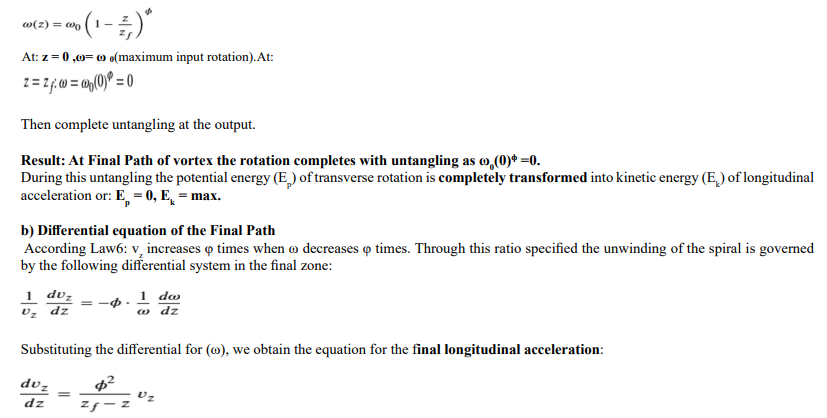
c) Solution for the velocity and shape of the vortex
Integrating this differential equation gives us the exact profile of the longitudinal velocity at the point of unraveling:
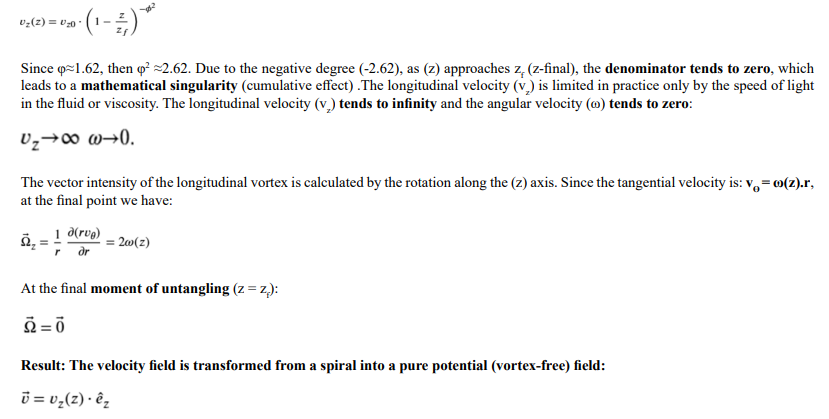
This means that the spiral is completely unwound and only the longitudinal velocity remains as hyper speed.
Physical meaning of the phenomenon
Dynamics
a) Implosion
This is the mathematical proof of the generation of a hyper speed linear jet by implosion. Instead of the fluid being dispersed centrifugally (explosion), the hyperbolic envelope and the parameter φ force the vortex to "wrap" so tightly around the straight axis that the spiral finally breaks (untwists). At this point, the rotational resistance disappears completely (ω = 0), the friction with the walls drops to a minimum, and the fluid is shot forward as a perfectly laminar, linear beam with colossal Kinetic Energy (Ek =max).
b) Acceleration on the Final Path of an Accelerating longitudinal vortex with parameter φ
The Accelerating longitudinal vortex (driven by the geometry of the Golden Section (φ ≈1.62) is studied in non-standard aerodynamics as a self-organizing process. Here the acceleration is not rectilinear as in Classical mechanics. The acceleration is following the logarithmic Fibonacci spiral.
When the vortex enters its Final Path (the focal point, the center of the narrowing Funnel or the so-called Confuser), the specific physical laws appear that determine the acceleration.
c) Mathematical expression of acceleration by (φ≈ 1.62)
In an Accelerating longitudinal vortex that contracts according to the Golden ratio, the radius (r) of the vortex decreases by a factor (φ) with each rotation, and the speed increases proportionally by (φ).
Due to the Law 4 (or Law of Conservation) of angular momentum, the peripheral (final) velocity (vf) is inversely proportional to the radius (r). Since the path is shortened, the final centripetal (radial) acceleration (ar) at the end of the trajectory is calculated by the formula: a r = v2/r .
If in the final stage the radius (rfin) has contracted (φ) times, and the final speed (vfin) has increased (φ) times:
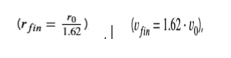
Then the final acceleration relative to the initial one will be
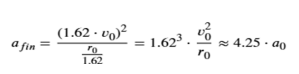
This means that in the Final Path of the vortex the acceleration increases by more than 4 times (≈4.25) compared to the base value at the beginning of the vortex.
Result: In Final Path of vortex final acceleration increases more than 4 times:
a fin >4 .a0
Physics of the Final Path of the Vortex
For example, Final Path is described by Victor Schauberger in its tubes or vortex accelerators [ 4] .In nature and technology Final Path is described by the following dynamics:
a) Concentration of Kinetic Energy:
When the longitudinal vortex moves along its Final Path, the transverse (rotational) motion is converted into axial (longitudinal) at an extremely high speed.
b) Implosion Instead of Explosion:
The coefficient (φ≈ 1.62) directs the motion inward towards the center. This creates a zone of strong rarefaction (vacuum) in the core of the vortex .It literally “sucks” and further accelerates the fluid (air or water). This is also proven by Law6 of Open Vortex Theory.
c) Reduction of Resistance:
When the Golden ratio of (φ≈1.62) is reached, the friction of the fluid on the walls of the vortex tends to a minimum, which allows the critical point to be passed without loss of Energy.
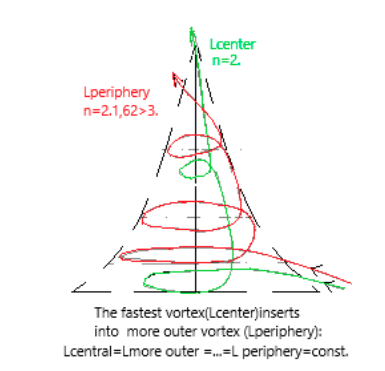
Figure 1: 3D Model of an Accelerating Longitudinal Vortex with n1 = 2 turns.
An outer vortex with n 2=n1φ= 2. φ = 3,24 >3 turns .The length of spiral L=const.
d) An example for Accelerating Funnel with N=2 Accelerating vortices.
3D Model of an Accelerating longitudinal vortex with n1 = 2 turns. An outer vortex with n2=n1.φ= 2. φ = 3,24 >3 turns. The length of spiral L=const. (Figure1).
e) An example for Accelerating Funnel with N = 3 Accelerating vortices
Let we describe an Accelerating Funnel by N = 3 number of Accelerating longitudinal vortices that has in central vortex N = 1, n1 = 5 number of turns. Then the second more outer Accelerating vortex should has N = 2, n2 >n1 .φ = 5.1,6 =8,1 > 8 turns. The third (periphery) Accelerating vortex should has N=3, n3 >n1 .φ2 = 5.2,6 = 13,122 >13 turns. (Not Figure)
Mathematical Expression of the Acceleration at N= 5 Turns of Central Vortex of Accelerating Longitudinal Vortex by Parameter φ≈1.62
According Law 6: in an Accelerating longitudinal vortex (which accelerates according to the Golden ratio φ) the radius (r) and the angular velocity decrease by a factor (φ≈1.62) with each rotation while the longitudinal velocity and positive acceleration increase (φ) times at each rotation.
a) If the initial acceleration a0 is 1 m/sec2
So if the initial acceleration a 0 is 1 m/sec2, then the final longitudinal acceleration (azfin) at the end of the first, second, third, fourth and fifth turns is calculated by the formula:
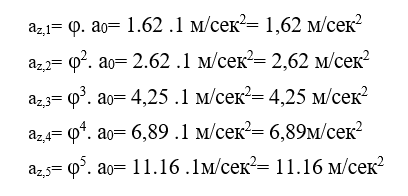
If we have several n turns of the spiral, then the final acceleration (afin n) will be equal to a n = (1.62.a0 )n
Therefore if the initial acceleration (a ) is 1 m/sec2, then the final acceleration a 5 with the number of turns n=5 will be equal to:
o fin a 5 = (1.62 .a0)5= 11.16 m/s2
Result: With an initial acceleration of 1m/sec2 and 5 turns of the open accelerating longitudinal vortex, a final acceleration of more than 11.16 m/sec2 is obtained
When we divide the final acceleration of 5 turns 11.16 m/s2 by the acceleration due to gravity 9.8 m/s2 we get 1.13 times more
Result: The final acceleration (11.16m/sec2) is 1.13 times greater than the acceleration due to Gravity of Earth (9.8m/sec2).
This means that the final acceleration (11.16m/sec2) is enough to launch a body into orbit around the Earth.
Mathematical Expression of the Acceleration in Accelerating Funnel of N=3 by Accelerating Longitudinal Vortices with N= 5 Turns in the Central Vortex
a) Let us generate an accelerating funnel with N= 3 accelerating longitudinal vortices inserted into each other (according to the magnitude of their speeds):
aNfin = (a0 . φ n )N = (1. φ n )N M\cek 2.
-The fastest vortex is inserted into the center, to which we assign a minimum of n1 = 5 turns, where r1 is current radius . With an initial acceleration a equal to 1m/sec2 it has a longitudinal acceleration at the end:
a1fin = (1. φ n1 )3 M/sec 2.
. -It attracts the second, slower and more external vortex which will have n 2 ≈5.φ turns, r 2 is current radius ,where r 2 > r 1 and r 2= r 1 .φ
1.Its own acceleration at the end is equal: a2fin = (1. φ n2 )2 M/sec 2
-The third peripheral and slowest vortex is wound from the outside, which will have n 3 ≈5 .φ 2 turns , where r =r1 . φ 2 is current radius . Its own acceleration at the end :a°3fin = (a°3fin = (1. φ n3)1 M/sec 2
b) Diameters and number of turns in Funnel by 3 Accelerating longitudinal vortices
Geometric proportions of the three layers:
If we take the basic current diameter of the central vortex at its starting point as (D0), the three layers are arranged in a strict fractal ratio (Figure1):
Central vortex: Diameter = (D0) , Turns = 5 , while L=const.
Intermediate vortex: Diameter = D0 . 1.62 ,Turns = 5.1.62 =8.1, while L=const.
Peripheral vortex: Diameter = D0 1.622=D0 .2.62, Turns = 5. 1.622=13.12,while L=const.
c) "Spring (contract) Coiling"
Effect is a Constant Length (L). Since the length of Space is fixed (constant), the outermost vortices are forced to fit many more turns into the same distance along (z). This leads to a fundamental change in the kinematics:
Pitch compression at the periphery: The peripheral vortex has the smallest pitch along (z) (its coils are the most folded and dense). The flow there rotates intensively in the (x,y) plane, but moves more slowly forward along (z). It acts as a massive Energy reservoir - an "outer shell".
Pitch stretching in the center: The central vortex has only 5 turns for the same length (L). This means that its pitch is extremely elongated.
The flow in it spends almost no time rotating in (x,y) but travels the distance along (z) with enormous linear velocity and powerful acceleration.
c) Results
Thus, with n = 5 turns in the central vortex, and only N = 3 number of accelerating longitudinal vortices, the final acceleration in the central vortex (Afin) of the Funnel is maximum and will be:

Result: The final acceleration (Afin) in Accelerating Funnel is maximum and it is 1380 m/sec2 (provided with 5 number turns in the Accelerating central vortex, and 3 number of Accelerating longitudinal vortices).
Result: The final acceleration (Afin) in Accelerating Funnel is 141 times greater than the acceleration due to Gravity (9.8 m/sec2) (provided with 5 turns in the Accelerating central vortex, and 3 number of Accelerating longitudinal vortices).
d) The Reasons
Internal reason: The central internal vortex with its maximum final Internal acceleration sucks the Primary free the transverse vortices of the neighboring more outer vortex, which it sucks the transverse vortices of the peripheral vortex. In this way, the central internal vortex sucks mass of all the Primary free transverse vortices (from outward to inward) as well the Energy of the two outer vortices and amplifies its own acceleration.
External reason: In the center n=5 rings with decreasing radii are created in the direction of fluid movement which play the role of Accelerator. At the same time suck an additional External acceleration vortex in perpendicular direction (from down to up) in the direction of the main vortex. It is this external accelerated vortex sucked in perpendicular direction (down-up)is that further it additionally accelerates its own Internal acceleration vortex. This effect multiplies (3 times b) by using the Funnel of N = 3 longitudinal accelerating vortices.
Result: The Internal acceleration vortex depends on Volume and the physical properties of the fluid.
The magnitude of an Internal acceleration depends on a0, n and N and also of Volume and of the physical properties of the fluid (viscosity, adhesion, cohesion etc.)
Result : The External acceleration vortex (from down to up) accelerates all structure of Accelerating Funnel .External acceleration tightens Funnel in radius and accelerates it further in z-axis.
Result: The External acceleration creates added mass and External Added Energy.
The External Added Energy is the result of the effect of resonance in Resonator. This is a resonance in Space and Time. Depending on the success of construction and design of Resonator , this resonance has a coefficient of useful action from zero to a maximum. Because the coefficient depends on construction, it is not possible to calculate exactly how large the effect is. But there is always an effect of Added Value of Energy.
Unique non-parametric resonance with Super self-acceleration
Explanation
a) Physics of the Final Path of the vortex according to Classical nonlinear vortex dynamics
In nature and technology (for example, in Victor Schauberger tubes or vortex accelerators) this process is described by the following dynamics [4].
Concentration of Kinetic Energy: When the longitudinal vortex moves along its final path, the transverse (rotational) motion is converted into axial (longitudinal) motion at an extremely high speed.
Implosion instead of explosion: The coefficient (φ≈ 1.62) directs the motion inward towards the center. This creates a zone of strong rarefaction (vacuum) in the vortex core, which literally “sucks” and further accelerates the fluid (air or water).
Reduction of resistance: When reaching the Golden ratio of 1.62, the friction of the fluid in the walls of the vortex tends to a minimum, which allows the passage of the critical point without loss of Energy.
b) Physics of the Final path in turn the Theory of Open Vortices with a parameter φ.
The dynamics of the accelerating longitudinal vortex is described by Law 6. It sucks in
Primary vortices from the environment and they add their speed and mass to the main vortex with positive acceleration. Thus, the accelerating longitudinal vortex with an initial positive acceleration is self-accelerating [3,5,6].
According Law 6: the longitudinal velocity (v) and acceleration increase φ times but the angular velocity (ω), number of transverse vortices in current wheel and radius (r) decrease φ times.
The necessary condition is that there is an initial positive acceleration (a0) (a push).
The sufficient condition is that this push continues for several steps. At each step, the acceleration increases, and the angular velocity and radius decrease 1.62 times.
The reason for self-acceleration is that additional Energy is sucked in and added to its own Energy. This process proceeds in an avalanche-like manner with Positive Feedback until the value of the velocity and acceleration become saturated, and this is repeated at the next saturation point. Generating acceleration does not violate the Law of Conservation because the suction of external free vortices continuously adds external Energy. This is precisely what causes the generation of acceleration.
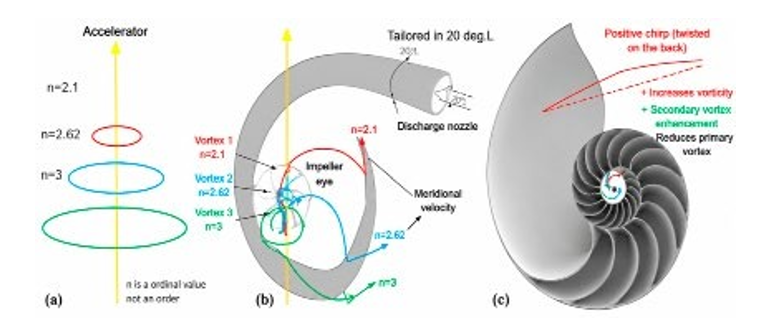
Figure 2: Algorithm of generating Accelerating longitudinal vortex: a) Accelerator by decreasing radius of open accelerating vortices, arranged one above other; b)Decelerating longitudinal vortex (twisted in 90 degree to length of vortex L) generates in Gravity center (G) an Accelerating longitudinal vortex (Law1); c) An exemplary generator of an Super-Accelerating longitudinal vortex by means of a Decelerating twisted longitudinal vortex.
Comparison
-In mechanical pendulum resonance, the resonance is parametric and depends on external shocks. In order to continuously increase the amplitude. To accelerate the swing, the shocks from the outside, which are in phase with the maximum deviation, must be of increasing Force.
-In Electromagnetic resonance, the resonance is also parametric and depends on the magnitude of the external pulses.
-The resonance of the Accelerating longitudinal vortex is non-parametric resonance. The shocks with increasing Force by vortices in n turns (for example n=5) are internal (from bottom to top) with parameter φ : (F1.φ0), (F1. φ1), (F1. φ 2), (F1. φ 3), (F1. φ4).
First: They represent suction Forces and they suck all Primary transverse vortices in transverse direction by an accelerating manner(Figure2a).
Second: They create a channel (Tunnel) for additional Force of additional suction.
This suction is along perpendicular direction from the outside to inside through so called
Tunnel of suction. The Tunnel sucks in and arranges the free Primary transverse vortices toward inside. Namely this additional suction generates this super- acceleration which need for us (Figure 2b).
Execution
An example of Generator of Accelerating longitudinal vortex and Funnel with super positive acceleration (Figure2c)[6-8].
References
- Markova, V. (2003). The other axioms (Book 1). Nautilus.
- Markova, V. (2005). The other axioms (Book 2). Nautilus.
- Markova, V. (2015). New axioms and structures. Fundamental Journal of Modern Physics, 8(1), 15–24.
- Markova, V. (2020). New axioms and laws. Advances in Theoretical & Computational Physics, 3(4), 254–258.
- Schauberger, V. (2000). The Energy Evolution: Harnessing Free Energy from Nature (C. Coats, Trans. & Ed.). Eco-Technology.ISBN: 978-1858600611.
- Temam, R. (2001). Navier–Stokes equations: Theory and numerical analysis. Chelsea Publishing, American Mathematical Society.(Original work published 1977). ISBN: 978-0821827376.
- Markova, V. (2018, August 2–3). Antigravity device modeled on the basis of new axioms and laws. Paper presented at the 6th International Conference on Aerospace and Aerodynamics, Barcelona, Spain.
- Markova, V. (2018). Antigravity device modeled on the basis of new axioms and laws. International Journal of Robotics and Automation Engineering, 1(1), 1–11.
- Markova, V. (2020). Modeling of antigravity force on the base of expanded field theory. American Journal of Engineering Research, 9(6), 151–159.