

Current Trends in Business Management(CTBM)
ISSN: 2995-4010 | DOI: 10.33140/CTBM



Research Article - (2024) Volume 2, Issue 1
Value Based Classification Technique for Sustainable Business Models (SBMs)
Received Date: Jan 16, 2024 / Accepted Date: Feb 04, 2024 / Published Date: Feb 28, 2024
Copyright: ©©2024 Maruf Mohammad Sirajum Monir, et al. This is an open-access article distributed under the terms of the Creative Commons Attribution License, which permits unrestricted use, distribution, and reproduction in any medium, provided the original author and source are credited.
Citation: Monir, M. M. S., Gebremeskel, A. N., Doan, K. H. (2024). Value Based Classification Technique for Sustainable Business Models (SBMs). Curr Trends Business Mgmt, 2(1), 1-6.
Abstract
Sustainable innovations, efficiency, and social responsibility for society are demanded by every long -term surviving business model. Though they are important, but insufficient in themself to perform innovation when applied individually. Any long-term innovation and sustainable business model are difficult to achieve its goal if these holistic techniques are applied individually. That is a big challenge for any sustainable technique with minimizing the risk factor associated with it. Many sustainable business models involve a triple bottom line approach and include a wide proportion of stakeholder interest along with social and environmental sustainability. They are important and work as the driving potential for growth in the long term. These sustainable innovations can be embedded into business processes and purposes and work as the key factors in a competitive global market. Many innovative techniques perform quite well when applied individually but not grouped under a single theme. In this work wide range of literature is analyzed and various sustainable models are grouped under a common theme in terms of samples. These samples have collaborated with the various available case studies and industrial exposure. These sustainable business models are introduced by describing grouping mechanisms and their solutions that can be used as hands-on exposure to the new practitioner. The aim of this grouping is to give a common language for the acceleration of sustainability impel enation in the business model.
Keywords
Business Model Innovation, Industrial Sustainability, Value Creation and Stake Holder.
Introduction
With the anticipation of a growing population of the world along with proportionate accelerated global expansion resulted in escalating use of resources and detrimental environmental impacts. It is obviously apparent from the current scenarios of these constraints that any conventional business setup will not sustain for long terms. The world needs more than 1.8 times the planet to provide the needs of the current planet and wastes [The world Count]. Awareness regarding these needs with the current ecological system on the earth requires new trends with sustainable business models [1]. In history and even in the current scenario, it is not common to give appropriate values to free natural resources. So, for having a sustainable future, it is re- quired to have a universal or comprehensive approach in business models across the world. These models should include the approaches to combat detrimental effects on the environment. Model to have a sustainable economy should have the following features [2]:
• A Model should concern with reducing and if it is possible then imposing limits on the quota of consumption on energy, goods, and water used for processing purposes.
• A Model should impart growth of environment and society rather than focusing only on economic growth.
• There should be 100% closed-loop processing within the business model. i.e. there should not be any kind of wastage or discard of unused or defective material and parts. The business model should focus on recycling, repairing, and remaking.
• A model should envisage developing expertise and functionality instead of focusing on ownership of the product.
• A model should also focus on developing human skills and creativity.
• Model should focus on collaboration of similar type of business rather than aggressive approaches in competition.
These types of alteration require a fundamental shift in existing or any new model for sustainability. These innovations on any business model offer revitalization of the purpose of that model and logic development that create value for that particular model. It has been found that in the case of the existing mainstreaming business model if incubation of the above-stated features is done carefully then it is quite simpler to make the existing model into a sustainable model [3].
Innovation of the Business model results in greater environmental and social sustainability in the existing industrial lobby [4]. However, in the current era of cutthroat competition among various companies, it is difficult to maintain that sustainability [3]. In this paper, an attempt has been made to review various types of business model innovations along with categorizations for imparting sustainability in the existing or new models. This categorization results in further research by proposing samples of sustainable business models. These samples can be used for im- parting it on new business or existing business models. In this paper, an attempt has been made to define the categorization mechanism of the sustainable business along with their hand on the example of current industrial uses. This hand-on exposure may be used for any new or existing business models that fall under a common theme.
Literature review
Many research works have been done for sustainable business model development through innovation that has strived thoroughly for presenting current models. This literature review is used for framework and guideline development for sample creation which is the main work of this research article. Some critical findings during review have been discussed here in this section: Evan et al [5]. Have proposed a work that emphasized five steps for any sustainable business model is to create value in the model the first step is to create social, economic, and environmental benefits. Geissdoerfer et. Al [6]. Has proposed work by designing the concept of ‘Value Ideation’, value opportunity portion, and value proposition prototyping. Biloslavo et al [7]. Have proposed a value triangle (VT) for the economic growth of the firm. In this framework, value is co-created by the collaboration of the firm with the stakeholders.
The value generated through this model is used for facilitating customer value, partner value, and public value.
Oskam et al [8]. Have introduced value shaping in sustainability-based innovation. This results in gen- erating financial, environmental, and social values by interacting with various values generating networks. Different networks assist in designing the value. They also argue that change in the value generated by a firm is the direct result of the change in the mindset of the firm. Joyce et.al [9]. Have proposed a novel approach for developing a sustainable business development model. That model is a triple layer to meet the social, economic, and environmental benefits. Each of these layer’s results in value creation and satisfy the need of business through the economic, environmental, and social benefits.
Roman et al [10]. Have proposed a three-step approach for a sustainable business development model. This model progresses toward a sustainable business model through the open database. These datasets are used for the open innovation process. Schaltegger et al [11]. Have proposed a strategic model that works as an alternative to the sustainable business model. This model results in a competitive advantage to the industry by making a conventional business model meet the sustainable development goal. This ultimately results in increased profitability and productivity. Apart from this literature based on value identification of business models, a business model based on the economic growth of the organization has been shown in table 1. Along with societal and environmental sustainability, every organization is required to have self-sufficiency in terms of economic growth.
|
Author/Authors |
Year of publication |
Economic factor in Contribution |
Data source |
|
De bernadi et al. [12] |
2018 |
Process and designing |
Case study |
|
Baldassarre et al. [13] |
2017 |
Framework |
Literature synthesis |
|
Tolkamp et al. [14] |
2018 |
Process and designing |
Interview |
|
Kurecz et aal. [15] |
2017 |
Conceptual model |
Literature synthesis |
|
Morioka et al. [16] |
2018 |
Framework |
Case study |
|
Stubbs [3] |
2017 |
Process and designing |
interview |
Table 1: Application of Sustainable Business Model in Economic Growth of Organization.
Methodology
Basically, business model is a conceptual tool that envisages the functionality of a particular firm. This model is used for analysis, assessment, innovation, and comparison of firms. The business model defines the competitive strategy by analyzing the design pattern, marketing trend, and pricing strategy of the services and products offered by them. It also depicts how it is differentiating itself from other firms in terms of value.
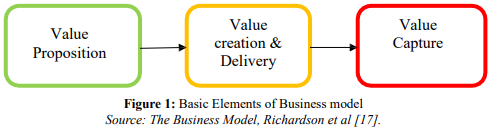
In this paper, any business model is defined by three elements.
That are value proposition, value creation, and delivery, and the last one is value capture as indicated in figure 1. The value proposition is associated with products and services offered by the firm in hope of economic returns on the other hand Value creation can be assumed as the heart of any business model while for capturing value, the firm needs to be always in the hunt to find out new channels for making funds and goodwill among customers. Business models along with their innovations are keys to the success of any business within an industry.
Ludeke et al [4]. found in their work that a sustainable business model creates competitive models that create advantage not only by providing values to the customers but also by contributing to society and the environment. Eco-design and Eco-Friendly techniques are important from a sustainability point of view. It is achieved through the reduction of energy and product consumption along with the reduction of waste per unit and emission. This efficiency improvement will culminate into improved services and products by making them more accessible and affordable as defined by the “rebound effect” [18]. In a similar attempt, the government of the United Kingdom has declared reduction of 80 % greenhouse gases by 2050 relative to the year 1990. This can be only possible through long-term sustainable development. By improving efficiency, it is easier to convert efficiency into profit but it is not feasible always to convert societal and environmental policies into the profit of the firm. To tackle the unsustainable future of the organization, innovations are required at the core of the organization rather than as an add-on to counteract the negative effects of an unsustainable future. Business model innovations may not be viable at starting but may become viable after a certain time period due to environmental needs and regulations from the government. This can be assimilated through the invention of the electric car as it was not so viable in the launch year though it was innovative and ecofriendly now due to demand of cleaner environment those firm are blooming than conventional Business Model of vehicles.
In the literature review, it has been found that there are various different strategies and approaches for innovation in sustainable business development. Also, there are not exactly common sources that are avail- able for the construction of innovation models. That makes it difficult for practitioners to make an innova- tion model with available data hence causing hindrance in practical experimentation. These un-connected sources also restrict the synergic implementation of different innovation approaches. This reduction or con- straint on potential benefits can be overcome by systematic categorization of business models having inno- vative approaches. This grouping can make it easy for practitioners to perform experiments in developing business models and identification of the corresponding bottlenecks in the growth. This grouping is termed a sample in this work. These samples are found by following 3 steps. The first step is to find out the correct theme for the development of the sustainable model. In the second step, work has been done to suit the sustainable business model categorization of the sample and in the third step, an attempt has been made for analyzing business model innovations through practice or available examples. Similar is depicted in figure 3.
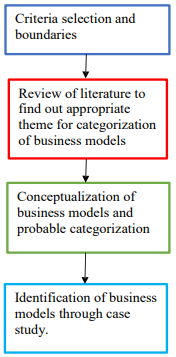
Figure 2: Methodology for Finding Out Sample of Sustainable Business Model.
Boundaries and criteria are defined for facilitating the steps of collection of examples for literature and experimental practice point of view. It defines the generic methodology for supporting business model developments for innovations. The sample made through this is representative of the main feature of the transformation of business model innovations. It also should be exemplary and mutually exclusive but not should be overly susceptible. The literature review is achieved through standard journals. This literature contains all relevant keywords. This literature envisages sustainable business models. Major script achieved from the sustainability literature focuses on contribution to the business model for sustainability. In the literature of concerned research articles, it has been found that there is a lack of categorization of business model sampling. In some industrial case studies, it has been found that they are using techniques for sustainable business model innovations that are much ahead of existing theoretical studies. So, examples from existing industries are crucial in developing categorization samples
Results
In this section, samples of the various sustainable business models have been found. These samples are classified on the grouping of higher orders. Important types of innovations of business model include Technological, social, and Organizational based innovations. The technical grouping includes samples that are mainly focusing on technological development for the development of the business model. To achieve this, manufacturing and product redesigning is achieved; similarly, the social grouping includes improvements in offerings to the customers and modification of consumer behavior while in case of organizational grouping focus is made on changing the fiduciary responsibilities of the firm. They are a high level of grouping but often they are paired with other innovations.

Figure 3: Classifications of Sampling
In this section 8 types of samples have been founded out that discussed below:
• Maximize material productivity and energy efficiency: In this type of business model sample, there are approaches to do maximum with fewer available resources. Hence results in less emission and pollu- tion. This sample focuses on the basic manufacturing sector and industrial sustainability. This sample should propagate through the entire business structure subsequently resulting in value propositions. As resources available are going to be short in the future along with increment in energy price, this model is going to be high uses in the future. This model encompasses lean manufacturing, eco-friendly and cleaner production firm that improves resource efficiency. There are various industrial or businesses available having this type of approach. An industrial example of this model is Toyota Production System [19]. They integrate lean manufacturing throughout their business.
• Create value from waste: In this stream, waste is eliminated from business. Waste is converted into a useful product for the input of the processing unit. For any efficient seeking organization, waste removal may be a beneficial step as it affects efficiency directly. In some industries, waste removal is added up as complementary value additions as in the case of coal thermal power plants, fly waste ash can be used for fire bricks. This approach is similar to our food supply chain where waste from species becomes food for other species [20]. This type of sampling of sustainable business models results in a reduced effect on the environment. And also, the continuous demand is supplied by recycling of the resources resulting in a closed material loop. Cradle to cradle incorporate the idea of a close-loop instead of the open-loop cycle in the nutrient development phase [21]. In the latter case, they found it difficult to recapture the waste products.
• Substitute with the natural and renewable process: It aims in reducing environmental impact and increase business resilience by incorporating the limit to a growth model in the case of non-renewable sources and the current production system. This sample includes a business model that relies on renewable energies and natural processes to create an eco-friendly industrial system. This focuses on limiting the use of available resources on the planet. Evan et al. Studied an industry where solar energy is used for lighting purposes and hybrid solar and windmill incorporated for generating electricity for manufacturing purposes [5].
• Delivery functionality rather than ownership: In this approach basic idea found is to focus on product improvement as per the interest of the consumers. So, ultimate idea is to focus on improving the quality of the product rather than its quantity. This type of model solemnly shifted toward the providing greater ser- vice model. Hence provide products that have pay per service rather than selling a complete set of products with similar attributes. To achieve this product is going to be changed again and again inside the industrial system. Manufacturers may develop products having good upgradability, reparability that results in low uses of resources, and corresponding wastes are also reduced. Example of this type of model includes car servicing firms and Xerox performing firms [22].
• Adopt a stewardship role: In this approach business models have been found to be in long-lasting relation with their stakeholders for the long-term good future of the firm. Stakeholders are thoroughly in- volved in all crucial as well as other decision-making meetings. This long-term satisfaction of stakeholders results in a positive effect on society. An example of this type of model is found in Marine stewardship council
• Encourage sufficiency: This type of business model has an approach to reduce the demand of the prod- cut on consumer size hence limiting the production of that firm. This involves durable product design so that products have a longer life. This model tries to have the habit of consuming and wasting less on the customer side. This type of model results in a good relationship with the customer and also result in large market capture as increased reputation due to durable product development. Energy-saving companies have adopted this model to save energy consumption by customers. Due to these savings, profit made by the company is shared with customers partially [23].
• Repurpose for society/environment: In this type of sample, there is the business model that seeks sus- tainability through capturing the social and environmental benefits rather than economic profits. Close in- tegration between society, firm, and stakeholder established. On a basic system level, this type of firm is inclined for driving globally rather than scale for the smaller regions. Example of these type of model includes microfinance and manufacturing enterprises having service area in rural cantonment [24].
• Develop scale-up solutions: The aim of this type of model is to mass-scale level sustainable production for maximizing benefits to the society and environment. This type of business model can be created by having proper employing channels and partners so that long-term and large-scale benefits can be combined simultaneously. Most franchise-based organizations are examples of this type of model [25].
Conclusion
The available literature for sustainable innovation is segregated in a large range. There are various novel techniques also found out that are of great for innovations for sustainability. This research work tries to group those techniques into 8 unique with common themes for each domain in terms of the sample. The main purpose of sampling is to group similar types of value generation businesses under a single umbrella. This mechanism assists in further research and innovation that can be done for sustainability. Results ob-trained can be used as de-risking parameters for beginners as an analysis done on various industries in literature and case studies. The 8-business model can be viewed as an initial point for broadening research and innovation for starting or existing business model.
Acknowledgement
This paper was co-financed by the Bucharest University of Economic Studies during the PhD program.
References
- Costanza, R., d'Arge, R., De Groot, R., Farber, S., Grasso, M., et al. (1997). The value of the world's ecosystem services and natural capital. nature, 387(6630), 253-260.
- Jackson, T. (2009). Prosperity without growth: Economics for a finite planet. Routledge.
- Stubbs, W. (2017). Characterising B Corps as a sustainable business model: An exploratory study of B Corps in Australia. Journal of Cleaner Production, 144, 299-312.
- Lüdeke-Freund, F. (2010). Towards a conceptual framework of ‘business models for sustainability'. Knowledge collaboration & learning for sustainable innovation, R. Wever, J. Quist, A. Tukker, J. Woudstra, F. Boons, N. Beute, eds., Delft, 25-29.
- Evans, S., Vladimirova, D., Holgado, M., Van Fossen, K., Yang, M., et al. (2017). Business model innovation for sustainability: Towards a unified perspective for creation of sustainable business models. Business strategy and the environment, 26(5), 597-608.
- Geissdoerfer, M., Vladimirova, D., & Evans, S. (2018). Sustainable business model innovation: A review. Journal of cleaner production, 198, 401-416.
- Biloslavo, R., Bagnoli, C., & Edgar, D. (2018). An eco-critical perspective on business models: The value triangle as an approach to closing the sustainability gap. Journal of cleaner production, 174, 746-762.
- Oskam, I., Bossink, B., & de Man, A. P. (2018). The interaction between network ties and business modeling: Case studies of sustainability-oriented innovations. Journal of Cleaner Production, 177, 555-566.
- Joyce, A., & Paquin, R. L. (2016). The triple layered business model canvas: A tool to design more sustainable business models. Journal of cleaner production, 135, 1474-1486.
- Roman, M., Liu, J., & Nyberg, T. (2018). Advancing the open science movement through sustainable business model development. Industry and Higher Education, 32(4), 226-234.
- Schaltegger, S., Hansen, E. G., & Lüdeke-Freund, F. (2016). Business models for sustainability: Origins, present research, and future avenues. Organization & environment, 29(1), 3-10.
- De Bernardi, P., & Tirabeni, L. (2018). Alternative food networks: Sustainable business models for anti-consumption food cultures. British Food Journal, 120(8), 1776-1791.
- Baldassarre, B., Calabretta, G., Bocken, N. M. P., & Jaskiewicz, T. (2017). Bridging sustainable business model innovation and user-driven innovation: A process for sustainable value proposition design. Journal of cleaner production, 147, 175-186.
- Tolkamp, J. C. C. M., Huijben, J. C. C. M., Mourik, R. M., Verbong, G. P. J., & Bouwknegt, R. (2018). User-centred sustainable business model design: The case of energy efficiency services in the Netherlands. Journal of cleaner production, 182, 755-764.
- Kurucz, E. C., Colbert, B. A., Luedeke-Freund, F., Upward, A., & Willard, B. (2017). Relational leadership for strategic sustainability: Practices and capabilities to advance the design and assessment of sustainable business models. Journal of Cleaner Production, 140, 189-204.
- Morioka, S. N., Bolis, I., Evans, S., & Carvalho, M.M. (2017). Transforming sustainability challenges into competitive advantage: Multiple case studies kaleidoscope converging into sustainable business models. Journal of cleaner production, 167, 723-738.
- Richardson, J. E. (2005). The business model: an integrative framework for strategy execution. Available at SSRN 932998.
- Herring, H., & Sorrell, S. (2009). Energy efficiency and sustainable consumption. The Rebound Effect, Hampshire, 1-266.
- http://www.blackerbyassoc.com/Resources/LeanThinking-HomeBuilding.pdf
- Lambert, A. J. D., & Boons, F. A. (2002). Eco-industrial parks: stimulating sustainable development in mixed industrial parks. Technovation, 22(8), 471-484.
- McDonough, W., & Braungart, M. (2010). Cradle to cradle:Remaking the way we make things. North point press.
- Tukker, A. (2004). Eight types of products–service system: eight ways to sustainability? Experiences from SusProNet. Business strategy and the environment, 13(4), 246-260.
- FORA. (2010). Green Business Models in the Nordic Region: A Key to Promote Sustainable Growth.
- Yunus, M., Moingeon, B., & Lehmann-Ortega, L. (2010). Building social business models: Lessons from the Grameen experience. Long range planning, 43(2-3), 308-325.
- Dant, R. P., Grünhagen, M., & Windsperger, J. (2011). Franchising research frontiers for the twenty-first century. Journal of Retailing, 87(3), 253-268.