

World Journal of Clinical & Medical Images(WJCMI)
ISSN: 2833-9312 | DOI: 10.33140/WJCMI

Research Article - (2026) Volume 4, Issue 1
Utilization and Associated Factor for Reproductive Health Service Among Private College Students in Addis Ababa, Ethiopia, an Institutional Cross-Sectional Study. Addis Ababa, Ethiopia, 2022
2Addis Ababa university, school of nursing, Tikur Anbessa specialized hospital, Addis Ababa, Ethiopia
3Department of Public Health, Saint Paul hospital millennium medical college, Addis Ababa, Ethiopia
4Defense University health science college, Armed forces comprehensive specialized hospital, Addis Ab, Ethiopia
5Department of Public Health, Saint Paul hospital millennium medical college, Addis Ababa, Ethiopia
6Armed force comprehensive specialized hospital, Addis Ababa, Ethiopia
Received Date: Jan 14, 2026 / Accepted Date: Feb 11, 2026 / Published Date: Feb 26, 2026
Copyright: ©2026 Mulugeta Taybele, et al. This is an open-access article distributed under the terms of the Creative Commons Attribution License, which permits unrestricted use, distribution, and reproduction in any medium, provided the original author and source are credited.
Citation: Alem, A., Birhan, G., Gezahegn, T., Taybele, M., Lombamo, F, et al. (2026). Utilization and Associated Factor for Reproductive Health Service Among Private College Students in Addis Ababa, Ethiopia, an Institutional Cross-Sectional Study. Addis Ababa, Ethiopia, 2022. World J Clin Med Img, 4(1), 01-16.
Abstract
Introduction: The college students were vulnerable to persistent reproductive health problems which are related to unprecedented social, economic, and cultural change regardless of health education, family support, and health knowledge factors . About one half of all HIV infections worldwide occur among people aged 25 years and under. And up to 100 million youths become infected with a curable sexually transmitted infections. The trends of modern contraceptives utilization in sexual active age group were very low. For instance the use of modern contraception in lower socio-economic status country including, Ethiopia were only 50%.These low coverage of all type of family planning methods leads unwanted pregnancy and unsafe abortion in the youths.
Objective: The main objective of the study is to examine the prevalence and determinants of reproductive health services use among private college student in Addis Ababa, 2022.
Method: Institutional based cross-sectional study would be employed from May to June,2022 to assess reproductive health service use and its associated factors by administering a pretested structured questionnaire. A multi stage cluster sampling technique would be used to select a total of 575 college student. The data was collected from nine Private collages by using self-administered questionnaire. The collected data would be checked for its completeness and clarity by the principal investigator daily and entered and analyzed by epi info version 7 and analyzed by SPSS version 25 software package respectively. Logistic regression (Bivariate and multivariable) analysis would be used to examine possible factors associated with reproductive health service use . P value less than 0.2 for Bivariate logistic regression and p value less than 0.05for multivariable logistic regression would be considered as level of significance. Confidentiality will be reserved. Participants’ involvement in the study would be on voluntary basis and they didn’t ask to write neither their name nor their address.
Result: About half of (51.03%) of the students utilized at least one of reproductive health services. Students who had discussed with their reproductive health issues with their sexual partner were around 85% less likely to use reproductive health service than those student who were not discussed with their sex partners, and Students who had discussed with their reproductive health issues with their peers were around nine times more likely to use reproductive health service than their counter parts (AOR= 0.148, 95% CI:0.025-0.8972 and AOR= 8.320, 95% CI: 1.807-38.315 ) respectively. Student who were exposed to different type of mass media were around fifteen times more likely to utilize reproductive health service than those who were not exposed to mass media (AOR= 14.732, 95% CI=3.777-50.461).Ever had sexual intercourse were around seven times more likely utilized one of the four reproductive health service than against the counter (AOR 6.566 ,95% CI ;1.534-28.103).
Conclusion and Recommendation: The use of reproductive health services among student in the study area were low related to other study finding . Discussion with sexual partner and peers, exposure to mass media and ever had sexual intercourse was among the predictors of reproductive health services use. College reproductive health clubs are important steps to improve students reproductive health service utilization.The results are limited by the sampling bias and the quasi-experimental study design. Findings suggest the program successfully enhanced clinical teaching knowledge and confidence
Keywords
Addis Ababa, Ethiopia, College Student, Reproductive Health, Service UseList Of Abbreviations
AIDS: Acquired Immunodeficiency Syndrome
AOR: Adjusted Odds Ratio
CL: confidence level
CI: Confidence Interval
COR: Crud Odds Ratio
EDHS: Ethiopian Demographic and Health Survey
FP: Family Planning
HIV: Human Immunodeficiency Virus
HPV: Human papilloma virus
ICPD: International Conference on Population Development
IRB: Institutional Review Board
MSc: Master’s Degree in Science
NGO: Non-Governmental Organization
RH: Reproductive Health
RHS: Reproductive Health Service
STD: Sexually Transmitted Disease
STI: Sexually Transmitted Infection
VCT: Voluntary Counseling and Testing (for HIV)
IUCD: intrauterine contraceptive device
WHO: World Health Organization
USA : united states of America
Introduction
Reproductive health address the reproductive process ,function, and system at all stages of life. According to the World Health Organization (WHO), youth is defined as a young person between the age group of 15 and 24 years [1]. Youth age group also a period of transition from childhood to adulthood characterized by significant physiological, psychological, and social changes that place their life at high risk. And these age group labeled as the vulnerable group, because this segment of population is subjected to curiosity, sexual maturity, and natural inclination towards experimentation, and peer pressure leads to risky behavior. Majority of college students were youth age group and faced different type reproductive health problem . Many girls in developing countries are vulnerable to leaving school, child marriage, early pregnancy, Exposure to human immunodeficiency virus (HIV), sexual exploitation, coercion and violence, unwanted pregnancy, and unsafe abortion and its complications [1]. More than a quarter of the world’s population is between the ages of 15 and 24, with 86% living in less developed countries. Globally, there are 1.8 billion youth people with over 80% unmet reproductive health (modern contraceptives, voluntary counseling and testing ,sexual transmitted infection diagnosis and treatment , low access to reproductive health education and communication etc.). Particularly, in sub-Saharan Africa reproductive health needs among the youth remain as a problem for most people. They are more at risk of experiencing reproductive health problems like sexually transmitted infections (STIs), poor family planning utilization service and poor voluntary counseling and testing service including HIV/AIDS. problems due to limited access to services and information [2].
Ethiopia adapted International Conference On Population and Development (ICPD) agreement which is the ICPD review in 2004 demonstrated that countries had made significant progress in adopting and implementing a reproductive health approach; strengthening efforts to improve and addressing youth reproductive health problems And take measures that have been commenced to alleviate the problem which includes the development of the national adolescent and youth reproductive health strategy, youth policy, standards on youth friendly reproductive health (RH) Services, and youth sector development plan [3]. Even though, More than 1/3 of the Ethiopian population is found between 10 and 24 years [2]. Most of the existing services are still adult-centered, none-youth friendly, undertaken in small scale and not well organized to meet the reproductive health service needs of this section of the population. But despite these initiatives, reproductive health service use among the youth still faces a lot of challenges related the sensitive nature to of youth sex and sexuality [4].
The college students are also vulnerable to persistent reproductive health problems , which are related to unprecedented social, economic, and cultural change regardless of health education, family support, and health knowledge factors [5]. Existing evidences show that the major reproductive health problems of adolescents and youth in Ethiopia include risky sexual practices, child marriage, early child bearing, unintended pregnancy, unsafe abortion and its complications and STIs including HIV these directly linked to low utilization of any reproductive health service [1]. Different studies indicate that the college/university environment increases the susceptibly of its community for HIV infection as a result of HIV, high-risk behaviors and lack of parental controls. In-adequate utilization of reproductive health service has a negative effect on the health of newborn children and on the health of the young mothers and pregnant young college students, who may encounter stigma and stress and thus be less likely to complete schooling [5-7].
A meta-analysis study conducted in 26 country in Africa has shown that out of 19,148 males aged 15-24 years who reported having sexual intercourse in the 12 months preceding the survey, 75% engaged in higher-risk sex. Specifically, the proportion of higher-risk sex among male youth aged 15–19 years was nearly 90% in 21 of the 26 countries surveyed (including Ethiopia) [8]. In Ethiopia, comprehensive knowledge of HIV/AIDS among youth is relatively low: 24% for girls and 35% for boys. As a result, awareness about reproductive health matters is generally low among Ethiopian adolescents and youth. All of these evidences suggest the need for specific interventions to reduce the risks and vulnerabilities of adolescents and youth to STIs including HIV in the country. And also in the same study there is low prevalence of modern family planning methods which is 9.2%for age group 15-19 and 29.3% for those age group 20-24 [1].
The magnitude of reproductive health service utilization was different from country to country and also big variation were occurred with the same country, as more explanation the prevalence of reproductive health utilization in Nepal 24.7%and other study conducted in Nigerian university student around 12.2% of the student were utilized at least one of the four reproductive health services utilization these indicate very low service utilization [9,10].
In Ethiopia there some studies conducted in different university like wolaita sodo university and private college students in Arsi zone, the magnitude of reproductive health services utilization were 49.8%,58.6% respectively [5,6]. In our study setting it is difficult to know the magnitude of reproductive health service utilization due to limited resource. Hence, this study aimed at assessing reproductive health service utilization specifically VCT, modern contraceptives and STI diagnosis, and treatment service ,information and education service in any reproductive health issue and its determinant factors. Even though there are many reproductive health service, the focus of this study is on the use of modern contraceptives, voluntary counseling and testing, sexual transmitted infections (STIs) diagnosis and treatment, reproductive health education and information and to identify factors associated to reproductive health service use. According to the World Health Organization (WHO) about one half of all HIV infections worldwide occur among people aged 25 years and under. And up to 100 million youths become infected with a curable sexually transmitted disease (STD). WHO also estimates 60% of all new HIV infections occur in youths aged 15-24 years in Africa [11]. Young people aged 10–24 experienced the highest rates of STD of any age group in 2015 globally [12].
The utilization of modern contraceptives in sexual active age group in Ethiopia, Burkina Faso and Nigeria shows that very low use of modern contraception. For example from those who were lower socio-economic status and unmarried youths only 50% were using modern contraception [15]. When we come to in our country the vulnerability of private college students to reproductive health problems is high. These was due to lack of accommodations for their students like governmental universities. living out of the compound or living in rental house predispose to some risk factors like bar house, different movies, chat chewing place and others. Especially this problem more pronounced in girls because of various social ,cultural and environmental factors, these include: traditional practices of early marriage, unprotected sexual behavior that may be increasing their risk for exposure to HIV/AIDS, sexual transmitted infection, problems secondary to unwanted pregnancy. Finally student may drop from the college ,this leads sever social and economic problem [14].
When we see the factors that contribute low service utilization, published studies from some countries in Africa and other country suggest that there were many factors to youth involvement in reproductive health programs. For example studies in Nepal, feeling of shyness causing reluctance to use reproductive health service , lack of awareness, fear of seen while using the reproductive health service are the cause of low service utilization [9]. In other study in Nigeria Lagos state the cause of the low reproductive health service utilization are feel of embarrassment and lack of awareness [13]. In Ethiopian context lack of available sources for good information and education about reproductive health ,health care preference ,time preference, health facility setup were the most contributor’s for low reproductive health service utilization particularly research conducted in Arsi zone the cause of low reproductive health service utilization are lack of separated room for service, inconvenient working hour, long distance from health facility ,preferring specific sex are major cause of reproductive health service utilization [14,5].
when we come to our study area ,since there was limited source so it is difficult to determine the exact cause and magnitude of reproductive health service utilization. As shown above global area to our country there were different magnitude and prevalence of reproductive health service utilization and different associated factor. one of the challenges of reproductive health service utilization in our community were social taboos since reproductive health were sensitive issue in our study setting, it difficult to know the burden of the problem in study participants. These was due to lack of free discussion of the peer, girl/boyfriends, sexual partners health care workers and family members .The major gap of the previous studies were not well addressed the free discussion between study participant with other stakeholders. So discussion with different stakeholder’s about the issue of reproductive health services were considered as one strategies to increase the reproductive health service utilization in college students. And the other gap of the previous study was not addressed the prevalence of female condom utilization but in these study as much as possible it identify the prevalence of female condom use in female college students. So these study would be fill the gap on these issue. When we come to the factors that affect reproductive health service utilization , even though certain factors (Sociodemographic, individual, knowledge factors) were raised as a reason for low service utilization which in turn affect the youth reproductive health in some areas of the country, more other factors need to be investigated.
Conceptual Framework
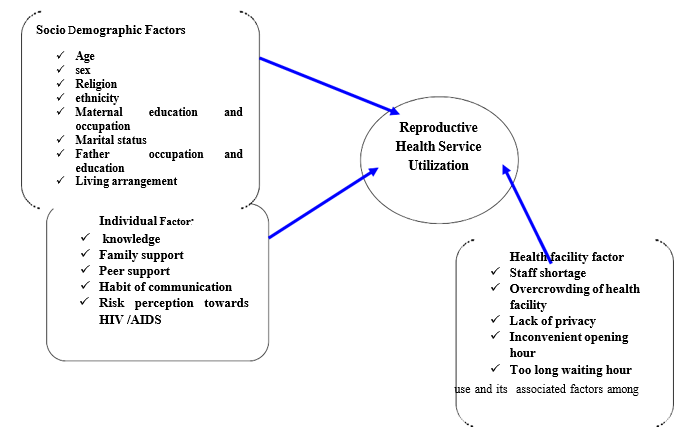
Figure 1: Conceptual Framework for Assessment of Reproductive Health Service Use and its Associated Factors Among Private College Student in Addis Ababa, Ethiopia, 2022.
Methods And Materials
The study was conducted from July 2022 to August, 2022 among students in private college in Addis Ababa city. Addis Ababa is the capital city of Ethiopia and had eleven sub cities and 116 District. The city had a total population of 3,435,030, of which female population accounts 1,8 09,577 (52.68%). From the total female population, 124,635 ( 6.89%) were teenagers aged 15-19 years. According to Addis Ababa education bureau education statistics 2015/2016 report, the city had a total of 215 high schools out of which 66 were government high schools and 149 were private high schools [41]. And also 37 private colleges which was licensed by the Education and Training authority and have a total of 26,210 students in regular base only, from which 14,597 students were female and 11,613 students were male [42]. The health facility that avail in Addis Ababa city administration were 112 health center that owned by city government,52 hospitals which 6 are government hospitals under Addis Ababa health bureau, 5 hospitals under federal ministry of health (FMOH), 2 hospitals under defense force and police. Three hospital that owned by nongovernmental organization(NGO) and 36 private hospitals. There were also 98 health centers and 800 different categories of clinic in the city [43]
Study Design
The study design was an institution based cross-sectional study design that generates quantitative data would be conducted.
Population
• Target Population
The target population would be all students in all private college in Addis Ababa in 2022.
• Source of Population
The source population would be all students in selected private colleges in Addis Ababa
• Study Population
All regular student in selected private college.
Eligibility Criteria
• Inclusion Criteria
• Students who were attend in regular program,
• age greater than and equal to 18 years and less than and equal to 24 years
• Exclusion Criteria
• master and diploma students
• Age less than 18 years and above 24 years
• weekend, distance and night program students
Sample Size Determination and Sampling Procedures
Sample Size Determination
The sample size (n) was determined using single population formula by considering Level of confidence was taken to be 95% with 0.05 α value (which yields Z α/2 = 1.96 on the standard normal distribution curve),
A 5% margin of error (d= 0.05) and A proportion of the utilization of at least one RH service is obtained from study in Deber Birhan town central Ethiopia. (33.8%) of youth utilized at least one of reproductive health services [28]. Based on this assumption the calculated sample size for this study was computed using the single population proportion formula
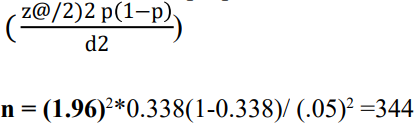
Additionally, when 10% allowance for absenteeism and refusal to participate in the study (none response rate) was considered, The calculated sample size becomes: 379 (344+ 35). We consider design effect 1.5 then the SS =569
The following table shows sample size calculated considering different proportions of RH utilization from similar previous study or published articles.
|
Variable |
Proportion from previous study |
Calculated sample size |
|
Inconvenient service hour |
31.8%(36) |
500 |
|
Age (20-24) |
65.7%(5) |
519 |
|
Peer discussion |
47.7%(33) |
575 |
|
Living with both parent |
73.4%(37) |
449 |
Table 2: The Calculated Sample Size for Associated Factors in Different Variable for Sample Size Determination
By comparing the Sample size of the prevalence of the dependent variable which was 33.8% and sample size of associated factor (independent variable) which was 31.8% we select the largest one from both sample size i.e. The final sample size with 1.5 design effect 575.
Sampling Technique and Procedures
A multi-stage cluster sampling technique was employed to select study participants. In the first stage, nine colleges were randomly selected from a total of 37 colleges using simple random sampling. In the second stage, the total number of students in each selected college was identified. In the third stage, the sample size was proportionally allocated to each college based on the number of students enrolled. In the fourth stage, study participants were selected from each college using a lottery method from a list of students. Finally, students who met the inclusion criteria from the selected sections participated in the study.
The sample size for each college was determined proportionally using the formula:
Proportionate Allocation:
nj = (nN)×Njn_j = \left(\frac{n}{N}\right) \times N_jnj=(Nn)×Nj
Where:
• njn_jnj = sample size for the jth stratum (college)
• NjN_jNj = population size of the jth stratum (college)
• nnn = total sample size
• NNN = total population size
Based on the total sample size of 575 and total population of 8,688, the sample sizes for each selected college were calculated as follows:
• Admas University: 575/8688×1218 = 80
• Rift Valley University: 575/8688×1930 = 128
• Gidgdan College: 575/8688×1000 = 66
• Ayer Tena Health and Business College: 575/8688×870 = 57
• Tropical College: 575/8688×800 = 53
• Gage College: 575/8688×570 = 38
• Queens College: 575/8688×940 = 62
• St. Lideta Health and Business College: 575/8688×1010 = 69
• Select College: 575/8688×350 = 22.
Study Variables
Dependent Variable
Reproductive health services utilization status.
Independent Variables
|
Socio Demographic variables |
Age, Sex Religion, maternal education status, parent occupation Living arrangement |
|
Individual Factors |
Previous knowledge, family support, peer support, habit of communication with family and others Risk perception towards HIV/AIDS |
|
Health facility factors |
Staff shortage, Overcrowding of health facility, Lack of privacy, Inconvenient opening hour, Too long waiting hour |
Operational Definition
Adequate Knowledge: Students who scored above the mean value.
Inadequate Knowledge: Students who scored below the mean value.
College Students: Students learnt in private college.
Youth: In this study youth stands for boys and girls between the ages of 15–24 [44].
Discussion on RH Issues: Students who discussed at least one RH issues ( HIV/AIDS VCT service, Contraception ,STI Diagnosis And Treatment, Information and education on RH) with health care provider, family, peers and sexual partner in the last 12 months [44].
Media Exposure on RH Issues: Students who were exposed to mass media (including radio, television, magazine/newspaper and pamphlet and other ) on at least one RH issues (information and education on RH, VCT service for HIV/AIDS, modern Contraceptives ,STI diagnosis and treatment) in the past 12 months [44].
STI Diagnosis and Treatment Service Utilization: Students who ever obtained STI diagnosis and treatment service in last 12 month in any health facility.
Modern Contraceptive Service Utilization: Students who used any of the modern birth controlling methods (contraceptives) in the past 12 months in any health facility.
Perception of Risk Towards HIV/AIDS: Students attitude towards perceiving themselves as susceptible to HIV infection.
RH Service Utilization: students who received at least one of the four RH services that the study focuses on, that is, RH information and education service, modern contraceptive service, VCT service, and STI diagnosis and treatment service utilization [28].
RH Information and Education Service Utilization: Students who received information and education regarding to reproductive health issues from health worker working in any of the service providing points within the past 12 months.
Peer: people who share similarities such as age, background, and social position, the members of this group are likely to influence each other
Voluntary Counseling and Testing Service: Students who receive VCT service from any health delivery setting 12 month prior to the study.
Family Support: Student got any type support regarding to reproductive health service from any member of family.
Peer Support: Student got any type support regarding to reproductive health service from peers.
Sexual Partner: Someone to whom to engage in sexual activity.
History of Sexual Exposure: Students who ever experience sex in life were classified as having the history of sexual exposure and not otherwise.
Data Collection Tool, Methods and Procedures
The questionnaire would be developed by combining the John Cleland’s Illustrative questionnaire for interview-survey and several literatures review to achieve the research objective [5,26,45]. A self-administered questionnaire would be used. The main points would be included in the questionnaire were socio demographic characteristics, individual factor, Health facility factor. The data would be collected by six BSc nurse professional ( 3 female 3 male) for five days after giving half day data collection training, under close supervision and facilitation by one MPH holder supervisor and the principal investigator closely monitor the overall data collection procedure. The data collection procedure was first arrange all the necessary data collection martials like print the questionnaire, pencil, pen ,marker. Secondly, select data collector and give half day training ,thirdly submitted the ethical clearance letter for all selected private college administration and get permission to proceed ,fourthly select the study participants based on inclusion criteria finally get consent and proceed the data collection if they were agree.
Data Quality Assurance
The questionnaire and consent documents was first developed in English language, then translate into Amharic, local language(which is the most commonly spoken language in Addis Ababa city) and finally retranslated into English by Language expert to check consistency. Items interpretability and understandability by the study participants would be evaluated by pre-testing the questionnaire on 29 student (5% of the total sample size) at unselected private college and necessary correction would be taken accordingly especially on the questionnaire part there was disorganized questionnaire , overwriting, missing of the necessary concepts, more pages, all these were corrected after pretesting. The six data collector and the MPH holder supervisor oriented the overall data collection process, how to approach and communicate with student to collect data. The anticipated time duration to complete the questionnaire was not more than 30 minute. Supervision would be done on the spot by the supervisors. The collected data would be checked for its completeness and clarity by the principal investigator daily. Data cleaning and cross-checking would be done before analysis. Data reliability checked by considering the Cronbach alpha which was greater or equal to 0.5. multi culinary also checked by considering the viral inflation factor (VIF) which was less than 10 considered as no multi culinary.
Data Processing and Analysis
After checking for its completeness, data would be entered by epi info version 7 and analyzed by SPSS version 25. Descriptive statistics like Percentage, frequency distribution would be used for describing different variables and was employed to know the association between dependent and independent variables on bivariate analysis by considering p value less than 0.2 with 95% CL and on multivariable analysis by considering p value less than 0.05 with 95% CL .The analyzed data were presented in different ways like table ,text, different type of charts accordingly.
Ethical Consideration
The proposal was reviewed by the School of Public Health and Ethical clearance would be obtained from Saint Paul’s Hospital Millennium Medical College Institutional review board (IRB) with Ref. No pm23/755 and Addis Ababa health Bureau public health research and emergency management directorate with Ref  Official letter was received from Addis Ababa health Bureau public health research and emergency management directorate and submitted to the selected private college administrative. After getting permission from college administrator’s to proceed, the purpose of the study would be explained to all participants then written consent was obtained. participants’ involvement in the study would be on voluntary basis and neither their name nor their address will not be recorded.
Disseminations and Utilization of Results
First, the final research would be presented and submitted to the School of Public Health, St, Paul’s Hospital Millennium Medical College. Then, the research reported would be archived in the Saint Paul’s Hospital Millennium Medical College’s library. The results would be disseminated to all private colleges in Addis Ababa, through Education and Training Authority ,Addis Ababa health Bureau public health research and emergency management directorate, Federal Minister of Health and NGOs that are interesting in working in the area. Attempts would be made to present the findings in different scientific conferences and publish the findings of the research on peer reviewed reputable journal for better communication of the result.
Results
Socio Demographic Characteristics of the Study Participants
From the total 575 participants, 553 of them responded to the questionnaires yielded a response rate of 96.1%.
Out of 553 participants 172 (31.1%) were males and 381 (69.9%) were female participants. The mean age of the respondents 21.16 with standard deviation +1.65 with the age range of 18-24 years.
About 290(52.4%) respondents were Orthodox Christian followed by 117 (21.2%) Muslim followed by 92 (16.6%) protestant followed by 52 (9.4%) Catholic the rest two (0.4%) are other religion follower.
Regarding to year of the class 203 (36.6%) were first year 176 (31.8%) were second year 108 (19.5%) were third year the rest 65 (11.8%) were forth year students.
Based on marital status of the student 471 (85.2) were single 65 (11.8) were married 12 (2.25) were divorced the rest 3(0.5%) were living in different area.
when we came to the mother education status 73(13.25) were unable to read and write, 124 (22.4%) were able to read and write, 91(16.5%) were primary school, 135 (24.4%) were secondary school and 130(23.5%) were Diploma and above holders
In the case of father education status 58(10.5%) were unable to read and write, 109 (19.7%) able to read and write, 92 (16.6%) primary school completed were 136 (24.6%) secondary school and 158 (28.6%) were Diploma and above holder. Based on living arrangement 344 (62.2%) were living with both the father and mother209 (37.8%) were living other than living with both parents.
The other issue was the mother occupational status of the student 205(37.1%) were house wife 128(23.1%) were merchants,110(19.9% were governmental workers ,100 (18.1%) were non-governmental workers and the rest 10 (1.8%) were other occupational category.
The other category related occupational status to father occupational status, 78(14.1%) were farmers, 141 (25.5%) merchants, 141 (25.5%) were governmental workers 139 (25.1%) were non-governmental workers and the rest 53 (9.6%) were other occupational category (see table 3 )
|
Variable |
Group |
Frequency |
Percentage |
|
Sex |
Female |
381 |
68.9 |
|
Male |
172 |
31.1 |
|
|
Age |
18-20 |
215 |
38.8 |
|
21-24 |
338 |
61.2 |
|
|
Ethnicity |
Amhara |
163 |
29.5 |
|
Oromo |
144 |
26.0 |
|
|
Guragie |
111 |
20.1 |
|
Tigry |
69 |
12.5 |
|
|
Other |
66 |
11.9 |
|
|
Religion |
Orthodox |
290 |
52.4 |
|
Muslim |
117 |
21.2 |
|
|
protestant |
92 |
16.6 |
|
|
Catholic |
53 |
9.8 |
|
|
Marital status |
single |
471 |
85.5 |
|
married |
65 |
11.5 |
|
|
divorced |
12 |
2.2 |
|
|
Lived-in separate place |
3 |
0.5 |
Table 3: Socio Demographic Characteristics of the Study Participants from Private Colleges in Addis Ababa, Ethiopia (n = 553)
Individual Characteristics and Knowledge Related to Reproductive Health Service Use
Out of the total participant 193 (34.9%) have had sexual partner during the survey. From those who had sexual partners 119 (21.5%) had only one sexual partners. While 50 (9.8%) and 19 (3.5%) students had two and more than two sexual partners respectively.
Two hundred twenty two (40.1%) students ever had sexual intercourse in their lifetime. Out of the total participants who had sexual partners, about three-fourth (74.6%, 75.5%, and 76.5%) had discussed about condom use, contraceptives, and sexual transmitted infection including HIV/AIDS with their sexual partners, respectively in last 12 month prior to the survey.
From the total participants about one –third (31.8%,31.8%,32.4%) had discussed with peer about condom use, modern contraceptives methods, sexual transmitted infection including HIV/AIDS respectively in last 12 month prior to the survey. Out of the total participants about one –third (31.5%,32.7%) had family and peer support to use reproductive health service respectively in last 12 month prior to the survey.
About one –third (32.5%,31.1%,30.6%) had discussed on condom use and modern contraceptives, STI/HIV/AIDS with health care workers respectively in the last 12 month prior to the study
About one –third (31.5%) of participants were freely discussed with their family members. Around one –fourth of the participant(25.7%,25.5%,25.5%.) had discussed with family members about condom use, modern contraceptives, about STI/ HIV/AIDS respectively in last 12 month prior to the survey. About one –fourth of the participants perceived them self’s risk for acquiring HIV/AIDS.
From the total participants 69.3% participants had media exposure about reproductive health education and communication.
Concerning knowledge 423 (76.5%) of the participant have adequate knowledge about where to get Voluntary counseling and testing services, 415(75%) had adequate knowledge about where to get sexual transmitted disease diagnosis and treatment services, 388 (70.2%) had adequate knowledge about where to get modern contraceptive service.
More than one third(35.7%) of the students obtained reproductive health service information from health center,219(29.2%) students know about reproductive health education and communication, 287(37%%) and 262(33.8) of the students know that voluntary HIV counseling and testing service, and STD/HIV/AIDS diagnosis and treatment service respectively (see table 4).
|
Variable |
Group |
frequency |
Total percentage |
|
Year of study |
First |
204 |
39.9 |
|
Second |
176 |
31.8 |
|
|
Third |
108 |
19.5 |
|
|
Forth |
65 |
11.8 |
|
|
Family support to any RH service |
Yes |
174 |
31.5 |
|
No |
379 |
69.5 |
|
|
Had sexual partners |
Yes |
193 |
34.9 |
|
No |
360 |
65.1 |
|
|
Number of sexual partners had(n=193) |
One |
124 |
64.2 |
|
|
More than one |
69 |
35.8 |
|
Had sexual intercourse |
Yes |
222 |
40.1 |
|
NO |
331 |
59.9 |
|
|
Condom discussion with sex partners |
Yes |
144 |
73.8 |
|
No |
51 |
26.2 |
|
|
Other type of Contraceptive discussion with sex partners |
Yes |
148 |
75.5 |
|
NO |
45 |
24.5 |
|
|
Discussed STI/HIV with sex partners |
Yes |
150 |
76.5 |
|
No |
43 |
24.5 |
Table 4: Individual Characteristics of the Study Participants from Private Colleges in Addis Ababa, Ethiopia (n = 553)
Health Facility Related Factor
Concerning preference to health care professional 135 (24 .4%) participant had no gender based criteria to get the service,176(31.8%) wants young health care professional with similar gender of the participants. While 242(43.7%) had no chosen health care professional based on gender and age. Overcrowded health facility, 135 (24 %) and inconvenient working hours, 165 (30 %) were the reasons for not to use reproductive health services in the health facility and Too long waiting hour was the other cause.
Concerning time preference 173 (31.8%) of participant were comfortable at any time to access the service. Around one-third (28%) want the service delivery time was before schooling,106(19.2%) were want after schooling,144 (26%) wants weekend time to get the service,
<img src="https://www.opastpublishers.com/scholarly-images/10353-69d5d08f34ff6-utilization-and-associated-factor-for-reproductive-health-se.png" width="600" height="500">
<img src="https://www.opastpublishers.com/scholarly-images/10353-69d5d0c060eb0-utilization-and-associated-factor-for-reproductive-health-se.png" width="600" height="600">
<img src="https://www.opastpublishers.com/scholarly-images/10353-69d5d0ebddfd4-utilization-and-associated-factor-for-reproductive-health-se.png" width="500" height="250">
Factors Associated With Reproductive Health Service Utilization
Bivariate analysis produced statistically significant association between service utilization and majority of the independent variables. In Bivariate analyses, factors found to be significantly associated with reproductive health service utilization includes; father’s educational status, mother’s educational status, living with both parents, mother’s occupational, Father occupational, year of the study, ever had sexual partners, discussion about condom with sex partners, discussion about STI/HIV with sex partners, Discussion about other contraceptives method with sex partner. Ever had sexual intercourse in the life, Peer discussion about condom, Peer discussion about other contraceptives, Peer discussion about HIV/STI, Family support to reproductive health services service, Peer support to reproductive health services, discussion about condom use with health care professional, discussion about other contraceptives with health care professional ,discussion about STI/HIV with health care Contraceptive, discussion with family members STI/HIV AIDS, discussion with family member , Condom use discussion with family member, Risk perception towards STI/HIV AIDS, Mass media exposure. At p value 0.20.
Those students whose mother Completed secondary school had 32% less odds of were utilizing RH services than those whose mothers were unable to read and write (COR, 0.68 85% CL,0.379-1.022). In addition those students who Ever had boy/girlfriends were utilized RH services about nine time more likely than the counter (COR 8.861, 5.723-13.720, 95% CL). While those students who discussed about STI/HIV with sex partners were utilized RH service about five times than those students who were no discussed(COR, 5.062, 2.302-11.134 with 95% CL).
Risk perception of oneself towards HIV/AIDS acquisition were also positively linked with service utilization (COR, 13.486, 7.481-24.310 with 95%CL)
In addition those students who were exposed to different type of mass media were utilized Reproductive health service about four times than the counter (COR, 4.274, 2.853-6.404 with 95% CL).
Variables that produce statistically significant relationship with the outcome of interest on bivariate analyses were fitted in to multivariable logistic regression. Based on this, Peer discussion, Discussed about condom with their sex partner , ever had sexual intercourse ,mass media exposure, were significantly associated with the outcome variable based on back ward conditional logistic regression model .So based on these those students who were discussed with peer about STI/HIV were around nine times more likely to utilized at least one of the four reproductive health services that the researcher focused on than their counter parts (AOR= 8.320, 95% CI: 1.807-38.315). Discussing about condom with their sex partner were around 86% less likely utilized one of the Reproductive health service than those did not have (AOR, 0.148.CI 0.025-0.897) . Ever had sexual intercourse in lifetime was around seven times more likely to utilized reproductive health services than those did not history sexual intercourse prior to the study(AOR, 6.556,CI 1.534-28.103). Those participant were exposed to different type of mass media were utilized Reproductive health service around fifteen times more utilized than those who were unexposed (AOR 14.732, CI 3.777-50.461) .the other factor that associated with the outcome variable were peer discussion about sexual transmitted infection and HIV/AIDS ,discussing with peer about sexual transmitted infection and HIV/AIDS were around nine times more likely to utilized reproductive health than those did not discussed with peers(AOR8.320,CI 1.807-38.315) (see table 5).
|
variable |
group |
frequency |
AOR |
cl lower upper |
p value |
|
|
|
|
Used |
Not used |
|
|
|
|
discussed about |
Yes |
121 |
16 |
0.148 |
0.025-0.897 |
0.038* |
|
condom with sex |
No |
32 |
18 |
1 |
- |
- |
|
partner |
|
|
|
|
|
|
|
ever had sexual |
Yes |
178 |
38 |
6.556 |
1.534-28.103 |
0.011* |
|
intercourse |
No |
95 |
|
1 |
- |
- |
|
|
|
224 |
|
|
|
|
|
mass media |
Yes |
226 |
143 |
14.732 |
3.777-50.461 |
|
|
exposure |
No |
44 |
119 |
1 |
|
|
|
peer discussion |
Yes |
146 |
26 |
8.320 |
1.807-38.315 |
0.007* |
|
about STI/HIV |
No |
127 |
236 |
- |
- |
|
|
*Shows p value less than 0.05 implies statically significant AOR- adjusted odd ration CI confidence interval |
||||||
Table 5: Multivariable Logistic Regression of Factors Associated With Utilization of Rh Service Among Private College Student Addis Ababa Town, Ethiopia, 2022.
Discussion
This institutional based cross-sectional study tried to assess reproductive health utilization and range of factors associated with utilization of students reproductive health services . the main purpose of these study were to determine the prevalence of reproductive health services that utilized by the college student and to identify possible factor that associated with reproductive health service use.
This study assessed a range of possible predictors, including socio-demographic characteristics ,students individual attributes including sexual history and personal discussion with different group related to reproductive health services, Health facility related Issue. Based on these the main finding of these study were from the total participant 68.9% were females,61.2% of the students were in between 21-24 ages ,85.5% were single and 2.2% were divorced .Around two-third of the students were living with both parents, around forty percent of the student were year one students and also one –third of the student had sexual partners during the survey. One fourth of the student had habit of discussion with their family member in different reproductive health issues, like condom use, STI/HIV/AIDS,VCT service and the use of modern contraceptives .majority of the student had exposed to different type of mass media. The percentage of students who were exposed to mass and sexual intercourse ,peer discussion about STI/HIV/AIDs ,discussing with sex partner about condom used were indicators of the immediate and long term reproductive health needs of the students. Taking this in to consideration, this institution based study which assessed the patterns of students reproductive health services utilization and associated factors have got important figures which can be served as an indicator for the stakeholders to appreciate the progress towards achieving their goals.
Before rushing to discuss major topics of the study, it might be better to compare some common socio-demographic and individual related aspects of the respondents with other studies as it gives information on comparison between studies are logically appropriate or not. Based on the respondents’ mean age ,the mean age of the respondents 21.16 with standard deviation + 1.65 which is higher than study conducted in west Arsi zone of oromiya region which was 20.4 (±standard deviation (SD), 1.84) years and study conducted in Bahir dar city mean (±) age of the respondents was 20 ± 2:56 years old, and also higher than another study conducted in Nigeria which was (18.5 ± 3.0)(13) these age variation might be due to the category of the study participant for example in these study participant are college students but the other study participants are college and high school students and also the inclusion criteria of each study site [5,2].
According to the respondents living arrangement, 62.2% of the respondents in this study were living with both their parents at the data collection time which was lower figure than conducted Hadiya Zone, Southern Nations, Nationalities and Peoples Region which is 65.1% and study conducted in western Ethiopia which was 69.4% of participant were living with both and higher than study which conducted in Gondar town which was 61.7%,these variation may be due to study setting means when we conducted community based cross sectional study in urban area out of Addis Ababa majority of participants were living with their parents [6,46].
Around forty percent of the respondents in this study respond that they had sexual intercourse compared which is higher than another study conducted in wolaita sodo university students which is 29.5%,these is may due to difference in urbanization [6].
In case of the number of sexual partner in our study the prevalence of multi sexual partners was 37.7% of the student had multi sexual partner during and prior to the survey these finding was higher than other study conducted in wolaita sodo university student which was 27 % these significant difference might be due to peer pressure and technological advancement [33].
The other socio demographic factor was marital status in these study 85.5% of the participant were single or unmarried during the survey these finding was lower than other study conducted in West Badewacho district, Hadiya Zone, South Ethiopia which was 90.8% [4].
The measurement of utilization of reproductive health services varies widely. Some studies used just one aspect of RH services (32,35,40)while others used multiple aspects . However, very few studies assessed all four essential aspects of RH services as did in this study.
This study revealed that the overall service utilization was 51.9% which was much higher than study conducted in Deber birhan which is 33.8% south wollo zone of the Albuko district which was 34.31% ,study conducted in Nepal which was 24,7% and lower than study conducted in west Arsi zone which was 58.6% and other study conducted in Indonesia which was 63.4% these variation may be due to socio demographic and economic reason [28,22,9,5,17].
41.2% of the participants in this study were utilized information and education related with sexual and reproductive health from health care workers and this finding lower than study conducted in Bahir dar university which is 47.2% these may due to in governmental university had different clubs that give information to the students in case of private colleges there were no access of health clubs in the compound [31].
Regarding to modern contraception utilization, in this study utilization of any methods of modern contraceptives were 31.5% these result were lower than another finding which was conducted in Gondar City, Northwest Ethiopia which was 41.2% and Arbaminch town which was 63.4% [47,40]. But higher than study conducted in madawollabo university students which 27.7% (7) these difference may be due to the difference in multi sexual partners, socio-demographic characteristics of the respondents and knowledge difference across the study areas.
When we came to voluntary counseling and testing for HIV, 39.1 % of student utilized voluntary counseling and testing service these finding is lower than study finding in deber markos university students which was 58.5% and higher than another study conducted in Bahir dar university students which was 37.8% and other study conducted out of our country in Nepal which was 38.6% and among tertiary institution students in the Hohoe Municipality, Ghana which was 30.6% [35,31,9,29]. This variation could be due to the number of multi sexual partner in these study was higher so these may positive pressure to take VCT, Communication of sexual and reproductive health issues with in the family (especially if the family members have good knowledge on reproductive health problems and reproductive health services) allows the students to enhance their knowledge, build their confidence and in turn scale up their tendency to use those services in demand.
Regarding to sexual transmitted disease diagnosis and treatment service utilization in the students around 31.8% of the participant utilized sexual transmitted infection including HIV/AIDs services these result higher than study conducted in Arsi zone private college students which is 21.7% these might be the accessibility of health facilities in nearby [5]. and also higher than study conducted in rural area of Nepal district which was 4.0% these may be due to information accessibility about reproductive health service utilization [9].
There was relatively good communication between students and family member compared to other. For example study conducted in east Gojjam zone Machakal district in these district there is no habit of communication between family member and youth regarding to different reproductive health due to social taboos [48].
In this study, the researcher found that discussion with peer and ever had sexual intercourse, exposed to different type of mass media, discussing about condom use with sexual partners were played an important role in students utilization of RH services. For instance, students who were discussed with peer were significantly associated with the use reproductive health service utilization in private college students. These finding is supported by another finding which is conducted In Amhara regional state night students [2]. And study conducted West Badewacho district, Hadiya Zone, South Ethiopia So these indicate that freely discussion between sex partner and peer are an important role for the utilization of reproductive health services .another important role in youth RH service utilization in these study are ever had sexual intercourse , student who had sexual intercourse were more likely to use RH service than those who hadn’t sexual intercourse .these finding were supported by another local finding which was conducted in wollega western Ethiopia,study conducted among secondary and preparatory schools’ students in Deber markos town, North West Ethiopia [4,39]. So in both area those student around two time odds to use reproductive health service than those did not had sexual intercourse [44].Wolaita Sodo University Students, in Wolaita Sodo university those student who had sexual intercourse were five times more utilized RH service than those did not had sexual intercourse .Also other study conducted in dares Elam university of Tanzania ever had sexual intercourse had higher odd ratio to use RH service than those who had not sexual intercourse [25].
The other associated factor in these study were media exposure these finding also supported by another local finding which was conducted in Dilla town ,in Dilla town students who were exposed to mini media were around two times more utilized reproductive health services than unexposed study participants,these also supported another study conducted in western Ethiopia , In wollega university student those who were exposed to different type of mass media were around twelve times more utilized reproductive health services than those did not exposed(AOR,11.33,CI 5.59-22.96) [26,39]. Since mass media exposure were one of the associated factor of reproductive health service utilization in our study setting ,these was strongly supported another study conducted in Nepal, Bhaktapur district those who were exposed to mass media or hear about reproductive health issue in the last12 month prior to the study period were around thirty one times more utilized reproductive health service than those who were no information AOR,31.17,CI9-107.3) [9].
Different research findings revealed that discussion on sexual and reproductive health matters with peers, ever had sexual intercourse, mass media exposure increase the chance of service utilization Same wise in this study, student who had discuss about STI/HIV with their peers were around eight times more utilized Reproductive health issues than the others, ever had sexual intercourse were around seven times more utilized reproductive health issue than those who had not sexual intercourse. Exposed to mass media were around fifteen times more utilized reproductive health issue than those did not exposed to mass media..
• The Strength of the Study: These study addressed the private college students which majority of previous study focused on governmental higher institution so these finding important to know the reproductive health service utilization in private sectors and used as comparison and serve as base line for the next. And as much as possible it was representative because large amount of sample was drawn from nine private colleges. The other strength were the questionnaire mainly stressed on discussion about reproductive health issues with the main stakeholder like the family member, peer, sexual partner, girl/boyfriend, health care professional . The last strength of the study were since the data were collected from different colleges so there were variation in age category ,sex variation, different in geographical back ground, different department students were included in the study . So the result would be highly representative related to other study conducted in different colleges and university students.
• The Limitation of these Study: The study design was cross-sectional, it cannot indicate the direction of causal relationships between the predictor and outcome variable. Secondly, because the questionnaire incorporates student’s private matter including their sexuality, some sort of social-desirability bias may not be eliminated. Thirdly ,since the data were included 12 month personal activities recall bias might be presented. Lastly better to done mixed study design but the study was quantitative design only these was due to economic constraints.
Conclusion and Recommendations
Conclusion
Since the focus of these study were to identify the service utilization of contraceptive service used, voluntary counseling and testing service ,diagnosis and treatment of sexual transmitted disease including HIV/AIDS and the access and ever got health education and communication related to reproductive health ,so majority of the students had high accessibility of health facility and health professional on reproductive health services and service providers, utilization of reproductive health services among students in the study area were shows as follow .the utilization of reproductive health education and communication service among students were 41.2% i.e. below half of the student got reproductive health education and communication services, only 39.1% of the student got voluntary counseling and testing services and around one third of students were got sexual transmitted disease treatment and diagnosis .the last reproductive health service that utilized by the students were the use of any modern method of contraceptives implies that only 31.5% of student used any method of modern contraceptives . Ever got reproductive health education and communication service) was the most frequently service that the students used and on the contrary, the utilization of contraceptive in any methods was the least. So as general the utilization of reproductive health services in the study area were low .
Exposure to mass media, Discussed about condom with sex partner, peer discussion about STI/HIV/ADIS, ever had sexual intercourse was among the factors associated with use and non-use of RH services.
Generally, these finding were different from the previous finding by the following main issue
• It shows the prevalence of female condom utilization.
• In order to penetrate societal taboos the questionnaire address free discussion between study participant and peers, sex partners, family members ,health care professional.
• Relative large number of participant was included in the study from nine private colleges so these is more representative than the previous study.
• It shows the level of reproductive health service utilization in private college students.
Recommendation
The recommendation were to the concerned body hierarchically as follows
• For the Study Participants: The students better to freely discussed with peers, girl/boy friends ,family members on the issue of reproductive health concerns. Students are better to participate on reproductive health clubs and college mini media if there is availability of reproductive health clubs. Currently there were access to know more about reproductive health so student should be more search regarding to reproductive health issue
• For the Health Facility: The health facilities better to perform community mobilization in order to fill the gap, arrange preferable time and health care professional while the students getting the services, Settle separate and secure place for the students while getting reproductive health services
• For Addis Ababa Health Bureau: Better to arrange continuous training for those health care professional whose served for the students related to reproductive health services ,check the availability of reproductive health martials that increase knowledge and attitude of the student like flyers, posters ,videos, make sure that all reproductive health services were available in all health facility at any time under Addis Ababa health bureau, make supervision and controlling for the achievement of reproductive health services in each health facilities
• For Concerning Non-Governmental Organizations: Better to support the health facility by martials, give training for the concerned health care professional to increase quality and coverage of reproductive health services, to make supervision
• For the Federal Ministry of Health: It is better to the reproductive health issue should be included in curriculum in college, financial and material support for the health facility to increase the quality of reproductive health services, better to work closely with the private colleges to address reproductive health issues, the federal ministry of health should be influenced the private college administrator’s arrange health club in their compounds, better to work closely with higher education quality authority to improve college environments comfortable for reproductive health issue because higher education quality authority had the power to obligate the private college
Declaration
I (corresponding author) agree to accept all responsibilities for the scientific and ethical conduct of the proposal & thesis project and for the provision of required progress reports as per terms and conditions of the research publications office in effect at the time of grant is forwarded as the result of this application.
Ethical Approval and Consent to Participate
The ethical clearance was obtained from Institutional Review board of saint Pauli hospital Health Sciences College and official letters was submitted to each respective health facility. After explaining the objectives of the study, informed written consent was obtained from all mothers and caregivers, and anonymity and confidentiality of the data were kept. Respondents have the right not to participate or withdraw from the study at any stage, and all study methods were performed in accordance with the Declaration of Helsinki.
Consent For Publication: Not applicable.
Availability of Data And Materials: The data used to support the findings of this study are available from the corresponding author upon request.
Competing Interests: The authors declare that they have no conflicts of interest Funding: Not applicable.
Author Contributions:
A.A: Conceptualization, Data curation, Formal analysis, Investigation, Methodology, Project administration, Resources, Software, Visualization, Writing – original draft
G.B: Conceptualization, Formal analysis, Investigation, Methodology, Project administration, Resources, Software, Visualization, Writing – original draft
T.K: Conceptualization, Formal analysis, Methodology, Software, Supervision, Writing, review & editing
M.T: Conceptualization, Formal analysis, Methodology, Software, Supervision, Writing, review editing & finalizing
F.L: Conceptualization, Formal analysis, Methodology, Resources, grammar checking, Software, Visualization, Writing and original draft
B.M: Conceptualization, Formal analysis, Methodology, Software, Supervision, Writing, review & editing
Acknowledgements: The authors would like to express their gratitude to respective health facility, data collectors, supervisors and study participants for their diligence and dedication in the collecting and inputting high quality data used in the study
References
- Republic D.(2016). National Adolescent and Youth.;1:1–100.
- Liyeh, T. M., Goshu, Y. A., Belay, H. G., Tasew, H. A., Mihiretie, G. N., & Ayalew, A. B. (2021). Youth reproductive health service utilization and associated factors among Amhara Region female night students, Ethiopia. BioMed Research International, 2021(1), 6640219.
- Report M.(2009) ICPD and the MDGs: Working as One.;15:1–194.
- Niguss C, Gurmesa T, and ANT.(2015). Reproductive health needs and service utilization among youths in West Badewacho Woreda, Hadiya Zone, South Ethiopia. J Public Heal Epidemiol. 7(4):145–53.
- Wachamo, D., Tegene, Y., Tibeso, A., & Washo, A. (2020). Sexual and reproductive health services utilization and associated factors among college students at West Arsi Zone in Oromia Region, Ethiopia. The Scientific World Journal, 2020(1), 3408789.
- Gunta, M., Tantu, T., Wolka, S., Meskele, M., Ayza, A., & Duko, B. (2021). Sexual and reproductive health services utilization among Wolaita Sodo University students, Ethiopia: a mixed method approach. The Scientific World Journal, 2021(1), 2415023.
- Dida, N., Darega, B., & Takele, A. (2015). Reproductive health services utilization and its associated factors among Madawalabu University students, Southeast Ethiopia: cross-sectional study. BMC research notes, 8(1), 8.
- Belay, H. G., Arage, G., Degu, A., Getnet, B., Necho, W., Dagnew, E., ... & Worke, M. D. (2021). Youth-friendly sexual and reproductive health services utilization and its determinants in Ethiopia: A systematic review and meta-analysis. Heliyon, 7(12).
- Napit, K., Shrestha, K. B., Magar, S. A., Paudel, R., Thapa, B., Dhakal, B. R., & Amatya, A. (2020). Factors associated with utilization of adolescent-friendly services in Bhaktapur district, Nepal. Journal of Health, Population and Nutrition, 39(1), 2.
- Adefalu, G. A., & Ayodele, K. O. (2019). Factors influencing access and utilization of reproductive health services among undergraduates in selected tertiary institutions in Ogun State, Nigeria. International Journal of health sciences, 7(2), 38-49.
- Dehne, K. L., & Riedner, G. (2001). Sexually transmitted infections among adolescents: the need for adequate health services. Reproductive Health Matters, 9(17), 170-183.
- UNFPA, U., & Sexual, W. H. O. (2015). reproductive health of young people in Asia and the Pacific: a review of issues, policies and programmes. United nations population fund (UNFPA). Bangkok: United Nations Educational, Scientific and Cultural Organization (UNESCO) and World Health Organization WHO.
- Femi-Adebayo, T. T., Kuyinu, Y., Adejumo, O. A., & Goodman,O. (2019). Factors affecting utilization of youth friendly health services in Lagos State, Nigeria. International journal of adolescent medicine and health, 31(2).
- Hiwot A. November, (2017) addis ababa, ethiopia 1. Addis Ababa Univ.
- Hounton, S., Barros, A. J., Amouzou, A., Shiferaw, S., Maïga, A., Akinyemi, A., ... & Koroma, D. (2015). Patterns and trends of contraceptive use among sexually active adolescents in Burkina Faso, Ethiopia, and Nigeria: evidence from cross-sectional studies. Global health action, 8(1), 29737.
- World Health Organization (WHO). (2010). Social Determinants of sexual and reproductive health. Informing future research and programme implementation. WHO, Geneva: Switzerland.
- Violita, F., & Hadi, E. N. (2019). Determinants of adolescent reproductive health service utilization by senior high school students in Makassar, Indonesia. BMC Public Health, 19(1), 286.
- Yakong, V. N., Rush, K. L., Bassett-Smith, J., Bottorff, J. L., & Robinson, C. (2010). Women’s experiences of seeking reproductive health care in rural Ghana: challenges for maternal health service utilization. Journal of advanced nursing, 66(11), 2431-2441.
- Simegn, A., Azale, T., Addis, A., Dile, M., Ayalew, Y., & Minuye, B. (2020). Youth friendly sexual and reproductive health service utilization among high and preparatory school students in Debre Tabor town, Northwest Ethiopia: a cross sectional study. PloS one, 15(9), e0240033.
- Mekie, M., Taklual, W., & Tesfaw, A. (2020). Youth reproductive health problems, service preference and associated factors among female secondary school students in lay Gayint district of Amhara region, Ethiopia, 2019. The Open Public Health Journal, 13(1).
- Abate, A. T., Ayisa, A. A., & W/Mariam, T. G. M. (2019). Reproductive health services utilization and its associated factors among secondary school youths in Woreta town, South Gondar, North West Ethiopia: a cross sectional study. BMC research notes, 12(1), 90.
- Prof (Dr).P.Surender Reddy WGh TA.(2016) Assessment of Youth Friendly Services Utilization And Associated Factors Among Young People in Albuko Woreda, South Wollo Zone, Amhara Region, Ethiopia. Indian Journal of Appllied Science.2016;6 (4).
- Binu, W., Marama, T., Gerbaba, M., & Sinaga, M. (2018). Sexual and reproductive health services utilization and associated factors among secondary school students in Nekemte town, Ethiopia. Reproductive health, 15(1), 64.
- Akintade, O. L., Pengpid, S., & Peltzer, K. (2011). Awareness and use of and barriers to family planning services among female university students in Lesotho. South African Journal of Obstetrics and Gynaecology, 17(3), 72-78.
- Somba, M. J., Mbonile, M., Obure, J., & Mahande, M. J. (2014). Sexual behaviour, contraceptive knowledge and use among female undergraduates’ students of Muhimbili and Dar es Salaam Universities, Tanzania: a cross-sectional study. BMC women's health, 14(1), 94.
- Fikre, R., & Soresa, M. (2019). Reproductive health service utilization and associated factors among youths in Dilla town, Southern Ethiopia, 2017.
- Laari, L., Anim-Boamah, O., & Boso, C. M. (2022). NursingPractice Today.
- Tlaye, K. G., Belete, M. A., Demelew, T. M., Getu, M. A., & Astawesegn, F. H. (2018). Reproductive health services utilization and its associated factors among adolescents in Debre Berhan town, Central Ethiopia: a community-based cross-sectional study. Reproductive health, 15(1), 217.
- Agamlor, E., Pencille, L., Lutala, P., Akoku, D. A., & Tarkang,E. (2020). Uptake of HIV testing and counseling among tertiary institution students in the Hohoe Municipality, Ghana. Journal of Public Health in Africa, 10(2), 1044.
- Iliyasu, Z., Abubakar, I. S., Kabir, M., & Aliyu, M. H. (2006). Knowledge of HIV/AIDS and attitude towards voluntary counseling and testing among adults. Journal of the National Medical Association, 98(12), 1917.
- Fikadie, G., Bedimo, M., & Alamrew, Z. (2014). Prevalence of voluntary counseling and testing utilization and its associated factors among Bahirdar University students. Advances in Preventive Medicine, 2014(1), 906107.
- Forhan, S. E., Gottlieb, S. L., Sternberg, M. R., Xu, F., Datta, S. D., McQuillan, G. M., ... & Markowitz, L. E. (2009). Prevalence of sexually transmitted infections among female adolescents aged 14 to 19 in the United States. Pediatrics, 124(6), 1505-1512.
- Yohannes, B., Gelibo, T., Tarekegn, M., & Gelibo, T. (2013). Prevalence and associated factors of sexually transmitted infections among students of Wolaita Sodo University, Southern Ethiopia. Int J Sci Technol Res, 2(2), 86-94.
- Kassie, B. A., Yenus, H., Berhe, R., & Kassahun, E. A. (2019). Prevalence of sexually transmitted infections and associated factors among the University of Gondar students, Northwest Ethiopia: a cross-sectional study. Reproductive health, 16(1), 163.
- Tsegay, G., Edris, M., & Meseret, S. (2013). Assessment of voluntary counseling and testing service utilization and associated factors among Debre Markos University Students, North West Ethiopia: a cross-sectional survey in 2011. BMC public health, 13(1), 243.
- Abebe, M., & Awoke, W. (2014). Utilization of youth reproductive health services and associated factors among high school students in Bahir Dar, Amhara regional state,Ethiopia. Open Journal of Epidemiology, 4(2), 69-75.
- Lejibo, T. T., Assegid, S., Beshir, M., & Handiso, T. B. (2017). Reproductive health service utilization and associated factors among female adolescents in Kachabirra District, South Ethiopia: a community based cross sectional study. Pediatric and Adolescent Medicine, 2(4), 67-76.
- Thongmixay, S., Essink, D. R., Greeuw, T. D., Vongxay, V., Sychareun, V., & Broerse, J. E. (2019). Perceived barriers in accessing sexual and reproductive health services for youth in Lao People’s Democratic Republic. PloS one, 14(10), e0218296.
- Tilahun, T., Bekuma, T. T., Getachew, M., & Seme, A. (2021). Assessment of access and utilization of adolescent and youth sexual and reproductive health services in western Ethiopia. Reproductive Health, 18(1), 85.
- Sorato, M. M. (2017). Assessment of modern contraceptive method utilization and associated factors among women of reproductive age group in Arba Minch Town, SNNPR Ethiopia. Ec Gynaecol, 6, 36-53.
- Ababa, A. (2007). Government of ethiopia. Ministry of Health.

- Day, C., & Gray, A. (2012). Health and related indicators. South African health review, 2012(1), 207-329.
- Shiferaw, K., Getahun, F., & Asres, G. (2014). Assessment of adolescents’ communication on sexual and reproductive health matters with parents and associated factors among secondary and preparatory schools’ students in Debremarkos town, North West Ethiopia. Reproductive health, 11(1), 2.
- Cleland, J. (2001). Illustrative questionnaire for interview-surveys with young people. World Health Organization, 2021-05.
- Feleke, S. A., Koye, D. N., Demssie, A. F., & Mengesha, Z. B. (2013). Reproductive health service utilization and associated factors among adolescents (15–19 years old) in Gondar town, Northwest Ethiopia. BMC health services research, 13(1), 294.
- Oumer, M., Manaye, A., & Mengistu, Z. (2020). Modern contraceptive method utilization and associated factors among women of reproductive age in Gondar City, Northwest Ethiopia. Open Access Journal of Contraception, 53-67.
- Abajobir, A. A., & Seme, A. (2014). Reproductive health knowledge and services utilization among rural adolescents in east Gojjam zone, Ethiopia: a community-based cross-sectional study. BMC health services research, 14(1), 138.