



Review Article - (2019) Volume 4, Issue 1
Using Nutrition Based Therapy for Improving Sleep Quality
Received Date: Jan 08, 2019 / Accepted Date: Feb 25, 2019 / Published Date: Mar 16, 2019
Copyright: ©Abhishek G Dhawan. This is an open-access article distributed under the terms of the Creative Commons Attribution License, which permits unrestricted use, distribution, and reproduction in any medium, provided the original author and source are credited.
Abstract
Sleep is an important factor in human life cycle. Many of the people are struggling from sleep disorders that may range from sleep deprivation to insomnia. Other major factor with respect to sleep is quality of sleep. It tends to happen with many of the people now a days that they get sleep for 6 to 8 hours but still they feel fatigue or sleepy throughout the day or even they are not satisfied with their sleep
Introduction
Sleep is an important factor in human life cycle. Many of the people are struggling from sleep disorders that may range from sleep deprivation to insomnia. Other major factor with respect to sleep is quality of sleep. It tends to happen with many of the people now a days that they get sleep for 6 to 8 hours but still they feel fatigue or sleepy throughout the day or even they are not satisfied with their sleep. Many people move towards the clinical/medical way to get good deep sleep like sleeping pills or tablets having alprazolam [1]. This may have seductive side effects throughout the day. Here in this paper we focus to improve sleep quality by maintain efficient hormonal profile of tryptophan i.e. melatonin through food based therapy to improve quality of sleep [2-4].
Hormones Involved In Sleep Process
Tryptophan
L-tryptophan is an amino acid [2,5]. Amino acids are protein building blocks. L-tryptophan is called an “essential” amino acid because the body can’t make it. We must get all the essential amino acids (like tryptophan, histidine, leucine and lysine, for example) through our diets since we can’t create on them on our own. Tryptophan (also called L-tryprophan) is an essential amino acid that acts like a natural mood regulator; since it has the ability to help the body produces and balance certain hormones naturally.
Tryptophan is found in most proteins and a precursor of serotonin. Tryptophan is converted to 5-hydroxy-tryptophan (5-HTP), converted in turn to serotonin, a neurotransmitter essential in regulating appetite, sleep, mood, and pain [5,6]. Tryptophan is a natural sedative and present in dairy products, meats, brown rice, fish, and soybeans. Tryptophan is an essential amino acid that is the precursor of both serotonin and melatonin. Melatonin is a hormone that is produced by the pineal gland in animals, which regulates sleep and wakefulness.
Serotonin [7-9]
Serotonin is a chemical nerve cells produce. It sends signals between your nerve cells. Serotonin impacts every part of your body, from your emotions to your motor skills. Serotonin is considered a natural mood stabilizer. This chemical is responsible for stimulating the parts of the brain that control sleep and waking. Whether you sleep or wake depends on what area is stimulated and which serotonin receptor is used.
Melatonin
Melatonin, also known as N-acetyl-5-methoxy tryptamine, is a hormone that is produced by the pineal gland in animals and regulates sleep and wakefulness [5,10,11].
Melatonin is a neurotransmitter also derived from the amino acid Tryptophan through the conversion of Serotonin. During the daytime, production of Serotonin is high and production of Melatonin is low. The pineal gland in the brain switches to converting higher levels of Serotonin into Melatonin when there are lower levels of light in the ambient environment. This forms the basis for our natural circadian rhythms, or 24-hour day cycle.
Circadian Rhythms
Your circadian rhythm (also known as your sleep/wake cycle or body clock) is a natural, internal system that’s designed to regulate feelings of sleepiness and wakefulness over a 24-hour period. Your circadian rhythm is a roughly 24 hour cycle, commonly referred to as a clock, that controls alertness, sleep, hormone production, body temperature and organ function.
Phases of Sleep [4,11]
1. Awake: Eyes open, responsive to external stimuli, can hold intelligible conversation
2. REM (Rapid eye movement): During REM (rapid eye movement) sleep, brain waves mimic activity during the waking state. The eyes remain closed but move rapidly from side-to-side, perhaps related to the intense dream/Thoughts and brain activity that occurs during this stage.
3. Light Sleep: light sleep where you drift in and out of sleep and can be awakened easily. In this stage, the eyes move slowly and muscle activity slows. During this stage, many people experience sudden muscle contractions preceded by a sensation of falling.
4. Deep Sleep: When a person enters DEEP SLEEP, extremely slow brain waves called delta waves are interspersed with smaller, faster waves. This is deep sleep.
Procedure and Observations
How Tryptophan Can Help Increase Quality Sleep
Ingestion of a meal rich in carbohydrates triggers the release of insulin. Insulin, in turn, stimulates the uptake of large neutral branched-chain amino acids (BCAAs) into muscle, increasing the ratio of tryptophan to BCAA in the bloodstream. The increased tryptophan ratio reduces competition at the large neutral amino acid transporter (which transports both BCAAs and tryptophan), resulting in greater uptake of tryptophan across the blood-brain barrier into the cerebrospinal fluid (CSF). Once in the CSF, tryptophan is converted into serotonin and the resulting serotonin is further metabolized into melatonin by the pineal gland, which promotes sleep [3,5,12].
Your body uses tryptophan and turns it into a B vitamin called niacin. Niacin plays a key role in creating serotonin, a neurotransmitter that’s associated with sleep and melatonin levels. In simple words: Eating tryptophan doesn’t immediately impact serotonin levels. Tryptophan is just one of many different amino acids that are contained in foods like turkey. And all of those amino acids compete to get transported to the brain. Tryptophan is one of the least represented amino acids in those foods, which means that it gets shoved out of the way by the others. There’s one thing that allows tryptophan to easily enter the brain: eating carbohydrates. Carbohydrates cause your body to release insulin, which removes all amino acids—except tryptophan—from your blood. That means that tryptophan has no competition and can enter the brain easily, boosting serotonin levels.
So eating a snack that’s all carbohydrates will react with stored tryptophan in your body and give you a much bigger increase of serotonin.
RDI: In its effort to prevent pellagra, a disease caused by tryptophan deficiency, the World Health Organization suggests a daily of 3.5 milligrams per kilogram of weight, which works out to around 225 milligrams for a 140-pound woman. Sometimes taking in the exact amount of recommended tryptophan is not enough, depending upon other dietary factors. The absence or presence of specific fuel nutrients can facilitate or inhibit the body’s ability to use available tryptophan [7,13].
Case Study:
Tryptophan source: Raw cashew (Tryptophan: 287mg) per ounce
Carbohydrate source: Whole cow Milk about 150 ml (11.7 g of carbohydrates per 100ml) and sweet preserve of Rose petals i.e. Gulkhand (20 g Approx) [7,12]
Sleep tracking device used: Fit bit charge 2.
The following is used as bed time snack approx 1.5 hrs before the bed. The above procedure was followed and observed for nearly 1.5 months with alternative suggestion of bedtime snack. The procedure was done on a male 28/yrs with previous complains of poor quality sleep.
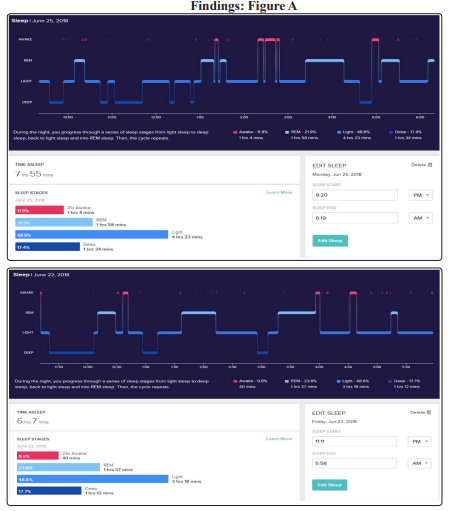
Without High Tryptophan snack before bedtime The Average REM phase for month nearly above 21% and the deep sleep was average of 17%.
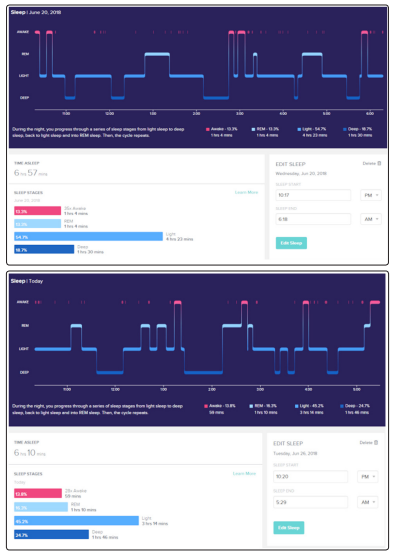
With High Tryptophan snack before bedtime The Average REM phase for month nearly 14.4% and the deep sleep was average of 19%.
It was observed that with tryptophan increased in nutrition the REM phase is decreased and increase in deep sleep. Also the observation suggested in increase in quality of sleep and sleep satisfaction [14,15].
Discussion
The easiest way to use these hormones to get a good night’s sleep is to increase your melatonin levels at night. Besides other factors the high tryptophan food based nutrition can be used to get good night’s sleep. This can be one of the natural remedies to insomnia, Sleep deprivation due to stress, etc rather than on to going for drugs and anti-anxiety medicine.
References
- https://www.livestrong.com/article/541961-how-much-tryptophan-per-day/
- Dawn M Richard, Michael A Dawes, Charles W Mathias, Ashley Acheson, Nathalie Hill Kapturczak (2009) L-Tryptophan: Basic Metabolic Functions, Behavioral Research and Therapeutic Indications. International J Tryptophan Res 2: 45-60.
- https://www.insomnia.net/natural-remedies/l-tryptophan/
- https://pubchem.ncbi.nlm.nih.gov/compound/L-tryptophan#section=Experimental-Properties
- https://sleep.org/articles/what-is-tryptophan/
- http://nutritiondata.self.com/foods-012079000000000000000-w.html?maxCount=52
- https://n2h.in/product/rose-gulkand-2/
- https://mammothmattress.com/melatonin-vs-serotonin-science-behind-good-nights-sleep/
- https://www.benbest.com/nutrceut/melatonin.html
- https://www.webmd.com/vitamins/ai/ingredientmono-326/l-tryptophan
- https://www.tuck.com/stages/
- https://nootriment.com/serotonin-and-melatonin/
- http://www.yourhormones.info/hormones/melatonin/
- https://draxe.com/tryptophan/
- https://www.sciencedaily.com/releases/2016/04/160414214830. htm