

Annals of Civil Engineering and Management(ACEM)
ISSN: 3065-9779 | DOI: 10.33140/ACEM


Research Article - (2024) Volume 1, Issue 1
Using Mill-Rejected Granular Cement as a Replacement for Fine Aggregate
2Civil, Environmental, and Construction Engineering, Texas Tech University, USA
Received Date: Aug 23, 2024 / Accepted Date: Sep 11, 2024 / Published Date: Sep 16, 2024
Copyright: ©Â©2024 Feseha Sahile Asrat, et al. This is an open-access article distributed under the terms of the Creative Commons Attribution License, which permits unrestricted use, distribution, and reproduction in any medium, provided the original author and source are credited.
Citation: Asrat, F. S., Ghebrab, T. T. (2024). Using Mill-Rejected Granular Cement as a Replacement for Fine Aggregate. Ann Civ Eng Manag 1(1), 01-07.
Abstract
This research study presents a report on the effect of mill-rejected coarse-grained cement on concrete properties when the cement is used as a partial replacement for fine aggregates. Concrete mixes containing 5%, 10%, 15%, and 20% replacement of natural sand with mill-rejected cement were prepared and tested for strength and permeability. The test results indicate that the strength of concrete increases and its permeability decreases with the increase in the amount of mill-rejected cement.
Introduction
Concrete is a composite material produced by mixing water, cement, fine aggregate, and coarse aggregate. The properties of concrete depend on the properties and mix proportion of these constituent materials. If the type or amount of one of these constituent materials changes, a change in the property of the concrete is inevitable. However, the degree of change may vary based on the significance of the materials and the amount of change. Cement paste makes about 25- 40% of the volume of concrete, and cement makes about 25-45% of it. The strength and durability of concrete are directly proportional to the amount of cement but inversely proportional to the amount of water added. Therefore, a slight change in the content of these constituents could affect the strength and durability of concrete. The rate of cement hydration depends, among other factors, on the size of cement grains and w/c ratio. For a typical water-cement ratio, only 70-75% of cement hydrated Bentz et al [1]. Aggregates make about 70-75% of the total volume of concrete, with coarse aggregate making about 60-67% of it. Studies indicate that the physical and chemical properties of aggregates have significant effects on the strength and durability of concrete. The proportion of the fine and coarse aggregates affects the fresh and hardened concrete properties. For example, concrete workability decreases with an increase in fine aggregate content. Therefore, any changes made to the properties or amount of aggregates could change the properties of concrete. However, no report on mill-rejected cement grains as a replacement for fine aggregate was found in the literature.
This paper presents a report of a research study evaluating the effect of mill-rejected granular cement on the properties of concrete when used as a partial replacement for fine aggregate. Several researchers have investigated the effect of partially or fully replacing natural fine aggregate with recycled materials on the physical and mechanical properties of concrete Sawant et al., Elango et al., Bakoshi et al., Ghernouti et al, Malik et al., Modania and Vyawahare [2-7]. Mill-rejected cement is pure cement rejected during processing because of its grain size, which is larger than 90 microns. The rejected cement is reprocessed to meet the required grain size, which demands additional energy. The purpose of this study is to evaluate the performance of mill-rejected granular cement as a partial replacement for fine aggregate in the production of concrete. If the outcome of the research is positive, then the use of the rejected cement for such an application could avoid any additional energy required for its reprocessing and reduce energy-related carbon emissions.
Materials Used
Cement
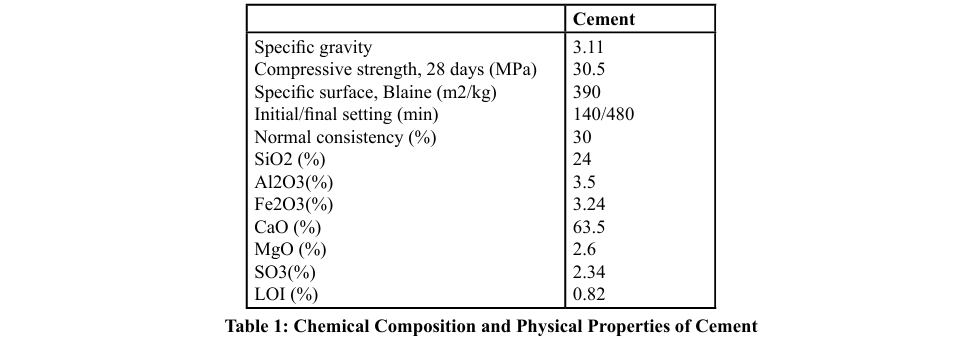
Portland cement was obtained from Ethio Cement Factory, Ethiopia. The chemical compositions and physical properties of the cement are shown in Table 1.
Mill-Rejected Granular Cement (MRGC)
MRGC was obtained from Ethio cement factory. It was sorted as mill-rejected because it was coarser than 75 µm and stocked to be reprocessed. The size of the GC used in this study was between 0.075 mm and 1.18 mm. Samples of the mill-rejected granular cement used in the experiment are shown in Figure 1.

Grain size distribution of the granular cement was carried out following BS EN 933-1standard procedure for sieve analysis of fine aggregates [8]. This procedure was selected because the size of the GC used meets the specifications of fine aggregate. The resulting grain size distribution is shown in Figure 2. No GC f iner than 75 µm was used in the mix. A fineness modulus of 2.36 was obtained for the GC.

Fine Aggregate
The fine aggregate was natural sand obtained from the river bed in the outskirts of Addis Ababa, Ethiopia. The unit weight of sand was determined according to BS EN 1097-3 [9] standard procedure. Sieve analysis was carried out following BS EN 933 1 standard procedure and the grain size distribution indicated that the sand fits the standard concrete mix design requirement [8]. Specific gravity and water absorption of the fine aggregate were determined according to BS EN 1097-6 [10]. specific gravity of 2.7, water absorption of 1.26%, and fineness modulus of 2.66 were obtained for natural sand.
Coarse Aggregate
Crushed sandstone coarse aggregate, 20 mm maximum aggregate size, collected from the same quarry was used to avoid the effect of aggregate type variation on the test results. Grain size analysis of the coarse aggregates was carried out following BS EN 933-1 standard procedure, and the result fitted the minimum requirement for concrete mix [8,11]. Specific gravity and water absorption capacity of coarse aggregate were determined according to BS EN 1097-6, and the obtained values were 2.74 and 1.31%, respectively [8]. The abrasion value of 26.8% was determined per BS EN 1097-8 for the coarse aggregate [12].
Testing
*Concrete Mixing
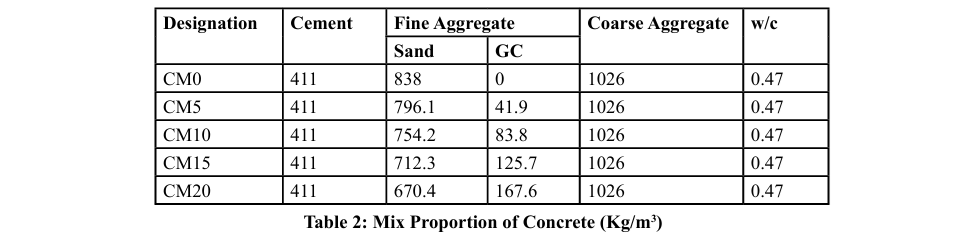
Concrete mix design was carried out following BS EN 206-1 and BS 8500-2 standard procedure with a targeted compressive strength of 25 MPa using a water-to-cement ratio (w/c) of 0.47 [11,13]. The required quantities of the constituent materials of the mixes are presented in Table 2. The control mix (CM0) was prepared using natural fine aggregate (sand), while other mixes were prepared by replacing the sand with 5%, 10%, 15%, and 20% (designated as CM5, CM10, CM15, and CM20) by weight of GC as shown in Table 2. The designation of each mix was given such that the number following the two letters CM represents the weight percentage replacement of fine aggregate by GC.
*Test Procedure
The required amount of GC was first mixed with the sand and then added into the mix with the cement and water. Concrete mix and specimen preparations were performed according to BS 1881-125 standard procedure and the slump test was carried out following BS EN 12350-2 standard procedure [14,15]. Concrete specimens were cast and compacted using a vibration table to ensure good compaction. The surface of each specimen was leveled with a trowel and sealed off with a plastic cover to avoid moisture loss. After the specimens were air-dried for 24 hours, they were placed in a water bath at room temperature until they were tested.
*Compressive Strength
The compressive strength of the 150 x 150 x 150 mm cube specimens was determined according to BS EN 12390-3:2009, the standard testing procedures for the compressive strength of concrete [16]. Three replicates of concrete specimens were tested for each concrete mix at the ages of 1, 3, 7, 14, and 28 days, and the average strength was considered for analysis. The compressive strength was determined by dividing the force required to break the specimen by its cross-sectional area.
*Split Tensile Strength
The split tensile strength tests were performed on 100 x 200 mm cylindrical specimens following BS EN 12390-6:2009 standard testing procedures [17]. Three replicate specimens were tested for each concrete mix at the ages of 7, 14, and 28 days, and the average tensile strength of the three specimens was considered.
*Flexural Strength
The flexural strength tests were carried out on 100 x 100 x 500 mm prismatic specimens following BS EN 12390-5:2009 standard testing procedures [18]. Three replicate specimens were tested for each concrete mix at the ages of 7, 14, and 28 days and the average tensile strength of the three specimens was considered. A total of 45 specimens were tested for flexural strength.
Water Permeability Tests
The constant head permeability test method was carried out using UTC 1080 apparatus following BS EN 12390-8 standard testing procedures to determine the coefficient of permeability of the concrete specimens [19]. Concrete disc specimens with 200 mm diameter and 100 mm thickness were placed into the permeameter cell. The outer surface of the samples was sealed with a water-tight plastic material to prevent water leakage. The cell was filled with de-aired water to avoid air pockets or bubbles. A constant pressure head of 800 kPa was applied on the inflow side of the sample for 48 hours. The pressure was applied from a water tank that was connected to an air compressor. Pressure regulators controlled the pressure. The volumetric inflow and outflow of the water were monitored. When a steady-state flow was achieved, the volume flow versus time was plotted until the slope of the inflow and outflow lines were achieved. Then the permeability was determined by taking the average value of the inflow and outflow plots within the steady-state flow range. Two replicates of the specimen were tested for each concrete mix at the age of 28 days, and the average values were considered. The coefficient of permeability K (m/s) was calculated using the following equation.

where Q (m3) is the volume of drained water; A (m2) is the cross-sectional area of the sample; L (m) is the length of the sample; h (m) is the water pressure head; and t (s) is the time elapsed.
Experimental Results and Discussion
Concrete Workability
The slump test results of each concrete mix are given in Table 3. The measurement for the slump was taken to the nearest 5 mm.

The results indicate that the workability of concrete decreases with the increase in GC content. This may be due to the high absorption capacity developed as a percentage replacement of GC increased and the absorption of part of the mixing water by GC. Thus, concrete mix with the more abundant GC content needs more water or superplasticizer to achieve better workability.
Compressive Strength
Compressive strength test results of concrete specimens are presented in Table 4.

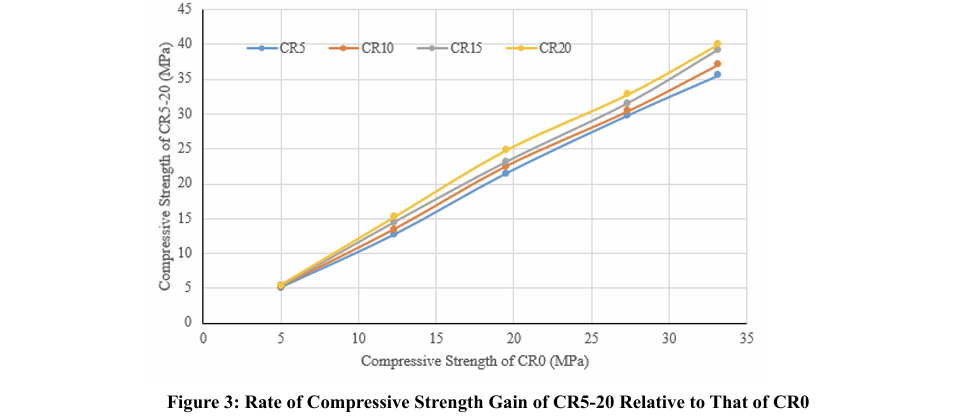
The general trend in the compressive strength test results is that there was an increase in strength with time and GC content. When compared to the strength of the control mix (CR0), the results indicate that compressive strength increases at a slightly increasing rate with GC content and curing time. This phenomenon is shown in Figure 4 by plotting the strengths at different ages of the specimens containing GC versus that of CRO. At the age of 1 day, the percent difference in the strength of CR5 and CR20 from CRO are 2.4% and 9%, respectively, but these values became 7.36% and 20.83% at the age of 28 days. This result indicates that the rate of strength gain increases with an increase in GC content.
Splitting Tensile Strength
Split tensile strength test results of the concrete cylinder specimens are presented in Table 5.

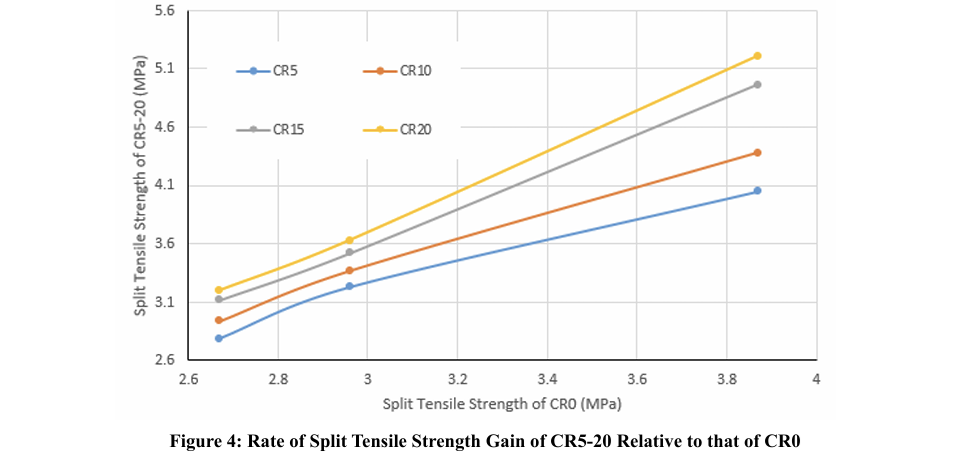
Similar to that of compressive strength test results, the general trend in the split tensile strength test results is that the strength increases with the age of concrete and GC content. When the tensile strengths of the mixes containing GC are compared to that of the control mix (CRO), the results indicate an increase in strength in the former mixes at a rate slightly increasing with GC content and age of the concrete. The trend is demonstrated in Figure 5 by plotting the split tensile strengths at different ages of the specimens containing GC versus that of CRO. At the age of 7 days, the percent difference in the strengths of CR5 and CR20 from that of CRO is 4.5% and 19.9%, respectively, but these values became 4.7% and 34.6% at the age of 28 days. This result indicates that the rate of strength gain increases with an increase in GC content.
Flexural Strength
The flexural strength test results are presented in Table 6.

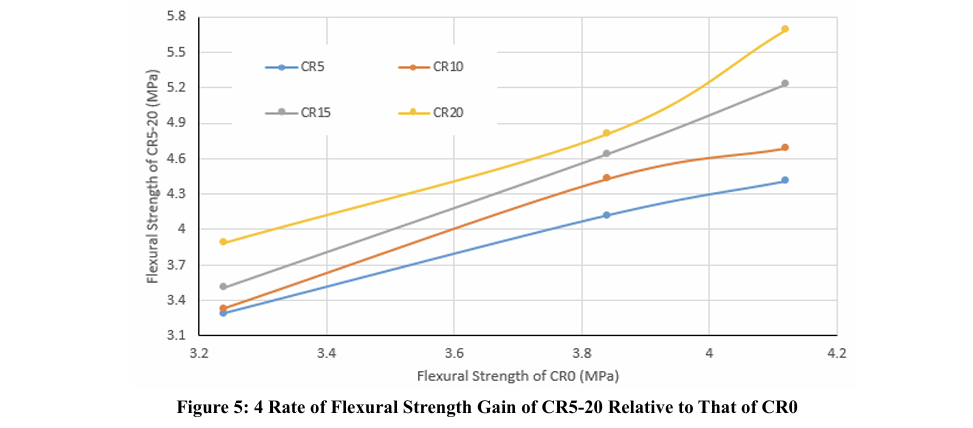
The flexural strength test results, similar to those of the compressive strength test and split tensile strength test results, indicate that the flexural strength of concrete containing GC increases with the age of concrete and GC content. When the tensile strengths of the mixes containing GC are compared to that of the control mix (CRO), the results indicate an increase in flexural strength in the former mixes at a rate slightly increasing with GC content and age of the concrete. The trend is demonstrated in Figure 5 by plotting the flexural strengths of the specimens containing GC versus that of CR0. At the age of 7 days, the percent difference in flexural strength of CR5 and CR20 from that of CR0 is 1.54% and 20.06%, respectively, but these values became 7.04% and 38.11% at the age of 28 days.
This result indicates that the rate of strength gain increases with an increase in GC content. As shown in Figure 5, the 7-day and 28-day flexural strength results of CR20 were relatively higher than that of CRO when compared to the other mixes.
Water Permeability
The concrete water permeability test results at the age of 28 days are presented in Table 7. 
Conclusions
From the experiment results obtained from the laboratory, the following conclusion can be made
• The slump test results indicate that concrete workability decreases with the increase in the percentage replacement of fine aggregate with GC.
• The compressive, tensile, and flexural strengths of concrete increase with the increase in the percentage replacement of fine aggregate with GC, and the rate of strength gain increases with time.
• The water permeability of concrete decreases with the increase in the percentage replacement of fine aggregate with GC.
• Generally, using mill-rejected granular cement as a partial replacement for conventional fine aggregate improves the properties of concrete and has environmental advantages by minimizing dependence on naturally available fine aggregates [20,21].
Availability of Data and Materials
The raw data that support the findings of this study and materials are available from the corresponding author until reasonable request.
Funding
This study was supported by the Ministry of Science and Higher Education of the Federal Democratic Republic of Ethiopia under Grant No. 23A742.
Authors Contribution
The corresponding author of this study construct the hypothesis, performer the experiment, manage data, interpret and present the result, construct the manuscript. The second author of this study constructs the idea or hypothesis of the study, supervises the research work, constructs the body of the manuscript, and reviews the manuscript before submission.
Acknowledgments
This material is based upon work supported by the Ministry of Science and Higher Education of the Federal Democratic Republic of Ethiopia under Grant No. 23A742. Any opinions, f indings, conclusions, or recommendations expressed in this material are those of the author(s) and do not necessarily reflect the views of the Ministry of Science and Higher Education. The authors are thankful to Texas Tech University and Jimma Institute of Technology for their support.
References
1. Bentz, D. P., Garboczi, E. J., Haecker, C. J., & Jensen, O. M. (1999). Effects of cement particle size distribution on performance properties of Portland cement-based materials. Cement and concrete research, 29(10), 1663-1671.
2. Sawant, A., Sharma, A., Rahate, R., Mayekar, N., & Ghadge, M. D. (2018). Partial replacement of sand with sawdust in concrete. International Research Journal of Engineering and Technology, 5(3), 3098-3101.
3. Elango, A. A. K. A., & Ashok Kumar, A. (2018). Study on partial replacement of plastic waste as fine aggregate in concrete. International Journal of current Engineering and scientific research, 5(5), 2394-0697.
4. Bakoshi, T., Kohno, K., Kawasaki, S., & Yamaji, N. (1998). Strength and durability of concrete using bottom ash as replacement for fine aggregate. Special Publication, 179, 159-172.
5. Ghernouti, Y., Rabehi, B., Safi, B., & Chaid, R. (2011). Use of recycled plastic bag waste in the concrete. Journal of International Scientific Publications: Materials, Methods and Technologies, 8, 480-487.
6. Ahmad, S., Malik, M. I., Wani, M. B., & Ahmad, R. (2013). Study of concrete involving use of waste paper sludge ash as partial replacement of cement. IOSR Journal of Engineering, 3(11), 06-15.
7. Modani, P. O., & Vyawahare, M. R. (2013). Utilization of bagasse ash as a partial replacement of fine aggregate in concrete. Procedia Engineering, 51, 25-29.
8. BS, 2012. Tests for geometrical properties of aggregates. Determination of particle size distribution - Sieving method, London, UK:" BS EN 933-1:2012.
9. BS, 1998. Tests for mechanical and physical properties of aggregates. Determination of loose bulkdensity and voids, London, UK: BS EN 1097-3:1998.
10. BS, 2000. Tests for mechanical and physical properties of aggregates. Determination of particle density and water absorption, London, UK: BS EN 1097-6:2000.
11. BS, 2015. Concrete – Complementary British Standard to BS EN 206 – Part 2: Specification for constituent materials and concrete, London, UK: BS 8500-2:2015.
12. BS, 2000. Tests for mechanical and physical properties of aggregates. Determination of the polished stone value, London, UK: BS EN 1097-8:2009,
13. BS, 2013. Specification, performance, production and conformity,”, London, UK: BS EN 206:2013.
14. BS, 2013. Method for mixing and sampling fresh concrete in the laboratory, London, UK: BS 1881-125:2013, London, UK.
15. BS, 2019. Testing fresh concrete. Slump-test, London, UK: BS EN 12350-2:2019.
16. BS, 2010. Testing hardened concrete. Compressive strength of test specimens, London UK: BS EN 12390-3:2009.
17. BS, 2010. Testing hardened concrete. Tensile splitting strength of test specimens, London, Uk: BS EN 12390 6:2009.
18. BS, 2010. Testing hardened concrete. Flexural strength of test specimens, London, UK: BS EN 12390-5:2009.
19. BS, 2019.Testing hardened concrete. Depth of penetration of water under pressure BS, "Testing hardened concrete. Depth of penetration of water under pressure, London, UK: BS EN 12390-8:2019.
20. Abdullahi, A., Abubakar, M., & Afolayan, A. (2013). Partial replacement of sand with sawdust in concrete production. Proceedings of 3rd Biennial Engineering Conference, School of Engineering and Engineering Technology, Federal University Technology Minna.
21. Samantaray, S. S., Panda, K. C., & Mishra, M. (2016). Rice husk ash as fine aggregate sustainable material for strength enhancement of conventional and self-compacting concrete. Key Engineering Materials, 692, 94-103.