

Annals of Civil Engineering and Management(ACEM)
ISSN: 3065-9779 | DOI: 10.33140/ACEM


Review Article - (2026) Volume 3, Issue 2
Urban Congestion as a Volatility Pricing Problem: A Call–Put Options Framework with Black–Scholes Travel Time Valuation

Received Date: May 13, 2026 / Accepted Date: Jun 08, 2026 / Published Date: Jun 16, 2026
Copyright: ©2026 Paul T E Cusack. This is an open-access article distributed under the terms of the Creative Commons Attribution License, which permits unrestricted use, distribution, and reproduction in any medium, provided the original author and source are credited.
Citation: Cusack, P. T. E. (2026). Urban Congestion as a Volatility Pricing Problem: A CallâPut Options Framework with BlackâScholes Travel Time Valuation. Ann Civ Eng Manag, 3(2), 01-03.
Abstract
This paper develops a unified financial-economics framework for urban congestion in which travel time is treated as a stochastic asset with density-dependent volatility. Automobile travel is modeled as a call option on low-congestion travel time, while transit and avoidance behavior act as put-like hedges against congestion risk. We embed a Black–Scholes- type valuation framework to price travel-time uncertainty and derive a congestion pricing rule equivalent to an option premium. Marginal external costs are shown to scale convexly with congestion-induced volatility, providing a structural basis for congestion pricing in urban systems.
Introduction
Urban congestion is traditionally modeled using marginal cost pricing:
MB = MC + MEC
However, this formulation omits a key empirical feature: travel time is stochastic and volatility increases with density. This paper reframes congestion as a financial options market over uncertain travel-time outcomes, where congestion externalities arise from unpriced volatility risk.
Travel Time as a Stochastic Process
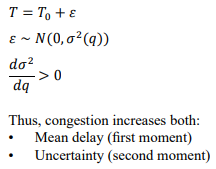
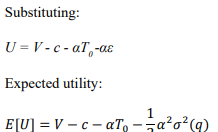
Utility Function
U = V - c - αT
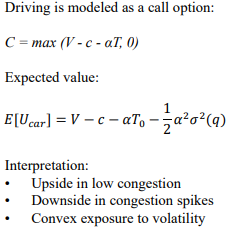
Call Option Interpretation (Automobile Travel)
Put Option Interpretation (Transit / Avoidance)
Transit acts as downside protection:
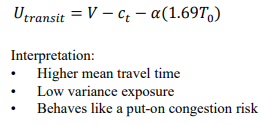
Marginal External Cost (Volatility Externality)
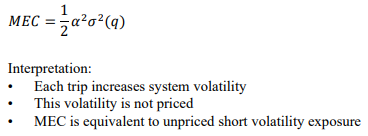
Black-Scholes Framework for Travel Time Valuation
Define the “Travel Asset”
Let:
• S = realized travel efficiency (inverse travel time)
• K = free-flow benchmark efficiency
• σ = congestion volatility
• t = travel horizon
• r = social discount rate
Black–Scholes Call Option (Driving Value)
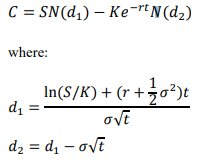
Interpretation in Transportation Terms
|
Variable |
Meaning |
|
S |
realized travel speed |
|
K |
free-flow speed |
|
σ |
congestion uncertainty |
|
C |
value of driving option |
Table1
Key Insight
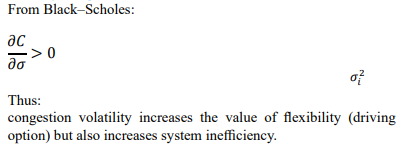
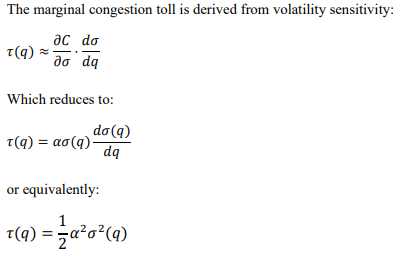
Congestion Pricing from Black-Scholes Sensitivity
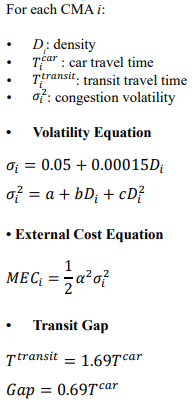
CMA Empirical Structure
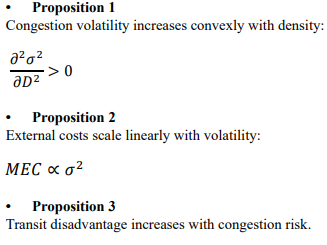
Structural Results
Conclusion
This paper shows that urban congestion can be modeled as a Black–Scholes-style options market over stochastic travel time. Automobile travel behaves as a call option on free-flow mobility, while congestion externalities correspond to unpriced volatility exposure. Optimal congestion pricing is equivalent to an option premium that internalizes travel-time risk.
Final Core Result
Urban congestion is a Black–Scholes-style mispriced volatility market in which travel behaves as a call option on stochastic mobility, and marginal external costs arise from unpriced sensitivity to travel-time variance.
References
- Arnott, R., De Palma, A., & Lindsey, R. (1993). A structural model of peak-period congestion: A traffic bottleneck with elastic demand. The American Economic Review, 161-179.
- Arnott, R., De Palma, A., & Lindsey, R. (1994). The welfare effects of congestion tolls with heterogeneous commuters. Journal of Transport Economics and Policy, 139-161.
- Black, F., & Scholes, M. (1973). The pricing of options and corporate liabilities. Journal of political economy, 81(3), 637-654.
- Börjesson, M., Eliasson, J., Hugosson, M. B., & Brundell-Freij, K. (2012). The Stockholm congestion charges—5 years on. Effects, acceptability and lessons learnt. Transport Policy, 20, 1-12.
- Button, K. (2010). Transport economics. Edward Elgar Publishing.
- Downs, A. (1962). The law of peak-hour expressway congestion. Trafic Quarterly, 16(3).
- Eliasson, J. (2009). A cost–benefit analysis of the Stockholm congestion charging system. Transportation Research Part A: Policy and Practice, 43(4), 468-480.
- Engle, R. F. (1982). Autoregressive conditional heteroscedasticity with estimates of the variance of United Kingdom inflation. Econometrica: Journal of the econometric society, 987-1007.
- Fosgerau, M., Hjorth, K., & Lyk-Jensen, S. V. (2010).Between-mode-differences in the value of travel time: Self-selection or strategic behaviour?. Transportation research part D: transport and environment, 15(7), 370-381.
- Fosgerau, M., & Karlström, A. (2010). The value of reliability. Transportation Research Part B: Methodological, 44(1), 38-49.
- Goodwin, P. B. (1996). Empirical evidence on induced traffic:A review and synthesis. Transportation, 23(1), 35-54.
- Greenshields, B. D., Bibbins, J. R., Channing, W. S., & Miller, H. H. (1935, December). A study of traffic capacity. In Highway research board proceedings (Vol. 14, No. 1, pp. 448-477).
- Knight, F. H. (1924). Some fallacies in the interpretation of social cost. The Quarterly Journal of Economics, 38(4), 582-606 .
- Litman, T. (2023). Transportation Cost and Benefit Analysis. Victoria Transport Policy Institute.
- MERTON, R. (1973). Theory of Rational Option Pricing. BellJournal of Economics and Management Science, 4, 141-183.
- Mohring, H. (1972). Optimization and scale economies in urban bus transportation. The American Economic Review, 62(4), 591-604.
- Pigou, A. C. (1920). The Economics of Welfare. Macmillan.
- Small, K. A., & Verhoef, E. T. (2007). The Economics of Urban Transportation. Routledge.
- Small, K. A., Winston, C., & Yan, J. (2005). Uncovering the distribution of motorists' preferences for travel time and reliability. Econometrica, 73(4), 1367-1382.
- Train, K. E. (2009). Discrete Choice Methods with Simulation (2nd ed.). Cambridge University Press.
- Vickrey, W. S. (1963). Pricing in urban and suburban transport.The American Economic Review, 53(2), 452-465.
- Vickrey, W. S. (1969). Congestion theory and transport investment. The American economic review, 59(2), 251-260.
- Wardrop, J. G., & Whitehead, J. I. (1952). Correspondence. some theoretical aspects of road traffic research. Proceedings of the institution of civil engineers, 1(5), 767-768.
- These are particularly useful because your paper's novelty is the treatment of congestion as a volatility process.
- Bates, J., Polak, J., Jones, P., & Cook, A. (2001). The valuation of reliability for personal travel. Transportation Research Part E: Logistics and Transportation Review, 37(2-3), 191-229.
- Noland, R. B., & Polak, J. W. (2002). Travel time variability: a review of theoretical and empirical issues. Transport reviews, 22(1), 39-54.
- Carrion, C., & Levinson, D. (2012). Value of travel time reliability: A review of current evidence. Transportation research part A: policy and practice, 46(4), 720-741.
- Peer, S., Koopmans, C. C., & Verhoef, E. T. (2012). Prediction of travel time variability for cost-benefit analysis. Transportation Research Part A: Policy and Practice, 46(1), 79-90.