

Current Research in Statistics & Mathematics(CRSM)
ISSN: 2994-9459 | DOI: 10.33140/CRSM



Research Article - (2025) Volume 4, Issue 2
Trade Openness, Income Inequality and Economic Growth in the Democratic Republic of Congo
Received Date: Jul 17, 2025 / Accepted Date: Aug 19, 2025 / Published Date: Aug 29, 2025
Copyright: ©©2025 Jonathan Kitoko Asenga, et al. This is an open-access article distributed under the terms of the Creative Commons Attribution License, which permits unrestricted use, distribution, and reproduction in any medium, provided the original author and source are credited.
Citation: Boongo, E. B., Asenga, J. K., Bahati, M. Z. (2025). Trade Openness, Income Inequality and Economic Growth in the Democratic Republic of Congo. Curr Res Stat Math, 4(2), 01-13.
Abstract
This research examines the relationship between trade openness, income inequality and economic growth in the Democratic Republic of Congo (DRC) from 1990 to 2020. Using an ARDL (Auto Regressive Distributed Lag) econometric model, the study assesses the how trade openness and income inequality influence economic growth. The results of this study demonstrate that in the short term, trade openness has a positive and significant effect on economic growth. Every additional 1 point of trade opening leads to an increase in economic growth of 26.85%; GINI has a negative and significant effect on economic growth. Any increase in inequality of 1 point leads to a decrease in GDPH of 141.8667%., and that in the long term, trade openness has a positive and insignificant effect on economic growth. Every additional 1 point of trade opening results in an increase in economic growth of 84.85%; GINI has a negative and significant effect on economic growth.
Keywords
Trade Openness, Income Inequality, Economic Growth, Governance
Introduction
The Democratic Republic of Congo (DRC) faces a dilemmapersistent: how to reconcile increased trade openness, potentially beneficial for economic growth, with the reduction of income inequalities whichhave persisted for decadesThis complex and multidimensional paradox is at the heart of this study, which aims to explore the impact of trade openness on economic growth and the potential correlation with income inequality in the DRC. Analyzing this interaction is crucial for formulating relevant and sustainable economic policies capable of supporting sustainable development. inclusive and equitable developmentin the country. The analysis of the impact of income inequality on economic growth in the DRC is part of a broader theoretical framework. Manystudies, notably those of Kuznets (1955) and Acemoglu et al. (2005), explored the complex relationship between inequality and growth. This work suggests that extreme inequality can ultimately hinder growth by limiting access to human capital, curbing consumption, and undermining political stability. The DRC, with its stark regional and social disparities, perfectly illustrates this potential. Trade openness, often presented as an engine of growth, is seen as an essential lever for stimulating production, improving the allocative efficiency of resources, and promoting integration into the global economy. It involves lowering customs barriers, liberalizing trade, and improving the business climate. However, the benefits of openness are not always distributed equitably. Previous studies suggest that trade openness can, in certaincircumstances, amplify income inequality by promoting the concentration of wealth in certain sectors, individuals, or regions [1]. This phenomenon, often linked to weak institutions and poor governance, can compromise the sustainability of growth and the consolidation of social cohesion. The DRC is open to international trade, which accounts for 95% of its GDP (World Bank, latest available data). With 80 million hectares of arable land and more than 1,100 minerals and precious metals, the DRC has the potential to become one of the continent's leading exporting countries and an engine of African growth. The country mainly exports refined copper (USD 16.3 billion), cobalt (USD 5.99 billion), copper ore (USD 1.55 billion), raw copper (USD 1.37 billion), and crude oil (USD 916 million), while imports are dominated by refined oil (USD 1.12 billion), sulfur (USD 979 million), delivery trucks (USD 367 million), stone processing machinery (USD 363 million), and iron structures (USD 285 million - OEC 2022 data). Between 2020 and 2022, copper exports from the Democratic Republic of Congo jumped by almost 50%, from 1.601 milliontonnes in 2020 to 2.394 milliontonnes in 2022, with interim figures of 1.797 million tonnes in 2021. This remarkable growth is mainly attributed to the surge in copper prices, which increased by 51.3% to an average of USD 9,299.3 per tonne in 2021, which significantly increased the value of copper exports. In addition, cobalt exports increased from 86,590 tonnes in 2020 to 115,371 tonnes in 2022, with an estimate of 93,010 tonnes in 2021 [2]. While the DRC's trade balance was structurally negative, the recovery in commodity prices issupporting export growth and current account rebalancing, shifting the country's trade balance to positive in recent years. According to WTO figures, exports of goods totaled USD 28.2 billion in 2022, compared to USD 11 billion in imports. Regarding services, the DRC is a net importer (USD 4.5 billion in imports compared to USD 109 million in exports). Drawing on quantitative and qualitative data, this research will seek to shed light on the correlation between trade openness, income inequality, and economic growth in the DRC. The study will examine the structural and institutional factors that moderate this relationship. It will seek to identify policies and strategies likely to promote more inclusive and sustainable growth in the country. The need for analysis on this subject raises questions to which the attempt to find empirical answers constitutes the framework of our study. Thus, the present study attempts to contributeprovide elements of response to the following questions: • How does trade openness influence economic growth in the DRC; and • What is the impact of income inequality on economic growth in the DRC? In search of answers to these questions, the present research aims to assess how trade openness influences economic growth in the DRC and to identify the impact of income inequality on economic growth in the DRC. Besides this introductory section, the rest of the article is composed of four sections. The first deals with the literature review, the second with the methodology, the third with the presentation of results, discussion and the last point sets out the conclusion and recommendations.
Literature
Theoretical Review
(Economic) Inequalitie
Economic inequality refers to situations in which some people have greater resources (in the broad sense) than others. Economic inequality refers to the existence of social stratification: some individuals have a higher level of income or wealth, they have access to goods and services, or professional status, etc., which are socially valued and hierarchical. There are several types of inequality to distinguish: • Inequalities in rights, which are enshrined in law, for example in caste societies (certain professions are reserved for the highest castes) or feudal societies (privileges of the clergy and nobility, serfdom), within the framework of apartheid. • Inequalities of opportunity are those which prevent individuals from exercising their talents and accessing the highest positions in society because of their social background (the academic success of children of workers is, for example, lower than that of children of executives, which is an obstacle to accessing high social positions). • Finally, inequalities of situations are those which are observed in a society, from an economic, social, cultural, etc. point of view (inequalities of salaries, living conditions, etc.). We must distinguish between inequality and discrimination. The latter, which consists of treating individuals differently basedon their personal characteristics (religion, ethnic origin, gender, etc.), necessarily leads to inequality. However, inequality is not necessarily discrimination. If we take up Aristotle's saying, "that which is equal is just," we can deduce that inequalities are unjust, which explains the existence of public policies aimed at reducing them. By fighting discrimination, by modifying regulations and institutional arrangements in a way favorable to equality, by implementing vertical redistribution, etc. Each society determines the areas in which it intends to promote equality (by specifying what form it takes) and the areas in which it accepts to allow inequalities to manifest themselves. There is a debate among inequality experts: For some, all inequality is unjust. For others, there are just inequalities. What matters, then, is how one judges the criteria of justice.
Measurement of Income Inequality
Unlike poverty measures, which are limited to the poor, inequality measures include the entire population, since the concept of inequality is much broader than that of poverty. Most inequality measures do not depend on the mean of the distribution but on each individual's situation relative to the mean value. The most common measures are (i) the Lorenz curve, (ii) the Gini index, (iii) the share of the poor in resources, and (iv) Kuznets ratios.
The Gini Index
The Gini coefficient is the most commonly used measure of inequality. It translates into numerical terms the level of inequality represented by the Lorenz curve. The coefficient varies between 0, which indicates complete equality, and 1, which indicates total inequality (one individual receives all the income and the others receive absolutely nothing).
Commercial Opening
A Definition Trade
openness, also known as trade liberalization or market opening, refers to the process by which countries reduce or eliminate trade barriers that hinder the free exchange of goods and services between them. This results in greater integration of global economies. Trade openness is characterized by a reduction in government restrictions on international trade. These restrictions can take several forms: Tariffs: These are customs duties (taxes on imports), which increase the price of foreign products and make imports less competitive. Non-tariff: This is a set of more subtle and complex measures, such as: quotas: quantitative limits on imports, Technical and sanitary standards: regulations on the quality, safety and health of imported products, which can be used to restrict imports. Subsidies: financial aid to national companies which allows them to compete more easily with imports. Anti-dumping and compensatory measures: implemented to counter unfair commercial practices (dumping = selling at a loss). Bureaucratic obstacles: complex and lengthy administrative procedures that make imports more difficult.
B.Measures of Trade Openness
Several indicators can be used to measure the degree of commercial openness of a country or region: Degree of openness: The degree of openness is the ratio (Imports + Exports) / GDP. The higher this ratio, the more open the country is to trade. It reflects the share of international trade in national economic activity. Share of imports in domestic consumption: This measures the extent to which a country’s consumers rely on foreign goods and services. Effective protection rate: This indicator measures the impact of protectionist measures (tariff and non-tariff) on domestic prices. Economic Complexity Index (ECI): The ECI measures the diversity of a country’s exports, reflecting a certain degree of openness to trade in varied and sophisticated products. A high ECI suggests greater openness and sophistication. Membership in trade agreements: The number of free trade agreements a country participates in reflects its commitment to trade openness
Advantages and Disadvantages of Trade Openness
Advantages of Trade Openness Economic growth
: Increased productivity, competition, and innovation. Price reduction: Increased supply and competition, leading to lower prices for consumers. Improved welfare: Access to a wider variety of goods and services. Specialization and productivity gains: Countries specialize in producing goods and services for which they have a comparative advantage.
Disadvantages of Trade Openness
Job losses in certain sectors: Foreign competition can lead to the closure of domestic companies. Increased inequalities: The gains from trade openness are not always distributed equally. Dependence on foreign markets: Countries can become vulnerable to international economic shocks. Environmental issues: The production and transport of goods can have negative environmental consequences. In short, trade openness is a complex and multifaceted process, whose advantages and disadvantages must be carefully assessed. Its measurement relies on various indicators that help analyze its impact on national and international economies.
Economic Growth
Economic growth is a long-term phenomenon, which differs from expansion, a term used in the analysis of fluctuations and cycles. According to F. Perroux, growth is also distinct from economic progress and economic development, which “encompass and sustain growth. F. Perroux's (1962) definition, which equates growth with an increase in a country's economic output, remains a benchmark. The famous economic growth rate is thus measured by the change in gross domestic product (GDP) in volume. However, more and more economists today are defining growth as a long-term increase in per capita output. The origins of growth date back to the Industrial Revolution. Indeed, before this period, reconstructed economic data allow us to observe a near stagnation of production. For P. Bairoch (1997), the Industrial Revolution isthe second decisive rupture in the history of humanity, the first being the Neolithic revolution which established agriculture. According to this historian, between the two revolutions, Neolithic and Industrial, the increase in the standard of living was modest, around 60 to 90%, and this, over nine millennia. According to the work of A. Maddison (2001), in the period preceding the Industrial Revolution, European countries experienced an average annual growth rate of their gross domestic product (GDP) of 0.6%. Between 1820 and 1980, the average annual growth rate was 2.5%, thus attesting to the decisive rupture made with the emergence and rise of industrial capitalism.
Measuring Economic Growth
Economic growth is generally measured by the increase in gross domestic product in volume. This national accounting aggregate is based on conventions that only count production, both market and non-market, if it is produced using market factors.
Review of the Literature on Trade Openness, Income Inequality and Economic Growth
This literature review examines the theoretical and empirical links between trade openness, income inequality and economic growth, focusing on aspects relevant to the case of the Democratic Republic of Congo (DRC
Impacts of Inequalities on Economic Growth
We can divide the literature on the impact of inequality on economic growth into two main theses: an optimistic thesis and a pessimistic thesis.•
Optimistic Thesis(Growth Stimulated by Inequalities)
This thesis, also called trickle-down economics, posits that increasing inequality, by concentrating wealth among the wealthy, ultimately stimulates economic growth for all. The key arguments are as follows: • Savings and investment: The rich have a higher savings rate than the poor. This increased savings fuels investment, promoting innovation, job creation, and economic growth. global omics (Simon Kuznets initially observed an inverted U-shaped relationship between inequality and growth, suggesting a positive relationship in the early stages of development) more recent work such as of [3,4]. • emphasize the impact of inequality on innovation and growth. They argue that a certain inequality is necessary to encourage effort and risk-taking, which drive innovation. • Increased demand: Consumption by the rich, even though it represents a smaller share of GDP than that of the poor, generates increased demand for high-end goods and services, stimulating production and employment in certain sectors [5]. Suggest that financing innovation is more efficient when resources are concentrated in the hands of a few individuals. • Multiplier effect: The enrichment of the better-off can have a ripple effect on the economy, creating jobs and opportunities for the less well-off. Explores the impact of spatial interactions and externalities on growth [6]. •
Pessimistic Thesis (Growth Hampered by Inequalities)
This thesis highlights the negative effects of high inequalities on economic growth. The key arguments are: • Social and political instability: High inequality can lead to social unrest, conflict, and political instability, which harm investment and economic growth [7]. Large wealth disparities can lead to protests, strikes, and even revolutions. • Market imperfections: Inequality can amplify market imperfections, such as discrimination, limited access to credit, and debt accumulation, leading to inefficient allocation of resources [8]. Access to credit, education, and healthcare is often unequal, limiting opportunities for the less well-off. • Poverty traps: Inequality can trap individuals and families in cycles of poverty, limiting their ability to invest in education, health, and entrepreneurship. Shows the impact of capital concentration on long-term inequality [9,10]. • Insufficient demand: A high concentration of wealth in the hands of a small minority can lead to insufficient aggregate demand, because the rich have a lower propensity to consume than the poor. • Reduced social mobility: High inequalities limit social mobility, reducing the prospects for improving living standards for low- income individuals and families. The impact of inequality on economic growth is a complex and debated topic. Although trickle-down theory has its proponents, the majority of empirical literature suggests that high levels of inequality have a negative impact on long-term growth, particularly due to adverse effects on social stability, investment, and economic efficiency. The case of the DRC, with its glaring inequalities, perfectly illustrates the relevance of this question. Further research is needed to better understand the complex mechanisms linking inequality and economic growth in specific contexts. . Impact of Trade Openness on Economic Growth Trade openness is widely considered a driver of economic growth. Adam Smith (1776) already highlighted the market expansion and increased efficiency of firms through international competition. The HOS (Heckscher-Ohlin-Samuelson) model and the theory of comparative advantage (Ricardo) predict a reallocation of resources towards the most efficient sectors, increasing total factor productivity [11]. Integration into international trade also promotes technological innovation, technology transfer, and an improvement in the division of labor. The endogenous growth approach supports this view by integrating increasing returns and capital accumulation [12]. However, traditional analysis did not sufficiently consider the role of endogenous factors and the impact of imperfect competition. 3.3. Optimistic Thesis A country with a higher degree of openness has a greater ability to employ technologies produced in advanced economies; and these opportunities lead them to develop faster than a country with a lower degree of openness [13]. Thus, some studies have identified a positive association between trade openness and economic growth [14,15]. The defenders of this thesis believe that trade openness has a positive influence on economic growth through a number ofmechanisms including technology transfer, market expansion, etc. They also support the fact that trade openness drives economic growth through investment, as is the case of Grossman and Helpman (1991). 3.4. Pessimistic Thesis Unlike the first, this thesis supports the fact that trade openness can be harmful to economic growth [16]. Indeed, the trade composition in terms of goods also matters regarding its growth effect if the gains of a country from international trade also depend on the ease with which foreign technologies are mastered and adapted to the local environment [17-19]. Many authors present this negative association, this is the case of Rodriguez and Rodrik (1999); Rodrik (2001). They believe that prescribing trade openness as the key to the success of contemporary economies and especially developing countries is a utopia because most developing countries have poorly adapted structures and are unable to cope with the industries of developed countries and therefore cannot benefit from trade openness. Along the same lines, Koeniger and Silberberger (2015) show that although trade openness drives economic growth, the preconditions for achieving a positive effect of trade openness on growth are not met in most developing countries. Consequently, the effect of trade openness on growth can only be negative. This literature therefore shows us that trade openness does not automatically lead to economic growth. This literature review highlights the complexity of the relationships between trade openness, income inequality, and economic growth. Applying theoretical models to the case of the DRC requires a contextual analysis, taking into account its structural and institutional specificities.
Methodology
Method
To achieve the assigned objectives, the study uses the analytical method operationalized in an econometric approach. This method is supported on the one hand by the documentary technique for collecting the data necessary for the materialization of the research and on the other hand by the analysis of the economic facts observed through data collected from the World Bank. These data are analyzed using the Eviews software.
Data Collection Techniques
The documentary technique allowed us to collect data by consulting various archives, reports from the Central Bank of Congo, the World Bank and then the work carried out by other researchers closely related to our subject.
Model Selection and Specification
The stochastic analysis of the variables under examination led us to use an autoregressive model with staggered lags (ARDL model) following the new cointegration approach of Pesaran et al. (2001) or bounds cointegration test. The ARDL model is one of the classes of dynamic models. These have the particularity of taking into account temporal dynamics (adjustment time, anticipations, etc.) in the explanation of a variable (time series), thus improving forecasts and the effectiveness of policies (decisions, actions,etc.), unlike the simple (non-dynamic) model whose instantaneous explanation (immediate effect or not spread over time) only restores part of the variation of the variable to be explained. Indeed, although previous literature on the subject suggests several variables that may influenceeconomic growth, it is not possible to include them all. For this purpose, this study retains only a few in the context of the DRC. As stated earlier, the present study seeks to capture the effect oneconomic growth measured by GDP per capita (GDP)(variesdependent), the GINI indexAndcommercial opening (OUVCOM)who are thevariablesof interest taking into account other essential control variablesof whichquality of governance (QOG) andforeign direct investment (FDI)whose influence improves the results. Thus, we propose to estimate an ARDL model for the following function (linear functional form):
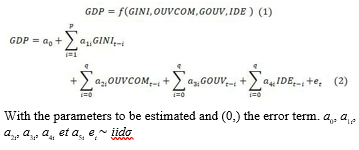
With the parameters to be estimated and (0,) the error term. a0, a1i, a2i, a3i, a4i et a5i et ∼ iidσ 4.4.
Source and Description of Variables•
GINI: This is the Gini coefficient collected from the WID database and measures the level of income inequality in the country. The Gini coefficient is a number ranging from 0 to 1, where 0 means perfect equality and 1 means perfect inequality. It is the dependent variable of the model. • OUVCOM: This is trade openness. It is measured by the ratio of the sum of exports and imports to GDP (as a percentage) and collected from the World Bank database..A high level of trade openness indicates that the country is actively participating in global trade, which can influence economic growth and competitiveness and in turn reduce income inequality. • GDP: GDP per capita measures economic growth and is obtained from the World Bank database. Several empirical studies show economic growth as a determinant of income inequality. • GOUV: This is the indicator of the quality of governance and is collected in the QOG database. The governance quality indicator is a composite indicator. Itis the average of three variables including corruption, laws and orders and the quality of bureaucracy. Its value is between 0 and 1. The closer the value is to 1, the better the quality of governance; the closer the value is to 0, the lower the quality of governance. • IDE: FDI is defined as an operation by which an investor based in one country (home country) acquires an asset in another country (host country) with the aim of exercising significant influence over its management. As for any dynamic model, we will use the information criteria (Akaike-AIC, Shwarz-SIC and Hannan-Quin) to determine the optimal shifts (p,q) of the ARDL model by parsimony . Note that after the estimation of the model, a series of tests is carried out (LM test of autocorrelation of Breusch-Godfrey/BG errors (lag = 2), normality test of JarqueBerra residuals, homoscedasticity test (either the Breush-Pagan-Godfrey/BPG test, that of Harvey, that of Glejser, that of ARCH or White as the case may be, etc.), Ramsey specification test, stability test, etc.) for the validity of the estimated ARDL model.
Presentation of Research Results
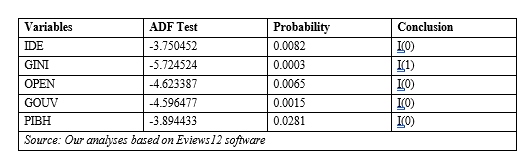
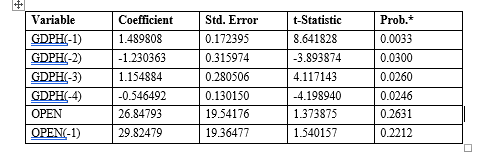
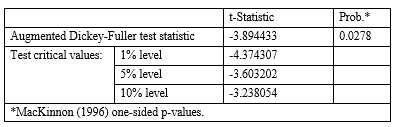
Table 1: Stationarity Test The table above shows the results according to which: the variables IDE, OPEN, GOUV and PIBH are stationary at level and therefore integrated of order 0; while the variable GINI is stationary at the first difference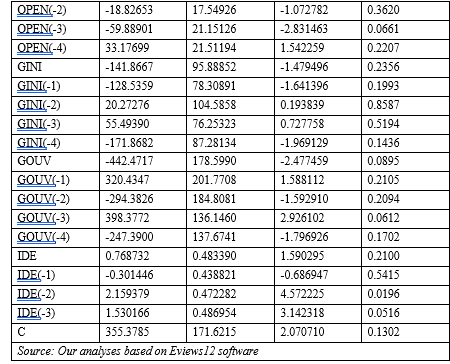 and therefore integrated of order
Table 2: Estimation of the ARDL Model
As it appears in the estimation result, the model ARDL(4, 4, 4, 4, 3) is the most optimal among the 19 others presented, as it offers the
smallest AIC value
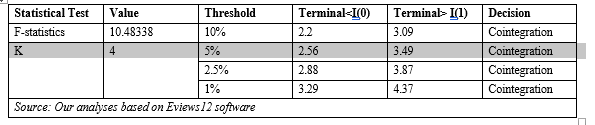
Table 3: Cointegration test at the limits
The result of the bounds cointegration test indicates that the value ofCalculated F-statistic is greater than the upper bound values, so there is acointegration between the variables under study. In other words, there is a long-term relationship between the series under study.
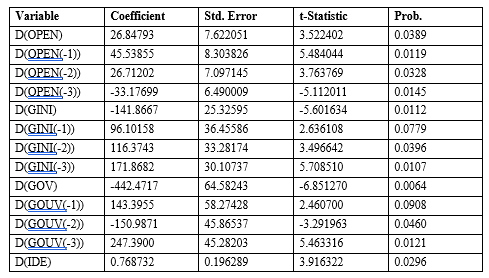

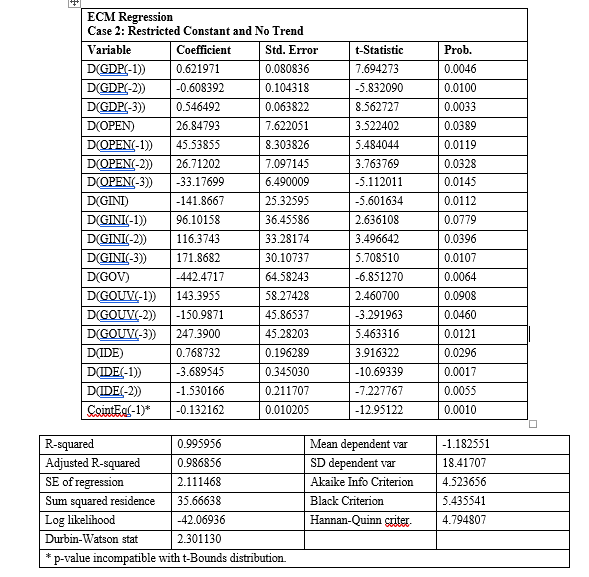
Table 4: Short-term dynamics
The adjustment coefficient or restoring force is statistically significant, which guarantees an error correction mechanism. And there is a long-term relationship between the variables.
The result of the short-term model indicates that:
- Trade openness has a positive and significant effect on economic growth. Every additional 1 point of trade openness leads to an increase in economic growth of26.85%.
- GINI has a negative and significant effect on economic growth.
Every increase in inequality of 1-point leads to a decrease in GDP of141.8667%.
- GOUV has a negative and significant effect on GDPH. This implies that every increase in the quality of governance by 1 unit leads to a decrease in GDPH of 442.4717%.
- IDE has a positive and significant effect on economic growth. Every 1% increase in FDI leads to an increase in economic growth of0.768732.
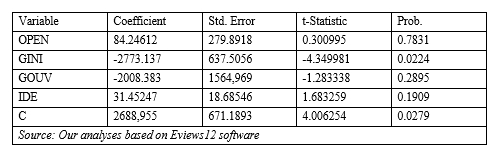
Table 5: Long-term dynamics
The result of the long-term model indicates that:
Table 5: Long-term dynamics
-
- GOUV has a negative and insignificant effect on GDPH. This
- Trade openness has a positive and insignificant effect on economic growth. Every additional 1 point of trade openness leads to an increase in economic growth of84.85%.
- GINI has a negative and significant effect on economic growth. Every increase in inequality of 1 point leads to a decrease in GDP of 2773.137%.
implies that every increase in the quality of governance of 1 unit leads to a decrease in GDPH of-2008.383%.
- IDE has a positive and significant effect on economic growth. Every 1% increase in FDI leads to an increase in economic growth of31.45247%.
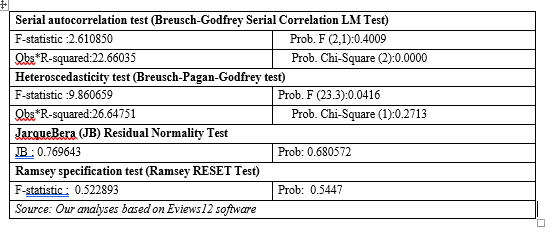
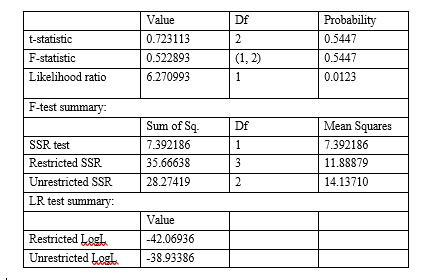
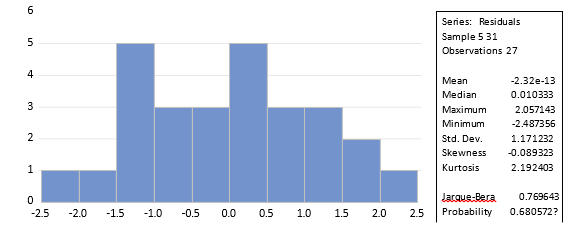
Table 6: Summary of Residue Tests- From this table, it appears that the null hypothesis is accepted for all these tests. Therefore, the required econometric conditions (absence of autocorrelation, absence of heteroscedasticity, normality of the residuals and a good specification of the functional form of the model) are valid.
Conclusion
This paper attempted to empirically study the relationship between trade openness measured by the degree of openness, income inequality measured by the GINI index and economic growth measured by GDP per capita, using appropriate indicators. Thiswork aimed to address major concerns such as how does trade openness influence economic growth in the DRC and how does income inequality impact economic growth in the DRC? In view of these concerns, the objectives assigned were to identify the influence of trade openness on economic growth in the DRC and to analyze the impact of income inequality on economic growth in the Democratic Republic of Congo despite the use of certain policies were the objectives pursued in this work. To achieve these objectives, this research uses the ARDL (Auto Regressive Distributed Lag model), which is an innovative approach addressing this issue for the case of the DRC. This model, which is part of the class of dynamic models, makes it possible to capture temporal effects (adjustment time, expectations, etc.) in the explanation of a variable. In this study, the estimated ARDL model helped to capture GDP per capita taken as an indicator of economic growth (GDP: dependent variable), Degree of openness (OUVCOM: variable of interest), Income inequality (GINI: variable of interest) taking into account other essential control variables, commonly used in the empirical literature, whose influence improves the results: Quality of governance (GOUV) and foreign direct investment (FDI). After empirical analysis, the results showed that in the short term: Trade openness has a positive and significant effect on economic growth. Every additional 1 point of trade openness leads to an increase in economic growth of26.85%; GINI has a negative and significant effect on economic growth. Every increase in inequality of 1-point leads to a decrease in GDP of141.8667%.; GOUV has a negative and significant effect on the GDPH. This implies that every increase in the quality of governance of 1 unit leads to a decrease in the GDPH of 442.4717% and FDIhas a positive and significant effect on economic growth. Every 1% increase in FDI leads to an increase in economic growth of0.768732. In the long term: Trade openness has a positive and insignificant effect on economic growth. Every additional 1 point of trade openness leads to an increase in economic growth of84.85%; GINI has a negative and significant effect on economic growth. Every increase in inequality of 1-point leads to a decrease in GDP of2773.137%; GOUV has a negative and insignificant effect on the GDPH. This implies that every increase in the quality of governance of 1 unit leads to a decrease in the GDPH of-2008.383% and FDIhas a positive and significant effect on economic growth. Every 1% increase in FDI leads to an increase in economic growth of31.45247%. In light of the results found, the following recommendations are addressed to public authorities and other actors in the economic life of the DRC: • Reduce inequalities in income distribution between the political class and public officials. • Improving the quality of institutions; • Establishment of an efficient production structure so that commercial opening can benefit the DRC. • Reform the business climate to encourage local investment and attract foreign direct investment [20-34].
Annexes
Appendixes 1: Unit Root Test 1.1 Test of Unit Roots of the Gini Variable (1) Null Hypothesis: D(GINI) has a unit root Exogenous: Constant, Linear Trend Lag Length: 0 (Automatic - based on SIC, maxlag=7) 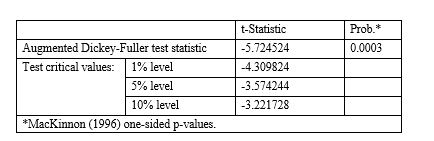
. Unit Root Test of the Variable GOUV I (0) Null Hypothesis: GOUV has a unit root Exogenous : Constant Lag Length: 7 (Automatic - based on SIC, maxlag=7) 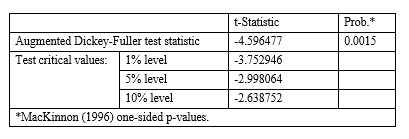
. Unit Root Test of the Variable IDE I(0) Null Hypothesis: IDE has a unit root Exogenous : Constant Lag Length: 0 (Automatic - based on SIC, maxlag=7)
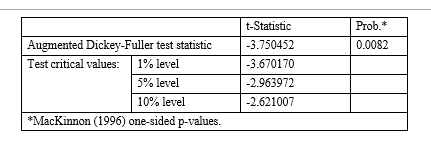
Unit Root Test of the Variable OPEN I(0)
Null Hypothesis: OPEN has a unit root
Exogenous : Constant, Linear Trend
Lag Length: 7 (Automatic - based on SIC, maxlag=7)
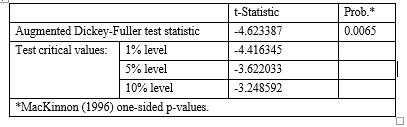
â??â??â??â??â??â??â??Unit Root Test of the Variable GDP I (0)
Null Hypothesis: GDP has a unit root
Exogenous : Constant, Linear Trend
Lag Length: 5 (Automatic - based on SIC, maxlag=7)
Long Run Model
ARDL Long Run Form and Bounds Test Dependent Variable : D(GDP)
Selected Model: ARDL(4, 4, 4, 4, 3)
Case 2: Restricted Constant and No Trend Date : 01/03/20 Time : 03:50
Sample: 1 31
Included observations: 27
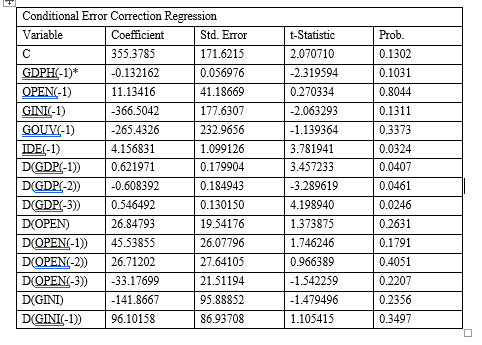
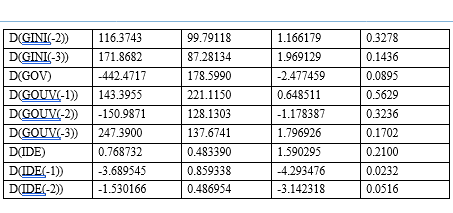
Short-Term Model
ARDL Error Correction Regression Dependent Variable: D(GDP) Selected Model: ARDL(4, 4, 4, 4, 3)
Case 2: Restricted Constant and No Trend Date : 01/03/20 Time: 03:51
Sample: 1 31
Included observations: 27
- Residue Tests
- Ramsey Stability Test Ramsey RESET Test Equation: UNTITLED
Omitted Variables: Squares of fitted values
Specification: GDP GDP(-1) GDP(-2) GDP(-3) GDP(-4) OPEN
OPEN(-1)
OPEN(-2) OPEN(-3) OPEN(-4) GINI GINI(-1) GINI(-2) GINI(- 3) GINI(-4)
GOUV GOUV(-1) GOUV(-2) GOUV(-3) GOUV(-4) IDE IDE(- 1) IDE(-2)
IDE(-3) C
- Heteroscedasticity Test
Heteroskedasticity Test: Breusch-Pagan-Godfrey Null hypothesis: Homoskedasticity

- Normality Test
-
- Autocorrelation Test
-
Breusch-Godfrey Serial Correlation LM Test:
Null hypothesis: No serial correlation at up to 2 lags
-
 Information Criteria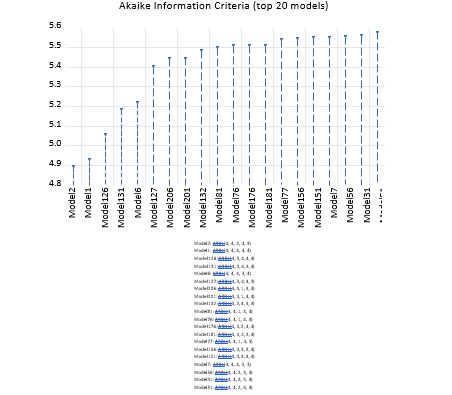
References
- Rodrik, D. (2008). One economics, many recipe: globalization, institutions, and economic growth. In One Economics, Many Recipes. Princeton university press.
- CAM (2021). Annual report on mining exports from the DRC.
- Kuznets, S. (2019). Economic growth and income inequality. In The gap between rich and poor (pp. 25-37). Routledge.
- Aghion, P., Caroli, E., & Garcia-Penalosa, C. (1999). Inequality and economic growth: the perspective of the new growth theories. Journal of Economic literature, 37(4), 1615- 1660.
- Rajan, R. G., & Zingales, L. (2004). Saving capitalism from the capitalists: Unleashing the power of financial markets to create wealth and spread opportunity. Princeton University Press.
- Kremer, M. (1993). The O-ring theory of economic development. The quarterly journal of economics, 108(3), 551-575.
- Torsten, P., & Tabellini, G. (1994). Is inequality harmful for growth.
- Stiglitz, J. E. (2012). The price of inequality: How today's
divided society endangers our future. WW Norton & Company.
- Banerjee, A., & Duflo, E. (2013). Poor Economics. A Radical Rethinking of the Way to Fight Global Poverty'. Society and Economy, 35(4), 573-587.
- Piketty, T. (2013). Capital in the 21st Century. Seuil
- Harrison, A. (1996). Openness and growth: A time-series, cross-country analysis for developing countries. Journal of development Economics, 48(2), 419-447.
- Solow, R. M. (1956). A contribution to the theory of economic growth. The quarterly journal of economics, 70(1), 65-94.
- Edwards, S. (1998). Openness, productivity and growth: what do we really know?. The economic journal, 108(447), 383- 398.
- Chang, R., Kaltani, L., & Loayza, N. V. (2009). Openness can be good for growth: The role of policy complementarities. Journal of development economics, 90(1), 33-49.
- Jouini, J. (2015). Economic Growth and Trade Openness: Evidence from Tunisia. Economic Modeling, 47, 205-212.
- Almeida, R., & Fernandes, A.M. (2008). Openness and Technological Innovations in Developing Countries: Evidence from Firm-Level Surveys. Journal of Development Studies,
- Hausmann, R., Hwang, J., & Rodrik, D. (2007). What you export matters. Journal of economic growth, 12(1), 1-25.
- Kali, R., Méndez, F., & Reyes, J. (2007). Trade structure and economic growth. The Journal of International Trade & Economic Development, 16(2), 245-269.
- Grossman, G. M., & Helpman, E. (1991). Trade, knowledge spillovers, and growth. European economic review, 35(2-3), 517-526.
- Bairoch, Paul (1997). Victories and setbacks: Economic and social history of the world from the 16th century to the present day. Paris: Gallimard.
- World Bank. (2022). World Development Indicators. Accessed at [[https://www.worldbank.org]
- Engle, R. F., & Granger, C. W. (1987). Co-integration and error correction: representation, estimation, and testing. Econometrica: journal of the Econometric Society, 251-276.
- Pesaran, M. H., Shin, Y., & Smith, R. J. (2001). Bounds testing approaches to the analysis of level relationships. Journal of applied econometrics, 16(3), 289-326.
- Koeniger, W., & Silberberger, M. (2015). Trade, Growth, and Inequality: Evidence from Africa. African Development Review, 27(2), 155-172.
- Maddison, Angus (2001). TeaWorld Economy: A Millennial Perspective. Paris: Organisation for Economic Co-operation
-
and Development (OECD).
- Observatory of Economic Complexity (OEC). (2022). Trade data of the Democratic Republic of Congo.
- World Trade Organization (WTO). (2022). World Trade Report.
- Park, K. H. (1996). Educational expansion and educational inequality on income distribution. Economics of education review, 15(1), 51-58.
- Perroux, François (1961). The economy of the 20th century. Paris: University Press of France (PUF).
- Pesaran, M. H., Shin, Y., & Smith, R. J. (2001). Bounds testing approaches to the analysis of level relationships. Journal of applied econometrics, 16(3), 289-326.
- Rodríguezâ?Pose, A., & Tselios, V. (2009). Education and income inequality in the regions of the European Union. Journal of Regional Science, 49(3), 411-437.
- Psacharopoulos, G. (1977). Education and Income Distribution. Review of Economics andStatistics,59(1), 103- 108.
- Rodriguez, F., & Rodrik, D. (2000). Trade policy and economic growth: a skeptic's guide to the cross-national evidence. NBER macroeconomics annual, 15, 261-325
- Rodrik, D. (2001). The global governance of trade: as if development really mattered (Vol. 58). New York: UNDP.