

Advances in Theoretical & Computational Physics(ATCP)
ISSN: 2639-0108 | DOI: 10.33140/ATCP
Impact Factor: 2.6

Research Article - (2025) Volume 8, Issue 4
Toward a Unified Multidisciplinary Model of Reality
Received Date: Sep 10, 2025 / Accepted Date: Oct 03, 2025 / Published Date: Oct 17, 2025
Copyright: ©2025 Donald G. Palmer. This is an open-access article distributed under the terms of the Creative Commons Attribution License, which permits unrestricted use, distribution, and reproduction in any medium, provided the original author and source are credited.
Citation: Palmer, D. G. (2025). Toward a Unified Multidisciplinary Model of Reality. Adv Theo Comp Phy, 8(4), 01-09.
Abstract
Over the last several centuries, science has discovered objects in the world along a continuum of scale. In one direction, we have discovered planets and stars, galaxies, and galaxy clusters. In the other direction, we have found cells and proteins, atoms and neutrinos. To locate and model this world, we use the 3 traditional directions of length, width, and height. However, inherent in all our measurements is the scale of what we are measuring – a continuum we do not directly see with our eyes. The author presents the hypothesis that we need to include this continuum in a full model of nature and our world. This hypothesis presents the need to measure distance across a 4-D space with an exponential scale dimension. To account for this concern, the author presents the mathematical conjecture that new mathematical tools are required, such as a new numeric representational system with more power than our traditional decimal or positional-based numerals that could measure across scale. Such a system could provide a single value for complex numbers and make possible measurements currently invisible to science today.
These would be directions that could significantly expand both science and mathematics, connecting all levels of scale.
Keywords
Philosophy of Science, Scale, Dimension, Numeric System, Complex Values
Overview of Philosophical Discussion
In general, science has broken into levels of study at one or another level of scale to consider the objects and processes found at that level. Thus, we have particle and atomic physics, molecular and protein chemistry, mitochondrial and cellular biology, bone and organ medicine, ecological studies, meteorological and atmospheric studies, solar system studies, galactic studies, and large-scale as trophysics. These are all important areas of scientific study; however, each level tends to have its own characteristics, objects, and interactions along with its own measurements and equations.
In order to model these levels, scientists tend to limit themselves to specific levels of scale. Multi-scale modeling is explicit in attempt- ing to address several levels of scale. The issues stemming from this stratification have made it difficult to unify all these levels. The reductionist attitude that all higher-level objects and processes can be explained via lower-level objects and processes belies the many levels we observe and the similar behaviors of objects at macroscale from distinctly different micro-scale objects. Bat- terman (2017) states it this way: “The problem is to explain how it is possible that systems radically different at lower scales can nevertheless exhibit identical or nearly identical behavior at upper scales” [1]. To address these issues, we need to provide a modeling space that crosses many levels of scale.
Scientists and philosophers have arguments over whether reality can be explained through bottom-up reductionist methods (the smallest objects determine reality) or whether top-down anti reductionist methods are needed [2]. This situation is especially a concern when working with biological systems. This author believes both arguments obscure the continuum of scale that observations have presented us with. Reality is a whole and should be modeled as such, meaning we must include this continuum of scale in our models of reality.
There are many situations where quantum mechanics plays either a minor role or even can be dismissed entirely when modeling a specific large-scale situation, as with a square peg and a round hole at our level [1]. The materials of the peg and the board with the hole can be of many different materials with the large-scale situation being the same quantum mechanics matters little, if at all, in such a situation. At the same time there are many situations where quantum mechanics impacts the lower levels of biological systems, especially related to large molecules, DNA, and proteins. A strict bottom-up approach seems unlikely to be effective.
It is acknowledged by systems biologists, that biological systems require multilevel analysis and cannot be reduced to actions and processes strictly at the quantum mechanical level [1,3,4]. The complexity of biological systems involves, as Green & Batterman (2017) calls it, “the tyranny of scales”, where modeling a biologic process requires multiple models at different scales [5]. These multi-level models address the connections between scales as boundary constraints: “This conclusion may be surprising given that physics is often associated with reductionism in the context of biology. Yet, examples from multi-scale modeling in both physics and biology show that modelers in both domains must confront the tyranny of scales problem. There is no single approach that can account for all relevant aspects of multi-scale systems” [5]. This author believes that such a single approach to multi-scale modeling is to include scale as a physical continuum and would connect quantum physics with biological systems and emerging complexity.
There is another aspect to address when considering the reductionist perspective attempting to explain emergent phenomena. Emergent properties need to be modeled at the level of the phenomena, even if there is an underlying explanation of how the phenomena emerges. As an example, the concept of heat emerges from the movement of molecules, however, heat cannot be modeled at the level of molecules. Understanding how these phenomena emerge will involve multi-scale modeling of the processes, since an explanation only at the level of quantum mechanics will be insufficient to describe the emergent phenomena.
An additional concern is the interconnected aspects of biological systems with their environments. The surrounding context of the biological system being crucial to an understanding of it. This might be seen as possibly at odds with the weak coupling assumption of systems and their environment in quantum thermodynamics [6]. Such concerns have led some scientists to call for new methods and mathematics to handle the complexity of biological systems:
Developing the mathematical and computational tools to deal with these multiple causation loops is itself a major challenge. The mathematics that naturally suits one level may be very different from that for another level. Connecting levels is not therefore trivial. Nor are the problems simply mathematical and computational [3].
The problem refers to the scale-dependency of physical behaviors that presents a hard challenge for modeling and explaining multi scale systems. No single mathematical model can account for behaviors at all spatial and temporal scales, and the modeler must therefore combine different mathematical models relying on different boundary conditions [5].
We need at least a comparable change of paradigms or conceptual enrichment of Mathematics in order to deal with the biological phenomena: by their peculiar autonomy and contextual dependence, we cannot easily draw their mathematics on the phenomenal view by “cutting them off” from their contexts and by giving them constructed contours. This, I believe, is the underlying methodological challenge for Mathematics in Biology, as Mathematics usually organizes the physical world, sets norms for it [4].
This paper will present directions for solutions to both the tyranny of scales and the call for new mathematical tools, with new mathematical tools required to manage the many levels of scale.
This author can, at best, lay out these directions, as most of the particulars in either science or mathematics will require capabilities and efforts considerably beyond those of the author or any individual. The complementary theses are:
1) Scientific Hypothesis: We should consider a single model of reality where objects at all levels of scale are included and interact together. This will involve identifying the scale of all objects to locate them within the model and require a four-dimensional physical model with scale as the fourth dimension.
2) Mathematical Conjecture: We will require the development and expansion of significantly more powerful mathematical tools that can adequately manage this model. We will need the ability to measure across a non-linear fourth (scale) dimension. The mathematical conjecture is that this measurement ability will involve a more powerful numeric representational system to address combined linear and non-linear dimensional measurements. The author suggests the particular system should provide complex values as single numeric values that can provide measurements across scale.
Generating a Single Model of Reality
The size, or scale, of objects in our world is a commonplace part of our experience. We perceive objects smaller than ourselves, like a pin, and objects larger than ourselves, like a building. For centuries, our perceptions have not gone beyond what we can directly experience through our five senses. The Greeks may have hypothesized atoms, but they could not perceive any such objects. Only in the last few hundred years have science and technology shown us very small atomic particles and very large galactic objects. We cannot experience these objects directly with our five senses and need tools to perceive them. This world, expanded through technological tools, has become the directly and indirectly perceived world of science today. We understand the scale of objects in this world to be along some sort of continuum – from the very small to our scale to the very large (see Figure 1). This continuum has expanded several orders of magnitude just in the past century. What we consider to be the ‘space’ of our world has expanded accordingly. A key concern of this paper involves our model of ‘space’ and whether it adequately accounts for this continuum of scale.
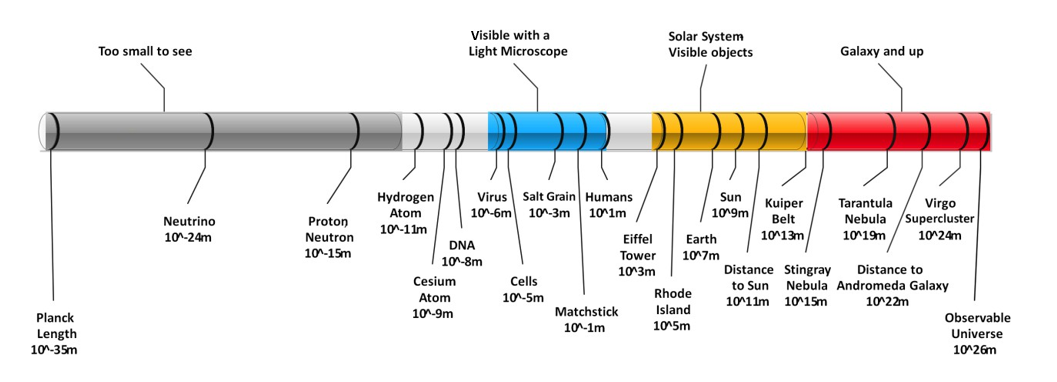
Figure 1: The Continuum of Scale
Our geometric model of physical space has not changed over several millennia. We have expanded the objects we find in space by many orders of scale, yet we still hold to a three-dimensional model of space devised more than two million years ago. We still consider the only perceivable dimensions of physical space to be length, width, and height. This is a very human-centric perspective based upon our direct senses. We continue to think our millennia- old human-centric three dimensions are the only dimensions needed to uniquely locate an object in space.
Consider the observation that if we touch our finger to a pane of glass, the direct evidence is of our finger touching the glass. If we perceive the action with a magnifying glass, we will see specific ridges of our skin touching the less-than-smooth surface of the glass. If we perceive the action with a microscope, we will see cells touching the crystalline surface of the glass. We can continue indirect observations using different magnifying tools down to the protein and molecular scale levels. We could set up multiple observational tools to observe different scale levels during the same action, and we would gather the observational evidence that the action occurs at all these levels together, not one or the other. If science is about observations, then we should agree that nature operates as a cohesive whole, not at only one or another level.
This allows us to include objects and actions at all levels in our new model as our observations indicate. To build a single model of nature, we need to include this ‘scale direction’ into our scientific models of nature.
If we are to efficiently model this one action of touching the pane of glass at all levels, we will need to be able to specify the actions at every level and then combine them across levels. Each level exists at a certain scale, with differing objects at different scales. Since we model each level as actions in a three-dimensional space, combining them as multiple three-dimensional layers would most effectively require a four-dimensional physical model, identifying the scale level as one of the locators in the modeled space (Figure 2). This methodology would provide a means of locating a pen on a table, an atom of the pen, and a star in a different galaxy all in one model. It would not be limited by individual models at each scale, nor require squashing all levels down to a single (three- dimensional) level, say to calculate the distance between the star and that atom of the pen. Rather, it would require these individual models to be integrated across scales. Such a holistic model could allow for actions between levels, both upward in scale as well as downward in scale.

Figure 2: The Hypothesis of Scale Space
The Argument for Scale
The use of multi-scale modeling and dimensional analysis both can be seen as indications that science is converging upon the need to explicitly include scale. Some authors tack scale onto our existing theory of space-time [7,8]. And there are signs that a fourth phys- ical dimension exists [9,10]. Some scientists even suggest such a fourth physical dimension could answer some unexplained phe- nomena today [11-13]. The author suggests these are implicit signs of such a convergence to include scale in our scientific models.
There are two classic videos of traveling across scale: Cosmic Zoom (National Film Board of Canada 1968) and Powers of Ten (Eames 1977), both inspired by Kees Boeke’s 1957 book Cosmic View: The Universe in 40 Jumps [14-16]. More recently is a 2011 book that looks at traversing the levels of scale by Gott, J. Richard, and Vanderbei, Robert J. Sizing Up the Universe: The Cosmos in Perspective, and a worthy interactive website, The Scale of the Universe, by the Huang brothers [17,18]. These all provide a perspective of traveling upward and downward in scale, seeing different objects come into view at different levels of scale. They also give a feeling about how it would appear to travel through different levels of scale. Two things to note in all these media:
1) As we progress up or down, we see different objects (especially noticeable when progressing down). This is characteristic of trav- el in our normal three dimensions. Traveling across scale we see different objects while looking at the same three-dimensional loca- tion. As the preceding discussions indicate, this implies a four-di- mensional model of nature.
2) From a standard unit of length perspective, travel up or down in scale involves traveling in ‘Powers of Ten.’ One unit upward would be an increase of 10 of our ‘standard units’ and two units upward would be an increase of 100 of our ‘standard units’. This means a linear movement in the scale direction involves a power (or exponential) change in the relative lengths we measure moving across scale.
Scale should be explicitly identified in our models as a dimension of space. However, it is not like our traditional three dimensions, since a unit of length in scale would not match a unit of length in our traditional dimensions. A unit of length in scale, relative to our traditional units of length, would be an exponential unit, possibly using a logarithmic scale. What this translates into is that a linear movement in scale will appear to us as an exponential movement according to our standard units of length. Such a movement may appear to us as a constant acceleration rather than a constant velocity, which could have many impacts on what we appear to perceive. This should not be a reason to exclude it as a dimension of physical space in our models. It does provide some interesting challenges.
Adding the continuum of scale to our physical model of space would address the tyranny of scales. The author believes this is the next direction that scientists should look to as we expand our knowledge and understanding of our world, including connecting quantum mechanics and biological systems.
A particular issue with including scale as a physical dimension derives from this difference in measuring distances: How do we manage a physical space where not all dimensions are the same? We may have mathematics to handle such a geometric situation, however, do we have the appropriate mathematical tools to handle units of length in scale? Connecting models at different scale positions would require some form of distance measure for the scale dimension. We may not have units of measure that equate to lengths in scale, especially those that are relatively different than our other length units. This situation, the author believes, is the real issue to be resolved. Without appropriate units of measure for scale lengths, we will not be able to manage models involving a scale dimension and likely is a key reason scale has not already been included in our scientific model of reality.
Challenge for Scale Measurements and Mathematics
Underlying science is mathematics, which needs to provide the quantitative means to account for this scale direction of nature. Using the mathematical tools of today, how can we compare and handle interactions at very different levels of scale, where the error term at the higher level is larger (sometimes by orders of magnitude) than the measurements at the smaller scale? The author suggests that a key reason we do not include this direction as part of our model of nature is that we do not have the appropriate mathematical tools to handle measurements and activities that cross this scale continuum.
If defining the position of any object is only a question of accuracy in a 3-dimensional world, then we should have no trouble measuring the distance between any two objects in nature. But how can we measure the distance between objects at very different scales - say from a pen on the table to a molecule of the table? There is a large difference in the accuracy, or error term, of a measurement, say in meters for the position of the pen and in nanometers (meters * 10-9 or .000000001 m) for that of a molecule. To compare measurements made at vastly different levels of scale, we need to be consistent and use the same units and scale for the measurements. However, using units at our scale provides an accuracy, or rather an error term, that is many times larger than the measurement of the molecule (e.g., 0.436 m ± .001 m for the pen and .00000003.1 m ± .0000000001 for the molecule). The level of accuracy (or error term) on the measurements at the different scales does not match up and are therefore not compatible. While some might say this is ‘just how measurements work’, the author suggests this shows the inadequacy of our current system of measuring values to address differences in the scale of objects we find in our world.
The author introduces the conjecture that new mathematical tools will be required to adequately measure across scale and to manage the processes of this continuum. We will need a new method of representing measurement values that cross scale, which indicates we need a new method of representing numbers – a new (more powerful) numeric representational system.
Adding scale as a dimension is a change in perspective of nature that does not (immediately) change our observations to date. Measurements at each level remain unchanged, so all current measurements and equations at one scale or another would remain intact. Interpretations of those measurements and equations might involve a cross-scale review. The above discussion about touching our finger to glass suggests modeling the many levels of nature using four spatial dimensions is more direct and potentially better than our traditional three-dimensional space, since it can account for objects at different scales. The implication is that ‘space-time’ as four-dimensional might not be a good model, perspective, or interpretation. The hypothesis introduced is to expand space to four dimensions, and then we could tack time onto these four spatial dimensions – conceivably modeled as a five-dimensional ‘space-time’.
A couple possible interpretations of scale with an exponential metric could be that constant movement in only scale might appear to us as a constant acceleration on objects, even if the objects do not move in our three dimensions. Acceleration at the galactic scale could appear to us as expanding galactic space.
This relative exponential metric of scale is a challenge for mathematics rather than science. Traditional geometry assumes all dimensions of a space have the same units, with the distance between any two points in space defined by linear dimension measurements (e.g., distance = sqrt (x^2 + y^2 + z^2)). However, to model nature, we may need a geometry that does not have the same distance measurement, or metric, in all spatial dimensions. Since the position of objects uses distance measurements and the location of objects is key to science, we will need to address distance measurements across scale. For this, we will need to identify units for scale distances that integrate with our traditional distance measurements in science, which bridges into the mathematical conjecture.
It could be that anomalies in our current scientific models are a consequence, not just of an inadequate model, but of inadequate mathematical tools to build a better model. There is a saying: ‘If all you have is a hammer, everything looks like a nail.’ Consider if the mathematical hammer we have is our decimal (or positional) numeric system, which can handle Real numbers that fit on a continuum (the Real number line). We will see all continuums as Real ones that can be entirely handled by decimal (or positional) numeric values. If we come across something more than this, such as complex values, we couch such a different tool in terms of the hammer we know – Real numbers that have decimal values. We do this with complex numbers, breaking them into two parts, each of which involves a Real value (e.g., x + iy). In expanding our concept of space, we may also need to expand our measuring tools at a basic mathematical level.
If our scientific hammer is three-dimensional space and our mathematical hammer is the decimal numeric system, what might occur if the mathematical hammer affects, even causes, the scientific hammer? If we are unable to represent certain mathematical values, then we might also be unable to represent certain measurements in nature and therefore we could be missing aspects of nature we endeavor to study (such as cross-scale distances). Part of the mathematical conjecture in this paper is that a more powerful numeric system could provide more advanced scientific theories than we have today – we need new hammers in both disciplines.
If we are unable to adequately compare and relate measurements at significantly different scale levels, then there are limits to our current measurement tools. If we are unable to properly measure across scale with our current tools and we agree that differences in scale constitute distances in scale-space, then we have identified an aspect of our new four-dimensional model for which we do not have the mathematical tools to measure. At a time when the reigning philosophy is to only consider what we can measure, we have hit that uncomfortable situation that might be stated as “we don’t know what we cannot measure,” and we have now identified aspects of nature we cannot measure.
New Mathematical Tools
In our current paradigm, measurement accuracy is considered an inherent issue of any measurements which cross scale. If this is the case, we will be unable to properly deal with measurements across scale, since we assume we will always be lacking considerable accuracy at the extremes of scale. At first glance this might seem to be an inherent limitation of our abilities to measure. However, the author suggests the problem resides with our implicit assumption that scale is simply an aspect of being ‘more accurate’ and not, therefore, a real or measurable property of space. This implicit assumption essentially results in a confusion of accuracy with scale, hiding the idea that scale could possibly be a measurable property of space.
This confusion can be overcome. We can consider scale to be a dimensional aspect of space with distance measurements including their own accuracy of measurement along scale. This means accuracy and scale are not synonymous and should not be confused. Note that this conclusion is a result of simply allowing scale to be in any way measurable.
An additional implicit assumption is that we already have all the mathematical tools necessary to make any measurement in the universe. The author suggests this is a false assumption and that what is lacking are our mathematical tools. Our means of measuring and calculating quantities our numeric representational systems are inadequate to the task of measuring across scale. We require new mathematical tools for measuring and calculating, which the author suggests is a new numeric representational system.
Looking at the many areas of science that are utilizing multi scale modeling, the author has indicated there appears to be a conver gence towards the need to incorporate scale into our models. In a similar vein, looking at the increasing use of complex numbers in science, the author suggests that complex numbers are more foun- dational as well. There is an issue with complex numbers, however, as we represent them as two separate values as in x + iy. A true unit of measure, such as a distance measurement, should involve a single value. From a pure mathematical perspective, a complex number should be a single value. Then why are we limited to representing such numbers as a pair of values? Because we do not have a value for sqrt(-1) = ‘i’. Identifying a value for ‘i’ would resolve this situation. It would provide a means of having a single value for a complex number that could also be a measurement. If such a single complex value could provide a measure for the unit of scale length, then we have a program for significantly advancing both science and mathematics.
There is an intriguing interplay between numbers and their repre- sentations. We have numbers and we have representations of num- bers (or ‘numerals’). It is simple to state that the representation of a number is not the same as that number. However, the two are intimately connected, and we could argue that only by some representation of a number (even if verbally or by show of fingers) could there be the concept of number in the first place. Early humans had marks on a stick or a papyrus pad. Romans invented Roman numerals, and Greeks used a version of fractions for ratios. All these involved representations for numbers in order for them to be utilized and communicated. Note that this discussion is not about the type of abstract numbers we refer to such as Integers, Rationals, Reals, or Complex. It is about how these numbers are represented and manipulated as values and measurements. We could state that numerals are critical to the development and application of numbers.
Consider that current science would not be possible without the decimal (and positional) numeric system we use to represent numbers today [19]. The author submits that a system such as Roman numerals is completely inadequate for the measurements of current science. Fractions are, likewise, not up to the task of capturing measurements and providing the arithmetic for equations defining scientific laws today. Measurements on the quantum scale would not be possible using fractions or other limited numeric representational systems. A strong statement could be: Without our current method of representing number values particularly for measurements we would not have the science of today.
The decimal numeric system became the defining means of rep- resenting numbers and measurements less than a thousand years ago. Its use predates the explosion of science in the last 400 years, lending support to the idea that current science needs such a rep- resentational system to manage the measurements of today. We cannot manipulate nor measure nor calculate quantities without numeral systems. And, as implied above, the power of science has a significant dependency upon the power of the numeric systems used (e.g., decimals vs Roman numerals). This provides a view into how deeply science depends upon our numeral systems it is at a very foundational level.
As a consideration for the need to identify complex values as single values, there is the intuition that how we represent number values has a direct impact upon the capabilities of our science using those numeric values. The author submits that current science requires our positional numeric system (typically the decimal numeric system) to represent number values as measurements. Given the increasing use of complex numbers in science, by extrapolation, we might find that a new complex numeric system capable of representing complex numbers as single values might prove able to extend what science can handle. This could mean we would be able to handle calculations and equations beyond what our current positional numeric system can.
In addition, consider that Roman numerals generally represent Integers, fractions represent Rational numbers, and positional (decimal) numerals represent Real numbers. This would be another indication that a new numeric system is needed that represents Complex numbers as single values and would constitute a new direction for mathematics and science.
To drill into how we might identify such a new complex numeric system, consider the progression of Number systems with numeric systems. Integers only need addition and subtraction to reach ev- ery Integer. So, a numeric system that only incorporates addition and subtraction would be sufficient (e.g. Roman numerals). Rational numbers require multiplication and division to reach every Rational. Fractions can, theoretically, represent any Rational num- ber and incorporate division into the definition of a fraction. Note that addition/subtraction and multiplication/division are reversing (or complimentary) operations. Real numbers need exponents to reach every Real number. Decimals incorporate exponents into the definition of a single value and can handle powers and roots (e.g., square root, cube root). These are also reversing operations. Again, extrapolating, Complex numbers would need a pair of reversing operations to define single values for complex values. The author suggests the reversing operations are integration/differentiation. A numeric system using natural logarithms and, say, Laurent series, that utilize continued differentiation, might be a direction to look into.
Consider that integration and differentiation are inherent in connecting models at different scales, integrating from a smaller scale level to a larger scale. A new numeric system that had integration and differentiation built into it could prove a powerful tool for integrating levels of scale, to say nothing of the many areas of science using complex numbers today. The author suggests this is an expansive direction for mathematics that would provide many advantages for science.
It is very possible that such a numeric system may not be representable using traditional paper and pencil methods, requiring the use of computers. It is also possible that we would need to shift to this new numeric system en masse across all areas of scientific fields that involve scale moving away from strictly Real values represented by decimals.
Finding Adequate Measurement Tools Advanced Representational Numeric Systems
Our simple whole numbers can be defined using a basic unit (one) and the operations of addition and subtraction. This is how we represent the Integers, including negative whole numbers. Examples include: 1 + 1 = 2, 4 + 1 = 5, and 2 – 3 = (-1). Fractions are defined using integers plus the reversing operations of multiplication and division. This is how we can represent the Rational numbers as ratios, which include the Integers. Examples include: ½, 2/3, 4/4, 47/35, -5/7, 13/93762. Positional base numerals, like decimals, add the reversing operations of exponents and roots to represent Real numbers, which include the Rationals. An example of how we build up a decimal is: 5x10^2 + 1x10^1 + 2x10^0 + 3x10^-1 + 6x10^-2= 512.36. Using these three pairs of reversing operations, we have a representational system that can theoretically represent all Real numbers, although infinite decimals present a practical limitation. Note that in all three cases, we have defined a specific value for each Real number that can be used as a quantity or measurement and in calculations.
While simple numerals, primarily for small counting numbers, have unique representations for each number, fractions are not the same, as there can be an infinite number of ratios, and therefore of numerals, to represent the same Rational number (e.g., 1/3, 2/6, 3/9...). Transitioning to decimals, we find that these numerals may not be as precise as fractions, since the fraction 1/3 is exact while the decimal equivalent is 0.333… - a representation that can only approximate the same fractional value. Further, adding two fractions and two equivalent decimals, we get 1/3 + 2/3 = 3/3 = 1. However, using decimals, we have 0.333… + 0.666… = 0.999… = 1.00(?) So we must make 1.000… = 0.999… for the arithmetic to work. Even with decimals, we have the situation of two numeric representations for the same number value.
It is important to understand that representations of numbers have characteristics and limitations that are not true for the numbers they represent. This aspect may be especially important if we are unable to adequately represent a number as a single value, such as a complex number. By not accounting for the limits of our mathe- matical tools, our models may be missing measurements our tools cannot address. This would be the situation with how we currently represent complex numbers. We are unable to represent a complex number as a single value that could be used as a measurement, so we manage with what we know and represent a complex value using two Real numbers: x + iy. However, this means our models cannot account for measurements of single complex values (i.e., that require a value for ‘i’).
Ignoring the entire imaginary part allows many theoretical calcula- tions involving measurements to produce different complex values yet result in the same real quantity (5 + yi equates to the Real value 5, regardless of what ‘y’ or ‘yi’ are). This is a logical problem for physical theories, since calculations in a theory could produce different complex values, yet the calculations for the theory would have to reduce to something we can measure and represent as a single value. Even if we account for ‘y’, we still cannot account for ‘i’ and thus cannot identify what a single complex value looks like, let alone what it could measure. We are left with two separate parts of a complex number that we can only evaluate as two parts. Five and π are understood as a single value and can be used in mea- surements and calculations as a single value. Not so with complex numbers – as we represent them today. If the currently accepted scientific philosophy is that all we can know of the physical world is through measurements, and we realize that our numeral systems are not capable of entirely specifying all practical quantities, then we have a direction to investigate before any scientific theories can be considered complete.
On the theoretical mathematics side, we have become used to un- derstanding complex numbers as 2-dimensional numbers. This situation appears to have ‘gelled’ into the idea that this is a property of the complex numbers. However, as noted previously, our numeric representations have aspects and limitations that are not true of the abstract numbers they represent. This might very likely be the case for the numeric methods we use to represent complex numbers. We only know how to represent them as 2-part decimal (or Real) numerals that involve an always unknown value (‘i’). We are unable to resolve the imaginary part into an actual numeric value, and so we leave it apart unresolved.
We should note that science uses complex numbers for many calculations and equations. Our numeral system for representing complex numbers theoretically appears to produce unique values for all complex numbers. We use complex numbers for all sorts of calculations, but because we cannot resolve the imaginary part into an actual value, we ignore at least the undefined term, if not the entire imaginary part, or we square the terms to remove the undefined term. This suggests we are not utilizing the full complex values for quantities or measurements. Distance is understood as a single-valued measurement (with appropriate units). Since we cannot represent a complex number as a single value, we are unable to provide a single value that could be used as a complex distance measure.
To gain a perspective on how to include the non-linear scale dimension into a single model of the universe, we could consider a simple model that collapses all three ‘standard’ dimensions onto a single dimension and then models scale along a separate axis. The collapsed dimension holds all linear dimensions, while the separate dimension is the non-linear dimension. We could model this using complex numbers and the complex plane as our simple model. This model might suggest that we are already making use of mathematics that differentiates our standard dimensions and measurements from a dimension that acts differently.
The author notes that the use of complex numbers in science has been increasing over at least the last century. The application of complex mathematical frameworks to a number of scientific areas provide support for this increased use of complex numbers and complex values.
What if we could find a means of fully representing a value for that pesky 'i'? This value certainly does not fall into the mathematical notations of today. So maybe mathematics needs to take a new step here. Maybe the more than 1000-year-old numerals we use today are not sufficient to represent 'modern' complex values. The ‘yi’ symbols used to define ‘imaginary’ values could be consolidated with the ‘real’ part of a complex number and reduced to a single value. This could simplify many equations made complicated due to 2-part complex values.
If we start to consider how to define a complex numeric system, we might extrapolate the pattern identified previously by adding reversing operations into the definition of a complex numeral. Maybe we need the reversing operations of integration and differentiation added into the definition of a complex numeric value. To represent negative square roots, we might need to define an undefined area of mathematics that of negative bases. This might indicate a bit of theoretical work is required maybe even a little inventing.
As Donald Knuth worked on more than 60 years ago [20], maybe we need to develop to invent numerals using negative bas- es, which can represent negative square roots [20]. Euler’s great equation (e^(πi) + 1 = 0) might provide a clue to how to construct complex numerals, using ‘e’ as a base. When used for integration and differentiation, base ‘e’ allows for continuous integration or differentiation and does not ‘bottom out’ as typical bases do (e.g. Derivative of x^2 = 2x and derivative of 2x = c, bottoming out while derivative of e^(2x) = 2e^(2x) and so the exponent does not decrease). A complex numeral might involve the positional placement of integrated and/or differentiated ‘digits’ in some similar way as exponential digits are used for decimal and positional base numerals. Directions for research might be Taylor or Laurent series.
The capability of incorporating integration and/or differentiation into numerals suggests integration and differentiation operations should become simplified. Consider that modeling upward in scale generally involves integration, suggesting such a numeral system could ‘take on’ the difficulties of the scale continuum.
This representational discovery or invention could open a new universe of possibilities for mathematics. It might also alter the interpretation of physical equations that ‘toss out’ the imaginary value for quantities and measurements, given that we can only use Real numerical values as measurements. Now we could have a value or measure that included the imaginary part. Now, a complex value could be handled in its complete form, possibly opening measurements not possible before (e.g., across scale). There would be complex measurements, not real measurements + imaginary placeholders potentially identifying measurements we cannot make today.
Conclusion
As we move toward digitally modeling biologic bodies in the universe, we will find the need for locating objects in scale, in addition to locating objects in three-dimensional space. This will require a four-dimensional scientific model of space, which will require some distance measure and units that cross non-linear scales. The ability to measure across non-linear scale becomes an imperative for a four-dimensional scale-space model of nature. This leads to the need to advance the underlying means of taking measurements and representing numbers, so that such exponential distance measurements can be adequately quantified. Continuing the pattern of developing numeral systems to represent values for Integers, Rations, and Reals, the author recommends developing a numeral system that can adequately represent Complex numbers as single values.
The mathematical conjecture is that complex values should be able to measure across scales. Supporting this assumption is the pattern suggesting integration and differentiation appears to be the next reversing operations to add to a numeral system, along with the use of integration and differentiation in multi-scale modeling today. In addition, the author notes that decimals use three reversing opera- tions to represent the Real numbers, useful for three-dimensional work, and the next numeral system to represent Complex numbers would use four reversing operations to represent four-dimensional work.
It is very possible that such a numeral system may not be repre- sentable using traditional paper and pencil methods, requiring the use of computers. It is also possible that we need to shift to this new numeric system en masse across all areas of scientific fields that involve scale moving away from strictly Real values rep- resented by decimals (as was done prior to the current scientific explosion over the past five centuries).
It is not a huge step to consider systems beyond a complex numeral system beyond where we do not quite see yet. So, we may still be in the early stages of understanding the extent of what mathematics can provide and science can utilize. Where mathematics needs to go could be well outside the 'standard model' of current mathematics (with only a Real line continuum) and there might be tremendous dividends for science as well.
References
- Batterman, R. W. (2017). Autonomy of theories: An explanatory problem. Noûs, 52(4), 858–873.
- Franklin, A. (2024). How the reductionist should respond to the multiscale argument, and what this tells us about levels. In Levels of explanation (pp. 77–98). Oxford University Press.
- Noble, D. (2010). Biophysics and systems biology. Philosophical Transactions of the Royal Society A:Mathematical, Physical and Engineering Sciences, 368(1914),1125–1139.
- Longo, G. (2021). Space and time in the foundations of mathematics, or some challenges in the interactions with other sciences. In B. Sriraman (Ed.), Handbook of the mathematics of the arts and sciences (pp. 2459–2486). Springer International Publishing.
- Green, S., & Batterman, R. (2017). Biology meets physics: Reductionism and multi-scale modeling of morphogenesis. Studies in History and Philosophy of Science Part C: Studies in History and Philosophy of Biological and Biomedical Sciences, 61, 20–34
- Colla, A. (2024). Quantum thermodynamics lecture notes.
- van Oosterom, P., & Stoter, J. (2010). 5D data modelling: Full integration of 2D/3D space, time and scale dimensions. In Lecture notes in computer science (pp. 310–324). Springer Berlin Heidelberg.
- Fedosin, S. (2012). Scale dimension as the fifth dimension of spacetime. Turkish Journal of Physics, 36(3), 461–464.
- Lohse, M., Schweizer, C., Price, H. M., Zilberberg, O., & Bloch, I. (2018). Exploring 4D quantum Hall physics with a 2D topological charge pump. Nature, 553(7686), 55–58.
- Zilberberg, O., Huang, S., Guglielmon, J., Wang, M., Chen,K. P., Kraus, Y. E., & Rechtsman, M. C. (2018). Photonic topological boundary pumping as a probe of 4D quantum Hall physics. Nature, 553(7686), 59–62
- Salmon, F. (2025). Unifying physics theories with a single postulate. Physics Open, 23, 100258.
- Frade, J. M. (2023). Three-dimensional space displacement through a fourth spatial dimension explains both light speed value and special relativity. Physics Essays, 36(3), 242–249.
- Stewart, S. A. (2022). Length scale as a fourth spatial dimension in geology and geophysics. Pure and Applied Geophysics, 179(8), 2817–2830.
- National Film Board of Canada (Director). (1968). Cosmic zoom [Film]. National Film Board of Canada.
- Eames, C. (Director). (1977). Powers of ten [Film]. IBM.
- Boeke, K. (1957). Cosmic view: The universe in 40 jumps. John Day Co.
- Gott, J. R., & Vanderbei, R. J. (2011). Sizing up the universe: The cosmos in perspective. National Geographic Books.
- Huang, C., & Huang, M. (2012). Scale of the universe: Discover the vast ranges of our visible and invisible world. The Scale of the Universe.
- Dantzig, T. (1954, 2005). Number: The language of science. Dutton Juvenile.
- Knuth, D. E. (1960). A imaginary number system.Communications of the ACM, 3(4), 245–247.