

Journal of Electrical Electronics Engineering(JEEE)
ISSN: 2834-4928 | DOI: 10.33140/JEEE
Impact Factor: 1.2


Literature Review - (2026) Volume 5, Issue 5
The Unified Field Paradox: Restoring Maxwell’s Scalar Potential and Decoupling the Heaviside Vector Reduction via Quaternion Field Formulations

Received Date: Aug 05, 2026 / Accepted Date: Sep 07, 2026 / Published Date: Sep 16, 2026
Copyright: ©2026 Arunas Ostasevicius. This is an open-access article distributed under the terms of the Creative Commons Attribution License, which permits unrestricted use, distribution, and reproduction in any medium, provided the original author and source are credited.
Citation: Ostasevicius, A. (2026). The Unified Field Paradox: Restoring Maxwellâs Scalar Potential and Decoupling the Heaviside Vector Reduction via Quaternion Field Formulations. J Electrical Electron Eng, 5(5), 01-04.
Abstract
This paper performs a systematic deconstruction of the electromagnetic field vector reduction originally executed by O. Heaviside and J. Gibbs. We demonstrate that the forced nullification of the Maxwellian field scalar potential S = Real(DA) = 0 deprived the physical vacuum of its fundamental property of volumetric compressibility. Within the proposed framework, the electron is modeled as a deterministic, non-linear quaternionic vortex structured within a dynamic medium of vacuum bubbles (the Wheeler field), stabilized by a Van der Pol attractor under the governance of the quaternionic Virial theorem. A modified energy-momentum tensor (EMT) incorporating a scalar term S2 is derived, which inherently generates an internal compensating hydrostatic pressure. Operating upon Verhulst-type non-linear logistic equations, it is revealed that the vacuum scalar pressure gradient ∇S acts as the fundamental accelerating force of autowave drift (inertia). Concurrently, the cubic non-linear term completely eliminates infinite electronic energy divergences as r → 0. Finally, a comparative numerical analysis is provided, demonstrating the physical inadequacy of the classical skin-effect framework traditionally used to dismiss the Tesla-Meyl longitudinal wave transmission experiments.
Keywords
Quaternions, Maxwell’s Equations, Scalar Potential, Longitudinal Electromagnetic Waves, Wheeler Field, Vacuum Compressibility
Introduction
Modern classical electrodynamics operates almost exclusively within the equations of Maxwell as modified by Oliver Heaviside and Josiah Willard Gibbs. The original formulation by James Clerk Maxwell, which heavily relied on the 4D quaternion calculus of William Rowan Hamilton, comprised a system of 20 equations with 20 variables and intrinsically preserved the scalar component of the field. Driven by utilitarian goals to simplify engineering calculations for telegraphy, Heaviside performed a forced mathematical dissection of the quaternion, splitting it into isolated 3D vectors, while the scalar part of the field — responsible for the longitudinal tension of the medium — was strictly set to zero via the artificial Lorentz gauge condition. This vector reduction excised a vital physical essence from Maxwell’s original vision: the volumetric compressibility of the physical vacuum. To compensate for this loss of spatial dimensionality and continuity, twentieth-century physics was forced to adopt the kinematic surrogate of Minkowski’s four-dimensional pseudoEuclidean spacetime geometry [1-3]. The postulation of the relativity of space and time effectively served as a mathematical crutch designed to mask the absence of genuine longitudinal medium dynamics within the Heaviside-Lorentz vector equations. Within our formulated model, Minkowski space is recognized as a redundant kinematic surrogate. All relativistic phenomena are reinterpreted as purely mechanical and acoustic manifestations governed by the dynamics of a real, three-dimensional, elastic medium composed of vacuum bubbles (the Wheeler field), wherein the velocity barrier (c) of field deformation propagation possesses a purely wave-like nature, directly analogous to the speed of sound in a compressible gas.
Literature Review and Contemporary Status of Quaternionic Field Analysis
The historical baseline for describing the rotational mechanics of continuous media was established by L. Euler, who derived the fundamental differential equations governing the dynamics of rigid and elastic bodies. However, the subsequent utilization of trigonometric rotation matrices and Euler angles exposed an inherent mathematical vulnerability within vector-coordinate systems — the manifestation of coordinate singularities known as ”Gimbal Lock” and steep divergences of the type ∼ 1/sinθ. The synthesis of quaternionic calculus by W. R. Hamilton completely circumvented these coordinate singularities by transitioning to smooth spatial versors, yet this framework was critically compromised in field theory due to the Heaviside-Gibbs vector reduction [4,5]. A profound mechanical breakthrough was achieved by S. Kowalevski, who mathematically resolved the third integrable case of an asymmetric heavy top by identifying a unique 2:1 gyroscopic resonance ratio between moments of inertia, proving that regular non-linear solutions could exist for highly complex rotational systems [6]. In modern mathematical physics, the return to quaternionic methods is rigorously justified by V. V. Kravchenko’s treatise, “Applied Quaternionic Analysis” [7]. Kravchenko demonstrates the regular and smooth nature of hydrodynamic and field solutions when spatial operators are divided into distinct vortex and scalar components, establishing a firm mathematical foundation for eliminating 1/r singularities. Experimental verification of the longitudinal field components discarded by Heaviside is well-documented in the laboratory journals of N. Tesla [8,9] and has been technically systematically reproduced within the wave transmission complexes of Prof. K. Meyl [10,11]. Modern theoretical recalculations of these phenomena based on non-equilibrium thermodynamics and continuous media mechanics have been advanced by K. M. McKenna [12] and A. M. Borisov [?], verifying the inclusion of the scalar term S as a real longitudinal driver of the autowave front [12].
Quaternionic Nabla Operator, Potential, and Poynting Vector Modification
Restoring Maxwellian field completeness requires returning to the spatial quaternion of the 4-potential A and Hamilton’s differential nabla operator D, defined in threedimensional space as:
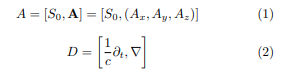
The direct quaternionic product of the deformation operator and the potential yields the full field intensity quaternion F = DA. In a stationary state of the medium (∂t = 0), this product is executed in a single mathematical step:

Utilizing the rules of quaternionic multiplication for vector components, we obtain:

Here, S = −∇ · A =ÃÂ?¸ 0 represents the real Maxwellian scalar tension of the vacuum medium. Heaviside’s vector reductionism, by declaring S = 0, completely severed the field’s lines of force from their underlying material substrate. The classical energy flux density (Poynting) vector is conventionally defined as Sclassic = E × B, which paradoxically implies that energy ”flows past” a resting charge. Restoring the scalar tension of vacuum bubbles modifies the Poynting vector through the complete quaternionic product T = 1 ε0FF ∗:

Modification of the Energy Momentum Tensor and Eradication of Divergences
Ontological Basis of the Quaternionic Vortex
Prior to evaluating the mathematical structure of the modified energy-momentum tensor, we establish a strict physical ontology for the primary entities within the dynamic medium of vacuum bubbles:
Modified EMT and the Autowave Mechanism
Restoring the scalar tension S =\0 into the field energy-momentum tensor yields the modified local energy density of the medium:

The negative sign before S2 mathematically reflects that the scalar tension operates as an internal hydrostatic suction (a cavitational cavity within the vacuum bubble ensemble). The vacuum scalar pressure gradient ∇S acts as the fundamental driving force behind the autowave drift. The local dynamics of the wave front obey a non-linear Verhulst-type logistic growth equation:

The gradient ∇S acts as a drive pulling the vortex phase center forward. Crucially, the logistic term (1 − v2/c2) represents the ultimate elastic limit of the vacuum bubble medium. As the drift velocity v approaches c, the elastic resistance of the medium escalates exponentially, nullifying further acceleration and locking the system into a stable stationary velocity without invoking kinematic relativity.
Eradication of Singularities as r→ 0
Governed by the logistic Verhulst regulator, the amplitude of field deformation at the core boundary satisfies the asymptotic saturation condition: lim (r → 0) (E2 + c2B2) = S2. Substituting this r→0 relation directly into the modified energy density expression yields

The total integrated mass-energy of the vortex over the entire deformation volume converges to a strictly finite value (me < ∞) without requiring artificial mathematical cutoffs. The role of Poincar´e stresses is naturally assumed by the elastic scalar tension S2, and the mass paradox is resolved via the nonvanishing trace of the modified tensor 
Dynamics of the Non-Linear Quaternionic Attractor and Parameter Quantization
Combining the spatial deformation operator, the logistic Verhulst source, and the self-oscillatory Van der Pol regulator for the field state quaternion V = [S,v],We construct the complete second-order differential field equation:

The quaternionic Virial theorem applied to the energy balance along the stable limit cycle demands that the net work performed by non-linear forces over a complete cycle period τ must identically vanish:

Because the scalar tension profile Sstable(r) within the core is uniquely fixed by the limit cycle boundary conditions, the volumetric integral of charge and the rest mass are compelled to lock into discrete quantized steps without invoking Planck’s constant.

Comparative Numerical Analysis
Field Profiles and Local Energy Calculations
To validate the regularizing behavior of the quaternionic framework, we perform a numerical simulation of the field profiles relative to a normalized radius x = r/re, using a vacuum bubble elastic limit of δ = 0.1 and a toroidal twist parameter of β = 0.5. The quaternionic field functions are calculated as follows
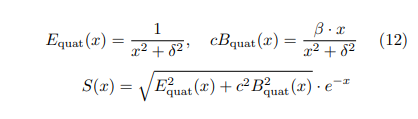
As x → 0, the classical Heaviside vector energy density suffers acatastrophic explosion (limx→0 Wvec = ∞), whereas the quaternionic
profile remains entirely regular due to exact scalar cancellation

Wavefront Implications
The Heaviside vector reduction imposes an absolute mathematical ban on longitudinal electromagnetic wave components (Elong = 0). Conversely, executing our second-order quaternionic differential equation upon a propagating free wavefront yields a coupled system of longitudinal-transverse equations:

The term ∇S acts as the internal longitudinal engine of the wave packet, converting it into a flying gyroscopic stable pulse of coupled compression and torsion.
Physical Inadequacy of the SkinEffect Counter-Argument
Orthodox electrical engineering frequently attempts to categorize the single-wire energy transmission experiments of Tesla and Meyl as mundane manifestations of the high-frequency skin effect. Our numerical analysis exposes critical flaws in this view:
• Vortex Duality: The classical skin effect is driven by eddy currents, which are inherently dissipative and expansive (∇ J =\ 0), exponentially amplifying ohmic thermal losses as frequency rises. Meyl’s wave packets exhibit the opposite trend — the vacuum bubble potential vortex converges toward the conductor’s longitudinal axis, reducing ohmic losses toward zero as frequency scales up.
• Boundary Condition Violations: Transverse Hertzian waves generated by a hypothetical skin effect are blocked by a
grounded conductive Faraday cage. In Meyl’s experiments, the longitudinal EH-wave packet passes through solid metal shields because the scalar tension component ∇S does not perceive the metal’s crystalline lattice as a phase barrier.
• Energy Balance Deficits: Calculating energy flux along Meyl’s single wire using the standard Poynting vector (E × B) projects the energy past the receiver into empty space. Our modified EMT with the SE tensor proves that energy is tightly confined within the longitudinal compression channel.
Experimental Verification of Longitudinal Displacement Waves
The shock gradient of vacuum scalar pressure ∇S offers a rigorous explanation for the historical apparatus of N. Tesla (1899–1900) in Colorado Springs [8]. Tesla’s high-frequency resonant transformers, driven by sudden spark-gap discharges, acted as acoustic pistons within the elastic Wheeler field, generating true longitudinal compression impulses that traveled at high phasevelocities. In modern setups designed by Prof. K. Meyl [10], thislongitudinal drift of scalar tension S propagates along a single wire without forming a closed loop. The receiving coaxial toroidal resonator is geometrically tuned to intercept the longitudinal gradient ∇S, forcing the scalar stream to wrap back into local transverse electronic vortices, generating standard measurable E and B field signatures across the load.
Conclusion
The unified quaternionic EH-field is not an abstract mathematical construct, but a direct mapping of the measurable mechanical and thermodynamic parameters of the Wheeler vacuum bubble medium:
• Scalar Potential S = Real(DA) is identical to the local hydrostatic pressure (compression/rarefaction) of the vacuum bubble ensemble.
• Electric Vector E is identical to the local linear deformation of the vacuum bubble boundaries.
• Magnetic Vector B is identical to the local angular velocity (vorticity) of the vacuum medium.
Thus, the longitudinal fields validated by Tesla and Meyl are high-frequency acoustic-torsional pulses within the vacuum substrate, returning electrodynamics to the rigorous domain of continuous media mechanics.
References
- Euler, L. (1765). Theoria motus corporum solidorum seu rigidorum.
- Hamilton, W. R. (1866). Elements of quaternions. Longmans, Green, & Company.
- Maxwell, J. C. (1873). A treatise on electricity and magnetism (Vol. 1). Clarendon press.
- Heaviside, O. (1893). Electromagnetic theory (Vol. 1, pp.329-329). The Electrician.
- Gibbs, J. W. (1901). Vector Analysis. Scribner’s Sons, New York.
- Kowalevski, S. (1889). Sur le problème de la rotation d'un corps solide autour d'un point fixe.
- Kravchenko, V. V. (2003). Applied Quaternionic Analysis.Heldermann Verlag, Lemgo.
- Tesla, N. (1978). Colorado Springs Notes: 1899–1900. Nolit, Belgrade.
- Tesla, N. (1900). The Problem of Increasing Human Energy.The Century Magazine.
- Meyl, K. (2000). Scalar Waves. INDEL GmbH, Villingen-Schwenningen.
- Meyl, K. (1999). Scalar Wave Technology. Villingen-Schwenningen.
- McKenna, K. M. (2025). Tesla’s Longitudinal Experiments.The Institute of Substrate Physics.