

Journal of Electrical Electronics Engineering(JEEE)
ISSN: 2834-4928 | DOI: 10.33140/JEEE
Impact Factor: 1.2



Research Article - (2026) Volume 5, Issue 1
The Third Lorentz Transformation as a Reformulation of Special Relativity
Received Date: Jan 12, 2026 / Accepted Date: Feb 02, 2026 / Published Date: Feb 09, 2026
Copyright: ©2026 Hyoungseok Koh. This is an open-access article distributed under the terms of the Creative Commons Attribution License, which permits unrestricted use, distribution, and reproduction in any medium, provided the original author and source are credited.
Citation: Koh, H. (2026). The Third Lorentz Transformation as a Reformulation of Special Relativity. J Electrical Electron Eng, 5(1), 01-07.
Abstract
This study derives the Lorentz transformation using a third method, distinct from the approaches of Lorentz and Einstein, without introducing Lorentz symmetry or the principle of relativity. First, following Einstein’s operational method, an arbitrary stationary frame is constructed using rigid rulers, atomic clocks, and light signals. Next, the Lorentz transformation is derived solely from the principle of the constancy of the speed of light. This derivation suggests that special relativity does not inherently require the denial of an absolute stationary frame. Accordingly, this study demonstrates that observer relativity and the absoluteness of inertial frames coexist within the Lorentz transformation and its inverse. The former arises from the shared use of light signals and atomic clocks, whereas the latter originates from the operational asymmetry that only the stationary frame employs rigid rulers for spatial measurement. This distinction is evident in the determination of the speed of light: the stationary frame determines it experimentally through round-trip light measurements, whereas moving frames define it axiomatically. Furthermore, while the Doppler effect illustrates observer relativity—where the observed frequency depends on the relative motion and direction—phenomena such as round-trip light experiments and electrostatic interactions between stationary and uniformly moving charges reveal the absoluteness of inertial frames. In conclusion, this study proposes a new theoretical framework—termed absolute relativity—that preserves the empirical successes of special relativity while maintaining physical consistency by restoring the concept of an absolute stationary frame.
Keywords
Stationary Frame, Constant-Velocity Frame, Measuring Tools, The Third Lorentz Transformation, Constancy of Light Speed, Observer’s Relativity
Introduction
Classical mechanics, in accordance with Newton’s law of inertia, admits only bodies at rest or in uniform motion as members of inertial frames. Between a stationary body and a body in uniform motion, the Galilean transformation and its inverse, discovered by Galileo, are applied. Since spatial coordinates are measured by rigid rulers and time is measured by mechanical clocks, the Galilean transformation presupposes the coexistence of absolute time and relative space. With the discovery of light propagating at a constant speed cthrough electromagnetism, however, inertial frames came to include not only bodies at rest and bodies in uniform motion, but also light itself. Lorentz, in order to preserve the invariance of the speed of light defined in vacuum as c= 1/√u0€0 , assumed the existence of an absolute rest frame and, on this basis, derived transformation equations that preserve Maxwell’s equations [1].
In 1905, Einstein adopted a fundamentally different approach. He abandoned the existence of a stationary frame and assumed the equivalence of all inertial frames [2]. By postulating the constancy of the speed of light and the principle of the relativity of physical laws, he derived the same mathematical transformation equations as Lorentz.
The fact that Lorentz and Einstein arrived at identical formulas from diametrically opposed philosophical premises suggests that the Lorentz transformation itself does not uniquely determine the existence or non-existence of an absolute stationary frame. Rather, its physical interpretation depends decisively on the operational definition of measurement within an inertial frame. This insight leads to the central question of this study:
Is it possible to derive the Lorentz transformation solely from the constancy of the speed of light, as a third approach?
To investigate this, we reconstruct an arbitrary stationary frame using rigid rulers, atomic clocks, and the physical invariance of light. We then derive the coordinates of a constant-velocity system based on the single assumption of the invariant speed of light. This approach clarifies the distinction between observer relativity, arising from shared light signals and synchronized clocks, and inertial frame relativity, which is not physically inevitable. It suggests that the relativity of physical laws is not an independent postulate but a consequence of the constancy of the speed of light.
Our analysis confirms three physical distinctions between an arbitrary stationary frame and a constant-velocity frame [3].
• Spatial Measurement: The stationary observer P(x,y,z,t) measures coordinates using both rigid rulers and light. In contrast, the moving observer P' (ξ,η,ζ,τ) measures transverse coordinates (η,ζ) with rigid rulers and light, but measures the longitudinal coordinate ξsolely using light signals.
• Time Synchronization: Stationary clocks are synchronized using both rigid rulers and light. Moving clocks are synchronized using light signals from both the stationary and moving frames.
• Speed of Light Determination: In the stationary frame, c is measured directly via round-trip experiments. In the moving frame, c is defined axiomatically.
This asymmetry implies that the Lorentz transformation acquires operational physical meaning only when interpreted with respect to an absolute stationary frame. Consequently, the "arbitrary" stationary frame in Einstein’s relativity effectively assumes the status of an absolute reference frame. We term this framework absolute relativity. To illustrate this, we analyze the Doppler effect as a manifestation of observer relativity and the electrostatic force between charges as evidence of inertial-frame absoluteness.
Theorey
To construct an inertial frame through a thought experiment, one must establish an arbitrary stationary frame, as Einstein did [4]. For an arbitrary stationary frame to become a physical coordinate system, the coordinates of a stationary point, the speed of light, the synchronization of distant clocks, and the coordinates of a moving point must be defined first. To this end, a stationary observer constructs a coordinate system using a rigid ruler, an atomic clock, and light. The observer assumes a valid spatial structure based on Euclidean geometry and measures the coordinates of a stationary point using the rigid ruler and atomic clock. Spatial coordinates are determined using a rigid ruler made of a rigid ruler that cannot be scaled or contracted. Time coordinates are determined by an atomic clock (then a clock) that uses the period of light emitted from atoms. Meanwhile, the coordinates of a moving point are replaced by the coordinates of a stationary point passing instantaneously nearby. In other words, the coordinates of a moving point are expressed as a function of time at the stationary point. To achieve this, time at rest is defined. Time at rest refers to the synchronization of distant atomic clocks using a rigid ruler and light.
However, to synchronize distant atomic clocks, one must measure the speed of light. Since the one-way speed of light cannot be measured, Einstein also determined the value of the speed of light, c, through a round-trip experiment. When the distance from O to A is r, a ray of light leaves O at time t0, reflects at A at time tA, and arrives back at O at time tO' . If it is assumed that the speed of light is the same for the round trip over the same distance r, then the round-trip time of light is also equal. The relation tA - tO = t0' - tA is referred to as the synchronization condition in an inertial frame. The speed of light that satisfies this synchronization condition is given by 2r⁄ (tO' - tA ) = c [5]. (1)
Next, the separated atomic clocks are synchronized using a rigid field and light. If the distance between two points O and A measured by a rigid field is r, then tA = tO + r⁄c. (2)
This is called distance synchronization or a synchronized atomic clock [6]. When stationary points are synchronized in this way using a rigid field and light, the entire stationary system becomes synchronous and can be represented by a stationary observer P(x,y,z,t). Eq. (2) can be rewritten as r = c (tA - tO). This is called a light field made with an atomic clock synchronized with light. A light field refers to calculating the distance by multiplying the synchronization time interval by the speed of light. The length r measured by a rigid field in a stationary system and the length c (tA - tO) measured by a light field are equal to r = c (tA - tO). (3)
This is called the coincidence of a rigid ruler and a light ruler in a stationary system [7].
Meanwhile, once the coordinates of an observer P(x,y,z,t) in a stationary system are determined, an observer P' in a constant- velocity system passing through the neighborhood also determines his own coordinates. The coordinates of the constant- velocity system observer P' are determined in relation to the stationary system observer P(x,y,z,t). Since the constant- velocity observer P' passes through the stationary system observer P, the stationary system observer assigns the same coordinates P(x,y,z,t) to that event. Nevertheless, the constant-velocity observer P' measures a new set of coordinates P' (ξ,η,ζ,τ) using his own light signals and atomic clock. Consequently, an equation is established between the coordinate P(x,y,z,t) assigned by the stationary system observer and the coordinates P' (ξ,η,ζ,τ) measured by the constant-velocity observer. This equation holds because both the stationary system observer P(x,y,z,t) and the constant- velocity observer P' (ξ,η,ζ,τ) employ light signals and atomic clocks in common. In other words, the two observers P and P' relate their coordinate systems solely by applying the principle of the invariance of the speed of light.
The following describes the process of deriving the Lorentz transformation and its inverse transformation using only the law of constancy of the speed of light, without the relativity of physical laws, unlike special relativity. A moving observer P' (ξ,η,ζ,τ) moves with a relative velocity v in the x-direction with respect to a stationary observer P(x,y,z,t), whose axis is coincident with the x-axis, and whose axis and the ζ-axis are parallel to the y-axis and the z-axis, respectively. The law of constancy of the speed of light holds between the stationary observer P(x,y,z,t) and the moving observer P^' (ξ,η,ζ,τ). If x2 + y2 + z2 = (ct)2, then ξ2 + η2 + ζ2 = (cτ)2, and conversely, if ξ2 + η2 + ζ2 = (cτ)2, then x2 + y2 + z2 = (ct)2. (4)
First, linearity and relative velocity affect the coordinates of the motion axes of the moving observerP^' and the stationary observer P and the time coordinate.
Since P′ moves with velocity v in the x-direction relative to P, we have x = vt and ξ = 0. (5)
Because ξ is linear in x and t, it may be written as ξ = f(v)x + g(v) t, and since ξ = x when v = 0, f(0) = 1. (6)
From (5) and (6), it follows that g(v) = –f(v)v, and therefore:
ξ = f(v)(x – vt). (7)
Similarly, τ is linear in x and t and may be written as τ = a(v)t + b(v)x. Since τ = t when x = 0, a(0) = 1. (8)
From (4), when x = ct, we have ξ = cτ. Substituting into (7) gives:
cτ = f(v)(c – v)t. (9)
Applying the same condition to (8), we obtain:
τ = a(v)t + b(v)ct. (10)
From (7), if x = –ct, then ξ = –cτ′. From (4), this yields:
–cτ′ = f(v)(–c – v)t. (11)
Using (8) under the same condition gives:
τ′ = a(v)t – b(v)ct. (12) Solving (9), (10), (11), and (12)
simultaneously yields: a(v)=f(v),b(v)=–vf(v)/c². (13)
Substituting (13) into (10) gives: τ = f(v)(t – vx/c²). (14)
Thus, the coordinate transformation between P and P′ along the direction of motionis: ξ=f(v)(x–vt),τ=f(v)(t– vx/c²). (15)
If x = 0 in (15), then ξ = –f(v)vt and τ = f(v)t, which implies ξ = –vτ. (16)
This shows that the stationary observer P1 (0,y,z,t) appears to move with velocity –v along the ξ-axis from the point of view of P1' (-vτ,η,ζ,τ). In general, since xand tare linear in ξ and τ between the stationary observer P(x,y,z,t)and the moving observer P' (ξ,η,ζ,τ), the following relation holds by comparing equation (16) with equation (5):
x = f′(–v)(ξ + vτ), t = f′(–v)(τ + vξ/c²), with f′(0) = 1. (17)
Because x = ct implies ξ = cτ, substituting (15) and (17)gives:
1 = (1 – v²/c²) f(v) f′(–v). (18)
If f(v) > f′(–v) or f(v) < f′(–v), the condition f(0) = f′(0) = 1 cannot be satisfied. Thus: f(v) = f′(–v) = 1 / √(1 – v²/c²). (19)
Using (15), (17), and (19), we obtain the Lorentz transformation for the motion axis: ξ = k(x – vt), τ = k(t – vx/c²), x = k(ξ + vτ), t = k(τ + vξ/c²), where k= 1 /√1 − v²/c² . (20)
Second, only the relative velocity affects the coordinates perpendicular to the motion axes of the moving observer P' and the stationary observer P.
Since P′ moves only in the x-direction with velocity v, the perpendicular coordinates satisfy:
η = g(v)y, ζ = g(v)z, with g(0) = 1. (21)
From the viewpoint of P′, P moves with velocity –v, so:
y = g′(–v)η, z = g′(–v)ζ, with g′(0) = 1. (22)
From (21) and (22):
ηy = g(v)g′(–v)yη, ηz = g(v)g′(–v)zη.
If g(v) ≠ g′(–v), then g(0) = g′(0) = 1 cannot both hold. Thus: g(v) = g′(–v) = 1. (23)
Combining (21), (22), and (23), the full Lorentz transformation
becomes: ξ = k(x – vt),
τ = k(t – vx/c²),
η = y,
(k= 1 /√1 − v²/c² ). (24)
Once the coordinates of P^' (ξ,η,ζ,τ) are determined through this Lorentz transformation, the velocity of any moving object can be computed. The velocities measured in P′ are electromagnetic velocities, because the clocks in P′ are synchronized using atomic clocks tied to light signals. The inverse Lorentz transformation is obtained by solving (24) for x and t:
x = k(ξ + vτ), t = k(τ + vξ/c²), y = η, z = ζ. (25)
(24) and (25) are the Lorentz transformation and its inverse, derived solely from the invariance of the speed of light applied to an arbitrary stationary frame. In the Lorentz transformation and its inverse, each observer claims that they are at rest while the other is moving with velocity v. To distinguish this from Einstein’s relativity of inertial frames, this is referred to as the relativity of observers [8].
As indicated by Eqs. (5) and (16), the linearity of spacetime coordinates implies that the stationary-frame observer P(x,y,z,t) and the moving-frame observer P' (ξ,η,ζ,τ) are in relative motion. Applying the law of the constancy of the speed of light then yields the relationship between these observers, from which the Lorentz transformation and its inverse follow. In the Lorentz transformation, the stationary observer P asserts that the moving-frame observer P′ is moving with velocity v; in the inverse Lorentz transformation, the moving-frame observer P′ asserts that the stationary observer P is moving with velocity –v. To distinguish this from Einstein’s relativity of inertial frames, this is referred to as the relativity of observers [9].
However, the fact that the Lorentz transformation and its inverse are obtained solely from the law of the constancy of the speed of light implies that any arbitrary stationary frame functions as an absolute stationary frame. The reasons are as follows. First, as argued by V. Guerra and R. de Abreu, in any arbitrary stationary frame, the one-way speed of light is c in all directions [10]. Second, the tools and methods used by the stationary-frame observer P (x, y, z, t) and the moving-frame observer P' (ξ,η,ζ,τ) to measure coordinates are physically different. The following describes how the stationary-frame observer P (x, y, z, t) and the moving-frame observer P' (ξ,η,ζ,τ) are distinguished.
First, the methods for measuring spatial coordinates in the stationary frame and the constant-velocity frame are asymmetric. As axes parallel to the direction of motion, the x-coordinate of the stationary-frame observer P(x,y,z,t) is measured using both a rigid ruler and a light ruler, whereas the ξ-coordinate of the moving-frame observer P' (ξ,η,ζ,τ) is measured using a light ruler., whereas the ξ-coordinate of the moving-frame observer P' (ξ,η,ζ,τ) is measured only with a light ruler. When x ≠ vt, if the coordinate along the axis parallel to the direction of motion is measured with a rigid ruler, then x′ = x − vt; however, the distance estimated using a light ruler is ξ = γx' as shown in Eq. (20) [11]. (26)
From Eq. (3), the rigid ruler and light ruler coincide in the stationary frame, but from Eq. (26) the coordinate ξ measured in the moving frame with a light ruler is k times longer than x′ measured with a rigid ruler. Therefore, when both the rigid ruler and the light ruler are used in an inertial system, the stationary frame and the constant-velocity frame can be distinguished. Meanwhile, when x = vt, we have x′ =ξ= 0, and the time at the moving-frame origin O1'is τ0 = t/k. (27)
Second, the methods of synchronization differ between the stationary frame and the constant-velocity frame. The stationary- frame observer P (x, y, z, t) measures the time t with atomic clocks synchronized by both rigid rulers and light, whereas the moving- frame observer P' (ξ,η,ζ,τ) measures the time τ with atomic clocks synchronized by the light of both the stationary and moving frames. If t0 is the time at the stationary-frame origin and r is the distance to the stationary-frame observer P (x, y, z, t), then from Eq. (2) we have t = tO + r⁄c (where r=√x2 + y2 + z2). (28)
However, if τ0 is the time at the moving-frame origin O1' and τ is the time at the moving-frame observer P' (ξ,η,ζ,τ), then from Eqs. (24) and (27) we obtain τ = k(t -vx⁄c2 )=t⁄k- vξ⁄c2 =τ0 - vkx'⁄c2. (29)
From Eqs. (28) and (29), it follows that the stationary frame is entirely simultaneous, whereas the moving frame is simultaneous only on planes perpendicular to the direction of motion. Because the synchronization methods differ between the stationary frame and the constant-velocity frame, the two can be physically distinguished within an inertial system.
Third, the methods for determining the speed of light differ between the stationary frame and the constant-velocity frame. In the stationary frame, the speed of light c is measured through a round- trip light experiment, whereas in the moving frame, the speed of light c is defined axiomatically. Because Einstein incorporated the relativity of inertial frames into the relativity of physical laws, the speed of light in the moving frame was replaced by an axiom. The following is the law of the constancy of the speed of light established in special relativity [12].
Any ray of light moves in the “stationary” system of co-ordinates with the determined velocity c, whether the ray be emitted by a stationary or by a moving body. Hence velocity = light path time/ interval where time interval is to be taken in the sense of the definition in § 1.
Here, Einstein postulated that just as the speed of light can be measured by a round- trip light experiment in an arbitrary stationary frame (§1), it can likewise be measured in a moving frame. However, contrary to his assertion, when a round-trip light experiment is performed in a moving frame, the round-trip time depends on the direction of light propagation, and therefore the speed of light cannot be measured in that frame. The following describes the measurement of the round-trip time of light traveling in two opposite directions over the same distance x′ from a moving light source. From the viewpoint of the stationary frame, when a photon emitted from the moving-frame origin O' travels perpendicularly to the direction of motion toward a mirror, it takes kx′/c to reach the mirror, and the same time kx′/c to return to O ' .
Hence, the total round-trip time is 2kx′/c. 1 (30)
Meanwhile, when the photon travels parallel to the direction of motion, it takes x′/(c − v) to reach the mirror and x′/(c + v) to return, giving a total round-trip time of 2k²x′/c. (31)
On the other hand, when observed in the constant-velocity frame,a photon traveling perpendicularly to the direction of motion takes x′/c to reach the mirror and x′/c to return, so that the total round- trip time is 2x′/c. (32)
For the photon traveling parallel to the direction of motion, according to Eq. (24), the time required to reach the mirror is kx′/c, and the time required to return is likewise kx′/c. Hence, the total round-trip time is 2kx′/c. (33)
In the moving-frame round-trip light experiment, the measured round-trip time is always reduced by a factor of 1/k compared with that measured in the stationary frame. Furthermore, in both the stationary and moving frames, the light traveling perpendicular to the direction of motion always arrives first, while the light traveling parallel to the direction of motion arrives later [13]. When a round-trip light experiment is conducted in an inertial frame, the stationary frame and the constant-velocity frame can thus be distinguished.
This distinction between the stationary frame and the constant- velocity frame in the Lorentz transformation and its inverse arises because the stationary frame employs rigid rulers, light, and atomic clocks, whereas the constant-velocity frame uses only light and atomic clocks. This indicates that the arbitrary stationary frame described by Einstein is, in fact, an absolute stationary frame. This property is referred to as the absoluteness of inertial frames.
In summary, in the Lorentz transformation and its inverse, the x, y, z coordinates of the stationary-frame observer P(x,y,z,t) and the η, ζ coordinates of the moving-frame observer P' (ξ,η,ζ,τ) coincide when measured using both the rigid ruler and the light ruler. However, for the ξ-coordinate along the axis of motion in the moving frame P' (ξ,η,ζ,τ), the values measured using the rigid ruler and the light ruler do not coincide, since ξ = kx′. The stationary frame and the moving frame are therefore not isotropic. That is, in an inertial frame, if the observer uses both the rigid ruler and the light ruler, the stationary frame and the constant-velocity frame can be distinguished. This corresponds to Einstein’s statement that an arbitrary stationary frame is in fact an absolute stationary frame. This is referred to as the absoluteness of inertial frames.
In summary, in re-deriving the Lorentz transformation and its inverse, Einstein intruleruced an unnecessary axiom—the relativity of physical laws— and treated the invariance of the speed of light as a mathematical axiom. As a result, while he clarified observer relativity, he committed the error of excluding the absoluteness of inertial frames (the absolute stationary frame). Because he did not begin with the physical invariance of rigid rulers, atomic clocks, and light, he overlooked the coexistence of observer relativity and inertial-frame absoluteness. The problem is that by interpreting observer relativity as the relativity of inertial frames, Einstein misinterpreted various physical phenomena. Therefore, in the applications to follow, experiments that represent both the absoluteness of inertial frames and the relativity of observers will be intruleruced, demonstrating the necessity of applying the light ruler and the rigid ruler differently.
Applications
In the previous chapter, we examined the coexistence of the relativity of observers and the absoluteness of inertial frames. The coexistence of observer relativity and inertial-frame absoluteness within an inertial system can be confirmed through specific physical phenomena.
First, as an example of the relativity of observers, we consider the Doppler effect. Einstein (1905) described a plane electromagnetic wave measured in the stationary frame as follows [14].
X = X0sin Φ, Y = Y0sin Φ, Z = Z0sin Φ,
L = L0 sin Φ, M = M0 sin Φ, N = N0 sin Φ,
Where the phase is given by
Φ = ω (t − (x cos α + y cos β + z cos γ)/c),
and cos α, cos β, and cos γ are the direction cosines. (34)
Applying the inverse Lorentz transformation to this expression, the phase measured by a constant-velocity observer moving with velocity v along the +x-axis relative to the stationary observer is given by:
Φ′ = ω′ (τ − (ξ cos α′ + η cos β′ + ζ cos γ′)/c ),
where
cos α′ = (cos α − v/c) / (1 − v cos α / c),
cos β′ = cos β / (k (1 − v cos α / c)),
cos γ′ = cos γ / (k (1 − v cos α / c)),
and k= 1 /√1 − v²/c² . (35)
The Doppler frequency transformation is then given by
ω′ = ω k (1 − v cos α / c), ν′ = ν k (1 − v cos α / c). (36)
Thus, the frequency measured by the constant-velocity observer depends on both the direction of wave propagation and the relative velocity between the observer and the wave.
Next, consider a plane electromagnetic wave
measured in the constant-velocity frame, whose phase is expressed as
Φ′ = ω′ (τ − (ξ cos α′ + η cos β′ + ζcos γ′)/c), where cos α′, cos β′, and cos γ′ are the direction cosines. (37)
Applying the Lorentz transformation to this expression, the phase measured by the stationary observer—who appears to move with velocity v along the ξ-axis relative to the constant-velocity observer is given by:
Φ = ω (t − (x cos α + y cos β + z cos γ)/c),
where cos α = (cos α′ + v/c) / (1 + v cos α′ / c),
cos β = cos β′ / k (1 + v cos α′ / c),
cos γ = cos γ′ / k (1 + v cos α′ / c),
and k= 1 /√1 − v²/c². (38)
The inverse Doppler frequency transformation is therefore
ω = ω′ k (1 + v cos α′ / c), ν = ν′ k (1 + v cos α′ / c). (39)
Accordingly, the frequency measured by the stationary observer also depends on the direction of wave propagation and the relative velocity between the observer and the wave. Hence, it follows that the forward and inverse Doppler formulas are mutually.
Next, as an example of the absoluteness of inertial frames, we consider the interaction between a stationary charge and a uniformly moving charge. In the stationary frame S, the charge q1 is at rest. In the stationary frame S, another charge q2 passes the point on the x-axis at a distance r measured by a rigid ruler (x = r) with a constant- velocity v in the +x direction (q1, q2 ? > 0, k= 1 /√1 − v²/c² ).
First, we determine the force exerted by charge q1 on charge q2. Since q2 is at rest in the stationary frame S, only an electrostatic field exists. By Coulomb’s law, the electric field at x = r is given by
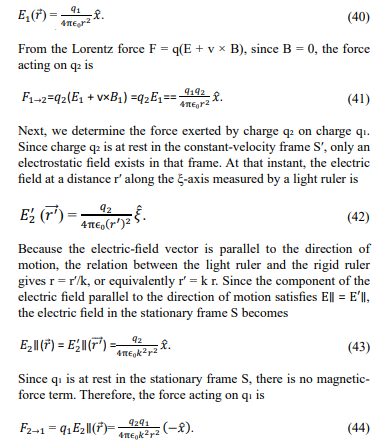
Because q2 is located on the +x side of q1, q2 is pushed in the −x direction by q2.
(41) and (44) show that the force exerted by q1 on q2 is different from the force exerted by q2 on q1. This demonstrates that the roles of the stationary charge q1 and the uniformly moving charge q2 cannot be interchanged. That is, electrostatic-force experiments distinguish the stationary frame from the constant-velocity frame.
In summary, in the Doppler effect, the frequency of a wave measured by a stationary-frame observer and by a constant- velocity observer passing nearby varies depending on the relative velocity and the direction of wave propagation, regardless of the coordinate system to which the observer is fixed. Therefore, the Doppler effect cannot distinguish a stationary-frame observer from a constant-velocity observer. As an electromagnetic phenomenon obtained by directly applying the Lorentz transformation and its inverse, the Doppler effect constitutes a representative example of observer relativity.
By contrast, the electromagnetic force acting between a stationary charge and a charge moving with velocity vdepends on the coordinate frame in which the charge is at rest. Even when the same Coulomb’s law is applied, the electromagnetic laws governing relatively moving charges differ, thereby distinguishing the stationary frame from the constant-velocity frame. In this way, within inertial systems, electromagnetic phenomena that exhibit relativity between nearby observers coexist with electromagnetic phenomena that exhibit absoluteness between inertial frames. However, Einstein interpreted the relativity between observers as the relativity of inertial frames and thereby overlooked the coexistence of inertial-frame absoluteness. He did not take into account the difference in measuring instruments between the stationary frame, which employs rigid rulers, atomic clocks, and light, and the constant-velocity frame, which is constructed using only light and atomic clocks.
Conclusion
This study reexamines the conceptual foundations of special relativity by explicitly incorporating the physical invariance of measuring instruments—rigid rulers, atomic clocks, and light— into relativistic kinematics. That is, unlike Lorentz’s approach, which presupposes an another stationary frame, or Einstein’s approach, which is based on the equivalence of all inertial frames, the Lorentz transformation and its inverse are derived, as a third method, solely from the constancy of the speed of light. This result shows that the mathematical structure of special relativity does not inherently entail the necessary denial of the existence of an absolute stationary frame.
Accordingly, this study demonstrates the coexistence of observer relativity and the absoluteness of inertial frames. Observer relativity arises from the shared use of light signals and synchronized atomic clocks, leading each observer to describe themselves as at rest while the other is in motion. In contrast, the absoluteness 2→1 1 2 4πð??oð??2ð??2 of inertial frames originates from the fact that only the stationary frame employs rigid rulers. That is, only the stationary frame can operationally measure spatial distances, temporal intervals, and the round-trip speed of light by jointly using rigid rulers and synchronized atomic clocks. By contrast, in constant-velocity frames these physical quantities cannot be measured in the same manner and must instead be defined axiomatically. From this, it becomes clear that the relativity of physical laws is not an independent postulate, but rather a consequence that follows from the physical condition of the invariance of the speed of light.
Through this third derivational approach to the Lorentz transformation, the present study makes explicit the coexistence of observer relativity and inertial-frame absoluteness. The relativistic Doppler effect provides a representative manifestation of observer relativity, as the observed frequency depends on the direction of wave propagation and relative motion. Conversely, round-trip light experiments and electrostatic interactions between stationary charges and uniformly moving charges reveal the absoluteness of inertial frames. In particular, the asymmetry of electrostatic forces demonstrates that stationary charges and uniformly moving charges are not physically interchangeable, thereby indicating that stationary and constant-velocity frames can be experimentally distinguished. These results indicate that although special relativity formally excludes an absolute stationary frame, it remains operationally constructed upon one. Einstein’s treatment of an “arbitrary stationary frame,” which was essential for deriving expressions for momentum, energy, and mass–energy equivalence, is thus shown to reflect a fundamental physical necessity rather than a mere mathematical convenience.
In conclusion, this study resolves long-standing conceptual ambiguities in relativistic physics and proposes a coherent physical framework—absolute relativity—that preserves the empirical successes of special relativity while restoring a physically grounded notion of an absolute stationary frame. This perspective holds the potential to provide meaningful insights for the future development of general relativity.
Data Availability
All data generated or analyzed during this study are included in this published article.
Acknowledgments
Author Contributions
The author formulated the conceptual system work, conducted the theoretical analysis, and synthesized relevant literature. AI assistance was limited to ensuring linguistic precision, standardizing terminology, and verifying the logical coherence of new ideas
Financial Declaration
The author did not receive support from any organization for the submitted work.
Declarations
The author declares no conflict of interest. All findings and interpretations presented in this work are derived independently, without any external influence that could bias the conclusions.
References
- Lorentz, H. A. (1937). Electromagnetic phenomena in a system moving with any velocity smaller than that of light. In Collected Papers: Volume V (pp. 172-197). Dordrecht: Springer Netherlands.
- Miller, A. I. (1981). Albert Einstein’s special theory of relativity: On the electrodynamics of moving bodies. Addison- Wesley, Massachusetts. p. 395.
- Koh, H. (2023). Special relativity and absoluteness. Journal of Electrical Electronics Engineering 2(4), 452.
- Miller, A. I. (1981). Albert Einstein’s special theory of relativity: On the electrodynamics of moving bodies. Addison- Wesley, Massachusetts. p. 393.
- Miller, A. I. (1981). Albert Einstein’s special theory of relativity: On the electrodynamics of moving bodies. Addison- Wesley, Massachusetts. p. 394.
- Jammer, M. (2006). Concepts of simultaneity: From antiquity to Einstein and beyond. Johns Hopkins University Press, Baltimore. p. 134.
- Koh, H. (2023). The study of absoluteness overlooked by special relativity. Journal of Electrical Electronics Engineering 2(1), 25.
- Koh, H. (2023). Coexistence of relativity between observers and the absoluteness of inertial systems. Journal of Electrical Electronics Engineering 2(1), 35.
- Koh, H. (2023). Coexistence of relativity between observers and the absoluteness of inertial systems. Journal of Electrical Electronics Engineering 2(1), 37.
- Guerra, V., De Abreu, R. (2006). Special relativity in absolute space: From a contradiction in terms to an obviousness. Instituto Superior Técnico, Lisbon, p. 7.
- Koh, H. (2023). Coexistence of relativity between observers and the absoluteness of inertial systems. Journal of Electrical Electronics Engineering 2(1), 36.
- Miller, A. I. (1981). Albert Einstein’s special theory of relativity: On the electrodynamics of moving bodies. Addison- Wesley, Massachusetts, p. 395.
- Koh, H. (2025). Special relativity with modified relativity of physical laws. Journal of Electrical Electronics Engineering 4(5), 5.
- Miller, A. I. (1981). Albert Einstein’s special theory of relativity: On the electrodynamics of moving bodies. Addison- Wesley, Massachusetts, p. 407.