

Journal of Electrical Electronics Engineering(JEEE)
ISSN: 2834-4928 | DOI: 10.33140/JEEE
Impact Factor: 1.2


Research Article - (2025) Volume 4, Issue 4
The Special Theory of Relativity, “May Be” a Wrong Theory
E/M Projects Designer and Contractor Engineer, Greece
Received Date: Jun 03, 2025 / Accepted Date: Jul 14, 2025 / Published Date: Jul 22, 2025
Copyright: ©Â©2025 Vaggelis Talios. This is an open-access article distributed under the terms of the Creative Commons Attribution License, which permits unrestricted use, distribution, and reproduction in any medium, provided the original author and source are credited.
Citation: Talios, V. (2025). The Special Theory of Relativity,
Abstract
In Mathematics, when we make a mistake in solving a problem, this mistake is also transferred to the calculations of the problem and usually leads us to an incorrect result. If we transfer this incorrect result to Physics, e.g. in the study of a topic, then we usually end up with an incorrect conclusion about the topic of our study.
Some scientists, when they make a mistake, whether due to overconfidence, or of lack of information, or of something else, often, instead of correcting their mistake, try to verify it by basing the verification on a new mistake of theirs. In this case, when we verify an error with a new error, we do not simply end up with an incorrect result, but we create an ambiguity that often completely alters the reality.
Something similar has happened with the Special Theory of Relativity, where Einstein incorrectly assumed that a stationary observer located outside a space moving at a speed “a” relative to the observer, for a ray of light moving at a speed “c” within the moving space, will measure the speed of light c�?=c, which is an incorrect measurement, instead of the correct measurement which according to the invariant Mathematical Law of Superposition will be c�?=c+a.
Einstein verified the incorrect and paradoxical equation c�?=c based on incorrect experimental data as we will see, and used it in all the calculations of the Special Theory of Relativity, with the consequence that all the results of the calculations of the theory are incorrect. Then he transferred all the results of the incorrect calculations to the theory, with the result that all the conclusions of the Special Theory of Relativity to be also incorrect.
On the incorrect conclusions of the Special Theory of Relativity, Einstein also based the General Theory of Relativity, with which he tried to explain the cause of gravity. However, apart from some more accurate calculations, than the calculations of Newton’s theory, when we examine gravity on a global scale, for the cause of gravity, the General Theory of Relativity did not give us, any other clear positive result.
Keywords
Theory of Relativity, Reference System, Einstein, Inertial Space
General
From the beginning I want to clarify that this work is not written to diminish the greatness of Einstein, who, however we may put, undoubtedly the greatest physicist of the last century (1900-2000), for his great contribution to Physics and Cosmology, but the work is written to specifically question the Special Theory of Relativity, and to comment on the fact that the General Theory of Relativity, in no way explains the cause of gravity. As for Einstein’s greatness, it is a rule of science that the best is not the one who makes no mistakes, but the one who makes the most rights and the fewest mistakes.
However, the main reason for writing this paper is to highlight the case that Einstein’s later supporters, ignoring the reality, support his greatness, citing the Special and General theories of Relativity, which they try in vain to verify or establish de facto as correct theories, even without proof [1,2]. In fact, in their attempt to verify the theories, they also created two new questionable theories, the Big Bang theory and the Standard Model theory, which instead of smoothing the situation complicated it, even more. In this case, they unwittingly do a very great harm, both to Einstein and to Modern Theoretical Physics and Cosmology.
The Special Theory of Relativity is based on two axioms, namely:
-
- First Axiom: The laws of physics are the same for all inertial reference systems[ An inertial system is a space in which all its elements have the same velocity. For example, a moving motor bus, a train, an airplane, a spaceship, the Earth, the Moon, the planet Mars, etc. are independent, distinct inertial spaces.]. That is, the fundamental laws of physics have the same mathematical form for all inertial observers.
-
- Second Axiom: The speed of light is independent of the motion of the light source and is the same c for all observers and for all inertial reference systems. That is, that: a) the speed of light emitted by a light source is always the same speed “c” and is independent of the motion of the light source,
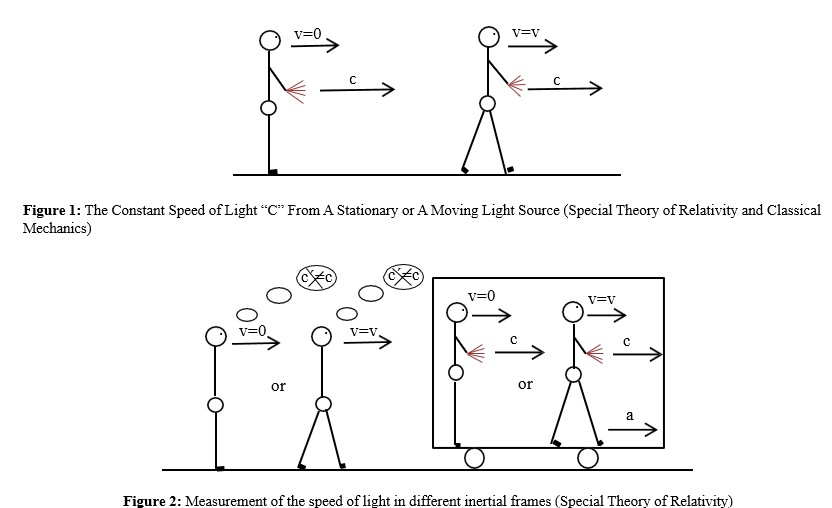
Figure 1 and: b) a stationary observer located outside a space that moves with speed “a”, relative to the observer, for a ray of light moving with speed “c” inside the moving space will measure a speed of light cÃÃÃÂ????=c, regardless of its motion, Figure 2.
As for the first axiom, that the laws of physics are the same for all inertial reference systems, the theoretical and experimental progress of Physics has confirmed that the axiom is valid. As for the second axiom of the constant speed of light, this is not a single axiom but in essence it is two completely different axioms that Einstein mistakenly combined into one axiom, namely: 1) The speed of light is “c” and is independent of the motion of the light source and that: 2) The speed of light is the same cÃÃÃÂ????=c for all observers and for all inertial reference systems.
Of the two axioms that the second axiom is separated, the first one, that the speed of light is independent of the motion of the light source that emits it, is absolutely correct, but Einstein gave to it the wrong interpretation, as to why the speed of light is independent of the motion of the light source that emits it, claiming that this is due to the fact that light does not obey the invariant Mathematical Law of Superposition!!! If possible!!!, while the correct interpretation is that the speed of light is independent of the motion of the light source that emits it, is that light is an immaterial interaction and therefore, as an immaterial interaction, is not affected by the motion of the light source.
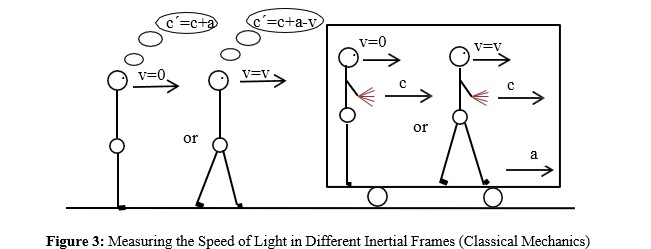
Regarding the second part of the second axiom that a stationary observer located outside a space moving with a speed “a” relative to the observer, for a ray of light moving with a speed “c” inside the moving space will measure the speed of light cÃÃÃÂ????=c is a wrong and illogical thought of Einstein[ Perhaps at that time (1905) our knowledge of the speed and the propagation of light was not at the current levels, for Einstein to understand that the equation cÃÃÃÂ????=c was incorrect. However, today, with the knowledge we have about the speed and the propagation of light, it is unjustifiable that there are scientists, who deal with related issues, and accept that cÃÃÃÂ????=c . which is in complete contradiction with the invariant Mathematical Law of Superposition that the speed of light that the stationary or the moving observer will measure with speed v is cÃÃÃÂ????=c+a or cÃÃÃÂ????=c+a-v respectively, Figure 3
However, since a rejection of the second part of the axiom would essentially reject the entire Special Theory of Relativity, since the axiom is the essencial basis of the theory, Einstein tried, again incorrectly, to verify the axiom experimentally by claiming that the Michelson-Morley experiment verifies it. In this case, Einstein did not take into account that the correct sicuence of a verification is first the theoretical verification and then comes the experimental verification. At the same time, however, he made another mistake because he did not realize that the Michelson-Morley experiment with which he tried to verify the axiom has nothing to do with an observer measuring the speed of light in different inertial spaces, since in the Michelson-Morley experiment the observer is in the same inertial space as the space of the experiment [3].
Next, we will examine three basic cases of incorrect calculations of the Special Theory of Relativity, namely: a) the length contraction, that is, that the length of a moving body is different from its length when it is stationary, b) the time dilation, that is, that the time for a moving observer is shorter than the time of a stationary observer, and c) that the kinetic energy of a stationary body of mass m is not zero, but it is E=mc2, and then we will explain how Einstein established these incorrect calculations as correct calculations. In fact, he characterized the incorrect equation E=mc2 as the most important equation of the last century (1900-2000),!!!
The Length Contraction
So, according to the Special Theory of Relativity and using the incorrect equation cÃÃÃÂ????=c of the second axiom of the theory, Einstein calculated that the length of a moving body contracts. That is, a stationary body of length “l”, when we move it with a speed “a”, then its length becomes:
If we use the correct equation cÃÃÃÂ????= c+a, of Classical Mechanics, then we calculate the correct result, which according to Classical Mechanics is:
ðÂÃÃÂ??ÂÃÂ?ÂÂ??′ = ðÂÃÃÂ??ÂÃÂ?ÂÂ?? (2)
Which tell us that the length of a body remains unchanged, whether the body is moving or if it is stationary?
The contraction of the length of a body according to the Special Theory of Relativity for conventional speeds is very small, so small that with the current data of science it is not possible to verify it. All the experiments that have been done to prove the contraction of the length calculated from equation (1), fall within the margins of error and safety of the experiments.
For example, if we take a ruler of length “l” thirty centimeters (0.30 m) and move it with a speed “a”, three meters per second, the ruler will shrink by:

That is, the ruler will contract by 3.10-9m, which is an incorrect result, but unverifiable with today's scientific means. So, Einstein established it as a correct result.
The Time Dilation
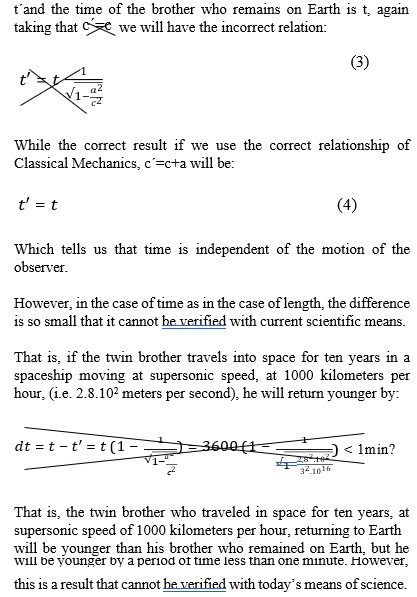
Another incorrect result is the calculation of time in different inertial spaces. That is, the time of a moving observer passes later than the time of an observer who remains stationary. For example, the Special Theory of Relativity mentions the case of two twin brothers, one of whom travels in space and the other remains on Earth. That is, if the time of the brother who travels in space is
The Kinetic Energy of a Body of Mass M at Rest or Moving with Speed “a”
The kinetic energy of a body of mass “m” moving at speed “a” according to the Classical Mechanics is:
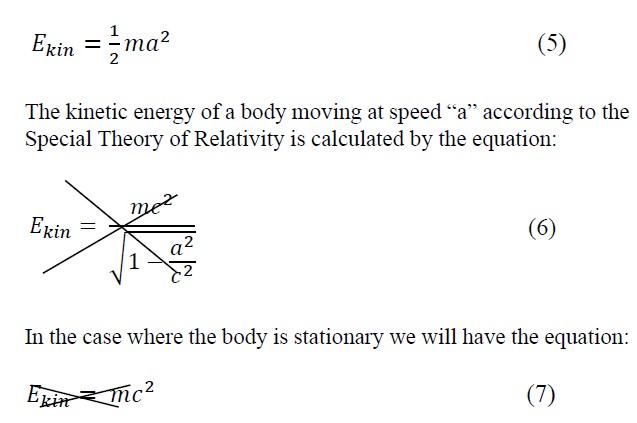
However, in Classical Mechanics, a stationary body, as shown by relation (5), has zero kinetic energy. This shows that equation (7) is an incorrect equation. However, Einstein claimed that equation (7) does not represent the kinetic energy of mass!!! But represents the internal energy of mass!!! Thus created the incorrect equation:
Ε=mc2 (8)
which he managed to present not only as the equation of the internal energy of a mass m but to present it as the most important equation of the last century (1900-2000) !!!
However, the equation (8), apart from the fact that it resulted from Einstein’s incorrect and strange associations, cannot correspond to the internal energy of the mass m since the internal energy of the mass m as we calculate below is less than 1/2mc2.
Indeed, if we divide the mass m into the elementary particles of which it consists, we will have:
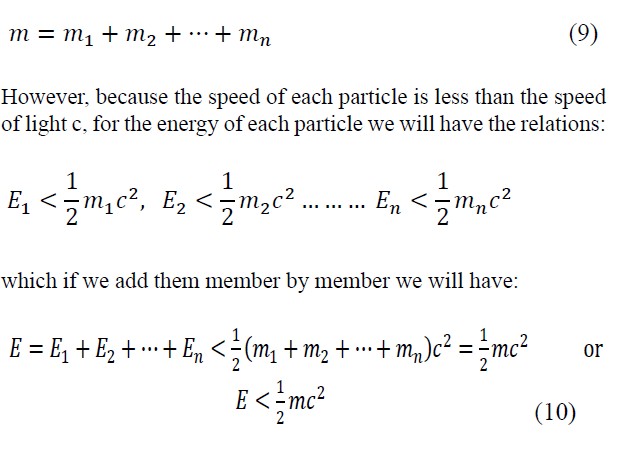
From the relation (10) we observe that the total internal energy of a body of mass m is less than 1/2mc2, so in no case can equation (8) be valid. We therefore reach the simple conclusion that not only the equation (8), but also the entire reasoning for establishing the equation, is incorrect.
Judgments and Conclusions
After the above analysis, it becomes clear that the Special Theory of Relativity is not a theory with certain errors that we need to correct, but it is a completely wrong theory, that is, it is a theory that does not have any correct result and must be rejected. Now regarding the General Theory of Relativity, it must be reexamined as a theory, since a large part of it is based on the incorrect Special Theory of Relativity.
However, for the General Theory of Relativity, what is certain is that it calculates gravity, perhaps with some greater accuracy than Newton’s theory, but it does not explain the cause of gravity as the later supporters of the theory, after Einstein, wrongly claim.
The fact that the General Theory of Relativity does not explain the cause of gravity is not my personal opinion, or the opinion of some scientists, but it is the opinion of Einstein himself. This is the reason why Einstein, in the last years of his life, and specifically from 1930 onwards, tried to develop a new theory for the creation of the Universe that included gravity, but without any positive result. Perhaps, the scientific conditions of that time were not then suitable for the creation of a relevant theory, even by Einstein’s personality.
Subsequently, two complementary theories were developed by the supporters of the theories of Relativity, namely: a) the Big Bang theory, which had already been proposed since the end of the decade (1920-1930) and explains the creation of the Universe, and
b) the Standard Model theory, which was proposed in the decade (1970-1980), specifically after the discovery of the up and down quark particles, and explains the origin of elementary particles and the creation of the Fundamental Interactions, except Gravity, which were supposed to complement and verify the theories of Relativity. Unfortunately, however, the two new theories were also called into question, with the result that, instead of offering any positive result, they complicated the situation even more and created a big ambiguity that tends to destroy all the progress of modern Theoretical Physics and Cosmology, which was made in the last century [5-7].
However, since a rejection proposal, always creates negative emotions and raises the reasonable question of how the gaps left by the rejection will be filled, the rejection proposal should be accompanied by some new positive proposals. In this sense and in replacement of the theories of Relativity, I propose the reexamination of Newton’s theory and its completion by the theory of the Double Cause of Gravity [4]. At the same time, to replace the Big Bang theory, I propose the theory of the Chain Reaction, and to replace the theory of the Standard Model I propose the theory of the New Model [3,6]. The proposed theories answer to all of the above doubts and describe with greater reliability, logic and scientific consistency, the origin of elementary particles and the essential interactions, including gravity, and the creation and functioning of our Universe and the rest of the Cosmos, from elementary particles to infinity.
References
- Ohanian, H. C. (2007). Classical Electrodynamics. Laxmi Publications, Ltd.
- Hawking, S. (2009). A brief history of time: from big bang to black holes. Random House.
- Talios, V. (2020). From Elementary Particles to the Limits of the Infinite Cosmos. Nova Science Publishers, Incorporated.
- Talios V. (2021). A Modern Theory of Everything. Laplambert Academic Publishing.
- Talios, V. (2023). The Standard Model Theory [May Be] a Wrong Theory. Journal of High Energy Physics, Gravitation and Cosmology, 9(3), 602-610.
- Talios V. (2024). The unanswered questions that set-in doubt the Standard Model Theory and the answers that will establish the New Model. Journal of modern and applied physics.
- Talios V. Seven papers put Elementary particle Physics and Cosmology Back on the Right Track.