

Archivos de Ciencia e Investigación(ADCI)
ISSN: 3068-014X | DOI: 10.33140/ADCI


Review Article - (2026) Volume 2, Issue 2
The Migration of the Image: Zelem from the Rabbinic Body of Light to Infinity Without Thought
Received Date: Aug 01, 2026 / Accepted Date: Sep 02, 2026 / Published Date: Sep 04, 2026
Copyright: ©2026 Julian Ungar-Sargon. This is an open-access article distributed under the terms of the Creative Commons Attribution License, which permits unrestricted use, distribution, and reproduction in any medium, provided the original author and source are credited.
Citation: Sargon, J. U. (2026). The Migration of the Image: Zelem from the Rabbinic Body of Light to Infinity Without Thought. Arch Cienc Investig, 2(2), 01-13.
Abstract
This essay traces a single theological trajectory across nineteen centuries: the migration of the divine image (zelem) from a location to a dimension, from a dimension to a psyche, from a psyche to a linguistic veil, and finally to a marginal disturbance in an infinity that does not know it happened. The rabbis, on Alon Goshen Gottstein's reading, meant by zelem the body — a luminous body, but a body, occupying a place and susceptible to injury. The first kabbalists, on Sandra Valabregue-Perry's reading, dissolved that location into an infinite vertical axis by two conceptual moves: the deification of the sefirot and the collapse of Sefer Yetsirah's multidirectional expansion into a single ascending line. Erich Neumann interiorized the axis, mapping Eyn-sof onto the creative unconscious and tzimtzum onto the contraction of the ego. Elliot R. Wolfson stripped the image of ontological standing altogether, reading the anthropomorphic configuration as an imaginal veil woven of letters and demanding its iconoclastic erasure. The treatise Va-Avo ha-Yom el ha-Ayin, transmitted under the name of Jonathan Eybeschütz, terminates the sequence by positing an infinity without thought — a Godhead in which the cosmos figures as an involuntary ripple at the periphery of an unminding abyss. I argue that this is not a story of refinement but a sequence of four relocations, each purchasing explanatory power at the same price: the loss of an addressee. I then argue, from my own published work, that the trajectory can be answered only by a return to where it began — not to rabbinic corporeal realism, which is unrecoverable, but to an embodied theology in which the image is again something that can be wounded, and therefore again something that can be addressed. The last word of the essay is the first: the heel that outshone the sun.
Keywords
Zelem, Divine Body, Eyn-Sof, Tzimtzum, Theosophical Kabbalah, Erich Neumann, Elliot R. Wolfson, Va-Avo Ha-Yom El Ha-Ayin, Apophasis, Embodied Theology
The Problem: Where Did the Image Go
There is a question that most treatments of tzelem Elohim never quite ask. Not what does the image mean — that question has been answered a dozen ways — but where is it. The question of location is not a naive one. It is the question that determines whether the image is a thing one can stand in front of, a thing one can damage, a thing that can be lost, and above all a thing that establishes a second person: an addressee, a face, someone at whom a command can be directed.
The rabbis had an answer that is nearly scandalous in its concreteness. The image is the body. It is here, it is visible, it can be washed, it can be hanged from a tree, it can be murdered and murdering it does something to God. Alon Goshen Gottstein has argued the case with a force that has not been adequately absorbed: in all of rabbinic literature there is not a single statement that categorically denies body or form to God, and the bodily meaning of zelem is not one meaning among several but the only meaning the term carries in tannaitic and amoraic sources [1].
Nineteen centuries later, in a treatise circulating under the name of one of the great halakhic authorities of eighteenth-century Ashkenaz, the same tradition arrives at a Godhead so remote that it has no knowledge that a cosmos exists, and the whole structured world — sefirotic ladder, human image and all — is a marginal and involuntary disturbance at the edge of an unthinking infinity.
Between those two endpoints lies a trajectory. It is not a trajectory of abstraction merely; that description is too flattering and too vague. It is a trajectory of relocation. At each stage the image is moved: out of the body into a dimension, out of the dimension into a psyche, out of the psyche into a grammar, out of the grammar into an accident. And at each stage the move is made for good reasons, solves real problems, and costs the same thing. This essay is an attempt to describe the migration and to say what it cost.
Two pieces of modern scholarship supply the load-bearing evidence for the first two stages. Goshen Gottstein's 1994 study of the rabbinic corpus establishes the ground [1]. Sandra Valabregue-Perry's account of the emergence of the theosophic concept of infinity establishes the first migration, and does so with unusual precision, because she identifies the two specific conceptual shifts that convert a cosmological text into an intra-divine theosophy [2]. The remaining stages — Neumann, Wolfson, and the Ayin treatise — I have addressed piecemeal across two decades of published work, and part of what I am attempting here is to say what those pieces amount to when laid end to end. The dissertation with which I began this work, on the imaging and imagining of the divine in rabbinic literature, was already an argument that the rabbinic mashal le-melekh is a genre of theological risk rather than theological illustration; the essay on the evolution of theological consciousness attempted to state the whole arc in a single frame [3,4]. What follows is the arc, told as a single narrative, with the argument that the narrative is a declension.
A methodological note on register. This is a theological essay, not a clinical one. My published corpus is largely addressed to medicine, and I will draw on it freely, but I will draw on it for its theology. Where a clinical application is obvious I will let it remain obvious rather than develop it. The question here is what happened to God's image, not what to do at a bedside.
The Rabbinic Ground: Zelem as Body
The Bathhouse and the Twin
Two texts do most of the work. In Leviticus Rabbah 34:3 Hillel goes to the bathhouse and tells his disciples he is going to perform a commandment. The argument is a fortiori: if the official appointed to scrub the imperial statues erected in theaters and circuses is paid a salary and holds a position of standing, then those made in the image and likeness of the King of Kings are under obligation to care for the thing that carries that image [1]. The logic does not work unless the image is the body. There is nothing to scrub about a soul.
In Midrash Tanna'im on Deuteronomy 21:23, Rabbi Meir explains the prohibition on leaving an executed criminal hanging overnight with a parable of identical twins, one crowned and one turned bandit and hanged. Passersby see the corpse and say the king has been strung up; the king orders it taken down [1]. Goshen Gottstein's observation is the decisive one: the resemblance in the parable is purely physical. There is no other resemblance available. The hanged man does not look like the king in respect of his rational faculty.
A third text completes the pattern, the rabbinic parable that construes murder as an injury to the emperor's statue [1]. The prohibition of homicide in Genesis 9:6 is thus not grounded in a metaphysical dignity but in a mimetic offense: the physical human being resembles God the way a statue resembles a king, and to destroy it is lèse-majesté.
Marmorstein's schema of two tannaitic schools, an anthropomorphic Akivan and an allegorizing Ishmaelian, has structured a century of discussion of this material, and Morton Smith's important essays retained a modified version of it [5,6]. Goshen Gottstein's refusal of the schema is, I think, correct, and his reason is the strongest kind: Marmorstein produced no evidence of a school that denied divine form at the crucial junctures, only evidence of disagreement about divine function [1]. Altmann's reading, built from targumic fine points, likewise underweights the plain talmudic and midrashic evidence [7]. The question is not whether the rabbis believed God has a form. It is what kind of form.
The Body of Light
Here the material becomes theologically interesting rather than merely startling. The rabbinic divine body is not a scaled-up human body. It is a body of light, and the evidence for this comes from what is said about Adam, who was created in that zelem.
Resh Lakish, in the name of R. Simon ben Menasseya, says the apple of Adam's heel outshone the globe of the sun, and that the brightness of his face outshone the heel [1]. The reasoning offered is aesthetic and hierarchical: a person makes his own servant more beautiful than the household's, and Adam was made for the service of the Holy One while the sun was made for the service of humanity. Rabbi Meir's textual variant at Genesis 3:21 — garments of light rather than garments of skin — belongs to the same complex [1]. And the sugya at Bava Batra 58a, where R. Bana'ah marks out the burial caves and glimpses Adam's two heels like two orbs of the sun, links luminosity, beauty, and a graded descent from the divine form through Adam, Jacob, R. Abbahu, R. Kahana [1].
This is the crucial finding. The rabbinic zelem is corporeal and it is luminous, and those two predicates are not in tension. The divine body is an aesthetic body, a body for the sake of beauty, perceptible in principle to the pure of heart — the Pseudo-Clementine homily that Pines translated makes exactly this move, distinguishing form from function and grounding the divine body in beauty rather than use [1,23]. Body without bodily function. A form whose purpose is to be seen.
I have argued elsewhere that this luminous corporealism is the fountainhead of an entire tradition of non-cerebral knowing in Jewish anthropology — that the biblical and rabbinic person thinks with organs, and that the later relocation of the divine image into intellect is a philosophical import rather than an indigenous development [8]. The zelem of the rabbis is not a faculty. It is a surface.
The Soft Distinction
The reason the rabbis could say all this without embarrassment is that they had no hard body–soul dualism to embarrass them. Goshen Gottstein puts it well: the distinction between soul and body in rabbinic sources is soft rather than hard, a polarity within a whole rather than a metaphysical opposition [1]. Nowhere is the soul called divine. It may be of heavenly origin and pure in nature, but it is a vitalizing agent whose proper place is inside a body.
The parable of the lame watchman and the blind watchman in Leviticus Rabbah 4:5 is the classic statement: soul and body each disclaim the theft of the figs, and the king, being a person of insight, sets the lame man astride the blind man and judges them as one [1]. Eschatology follows anthropology. The future life is resurrection, not the immortality of a separated soul.
The severance comes later, with Hellenistic anthropology entering Judaism through the medieval philosophers [1]. And when it comes, it takes the image with it. Midrash Ha-Gadol on Genesis 1:26, a post-Maimonidean compilation, is the earliest midrashic text to align image and likeness with soul and body respectively — which is to say, the earliest text in which the image ceases to be the body.
That is the first hinge of the whole trajectory. Every subsequent migration is downstream of it.
The Image is Lost
Now the finding that I regard as theologically the most consequential in Goshen Gottstein's essay, and the one least noticed. Every dynamic process involving zelem in rabbinic literature runs in the direction of loss.
The image diminishes with Adam's sin; it is lost in the generation of Enosh, when faces became apelike and centaurs were born, in what Goshen Gottstein aptly calls a kind of reverse Darwinism; it is annulled by murder and, for Ben Azzai, by the refusal to procreate; it departs from the person who sins and takes the angelic escort with it; the Genizah benediction ties its loss to the destroyed Temple and to lying speech [1]. Sinai does not restore it. Moses's radiant face is Adam's luminous counterpart but is nowhere described as a restoration of zelem. Goshen Gottstein's summary is stark: the zelem is natural to creation, we hear only of its loss, it is never presented as a spiritual achievement, and there is no reference in the corpus to regaining it [1]. Its positive reinstatement waits for the coming of the son of David.
Compare the Pauline material, where the same metaphor runs the other way — a body being renewed, growing, built up, held fast to a head [1]. The rabbinic image only ever wanes.
I have pressed this asymmetry in several places, in work on the somatic crisis of free will in midrash and on the sacred abjection of bodily waste from Talmud to Kabbalah and I want to state the theological upshot plainly here. In the rabbinic system the divine image is an inheritance in decline [14,15]. It is not something you build; it is something you were given and are steadily losing, and whose restoration is not in your hands. That structure — endowment, attrition, eschatological repair — is the deep grammar that Lurianic Kabbalah will later formalize as shevirah and tikkun, and it is already fully present in the fourth century.
Urbach's treatment of the growing prominence of the soul across a millennium of midrashic activity supplies the diachronic frame [16]. Jervell's attempt to restrict zelem to Israel through Sinai is, as Smith showed and Goshen Gottstein concedes, a Heilsgeschichte imposed on the sources [1,17]; but Jervell touched a real nerve. The universality of the image — it belongs to all humanity, gentiles included — is very likely why the rabbis made so little of it [1]. A category that cannot be restricted is a category that will not serve a covenantal theology, and the rabbis preferred Torah as their source of value. The image is minor in the rabbinic corpus because it is too generous.
The Great Body
There is one exception, and it is the exception that opens the door to everything that follows. In the Sifra on Leviticus 19, Ben Azzai rejects Akiva's nomination of "love your neighbor" as the great principle of the Torah and proposes instead the verse from Genesis 5:1 about the generations of Adam and the making of the human in the likeness of God [1]. In the Tosefta at Yevamot 8:7, Ben Azzai says that the one who abstains from procreation sheds blood and annuls the likeness.
Goshen Gottstein offers two readings, both of which matter for this essay. On the first, all of humanity constitutes the great body of divine manifestation, so that to harm a person is to harm the body of God and to reduce the number of persons is to reduce the dimensions of that body. On the second, the image is the great body of Adam, containing within it all future generations — a body that is also a plan, unfolding through history until the souls in the guf are exhausted and the son of David can come [1]. Stroumsa's work on the macroanthropic being and Idel's on the golem both belong to this constellation [18,19].
Here, in embryo, is the entire theosophic project. A divine body that is composed of creatures; that is diminished by their suffering; that is completed only at the end. Once you have that, the sefirot are a short step away — and so is the whole Lurianic apparatus of a God who needs repairing. My work on the pain of the Shekhinah from midrashic exile forward is an attempt to trace exactly this line [20]: the idea that God can be hurt by what happens to bodies is not a mystical innovation but a rabbinic premise, and the mystics only gave it a diagram.
But note carefully what Ben Azzai's great body still has, and what the diagram will lose. It is still a body. It still has dimensions. And you can still injure it by injuring a person standing in front of you
The First Migration: From Body to Dimension
The Two Infinities of Sefer Yetsirah
Valabregue-Perry's argument begins by relocating the origin of the kabbalistic Eyn-sof. Against the assumption that infinity entered Kabbalah as a philosophical import, she shows that the notion is native to Sefer Yetsirah, where it appears in connection with the sefirot [2]. The passage in chapter 5 describes ten sefirot belimah whose measure is ten because they have no end, and then enumerates dimensions: beginning and end, good and evil, above and below, east and west, north and south — with the unique Lord ruling over them all from his holy abode [2,21].
Two things are worth marking. First, the infinite here is adverbial and multidirectional: expansion outward along six spatial and four modal vectors, from a center. Second, the sovereign Lord is precisely not identified with that infinity. He is at the center; the sefirot are his expansions; and there is, as Valabregue-Perry notes, a real tension between the One at the center and the infinite power of the multiple [2]. Liebes's analysis of the dynamic of expansion and annihilation in the term belimah sharpens the point: the same text carries an expansive vector and a restraining one [2,22]
Pines's demonstration that a strikingly similar doctrine of infinite expansions appears in the Pseudo-Clementine Homilies situates all this in a second-century milieu — the same milieu, it is worth noting, that produced the homily on the divine body for the sake of beauty. Infinite dimension and luminous form are neighbors before they are rivals
The Philosophers' Domestication
The tenth- to twelfth-century philosophical commentaries neutralize the dangerous notion. They convert infinity into a numerical infinite: one is not a number but the immutable principle embodied in every number, the count runs to nine or ten and returns to one, and the process repeats without end [2]. Infinity becomes a matter of endless recombination rather than endless extension.
Saadya Gaon goes further and makes the infinite human rather than divine. In the passage Pines translated, Saadya argues that the ten things have no end from the standpoint of created beings but have an end from the standpoint of their Creator: we cannot reach the end of the six directions, whereas He knows them [2]. This is a decisive theological choice. For Saadya, infinity is a sign of imperfection — the mark of a limit in the knower, not a perfection in the known — and God's perfection consists precisely in finitude and simplicity [2]. Scholem's account of the philosophical background remains the necessary orientation here [24].
Donnolo and the Inversion
The turn comes with Shabbetai Donnolo, whose commentary Wolfson analyzed and whom Valabregue-Perry reads as the earliest testimony to a theosophic concept of the sefirot [27]. Donnolo explains that no sage can penetrate to the end of these ten profound sefirot; a lifetime of pursuit will not amount to anything, because they are infinitely and endlessly deep [2].
Notice the inversion of Saadya. For Saadya, human inability marks an epistemological limit and leaves God finite and perfect. For Donnolo, the same inability is evidence of divinity. Unknowability has become an ontological sign. As Valabregue-Perry observes, the almost invisible line between the epistemological and the ontological infinite is inherent to the ambivalence of the concept itself [2] — and it is precisely by walking that line that the sefirot become God rather than God's instruments.
Wolfson's demonstration that positive, kataphatic assertion is far more prominent in early Kabbalah than the negative-theology reading allows and Idel's recovery of anthropomorphic descriptions of Eyn-sof itself and of the doctrine of an image of man above the sefirot both cut against the assumption that the movement here is simply from image to abstraction [25,26]. The picture is more interesting: the image does not disappear, it changes altitude.
The Two Shifts
Valabregue-Perry's central thesis can be stated in two propositions. The theosophic God emerged from the multidirectional expansion of the sefirot in Sefer Yetsirah by way of two shifts: first, the understanding of the sefirot as divine and therefore as infinite; second, the shift from multidirectional expansion to a unidirectional and vertical one [2].
I want to dwell on the second, because it is the one that matters for the fate of the image, and it has been underdiscussed relative to the first. Consider what is lost when a ten-vectored field collapses into a line. In Sefer Yetsirah the worshipper stands at a center from which reality extends in every direction; above and below have no priority over east and west. After the collapse, there is one direction that counts, and it is up. R. Isaac the Blind's numerical exegesis — things have dimensions and measure but thought has no measure, so they proceed ten by ten, subtle ones from the innerness of the subtle ones [2,28] — converts number into ascent. As Valabregue-Perry notes, ten rather than one becomes the unit, and the principle describes a vertical ascension expanding infinitely toward the Infinite [2].
The consequence for the zelem is exact. A body has dimensions in all directions; it can be walked around. An axis has only one, and it can only be climbed.
Isaac the Blind: Dimension, Limit, and Suckling
R. Isaac's distinction between midah (dimension) and takhlit (limit) is the most delicate thing in this material. Dimensions are received by separate things; prophets saw dimensions according to their apprehension and by receiving that power expanded their consciousness beyond other human beings, gaining breadth of soul to extend to particulars within Eyn-sof; but their limit is the limit of their investigation [2,28,29]
So the prophetic path is a widening, and the widening and the ascent are the same movement. The connection between finite and infinite is made by upward extension, and the path both brings the worshipper nearer and enlarges his consciousness [2]. Prayer is the instrument: there is no way to pray except by taking finite things and elevating them in thought toward Eyn-sof [2].
And then the phrase that gives the whole system away. The inner and subtle essences cannot be contemplated except by that which suckles from them — a mode of contemplation by way of suckling and not by way of knowing [2,28]. Daniel Matt's study of ayin rightly makes this the key to the concept of divine nothingness [30]. I have argued in my own work on the irreducible ayin that this is the pivotal metaphor of the whole tradition and that it has been consistently sentimentalized [31]. Suckling is not a gentler epistemology than knowing. It is a different relation: nourishment without recognition, contact without a face. The infant at the breast is in the most intimate contact available to a creature and is not, in that moment, addressing anyone. That is what replaces standing in front of a statue.
Asher Ben David and Azriel: Dimensions
Without Dimensions R. Asher ben David, Isaac's nephew and the crucial link in the transmission from Provence to Spain, formalizes the paradox. Seeking to know whether the divine dimensions are limited and separate or united in the cause of causes, he concludes that since they are His dimensions they must be dimensions without dimensions, without end or beginning, and without separation — and that they are called dimensions not with respect to themselves but with respect to what reaches us [2,32]. The idiom meshekh Eyn-sof, the infinite effluence, becomes from here the common denominator for emanation [2]
Read that formula against the bathhouse. Hillel's zelem is a dimension with respect to itself; that is exactly why it must be washed. Asher ben David's dimensions are dimensions only with respect to us. The image has become perspectival.
Azriel of Gerona then supplies the metaphysical warrant. Eyn-sof is perfection without imperfection; if one says God is without limit and therefore cannot participate in the limited, this implies He could not have created the world, and to say the limit emanates from Him would demonstrate weakness [2,33]. His resolution is the formula Valabregue-Perry treats as the encapsulation of theosophic dynamism: His power within the limitation is unlimited, and the limitation emanating from Him which delimits all existent beings is the sefirot, having power to act in perfection and in imperfection [2].
Azriel goes so far as to deem heretical those who hold that God's limitlessness makes Him ungraspable by the limited [2]. This is worth pausing on. At the very moment the tradition dissolves the divine body into an infinite axis, it anathematizes the conclusion that would follow naturally from the dissolution — namely, that the infinite is unreachable. Something in the tradition knows what it is giving up and legislates against the loss.
have worked this territory at length in my study of Makom and tzimtzum and the collapse of the horse-and-rider parable [34], and in the epistemology-versus-ontology essay on the tzimtzum model [35]. The argument I made there bears repeating here in its theological form. Tzimtzum is usually read as a doctrine about how a finite world can exist alongside an infinite God. It is at least as much a doctrine about how a located God became an unlocated one and what had to be invented to compensate. The sefirot are the compensation: a mediating apparatus that exists because the image no longer stands anywhere.
What the Axis Costs
Valabregue-Perry ends with a generous formulation: as an orientation rather than an unattainable transcendence, Eyn-sof opens a bridge rather than a chasm, and the vertical axis is at once divine and human, a ladder for God's thought and for man's [2]. That is right, and it is the strongest thing that can be said for the first migration. The theosophic Eyn-sof is not the God of the philosophers. It is directional, it is a focus of kavvanah, it is in constant interaction with every point in the system, and the infinite expansion can be immediately contracted and accessed [2].
But a ladder is not a face. What the first migration accomplishes is the conversion of the divine image from something seen into something traversed. Hillel's disciples could ask him where he was going and receive an answer that pointed at a building. After Gerona, the answer points up.
Interlude: The Anthropos Returns as a Diagram
It would be false to the record to say that the human form simply vanished into the axis. It came back, and came back enormously, as Adam Kadmon — the primordial anthropos whose limbs are the sefirot and whose measure is the measure of the divine.
But it came back changed, and the change is precise. The Shi'ur Komah body of the Hekhalot literature has dimensions so vast that they defeat utterance while remaining, formally, measurements; the clash between finite measurement and gigantic dimension is the distinctive trait of that literature [2]. Zoharic Adam Kadmon is not a measurement. It is a structure of relations — an arrangement of forces, gendered polarities, and channels — for which the anatomical vocabulary functions as notation.
I have argued this in the study of the Sifra di-Tzeniuta: the most concentratedly anthropomorphic stratum of the Zohar is also the most emphatically diagrammatic, and the two facts are not in tension. Skull, dew, beard, and eye are not organs there. They are positions. Idel's account of the two models — theosophic-theurgic and ecstatic — clarifies why the tradition could sustain such intense body language without corporeal commitment [36,37]. And the recurrent structural symbolism of number, proportion, and resonance in the tradition [38] is of a piece with this: the divine form has become a notation for relations.
The consequence follows. You can damage a body. You can misdraw a diagram. These are not the same kind of injury, and only one of them establishes an ethical relation. There is one place in the later material where the older register survives with full force, and it is worth naming because it will matter at the end: the Shekhinah. She has a body in the way the rabbinic zelem had a body — she is exiled, she suffers, she is wounded by what happens to persons. My work on the bird's nest metaphor and on the pain of the Shekhinah is an attempt to show that this register never died; it went underground, and it survives precisely in the figures the systematizers found hardest to systematize [20,36].
The Second Migration: Interiorization
The Mapping
Erich Neumann's Roots of Jewish Consciousness, written in the early 1940s and published in full only in 2019 in Ann Conrad Lammers's edition, performs on kabbalistic material the operation his Origins and History of Consciousness performed on mythological material generally: it reads a cosmology as a phenomenology of the developing psyche [40,41].
The mapping is straightforward and, on its own terms, elegant. Eyn-sof, the unformed and boundless nothing, corresponds to the creative unconscious — the undifferentiated matrix from which forms, archetypes, and conscious contents continuously emerge. The sefirot correspond to the archetypal lattice through which that raw material is filtered and structured into awareness. And the relation between the hidden God and the manifest image reproduces the ego–Self axis of analytical psychology.
Tzimtzum becomes the pivot. The mystic who contracts his own ego-centered desire mimics the primordial divine contraction, and in emptying himself becomes a vessel in which the coincidence of opposites can occur — discovering, at the innermost layer of subjectivity, something structurally identical to the creative ground of being.
The move is not arbitrary. Valabregue-Perry, discussing Isaac the Blind, notes that the ambiguity as to whether "thought" is human or divine is itself part of a psychologization of the divine characteristic of the theosophic structure [2]. Neumann did not invent the interiorization. He completed one that the Provençal kabbalists had begun seven hundred years earlier. This is why he could tell Sanford Drob's readers, in effect, that the Maggid had anticipated his entire psychology — and why the claim is not merely grandiose [48].
The Great Mother and the Dark Side
Neumann's other great contribution to this trajectory runs through The Great Mother [42]. If Eyn-sof is the unconscious matrix, then the maternal archetype in its dual aspect — nourishing and devouring — becomes available as a reading of the Shekhinah, including her dark aspect.
I have worked this material on Shekhinah consciousness as a theological and political paradigm for suffering, on the dark Shekhinah in mystical and post-Holocaust thought, and on maternal instinct and transcendence from Kabbalah forward [43-45]. What I want to register here is a structural observation. Neumann's Great Mother is the return of suckling. Isaac the Blind's mode of contemplation that nourishes without knowing reappears, seven centuries later, as the infant psyche's relation to the archetypal maternal ground. The same relation, the same absence of a second person, now given a developmental rather than a contemplative justification.
The Hand Over the Mouth
There is a fact about Neumann's own trajectory that no honest account of this stage may omit, and it is documented in Lammers's editorial introduction to the second volume of Roots [40]. A section of approximately thirty-six pages, "Das Leben in dieser Welt," was removed from the carbon copies of Part Two and never recovered; the table of contents and the internal cross-references still point at the missing material. Its content, so far as it can be reconstructed, was the Hasidic theodicy — the Ba'al Shem Tov's teaching that evil is a lower grade of a perfect good, Buber's Shekhinah as true unity and evil as the throne of goodness, and the counsel to accept the world exactly as it happens to be.
Lammers reads the excision against the liberation of the camps and Neumann's letter to Jung of 1 October 1945, and offers the formulation that Neumann may have taken Job for his model and laid his hand over his mouth [40].
The chronology matters. Depth Psychology and a New Ethic was begun in 1942, with the war at the door, and completed in 1943 — simultaneous with the Hasidic material. So, 1945 changed what Neumann could publish, not what he had believed while writing. He kept the ethics and cut the theodicy. And the unitive vision returns after 1948 in the Eranos essays as Einheitswirklichkeit, unitary reality — the same structure, stripped of its Jewish theological content and its explicit reconciliation of evil. The Jung–Neumann correspondence, edited by Liebscher, documents the intellectual context of these years [49,50].
I flag one thing as my own inference rather than Lammers's finding: that the postwar universalizing of the vocabulary is continuous with the excision. The book that began as Ursprungsgeschichte des jüdischen Bewusstseins was published as The Origins and History of Consciousness. The adjective was dropped and the noun went to Princeton, while the Jewish books stayed in a drawer.
What Interiorization Costs
The gain from Neumann is real and I do not want to understate it. A tradition that had converted the divine image into an axis of ascent regains, through him, an account of why anyone would climb: the vertical movement is redescribed as individuation, and the whole apparatus becomes phenomenologically intelligible rather than merely inherited.
The cost is equally real, and it is the cost of the whole trajectory in its clearest form. If the divine image is the archetypal Self, then what happens to a person happens to an instance. Neumann's own excised chapter is the evidence: an archetypal grammar was available in 1943 that made the catastrophe intelligible as a lower grade of perfect goodness, and in 1945 its author could not publish it. Something in that grammar had failed, and the failure was not empirical.
I have argued this in several places — on the absent divine in Jung, Hillman, and Drob, on the integration of shadow and light in Jungian and kabbalistic wisdom, on the limits of archetypal approaches, and in the retrospective on the mythopoetic movement thirty years on [54]. The argument is Levinas's, and I take it to be decisive: to relocate a person's suffering into a transpersonal figure is to confer meaning by impersonality, and the meaning arrives only after the sufferer's singularity has been spent to purchase it [51-55].
The rabbinic hanged man is a person who looks like the King. Neumann's is an instance of an archetype. You cannot take the second one down from the tree.
The Third Migration Erasure
The Paradox Wolfson Names
Elliot Wolfson's work identifies, across the whole span of Jewish esotericism, an unresolved tension: an irrepressible drive to configure the divine visually, coupled with an equally insistent denial that God has any visible form [56,57]. His resolution is neither to allegorize the images away nor to take them ontologically. The visual configuration is generated by the imagination — a faculty with genuine noetic function — and what is seen is seen in the mirror of the imaginal, which is to say in a form that is at once real and constructed [56].
The images themselves, the gendered and erotic anatomy of Adam Kadmon and the sefirot, are woven from the letters of the Hebrew alphabet. This is not decorative. It means the divine body is linguistic all the way down, and that the tradition's most intense corporeality is an effect of its most intense textuality [57,58].
The term "apophatic anthropomorphism" is a fair label for the resulting position and consonant with Wolfson's own idiom in the Habad material [60]. God is configured in order that the configuration may be undone; the image is constructed precisely so that its stripping can be performed. True contemplation requires an iconoclastic seeing-not, in which the mystic looks through the form and the apparent presence discloses itself as the trace of an absence that was never a presence [59
The Apophasis is More Radical than it Looks
It is important not to domesticate this as ordinary negative theology. Wolfson's later work presses toward what he calls overcoming theomania: an apophasis so thorough that it must negate even the negation, refusing the residual positivity that hides inside every "God is not X" [59]. The Nothing is not a superlative Something. There is no hyper-essential remainder to be reached by subtraction.
This is what has been called apophatic acosmism [34]. It is the most intellectually formidable position in this essay, and I want to say clearly that I regard it as unanswerable as a claim about predication. Nothing true can be said of Eyn-sof. Every image is a veil, including the veil called "veil."
I have circled this in essays on language and divine concealment, on insubstantial language and the space between persons, and on ego dissolution and the mysticism of the dissolving self [61-63].
What Erasure Costs
And yet. Consider what has now happened to the hanged man. For the rabbis, the corpse looks like the King, and the resemblance is physical, and the King orders it taken down. For Wolfson, "the King" is a linguistic configuration generated by the poetic imagination, to be constructed and stripped in the same act. The stripping is not a failure of the image but its fulfillment. There is no one to give the order. This is not a refutation. It is a description of a cost, and the cost falls in a specific place: apophasis is binding on predication, but the relation the rabbis established through the image was not predicative. Hillel does not predicate anything of God when he goes to the bathhouse. He acts toward a body on the grounds of a resemblance. The second person in that scene is established deictically — by pointing, by locating — not by attribution.
I have argued in the essay on relational theology from Hasidism forward that this distinction is the crux [64]: a theology may accept everything the apophatic critique demands about what can be said of God, and still hold that the pointing survives, because pointing is not saying. Whether that survives Wolfson's own scrutiny is the hardest open question in my work, and I do not claim to have settled it. What I do claim is that the trajectory reaches Wolfson with the addressee already three-quarters gone, and that his contribution is to make the loss explicit and honest rather than to cause it.
The Fourth Migration: Indifference Va Avo ha Yom el ha Ayin
The Text and Its Attribution
A caution before the argument. Va-Avo ha-Yom el ha-Ayin is transmitted under the name of Rabbi Jonathan Eybeschütz, and Scholem accepted the attribution, treating the work as evidence of crypto-Sabbatian theology at the highest level of eighteenth-century rabbinic authority [66,68]. The attribution has never been uncontested; it was the substance of Jacob Emden's accusation and it remains disputed. PaweÃÃÂ??? Maciejko's critical edition is the responsible point of entry [65], and Elisheva Carlebach's study of the Sabbatian controversies supplies the institutional context in which such a text could be both written and denied [67].
I proceed with the treatise as a document of post-Sabbatian theology whose authorship is contested, because nothing in my argument depends on whose hand held the pen. What matters is that the position exists inside the tradition, in the eighteenth century, in a text learned rabbis read.
The Title is the Doctrine
The title cites Genesis 24:42, Eliezer at the well: va-avo ha-yom el ha-ayin — "I came today to the spring." But ha-ayin pointed differently is the Nothing. The whole hermeneutic is compressed into four words: the well at which the servant waits for a sign is also the Nothing, and the text that looks like a servant's narrative is a treatise on the abyss.
I have written on this pun and on what it licenses [31]. It is the crypto-heretical method in miniature: the surface remains scriptural and the depth is unsayable in the surface's terms, and there is no procedure by which a reader can be compelled to see the second reading.
Infinity Without Thought
The treatise's central innovation is a distinction within the infinite. There is an Eyn-sof in which there is no thought — ein sof she- ein bo mahshavah — an aspect of the divine that is entirely aloof, self-contained, unthinking, and without knowledge that a cosmos exists. What we call creation, including the entire sefirotic chain, does not issue from a comprehensive divine decree. It arises as an involuntary disturbance within a marginal fraction of the divine light.
The wedge this drive is the point. On one side, an unaddressable first cause that neither knows nor intends. On the other, the God who speaks in Scripture, who is thereby demoted to a regional deity of a peripheral disturbance. This is, I have argued, the most economical theodicy in the Jewish archive [69]. It does not justify evil. It removes the need for justification by removing the party who would have had to answer for it. Nothing has gone wrong at the top, because there is no one at the top who is watching.
And it is structurally identical to a move made three centuries later on entirely independent grounds, when Jung demoted the biblical God in Answer to Job in favor of a ground that does not know itself. Two traditions, no genealogy, one solution. Under Sandmel's warning against parallelomania, congruence without derivation is not evidence of influence — but it is evidence about us, about what the mind reaches for when the personal God becomes unbearable [69].
The Image at the Terminus
Now run the zelem through this system and see what is left. In the rabbinic corpus, the human being is the visible image of an invisible King who cares, whose statue must be washed and must not be left hanging. In early theosophic Kabbalah, the human being is the crucial vertical channel through which the inner life of the Godhead is balanced and unified — a diminished role in one sense, but a role of extraordinary cosmic dignity, since prayer and theurgy actually accomplish something in God. In Neumann, the human being is where divine creativity becomes actual in space and time. In Wolfson, the human being is the imagination in which the veil is woven and unwoven.
In the Ayin treatise, the human being is a feature of an accident. Not a diminished image; not a veiled one; an unnoticed one. The theurgic dignity is gone because there is no longer anyone in whom to accomplish anything. What remains as a spiritual goal is not to mirror a body of light, not to ascend a ladder, not even to strip a veil, but to pass beyond the region where thought occurs at all — to dissolve into an infinity that is oblivious to its own creation.
I have called this, in the essays on kabbalistic heresy and its antinomian offspring, the shadow that the tradition casts at its own limit [70,71]. It is not an aberration. It is what you get when you follow the four migrations to the end and refuse to stop early.
Why the Terminus is a Terminus
There is nowhere further to go. Every prior stage preserved something on the other side of the relation: A King who orders the body taken down, a Godhead that can be unified by prayer, a Self toward which individuation moves, an absence whose trace can be traced. Infinity without thought preserves nothing on the other side, because there is no other side. The relation has not been attenuated. It has been cancelled.
That is why I take this text, and not Wolfson, as the true endpoint. Wolfson removes what can be said. The Ayin treatise removes what can be addressed. These are different amputations, and only the second is fatal.
It is worth noting the contrast with the Chabad tradition's handling of the same problem, where divine withdrawal is made to precede sin and the resulting structure preserves an addressee at enormous logical cost [72]. Both are post-catastrophe theologies. They differ on whether the cost of keeping someone to talk to is worth paying. I have argued the dialectic of midat ha-din and midat ha-rachamim as the classical frame in which this question was put, and I take the Ayin treatise to be the position that answers no [73].
Reading the Trajectory: One Operation, Four Times
Set the stations side by side and a single operation becomes visible.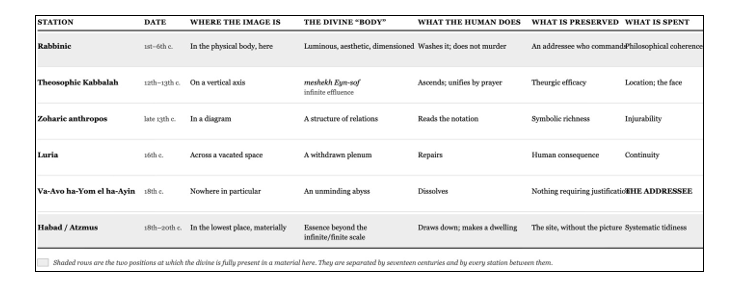
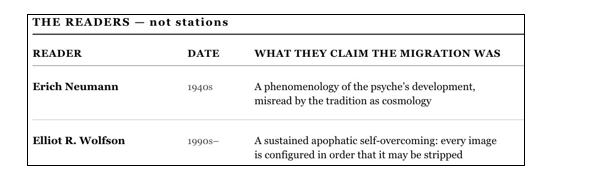
The operation is relocation, and its logic is constant. At each stage a genuine problem is solved — crude corporealism, the finitude of the philosophers' God, the unintelligibility of inherited symbols, the naivety of literal anthropomorphism, the intolerable cruelty of a God who watched. And at each stage the solution consists in moving the image one step further from the site at which a second person can be constituted.
This is not a story of enlightenment. It is a story of a tradition progressively purchasing explanatory power with relational capital, until the capital is exhausted.
Note also what the sequence does not do: it never returns. Each stage is available to its successors as material but never as a live option. No theosophic kabbalist could go back to washing the statue. No one after Wolfson can un-know that the image is woven of letters. The migration is one-way, which is exactly the property Goshen Gottstein identified in the rabbinic zelem itself: every dynamic movement runs toward loss [1].
The trajectory of the concept, that is to say, has the same shape as the concept. The image of God has been losing itself in the same direction, and by the same kind of steps, that the rabbis said the image of God loses itself in a person. This may be the most interesting thing in the whole story, and I do not think it is a coincidence. A theology whose founding intuition is inheritance in decline will produce a history of ideas in the shape of a decline
Against the Trajectory: The Body Returns
What follows is my own position, and I state it as such.
The Rabbinic Ground Cannot be Recovered, and Does Not Need to Be
I am not proposing a return to corporeal realism. That option closed with the medieval philosophers and it closed for good reasons. Nor am I proposing that the apophatic critique can be evaded; I have said that I regard it as binding on predication [34].
What I am proposing is that the trajectory misidentified what it was giving up. It thought it was giving up a crude picture. It was giving up a site.
The rabbinic image was not valuable because it depicted God accurately. It was valuable because it put something in the world that could be washed, injured, and taken down from a tree, and thereby created a place at which an obligation could land. Hillel's argument does not require that God look like Hillel. It requires that there be a thing here about which something is owed.
The whole trajectory can be read as the progressive loss of that thing, and the whole of my own constructive work as an attempt to put it back — not as a metaphysical claim about the divine anatomy, but as a theological claim about where the relation happens.
The wound as the site
The figure I have used for this is the wound as altar [74]. Its logic is exactly the logic of Hillel's bathhouse, transposed. The altar is not a claim about God's location; it is a place where something is owed and where an offering can be made. A wound is such a place. It is dimensioned, it is here, it can be attended to or neglected, and it constitutes an obligation that does not require any prior agreement about metaphysics.
This is why I have insisted, across the post-Holocaust essays, on anti-theodicy rather than theodicy, and why I take Braiterman's category to name the only honest post-catastrophe position [74-76]. Theodicy is the last and most seductive form of the relocation operation: it moves the meaning of a person's suffering into a scheme, and the scheme is always somewhere the sufferer is not.
The fractured vav — the broken letter that is still a letter and still counts — has been my emblem for a holiness that does not require repair before it can be honored [78]. And the grammatical work on the particle et, the untranslatable marker that points without predicating, is the linguistic form of the same argument: Hebrew has a word whose entire function is to indicate an object without saying anything about it. That is deixis, and it is not vulnerable to the apophatic critique, because it makes no claim [79].
Antinomy rather than synthesis
What I do not propose is a resolution. I have argued at length that the personal address and the impersonal ground must be held un-synthesized, because every available synthesis dissolve one of them [77].
Neumann's excision is my evidence for the failure from the archetypal side; the Ayin treatise is my evidence for the failure from the mystical side. Both are attempts to synthesize, and both end by dispensing with the second person — Neumann by making the sufferer an instance, the treatise by removing the one who would have had to answer. The discipline I am recommending is to refuse both and to tolerate the resulting incoherence, on the grounds that a theology which is coherent and has no one in it is worse than a theology which has someone in it and does not close. Hasidic sources supply the internal warrant. The Me'or Einayim holds together a radical acosmic vision and an intensely personal address without reconciling them, and does so knowingly; the doctrine of chesed and gevurah is precisely a refusal to resolve two divine registers into one [83-85]. The Brisker material shows the same refusal executed in a rationalist idiom [87]. And Rav Shagar's work is the modern instance of cutting a thinker along the seam between a vision one keeps and a prognosis one sets down [88].
What Returns from Each Station
If I am arguing against the trajectory, I owe an account of what I take from each stage rather than merely what I refuse.
From the rabbinic ground: the body as site, and the honest recognition that the image is an inheritance in decline whose restoration is not in our hands. Also, the Shekhinah as the one figure in which the older register survives — a divine presence that is exiled, embodied, and hurt by what happens to persons [20,86,89].
From theosophic Kabbalah: tzimtzum, which I regard as the single most useful idea in the corpus [46,47,80], and the theurgic premise that what people do makes a difference where it matters. The vertical axis I decline; the withdrawal that makes room for another I keep, and I keep it as an ethical and not merely a cosmological doctrine.
From Neumann: the phenomenology, and the honesty of the excision. A man who found in 1945 that he could not publish what he had written in 1943 performed, on himself, the operation I am recommending: he kept the practice and set down the doctrine that made suffering necessary.
From Wolfson: the discipline of the stripped image, and the permanent prohibition on mistaking a configuration for a description. Everything I say about presence must survive the knowledge that presence is a word.
From infinity without thought: the warning. It is the endpoint drawn accurately, and it should be read the way one reads a proof by contradiction — as the demonstration that the premises need revising.
The Heel
I want to close where I began, with Resh Lakish's remark that the apple of Adam's heel outshone the globe of the sun.
Consider what that sentence does. It selects the least dignified part of the body — the heel, the part that touches the ground, the part that in the Bava Batra sugya is the only part of Adam that R. Bana'ah is permitted to glimpse — and makes it the bearer of a light greater than the suns. Not the face. Not the mind. The heel. Every subsequent station in this trajectory would have located the divine radiance higher: in an ascending axis, in the Self, in the letters, in an abyss. The rabbis put it at the bottom of the body, on the floor of the world, where it can be stepped on.
I take that to be the correct theology, and I take the nineteen hundred years since to be an extended and brilliant argument that it is not. The argument has produced everything of value in Jewish mystical thought, and it has produced, at its terminus, a God who does not know we are here. Under those circumstances it seems reasonable to go back and look again at the heel.
References
- Gottstein, A. G. (1994). The body as image of God in rabbinic literature. Harvard Theological Review, 87(2), 171-195.
- Valabregue-Perry, S. (2012). The concept of infinity (Eyn-sof) and the rise of theosophical Kabbalah. Jewish Quarterly Review, 102(3), 405-430.
- Ungar-Sargon, J. Y. (2000). Imaging/imagining the divine in rabbinic literature. Brandeis University.
- Ungar-Sargon, J. (2026). Divine names, human psyche, and the emergence of process theology: A study in the evolution of theological consciousness. EC Neurology, 18(3), 1–16.
- Marmorstein, A. (1927). The old rabbinic doctrine of God (No. 10). Oxford University Press, H. Milford.
- Smith, M., & Cohen, S. J. (1995). On the Shape of God and the Humanity of Gentiles (Vol. 1, pp. 150-160).
- Altmann, A. (1968). " Homo Imago Dei" in Jewish and Christian Theology. The Journal of Religion, 48(3), 235-259.
- Ungar-Sargon, J. (2025). The wellsprings of embodied wisdom tracing non-cerebral intelligence from biblical anthropology to contemporary embodied theology. J Relig Theol, 7(4), 121-134.
- Ungar-Sargon, J. (2025). Dreaming Kingship: Meta-Parable and Divine Desire. Journal of Religion and Theology, 7(2), 14-24.
- Stern, D. (1994). Parables in Midrash: Narrative and exegesis in rabbinic literature. Harvard University Press.
- Ungar-Sargon, J. (2025). From Parable to Pedagogy: The Evolution of Meshalim as Literary Tzimtzum in Tanya, Likkutei Torah, and Torah Ohr. Journal of Religion and Theology, 7(2), 1-13.

- Ungar-Sargon, J. (2025). The hidden light in the therapeutic space: From ancient mystical wisdom to contemporary therapeutic transformation. Am J Med Clin Res Rev, 4(7), 1-17.
- Ungar-Sargon, J. (2025). Semen Through Fingernails: The Somatic Crisis of Free Will in Midrash. J Huma Soci Scie, 8(11), 01-17.
- Ungar-Sargon J. The sacred abjection: bodily waste from Talmud to Kabbalah and its implications for therapeutic presence. Am J Med Clin Res Rev. 2026;5(1):1-15.
- Urbach, E. E. (1975). The Sages: their concepts and beliefs/ [Vol. 2]. The Sages their concepts and beliefs.
- Jervell, J. (1960). Imago Dei: Gen 1, 26 f. im Spätjudentum, in der Gnosis und in den paulinischen Briefen. (No Title).
- Stroumsa, G. G. (1983). Form (s) of god: Some Notes on Metatron and Christ. Harvard Theological Review, 76(3), 269-288.
- Idel M. Golem: Jewish magical and mystical traditions on the artificial anthropoid. Albany: SUNY Press; 1990.
- Ungar-Sargon, J. (2026). The pain of the Shekhinah: from midrashic exile through to embodied theology. J Relig Theol, 8, 58-77.
- Hayman, A. P. (2004). Sefer Yeá¹£ira: edition, translation and text-critical commentary. Mohr Siebeck.
- Liebes Y. The ars poetica of Sefer Yetzirah [Hebrew].Jerusalem: Schocken; 2001.
- Pines, S. (1989). Points of Similarity between the Exposition of the Doctrine of the Sefirot in the Sefer Yezira and a Text of the Pseudo-Clementine Homilies. In Proceedings of the Israel Academy of Sciences and Humanities (Vol. 7, p. 82).
- Scholem, G. G., & Werblowsky, R. J. (2019). Origins of the Kabbalah.
- Wolfson, E. R. (1994). Negative Theology and Positive Assertion in the Early Kabbalah. Daat: A Journal of Jewish Philosophy and Kabbalah, 32, v-xxii.
- Idel, M. (1980). The image of man above the sefirot. Da’at, 4, 41-55.
- Wolfson, E. R. (1992). The Theosophy of Shabbetai Donnolo, with Special Emphasis on the Doctrine of" Sefirot" in His"Sefer Ḥakhmoni". Jewish History, 281-316.
- Sendor, M. B. (1994). The emergence of Provencal Kabbalah: Rabbi Isaac the Blind's" Commentary on Sefer Yezirah". (Volumes I and II). Harvard University.
- Pedaya, H. (2001). Name and sanctuary in th teaching of R. Isaac the Blind: a comparative study in the writngs of earliestkabbalist. Hebrew University Magnes Press.
- Matt, D. C. (1995). Ayin: The concept of nothingness in Jewish mysticism (pp. 67-108).
- Ungar-Sargon, J. (2026). The Heart Cannot Reach the Spring: A Normative Case for an Irreducible Ayin and Yesh. J Psychol Neurosci, 8(4), 1-9.
- Abrams, D. (Ed.). (1996). R. Asher ben David: his complete works and studies in his Kabbalistic thought; including the commentaries to the Account of creation by the Kabbalists of Provence and Gerona. Cherub Press.
- Dan, J., & Kiener, R. C. (Eds.). (1986). The Early Kabbalah.Paulist Press.
- Ungar-Sargon, J. (2026). Makom, tzimtzum, and the collapse of the horse-and-rider parable/mashal. Am J Med Clin Res Rev, 5(6), 1-23.
- Ungar-Sargon, J. (2025). Epistemology versus ontology in therapeutic practice: the tzimtzum model and doctor-patient relationships. Adv Med Clin Res, 6(1), 94-101.
- Ungar-Sargon, J. (2025). From Grammar to Theography: The Exegesis of
 From Talmud to Embodied Divine Inscription. J Psychol Neurosci, 7(4), 1-12.
 - Idel, M. (1988). Kabbalah: new perspectives. Yale University Press.
- Ungar-Sargon, J. (2025). Harmonia mundi: Cosmic sound, sacred number, and the architecture of musical consciousness. J Neurol Neurosci Res, 6(2), 203–214.
- Ungar-Sargon, J. (2025). The Bird's Nest Metaphor: From Biblical Text to Mystical Vision.
- Jung, C. G., Sorge, G. V., & Zimmer, H. (2025). On Dreams and the East: Notes of the 1933 Berlin Seminar.
- Neumann, E. (2026). The origins and history of consciousness.Princeton University Press.
- Neumann, E. (2015). The great mother: An analysis of the archetype. Princeton University Press.
- Markovich, R. V. (2025). Shekhinah Consciousness: Divine Feminine as Theological and Political Paradigm for Human Suffer-ing. EC Neurology, 17, 01-15.
- Ungar-Sargon, J. (2025). The Duality of Divine Presence: Exploring the Dark Schechina in Jewish Mystical Thought and Post-Holocaust Theology. J Behav Health, 14(2), 1-10.
- Ungar-Sargon, J. (2025). The Shekhinah, Maternal Instincts, and Transcendence: From Kabbalah to AI Ethics and the Therapeutic Space. EC Neurol, 25, 1-35.
- Ungar-Sargon, J. (2025). Divine error and human rectification: tzimtzum as theological rupture and therapeutic possibility. Adv Educ Res Rev, 2(1), 76-86.
- Ungar-Sargon, J. (2026). Self-kenosis and the hermeneutic clinician. Am J Med Clin Res Rev, 5(7), 1-19.
- Drob, S. L. (2023). Kabbalistic visions: CG Jung and Jewish mysticism. Taylor & Francis.
- Neumann E. Depth psychology and a new ethic. Rolfe E, translator. New York: Harper & Row; 1969.
- Liebscher, M. (2015). Analytical Psychology in Exile. The Correspondence of CG Jung and Erich Neumann. Princeton UniversityPress..
- Ungar-Sargon, J. (2025). The absent divine and the problem of evil in mental therapeutic encounters: insights from Jung, Hillman, and Drob. EC Neurology, 17(5), 1-15.
- Ungar-Sargon, J. (2025). The sacred paradox of healing: Integrating shadow and light in medicine, politics, and spirituality through Jungian and Kabbalistic wisdom. J Psychol Neurosci, 7(3), 1-16.
- Ungar-Sargon, J. (2025). Archetypal and embodied approaches to medical practice: A critical analysis of challenges to biomedicalorthodoxy. J Psychol Neurosci, 7(3), 1-16.
- Ungar-Sargon, J. (2026). The Wild Man and the Broken Vessel Sussex, 1993: A Clinical-Theological Retrospective on Bly, Hillman, Prechtel, and Meade Thirty Years On. Trends Gen Med, 4(3), 1-14.
- Levinas, E., Smith, M. B., & Harshav, B. (1998). Entre nous: On thinking-of-the-other (Vol. 53). New York: Columbia universitypress.
- Wolfson, E. R. (1994). Through a speculum that shines: Vision and imagination in medieval Jewish mysticism. PrincetonUniversity Press.
- Wolfson, E. R. (2020). Language, eros, being: Kabbalistic hermeneutics and poetic imagination. Fordham University Press.
- Wolfson, E. R. (2011). A dream interpreted within a dream:Oneiropoiesis and the prism of imagination.
- Wolfson, E. R. (2020). Giving Beyond the Gift: Apophasis and Overcoming Theomania. Fordham University Press.
- Wolfson, E. R. (2009). Open secret: Postmessianic messianism and the mystical revision of Menahem MendelSchneerson.Columbia University Press.
- Ungar-Sargon, J. (2025). Language and meaning in sacred texts: transcendence, immanence, and divine concealment in Jewish thought. J Relig Theol, 7(1), 32-39.
- Ungar-Sargon, J. (2025). Insubstantial language and the space between healer and patient. Int J Psychiatr Res, 8(2), 1-13.
- Ungar-Sargon, J. Y. (2026). The dissolving self in the therapeutic encounter: Mysticism, ego dissolution, and clinical transformation. Adv Med Clin Res, 6(2), 229–237.
- Ungar-Sargon, J. (2026). Neither object nor abyss: relational theology from Hasidism to the twelve steps to the bedside. Am J Med Clin Res Rev, 5, 1-15.
- Ungar-Sargon, J. (2025). Divine Error and Human Rectification: Tzimtzum as Theological Rupture and Therapeutic.
- Scholem, G. (1974). Kabbalah. New York: Quadrangle. The New York Times Book Co.
- Carlebach, E. (1990). The Pursuit of Heresy: Rabbi Moses Hagiz and the Sabbatian Controversies. Columbia University Press.
- Scholem, G. (2016). Sabbatai sevi: The Mystical Messiah, 1626–1676. Princeton University Press.
- Ungar-Sargon, J. (2026). The holiness of the heretical: Heretical Kabbalah as a response to catastrophe and the limits of theodicy. J Clin Oncol Adv Ther, 2(3), 1–5.
- Ungar-Sargon, J. (2025). The sacred shadow: Kabbalistic heresy and the antinomian roots of medical dissent. J Tradit MedAppl, 4(2), 1-10.
- Ungar-Sargon, J. (2025). Revelation in strange clothes: heresy as deferred prophecy in Orthodox Jewish thought. Journal of Religion.
- Ungar-Sargon, J. (2025). Radical Rupture: Chabad's Theological Continuity When Divine Withdrawal Precedes Sin. Journal of Religion and Theology, 7(3), 35-48.
- Ungar-Sargon, J. (2025). Between divine judgment and divine absence: post-Holocaust theology in the dialectic of Midas HaDin and Midas HaRachamim. J Relig Theol, 7(1), 40-49.
- Ungar-Sargon, J. (2026). The Wound as Altar an Anti-Theodicy of the Shoah. Journal of Religion and Theology, 8(2), 06-28.
- Ungar-Sargon, J. (2025). Revelation in concealment: Toward an embodied post-Holocaust spirituality. J Relig Theol, 7(3),123.
- Braiterman, Z. (1998). (God) after Auschwitz: tradition and change in post-Holocaust Jewish thought. Princeton UniversityPress.
- Ungar-Sargon, J. (2026). Neither answered nor absorbed: the irreducible antinomy of personal address and impersonal ground in the theology of recovery. Am J Med Clin Res Rev, 5(7), 1-17.
- Ungar-Sargon, J. (2025). The fractured vav: a theology ofsacred brokenness as portal between healing and holiness. J Behav Health, 14(4), 1-9.
- Ungar-Sargon, J. (2025). From grammar to theography: The exegesis of

from Talmud to embodied divine inscription. J Psychol Neurosci, 7(4), 1–12. - Ungar-Sargon, J. (2026). Self-kenosis and the hermeneutic clinician. Am J Med Clin Res Rev, 5(7), 1-19.
- Ungar-Sargon, J. Y. (2026). The spiral and the sparks: From eternity to the bedside—Divine time, human suffering, and the foundations of therapeutic presence. American Journal of Neurology Research, 5(1), 1–17.
- Ungar-Sargon, J. (2026). Between the Waters: Umbilicus Mundi on Living Tethered to the Provisional. Journal of Religion and Theology, 8(1), 40-57.
- Ungar-Sargon J. Revelation and the conquest of demonic forces: a critical analysis of the Meor Eynayim's radical mystical theology of Sinai. Am J Med Clin Res Rev. 2026;5(1):1-34.
- Ungar-Sargon, J. (2025). Seeing through divine eyes: Beyondthe veil of sacred text—The Me’or Einayim’s vision of transcendent reading. Adv Med Clin Res, 6(2), 157-166.
- Ungar-Sargon, J. (2025). Chesed and Gevurah and the Tzimtzum—Between Mercy and Judgment in the Theology of Healing. J Psychol Neurosci, 7(3), 1-12.
- Ungar-Sargon, J. (2025). Hidden Light & Maternal Transmission the Maternal Angel and the Universal Potential for Seeing the Divine. Journal of Religion and Theology, 7(4), 13-30.
- Ungar-Sargon, J. The Counter-University.
- Ungar-Sargon, J. (2026). The Wagons of Indictment Zohar, Rav Shagar, and the Theology of Betrayal an Addendum on the Nova Festival Massacre: How We Failed Them Spiritually on Simchat Torah. Journal of Religion and Theology, 8(1), 09-20.
- Ungar-Sargon, J. (2025). Shekhinah Consciousness in the Therapeutic Space: From Incarnation to Redemption in the Sacred Space of Healing. HSOA J Psychiatry Depress Anxiety 11: 059. of, 9, 2573-0150.