

Journal of Economic Research & Reviews(JERR)
ISSN: 2771-7763 | DOI: 10.33140/JERR
Impact Factor: 1.3

Research Article - (2025) Volume 5, Issue 1
The Impact of Government Expenditure on Economic Growth in Myanmar: A Fiscal Decentralization Perspective
2PhD Candidate, School of Insurance and Economic, UIBE, Beijing, China and Lecturer in Ethiopia, Ethiopia
Received Date: Dec 17, 2024 / Accepted Date: Jan 20, 2025 / Published Date: Jan 24, 2025
Copyright: ©Â©2025 May Zin Phyu, et al. This is an open-access article distributed under the terms of the Creative Commons Attribution License, which permits unrestricted use, distribution, and reproduction in any medium, provided the original author and source are credited.
Citation: Phyu, M. Z., Gonfa, D. B. (2025). The Impact of Government Expenditure on Economic Growth in Myanmar: A Fiscal Decentralization Perspective. J Eco Res & Rev, 5(1), 01-10.
Abstract
This study's main goal is to investigate how government spending affects Myanmar's economic growth, with an emphasis on fiscal decentralization and local governments' financial capabilities. Utilizing panel data collected spanning fifteen Myanmar regional states between 2000 and 2021, the study first used a fixed effects model before using quantile regression to confirm the findings' robustness. Secondary records supplied by the Budget Department and the Department of the Ministry of Planning and Finance served as the source of the data. The study's findings indicate that while labor and net exports have a negative impact on Myanmar's economic growth, financial decentralization, government spending, both decentralization and centralization, foreign direct investment, and the general populace all significantly and positively contribute to economic growth. Nonetheless, there is a statistically significant positive interaction between fiscal decentralization and government spending that results in economic growth. Government expenditure, decentralization for economic growth, and recommendations all play a major role in developing policies aimed at reducing poverty. This area has demonstrated its effectiveness in reducing poverty in Myanmar's regional states by providing aid to low-income or employed individuals who lack access to financial resources. Finally, by advancing understanding of regional supervisory skills beyond certifications, the government may use local expenditures as well as fiscal decentralization to improve development competitiveness, thus promoting regional autonomy and revolutionizing national economies.
Keywords
Economic Growth, Expenditures, Fiscal Decentralization, Regional State and Myanmar
Introduction
Government expenditure is an important instrument in national development. It is pivotal in any economy's functioning at almost all growth and development stages. Nowadays most developing and developed countries use public expenditure to improve income distribution, direct the allocation of resources in desired areas, and influence the composition of national income. In economic theory, expenditure by governments is a crucial determinant for national economic progress. Economic growth is considered a measure of a country's financial performance due to its capacity to enhance living standards, public benefits, and employment levels, making it a goal for most governments. Consequently, it is crucial to understand the efficient distribution of resources and the pivotal factors that can drive economic advancement [1]. The word "government expenditure" encompasses all financial outlays made by the government, including spending, transfers, and purchases. Government expenditure is essential to reduce poverty [2]. Keynesian theory posits that government expenditure can elevate aggregate demand, hence fostering economic growth and employment creation. Nonetheless, curtailing government expenditure may adversely impact the economy.
The fiscal decentralization of governmental operations became a progressively significant element of national economic changes. Decentralization can enhance the legitimacy of governance and the state, facilitate regional economic growth, and assist in resolving some internal conflicts. Decentralization advantages both the economic and political sectors, enabling localities to utilize pertinent technology autonomously, so enhancing investment sustainability and promoting efficiency [3]. Decentralization has numerous potential benefits, including improved transparency in government, agility, and efficiency in service delivery, as well as creating political stability, reducing conflict, and increasing competition in politics [4]. Decentralization has garnered increased global interest in recent years. Decentralization, the process of reallocating authority from national to local levels, consists of three components. This encompasses decentralization in governance, administration, and fiscal matters. The administrative aspect analyzes the organizational framework of local governments, whereas the political dimension emphasizes the elected executives who rule these entities. The fiscal factor primarily focuses on the financial and expenditure arrangements between the federal government and local governments [5]. Myanmar is an emerging nation with a budgetary shortfall. The efficient utilization of limited resources is essential in developing countries, especially for reducing poverty and promoting national economic development. Government expenditure is the paramount driver of this country's economic and social development.
Therefore, the government must allocate its funds in a manner that promotes the development of the nation and its citizens. In 2011, Myanmar transitioned to a decentralized financial budgeting framework. Fiscal decentralization directly influences expenditure generation, thus impacting economic growth and local development. It also seeks to enhance the effectiveness and efficiency of local governments in achieving financial autonomy. This article analyzes the correlation between government expenditure and economic growth via the lens of fiscal decentralization. The primary objective of this study is to identify potential obstacles or enablers that may influence the capacity and financial sustainability of local government in Myanmar. Firstly, there is a paucity of empirical research that particularly examine Myanmar's distinct socioeconomic and political conditions.
The majority of research regarding the correlation among economic development and government expenditure is either worldwide or extensive in nature. Secondly, extensive longitudinal studies that monitor changes over a prolonged duration are necessary. Third, research often neglects the impact of fiscal decentralization on infrastructure, healthcare, and education, among other sectors. A thorough sectoral analysis is essential to comprehend the effects of government investment in many areas on overall economic growth. Consequently, precisely defining fiscal decentralization, economic development, and government expenditure is difficult. Consequently, this study was undertaken to address the gap.
Objective of the Study
General objective: The primary objective of this research is to understand how government expenditure effects economic growth in Myanmar from the perspective of fiscal decentralization.
Specific objectives:
1. To determine the relationship between the government expenditure on economic growth in Myanmar.
2. To evaluate the impact of fiscal decentralization of government expenditure on economic growth in Myanmar.
3. To elaborate correlation between the explanatory variables and economic growth in Myanmar.
Research question
To make the aim of this study more concrete, we would like to specifically ask the following questions.
1. What is relationship between government expenditure and economic growth in Myanmar?
2. What is the impact of fiscal decentralization of expenditure on economic growth in Myanmar?
3. Is there a correlation between the explanatory variables and economic growth in Myanmar?
Significance of the study
Economic growth is an essential goal in a country's economy, especially for developing countries like Myanmar. The establishment of regional autonomy affects the delegation of power between the federal government and the regions in several areas. The establishment of regional autonomy will lead to decentralization, which entails managing regional funds and organizing plans delegated from the center to the regions for economic planning and regional development. The implementation of regional autonomy is a response to the aspirations of a new format regarding the relationship between the central government and the regional government in Myanmar. The implication for fiscal decentralization is that state and regional government and union government fiscal relations with significant change are critical to the future of Myanmar.
Myanmar's budget system can be studied in two main periods, before 2011 and after 2011, when fiscal decentralization occurred. Before 2011, there was only one state budget, and the budget process was centralized by the government. The central government allocated all the requirement amounts that were submitted by the respective line ministries, departments, and agencies. From 2011, the system of the budget was decentralized, including the Union budget (Central) and seven states and seven regions (Local) budgets. Carrying out such decentralization requires a strategy to systematically collect the revenue sources and allocate expenditures effectively and efficiently for regional development programs and projects.
Briefly, in Myanmar, the implementation of the budget system reforms, such as financial decentralization, a medium-term fiscal framework, and the effectiveness of budget allocation and sustainable national economic development. The implementation of fiscal decentralization government functions was an increasingly important aspect of economic reforms. Decentralization can promote the legitimacy of the division and state, execute regional economic development, and help address some internal conflict. Based on these factors, the study focuses on the effect of government expenditure on economic growth in Myanmar from a fiscal decentralization perspective.
The study's structure
This research paper is organized into three subsections. The first section deals with a detailed review of both theoretical and empirical literature on government fiscal decentralization, expenditure, and economic growth. The second section presents and emphasis the specifics of the methodology employed in the study, such as research design and sampling techniques. Finally, the third section analyses the findings and presents conclusions.
Literature Review
Introduction
This chapter provides a review of the literature on several Effects of Government Expenditure on Economic Growth in Myanmar: A Fiscal Decentralization Perspective by theoretical and empirical concepts. This material covers understanding of government expenditure, economic growth, and fiscal decentralization perspective. The links between government expenditure and economic growth is important because it can provide the policy makers as an empirical evidence of economic development process. Economic growth is a primary goal in a national economy, especially for developing countries. Fiscal Decentralization is an interest topic because it is include not only economic perspective, but also politic and other subject. Decentralization can create significant advantages in line with the government's policy priorities and the requirements of the people. Two important policy instruments can potentially affect and influence economic growth: government expenditure and fiscal decentralization.
Theoretical Reviews
• Economic Growth: An increase in GDP over time is the concept of economic growth. defined economic growth as the capacity of a nation to produce more commodities and services. Over a certain amount of time, it also raises productivity per person in the population. According to, an increase of real GDP, GDP per capita, and national output measured in constant prices is indicative of economic growth. Economic growth is facilitated by advances in capital products and technology. All of the definitions share the presumption that an economy is functioning well when it is producing more commodities and services. Economic growth can be evaluated by the Gross Domestic Product (GDP) and the Gross National Product (GNP). GDP is an appropriate instrument for figuring the framework, level and rate of the country’s economy during the period of time. GNP is the market value of the finished product manufactured by a country during a specific time period, excluding its geographic location.
• Government expenditures: According to, expenditure by the government is an outflow from the federal government as well as regional and local authorities that accounts for a sizeable amount of Gross National Product (GNP). Government expenditures are defined by as the costs borne by a government to support other countries as well as maintain itself, society, and economy. Since public spending controls the amount and pace of economic growth, all economies rely on it. Fiscal decentralization, encompassing the allocation of governance, expenditure provision, and revenue generation, is an articulated goal of many national governments in developing countries and forms part of their economic growth methods [6]. Fiscal decentralization entails the delegation of responsibilities and the distribution of authority and responsibility for decision-making within the fiscal sector, encompassing revenue as well as expense dimensions.
This aims to enhance responsiveness by aligning governmental services with the needs as well as needs of the local populace. Decentralization may have improved the technical reliability and quality of the public sector by reducing administrative bottlenecks and fostering increased accountability and openness. The traditional view of fiscal federalism highlights three critical public-sector objectives: economic effectiveness, financial stability, and equitable distribution of income [7,8]. The federal government ought to oversee the stability of the economy and income redistribution, whereas subnational governments, being closer to citizens and possessing greater insight into their preferences, should guarantee the efficient provision of public goods within the borders of their control [7].
As per the conventional fiscal federation theory proposed by decentralization ensures that local governments can deliver public goods more efficiently than federal governments, as they possess a better understanding of the inclinations of the local population [8]. The primary element of fiscal decentralized governance is the allocation of financial resources and expenditure authority to subordinate levels of government. Decentralization serves as a vital tool for fostering sustainable development; yet, it encounters significant challenges in optimizing the advantages of power distribution and resource allocation to the subnational levels of authority [9].
Annual Budget Process and Stages of Myanmar
The budget is as a fundamental policy document for the government. It is a fundamental tool of fiscal policy, and influences the operation and management of the economy. The budget illustrates the government's prioritization and allocation of resources for its annual and multiyear goals. A nation's budget can serve as a potent instrument for social transformation. It is a mechanism that enables the government to convert national resources into allocations, which, if strategically planned and effectively implemented, can result in sustainable and equitable national development.
In Myanmar, the fiscal year is from 1st April to 31st March. The constitution of Myanmar from 2008, Section 103, provides the legal basis for budget preparation. The President or their designated representative must present the budget bill to Parliament and receive permission to utilize Union funds. Myanmar's Sustainable Development Plan (MSDP) for 2018-2030 acts is the primary development framework for the nation. The Ministry of Planning and Finance (MOPF) has the responsibility of creating the national plan, annual plan, and five-year medium plan. The budget planning process starts in September for the coming fiscal year. The Myanmar's government expenditure includes current, capital, and financial expenses.
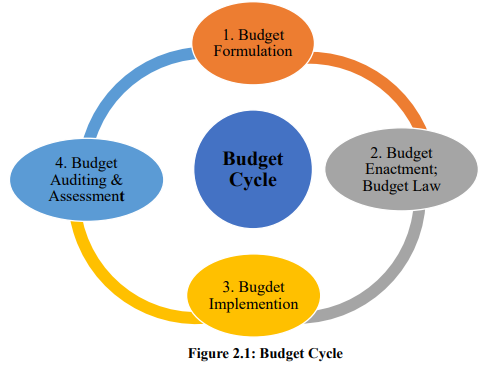
The Union of Budget Department (head office) estimates resource allocation for the union budget framework and calculates the amount the union provides for grants to states and regions using the MTFF method. This process is based on macroeconomic forecasts and fiscal policy objectives. Then, the Ministry of Planning and Finance issues the Budget Calendar to the line ministries at the union level and informs to the state and regional governments about the amount of the union government provides grants for regional governments. The budget cycle in Myanmar is divided into four stages as following; the budget planning and preparation stage; the budget formulation and approval stage; the budget implementation and execution stage; and the budget evaluation, reporting and auditing stage.
Empirical Literature Review
Decentralizing fiscal authority is an efficient policy tool that improves performance in constrained circumstances. The decentralization of spending must be accompanied by a corresponding decentralization of income to guarantee favorable results. Without these prerequisites, fiscal decentralization may result in decreased efficiency in public service delivery. [10]. Decentralization is a mechanism that strengthens the relationship among the state and the populace, hence necessitating the involvement of a subdivision and village levels in the crucial aspects of grassroots growth and delivery of services [11]. Fiscal decentralization correlates positively with economic growth and may act as a mechanism to promote sustainable economic growth.
It is proposed that factors such as overdependence on provincial governments, unclear functional and taxes responsibilities, and limited and inactive tax bases for the local and provincial governments may hinder the full benefits of decentralized fiscal administration [12]. Decentralization serves as a mechanism to attain state objectives, specifically enhancing public services and fostering a more responsive public decision-making process. Decentralization will be accomplished by empowering subordinate levels of government to allocate spending, collect taxes, form democratically elected regional leaders and councils, and facilitate payments by the governing body [13]. According to the study of asserts that fiscal decentralization enhances the potential for regional economic growth by enabling local governments to distribute their budgets more efficiently [14]. This efficiency is achievable because local governments possess greater knowledge of their areas' public goods requirements. The principal obstacles to economic growth include price inflation, the bureaucracy economy of scale, market dispersion, and corruption. Various measures can be implemented to overcome the principal obstacles to economic growth, namely the rate of inflation, the government, economics of scale, dispersion of markets, and corruption, particularly within the context of fiscal ecentralization. The functioning of regional governments can be enhanced efficiently, hence accelerating economic growth and streamlining licensing procedures. Regional guidelines and bureaucratic reforms can fulfill them. Secondly, economies of scale can be enhanced by optimizing certain regional economic sectors.
Attracting regional investment is essential for economic progress. Third, fiscal and monetary regulations might be prioritized to mitigate inflation. Subsequently, productivity must enhance, and price regulation must be robust. Fourth, to combat corruption, the tracking and oversight system must be robust to deter corrupt practices, and community engagement should also drive monitoring policy and spending decisions in the regions. Ultimately, fragmentation in the market can be mitigated by implementing standardized laws and policies throughout all regions. examine the impact of governmental expenditure on the economic growth of Kosovo [15]. The findings indicate a favorable correlation between government spending and economic development, while the two factors are not directly interdependent. The authors argue that the misallocation of public funds to non-growth-promoting initiatives has hindered the fulfillment of the original expenditure objectives in Kosovo. investigate the correlation between GDP expansion and government expenditure to ascertain the influence of government spending on output growth [16].
The results demonstrate an adverse and statistically important short-term lag in current expenditure for economic growth. The research indicates that delayed capital expenditure significantly enhances economic growth. Nonetheless, the findings failed to establish a persistent link between economic growth and government expenditure. assert that government expenditure positively and significantly influences economic growth [17]. evaluates the influence of government expenditure on Afghanistan's economic growth [18]. The findings indicate that government expenditure has a significant and detrimental correlation with Afghanistan's economic growth. Government expenditure can facilitate short-term economic growth. Increased government expenditure on profitable firms will enhance short-term GDP growth. Similarly, an increase for a long-term lucrative project can impact long-term economic growth [19]. In high-income nations, financial development is the principal driver of economic growth and sustainable development, with savings serving as the key resource for the financial sector [20]. Generally Spending by the government and Fiscal decentralization is still a crucial tool in the development process. It is essential to every economy's operation at practically every level of growth and development researchers reviewed many empirical and identified the problem.
Research Gap
Fiscal decentralization can impact economic growth in various ways. It may promote growth through increased government expenditure, but it can also lead to instability and negatively affect growth, particularly in developing countries. In these nations, local governments often struggle with management, budget allocation, and effective investment, leading to Changes. In Myanmar, fiscal decentralization began in 2011, aiming to enhance local governments' financial independence and improve expenditures, which should support economic growth and local development. However, there are few studies focusing on Myanmar's unique socio-economic and political context. Most existing research is broad or international, and the impact of fiscal decentralization on sectors like infrastructure, education, and health is often overlooked. This study aims to address these gaps by conducting extensive longitudinal research on the effects of fiscal decentralization in Myanmar and its impact on economic growth and sector-specific development.
Conceptual Framework
This study uses a conceptual framework to examine the relationship between economic growth (dependent variable) and independent variable: government expenditure, foreign direct investment (FDI), population, net exports, labor, and central/ decentralization. Economic growth is measured by GDP, a key indicator of national economic performance. The study draws on fiscal federalism theory, which explores the link between economic decentralization, public services, and social welfare. It considers two perspectives: the traditional Tiebout theory (1956) and newer theories by Musgrave (1959) and Oates (1972). The research investigates whether an increase in government expenditure leads to significant economic growth, using total government spending as the metric. Figure 2.2 illustrates the relationship between the independent and dependent variables.

Figure 2.2: Conceptual Framework
Research Methodology
Research Type and Design
According to research design is the methodical arrangement of parameters for gathering and analyzing data with the goal of balancing procedural efficiency with relevance. Furthermore, a research design is defined by as the structure, plan, or approach used to find answers to research questions. Through a unit of study and investigation, the study used a quantitative research design that makes it easier to gather all pertinent situational characteristics. After carefully collecting, presenting, and evaluating the data, the researcher came to certain conclusions and recommendations. Furthermore, as many researchers and academics have pointed out, quantitative panel data is considered more informative, more varied, less linear across variables, provides more degrees of freedom, and is therefore more efficient.
Data Collection and Procedures
The study only employed secondary data from different circumstances. A secondary data collection form was utilized to compile information from financial statements about expenditures, FDI, GDP, and the population as a whole in relation to GDP, among other variables. This information was then used to calculate pertinent ratios, descriptive statistics, and regression analysis. The Central Statistical Organization, the World Bank, the IMF, the Ministry of Planning and Finance, and the Ministry of International Foreign Economic Relations were the main sources of the secondary data.
Method of Data Analysis
In order to strengthen the models and lessen the cross-sectional effects of the intercepts, the study employed the fixed-effect regression technique. As per Brooks (2008), the fundamental types of fixed-effect models allow the regression model's intercept to fluctuate cross-sectional and also choose to employ fixed effects when T>N, meaning that there are twenty years more temporal dimensions than there are cross-sectional fifteen. Because the fixed-effects model takes into consideration all individual time-invariant variations, missing time-invariant features have no effect on the estimated value for the fixed-effects models. According to asserts that data analysis in research is the use of logic to understand the information gathered, with the aim of spotting recurring trends and summarizing relevant aspects discovered throughout the study. The obtained data was evaluated using a Fixed-Effect Regression model, and the results were produced using the econometrics program STATA 18.0. The selection of these software programs is based on their ability to make research analysis transparent and efficient. In order to analyze entity behavior over time, the study's dataset included pooled observations from panel data collected across a number of time periods. For central/decentral and descriptive statistics, the Fixed-Effect robust Regression technique was used to analyze and interpret the panel data.
Model Specification
The researcher examined government spending in Myanmar using the Fixed-Effect Regression model in addition to descriptive statistics. Many econometricians believe that the ability of the Fixed-Effect Econometric approach to identify the independent effects of a set of factors on the dependent variable is one of its main advantages. The regression technique is calculated for a thorough examination of the regional states.
lnGDPit = β0 + β1lnExpit + β2CDit+β3lnPOPit + β4lnFDIit +β5lnNEit+β6lnLBit+ εit
Where,
lnGDP is the observed natural logarithms growth domestic product of Myanmar i at year t,
ð?½0 is the constant term showing the value of GDP when all the coefficients of the independent variables are zero.
lnExp it is the natural logarithms government expenditure of Myanmar i at the time t,
CDit is the central /decentralization of an regional i at time t, lnPOPit is the natural logarithms population of Myanmar i at the time t, lnEit is the net export of Myanmar i at the time t,
lnLBit is the natural logarithms Labor of Myanmar i at the time t,
lnFDIit is the natural logarithms foreign direct investment of Myanmar i at the time t
βs are the partial effect of independent variables in period t.
ð??ð??ð?¡ is the error term of Myanmar i at time t.
Result and Discussion
Introduction
This chapter expounds at large on the findings, data analysis, results and discussions in line with the objectives of this study. The first descriptive analysis of both dependent and independent variables, second correlation analysis, third regression result and detail interpretations.
Descriptive Statistics
Descriptive statistics refers to the branch of statistics that focuses on summarizing and describing the features of a dataset. It provides a simple overview of the sample and the measures derived from the data without making inferences about the population from which the sample was drawn. Descriptive statistics are typically used to present quantitative descriptions in a manageable form.
|
|
(1) |
(2) |
(3) |
(4) |
(5) |
|
VARIABLES |
N |
mean |
sd |
min |
max |
|
lnGDP |
330 |
10.58 |
4.637 |
0 |
17.27 |
|
lnLB |
330 |
0.105 |
0.974 |
-2.591 |
1.329 |
|
lnPOP |
330 |
0.865 |
1.032 |
-1.871 |
5.288 |
|
CD |
330 |
0.500 |
0.501 |
0 |
1 |
|
lnFDI |
330 |
2.586 |
3.735 |
-2.847 |
15.25 |
|
lnEXP |
330 |
7.399 |
3.714 |
0 |
14.18 |
|
lnNE |
330 |
-2.113 |
3.152 |
-11.28 |
2.735 |
Table 4.1: Descriptive Statistics
Source: STATA 18.0 Results, 2025
The descriptive statistics for the dataset, covering 15 regions and 22 years with 130 observations, show significant variation in key economic variables. LNGDP (log of GDP) has a mean of 10.58, with a large standard deviation of 4.637, indicating considerable variation in GDP across regions. The minimum value of 0 suggests some regions have very low GDP, while the maximum value of 17.27 reflects regions with much higher GDP. The CD (centralization/decentralization) ratio has a mean of 0.5, with values ranging from 0 to 1, indicating varying levels of decentralization in the regions. LNFDI (log of foreign direct investment) has a mean of 2.586 and a high standard deviation of 3.735, showing significant variation in FDI levels, with some regions experiencing very low or negative foreign investments and others attracting large amounts. LNEXP (log of exports) has a mean of 8.213 and a standard deviation of 4.231, reflecting substantial export levels on average, though with significant variation, as indicated by the minimum value of 0 and the maximum value of 17.31. These results highlight the diversity in economic conditions and investments across regions in Myanmar.
Correlation Analysis
Correlation analysis is a statistical method used to assess the strength and direction of the linear relationship between two or more variables. There are several types of correlation analysis methods, but the most common one is Pearson's correlation coefficient, which measures the strength and direction of the linear relationship between two continuous variables. To make sure that the explanatory variables are correlated, a matrix of correlations is utilized. According to Brooks (2008) recommend that explanatory variables have a correlation coefficients above 0.8 since this indicates a multi-co linearity issue and degree of linear relationship between two variables is measured by their correlation. The following table 4.2 presents the correlation coefficient summery result as shown below.
|
|
LNGDP |
LNFDI |
LNPOP |
LN NE |
LN LB |
LNEXP |
|
LNGDP |
1 |
|
|
|
|
|
|
LNFDI |
0.79*** |
1 |
|
|
|
|
|
LNPOP |
0.31*** |
0.46*** |
1 |
|
|
|
|
LN NE |
0.67*** |
0.56*** |
0.18** |
1 |
|
|
|
LN LB |
0.26*** |
0.44*** |
0.99*** |
0.18** |
1 |
|
|
LNEXP |
0.17** |
0.04 |
-0.11 |
0.13* |
-0.11* |
1 |
Table 4.2: Correlation Result
Source: STATA 18.0 Results, 2025
A strong positive correlation with GDP tend to attract more Foreign Direct Investment (FDI), LNPOP, LNNE, LNLB, and LNEXP. This aligns with the economic theory that developed economies are more attractive to foreign investors. Positive relationship between a countries’s GDP and its government expenditures, the association. In other words, countries with higher GDP tend to have slightly higher government expenditures, but this is not a strong or definitive pattern. Foreign direct investment has positive correlation with LNPOP, LNNE, LNLB and LNEXP. Total population has positive correlation with LNNE LNLB and negative correlation with LNEXP. Net export has positive correlation with LNLB and LNEXP. Labor has positive correlation with LNEXP.
The Test of Endogeneity
The amount of LNGDP may be affected by many other factors, which have not been taken into account in this study. It implies that there may be an endogeneity problem. Therefore, this study employs the methods to eliminate the estimation bias caused by endogeneity. This study introduces the first-order lag term of the LNGDP and performs the dynamic General Moment Method (GMM) estimation. The result of the Arellano Bond test shows that the p-value is 0.000, which implies that the model in this study can be estimated by the GMM method. The result of the GMM estimation is presented by Model below in Table 4.3. The result indicates that expenditure has a significantly positive impact on economic growth in Myanmar. The estimation result indicate there is no endogeneity arises in this model.
|
|
(1) |
|
VARIABLES |
LNGDP(GMM) |
|
L.LNGDP |
0.0748*** |
|
(9.863) |
|
|
LNEXP |
0.392*** |
|
(8.079) |
|
|
LNFDI |
0.0542*** |
|
(5.227) |
|
|
CD |
4.022*** |
|
(10.90) |
|
|
LNPOP |
4.687*** |
|
(8.129) |
|
|
LNNE |
0.0383*** |
|
(4.549) |
|
|
LNLB |
-5.370*** |
|
(-29.15) |
|
|
Constant |
1.197*** |
|
(3.869) |
|
|
Observations |
298 |
|
Number of Regional |
15 |
Table 4.3: The Test of Endogeneity
Notes: z-statistics in parentheses *** p<0.01, ** p<0.05, * p<0.1
Source: STATA 18.0 Results, 2025
Robustness Check
Robust regression was employed in this study to address potential issues like heteroskedasticity and violations of normality in the error terms, providing more reliable coefficient estimates and standard errors. A robustness check was conducted to assess the stability and reliability of the results under different assumptions and models, ensuring the robustness of the conclusions.
The findings from both the robust regression model and the robustness checks confirmed that government expenditure (LNEXP) and decentralization (CD) have a statistically significant positive impact on economic growth.These results highlight the resilience of the conclusions, demonstrating the importance of fiscal policies and decentralization in promoting economic growth.
|
|
(1) |
(2) |
(3) |
(4) |
(5) |
(6) |
|
VARIABLES |
LNGDP FE Robust |
LNGDP 10th |
LNGDP 25th |
LNGDP 50th |
LNGDP 75th |
LNGDP 90th |
|
LNEXP |
0.393** |
0.462*** |
0.434*** |
0.389*** |
0.352*** |
0.327*** |
|
|
(2.568) |
(2.990) |
(3.799) |
(5.621) |
(4.488) |
(3.109) |
|
CD |
5.124*** |
5.632*** |
5.425*** |
5.094*** |
4.820*** |
4.640*** |
|
|
(5.367) |
(5.625) |
(7.328) |
(11.39) |
(9.490) |
(6.784) |
|
LNPOP |
4.420** |
0.817 |
2.288 |
4.636*** |
6.580*** |
7.854*** |
|
|
(2.810) |
(0.282) |
(1.072) |
(3.460) |
(4.453) |
(3.998) |
|
LNFDI |
0.0763** |
0.0755** |
0.0758*** |
0.0763*** |
0.0767*** |
0.0769*** |
|
|
(2.410) |
(2.113) |
(2.869) |
(4.795) |
(4.231) |
(3.151) |
|
LNNE |
-0.0350*** |
-0.152*** |
-0.104*** |
-0.0279 |
0.0353 |
0.0767** |
|
|
(-4.985) |
(-2.855) |
(-2.671) |
(-1.071) |
(1.287) |
(2.142) |
|
LNLB |
-4.330*** |
-1.273 |
-2.521 |
-4.513*** |
-6.162*** |
-7.244*** |
|
|
(-3.332) |
(-0.557) |
(-1.498) |
(-4.248) |
(-5.282) |
(-4.678) |
|
Constant |
1.215** |
|
|
|
|
|
|
|
(2.739) |
|
|
|
|
|
|
Observations |
330 |
330 |
330 |
330 |
330 |
330 |
|
R-squared |
0.986 |
|
|
|
|
|
|
Number of Regional ID |
15 |
|
|
|
|
|
Table 4.4: Robustness Check
Robust t-statistics in parentheses
*** p<0.01, ** p<0.05, * p<0.1
Source: STATA 18.0 Results, 2025
The robust t-statistics in parentheses confirm the significance of the coefficients even after correcting for heteroskedasticity, while the use of quantile regression offers a deeper understanding of how independent variables impact LNGDP across different quantiles (10th, 25th, 50th, 75th, and 90th). This method captures the heterogeneity in the data, revealing varying effects at different GDP levels. The model includes decentralization as a key variable, reflecting the impact of fiscal decentralization on economic growth. Increased local autonomy in fiscal policies can lead to more targeted public investments, improved tax policies, and better alignment with local needs, suggesting that effective decentralization can positively contribute to economic growth, provided local governments have the capacity for efficient service delivery.
Findings and Interpretation of the Regression Model
The analysis of the fixed-effects model reveals a statistically positive relationship between the natural logarithms of expenditure, central/decentralization, population, and foreign direct investment with the natural logarithm of economic growth (LNGDP) across different regional states in Myanmar. The model's R-squared value of 98.6% indicates an exceptionally high level of explanatory power, suggesting that the model effectively captures the variance in economic growth. This strong fit validates the model, highlighting the significant role of both centralized and decentralized fiscal policies in driving economic growth. The findings align with the theoretical understanding that fiscal decentralization, tailored to the development level and institutional capacity of regional governments, can positively contribute to economic growth.
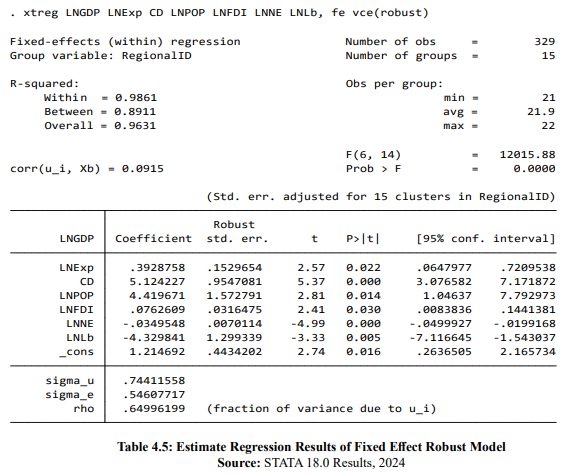
Interpretation of Fixed-Effects Robust Model Result
The study's fixed-effects regression analysis reveals significant insights into the relationship between government expenditure, fiscal decentralization, and economic growth in Myanmar. The results show that government expenditure (LNEXP) has a positive and statistically significant impact on GDP (LNGDP), with a 1% increase in expenditure associated with a 0.3929% increase in GDP. This highlights the importance of public investment in infrastructure, education, and technology, which can enhance productivity and stimulate economic growth. Similarly, fiscal decentralization (CD) shows a strong positive relationship with GDP, with a 1-unit increase in decentralization associated with a 5.1242 increase in GDP. This suggests that better governance, which decentralization can promote, leads to improved economic outcomes. The study also finds that population size (LNPOP) plays a significant role in boosting GDP. A 1% increase in population is linked to a 4.4197% rise in economic output, suggesting that a larger labor force and consumer demand contribute to higher growth. Foreign direct investment (LNFDI) similarly shows a positive relationship with GDP, where a 1% increase in FDI is associated with a 0.0763% increase in GDP. FDI contributes capital, technology, and access to new markets, which can enhance productivity and growth. However, the analysis also reveals negative relationships. Net exports (LNNE) show a negative impact on GDP, with a 1% increase in net exports leading to a 0.03495% decrease in GDP, potentially due to trade deficits or inefficient trade policies. Labor (LNLB) also demonstrates a negative relationship, with a 1% increase in labor associated with a 4.3298% decrease in GDP, which may reflect inefficiencies in the labor market. Overall, the findings emphasize the importance of fiscal policies, decentralization, and strategic investments in foreign capital, while addressing labor market inefficiencies, to foster sustained economic growth in Myanmar.
Conclusion
This study investigates the impact of government expenditures and fiscal decentralization on local government economic growth in Myanmar, using panel data from 2000 to 2021. The analysis utilized robust fixed effect and quantile regression models to examine the relationship between economic growth and various factors such as government expenditure, foreign direct investment, centralization/decentralization (CD), population, net exports, and labor. Descriptive statistics revealed significant variability across regions, with notable differences in economic indicators like GDP, FDI, and government spending, reflecting diverse regional economic conditions and development stages. The findings from the regression analysis indicate that government expenditure, decentralization (CD), population, and foreign direct investment have a positive and statistically significant relationship with economic growth. In particular, government spending in sectors like infrastructure, education, and technology, as well as decentralized governance structures, help stimulate productivity and demand, thus boosting GDP growth. A larger population contributes to economic growth by providing a bigger labor force and consumer base. FDI positively impacts the economy by facilitating capital influx, technology transfer, and market access. Conversely, net exports and labor showed a negative relationship with economic growth, suggesting that Myanmar’s trade policies and labor market conditions may need further improvement.
Overall, the study emphasizes that fiscal policies, decentralization, and targeted investments in infrastructure and human capital are essential for Myanmar's economic development. The results suggest that decentralization of fiscal responsibilities can enhance local governance and contribute positively to economic outcomes. Future policy and research should focus on refining these strategies, addressing challenges such as trade inefficiencies and labor market issues, and ensuring that economic policies are adaptable to the diverse needs of Myanmar’s regions. This study provides strong evidence for the critical role of fiscal decentralization and public expenditure in fostering sustainable economic growth in Myanmar.
Declaration Statement
Institutional Review Board Statement: Not applicable.
Informed Consent Statement: Not applicable.
Data Availability Statement: World Bank, IMF and Myanmar Planning Budget and Finance
References
- Vtyurina, S. (2020). Effectiveness and Equity in Social Spending-The Case of Spain. International Monetary Fund.
- Farooq, F., Zaib, A., Faheem, M., & Gardezi, M. A. (2023). Public debt and environment degradation in OIC countries: the moderating role of institutional quality. Environmental Science and Pollution Research, 30(19), 55354-55371.
- Rodríguez-Pose, A., & Ezcurra, R. (2011). Is fiscal decentralization harmful for economic growth? Evidence from the OECD countries. Journal of Economic Geography, 11(4), 619-643.
- Minoletti, P. (2016). Fiscal decentralisation and national reconciliation in Myanmar: Key issues and avenues for reform. International Growth Center.
- Dick-Sagoe, C. (2020). Decentralization for improving the provision of public services in developing countries: A critical review. Cogent Economics & Finance, 8(1), 1804036.
- Bahl, R., & Johannes, L. (1994). Fiscal decentralization and intergovernmental transfers in less developed countries. Publius: The Journal of Federalism, 24(1), 1-20.
- Musgrave, R. A. (1959). The Theory of Public Finance: A Study in Public Economy.
- Oates, W. E. (1969). The effects of property taxes and local public spending on property values: An empirical study of tax capitalization and the Tiebout hypothesis. Journal of political economy, 77(6), 957-971.
- Rodríguez-Pose, A. (2008). Decentralisation and local and regional development.
- Mouss, S., et al. (2018). Fiscal decentralisation and the efficiency of public service delivery, Fiscal Decentralization and Inclusive Growth OECD, KIPF.
- Efriandi, T. (2021). Decentralization and the challenges of local governance in Indonesia: Four case studies on public service provision and democratization in Papua and West Papua.
- Arshad, Muhammad. (2010). Fiscal Decentralization and Economic Growth in Pakistan: An ARDL Approach, KDI School of Public Policy and Management Google Search.
- Martínez-Vázquez, J., Lago-Peñas, S., & Sacchi, A. (2017). The impact of fiscal decentralization: A survey. Journal of Economic Surveys, 31(4), 1095-1129.
- Suprianik, S. (2023). Analysis of The Impact of Fiscal Decentralization on Economic Growth in Indonesia. AL-MANHAJ: Jurnal Hukum dan Pranata Sosial Islam, 5(1), 433-442.
- Balaj, D., & Lani, L. (2017). The impact of public expenditure on economic growth of Kosovo. Acta Universitatis Danubius. Œconomica, 13(5).
- Okoye, L. U., Omankhanlen, A. E., Okoh, J. I., Urhie, E., & Ahmed, A. (2019). Government expenditure and economic growth: The case of Nigeria. Proceedings of SOCIOINT,1184-1194.
- Mishra, B. R., & Mohanty, A. R. (2021). Nexus between government expenditure and economic growth: Evidence from sub-national governments in India. The Journal of Developing Areas, 55(2).
- Barlas, A. W. (2020). The impact of government expenditure on economic growth in Afghanistan. Journal of Economics and Business, 3(2).
- Poku, K., Opoku, E., & Agyeiwaa Ennin, P. (2022). The influence of government expenditure on economic growth in Ghana: An Ardl approach. Cogent Economics & Finance, 10(1), 2160036,.
- Ikhsan, A., & Satrianto, A. (2023). The effect of financial development on economic growth in high-income countries. Asian Economic and Financial Review, 13(3), 202-215.