

Current Trends in Business Management(CTBM)
ISSN: 2995-4010 | DOI: 10.33140/CTBM



Research Article - (2024) Volume 2, Issue 1
The Impact of Covid-19 on the Growth of Small and Medium-Scale Businesses in the Ga Central Municipality
Received Date: Dec 19, 2023 / Accepted Date: Jan 16, 2024 / Published Date: Feb 12, 2024
Copyright: ©©2024 Kingsley S. Agomor, et al. This is an open-access article distributed under the terms of the Creative Commons Attribution License, which permits unrestricted use, distribution, and reproduction in any medium, provided the original author and source are credited.
Citation: Agomar, K. S., Gamlan, C., Agomor, P. (2024). The Impact of Covid-19 on the Growth of Small and Medium-Scale Businesses in the Ga Central Municipality. Curr Trends Business Mgmt. 2(1), 1-13.
Abstract
The general aim of the research was to assess the effect of Covid-19 on the growth of small and medium-scale businesses in the Ga Central Municipality of the Greater Accra Region of Ghana. The study adopted a descriptive quantitative research approach. The study used a sample 92 SMB owners and managers from the Ga Central Municipality. Questionnaire was the main data collection tool, analyzed with SPSS version 22 and presented in frequencies, percentages, mean, standard deviation, correlation, regression, and one-sample t-test. The findings indicate that Covid-19 negatively affected the sales (income), profit margin, and market share of small and medium-scale businesses in the Ga Central Municipality. The study concludes with the following recommendations; business owners and managers must deploy adequate strategic management skills; adopt innovative methods to be able to withstand outbreaks of a pandemic; use appropriate modern technology (adopt online marketing) and the government must provide adequate financial support and incentives to SMBs.
Keywords
Covid-19, Growth, Small and Medium-Scale Business.
Introduction
The Covid-19 pandemic brought a number of challenges that had never been experienced before worldwide. First and foremost, it endangered millions of people around the globe. As of the end of June 2021, it had claimed the lives of roughly four million people around the world. Paradoxically, the service industries were hit the hardest by the social distancing guidelines implemented to contain the virus, as this is an industry in which proximity matters most, and which is operated by more on small and medium-scale businesses than the big or larger firms. The second point is that in both Europe and the United States, small and medium-scale businesses were hit harder by Covid-19 than their larger counterparts were. This was true for both types of establishments when compared to their larger counterparts.
Similarly, the COVID-19 epidemic had had a devastating impact on virtually every aspect of human life, including Ghanaian businesses (Ghana Statistical Service Survey, 2020, Agomor and Agomor, 2023) [1]. A significant amount of money had been lost due to the pandemic. Also, Ghana's GDP growth had slowed dramatically, the revised GDP growth forecast for 2020 was only 1.9%, down from an earlier estimate of 6.8%. Companies of all sizes in the private sector, from the smallest to the largest, particularly those operating in the restaurant, hotel, education, manufacturing, and agricultural felt the impact. Government public finance was likewise stressed, with an estimated deficit of 11.4% in 2020 (up from the deficit target of 4.7% of GDP) (Ministry of Finance, 2020).
Small and large enterprises alike felt the effects of the Covid-19 pandemic. NBER reported that 43% of small enterprises in the United States planned to shut down by December 2020 based on a survey of more than 5,800 small businesses. Most of the damage was done to locally owned businesses in the restaurant and retail sectors as well as those providing personal services, travel, and the arts. Connected Commerce Council's (2020) survey of over 5016 European SMEs showed that virtually all SMEs were affected, with revenues dropping by an average of 20% and client bases shrinking by 16%. According to a report compiled by the World Economic Forum in 2021, the International Labour Organization (ILO) predicted that due to the global pandemic, 93 percent of the world's employees were subjected to some form of workplace restrictions and that 8.8 percent of global working time was lost in 2020 compared to the fourth quarter of 2019; this was the equivalent of 255 million full-time jobs. In Ghana, for instance, over 770,000 employees had their incomes reduced, over 700,000 workers saw their hours cut back, and appointments of over 42,000 workers were terminated as a direct result of the economic shock caused by the COVID-19 outbreak. Ninety percent (90%) of all these firms in Ghana were classified as small medium-scale businesses, and they accounted for over 70% of the country's gross domestic product (Innovations for Poverty Action, 2020).
As a result of the Covid-19 shocks, many businesses were obliged to cut expenses by decreasing staff hours, lowering pay, and even laying off employees. In addition, some companies are modified their business strategies to rely increasingly on digital solutions such as the use of mobile money and online commerce. Also, self-employed people were hit more by COVID-19 than those who worked for someone else, and small-scale enterprises were hit harder than large ones. The Ghana Statistical Service 2020 Survey found that 35.7% of businesses were forced to shut down during the partial lockdown, with 16.1% remaining closed after the easing of the lockdown. The hospitality and food service industries were hit the most (24.0 percent had to close down). The Ga Central Municipal is home to the majority of impacted enterprises. Therefore, this research assessed the economic impact of the Covid-19 on the growth of small and medium-scale businesses in the Ga Central Municipality over the period. The study is relevant because the findings could assist small and medium-scale business (SMB) owners, managers, and the government to develop alternative strategies to improve their growth and productivity after the crisis.
Theoretical Literature Review
According to the Contingency Theory, companies may maintain competitiveness, growth performance, and sustainability by continuously matching strategies that correlate with the external environment and uncertainties. One of the most important theoretical perspectives on businesses is the Contingency Theory. Organizational effectiveness, according to the duality of the Contingency Theory, arises from the contextually appropriate adjustment of organizational components including structure and circumstances. Because the right strategic choices lead to improved outcomes, the company is eager to verify that its current strategy is a good match. There would be a wide range in the strength of any given correlation between an independent variable and a dependent variable due to contextual factors including firm age and size, technology and capital intensity, unionization levels, business sector, ownership structure, and geographical location.
For the most part, the contingency theory focuses on how an organization's processes, procedures, and practices must be tailored to the organization's specific needs while also ensuring that the organization's size, structure, personnel composition, and external environment all "fit" together optimally. Any organization may benefit from the perspective of Contingency Theory, which presents a strategy for dealing with difficult situations and possibilities. The Contingency Theory, proposes that here are no commonly accepted guidelines for managing human resources. One might say it is the antithesis of universalist thought. Because of this, managers are obligated to act in response to both internal and external environmental forces. The Contingency Theory's underlying concept is the complex relationship that occurs between change and permanence, which is a blend of both.
According to, exposing private sector employees to COVID-19 at work has a significant negative impact on their health and businesses. Covid-19 was present at the workplace of a large number of people worldwide. COVID-19 exposure had the greatest impact on employees in low-income nations like Ghana, Nigeria, Vietnam, and Haiti. Companies are urged to minimize misalignment caused by contingency improvements by adopting new organizational features suitable for higher contingency levels. Therefore, the organization undergo a transformation as a consequence of the requirement to alter its contingency plans in order to avoid losses in production. To this end, the theory of contingencies incorporates the idea of fit, which impacts performance and motivates adaptive change efforts and long¬term company success. Therefore, the most innovative problem-solving culture and interdependence that directly affects the availability of new products that satisfy the requirements of consumers, stakeholders, the general public, and the economic, social, and environmental sectors would be the adoption of a contingency approach to support the sustainable growth of small and medium-sized businesses.
Empirical Literature Review
According to a survey in Germany, although 88% of German SMEs functioned with required in-person labour before the start of the crisis, 81% anticipated the pandemic to make their firms more flexible, and one-third of SMEs believe digitization had gained significance as a result of the pandemic. Georgian Chamber of Commerce and Industry conducted a survey on firms in Georgia faced several obstacles, including lower sales (53 percent), currency rates (13 percent), and transportation issues (13 percent) (2020). The revenue of the hotel and food service industries had decreased as a result of lower demand and supply chain disruptions [2]. According to a poll conducted by the Georgian Chamber of Commerce and Industry, 66% of Georgian businesses lost money in the previous six months, and 76% of businesses saw a decrease in sales (GCCI, 2020). However, 53 percent of the businesses polled intended to keep their employees for the next six months, while 43 percent had reduced their pay packages. Only 3% of businesses believed they did not require assistance; financial assistance and extended credit, as well as reduced taxes or interim annulment, were viewed as solutions by businesses (GCCI, 2020). Furthermore, a survey by the US Chamber of Commerce revealed an acceleration in digitalization trends. Between April and May, the number of small firms that had started moving part or all of their staff to remote work went from 12 percent to 20 percent, while the number of small businesses that have started moving their retail operations online rose from 10 percent to 17 percent. Forthcoming.
According to a study done by Verizon in the United States at the end of May, small company owners were seeking further guidance and resources to help them recover from the epidemic. Small firms recognized financial (54%), e-commerce (42%), and human resources (40%) competence as necessary for recovery. It is common knowledge that a well-run retail store employs a large number of people. As a result of this trend, human resource management in retail firms is becoming increasingly important. A survey taken among Canadian small businesses by Portes, (2020) found that 44% were experiencing difficulties related to technology and technical support. This included issues with digital marketing (19%), e-commerce (13%), and other online offerings (17%). When asked what they needed most, small businesses cited assistance with workplace and customer safety (32%), money (28%), marketing assistance (19%), redirecting their business (18%), community and networking (14%), and workspace facilities including furniture and goods (11%). Among the 26% of business owners with online operations, 30% had experienced an increase in sales and 25% have seen a decline compared to pre-COVID-19 levels, according to a survey done by the Canadian Federation of Independent Company (CIBC) on May 4th. Some surveys also collected information on respondents' use of teleworking and digital sales channels.
According to a recent Japanese survey, the incidence of teleworking varies according to the size of the company (48 percent for large corporations versus 10-20 percent by the SMEs). A lack of infrastructure and worker abilities to use digital technologies were given as explanations. In Korea, the Bank of Korea's business confidence indicator increased for the second month in a row in June, with mood increasing more for small and medium-sized businesses than for bigger organisations. In China, it was discovered that COVID-19 made it difficult for small and medium-sized firms (SMEs) to exist. SMEs' development challenges led to low employment and GDP growth in a number of nations. On this premise, this work employed a structural equation model (SEM) to investigate the determinants impacting SMEs during the pandemic in Beijing, China. The survey administered two hundred and thirty-four (234) valid questionnaires to SMEs in various industries in Beijing with the assistance of the Federation of Industry and Commerce and the Chamber of Commerce in Beijing, following extensive desk research and interviews with relevant businesspeople. The data depicted the link between cash flow from financing operations, markets, workers, expenses, government regulations, and the pandemic's impact.
Oyewale, Adebayo, & Kehinde, pinned that most Nigerian business owners had suffered losses due to the COVID-19 because of lockouts and restrictions on movement. The findings also indicated that the COVID-19 pandemic caused a drop in investment levels and made it harder to import and export goods and services because of the total closure of all trade routes (road, water, rail, and air). Aladejebi, investigated the survival of SMEs during the Covid-19 using questionnaire on a population of sixty (60) SME owners in Aspanda/Alaba, Surulere, Lagos Island, Ikeja, Ikoyi/Victoria Island, and Yaba. It was found that the Covid-19 pandemic had reduced income and employee pay, and the government was doing little to mitigate the situation. SME loan, rent, and salary payments were challenging. Covid-19 had an effect on firm cash flow, compliance deadlines, home-based employees, people working overseas due to travel restrictions, directors' ability to attend board meetings, and supply chain delays. Dane, Akyuz, & Opusunju, investigated the impact of Covid-19 on the growth of small businesses in Nigeria. According to the findings, Covid-19 had a negative and minimal effect on small businesses in Abuja, FCT. Several small enterprises closed and individuals lost their jobs as a result of the Covid-19. Small business owners in Abuja, Nigeria, had also been hit by the Covid-19 outbreak. This had disrupted and weakened the social order of economic engagement, which had harmed small enterprises leading to sales declines, high product prices, and restrictions on foreign products imports which affected local product sales. Thus, the Covid-19 harmed small businesses in Abuja, FCT. Nwokocha (2021) examined the effects of strategic interfirm alliances on small-scale industries (SSI) in Nsukka, Nigeria and found that 15.47%, 22.45%, and 44.2% of respondents experienced relative, rising, and significant Covid-19 operating difficulties, respectively. The study contended that SSIs in Nigeria could adopt/institutionalize strategic interfirm partnerships to deal with the Covid-19 related challenges that had disrupted their production flow. Businesses must learn from corrective actions and apply them to enhance work designs and organizational performance, or the Covid-19 changes would be quickly forgotten once normalcy was restored.
According to In South Africa, Amoussou, Karagueuzian, and Bah, SMEs accounted for 90% of enterprises and 80% of employment in African economies and COVID-19 posed the greatest threat to wholesale and retail commerce, car and motorcycle repair, manufacturing, real estate, business and administrative activities, and housing and food services. This is mostly due to the impact on working hours and income of non-essential firm closures, social distancing limitations, global supply chain delays, and cancelled orders. Albonico, Mladenov, & Sharma, in South Africa, SMEs accounted for 98% of enterprises, employed 50-60% of the workforce, and contributed to a quarter of private sector job growth. Prior to Covid-19, small enterprises faced significant obstacles. A sluggish economy and several credit downgrades had harmed SMEs year after year, and the coronavirus might exacerbate these trends. McKinsey Consumer Pulse Survey at the end of March 2020, 80% of respondents intended to cut retail spending and 70% wanted to minimize transit and travel expenditures and business disruptions represent a drop in SMEs' revenue and profitability. Mkhonza and Sifolo studied the business performance of SMMEs in Johannesburg during Covid-19 (CBD). An online survey was completed on 169 SMME owners and managers in Johannesburg CBD. During the shutdown, several SMMEs ran out of money due to a shortage of funds, 95% of Gauteng SMMEs were unable to pay their staff. Other income sources were unavailable to 93% of SMMEs, and 71% had run out of cash and 87% of small businesses could operate from home, hurting deliveries, customer inquiries, and loyalty. The majority of SMME owners employed strategies to improve performance. When SMMEs formalize their strategic planning and leverage technology, they perform better. These are one-time outcomes; longitudinal study could illustrate how strategic planning affects SMME success.
Addo, Jiaming, Kulbo, & Liangqiang, conducted a time series assessment of previous pandemics on rates of return and discovered that pandemics reduce real rates of interest on capital [3]. The employee-employer relationship mandates, that when an employee works for an employer, they must contribute to the firm’s profitability and get a salary. The COVID-19 outbreak had resulted in a domestic income loss of $1 billion for Ghana by the middle of 2020 as a consequence of decreased output, service delivery, and taxes. Concern for labor productivity is shared by public and private sector organizations. Due to the restrictions on non-essential industrial activities, the loss of domestic supply and revenue was 84% on average [4]. Decision-making, which is a crucial role of employers is challenged at times of crisis which function as a change catalyst for the business [4]. Despite the limits of learning management systems, there is still a service workload for education and health companies to consider as health industry was under a lot of pressure to address the backlog of services caused by the crisis and employers were challenged to establish staffing plans that could safeguard the well-being of employees while also satisfying the demands of health centers in light of evidence showing a high incidence of mental health disorders (e.g., depression, anxiety, and sleeplessness) and stress among health professionals [5].
Methodology
The study employs both descriptive and explanatory approaches [6]. The purpose of descriptive research is to offer a better understanding of the relationship that exists between variables and it is also to expose perfect information about individuals, conditions, or situations [7]. Explanatory research elaborates more on descriptive research, and it aims at helping the researcher to determine a causal relationship between variables. A quantitative research approach will be used in this study to investigate the causal relationship between the economic effects of Covid-19 on small scale businesses in the Ga Central Municipality of the Greater Accra Region of Ghana. Secondly, there is the quantitative research design focused on gathering numerical data and generalizing it across groups of people or to explain a particular phenomenon [8-11].
The study was performed in the Ga Central Municipality of the Greater Accra Region. The target population for the study consists of small and medium-scale business owners and managers in the Municipality. There are basically, two types of sampling which are probability and non-probability sampling. The study adopted simple random sampling, a variant of the probability sampling technique. This was used because selection is random and allowed for the estimation of sample errors and may not be biased. The rationale behind the probability sampling method (random sampling) is to give every owner and managers the equal opportunity to taking part in the study.
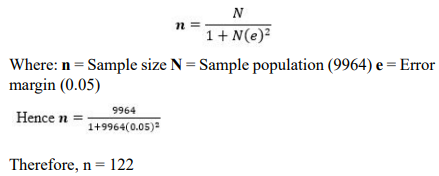
The sample size for the study comprised 122 small and medium-scale business owners and managers from the Ga Central Municipality. The researcher used simple random sampling to select 122 respondents out of the total population of 9964 with a ninety-eight percent (98%) confidence interval with a margin of error of five percent (0.05) and a population proportion of ninety-four percent (94%). The sample size was enough to carry out the study and analyze the data and be trustworthy of the target population of the study. This was justified by the observation of Mugenda and Mugenda (2009) who state that 50% proportion of the total population is adequate to carry out research.
The study data were from primary and secondary sources. The primary data for the study were drawn from the answers given by our respondents to the questions on the questionnaires which were administered to all the eligible 122 respondents. The secondary data were drawn from books, journals articles, newspapers, and reports among others. The study relied on both primary and secondary data to conduct a comprehensive analysis of the economic effect of Covid 19 on small scale businesses in the Ga Central Municipality of the Greater Accra Region of Ghana. The research data was collected from the respondent using questionnaires. The questionnaire comprised closed-ended questions to explored the determinants of economic effects of the Covid-19 on small and medium-scale businesses in the Ga Central Municipality of the Greater Accra Region of Ghana. To avoid redundant or wrong data, the raw data was cross-checked for any type of inaccuracy. The cleansed data coded into Microsoft Excel and then imported into the Statistical Program for Social Sciences (SPSS). The data in the SPSS format was then processed for interpretation. The data were analyzed and presented in descriptive statistics (mean and standard deviation, correlation analysis, regression analysis and one-sample t-test) form.
Findings And Discussion
Under this section analysis was done based on the three scaled objectives of the research. This analysis strictly followed descriptive statistics and deployed mean (x), standard deviation (s), bivariate correlation analysis, regression analysis and one sample T-test to test the null hypothesis. Below is the analysis.
Findings
Demographic Data: The sample data in Table 1 on the gender of respondents indicates that 40 are male, representing 43.5% whiles, whiles, 52 are female representing 56.5%. Data on the ages of respondents show that only 1 respondent (1.1%) was 19 or less, 35.9% were between 20-29 years, 41.3% were between 30-39 years, 10.9% were between 40-49 years, 10.9% were between 50-59 years and none of the respondents were 60 and above. This shows that most of the respondents were within the age range of 20-59 years. Sample data on the education level of respondents showed that not all the respondents were educated as 3 of the respondents representing 3.3%, 5 of the respondents representing 5.7% had basic education, 12 of the respondents representing 13.0 % had second cycle education, 10 indicating 10.9% attain a Diploma or HND, 55 representing 59.8% were bachelor’s degree holders, while 7 of the respondents 7.6% indicated that they had attained postgraduate education. This shows that over 85% of the respondents were highly educated.
In addition, the sample data shows that all the respondents (100%) were owner and managers of small and medium-scale businesses in the Municipality. In terms of the number of years of business operations, sample response shows that 18 (19.6%) were in operation for less than 1-year, 23 representing (25.0%) had operated between 1-5 years, 26 (28.3%) were in operation for 5-10 years, while 25 of the respondents (27.2%) were in operation over 10 years in the Municipality. This shows that over 75% of the small and medium-scale businesses sampled had been in operation for more than a year.
|
|
|
Frequency |
Percent |
|
Gender |
Female |
52 |
56.5 |
|
Male |
40 |
43.5 |
|
|
Total |
92 |
100.0 |
|
|
Age Group |
19 or less |
1 |
1.11 |
|
20â??29 |
33 |
35.9 |
|
|
30â??39 |
38 |
41.3 |
|
|
40â??49 |
10 |
10.9 |
|
|
50-59 |
10 |
10.9 |
|
|
Total |
92 |
100.0 |
|
|
Level of education |
None |
3 |
3.3 |
|
Basic |
5 |
5.7 |
|
|
Second Cycle |
12 |
13.0 |
|
|
Diploma/ HND |
10 |
10.9 |
|
|
Bachelor’s Degree |
55 |
59.8 |
|
|
Postgraduate |
7 |
7.6 |
|
|
Total |
92 |
100.0 |
|
|
Owner/Manager of SMBs |
No |
0 |
0 |
|
Yes |
92 |
100.0 |
|
|
Total |
92 |
100.0 |
|
|
Years of Business Operations |
Less than 1-year |
18 |
19.6 |
|
1-5 years |
23 |
25.0 |
|
|
5-10 years |
26 |
28.3 |
|
|
Over 10 years |
25 |
27.2 |
|
|
Total |
92 |
100.0 |
Table 1: Demographic and Professional Data.
Source: Author’s Field Survey, 2022
Covid-19 and Growth of Small and Medium Businesses: The descriptive statistics in Table 2 (below) include the frequencies, percentages, mean (x) and standard deviation (s) of the variables measured. In the first statement, the values of the mean and standard deviation of (x= 3.297, s = 1.479) indicate that the majority of the respondents agree that COV1 is an appropriate measure of Covid-19 effects on the growth of small and medium-scale businesses and the rate of dispersion of COV1 from the mean is not too significant. The mean and standard deviation of the second Covid effect statement (COV2) are (x=3.728, s= 1.187) which indicated that the majority of the respondents also agree that COV2 is a good measure of the Covid-19 effects on the growth of small and medium-scale businesses and the dispersion level of COV2 from the mean is significant. The mean and SD of the third statement (COV3) are (x = 4.413, s = 1.071); hence, more than half of the respondents further agree that COV3 is also good for measuring the effect of Covid-19 on the growth of small and medium businesses and the dispersion level of COV3 from the mean is significant. The COV4 mean and standard deviation values of (x= 3.935, s= 1.187) indicate that the majority of the respondents agree that COV4 is a fairly appropriate measure of Covid-19 effects on the growth of small and medium-scale businesses and the dispersion level of COV4 from the mean is to some extent significant. The COV5 mean and standard deviation values of (x= 3.772, s = 1.9302) indicate that the majority of the respondents agree that COV5 is an appropriate measure of the effects of Covid-19 on the growth of small and medium-scale businesses and the dispersion level of COV5 from the mean is very significant. Finally, (x = 4.087, s= 1.055) showed that most of the respondents agree that COV6 is an appropriate measure of Covid-19 effects on the growth of small and medium businesses and the level of deviation of COV6 from the mean is significant.
|
Statement |
|
||||||||
|
|
SD (1) |
D (2) |
N (4) |
A (6) |
SA (7) |
Total |
Mean (x)¯ |
Std.D |
|
|
Covid-19 and Growth of Small and Medium Businesses |
|||||||||
|
COV1: Covid-19 lead high cost of operating small and medium business |
F |
13 |
10 |
15 |
33 |
20 |
92 |
3.297 |
1.479 |
|
% |
14.0 |
11.1 |
16.3 |
35.9 |
21.7 |
100 |
|||
|
COV2: Experience business failure in one way or another, since the outbreak of small and medium business |
F |
4 |
6 |
20 |
37 |
25 |
92 |
3.728 |
1.187 |
|
% |
4.5 |
6.5 |
21.7 |
40.2 |
27.2 |
100 |
|||
|
COV3: Covid-19 causes high inflation affect the growth your business |
F |
5 |
0 |
11 |
12 |
64 |
92 |
4.413 |
1.071 |
|
% |
5.4 |
0 |
12.0 |
13.0 |
69.6 |
100 |
|||
|
COV4: Covid-19 affect foreign exchange rate which affect your business |
F |
5 |
2 |
18 |
34 |
33 |
92 |
3.935 |
1.187 |
|
% |
5.5 |
2.2 |
19.6 |
37.0 |
35.9 |
100 |
|||
|
COV5: Covid-19 interferes with your ability to provide the necessary resources for your business |
F |
6 |
7 |
12 |
37 |
30 |
92 |
3.772 |
1.302 |
|
% |
6.5 |
7.6 |
13.0 |
40.2 |
32.6 |
100 |
|||
|
COV6: Covid-19 results in unfavorable policy interventions which affect your business |
F |
2 |
4 |
11 |
38 |
37 |
92 |
4.087 |
1.055 |
|
% |
2.2 |
4.5 |
12.0 |
41.3 |
40.2 |
100 |
|||
|
Overall mean |
|
|
|
|
|
|
|
|
|
Table 2: Summary of Responses to Covid-19 and Growth of Small and Medium Businesses.
Source: Author’s Field Survey, 2022
Effect of Covid-19 and Growth of Small and Medium Businesses: The descriptive statistics Table 3 (below) include the frequencies, percentages, mean (x) and standard deviation (s) of the variables that were measured. In the first statement, the values of the mean and standard deviation of (x= 4.207, s = 0.884) indicate that the majority of the respondents agree that COV7 is an appropriate measure of Covid-19 effects on the growth of small and medium-scale businesses and the rate of dispersion of COV7 from the mean is not too significant. The mean and standard deviation of the second Covid effect statement (COV8) are (x=4.141, s= 0.897) which indicated that the majority of the respondents also agree that COV8 is a good measure of Covid-19 effects on the growth of small and medium-scale businesses and the dispersion level of COV8 from the mean is significant. The mean and SD of the third statement (COV9) are (x = 4.293, s = 0.764), hence, more than half of the respondents further agree that COV9 is also good for measuring the effect of Covid-19 on the growth of small and medium businesses and the dispersion level of COV9 from the mean is not quite significant. The COV10 mean and standard deviation values of (x= 4.228, s= 0.891) indicate that the majority of the respondents agree that COV10 is a fairly appropriate measure of Covid-19 effects on the growth of small and medium-scale businesses and the dispersion level of COV10 from the mean is to some extent not that significant. The COV11 mean and standard deviation values of (x= 4.054, s = 0.918) indicate that the majority of the respondents agree that COV1 is an appropriate measure of the effects of Covid-19 on the growth of small and medium-scale businesses and the dispersion level of COV5 from the mean is somehow significant. Finally, (x = 4.163, s= 0893) showed that most of the respondents agree that COV12 is an appropriate measure of Covid-19 effects on the growth of small and medium-scale businesses and the level of deviation of COV6 from the mean is significant.
|
Statement |
|
||||||||
|
|
SD (1) |
D (2) |
N (4) |
A (6) |
SA (7) |
Total |
Mean (x¯) |
Std.D |
|
|
Covid-19 and Growth of Small and Medium Businesses |
|||||||||
|
COV7: Covid-19 pose difficulties in assessing loans from banks for small and medium business |
F |
1 |
2 |
10 |
41 |
38 |
92 |
4.207 |
0.884 |
|
% |
1.1 |
2.2 |
10.9 |
44.6 |
41.3 |
100 |
|||
|
COV8: Covid-19 affect your availability of strategic plan to achieve goals and missions of SMEs |
F |
2 |
1 |
13 |
41 |
35 |
92 |
4.141 |
0.897 |
|
% |
2.2 |
1.1 |
14.1 |
44.6 |
38.0 |
100 |
|||
|
COV9: Covid-19 inhibits availability of material and logistics for small and medium business |
F |
2 |
0 |
5 |
47 |
38 |
92 |
4.293 |
0.764 |
|
% |
2.2 |
0 |
5.4 |
51.1 |
41.3 |
100 |
|||
|
COV10: Covid-19 inhibits government support for small and medium business |
F |
1 |
2 |
10 |
39 |
40 |
92 |
4.228 |
0.891 |
|
% |
1.1 |
2.2 |
10.9 |
42.4 |
43,5 |
100 |
|||
|
COV11: Covid-19 enhance deployment of appropriate technology for small and medium business necessary resources for your business |
F |
2 |
2 |
12 |
47 |
29 |
92 |
4.054 |
0.918 |
|
% |
2.2 |
2.2 |
13.0 |
51.1 |
31.5 |
100 |
|||
|
COV12: Covid affects the procurement of necessary stock to operate business |
F |
0 |
3 |
12 |
41 |
36 |
92 |
4.163 |
0.893 |
|
% |
0 |
3.3 |
13.0 |
44.6 |
39.1 |
100 |
|||
|
Overall mean |
|
|
|
|
|
|
|
|
|
Table 3: Summary of Responses to Effect of Covid-19 and Growth of Small and Medium Businesses.
Source: Author’s Field Survey, 2022
Covid-19 Effect on Growth of Small and Medium Businesses: The descriptive statistics in Table 4 (below) include the frequencies, percentages, mean (x) and standard deviation (s) of the variables that were measured. In the first statement, the values of the mean and standard deviation of (x= 4.391, s = 0.645) indicate that the majority of the respondents agree that COV13 is an appropriate measure of Covid-19 effects on the growth of small and medium-scale businesses and the rate of dispersion of COV13 from the mean is not too significant. The mean and standard deviation of the second Covid effect statement (COV14) are (x=4.533, s= 0.523) which indicated that the majority of the respondents also agree that COV14 is a good measure of Covid-19 effects on the growth of small and medium-scale businesses and the dispersion level of COV14 from the mean is not very significant. The COV15 mean and standard deviation values of (x= 4.370, s= 0.606) indicate that the majority of the respondents agree that COV15 is a fairly appropriate measure of Covid-19 effects on the growth of small and medium businesses and the dispersion level of COV15 from the mean is to some extent not that significant. The mean and SD of the third statement (COV16) are (x = 4.435, s = 0.617), hence, more than half of the respondents further agree that COV16 is also good for measuring the effect of Covid-19 on the growth of small and medium-scale businesses and the dispersion level of COV16 from the mean is not quite significant. Finally, the value (x = 4.446, s= 0.685) showed that most of the respondents highly agreed that COV17 is an appropriate measure of the effects of Covid-19 on the growth of small and medium-scale businesses and the level of dispersion of COV17 measuring the resultant effects deviation from the mean is not significant.
|
Statement |
|
||||||||
|
|
SD (1) |
D (2) |
N (4) |
A (6) |
SA (7) |
Total |
Mean (x)¯ |
Std.D |
|
|
Covid-19 and Growth of Small and Medium Businesses |
|||||||||
|
COV14: Covid-19 imposes trade restrictions and tariffs policies on small and medium business |
F |
1 |
0 |
2 |
48 |
41 |
92 |
4.391 |
0.645 |
|
% |
1.1 |
0 |
2.2 |
52.2 |
44.6 |
100 |
|||
|
COV15: Covid-19 foster harsh attitudes from government authorities on small and medium business |
F |
0 |
0 |
1 |
41 |
50 |
92 |
4.533 |
0.523 |
|
% |
0 |
0 |
1.1 |
44.6 |
54.3 |
100 |
|||
|
COV16: Covid-19 results in constant reduction in sales of small and medium business |
F |
0 |
0 |
6 |
40 |
46 |
92 |
4.435 |
0.617 |
|
% |
0 |
0 |
6.5 |
43.5 |
50.0 |
100 |
|||
|
COV17: Covid-19 affects ability to secure adequate finance for small and medium business |
F |
1 |
0 |
4 |
39 |
48 |
92 |
4.446 |
0.685 |
|
% |
1.1 |
0 |
4.5 |
42.4 |
52.2 |
100 |
|||
|
Overall mean |
|
|
|
|
|
|
|
|
|
Table 4: Summary of Responses to Covid-19 and Growth of Small and Medium Businesses.
Source: Author’s Field Survey, 2022
Descriptive Analysis for Main/Sub-Variables: The Table 5 (below) gives a summarized descriptive account of the main variables of this research. As indicated in table, there is a minimum value of 1.50 and a maximum value of 5.00 for each of the variables. With regards to the determinants government policies records a high mean of (x=4.4293) and a standard deviation of (s=.419850) indicating that 80% of the respondents agree that government policies is the most appropriate determinant of growth of small and medium-scale businesses in the Municipality. Entrepreneurship skills and technology/ innovation both had the lowest mean of (x=4.0960;4.2074) and standard deviation of (s=.7896;.5836) respectively, but, above the average level indicating that more than 80% of the respondents were fairly neutral in considering entrepreneurship skills and technology/innovation as factors that affect growth of small and medium-scale businesses in the Municipality. With the growth indicators a high mean of (x=2.8837) and a standard deviation of (s=.79300) indicating that over 50% of the respondents agree that is the most appropriate growth indicator of small and medium-scale businesses in the Municipality; they considered market shares as being the least growth indicator of small and medium-scale businesses. Finally, Covid-19 as indicated by the overall mean of (x=4.1474) and standard deviation of (s=.22779), clearly indicates that more than 90% of the respondent support the claim that the Covid-19 affected the growth of small and medium-scale businesses in the Municipality.
|
|
Range |
Min |
Max |
Mean |
Std. Dev |
|
Entrepreneurship skills |
3.00 |
2.00 |
5.00 |
4.0960 |
7.8960 |
|
Capital |
2.67 |
2.33 |
5.00 |
4.3804 |
5.6253 |
|
Marketing |
4.00 |
1.00 |
5.00 |
4.2255 |
6.2794 |
|
Technology and innovation |
2.00 |
3.00 |
5.00 |
4.2074 |
5.8359 |
|
Government policies |
2.00 |
3.00 |
5.00 |
4.4293 |
4.1985 |
|
Covid-19 and small/ medium busi-ness |
2.18 |
2.82 |
5.00 |
4.1474 |
2.2779 |
|
Sales/income |
3.00 |
1.00 |
4.00 |
2.8837 |
7.9300 |
|
Profit margin |
7.25 |
1.00 |
8.25 |
2.4530 |
1.0635 |
|
Market shares |
2.50 |
1.50 |
4.00 |
2.4187 |
5.1928 |
Table 5: Descriptive Analysis for the Main Variables of the Study.
Note: Valid N (listwise) 92
Source: Author’s Field Survey, 2022
Correlation Analysis
The Pearson’s correlation analysis was performed to measure the direct relationship between the dependent variable (growth of small and medium businesses) and the independent variable (Covid-19). The results are shown in the Table 6 (below). The results have indicated that there is a moderate positive correlation between Covid-19 and growth of small and medium businesses (sales/income, profit margin and market shares) as the correlation coefficient is (r = 0.060) and the significance level is below (p.003 < .01). In addition, there is also a moderate positive correlation between (entrepreneurial skills, capital, marketing technology and innovation and government policies) and growth indicator of small and medium businesses as they all have correlation coefficients above (r = 0.05) and the significance levels below (p. < .005).
|
|
|
SPM |
ES |
CAP |
MKT |
TECH |
GP |
COVID |
|
SPM |
Pearson Correlation |
1 |
|
|
|
|
|
|
|
Sig. (2-tailed) |
|
|
|
|
|
|
|
|
|
N |
92 |
|
|
|
|
|
|
|
|
ES |
Pearson Correlation |
.011 |
1 |
|
|
|
|
|
|
Sig. (2-tailed) |
.007 |
|
|
|
|
|
|
|
|
N |
92 |
92 |
|
|
|
|
|
|
|
CAP |
Pearson Correlation |
.126 |
.384** |
1 |
|
|
|
|
|
Sig. (2-tailed) |
.022 |
.000 |
|
|
|
|
|
|
|
N |
92 |
92 |
92 |
|
|
|
|
|
|
MKT |
Pearson Correlation |
.216* |
.286** |
.094 |
1 |
|
|
|
|
Sig. (2-tailed) |
.039 |
.006 |
.373 |
|
|
|
|
|
|
N |
92 |
92 |
92 |
92 |
|
|
|
|
|
TECH |
Pearson Correlation |
.141 |
.337** |
.260* |
.351** |
1 |
|
|
|
Sig. (2-tailed) |
.009 |
.001 |
.012 |
.001 |
|
|
|
|
|
N |
92 |
92 |
92 |
92 |
92 |
|
|
|
|
GP |
Pearson Correlation |
.110 |
.307** |
.421** |
.246* |
.395** |
1 |
|
|
Sig. (2-tailed) |
.298 |
.003 |
.000 |
.018 |
.000 |
|
|
|
|
N |
92 |
92 |
92 |
92 |
92 |
92 |
|
|
|
COVID |
Pearson Correlation |
.060 |
.323** |
.260* |
.092 |
.273** |
.341** |
1 |
|
Sig. (2-tailed) |
.003 |
.002 |
.012 |
.383 |
.009 |
.001 |
|
|
|
N |
92 |
92 |
92 |
92 |
92 |
92 |
92 |
Table 6: Summary of Pearson Correlation Analysis.
*Correlation is significant at the 0.05 level (2-tailed)
**Correlation is significant at the 0.01 level (2-taile)
Regression Analysis
The linear regression analysis was performed to measure the extent to which changes in the dependent variable (growth of small and medium businesses) are caused or explained by the independent variable (Covid-19 pandemic). The regression results are shown in the Table 6 (below). The model indicates that (0.526) that is, 52.6% of changes in the dependent variable are caused by the changes in the independent variables. In terms of variations in the R-square which is the coefficient of determination, the results show that (0.160), that is, about 16% of the variations in growth of small and medium businesses were caused by changes that may occur in (Covid-19 pandemic). The model is a very significant predictor, since the significance of the t-values of the three predictors is all less than 0.05.
|
R |
.526a |
|
R Square |
.160 |
|
Adjusted R Square |
.016 |
|
Std. Error of the Estimate |
.63079 |
|
Sig. F Change |
.000 |
Table 7: Summary of Regression Model.
a. Dependent Variable: SPM
b. Predictors: (Constant), ECNTG, COVID
Source: Author’s Field Survey, 2022
The unstandardized coefficients indicate that; a unit change in the Covid-19 pandemic causes a 20% change in the growth of small and medium businesses in the municipality. On the other hand, a unit change in the determinants (entrepreneurial skills, capital, marketing, technology and innovation and government policies) causes 18.9% change in growth of small and medium-scale businesses in the Municipality. Thus, the Covid-19 pandemic affected the growth of small and medium-scale businesses in the municipality more than any other factors.
|
|
|
(Constant) |
COVID |
ECNTG |
|
Unstandardized Coefficients |
B |
1.694 |
.020 |
.189 |
|
|
Std. Error |
.815 |
.167 |
.179 |
|
Standardized Co-efficients |
Beta |
|
.014 |
.120 |
|
T |
|
2.080 |
.121 |
1.059 |
|
Sig. |
B |
.040 |
.904 |
.293 |
|
95.0% Confi-dence Interval for |
|
Lower Bound |
.367 |
.093 |
|
|
|
Upper Bound |
1.044 |
.338 |
Table 8: Summary of Regression Coefficients.
Source: Author’s Field Survey, 2022
Hypothesis Test
The study further tested one sample T-test of the null hypothesis to further assess the relationships between the dependent variable (growth of small and medium businesses) and the independent variables (Covid-19 pandemic).
Test 1.
The results of the null hypothesis (H2o) in in Table 9 (below) indicate that there are indeed no effects of Covid-19 on growth of small and medium-scale businesses in the Municipality with an assumed test value of 3. The mean value after the test is 4.147 which is greater than the t-value of 2.991. The p-value is 0.031 which is less than 0.05 (p < 0.5). Therefore, the null hypothesis (H2o) is rejected. The positive hypothesis (H2a) is valid. That is, there are real effects of Covid-19 pandemic on growth of small and medium businesses in the Municipality.
|
|
|
|
COVID-19 |
|
Test Value = 3 |
T |
|
2.991 |
|
Df |
|
91 |
|
|
Sig. (2-tailed) |
|
.031 |
|
|
Mean Difference |
|
4.14738 |
|
|
95% Confidence Inter-val |
Lower |
4.0588 |
|
|
of the Difference |
Upper |
4.2360 |
Table 9: Summary of One-Sample Test of (H2o).
Source: Author’s Field Survey, 2022
Test 2.
The results of the null hypothesis (H2o) in Table 10 indicate that there are indeed no determinants of growth of small and medium-scale businesses in the Municipality with an assumed test value of 3. The mean value after the test is 2.585 which is greater than the t-value of 0.431. The p-value is 0.010 which less than 0.05 (p < 0.5). Therefore, the null hypothesis (H3o) is rejected. The positive hypothesis (H3a) is valid. That is, there are real effects of Covid-19 pandemic on sales (income), profit margin and market share small and medium businesses in the municipality.
|
Test Value = 0 |
|
|
SPM |
|
|
T |
|
0.431 |
|
Df |
|
91 |
|
|
Sig. (2-tailed) |
|
.010 |
|
|
Mean Difference |
|
2.58514 |
|
|
95% Confidence In-terval |
Lower |
2.4549 |
|
|
of the Difference |
Upper |
2.7154 |
Table 10: Summary of One-Sample Test of H3o.
Author’s Field Survey, 2022
Discussion
Regarding the Relationship between Covid-19 and Growth of Small and Medium Businesses response from the questionnaire indicated that over 90% of the small and medium-scale business owners and managers affirmed the argument that COVID-19 directly affected the growth of small and medium-scale businesses in the Ga Central Municipality. This has been established by Carroll and Conboy, who observed that Covid-19 had had a dramatic and immediate influence on workplace and organizational processes [12]. Also, further state that small firms in hospitality, retail, personal services, entertainment, and the arts were most affected by the Covid-19. With regards to what constitutes SMBs growth, three key indicators (sales/income, profit margin and market-shares) were assessed each with scaled measures. The performance indicators used in this study have been espoused by, the result from the questionnaire survey showed that the Covid-19 had a strong positive correlation with growth of small and medium businesses. The regression results further support the correlation claim as a unit change in the Covid-19 pandemic causes more than 20% changes in the indicators of growth (sales/income, profit margin and market-shares). This result was supported by a study conducted by Akyuz and Opusunju, in which they investigated the effect of the COVID-19 on the expansion of small businesses in Nigeria using a sample size of 253. The findings of the study indicate that there is a positive and significant influence of Covid-19 on the success of small and medium-scale businesses in Abuja,the Federal Capital Territory. The COVID-19 epidemic had the unfavorable consequence of leading to the closure of a large number of small businesses, which resulted in the joblessness of a great number of employees. This is supported by the findings of the Ghana Statistical Service's (GSS) Business Tracker Survey, which was carried out in collaboration with the United Nations Development Programme (UNDP). The survey, which was carried out between May 26 and June 17, 2020, involved the interviewing of 4311 businesses and stipulated that during the temporary lockdown of the country, businesses experienced supply and demand shocks for products and services. More than half of these companies experienced difficulty procuring inputs as a result of a surge in cost, which made it difficult for them to make up for income shortfalls (GSS; UNDP, 2020). According to situational leadership theories, the most rewarding type of leadership is one that adapts to the job environment [5].
On the effect of covid-19 on sales (income), profit margin and market share small and medium businesses. responses indicate that over 80% of the small and medium-scale business owners and managers affirm the argument that, the COVID-19 directly affected the sales and income of small and medium-scale businesses in the Ga Central Municipality. This finding is therefore in line with the survey conducted by Connected Commerce Council of more than European 5016 small and medium-sized businesses carried out in November -December 2020. The survey found that practically all SMEs were affected, with an average 20% decrease in sales and a 16% decrease in customer base (Connected Commerce Council, 2021). This is shown by the survey data of 83.7% disagreeing with the claim that the Covid-19 had achieved increase of sales in small and medium-scale businesses. In addition, 70% of the respondents also indicates that Covid-19 have resulted in constant reduction in sales of small and medium-sized businesses in the Municipality. This was affirmed by PcW Georgia who noted that relative to the earlier year, 63% of the businesses questioned reported a decrease in sales of more than 50% [1]. Response to the questionnaire survey indicated that over 82% of the small and medium-sized business owners and managers also affirm the argument that, COVID-19 negatively affects the profit margin of small and medium-scale businesses in the Ga Central Municipality. This was showed by the fact that 82.7% respondents strongly disagree with the claim that the Covid-19 had achieved increase in profit (profitable) of small and medium-scale businesses. In addition, 70% of the respondents also indicated that the Covid-19 had caused small and medium-sized businesses in the Municipality unprofitable. To further emphasize the negative effect of the COVID-19 on the profit margins of small and medium-scale businesses in the Ga Central Municipality, 53 respondents which represents 53.9% of business owners and managers affirm that indeed Covid-19 rather increased the rate of loss of businesses in the Municipality. Hence this correlate with the Georgian Chamber of Commerce and Industry's poll, which stated that 66% of Georgian businesses lost money in the past six months, and 76 percent of businesses saw a decline in sales (GCCI, 2020). Furthermore, the responses to the questionnaire indicated that over 80% of the small and medium-scale business owners and managers affirm the argument that, the COVID-19 directly affected the market shares of small and medium businesses in the Ga Central Municipality. This was shown by the fact that of 83 respondents representing 89.1% strongly disagreed with the claim that the Covid-19 had increased returns to shareholders or owners of small and medium-scale businesses. In addition, 83.7% of the respondents also indicates that Covid-19 have reduce stock price and stock price growth rate of small and medium businesses in the Municipality. As noted by Akyuz and Opusunju, negative returns are seen in reduction in sales, high cost of products and limited importation of foreign goods to reduce the prices of domestic products in the market. To further emphasize the negative effects of the COVID-19 on the market shares of small and medium-scale businesses in the Ga Central Municipality, 73 respondents representing 79.3% of business owners and managers indicated that indeed Covid-19 rather reduced the annual returns of small and medium-scale businesses in the Municipality [13-37].
Conclusion
The general aim of the research was to assess the impact of the Covid-19 on the growth of small- and medium-scale businesses in the Ga Central Municipality. The Covid-19 pandemic had caused drastic shifts in people's personal lives and changed roles within communities, in addition to being a health emergency and an economic danger and an especially difficult atmosphere for the small and medium-scale business, with the owners and managers being forced to immediately step into the unfamiliar to assist their employees in adjusting to the "current standard" as well as ensuring improvement in their organization’s performance.
Regarding the Effects Covid-19 and growth of small and medium businesses in the Ga Central Municipality finding indicated that over 90% of the small and medium-scale business owners and managers affirmed the argument that COVID-19 directly affected the growth of small and medium-scale businesses in the Ga Central Municipality. With regards to what constitutes SMBs growth, three key indicators (sales/income, profit margin and market-shares) were assessed each with scaled measures. The regression results further supported the correlation claim that the Covid-19 pandemic caused more than 20% changes in the indicators of growth (sales/income, profit margin and market-shares). Finally, the correlation data further indicated that there is a moderate positive correlation between Covid-19 and growth of small and medium businesses (sales/income, profit margin and market shares) as the correlation coefficient is (r = 0.060) and the significance level is below (p.003 < .01).
In order to enhance growth of small businesses during the pandemic, it is imperative to adopt adequate strategic management skills, apply innovative methods and use appropriate modern technology to be able to withstand outbreaks of a pandemic. The research findings and evidence indicate that indeed covid-19 directly affected the sales and income, profit margin and market shares of small and medium-scale businesses in the Ga Central Municipality.
Recommendation
A number of measures can be taken to ensure that small- and medium-scale businesses survive during a pandemic. Firstly, strategic management skills must be internalized in all small and medium-scale businesses to facilitate proper navigation of the businesses aimed a crisis to achieve growth and productivity. Also, transformational leadership qualities should be the benchmark for assessing SMBs managers' capacity for an organization’s goal achievement.
Furthermore, government should provide adequate financial support and incentives to small and medium-scale businesses and provide favorable conditionalities on interest on loans (loans without interest) for these businesses. Also, government must institute reasonable policies and grant loans/credit to businesses in order to allow businesses to operate successfully. Finally, government should reduce taxes on small and medium-scale businesses or introduce a tax holiday for start-up SMBs and reduce the policy rate so that businesses can access these facilities at a low interest rate. Moreover, the small and medium-scale business owners and managers should adopt innovative methods to be able to withstand the outbreaks of a pandemic. Businesses must use modern technology (adopt online marketing and sales; and digitize to be able to get access to customers regardless of any pandemic situation. The managers should go for training to acquire current knowledge and modern way of doing business.
Finally, the management of organizations must introduce measures to foster institutionalization and consolidation of new and reliable technologies to complement remote or electronic working and working from homes. In addition, management must implement redeployment, reskilling, and attrition of employees through intensive training of workers on crisis management.
References
- Agomor, J. E., & Agomor, K. S. The Effect of COVID-19 on Tertiary Students in Ghana: The Case of the Ghana Institute of Management and Public Administration (GIMPA).
- Georgia, P. (2020). Georgian Business in the face of the Covid-19 Pandemic. Tbilisi: PwC in Cooperation with Investors Council.
- Addo, P. C., Jiaming, F., Kulbo, N. B., & Liangqiang, L. (2020). COVID-19: fear appeal favoring purchase behavior towards personal protective equipment. The Service Industries Journal, 40(7-8), 471-490.
- Adeniran, A., Ishaku, J., & Yusuf, A. (2020). Youth employment and labor market vulnerability in Ghana: Aggregate trends and determinants. West African Youth Challenges and Opportunity Pathways, 187-211.
- McCluney, C. L., Wooten, L. P., & James, E. H. (2020). The unfolding process of organizational resilience in a diversity crisis: a case study of racial incidents at the University of Missouri. Research handbook on organizational resilience.
- Teegavarapu, S., Summers, J. D., & Mocko, G. M. (2008, January). Case study method for design research: A justification. In International design engineering technical conferences and computers and information in engineering conference (Vol. 43284, pp. 495-503).
- Kothari, C. R. (2004). Research methodology: Methods and techniques. New Age International.
- Muijs, D. (2010). Doing quantitative research in education with SPSS. Doing quantitative research in education with SPSS, 1-264.
- Bhattacherjee, A. (2012). Social science research: Principles, methods and practices 2nd edn. Creative Commons Attribution-Non-Commercial Share Alike 3.0 Unported License.
- Adams, J., Khan, H. T., Raeside, R., & White, D. (2007). Research methods for graduate business and social science students. Response books.
- Creswell, J. W., & Creswell, J. D. (2017). Research design: Qualitative, quantitative, and mixed methods approach. Sage publications.
- Carroll, N., & Conboy, K. (2020). Normalising the “new normal”: Changing tech-driven work practices under pandemic time pressure. International Journal of Information Management, 55, 102186.
- Adams-Prassl, A., Boneva, T., Golin, M., & Rauh, C. (2020). Inequality in the impact of the coronavirus shock: Evidence from real time surveys. Journal of Public economics, 189, 104245.
- Adonu, D., Opuni, Y. A., & Dorkenoo, C. B. (2020). Implications of COVID-19 on human resource practices: A case of the Ghanaian formal sector. Journal of Human Resource Management, 8(4), 209-214.
- Akkermans, J., Richardson, J., & Kraimer, M. L. (2020). The Covid-19 crisis as a career shock: Implications for careers and vocational behavior. Journal of vocational behavior, 119, 103434.
- Alavi, M., & Carlson, P. (1992). A review of MIS research and disciplinary development. Journal of management information systems, 8(4), 45-62.
- Al-Madi, F. N., Assal, H., Shrafat, F., & Zeglat, D. (2017). The impact of employee motivation on organizational commitment. European Journal of Business and Management, 9(15), 134-145.
- Arora, P., & Suri, D. (2020). Redefining, relooking, redesigning, and reincorporating HRD in the post Covid 19 context and thereafter. Human Resource Development International, 23(4), 438-451.
- Bakker, A. B., & Demerouti, E. (2014). Job demands–resources theory. Wellbeing: A complete reference guide, 1-28.
- Chandola, T., & Zhang, N. (2018). Re-employment, job quality, health and allostatic load biomarkers: prospective evidence from the UK Household Longitudinal Study. International journal of epidemiology, 47(1), 47-57.
- Halford, E., Dixon, A., Farrell, G., Malleson, N., & Tilley,N. (2020). Crime and coronavirus: Social distancing, lockdown, and the mobility elasticity of crime. Crime science, 9(1), 1-12.
- Fawaz, M., & Samaha, A. (2020). The psychosocial effects of being quarantined following exposure to COVID-19: A qualitative study of Lebanese health care workers. International Journal of Social Psychiatry, 66(6), 560-565.
- Galliers, R. D. (1991). Strategic information systems planning: myths, reality and guidelines for successful implementation. European journal of information systems, 1, 55-64.
- Harring, N., Jagers, S. C., & Löfgren, Å. (2021). COVID-19: Large-scale collective action, government intervention, and the importance of trust. World development, 138, 105236.
- Hite, L. M., & McDonald, K. S. (2020). Careers after COVID-19: Challenges and changes. Human Resource Development International, 23(4), 427-437.
- Iivari, J., Hirschheim, R., & Klein, H. K. (1998). A paradigmatic analysis contrasting information systems development approaches and methodologies. Information systems research, 9(2), 164-193.
- Joppe, M. (2000). The Research Process. Retrieved February 25, 1998.
- Levin, I. P., & Gaeth, G. J. (1988). How consumers are affected by the framing of attribute information before and after consuming the product. Journal of consumer research, 15(3), 374-378.
- Nantwi, W. K., & Boateng, B. (2020). Covid-19 and education in Ghana: A tale of chaos and calm. African Journal of Emerging Issues, 2(5), 41-52.
- Monitor, I. L. O. (2020). COVID-19 and the world of work. Updated estimates and analysis, 27.
- O’Leary, D. E. (2020). Evolving information systems and technology research issues for COVID-19 and other pandemics. Journal of Organizational Computing and Electronic Commerce, 30(1), 1-8.
- Sogunro, A., Obiwuru, T., Olaniyan, S., Olaiya, I., Oluwole,O., et al. (2020). Trend and Pattern of Advanced Airtime/ Data Lending and its Probability Distribution on Nigerian Telecommunication Network. Unilag Journal of Business, 6(1), 96-113.
- Patton, A. J. (2001). Modelling time-varying exchange rate dependence using the conditional copula.
- Brynjolfsson, E. (2011). Wired for innovation: how information technology is reshaping the economy. MIT Press Books, 1.
- Senghore, M., Savi, M. K., Gnangnon, B., Hanage, W. P., & Okeke, I. N. (2020). Leveraging Africa's preparedness towards the next phase of the COVID-19 pandemic. The Lancet Global Health, 8(7), e884-e885.
- Sumner, A., Hoy, C., & Ortiz-Juarez, E. (2020). Estimates of the impact of COVID-19 on global poverty (No. 2020/43). WIDER working paper.
- Valizade, D., Ingold, J., & Stuart, M. (2023). Employer participation in active labour market policies in the United Kingdom and Denmark: The effect of employer associations as social networks and the mediating role of collective voice. Work, Employment and Society, 37(4), 991-1012.