

International Journal of Probiotics and Dietetics(IJPD)
ISSN: 2993-3056 | DOI: 10.33140/IJPD

Research Article - (2023) Volume 3, Issue 1
The Effect of a Novel Probiotic Formula (SMT04) in Reducing Colorectal Cancer- Associated Biomarkers
2GenieBiome Limited, Hong Kong SAR, China
3Department of Medicine and Therapeutics, Faculty of Medicine, the Chinese University of Hong Kong, Hong Kong SAR, China
Received Date: Feb 12, 2023 / Accepted Date: Feb 16, 2023 / Published Date: Feb 25, 2023
Copyright: ©Â©2023 Jessica YL Ching. This is an open-access article distributed under the terms of the Creative Commons Attribution License, which permits unrestricted use, distribution, and reproduction in any medium, provided the original author and source are credited.
Citation: Jessica YL Ching, Pui Kuan Cheong, Jessie Qiaoyi Liang. (2023). The Effect of a Novel Probiotic Formula (SMT04) in Reducing Colorectal Cancer-Associated Biomarkers. J Probiotics and Dietetics. 3(1) 08-12.
Abstract
Background and aims: Certain probiotic bacteria have been shown to reduce the risk of CRC in animal experiments. This pilot study aimed to determine the efficacy and safety of a novel probiotic formula, SMT04, which consists of Bifidobacterial and Streptococcus, in reducing CRC-associated bacterial pathogens in humans.
Methods: This was a pilot study of subjects taking SMT04 for 3 months (50 billion CFU per sachet). Subjects aged 18 or above who underwent colonoscopy within one year were enrolled. Exclusion criteria included a history of CRC; severe co-morbidity; and use of probiotics, prebiotics, or antibiotics within 30 days. Subjects underwent a noninvasive stool test for the quantitation of three CRC-associated bacterial DNA markers (Fn, m3 and Ch) by qPCR according to a prespecified protocol at baseline, month 1, month 2, and month 3. The primary outcome was the change in CRC-associated bacterial DNA markers. Gastrointestinal symptoms and adverse events were assessed. All subjects provided informed written consent.
Results: Twenty-one (M:F 9:11) eligible subjects were recruited (mean age ± SD: 56.57 ± 8.81). All 3 bacterial DNA markers at month 1, month 2, and month 3 decreased compared to baseline (Ch [-91.4846, -67.2877, and -83.3429]; Fn [-31.8973, -24.4503, and -22.7081]; m3 [-30.5499, -12.2656, and -37.3651]. There was an improvement in gastrointestinal symptoms. None experienced adverse events.
Conclusion: SMT04 was effective in reducing CRC-associated bacterial DNA markers. This novel probiotic formula may potentially reduce the risk of CRC via modulation of gut microbiota.
Introduction
Colorectal cancer (CRC) is one of the most common cancers worldwide [1]. To date, there are few effective chemopreventive agents for CRC. While aspirin has been shown to be effective, its bleeding risk limits its widespread use [2].
Increasing evidence indicates that the gut microbiome plays an important role in colorectal carcinogenesis. Several bacterial gene markers are associated with CRC, such as Fusobacterium nucleatum (Fn), Clostridium hathewayi (Ch) and Bacteroides clarus (Bc) [3, 4]. Another bacterial gene marker, Lachnoclos-tridium (m3) has been shown to have a high diagnostic yield for colorectal adenomas. The combination of these 4 bacterial gene markers has demonstrated a high sensitivity and specificity for colorectal adenoma and cancer [5].
Certain probiotic bacteria have been shown to reduce the risk of CRC in animal experiments. For example, the level of bifidobac- teria decreased with colorectal neoplasia progression and was negatively correlated with CRC-enriched markers [5]. In vitro coculturing with individual bifidobacterium species significant¬ly inhibited the growth of Fn compared with control (24~65% inhibition) [6]. A subsequent study reported that a combination of Bifidobacteria spp. exhibited a greater inhibitory effect on Fn growth (70% inhibition) than the individual Bifidobacteria spp [7]. Subjects treated with this combination showed significantly increased levels of Bifidobacteria spp. at week 2 to week 5 com¬pared with baseline. Compared with the baseline, there was also a significant decrease in Fn, m3 and 4Bac up to week 12 in the treatment group but not in the control group. In addition, Strep¬tococcus thermophilus was found to be depleted in patients with CRC. In cultured colonic epithelial cells and murine models of intestinal tumorigenesis, Streptococcus thermophilus suppressed tumor growth by the secretion of β-galactosidase [7].
Based on the above research findings, a novel formula, SMT04, which consists of Bifidobacteria spp., Streptococcus spp. and prebiotics were developed using big data analysis and machine learning by GenieBiome Ltd, Hong Kong (M3XTRATM). This pilot study aimed to determine the efficacy and safety of SMT04 in reducing CRC-associated bacterial pathogens.
Methodology
Study Design and Participants
This was a pilot study of subjects taking SMT04 for 3 months. Each sachet of SMT04 contains 50 billion CFU. Subjects aged 18 or above who underwent colonoscopy within one year were enrolled. Exclusion criteria included a history of colorectal can-cer; co-morbid illnesses rendering poor compliance to the study protocol; and use of probiotics, prebiotics, or antibiotics with¬in 30 days prior to enrollment. All subjects provided informed written consent. The study was approved by a local ethics com¬mittee.
Procedure
At baseline, the research team collected demographic and clini-cal data including age, gender, date of birth, drug history, medi-cal history, concomitant medications and diet habits. Each sub¬ject underwent a noninvasive stool test for the quantitation of colorectal cancerassociated bacterial DNA biomarkers accord¬ing to a prespecified protocol (M3CRCTM). Briefly, fecal DNA was isolated using a Stool DNA Isolation Kit (Norgen, Canada) according to the manufacturer’s instructions. Since the study products do not contain Bc, the abundance of three microbial DNA markers (Fn, m3 and Ch) was quantified by qPCR. All stool specimens were processed by a central research labora¬tory at The Chinese University of Hong Kong. Samples were de-identified after processing and storage, then stored at -80°C for quality assurance.
All subjects received SMT04 1 sachet per day for 3 months. Use of antibiotics, probiotics, or prebiotics other than the study prod-ucts was prohibited during the study period. Protocol violation, if any, was recorded during the study period. Unscheduled med¬ical consultations by a physician would be arranged for adverse events if indicated
Study Outcomes Assessment
The primary outcome was the change in CRC-related bacterial DNA markers after treatment with SMT04 for 3 months. Sec-ondary outcomes included changes in the bacterial DNA markers across different time points, adverse events, and improvement of gastrointestinal (GI) symptoms (none, improved, unchanged, or worsened) at study completion. A semi-structured GI symptom and adverse event assessment form included nausea, vomiting, abdominal pain, bloating, diarrhea and constipation. Additional adverse events and symptoms, if any, were also recorded during each visit.
Follow-Up Assessment
All study subjects were instructed to collect stool monthly for assessment of the bacterial DNA markers. Monthly phone in¬terviews by trained research personnel were conducted for 3 months to assess compliance, GI symptoms, and adverse events.
Sample Size Calculation and Statistical Analysis
Since this is a proof-of-concept study, no prior information was found on the efficacy or safety of the study product. We there¬fore arbitrarily studied 20 subjects to assess the safety and effect size of SMT04 on the reduction of CRC-related bacterial DNA markers.
Descriptive statistics were used to report the demographics, fre¬quency of symptoms and adverse events reported. Mean scores with standard error of mean (SE) and the percentage change of the overall mean were used to describe the change of the in¬dividual bacterial scores across the study periods compared to baseline. Paired Wilcoxon test was used for within-subject com¬parison from baseline. 4Bac scores, the logistic combination of Fn, m3, Ch and Bc developed in our previous study [5], were evaluated to reflect the change of microbial risk associated with CRC. Those specimens with undetectable baseline values were not included in the analysis to avoid drastic percentage changes.
Results
Between May 2022 and October 2022, 50 subjects were screened, and 21 eligible subjects were recruited. The reasons for exclusion were a lack of colonoscopy reports and concur¬rent use of probiotics. Among 21 recruited subjects (mean age ± SD: 56.57 ± 8.81), 9 were male and 13 were female. Thirteen of them had at least one chronic disease such as hypertension, diabetes mellitus, hyperlipidaemia, benign prostate hypertrophy, coronary heart disease and chronic hepatitis B infection. There was no dropout. All 21 subjects had more than 90% compliance; 19 had 100% compliance.
At baseline colonoscopy, 2 had advanced adenoma, 9 had adeno¬ma, 7 had haemorrhoids, diverticula, or hyperplastic polyps, and 3 had normal findings.
Primary outcome
All 3 bacterial DNA markers at month 1, month 2, and month 3 decreased compared to baseline (Ch [-91.4846, -67.2877, and -83.3429]; Fn [-31.8973, -24.4503, and -22.7081]; m3 [-30.5499, -12.2656, and -37.3651]. (Table 1) When the bacte¬rial scores were compared within-subject (Table 2), the result showed a similar trend of percentage change. By comparing the changes in individual subjects, all the pathogenic markers and the combined 4Bac score were significantly reduced in month 1, month 2 and month 3 as compared to baseline (all P<0.05 except for m3 at month 1 and month 2 by pair-wise comparison; Figure 1).
Table 1: Percentage change of overall mean scores compared to baseline
|
Bacteria |
Timepoints |
Mean score |
Standard error of mean |
% change |
|
4Bac score |
Baseline |
2.6269 |
0.7673 |
|
|
|
Month 1 |
1.1062 |
0.2105 |
-57.8887 |
|
|
Month 2 |
1.3208 |
0.2594 |
-49.7212 |
|
|
Month 3 |
1.2523 |
0.2475 |
-52.3269 |
|
Fn |
Baseline |
10.8586 |
0.8147 |
|
|
|
Month 1 |
7.3950 |
1.1105 |
-31.8973 |
|
|
Month 2 |
8.2037 |
0.9344 |
-24.4503 |
|
|
Month 3 |
8.3929 |
1.0213 |
-22.7081 |
|
Ch |
Baseline |
2.0934 |
0.4610 |
|
|
|
Month 1 |
0.1783 |
0.1171 |
-91.4846 |
|
|
Month 2 |
0.6848 |
0.2942 |
-67.2877 |
|
|
Month 3 |
0.3487 |
0.2024 |
-83.3429 |
|
m3 |
Baseline |
6.5314 |
0.9915 |
|
|
|
Month 1 |
4.5361 |
1.2086 |
-30.5499 |
|
|
Month 2 |
5.7303 |
1.0648 |
-12.2656 |
|
|
Month 3 |
4.0909 |
0.9618 |
-37.3651 |
Table 2: Paired score comparison within the subject compared to the baseline
|
Bacteria |
Timepoints |
Median scores |
25% quartile |
75% quartile |
Paired Wilcoxon test (p-value) |
|
4Bac score |
Baseline |
1.4139 |
1.1640 |
2.7972 |
|
|
|
Month 1 |
0.9504 |
0.2346 |
1.5495 |
0.001 |
|
|
Month 2 |
1.3080 |
0.3202 |
1.7248 |
0.03 |
|
|
Month 3 |
0.8470 |
0.4120 |
1.5915 |
0.0002 |
|
Fn |
Baseline |
10.5015 |
8.0595 |
14.1855 |
|
|
|
Month 1 |
7.7800 |
2.7813 |
12.8141 |
0.0001 |
|
|
Month 2 |
8.3130 |
4.0486 |
11.4095 |
0.002 |
|
|
Month 3 |
8.2070 |
5.9910 |
11.3620 |
0.009 |
|
Ch |
Baseline |
1.3849 |
0.6235 |
4.0417 |
|
|
|
Month 1 |
0.0000 |
0.0000 |
0.1706 |
0.001 |
|
|
Month 2 |
0.0140 |
0.0000 |
1.4908 |
0.04 |
|
|
Month 3 |
0.0000 |
0.0000 |
0.2775 |
0.001 |
|
m3 |
Baseline |
6.3235 |
3.0041 |
10.3096 |
|
|
|
Month 1 |
2.3634 |
0.0000 |
9.8195 |
0.065 |
|
|
Month 2 |
6.0190 |
1.9999 |
9.1880 |
0.3 |
|
|
Month 3 |
2.8725 |
0.2163 |
8.1078 |
0.002 |
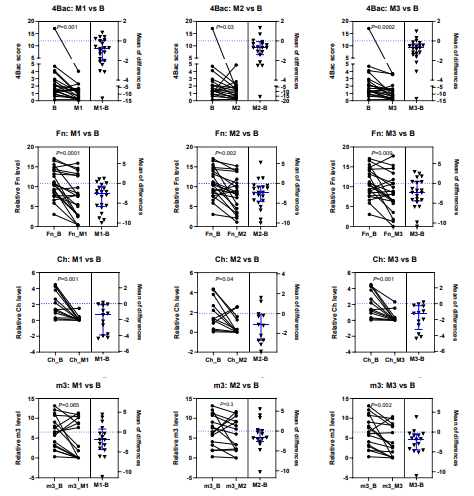
Figure 1: Change of the bacterial abundances and 4Bac score in individual subjects as compared to the baseline. B, baseline; M1, month 1; M2, month 2; M3, month 3.
Gastrointestinal Symptoms
Seven subjects had GI symptoms reported (1 abdominal pain, 3 bloating, 3 diarrhoea, and 4 constipation) at baseline. GI symp¬toms at the last visit were compared to baseline. At month 3, bloating (2 out of 3), diarrhoea (all 3) and constipation (1 out of 4) were improved. Abdominal pain and constipation in 2 sub¬jects remained unchanged. One bloating and one constipation were reported to worsen at month 3.
Adverse Events
None of the recruited subjects reported any study product-related adverse events. One subject reported headache and urinary tract infection after taking study products for 3 weeks, this subject took antibiotics for 7 days. Another subject developed an upper respiratory tract infection and took antibiotics. Both subjects did not withdraw and remained in the entire study period.
Discussion
In this pilot study, we demonstrated that the use of SMT04 for 3 months was effective in reducing the fecal levels of CRC-asso-ciated bacterial DNA markers, including Fn, Ch and m3. More¬over, SMT04 was safe and reduced GI symptoms. This formula was based on previous studies showing that certain probiotics demonstrated promising anti-CRC effects. To the best of our knowledge, SMT04 is the first commercial probiotic product de¬signed specifically to reduce CRC-associated pathogenic bacte¬ria. Our findings suggested that SMT04 may potentially reduce the risk of CRC via modulation of gut microbiota.
Previously this combination has been shown to decrease the de¬velopment of colorectal neoplasia and inhibit the growth of Fn in laboratory experiments [6]. This combination also reduced the abundance of CRC-associated bacterial DNA markers in human subjects when administered at a high dosage in our pre¬vious clinical trial. Streptococcus thermophilus has been shown to demonstrate anti-CRC properties in vitro and in vivo via the production of galactose, which inhibits the Hippo signalling pathway and activates oxidative phosphorylation in colonic cells [7]. The current human pilot study suggests that SMT04 not only reduces CRC-associated pathogenic bacteria but also may have anti-CRC effects in the long run.
Our study had limitations. With the small number of participants, the anti-CRC effects of SMT04 need to be verified in large-scale prospective trials. Although we demonstrated improvement in GI symptoms with SMT04, its true efficacy in patients with ir¬ritable bowel syndrome is being evaluated by another ongoing clinical trial.
In summary, this pilot study demonstrated the safety and po-tential value of SMT04 in reducing CRC-associated pathogenic bacteria. Our study suggests that SMT04 has a role in the che¬moprevention of CRC.
Funding source
Genie Biome Limited, Hong Kong
References
- Bray, F., Ferlay, J., Soerjomataram, I., Siegel, R. L., Torre,L. A., & Jemal, A. (2018). Global cancer statistics 2018: GLOBOCAN estimates of incidence and mortality worldwide for 36 cancers in 185 countries. CA: a cancer journal for clinicians, 68(6), 394-424..
- Katona, B. W., & Weiss, J. M. (2020). Chemoprevention of colorectal cancer. Gastroenterology, 158(2), 368-388.
- Liang, Q., Chiu, J., Chen, Y., Huang, Y., Higashimori, A., Fang, J., ... & Yu, J. (2017). Fecal Bacteria Act as Novel Biomarkers for Noninvasive Diagnosis of Colorectal Can-cerFecal Bacterial Markers for Colorectal Cancer. Clinical Cancer Research, 23(8), 2061-2070.
- Wong, S. H., Kwong, T. N., Chow, T. C., Luk, A. K., Dai,R. Z., Nakatsu, G., ... & Sung, J. J. (2017). Quantitation of faecal Fusobacterium improves faecal immunochemical test in detecting advanced colorectal neoplasia. Gut, 66(8), 1441-1448.
- Liang, J. Q., Li, T., Nakatsu, G., Chen, Y. X., Yau, T. O., Chu, E., ... & Yu, J. (2020). A novel faecal Lachnoclostridi-um marker for the non-invasive diagnosis of colorectal adenoma and cancer. Gut, 69(7), 1248-1257.
- Liang, J. Q., Zeng, Y., Xu, Z. L., Ng, S. C., & Chan, F. K. (2022). Sa1648: A PROBIOTIC FORMULA (SMT04) FOR MODULATION OF COLORECTAL CANCER RISK VIA REDUCING CRC-ASSOCIATED BACTERIAL GENEMARKERS. Gastroenterology, 162(7), S-453.
- Li, Q., Hu, W., Liu, W. X., Zhao, L. Y., Huang, D., Liu, X.D., ... & Wu, W. K. K. (2021). Streptococcus thermophilus inhibits colorectal tumorigenesis through secreting β-galac-tosidase. Gastroenterology, 160(4), 1179-1193.