

Advances in Theoretical & Computational Physics(ATCP)
ISSN: 2639-0108 | DOI: 10.33140/ATCP


Research Article - (2026) Volume 9, Issue 3
The Construction of Relative Absolute Spatiotemporal View: Logical Basis, Experimental Verification, and Paradigm Innovation

Received Date: Jun 09, 2026 / Accepted Date: Jul 31, 2026 / Published Date: Aug 10, 2026
Copyright: ©2026 Runsheng Tu. This is an open-access article distributed under the terms of the Creative Commons Attribution License, which permits unrestricted use, distribution, and reproduction in any medium, provided the original author and source are credited.
Citation: Tu, R. (2026). The Construction of Relative Absolute Spatiotemporal View: Logical Basis, Experimental Verification, and Paradigm Innovation. Adv Theo Comp Phy, 9(3), 01-33.
Abstract
To address the core issue of the lack of physical mechanism explanation in relativity, a solution is proposed to construct a "relative absolute spacetime view" by reconciling "absolute" and "relative". The necessity of an absolute stationary system is logically demonstrated: The system with the smallest degree of freedom in motion, the system that is most difficult to obtain acquired motion, and the system with "no displacement space" (such as the centroid system of a total galaxy and the cosmic background radiation framework) all point to a logically absolute stationary frame. Based on the difference in longitudinal inertial motion of photons and electrons revealed by the Jones experiment, a "geometric optical velocimeter" was designed to calculate absolute velocity and verify the existence of absolute motion by measuring the deflection angle of photons and electron rays. By assuming that the clock in absolute motion slows down, the contradiction between relative and absolute is quantitatively reconciled. The Jones experiment actually proved that the gaps in the hollow glass disk are ineffective in pulling photons. It is equivalent to proving that, relative to photons, the vacuum space inside a moving train carriage does not belong to the same inertial frame as the body of the train. Hafele Keating experiment proved that "different approximate inertial frames are not always equal". Both of these situations pose challenges to the principle of special relativity. It is proposed that physics research should follow a spiral upward path of "absolute → relative → relative-absolute", breaking through the binary opposition between classical absolute spacetime and special relativity. It can provide new explanations for the Michelson-Morley experiment and a new paradigm for spacetime theory.
Keywords
Relative Absolute Spatiotemporal View, Logical Absolute Stationary System, Geometric Optical Velocimeter, Jones Experiment, Absolute Motion Verification
Introduction
From a philosophical perspective, relativity and absoluteness are in opposition and unity. However, for a long time, people have only seen their opposition without finding ways and techniques to reconcile them. Relativity holds that observers in different inertial frames cannot communicate with each other and objectively agree on the same physical event. Relativity accurately describes spacetime phenomena in a rigorous mathematical form, but fails to fully explain the physical mechanisms behind these phenomena. The solution to this core issue can be supplemented and revised within the existing theoretical framework, or a new paradigm can be constructed by coordinating the relationship between "relative" and "absolute". This article chooses the latter and proposes the "relative absolute spacetime view", aiming to break through the dilemma of the binary opposition between the classical absolute spacetime view and the special theory of relativity. For quantum decoherent objects, all uniform and additive motions have a formation process (i.e., the historical process of velocity and acceleration changes). Relativity cuts off the formation and disappearance processes of velocity and acceleration. This has led to a disconnect between theory and practice, resulting in shortcomings in the completeness of theory and its engineering application value. Special relativity regards the function of all forms of inertial motion as completely identical. This is also inconsistent with people's experience and common sense in production and life practice (Mainly in the introduction of Supplementary Material A). This article will elaborate on the core discourse from several aspects.
In 1987, Li Yingjie foresaw from a philosophical perspective that relativity would inevitably develop into absolute relativity [1], and that the concept of relative spacetime would inevitably evolve into a relative absolute spacetime concept. In 1996, Runsheng Tu also began the construction of the theory of relative absolute spacetime and relativity absolute theory [2,3]. In 2007, Liu Zhenyong also published the popular science book "Relative Absolute Theory" [4]. However, prior to this, all three of this had relied on the laws of human cognition to establish a relative absolute view of time and space, without thoroughly exploring the physical origins and essence of this new concept. the author started to establish the theory of relativity and absolutism. This article is a significant research progress of the project. The research progress is mainly reflected in establishing the logical basis of the relative absolute spacetime view and relative absolute theory, designing operable verification experiments, and discussing the advantages of the relative absolute spacetime view and relative absolute theory. Especiallyï¼?the methods and techniques to reconcile qualitative and quantitative aspects of relative and absolute have been found. The qualitative method is to believe that only the space-time of absolute motion changes; The quantitative method preserves the positive achievements of both Newton's theory and relativity, and considers that the coordinate relationship between the absolute stationary system and the absolute motion system conforms to the Lorentz transformation (the Lorentz factor can still be used after replacing the velocity independent variable from relative velocity to absolute velocity). Thus breaking through the shackles of the binary opposition between the classical absolute spacetime view and the relative spacetime view in one fell swoop. The cognitive process conforms to the spiral upward law of "absolute → relative → relative-absolute.
The relative absolute spacetime view includes both the positive achievements of the relative spacetime view and the absolute spacetime view, and believes that in determining the effects of motion, the function of absolute motion velocity is the most powerful. In this way, one outcome is that different observers can communicate with each other and form consensus. A typical example is that the slowing down of absolute motion clocks can be recognized by observers in different systems. This situation is that different observers have the same view on the same event, which can achieve consistency and unity in the conclusions or results of the same event. This situation has the beauty of unified content, which can compete with the "beauty of unified form" of relativity (also known as the beauty of formal symmetry. see Section 3.1 and Chapter10 for details).
Found methods and techniques to reconcile qualitative and quantitative aspects of relative and absolute.
The Method of Harmonizing Relative and Absolute and Its Application Examples
We will demonstrate the necessity of an absolute stationary system from a logical perspective, by tracking the system with the smallest degree of freedom of motion (such as the total galactic mass center and the cosmic background radiation framework), and establishing a logical absolute stationary system (which will be discussed in Chapters 5 and 6 as "systems with smaller degrees of freedom of motion are superior" and several definitions of logical absolute stationary systems). At the same time, the contradiction between relative and absolute is harmonized by assuming the "slowing down of clocks in absolute motion", it is pointed out that most spatiotemporal experimental results (such as the bidirectional circumnavigation of atomic clocks) can be explained by both relative and absolute motion, and it is predicted that "the experimental results of atomic clocks can be better explained in the solar system" (Chapters 5 and 7 will discuss the "quantitative harmonization and experimental verification of absolute motion effects"). According to "the mass and energy of an object in absolute motion increase" ,"the definition of seconds and meters," and the theory of material structure, the conclusion can be derived that 'real rulers can be shortened due to absolute motion, and real atomic clocks can be slowed down due to absolute motion'. Thus, the physical mechanism by which spacetime changes due to motion was elucidated, and it was discovered that the physical mechanism by which spacetime changes due to motion differs from the mathematical mechanism provided by Lorentz transformation (the former obtains four-dimensional contraction, while the latter obtains two-dimensional contraction [5,6]).
Working Principle and Function of Geometric Optical Velocimeter
Based on the longitudinal traction difference between photons and electrons revealed by Jones experiment [7-9], we designed a "geometric optical velocimeter". One of the single arm speedometers, the dual gun one screen device, works on the following principle: that in high-speed motion systems, electron rays maintain their longitudinal velocity component due to inertia, while photon rays cease their longitudinal pulling effect after passing through the medium. Photons do not conform to the law of inertia. This can lead to the formation of a measurable deflection angle β between these two types of rays. Conducting experiments within a system, using this speedometer, the experimenter can measure their own and the system's movement speed. Based on past experience, it is not possible to find a reference frame for the measured speed. Only based on the theory of relative absolute spacetime do we know that this velocity is an absolute velocity (we will introduce the Jones experimental phenomena and the design and prediction of geometric optical velocimeters in Sections 3 and 4). This demonstrates the verifiability of absolute stillness in logic. reference [10] also strengthens this verifiability. The reason is that this literature provides astronomical measurement methods for the absolute velocity of the Earth's motion. Compared with the Michelson interferometer, the experimental results using geometric optical velocimeters have the advantages of simplicity, directness, and unambiguity.
Logical Loopholes in The Michelson-Morley (MM) Experiment and a Better Explanation For The Relative Absolute Spacetime Perspective
The widely accepted explanation for the Michelson Morley (MM) experiment is based on a premise. It is, using the concept of Ether wind—Observing from Earth, it is believed that the ether wind formed due to absolute stationary motioin [11-13]. This premise is not recognized by the absolute view of time and space, on the contrary, it is recognized by the relative view of time and space. Newton made it very clear that absolute space is absolutely stationary and its volume remains unchanged. In the framework of ether theory and absolute spacetime view, ether is absolutely stationary, and "ether wind" expresses absolute stationary system moving. Absolute stationary motion has obvious logical problems. Observing from Earth and recognizing the relative motion of the absolute stationary frame to the Earth, that is, treating the absolute frame as one of the countless inertial frames of relative motion (using the thinking of relativity). In short, a 0.4 unit interference fringe movement is not a prediction of absolute spacetime.
The principle of constancy of the speed of light and relativity are independent of each other. Otherwise, they will not be separately regarded as the fundamental premises of special relativity. Admitting the constancy of the speed of light does not mean acknowledging the principle of relativity. Admitting the constancy of the speed of light does not mean acknowledging the principle of relativity. Prior to the MM experiment, the constancy of the speed of light relative to the ground system had a solid experimental and theoretical foundation. For example, Fizeau's (1849) gear method experiment, Foucault's (1862) rotating mirror method experiment, a large number of experiments in which the propagation speed of waves is independent of the motion state of the wave source, and so on. Although these experiments did not directly confirm the isotropy of the speed of light in the ground system, they had rotated instruments and measured the speed of light at different locations, without feeling that the "speed of light in the ground system" was related to the direction and measurement location of the speed of light. So, the MM experiment can be explained by the constancy of the speed of light relative to the ground system. This explanation cannot be used to deny the existence of absolute stationary systems, and there is no reason to deny the view that the principle of relativity and the principle of constancy of the speed of light are independent of each other.
The above are the core vulnerabilities explained in the existing MM experiments. All loopholes to explaine the MM experiment will be discussed in detail in Section 5. There is another very important factor that is detrimental to the MM experiment: there are better experiments that can replace the MM experiment for verifying the spatiotemporal view (see Chapter 5 for details).
Starting from the "Functional Differences of Different Movements and The Stability Differences Between the Paths Traveled by A Photon and The Curent Path of a Photon"
The specific situation of these two differences is: Starting from the functional differences between visual motion (apparent motion) and objective motion (real motion); the differences between the path that photons have already traveled and the relationship between the curent path of photons and the visual motion state of the light source and observer, the article's context and main line are formed. The explanation of the circumnavigation experiment of atomic clocks proves that "different approximate inertial frames are not equivalent, and the functions of motion relative to different approximate inertial frames are different" (see Chapter 4 for details).
Starting from the functional differences between visual motion (apparent motion) and objective motion (real motion), as well as the differences between the path that photons have already traveled and the relationship between the cutent path of photons and the motion state of the light source and observer, the article's main thread and main line are formed. The former difference is the source of the "relative absolute spatiotemporal view" that coordinates relative and absolute. The latter difference has a significant impact on the principles of equivalence and general relativity (see Supplementary materials A and B for details). This article actually discusses the formation, development, verification, and application examples of these two differences as the main thread and structure. Relativity ignores or even denies these two differences, and regard the viewpoint of 'insisting that all inertial movements have the same function' as a major breakthrough. The supplementary materials point out that relativity has paid a great price to achieve the beauty of symmetry.
There are many experiments that can prove that 'Approximate Inertial Frames are not Equivalent'
The core operation of the existing explanation for the phenomenon of the atomic clock's circumnavigation experiment—transfer the observer from the ground system to the non rotating center of mass system of the Earth. This is the default operation of 'unequal rights of different approximate inertial frames'. Due to the blurred boundary between the approximate inertial frame and the Inertial frame that meets the requirements of special relativity, the boundary between "different approximate inertial frames are not equivalent" and "different inertial frames are not equivalent" is also blurred. This makes it difficult for experiments that require changing the observer's approximate inertial frame to better explain to be considered as strongly supportive of special relativity. There is a detailed discussion in Chapter 4.
This article ultimately proposes that physics research should follow a spiral upward path of "absolute relative relative absolute", providing a new paradigm for the development of space-time theory. The conclusion of this article is that the mass of motion increases and the speed of light remains constant (isotropic) in a flat space at absolute rest. These are two basic premises that have a solid experimental foundation. On this basis, adding the statement that "the coordinates between the absolute stationary frame and the inertial frame of absolute motion conform to the Lorentz transformation" can solve the problems that relativity can already solve and eliminate the difficulties encountered by relativity [14-17]. Thus, it is possible to establish a "relative-absolute spacetime view" [10] that harmonizes relativity and absoluteness, as well as the corresponding theory—Relative- Absoluteness Theory [1-4].
The influence of the relative absolute spacetime view on general relativity can be found in reference [18].
The exploration path chosen by the author of this article is to seek a balance between relative and absolute views of time and space, logical foundations, theoretical frameworks, techniques, and application methods. Therefore, not only does it not completely reject relativity and Newton's theory, but it also enjoys using the positive achievements of relativity and Newton's theory. Especially facts that can be qualitatively and approximately quantitatively verified by a large number of experimental facts. The most basic premise is obtained based on the principle of relative and absolute compatibility. The first basic premise is that the energy of the moving object increases (basic premise 1). The second basic premise is that different inertial velocities have different functions (basic premise 2). The core innovative research paradigm is based on thought experiments and facts that have been experimentally verified, using the physical mechanisms of things' development as logical clues to deduce various conclusions. The core paradigm innovation approach is, firstly, contrary to the derivation direction of relativity, the author starts from the irrefutable "basic premises 1 and 2" and combines it with the equivalence of mass and energy to obtain the relationship between mass, energy, momentum, and velocity. Taking into account the definitions of meters and seconds, we arrive at the conclusion that 'spacetime changes due to motion'. Secondly, logically speaking, "the energy of an object increases due to motion" includes two available contents: "the absolute energy of an object increases due to absolute motion" and "the relative energy of an object increases due to relative motion". Thirdly, by absorbing the positive achievements of special relativity, one should choose to follow the Lorentz transformation between the coordinates of the absolute system and any inertial system. Fourthly, the concepts of absolute stillness, absolute motion, relative absolute spacetime, and relative absolute theory are defined logically, forming a new conceptual system. In this way, the shortcomings of the lack of physical mechanisms in the theoretical description of motion changes in relativity have been addressed, and the goal of coordinating relativity and absoluteness has been achieved. Formed new research paradigms and coordinated relative and absolute theoretical paradigms.
Relativity realizes the beauty of formal symmetry (another manifestation of which is the formal unity of physical laws). The relative absolute theory, corresponding to the relative absolute spacetime view, achieves the unity of content, results, or conclusions: for the same physical event (the process and result of interaction), observers in different inertial frames can form a unified understanding. The results of the bidirectional circumnavigation experiment of the atomic clock demonstrate that different approximate inertial frames are not equivalent (unequal). The boundary between the approximate inertial frame and the inertial frame that meets the requirements of relativity is fuzzy, and the inertial frames in reality are all approximate inertial frames, without strict ideal inertial frames. In this way, the equality of different approximate inertial frames actually affects the strictness of the principle of special relativity. This is advantageous for the relative absolute spacetime view but disadvantageous for the relative spacetime view (see Chapter 10 and Supplementary Material A for details).
Reanalysis of Jones Experimental Results
The core objective of the Jones experiment is to verify whether the lateral propagation of light in a moving medium is affected by the longitudinal traction of the medium's motion. Essentially, it is an extension of the Fresnel traction formula and explores the interaction boundary between photons and the moving medium. Jones himself and his successors did not discuss or discover the impact of experimental results on relativity. This chapter supplements the description of Jones' experimental phenomena and makes multiple corollaries based on the experimental phenomena. Further explore the impact of Jones' experiment on special relativity and general relativity based on these corollaries.
The one way of expressing Jones' experimental phenomenon is that the longitudinal traction of photons by the moving medium ceases immediately after the photons exit the medium, and at the same time, the longitudinal velocity component caused by the previous traction immediately decreases to zero. The second way of expressing Jones' experimental phenomenon is that the traction effect is related to the thickness of the glass disk and independent of the width of the gap between the glass disk and the receiving screen [7-9]. The conclusion drawn by combining these two experimental phenomena is that when a photon leaves the glass disk, the pulling stops immediately, and the longitudinal velocity component caused by the first being pulled immediately returns to zero [see Figure 1 (b)], that is, the propagation direction of the photon immediately returns to the direction before being pulled (Corollary 1). The reduction to absurdity (proof by contradiction) for this inference is that if this velocity component does not return to zero, the traction effect will not be independent of the distance between the glass disk and the receiving screen. Further logical deduction is that the extension direction of the path traveled by photons (path left by photon propagation) is absolutely invariant regardless of the linear motion state of both the light source and the observer (Corollary 2). This is the principle that the direction of the speed of light in a vacuum remains constant, which is a supplementary content to the principle of the constancy of the speed of light. Corollaries 1 and 2 jointly demonstrate that the Jones experiment proves that the longitudinal motion of photons does not conform to the law of inertial motion. Of course, we can also directly derive from the two expressions of Jones' experimental phenomena that 'Jones' experiment proves that the longitudinal motion of photons does not conform to the law of inertial motion' (for the convenience of repetition and to highlight the importance of the conclusion, we refer to it as Corollary 3). The two connected arrows in Figure 1 (a) and (b) intuitively indicate that the law of refraction does not hold whether the refractive index is observed in a glass disk or in a laboratory system. And this has been proven by Jones' experiment
|
(a)
|
(b)
|


Figure 1 (a): Schematic diagram of the working principle of a speedometer with both an electron gun and a light source embedded in a glass disk (standing on a glass plate and observing). (b): Schematic diagram of Jones experiment. Observe in the laboratory. θ>α. L is the arm length, and d is the thickness of the glass disk.
Corollary 4 indicates that, For light, the volume of the inertial frame is generally not infinite. It is a well-known fact that photons can only change their frequency due to lateral traction. It is worth noting that if the glass disk is accelerated to rotate, the results and conclusions of Jones' experiment remain unchanged. Corollary 4 is also equivalent to the fact that the interior space of a train undergoing inertial motion and the physical structure of the train (railway carriage walls, railway carriage floor, locomotive) do not belong to the same inertial frame. According to Corollary 4, it can be inferred that the vacuum inside the moving railway carriage and the vacuum outside the railway carriage have identical effects on the motion of light (belonging to the same inertial frame of space). We call it Corollary 5.
The motion of quantum decoherent objects or particles requires three basic conditions: first, there must be a first driving force (i.e. sufficient energy is required); Secondly, there is space available for displacement, and thirdly, an entity capable of withstanding force. Thirdly, there the physical structure to can withstand force. The path traveled by photons in vacuum does not meet at least the first condition, and logically can only be absolutely stationary. This conclusion is equally important and can be referred to as Corollary 6. If the reader does not believe it to be an inference, treat it as a hypothesis temporarily. Based on these Corollaries 1-6, we can at least be certain that, in the vacuum of a flat space, the direction of the path traveled by photons remains absolutely unchanged (regardless of the motion state of the light source and observer).
Figure 1 visually illustrates the ability or function of a moving medium to pull photons (observed in a medium system with the light source moved into the medium).This graph also intuitively indicates (which has been proven by Jones' experiment) that, when observed in a system with real motion, the law of refraction does not exist for crossing the moving glass vacuum interface (the angle of refraction is not equal to the angle of incidence), and the principle of special relativity does not hold. Figure 1. Schematic diagram of Jones experiment with both electron gun and light source embedded in a glass disk. During the experiment, both a photon and an electron are emitted simultaneously. Observing on a moving glass disk, the electron beam emitted by the electron gun in the same direction follows the dashed line, while the photon beam follows the diagonal line. The angle between the two rays is α. The electron gun was not drawn (the yellow arrow only represents the direction of movement of the glass disk known to the observer). If observed on the ground and both the light source and electron gun are moved to the surface of the glass disk, photons follow the dashed line while electrons follow the solid diagonal line.
Let's review the illustration. The parallel lines outside the glass disk in Figure 1 (b) are the inevitable result of Corollary 1 and Corollary 2. The first line in the parallel line is also the propagation path for photons to recover their free body after breaking free from traction. The second line is the theoretical path of a photon assuming that it is not pulled. After the photon returns to its free motion state, the path it travels along in the longitudinal direction no longer satisfies the necessary and sufficient conditions for motion. So we came up with Corollary 6. It can be seen that Corollary 6 is the logical conclusion of Jones' experiment.
|
Comparative content |
The particles in the traction medium of motion |
The situation of the traction effect of particles after leaving the solid traction medium |
||
|
Target particles |
Electron |
Photon |
Electron |
Photon |
|
traction effect |
The traction effect is 100% |
The traction effect is related to the characteristics of the solid medium. For ultra-pure glass, it is very close to 100% |
The longitudinal velocity component formed by traction is retained due to the fact that electrons follow the law of inertial motion |
The longitudinal velocity component formed by traction cannot be retained due to photons not conforming to the laws of inertial motion |
|
Observing in the laboratory, the direction of motion of radiation |
Same direction as the emission of radiation |
Same direction as the emission of radiation |
Deviation from the emission direction of the radiation |
Parallel to the direction of radiation emission |
|
Horizontal drift of radiation |
Nothing |
Nothing |
Nothing |
Longitudinal translation of the radiation by a certain distance (see Figure 1b) |
|
The ability of particles to recover their original state after being stopped by longitudinal traction |
(Still in the process of being pulled) |
(Still in the process of being pulled) |
Due to the fact that decoherent electrons conform to the law of inertia, the inertial motion caused by being pulled continues to persist |
The experiment confirmed that the ongitudinal motion of photons does not conform to the law of inertia. The longitudinal inertial motion caused by being pulled is immediately terminated. Photons are 100% restored to their original state without any dragging [17] - the original propagation state in the absolute stationary frame, i.e., the vertical absolute stationary state |
Table 1: Comparison of The Sustained Longitudinal Pulling Effect of Emission Sources on Photons and Electrons Emitted Laterally
The following (especially Chapter 3) will introduce how to apply the above corollaryes. The following (especially Chapter 3) will introduce how to apply the above corollaries. As mentioned above, Jones' experimental results provide us with two very important insights (or clues): Revelation 1, install the light source inside the disc as shown in Figure 1. Install an electron gun near the light source inside the glass disk. When the disk is stationary, photons and electrons are emitted in a direction perpendicular to the glass vacuum interface (electron and photon rays are parallel inside and outside the disk). After starting the turntable (or give the glass plate a real movement in other ways), the electron beam and photon radiation passing through the glass disk will form a non-zero angle. Revelation 2, observe in a system of relative light source motion, The direction of photons emitted from a light source (with a layer of metal or glass on its surface) towards vacuum is independent of the motion state of the light source. One way to express the specific reason is that, when observed in a stationary frame, the light emitted from the glass towards the vacuum is deflected by the movement of the glass, but electron rays do not. In this example, the glass and the light source are in the same system. If a reader cannot understand the reason for the formation of Revelation 1 and 2, consider it as the author's hypothesis or prophecy. There is something absolutely invariant—the direction of extension of the path traveled by photons in vacuum is absolutely invariant. The thought experiment used here is the prototype of the "dual gun one screen speedometer".
Based on Corollaries 1 and 2, as well as the two revelations above, we can make another inference (also known as a well founded prophecy): Hollow out the middle of the glass disk and conduct a hollow disk Jones experiment. The vacuum cavity in the glass disk is ineffective for pulling photons (The longitudinal pulling effect of the transport disk on photons is only related to the thickness of the glass, not related to the thickness including the cavity. Corollaries 1-6 are essentially different versions of the same inference. Because they are too important and for the convenience of repetition, they are numbered separately. According to this prophecy, we can use a hollow glass disk to redo the Jones experiment, in order to verify the inferences and predictions of this article, as well as the relative absolute spatiotemporal view.
Corollary 4 means conducting optical and mechanical experiments inside a moving railway carriage and comparing the results of these two types of experiments can distinguish railway carriages with different inertial velocities. That is, conducting optical and mechanical experiments inside diffreent fully enclosed inertial system can reveal differences in inertial moving velocity (a conclusion that denies the principle of special relativity). This type of experiment includes the hollow Jones experiment that has already been discussed and the upcoming experiment that uses a geometric optical velocimeter to measure velocity. Corollary 5 can deny the relativity confirmed by Einstein's clock calibration method (when the front Aʹ and the point Bʹ at the rear of the carriage coincide with points A and B on the track, two pairs of photons are emitted simultaneously towards the midpoint from these four points. These two pairs of photons can reach the midpoint M ʹ of the car and the midpoint M of A−B on the ground at the same time).
The Jones experiment results also indicate that the degree of contraction of the outer ring of the rotating glass disk is greater than that of the inner ring, which is not true. Because as long as the contraction degree of the outer and inner rings of the high-speed glass disk is not consistent, the glass disk will break. The high-speed rotating glass disk in Jones' experiment did not crack. Indicating that the shrinkage of the high-speed transfer glass disc is uniform. This experiment also demonstrates that centripetal acceleration cannot cause spatiotemporal bending. The rotating glass disk has a centripetal acceleration in the radial direction. However, this centripetal acceleration did not cause any additional bending of the light passing through the glass disk. This indicates that the experiment has confirmed that centripetal acceleration cannot cause spacetime bending (the centripetal acceleration force field is not equivalent to the corresponding real gravitational field). Under the premise that 'centripetal acceleration cannot cause temporal and spatial curvature', the centripetal acceleration cannot cause temporal and spatial curvature. There is no reason why acceleration in a constant direction can cause spacetime bending. The statement 'normal acceleration cannot cause spacetime bending' suggests that the conclusion that acceleration causes spacetime bending is questionable. This is detrimental to the principle of equivalence.
Geometric Optical Speedometer
Designing a geometric optical velocimeter is not only an application for reanalyzing Jones' experimental results and drawing clear conclusions, but also an important method for verifying the absolute stationary system in logic.
Corollaris 1 and 2 in the previous section involve the conclusion that the longitudinal motion of photons does not conform to the law of inertia. And macroscopic objects, such as handgun bullets, must conform to the law of inertia. Macroscopic objects and quantum decoherent particles, such as handgun bullets and quantum decoherent electrons, must comply with the law of inertia. After the end of traction, entities that comply with the law of inertia maintain the inertial motion generated by previous traction, while experiments that do not comply with the law of inertia cannot maintain the inertial motion generated by previous traction after the end of traction. This is the difference in the persistence of forcedi nertial motion. Its performance is as follows: If aiming at the same direction on a rotating transparent plastic disk and firing bullets and photons separately, after they pass through the disk, the trajectory of the bullets and the path of the photons are no longer parallel. Based on this difference, we can design a single arm geometric optical velocimeter. According to its structure and working principle, it can be called a "dual gun one screen geometric optical speedometer". Three single arm speedometers are connected vertically to each other, forming a three arm geometric optical speedometer (if the reader wishes, this type of single arm speedometer and three arm speedometer can both be called Tu's speedometer).
Single Arm Geometric Optical Speedometer-Dual Gun One Screen Speedometer
There is a tube buried in the traction medium disk parallel to the direction of photon incidence (i.e., there is a horizontal channel on the disk suitable for bullets to pass through). Then install a handgun near the light source. The bullet fired from the handgun happened to pass through the channel in the medium and shoot towards the vacuum. At the same time, photons emitted by the light source also pass through the solid medium and enter the vacuum. Observing in the laboratory, when the medium disk is stationary, the trajectory in vacuum is parallel to the light rays. When the medium disk moves longitudinally, there is a non-zero angle between the trajectory and the light in the vacuum. The reason is "the persistence difference of forced inertial motion between non-zero stationary mass entities and bosons". We will compare this differences in detail in Table 2.
If we replace firing bullets with firing electrons, the non-zero angle α will still appear between electron rays and photon rays. It is obvious that if we stand on a moving physical medium and emit photons and electrons separately into a vacuum, there is a difference between "the relationship between the direction of photon motion and the motion state of the light source" and "the relationship between the direction of electrons and the motion state of the electron gun". Hereinafter referred to as the difference in the relationship between the moving direction of photons and electrons and the motion of the emission source (see Corollary 3 and 4 for reasons). When observed on a moving traction medium, light rays are deflected, while electron rays are not deflected. When observed in a stationary frame, electron rays are deflected while photon rays are not deflected. In summary, in the two systems involved, as long as a non-zero deflection angle is observed in one system, a non-zero deflection can also be observed in the other system (i.e. the existence of deflection angle has a certain degree of absoluteness). This is highly consistent with the objectivity and qualitative invariance of the difference in landing points between photons and electrons on the screen. For the fact that electron rays and photon rays can be separated, observers in both systems can reach a consensus. This situation also determines the deflection angle of the light observed by the observer in the glass disk system, not the aberration of light. But it is somewhat similar to the aberration of light. To distinguish it, we call it internal aberration, indicating that the experimenter can measure the deflection angle α inside the system. Landau stated in Field Theory that the angle transformation of Lorentz transformation is the aberration angle. As we all know, optical aberration is a visual motion effect. Therefore, the Lorentz transformation is suitable for describing visual motion effects. This also indicates that the special theory of relativity based on Lorentz transformation only considers the effects of apparent motion.
Three Arm Geometric Optical Velocimeter
In a system, parallel rays emitted by a stationary light source and an electron emitter become non parallel after the radiation source moves longitudinally. The method of separating two beams of radiation is as follows: when observed on a moving radiation source, the electron beam is not deflected, while the photon beam is deflected; When observed in a stationary frame, electron rays are deflected, while photon rays are not deflected. The reason for the separation of two types of rays is that photons and electrons in the rays have different abilities to maintain longitudinal inertial motion components after being radiated from the emission source into the vacuum (electrons can maintain them, while photons cannot maintain them due to not conforming to the laws of inertial motion). This is the working principle of the dual gun, one screen, single arm geometric optical velocimeter described above. We can combine three single arm dual gun one screen geometric optical velocimeters in a mutually perpendicular manner to form a three arm geometric optical velocimeter. The direction of electron radiation can replace the theoretical emission direction of photons determined by geometric optics theory methods (i.e., the actual landing point of electrons on the screen can replace the theoretical landing point of photons on the screen). The name of geometric optical velocimeter mainly comes from the optical determination method of this theoretical landing point. The method of determining the theoretical landing point using photon rays is more intuitive and easier to understand. Then measure the distance δ between the theoretical landing point and the experimental landing point. The Jones experiment also requires measuring this offset distance δ. This is similar to the comparative method used by Eddington to measure the impact point of bent light.
The design of various parameters for the geometric optical velocimeter and the hollow glass disk Jones experimental instrument mentioned below can refer to the parameters of the Jones experimental instrument. For example, arm length data, light source data, total thickness of glass disk, type and refractive index of glass, etc.
Calculation Method for Experimental Results of Measuring Speed Using Geometric Light Speed Speedometer
The experiment of using a geometric speedometer to measure speed in a space station is an extension of the Jones experiment (using the motion of the space station instead of the rotation of a glass disk to pull photons). The parameters of the instrument can be set to be similar to those of the Jones experimental instrument. For example, arm length, light source, receiving device, incident angle. In the experimental results conducted using Jones experimental apparatus and single arm speedometer, the quotient of
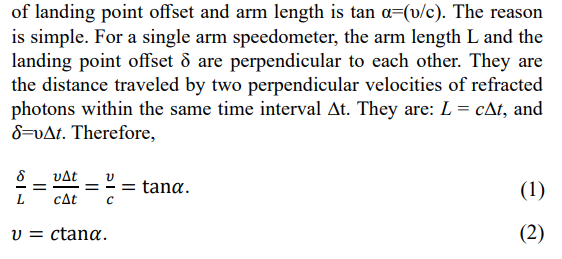
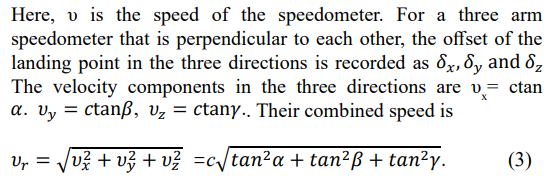
This speed measurement is completed in a completely enclosed system. What is measured is the speed of the observer and the instrument itself. In the context of relativity, the experimenter does not know which system the measured velocity is relative to. This is the measured velocity within a fully enclosed system, which is unique. The most reasonable explanation for it is absolute speed.
The Conditions, Essence, And Significance of The Non-Equivalence of Different Approximate Inertial Frames
The differences in motion effects between objective and apparent motion, the differences in the path traveled by photons and their real-time visual path, and the superiority differences in the same and similar inertial frames have been overlooked by people. People acknowledge that there are differences between the real gravitational field system and the accelerating force field system, but often overlook their significant differences at large scales (such as differences in delayed effects, etc.). By transferring the approximate the inertial frame that the observer stands there observing, the error in the bidirectional circumnavigation experiment results of the atomic clock can be eliminated. This success demonstrates that not all approximate inertial frames are equivalent. Not all inertial frames are equal "belongs to the category of "approximate inertial frames are not equivalent". We also discussed the conditions, essence, and significance of the non-equivalence of approximate inertial frames.
How far is it from 'different approximate inertial frames are not equivalent' to 'different inertial systems are not equivalent'? This is a thought-provoking question. In reality, the boundary between these two is very blurred. Vague enough to raise doubts about the conditional equivalence of different inertial frames. Especially, it is difficult to determine whether some experimental results verify the non-equivalence of different inertial frames or the non-equivalence of different approximate inertial frames. Because, strictly speaking, there is no truly standardized ideal inertial frame in reality. The vast majority of experiments are conducted on the surface of the Earth. The Earth's surface system is by no means an ideal inertial frame. Some experiments conducted on the surface of the Earth cannot be well explained by the relative ground velocity. For rigorous scientists who love to delve into the root causes, 'different approximate inertial frames are not equivalent' may be the inspiration for generating new ideas or the trigger for the outbreak of spatiotemporal and theoretical revolutions. The first thing to be questioned is the conclusion that 'all experiments rigorously prove the correctness of relativity'.
The principle of eliminating the twin paradox is also to utilize the inequality of different approximate inertial frames (the ground approximate inertial frame is not equal to the spacecraft frame. Even if the acceleration process of the spacecraft frame is cut off, the remaining approximate inertial frame is not equal to the ground approximate inertial frame).
The Functional Differences Between Relative Motion and Absolute Motion
The terms relative motion and absolute motion are quite familiar to everyone. Relative motion is also a visual motion. A large part of it is purely visual motion (also known as purely epigenetic motion). There is another type of movement that is purely objective, also known as real movement. It is absolute motion. The rest is a mixture motion of absolute and apparent motion. For example, a passenger sitting on a high-speed train observes the trees on the roadside moving relative to themselves. The movement of the trees is both relative and purely visual or apparent motion, while the movement of the passenger and the train is a mixture motion of the absolute movement of the Earth and the relative movement of the train relative to the ground. Absolute motion is also motion relative the absolute stationary system. When we talk about relative motion, we must exclude this special type of relative motion - motion relative the absolute stationary system. Below, this article mainly uses the terms "relative motion" and "absolute motion" (occasionally using the terms "visual motion" and "real motion").
The fast-moving car collided with a person on the sidewalk. When traffic police assign responsibility, they will never assume that pedestrians are responsible for hitting a small car. Also, A punched B heavily, causing him to be severely injured. When the court judges responsibility, it will never assume that it was Party B who actively punched Party A and exempted Party A from responsibility. Almost no passengers in various cars believe that the road is in motion rather than the car. When launching rockets and missiles, it is absolutely not assumed that the Earth is in motion while the rockets and missiles are stationary. The reason is simple: the formation process of relative motion between two macroscopic objects is not symmetrical, and the functions of their relative motion velocities are also different. The method of distinguishing different relative movements is also very simple. Meet the conditions required for movement—there is space available for displacement, sufficient external force to push, or internal energy explosion. The relative motion of such objects has a certain objectivity. If it does not meet the conditions required for motion, and there is neither external force pushing nor internal energy bursting, such motion is purely relative motion (apparent motion). Cutting off the processes of motion formation and cessation, the functions and utilities of the remaining inertial motion parts are still not completely the same. When explaining the twin paradox, this "difference" is utilized (see next section for details). In social practice, different relative inertial motions can be distinguished, while relativity holds that they are theoretically indistinguishable, which means that the theory of relativity is detached from reality. The remaining inertial motion interval after cutting off the process of motion generation and termination cannot be used with general relativity.
Differences in The Superiority of Different Approximate Inertial Frames
Among a pair of twins, A entered a spaceship and, after two minutes of acceleration, maintained a constant speed for 20 years. Then it mainly returns to Earth in a uniform motion. And B remained stationary on the ground. Which twin is younger? This is the famous twin paradox. When answering this question, the relativistic choice is not to observe in an accelerated spacecraft, but only on the ground. This choice also assumes that the motion of the spacecraft relative to the ground has different functions from the motion of the ground relative to the spacecraft. Moreover, even after deducting the time variation caused by the acceleration of the spacecraft, the function of the 20-year uniform linear motion is different from that of the inertial motion of the Earth relative to the spacecraft (the remaining relative inertial motion after cutting out the acceleration process is not equal rights). Relativity advocates will surely argue that the inertial velocity obtained by decapitation cannot be used to quantitatively calculate the "relativistic effect". However, when explaining the results of the bidirectional circumnavigation experiment of the atomic clock, the sum of the relativistic effects of acceleration and inertia motion was calculated. As a serious scientific worker, we cannot casually implement double standards, right! Moreover, the statement 'cannot be observed on the spacecraft' is only a subjective defense by the proponents of relativity, who do not allow A to observe. But in reality, A's eyes are not blind and his brain is not bad, he can observe. Especially during its uniform linear motion, relativity cannot deny that it can actually be observed. Theorists subjectively believe that A's observations do not count (this subjective judgment is based on finding a reason to use the conclusion that "different inertial frames are not equivalent or equal." However, this reason cannot be used within the theoretical system of special relativity).
Functional Differences and Superiority Gradients of Different Approximate Inertial Motions
Observing within a system, the observer can explain experimental phenomena more and better can be called a superior system. The phenomenon of different approximate inertial frames having different functions (unequal rights) is even more evident. In 1971, Hafele Keating conducted a bi-directional circumnavigation experiment of atomic clocks. The experimental results show that, after deducting the effects of gravity and acceleration, clocks flying eastward are 184 nanoseconds slower than clocks on the ground, while clocks flying westward are 179 nanoseconds faster than clocks on the ground (with a measurement uncertainty between 7-10 nanograms). Observing from the ground, using the theory of relativity to infer that "clocks in relative motion slow down" can explain the experimental results of clocks slowing down while sailing eastward. But it cannot explain the experimental results of the clock speeding up while sailing westward. It is necessary to transfer the observer to a non-rotating Earth center of mass system for observation, in order to use relativity to explain the phenomenon of clocks speeding up as they sail westward within the allowable range of uncertainty. For convenience, we refer to the system where the observer is transferred as "observer transfer". The superiority of different systems varies, indicating that different systems are not equivalent (unequal rights). Why is it necessary for the observer to transfer the inertial frame they are in? The reason is obviously that the non-rotating Earth's center of mass system is superior to the ground system. What is the difference between observing a clock sailing around the world in a non-rotating Earth's center of mass system and on the ground? One answer is that different approximate inertial frames are not equivalent (ground approximate inertial frames are not equivalent to non-rotating geocentric approximate inertial frames). The second answer is that, when observed in a non-rotating Earth center of mass system, the objectivity of the motion of a clock sailing around the world is enhanced (when observed on the ground, the epigenetics of the motion of a clock sailing around the world are too strong—the visual motion characteristics are more obvious). For the determining factors of the time dilation effect, the stronger the objectivity of movement, the stronger its function (the functions of visual motion and objective motion are different). This denies the notion that "all functions of relative motion are identical" upheld by special relativity. What are still the differences between the non-rotating Earth's center of mass system and the ground system? The non-rotating center of mass system of the Earth has fewer degrees of motional freedom than the ground system: it lacks the linear displacement caused by the Earth's rotational motion and rotation. If no other explanation can be found, there is a logical conclusion: systems with less freedom of movement are superior. Even if readers can find other explanations, this explanation in this article is still a competitive one. We will continue to analyze and see if we can confirm the explanation that 'the smaller the degree of freedom of the system's motion, the better'. Since the degree of freedom of the solar system's motion is smaller than that of the non-rotating Earth's center of mass system, it is necessary to clarify whether the results of the atomic clocks circumnavigation experiment can be better explained by transferring the observer to the solar system for observation.
In theory, deducting the influence of gravity. Observing from the non-rotating center of mass of the Earth, the degree to which a clock sailing eastward is slower than one on the ground should be exactly the same as the degree to which a clock sailing westward is faster than one on the ground. However, the measured values show a difference of 5 nanoseconds between these two situations. Observing in the Earth's core, the reason cannot be found. Just try

the measurement uncertainty of the atomic clock's bidirectional circumnavigation experiment cannot be less than 1%, the relative error of 2.75% also needs to be explained. Moving the observer into the solar system requires consideration of the Earth's orbital motion. The Earth completes one revolution per year. The annual revolution resulted in the Earth rotating an additional 1/365 times in one day. During the Hafele Keating experiment, the aircraft flew in the air for 41.2 hours and 48.6 hours, respectively. The number of revolutions of a clock flying east around the Earth must be increased by 41.2/24 × 1/365=0.0047 (revolutions), while the number of revolutions of a clock flying west around the Earth must be subtracted by (48.6/24)×(1/365) ≈ 0.0055 (revolutions). The delay of the clock sailing eastward increases by 184 × 0.0047=0.865 nanoseconds. The "time contraction amount" of the clock sailing towards the west is reduced by 179 × 0.0055=0.984 nanoseconds. 0.865- (-0.984)=1.86 nanoseconds.
Considering the increase in the number of rotations of the Earth caused by its revolution, the difference of 1.85 nanoseconds can be eliminated. The difference of 5 nanoseconds has two other determining factors: the atomic clock does not orbit the Earth exactly twice; The clock sailing in two directions stops at different times and positions in the middle. After considering the Earth's revolution, the speed at which an atomic clock travels eastward over the Earth's sun facing side is v-revolution + v-airplane + v-rotation. If sailing westward over the sun-shaded side side, the combined velocity of the clock is v-revolution − v-airplane − v-rotation. If the atomic clocks in both the east and west directions orbit the Earth exactly once without stopping in the middle, then the influence of the Earth's revolution in this regard is very symmetrical and can cancel each other out. However, the sum of the flying time of the clock heading east in the air is 41.2 hours, and the total time of multiple stops in between is 24.2 hours. The total time of the clock sailing westward in space is 48.6 hours, and the total time of multiple stops along the way is 33.7 hours each. The asymmetry of various situations makes it difficult to achieve the "mutual cancellation" mentioned above (stopping on the sunny side, the nightside side, and the side has different effects on the clock. Within 6.8 hours of the difference between 41.2 and 48 hours, the orientation of the clock above the Earth is different, and the clock is also affected differently by motion), resulting in a portion of the 5-nanosecond difference. The correction here is similar to the general relativity correction of the 43 second precession of Mercury's perihelion. Both are manifestations of theoretical progress.
The theoretical calculations above indicate that observing from within the solar system can better explain the results of the atomic clock's bi-directional circumnavigation experiment. This is also the fourth Prophecy (Prophecy 4) in this article. Unfortunately, the accuracy of the Hafele Keating experiment is too low to accurately verify. If anyone could redo the bidirectional circumnavigation experiment of the atomic clock (using solar powered drones, no longer sailing in stages, and speeding up the navigation speed, greatly improving the experimental accuracy), that would be great. This can verify the author's prediction and also verify that the solar system is superior to the non-rotating geocentric system. As long as the ground system is not superior to the non-rotating Earth's center of mass, the non-rotating Earth's center of mass is not superior to the solar system, the solar system is not superior to the Milky Way, and the Milky Way is not superior to the total galaxy, the most superior is the absolute stationary system with zero degrees of freedom of motion. This is a tracking method along the gradient of motion degrees of freedom and superiority of the system. The tracking result can have a logical absolute stationary system (this is the second logical stationary system in this article).
Thinking of the Foucault pendulum, we firmly believe that there are other ways to prove the superiority of the solar system over the non-rotating Earth's center of mass system. Prophecy 5: As long as the accuracy of the Foucault pendulum experiment is significantly improved, the Fourier pendulum can be used to discover the effect of the Earth's revolution on its rotation by (1/365) revolutions per day, thereby measuring the Earth's revolution speed. Replacing Foucault pendulum with a laser gyro to measure the Earth's orbital velocity. Thus, it can be qualitatively and quantitatively demonstrated that the solar system is superior to the non-rotating Earth's center of mass system in determining motion effects. We can trace along the gradient of system superiority to the most superior system. The principle of special relativity (or complete equivalence of different inertial frames) recognizes that the motion of different inertial frames has the same superiority in determining motion effects. Once the difference of “superiority of different systems” is proven through experimental methods, it is extremely detrimental to the principle of relativity.
According to the definition of the superiority order of the system, for explaining the results of the bidirectional circumnavigation experiment of the atomic clock, the superiority order of the ground system, non-rotating geocentric system < solar system.That is to say, the approximate motion relative to the solar system, the approximate motion of the Earth's center of mass that does not rotate, and the approximate motion relative to the ground system have different functions (i.e., the ability of these approximate inertial motions to determine spatiotemporal changes is not equal). This conclusion, together with the relativistic explanation of the "twin paradox" mentioned earlier, brings the "difference in superiority of different approximate inertial frames" closer to the difference and superiority gradient of different inertial motions.
The Relationship Between Different Degrees of Freedom of Motion of The System and The Superiority of The System
The concept of freedom of movement is familiar to many people. The degree of freedom of motion refers to the number of ways an object can move independently in space. According to this definition, logically speaking, a system with zero degrees of freedom in relative motion can be transformed into a system with non-zero degrees of freedom in relative motion by another observer. Only an absolute stationary system is considered a system with zero degrees of freedom in absolute motion. It can be seen that a classical object with zero absolute degrees of freedom in motion is an absolute stationary classical object, and the system associated with an absolute stationary object is an absolute stationary frame. Absolute stillness is a real stillness that does not change with the observer's movement state.
The order of degrees of freedom of motion for the Milky Way, solar system, non-rotating Earth's center of mass system, and ground system is: >non-rotating Earth's center of mass system >solar system>Milky Way> galaxy"s center of mass system > absolute stationary system. Considering this gradient, logical tracking based on the superiority gradient of "ground system
The Difference in The Relationship Between the Two Paths of Photons and The Observer's Motion State
These two paths are respectively the "path that the photon has already traveled" and the "real-time motion path of the photon as a particle". Their variations in extension direction and overall drift
with changes in the observer's movement state are different. There are two types of relationships: the relationship between the path traveled by photons and the relative motion state of the observer; The relationship between the real-time motion path of photons and the relative motion state of observers. The difference between these two relationships is significant. Over time, the real-time path of photons constantly transforms into the path they have already traveled. There shouldn't be any differences. Therefore, there shouldn't be any differences in the relationship between these two paths and the observer's movement state. In the context of relativity, these two paths are different, and the reason for the difference is the incorrect alteration of spatial membership relationships (which will be discussed in detail below).
Relativity is known as the 'spacetime theory'. However, it does not clearly define time and space. This is a fundamental flaw in relativity. The maintainers of relativity have provided an explanation. They believe that special relativity indirectly anchors time and space based on operations related to the speed of light. In relativity, space is related to time, which is actually reflected in the relationship between space and velocity. In relativity, there is no clear definition of time and space, nor is there a clear definition of four-dimensional spacetime. It leaves this concept for readers to understand the four-dimensional space-time continuum based on mathematics. Relativity denies the concept of spacetime in classical physics, and it is inappropriate to still use the concepts of time and space in classical physics (after all, relativity is not primarily a theory that describes the microscopic world). Relativity also does not provide a method for dividing spatial membership relationships. It also does not explain how the motion of space is created (especially artificially created). If the membership relationship of a space is not clearly defined, it is difficult to determine who a real space is moving relative to. In terms of how the motion state of space changes, in the process of application and interpretation, relativity allows people to equate time with the indicated reading of a clock, and equivalent the motion of a coordinate frame allowed in mathematics to the motion of an entity. Otherwise, the application and experimental verification of relativity cannot be carried out.
In the context of relativity, the hidden spatial membership relationship is: for a large real space, whoever observes it belongs to whom; The manufacturing method of spatial motion is to believe that the motion of an object not only represents the occupied space of the moving object, but also moves together with it. It also recognizes the existence of an infinite coordinate framework associated with the object and moves together with it. Otherwise, the covariance of the physical laws of the principle of special relativity cannot be expressed.
We first analyze a thought experiment to draw a logical conclusion: the "two relationships" mentioned in the title of this section are inconsistent. In Section 6 (Experimental verification of absolute stillness in logic), it can be seen that Jones' experiment supports this logical conclusion.
The conditions for the Lorentz transformation to hold are: applicable to the transformation of spatiotemporal coordinates between two inertial frames; The corresponding spatial coordinate axes of the two inertial frames are parallel to each other, and the X-axis extension direction is the direction of mutual motion between the two inertial frames. This article also follows this convention when the observer changes the inertial frame they are in. We install a tube in the ground system, with one end of the tube connected to a light source S. Let it emit a photon along the centerline of the tube. The centerline of this tube is a very small part of the path traveled by this photon. Regardless of the observation in any inertial frame, the path taken by this photon is the centerline of this tube. As long as the extension direction of the tube is independent of the observer's motion state, the extension direction of the path traveled by the photon is also independent of the observer's motion state and is absolute (absolutely invariant).
Why is the direction of motion of particles and photons as particles related to the observer's motion state? This is because in an inertial frame KÃÂ?¹, it takes time for a particle to move from one point to another. We emit a photon along the YÃÂ?¹-axis from
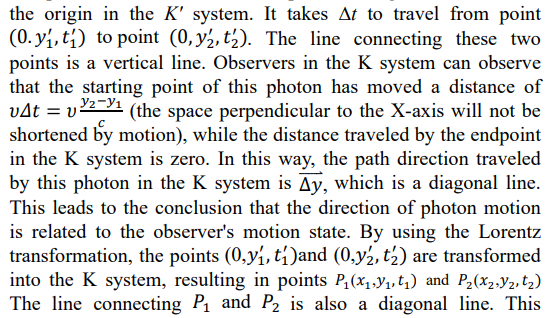
change in spatial ownership is artificial, a mental or mathematical behavior. The extension direction of the path that the photon has already traveled is independent of both the observer and the motion state of the light source. The "path traveled by photons" is different from the real-time visual motion path of photons as particles (the path already traveled is a line, and its direction of extension does not change). The above analysis reveals that there is a significant difference between "real motion" and "apparent motion". The direction of extension of the path traveled by a particle is independent of the observer's motion state, while the real-time apparent motion direction of a particle is related to the observer's motion state. The reason is that the real-time apparent motion direction of a particle is related to time, while the path traveled by a photon is a straight line whose extension direction is fixed and independent of time (not changing with time).
As mentioned above, the visual motion path of horizontally emitted photons (real-time visual motion direction and motion path of particles) is related to the visual motion state of the viewer and independent of the motion state of the light source. The extension direction of the path traveled by horizontally emitted photons is independent of both the "motion state of the light source" and the "true motion state of the observer". The apparent motion direction of photons emitted laterally is related to the observer's motion state and independent of the motion state of the light source. The "motion state" mentioned above includes the acceleration motion state. Observing in an inertial frame, Whether the light source is accelerating longitudinally or moving uniformly longitudinally, the path taken by the photons it emits is a straight line, and its direction of extension does not change with time. This has a significant impact on general relativity (which can make the principle of general relativity inapplicable to photons).
Although photons can continue to propagate forward after passing through the tube, the tube set above will not move along its extension direction. The points on the tube or on the photon path are no longer displaced forward. This is the path that the photon has already traveled, which is not related to the observer's motion state in the direction parallel to the light (Limited to observe13rs moving in a direction perpendicular to the light). Attention! The propagation path of photons extends forward, not the overall forward movement of the path. The situation with humans is similar: people move forward, but the road does not move forward.
Is the longitudinal motion state of the path traveled by photons related to the observer's motion state? Imagine multiple observers moving at different speeds perpendicular to the direction of photon propagation (these observers also represent multiple different inertial reference frames, labeled K1, K2, K3, ... Kn), collectively observing the path of the same photon. At this point, it will be found that the relative velocities of the photon paths measured by these observers in the longitudinal direction are different. The path referred to here is the trajectory that the photon has already traveled. The relative velocity change presented by this trajectory in the longitudinal direction is essentially a change in the observer's own motion state, and is an apparent, non-intrinsic change. If an observer jumps from a low-speed inertial frame to a high-speed inertial frame one by one, then in his view, the observed path seems to be accelerating inexplicably. However, innature, the motion state of macroscopic objects will never change without reason, except for quantum coherent particles. Therefore, for this observer who constantly changes the reference frame, the longitudinal motion of the photon path observed by him can only be attributed to an apparent motion lacking intrinsic dynamic reasons (i.e., the acceleration of the other party is the cause of the observation result, rather than the change in the photon path itself). In summary, the relative motion state of the same object is only formally related to the observer's motion state, and this correlation is superficial. In essence, the object observed by multiple observers does not have the conditions or incentives to change its objective motion state.
It is mistakenly believed that 'unable to find a point or system that is visually stationary relative to all inertial frames' means unable to find absolute stillness. Little do they know, logically speaking, a system that is visually stationary relative to all inertia cannot be found. Because the visual motion of a spatial point or a system must (and inevitably) be related to the relative motion state of the observer. As mentioned above, we found that the path traveled by photons has absolute static priority and is logically an absolute static thing. We have found something absolutely invariant—the direction of the path traveled by photons in vacuum remains absolutely unchanged. Now, as long as the path taken by the photon is verified to have zero velocity in the vertical direction, we have found something absolutely stationary. The above description is unfavorable to the principle of relativity and can enhance our confidence in finding things that are absolutely stationary.
A system that meets the following conditions has the strongest ability to "stabilize photon propagation paths": (1) "has the smallest degree of freedom in motion, (2) has the strongest ability to explain experimental phenomena, and (3) cannot satisfy macroscopic displacement conditions. So that after the photon exits the light source, the path it has already traveled remains absolutely stationary within it. This is the conclusion of this section.
The Significant Difference Between Gravitational Field System and Accelerating Force Field System That Cannot Be Ignored
Section 2.2 discusses the difference between the path traveled by photons and the real-time path obtained by treating photons as point particles. The former is independent of the observer's movement state, while the latter is related to the observer's relative movement state. This type of inconsistency involves two situations: the direction of extension of the motion path; The overall drift of the motion path (translation in the vertical direction). The extension direction of the path that the photon has already traveled is independent of the relative and absolute motion states of the observer. When the observer is absolutely stationary, the path that the photon has already traveled is vertically absolutely stationary, and the direction of extension remains unchanged. When the observer makes relative motion, the extension direction of the path that the photon has already traveled remains unchanged, but there is overall translational relative motion. The real-time motion path of photons is related in direction to the observer's motion state (relative to the observer's inertial frame). Due to the fact that the real-time motion path of photons can be transformed into the path already traveled by photons, logically, the direction and drift of these two paths must be consistent (observing in the same inertial frame). The only way to ensure consistency between the two is to acknowledge the motion of free photons observed in an absolute stationary frame or to acknowledge the motion of free photons in an absolute stationary frame. The core of this method is to acknowledge that free photons move laterally in an absolutely stationary frame (with a longitudinal velocity of zero), and to recognize that the space at absolute rest has the strongest stabilizing effect on the path of photon motion (It can make the movement of photons 100% unaffected by the motion state of the light source and observer, and even if it is longitudinally pulled by the physical medium, it can recover to a state where the longitudinal velocity component is zero after the longitudinal pulling ends). We must deny the validity and objectivity of events determined by some relative motion. If only relative motion is considered, it is difficult for these two paths to always remain consistent. In other words, the flat space system with the strongest ability to fix the motion path of photons is the logically absolute stationary system. This analysis conclusion is also one of the cases of the logical absolute stationary system (the absolute stationary system required in logic): Observing in it, a flat space system that can keep photons stationary in the longitudinal direction (including the direction of photon motion unchanged and independent of the motion state of the light source) along the path and real-time motion path of photons. This is the conclusion drawn from the thought experiment and logical analysis in the previous section. The experimental basis is the Jones experiment.
Mathematical and Logical Problems of General Relativity Itself
Solving the Dirac equation yields an electron energy solution of ±mc2. The speed of light c is a constant, and -mc2 represents the energy and mass of electrons are negative. Dirac predicted the existence of negative energy and negative mass electrons based on this. Soon after, someone discovered anti electrons. So, everyone believed that the discovery of anti-electrons confirmed Dirac's prophecy. This kind of introduction is still present in scientific and technological historical materials to this day. In fact, negative energy electrons are not anti-electrons (in other words, the mass and energy of anti-electrons are still positive. This can be seen from the large amount of positive energy released by the annihilation of positive and negative electrons). The fact is, no one has verified Dirac's prophecy. After learning about positive and negative numbers, middle school students can also understand the significant differences between positive and negative numbers. A knowledgeable scientist cannot be unaware of the truth behind it. However, after so many years, the history of science and technology has not clarified this matter. For this matter, the term 'misleading future generations' (harm the younger generation) can be used. This incident shows that very serious and rigorous scientists are not very rational. For decades, I haven't figured out why great scientists are so imprecise. It wasn't until a few days ago that I realized the reason behind it: if this matter were clarified, it would seriously threaten general relativity (and tarnish Einstein's

upwards. That is to say, the falling acceleration of positive energy electrons and negative energy electrons near the ground is not consistent. The equivalence principle and general relativity require that all objects outside of massive celestial bodies have identical falling accelerations. So, as long as negative mass matter exists, general relativity will suffer the same fate as electromagnetic theory, and it is unlikely to use spacetime bending to describe gravitational interactions. As mentioned above, acknowledging Dirac's prophecy of the existence of negative mass electrons (as long as there are negative electrons, there must be negative matter), the universe of physics collapses. And it is the disaster of relativity caused by quantum theory. At present, humans do not have the ability to prove the non-existence of negative mass substances. There is also no ability to eliminate the conflict between general relativity and Dirac theory. Dirac theory and general relativity are both believed to have been validated by a large number of experimental facts and production practices. This makes it impossible to choose between the two. The International Educational, Scientific and Cultural Organization only recognizes that 'gravity cannot be quantized' is a contradiction between the two pillars of relativity and quantum mechanics. General relativity also has other serious mathematical physical logic problems.
General relativity accurately describes the relationship of "matter spacetime coupling", but also treats spacetime as a background container. This is indeed a "structural contradiction" or "logical fissure" that exists within general relativity. It’s says' matter bends space-time 'while treating' space-time 'as a pre-existing background; It gives space-time dynamic properties, but does not provide a source for these dynamic properties. This is the contradiction of the "dual identity" in general relativity. The statement of general relativity implies a presumption. On a mathematical level, spacetime is dynamic geometry (Einstein's field equations), and spacetime can be altered by matter. At the ontological level, spacetime is the background manifold (four-dimensional differential manifold), and spacetime must exist in advance in order to be discussed. On a physical level, matter tells spacetime how to bend, spacetime tells matter how to move, and there is a 'coupling' between spacetime and matter, but 'the bottom layer is still a predetermined stage'. General relativity has two identities. (1) As a geometric theory, it states that 'spacetime can be bent' - implying that spacetime is not fixed (but locally variable). (2) As a background framework, it states that 'spacetime is a pre-existing manifold' - implying that spacetime precedes matter. These two identities are effective simultaneously, but their logical directions are opposite: one says' time and space are not fixed ', and the other says' time and space must be a fixed stage'. Conclusion general relativity states that "spacetime is the background" and "spacetime is bent by matter", which is a structural contradiction - spacetime must exist in advance to be bent, but bending also states that it is not a fixed background.
The statement 'spacetime must exist in advance' has a significant impact on the theory of special relativity. The pre-existing spacetime must be a spacetime without matter. It must be an infinite, unmoving, and unchanging spacetime - an absolutely stationary spacetime system (the vast space that existed before matter had no reserved space for displacement, no force to move it, and no point to receive force). After the appearance of matter, changes also occur in the space-time near the matter. However, there has been no fundamental change in the overall spacetime (the astronomical observation experiment results that the spacetime in the total galaxy is very approximately flat are experimental evidence for this viewpoint). The process of the formation of the universe from scratch proposed by the author also involves space first and matter later (Tu Runsheng, 2009).
In mathematics, curvature is the reciprocal of the radius of curvature. The correspondence between the "Einstein tensor (curvature tensor) ðºðÂÂ??ðÂÂ?£ and "mathematical curvature" is not simple (there is only a strict correspondence under weak field approximation). Therefore, stating that ðºðÂÂ??ðÂÂ?£ represents the curvature of spacetime curvature is a physics explanation that seeks mathematical form and contains subjective factors. In addition to the previous introduction that "centripetal acceleration does not generate an acceleration force field" (i.e. centripetal acceleration cannot cause spatiotemporal bending), Jones' experiment proves that the motion path of light is independent of the velocity and acceleration of the light source, and the above analysis conclusion. It is better for us to use 'spacetime bending' as a mathematical tool to describe gravitational interactions, rather than a real physical reality. The mathematical system of general relativity can be retained and continued to be used, but the explanation of spacetime curvature can be abandoned.
The Logical Loopholes in The Existing Explanation of MM Experiment and The New Explanation of Relative Absolute Spacetime View
The MM experiment has multiple logical loopholes and did not achieve the design purpose of the experiment: it cannot be absolutely certain that it verifies the non-existence of ether wind. The reason is that the experiment can also verify that 'in terms of verifying the ability of photons, the ether wind is weaker than the gravitational field in the Earth's atmosphere. Since the purpose of the experiment is to verify the existence of an absolute stationary system or absolute motion, it is necessary to first assume the existence of an absolute stationary system or absolute motion and make theoretical predictions. Since the purpose of the experiment is to verify the existence of an absolute stationary system or absolute motion, it is necessary to first assume the existence of an absolute stationary system or absolute motion and make theoretical predictions. In this section, this new view of spacetime is only a logical necessity (i.e., the need to compare theoretical predictions with experimental results). Logically, it definitely requires other logical reasons and experiments. This is a general method and principle for verifying theories through experimental methods. Verifying or even affirming this assumption requires other logical reasons and experiments. There are 7 logical loopholes in the current interpretation of MM experimental results.
Firstly, treating the blowing of ether wind on the "gravitational field space enveloping instruments and photons" as blowing ether wind directly onto photons. Ignoring the function of gravitational field and its impact on photon propagation is bound to be a logical loophole
Secondly, an incorrect premise was used - forcibly binding "existence at absolute rest" with "variable speed of light", using the velocity synthesis formula under the Galilean transformation [12]. Contrary to the experimental fact that the light beam remains invariant relative to the Earth's surface system (such as MM experiments, refraction experiments, etc.). It will be explained later that the constancy of the speed of light in absolute stationary systems and partially non-flat systems is not unique to relativity. In order to verify the existence of absolute motion, it is necessary to follow the methods and principles of verifying theories and viewpoints mentioned above when analyzing the results of MM experiments. Assuming the existence of an absolute stationary frame, we can use a new spacetime view that harmonizes relative and absolute, thus enabling the use of Lorentz transformation between the absolute stationary frame and the inertial frame of absolute motion. Figure 1 also uses the conclusion that the speed of light remains constant in an absolute stationary frame.
Thirdly, for an experiment that tests absolute motion, absolute velocity was not used when analyzing the experimental results (predicting experimental results). But it is a mistake to take the Earth's revolution speed as the speed of the ether wind (i.e., to take the Earth's revolution speed as the absolute speed of the Earth). As long as the Earth's orbital speed is not its absolute speed, it is a big logical loophole. How to compare the theoretical predictions and experimental results under the premise of the existence of an absolute stationary frame without using the absolute velocity of the Earth, and determine whether the absolute velocity of the Earth exists?
Fourthly, when quantitatively analyzing the results of the MM experiment, MM and Lorentz observed the motion of target photons in the ground system, using a relativistic perspective. Since it is to verify absolute motion, it must be observed in the most superior system (the results of the bidirectional circumnavigation experiment of the atomic clock are better explained by observing in a superior system). Otherwise, obtaining quantitative predictions based on the propagation speed of photons in the ground system for comparison with experimental results cannot complete the verification of absolute motion, which is a major mistake. As long as observed in an absolute stationary frame, the target photon in the MM experiment is moving in the absolute stationary frame. This allows for quantitative predictions containing absolute motion speed. In this case, in the transverse direction, the absolute optical path of the incident photon is not
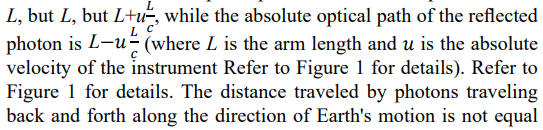
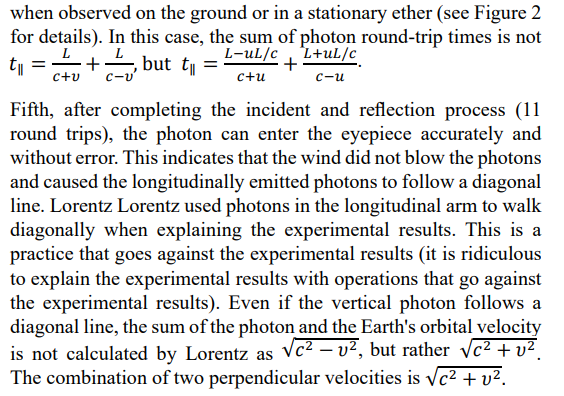
Sixth, the MM experiment and its accepted experimental results can only indicate that the experiment cannot measure the speed of the Earth's orbital motion, not necessarily the speed of the Taifeng wind. There are two reasons: firstly, the speed υ used in the method of predicting experimental results is the Earth's orbital velocity rather than the speed of the ether wind or the absolute velocity of the Earth; Secondly, the ground system is not a truly flat space, but a space with a strong gravitational field (and the gravitational field is uniform within a small range). We cannot rule out the possibility that 'this experiment proves that in terms of pulling photons, the ether wind is inferior to the gravitational field in the Earth's surface system'. It is very difficult to believe that it can verify that 'there is no such thing as ether wind'.
The traditional explanation of the MM experiment does not exclude the gravitational field's pulling effect on photons, and the experimental result can be explained by the statement 'Earth's gravity can 100% pull photons'.
Seventh, the ideal absolute stationary coordinate system is a flat spatial system (with only a coordinate framework). Even if it exists, it does not necessarily need to be too ether or ether wind. That is to say, the absolute stationary system can completely avoid ether and ether wind. Before the early 19th century, the ether in the ether wind theory was a substance. If it really exists, then the space filled with ether is not a flat space. So strictly speaking, proving the non existence of the ether wind does not mean proving the non existence of an absolute stationary system with a flat space.
There is a significant difference between the Taifeng theory and the correct theory that includes the argument of the existence of absolute stationary systems. One reason is that they recognize different objects of absolute stillness and absolute motion: on the one hand, the theory of ether wind recognizes that Tai is absolutely stationary, and on the other hand, it recognizes that the ether, which is absolutely stationary, can move to form ether wind; The correct theory that includes the viewpoint of the existence of an absolutely stationary system does not believe that a system that is absolutely stationary can move (it is believed that only non absolutely stationary systems can move). The so-called ether wind refers to the spatial flow formed by the motion of an absolute stationary system. It is virtual rather than real. Even if it is real, observers can only feel this wind by standing in a system of absolute motion. The concept of 'Tai Feng' is not only contradictory in itself (the absolute stillness of ether movement into spatial flow logically makes no sense), but also leads viewers standing the wrong system to observe and draw false conclusions. The correct theoretical system of including the existence of absolute stationary frames wouldn't think that absolute stationary frames can move. The most reasonable conclusion can only be obtained by observing in an absolute stationary frame. It is inevitable that the MM experiment does not support incorrect predictions, as making predictions based on the premise of "absolute stationary ether motion" is a wrong behavior.
Furthermore, people have not used other experimental methods to exclude the influence of gravitational fields on photon propagation. On the contrary, the results of the Sagnac's experiment, along with the fact that "the time it takes for photons to travel back and forth between GPS positioning satellites and a point on the ground is not equal," seem to prove that the gravitational field on the ground has a pulling effect on photons. According to the principles of scientific research, scientific spirit, and dialectical judgment, this is clearly a major loophole. Based on this, it can be predicted that conducting MM experiments in the space station will result in much stronger persuasiveness.
In 1881 and 1887, people knew that the propagation speed of waves was independent of the movement speed of the wave source (such as the propagation speed of sound, etc.). That is to say, 'the speed of wave is independent of the motion state of the wave source' is not unique to photons. It is not unique to special relativity that light speed is independent of the moving state. It has a broad and solid experimental foundation of conclusions, namely facts). It is wrong (reckless) to bind it to the non-existent of absolute stillness together. It is easier to see this in the context of relative-absolute spacetime. At that time, the MM experiment used the velocity synthesis equations of c+v and c− v to predict the experimental results. This is equivalent to using the viewpoint of 'variable speed of light'. This operation violates the fact that 'relative to the ground system, the speed of light remains constant and isotropic'. Therefore, the prediction of 0.4 stripe movements based on the variable speed of light is incorrect.
In the perspective of relative absolute spacetime, Lorentz contraction is isotropic. Therefore, we do not consider the impact of Lorentz contraction on prophecy. Method (d) is to use the relative absolute spacetime view to make relative and absolute compatible, and then quantitatively predict the amount of stripe movement using 'isotropic light speed on the Earth's surface'. Under the premise of beam invariance (isotropic speed of light) in an absolute stationary frame or on the Earth's surface frame, the method and process for predicting the results of the MM experiment assume that the instrument moves to the right in the system (the direction of motion is the extension direction of the horizontal arm). The longitudinal arm length is equal to the transverse arm length (both L=2bd) During the process of a horizontally moving photon traveling from the half mirror to the reflecting mirror,
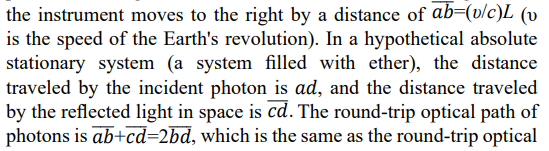
path of longitudinal photons. No interference fringe movement can be observed (see Figure 1). Back then, when explaining the phenomena of the MM experiment, everyone made the mistake of absolutizing Newton's view of spacetime. Special relativity has not proven, nor does it acknowledge the view that 'as long as the speed of light remains constant, absolute stationary frames cannot exist'. The relative absolute spacetime concept expressed by 'the clock of absolute motion slows down'. The viewpoint that the coordinate transformation between the absolute stationary frame and the inertial frame of absolute motion is still the Lorentz transformation directly allows for compatibility between "the constancy of the speed of light" and "the existence of the absolute stationary frame".
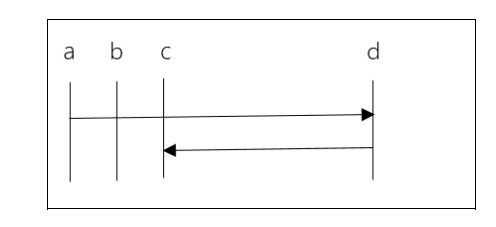
Figure 2: Predict (Or Explain) The Experimental Results of MM Using the Assumption That the Speed of Light Remains Constant in Absolute Space and Lorentz Transformation
The MM experiment can still be improved (it can be done in the space station), and a better and clearer alternative experiment can be found - using a geometric optical velocimeter to measure velocity (see the next section for details). This directly indicates that the MM experiment is no longer the most important experiment (although it was one of the relatively important experiments over a hundred years ago).
There are several better ways to validate the spatiotemporal view experiment as a substitute for the MM experiment. In this way, the fundamental status of MM experiments has significantly decreased.
The experiments to verify relativity and relativity absolute theory include: velocity measurement experiments using geometric optical velocimeters, high-precision electronic mass verification experiments, hollow glass disk Jones experiments, and high-precision atomic clock circumnavigation experiments (using solar powered unmanned systems instead of large aircraft to ensure uninterrupted flight around the Earth). If the same thickness of hollow glass disk and solid glass disk have exactly the same effect, it directly proves that the internal vacuum space of the moving hollow glass disk belongs to the same inertial frame as the glass. Otherwise, it is equivalent to proving that the carriage, base, and interior space of the moving train do not belong to the same inertial frame. In this case, the principle of special relativity does not hold: in a closed carriage, it is possible to distinguish whether the train is in motion based on mechanical experiments; For refraction passing through the glass vacuum interface, the law of refraction is difficult to maintain its form unchanged (when the glass changes its motion state). Refer to Figure 2 in Section 6 and Prophecy 1 in Section 7 for details. These experiments can verify whether the principle of relativity holds and whether a superior inertial frame exists. Especially the speed measurement experiments of geometric optical velocimeters and the Jones experiment on hollow glass disks. Compared with the MM experiment, it is much superior: easier to understand and explain, clear in context, and unambiguous. Some people may think that the explanation of Jones' experimental results on hollow disks can consider the mechanism of glass's attraction to photons, leading to the conclusion that there is a difference in the attraction effect between hollow disks and solid disks (which does not seem to fall within the scope of violating the principle of relativity). For this consideration, we can use a thought experiment to compare and analyze. This kind of thought experiment is to punch a small hole through the hollow disk, so that a bullet can pass through this hole exactly as the disk rotates. Due to the fact that the motion of the bullet conforms to the law of inertia, it can be foreseen that the cavity inside the hollow rigid rotating disk does not affect the longitudinal traction effect on the bullet (note: the motion of the bullet is considered as lateral motion). The difference in the 'traction laws and effects' of hollow rotating disks on photons and bullets is fatal to the covariant principle of special relativity.
The Hughes-Drever experiment detects the spatial anisotropy of the Earth's surface by utilizing changes in nuclear spin and orientation caused by the Earth's rotation. The experimental results can also be considered as “zero results”. At the atomic scale, the nucleus of lithium-7 or beryllium-9 atoms acts like a gyroscope, and the rotation of the Earth may not necessarily cause changes in the rotation of lithium atoms and the orientation of atomic nuclei in experiments. Even if lithium or beryllium atoms can rotate with the Earth, measuring instruments also rotate with the Earth. The instrument rotates synchronously with the target atom, but still cannot measure the changes in magnetic dipole and electric quadrupole interactions of the atomic nucleus. Even if lithium or beryllium atoms can rotate with the Earth, measuring instruments also rotate with the Earth. The instrument rotates synchronously with the target atom, but still cannot measure the changes in magnetic dipole and electric quadrupole interactions of the atomic nucleus. Hughes-Drever A common issue with the Hughes Dever experiment and the MM experiment is that both experiments were conducted in the Earth's gravitational field and did not consider the overall impact of the Earth's gravitational field on the experimental instruments and target objects. Is the gravitational field isotropic in a small area on the ground? Or is its impact on the instrument and target isotropic? The affirmative answer has not been ruled out, and the experimental conclusion drawn by everyone is still too hasty. There is a rigid water tank filled with water in space (where the water is isotropic). The instruments, observers, and target objects in this water tank will definitely not feel the movement of the water tank. It is inevitable to obtain zero results in conducting MM experiments and Hughes Dever experiments in such a water tank. This result does not prove the effectiveness of Lorentz invariance, but only proves that the water in the box is isotropic. In short, the ether is virtual, while the space filled with fields of matter and energy, which are the composition and structure of reality. Both the MM experiment and the Hughes Dever experiment did not rule out the wrapping and gripping effects of the gravitational field on the instrument and target object, so it is considered that the experiment proves the non-existence of ether (absolute static vacuum state space). They all have obvious logical loopholes. The spatial isotropy of the Earth's surface is determined by its composition and structure, not the nature of inertial frames.
The Derivation and Definition of The Concept of Absolute Stillness in Logic
Finally, search for experimental methods that can verify the existence of absolute stillness or absolute motion. Among them, experiments that are easy to implement can be carried out by scientists with the conditions.
There are various situations where an absolute stationary system is required logically. Firstly, there is no reason for a system to move (a system that cannot meet the displacement requirements). Secondly, based on the definition of degrees of freedom in motion, logical reasoning can be made: a degree of freedom in motion of zero means there is no motion, that is, absolute stillness. Thirdly, a system that has the strongest ability to determine the changes in space-time due to motion based on its relative velocity is called an absolute stationary system. Fourthly, the system with the strongest ability to stabilize the path traveled by bosons. Fifth, standing within it, the system that can explain experimental and natural phenomena the most and best. Other logically required absolute stationary systems will be introduced later.
Only logically verifiable absolute stationary systems are theoretically recognized as real absolute stationary systems. Different forms of absolute stillness in logic must point to the same real system. The principle or basis for defining an absolute stationary system in logic will be introduced later.
From Corollary 1-6, it can be seen that in a flat space, the most reasonable state for path travelled by photons is absolute stillness. The consequence of this situation is that free photons in a flat space can only propagate in an absolutely stationary frame (even if the light source moves, the photons will automatically recover to propagate in an absolutely stationary frame after leaving the light source). The path network formed by the paths taken by multiple free photons in a flat space is an absolutely stationary grid.
Definition 1: A flat space system that can make the "path traveled by photons" emitted by bare light sources in different motion states stationary is a logically superior coordinate system (logically absolute stationary system).
Definition 2: The collection of paths taken by photons in the cosmic background radiation constitutes a logically absolutely stationary framework system. The path framework system traversed by this photon coincides with the overall space system of isotropic cosmic background radiation. This is the most closely related logical system of absolute stillness to things that are absolutely stationary. It has the same source and experimental basis as Definition 1. Definition 1 has the strongest verifiability. Another logical deduction method is as follows. The real-time path of photons will gradually become the path they have already taken. Therefore, these two photon paths must be consistent in terms of their absolute rest characteristics. That is, the path that a photon has already traveled in a vacuum (flat space) is absolutely stationary, and the real-time path of a photon in a vacuum (flat space) is also absolutely stationary. In this way, the path of a large amount of microwave background radiation in space can anchor a logical framework of absolute stillness. This is the only type of absolutely stationary entity network (grid). The following will discuss the need for absolute stillness in various logical contexts. The movement of systems and objects requires space available for displacement. So, the infinite universe cannot move. If the total galaxy occupies all of the universe, then there is no space available for its center of mass to shift. The centroid system of a total galaxy can only be logically absolutely stationary.
Can the Big Bang provide power for the innate motion of the universe? The answer is no. Because there is no sufficient reason for the innate motion of the singularity in the universe. The Big Bang occurred at a singularity, and the force of the explosion radiated outward from this center (the thrust generated by the Big Bang is spherically symmetric), which cannot cause the center of mass of the universe to shift. Whether it is the Big Bang that opened up space or the Big Bang that occurred in the infinite universe, the "expansion motion of the total galaxy" is not the motion of the center of mass of the total galaxy relative to the infinite universe. If there is no matter or space outside the total galaxy, that is, the total galaxy is the entire structure of the universe, it is very similar to an infinite universe (in terms of motion difficulty).
Definition 3: The infinite universe space system is a logically absolutely stationary system.
In quantum field theory, a vacuum contains a large number of fleeting pairs of virtual particles. Many virtual particles can still be materialized. Special relativity holds that the space of each inertial frame is infinite. However, in the universe, there is only one truly infinite space. This determines that the spaces of different inertial frames can only be stacked together. Who should this unique infinite space belong to? Special relativity recognizes that whoever observes, this infinite space belongs to; Whose space belongs to whom will be carried by whom to move together; Including massive pairs of virtual particles in space. However, logically speaking, these particle pairs as a whole cannot be carried in one direction by an inertial frame and in countless other directions by countless other inertial bands (it is impossible to change the inertial frame for countless virtual particle pairs as the observer changes their motion state). Or in other words, it is impossible for an inertial frame to move together with its infinite extension of space, or in other words, the equal rights of "different inertial frames moving together in a space filled with virtual particles" can only be a false equal right, which is the visual equal rights after cutting off the history of motion.
Definition 4: The infinite and unique space filled by many pair of virtual particles is logically an absolutely stationary space.
In the macroscopic theoretical framework (especially in the framework of special relativity), the acquired motion of a system and a quantum decoherent object requires two basic conditions: there is space available for displacement and a power source. Moreover, these two conditions are mutually restrictive. The inertial motion of an object or system is theoretically sustainable, but if there is no space available for displacement, it cannot be assumed that the object or system has innate and acquired inertial motion. Objects or systems that do not meet these two conditions can only be logically stationary and are absolutely stationary. The first thrust of the center of mass translational motion of a total galaxy requires enormous energy. From the law of conservation of energy, it can be seen that there is no reasonable source for this energy. The system connected to the center of mass of the total galaxy, the infinite universe, is constrained by these two conditions, and it cannot be certain that they have innate and acquired inertial motion (even quantum like motion does not exist). Logically, they can only be considered as absolutely stationary. Can we consider the motion of the center of mass of the total galaxy relative to a small celestial body inside the total star? This needs to be divided into two situations. Firstly, following the approach of special relativity, we sever the connection between motion and its causes (i.e., the connection between the history of motion and equilibrium motion), and only consider the section of uniform translation. In this case, it is possible to only consider the relativity and epigenetics of motion (only considering visual motion). Secondly, respect the reality and consider the entire process of development of things (the entire process of movement). The motion of the total galaxy and the motion of a small celestial body in the system are asymmetric in terms of their causes of motion. The reason is that the motion of small celestial bodies can originate from a collision, other interactions between celestial bodies, or remnants of the thrust from the Big Bang; The mass center motion of the total galaxy cannot find such a large power source. The asymmetric motion history of two systems in relative motion means that the strength of their motion reality is asymmetric (inconsistent). Moreover, the quality of the system varies, and the priority of motion (or stillness) is not equal. There is no reason to say that an object in reality has innate motion. Under this premise (without cutting off the history of motion origin), the greater the mass and the smaller the thrust it receives, the greater the priority of absolute stillness. The system with the highest absolute static priority is the one with infinite mass and infinitesimal thrust (without the first thrust). Except for particles with quantum coherence.
Definition 5: The centroid system of a system with infinite total mass is the system with the highest absolute stationary priority, and it is also the logical absolute stationary system. The extended meaning of this definition is that the cosmic center of mass system, which cannot find a force that can accelerate it in the entire universe, is logically an absolute stationary system. Logically, the absolute stillness obtained by the above methods can only point to the same system. An absolutely stationary system is the most superior system.
Logically, there cannot be multiple superior systems in a universe. It is no longer just a pure mathematical coordinate framework (mathematical coordinate framework is just its abstraction). This is the "multi-path convergence" argument method, which can greatly enhance the persuasiveness of the conclusion. In the theory of special relativity, the most superior system is an absolutely stationary system. We accept this. Whether the absolute stationary system in logic is a superior system requires further verification. Among the empirical methods provided in this article, the Jones experiment on a hollow glass disk, the more accurate atomic clock bi-directional circumnavigation experiment, and the "velocity measurement experiment using a geometric optical velocimeter on a spacecraft" are good validation experiments.
In short, the absolute stillness system in logic refers to the absolute stillness system required for logical reasoning based on human basic knowledge. Including superior systems that track gradients to the end based on experimental facts. Used to explain the system with the least logical contradictions observed in experimental phenomena. It is the most powerful flat system that stabilizes the path and direction of photons emitted by bare light sources in reality. The absolute stillness in logic is the most rational, superior, infinite quality and spatial system, and the real system with the highest priority of absolute stillness. The absolute stationary system is a spatial and coordinate framework system that eliminates the entity matter.
Definition 6: An approximately flat space system with zero degrees of freedom in motion is a logically superior system. The stronger the objectivity of movement, the stronger the function that determines the effects of movement. For approximate inertial frames, there is experimental evidence to support this (such as the bidirectional circumnavigation experiment of atomic clocks). We cannot deny that this characteristic does not exist for inertial frames. In ground systems, the kinetic energy, momentum, Newton's first law, and Newton's second law of motion of objects all hold true (strictly speaking, they hold approximately, and hold very well). However, for the physical laws of spacetime that change due to motion, experiments have shown that ground systems have poor ability to ensure the covariance of physical laws. Generally speaking, there is only a quantitative difference between an approximate inertial frame and an ideal inertial frame, but they are qualitatively consistent. However, in terms of the laws of mechanics, the ground frame is a good approximation of the inertial frame, but for the timing function of atomic clocks that changes due to motion, surprisingly, a small increase in the degree of approximation led to a reversal in the qualitative conclusion (In reality, the high probability events that people see are those where a small change in the degree of approximation of the cause can only lead to a corresponding quantitative change in the result, rather than a qualitative reversal of the result). This is the inconsistency in the ability of different systems to ensure the covariance of different laws of physics. The greatest difficulty lies in maintaining the covariance of geometric optical laws. The Jones experiment proves that the law of refraction does not hold in an inertial frame of motion relative to the ground motion.
we can refine "the increase in energy of a moving object" to "the increase in absolute energy of an object in absolute motion. Under this premise, the existence of an absolute stationary system is a logical permission. This is the absolute stillness allowed logically.
Basic Premises and Derived Conclusions
To achieve the goal of successfully coordinating relativity and absoluteness, we take experimental facts as the starting point, screen out the positive achievements of relativity and Newton's theory, and then use the definitions of meters and seconds, with the logic connecting physical mechanisms as the main line, to derive the basic premises and principles of the relative-absolute spacetime view and the relative-absolute theory through induction. It is ‘the absolute energy of an object increases due to absolute motion’. The statement ‘the clock slows down due to absolute motion’ is an important inference (and also a very accurate inference. See the next section). Due to the concise and easier to understand expression 'the clock slows down due to absolute motion', we often use the latter expression instead of the former without causing any misunderstandings.
Verification Experiment of Energy Velocity Relationship and Mass Velocity Relationship
The fact that the energy of an object increases due to motion has been rigorously confirmed by a large number of experimental engineering applications. The absolute energy of an object increases due to its absolute motion is included in the energy of an object increases due to motion. Therefore, 'the absolute energy of an object increases due to its absolute motion' is no longer a purely scientific hypothesis. Moreover, the theme of this article is also about the reliability and superiority of the theory of relative absolute spacetime, as well as its verification experiments. There are several core validation experiments to verify the "mass increases due to motion, energy increases due to motion, and mass energy equivalence": Cockcroft Walton experiment (1932); Electron positron annihilation experiment (mid-20th century); Nuclear binding energy measurement (modern nuclear physics); High energy electron deflection experiment; Kaufmann experiment. The most fundamental and important qualitative relationship validated by these experiments is that 'the energy of an object increases due to its motion'.
The kinetic energy velocity relationship in classical mechanics is
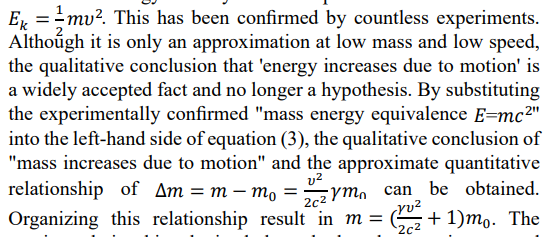
precise relationship obtained through thought experiments and achievable experiments is m=γm0. The process of reaching this conclusion and its quantitative relationship provides a physical mechanism for the increase of mass due to motion (clarifying that the increase of mass due to motion is not primary, and the increase of energy of an object due to motion is primary). It also indicates that it is not relativity and Lorentz transformation that have led to the conclusion that 'mass changes with motion', but rather the opposite, that the conclusion has led to the Lorentz transformation and relativity. The phrase 'energy increases due to motion' includes two types of content: 'energy increases due to absolute motion and energy increases due to relative motion'. Nevertheless, we still refer to the relationship between energy and absolute velocity as Hypothesis 1. The coefficient of the most representative core quantitative relationship is

Hafele Keating's clock experiment revealed that the functions and advantages of different approximate inertial frames are significantly different. The method of eliminating the twin paradox in relativity uses the approach of "cutting off the historical process of the generation of inertial motion and leaving different systems with different functional powers of inertial motion". The second fundamental assumption of this article (Hypothesis 2) is that absolute motion and relative motion have different functions and advantages, although it has logical and experimental clues (especially the advantage of the relative absolute spacetime view introduced in Section 4.1). After considering assumption 2, absolute motion effects take precedence among all motion effects. Based on the reasons provided in this article and the positive achievements of relativity, there are several expressions for the momentum velocity relationship and energy velocity relationship.
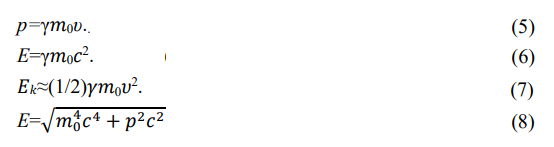
The Basic Premises and Concepts of Relative Absolute Spacetime and Relative Absolute Theory
The basic premise for constructing a basic conceptual system through theoretical analysis (logical analysis) in this article is: 1. The energy of an object increases due to its motion; 2. There are differences in the functions of absolute motion and relative motion; The extension direction of the path traveled by photons in a flat space is independent of the motion state of the light source and observer. There are two non-independent prerequisites: the coordinates of the absolute stationary frame and the coordinates of any inertial frame conform to the Lorentz transformation; In an absolute stationary frame, the magnitude and direction of the speed of light are independent of the motion state of the observer and the light source. These two are the connotations or derived conclusions of "the coordinates of any two inertial frames conform to the Lorentz transformation", and they are related to the positive achievements of relativity.
According to the conclusion that mass increases due to absolute motion and the definitions of seconds and meters, the conclusion that "spacetime changes due to absolute motion" can be strictly derived [5,6]. The mass increases due to absolute motion, and the Lorentz coefficient of spacetime changes due to absolute motion is also obtained based on logical and physical mechanisms.
Everyone has long known that the propagation speed of waves is independent of the movement speed of the wave source. Photons are no exception. The speed of light is independent of the motion state of the light source, which is not unique to special relativity, but a common characteristic of waves based on a large number of experimental facts. We are not blindly copying the premises of special relativity, but rather utilizing the positive achievements of special relativity. The author of this article also made a special statement different from special relativity: "When observed in a flat space, the direction of the speed of light is independent of the motion state of the light source.
It has been clearly pointed out above that 'the clock slows down due to absolute motion' is the basic premise of the relative absolute spacetime view. We can explain that this basic premise is not a fundamental assumption, but a conclusion and prediction that has been experimentally confirmed. Its meaning and prophecy include: 'The clock does not slow down due to relative motion'; Clocks with relative motion can slow down, speed up, or maintain a constant working speed; Whether the working rate of a clock in relative motion changes depends on the proportion of absolute velocity contained in the relative velocity. A typical example of only a mathematical mechanism (Lorentz transformation). It can be seen that although the two types of time change due to motion can be quantitatively consistent, the physical mechanisms of change are different. This leads to some events that can cause trouble for special relativity (for example, the theory of relativity is disconnected from practice). absolute motion included in relative motion is that due to the absolute motion of the Earth, the relative motion of an aircraft to the ground also includes a certain proportion of absolute motion. The above prediction has been confirmed by the results of the atomic clock's bi-directional circumnavigation experiment (some clocks on the plane have become faster and some have become slower compared to clocks on the ground. The speed of clocks is not determined by relative motion speed). As long as it is proven that the speed of some clocks is not determined by relative motion speed, or that "different approximate inertias are not always equal rights," the universality of the principle of special relativity will be challenged.
The Derived Conclusion That the Mass of Absolute Motion Increases
Seconds are the fundamental unit of time, defined based on the constant properties of atomic physics. The definition of second in the International System of Units established in 1967 is: second is the duration of 9192631770 cycles of radiation corresponding to the transition between two hyperfine energy levels in the ground state of cesium-133 atom. The definition of the benchmark length meter established in 1983 is: meter is the length of the path that light travels through in vacuum at a time interval of 1/299792458 seconds. According to this definition, the readings of time and space measured by real clocks and rulers are logically related to the quality of electrons. The energy level formula for hydrogen atoms

the reduced mass of the electrons). The energy level formula for cesium atoms is also similar. The reduced mass μ increases due to motion, and the absolute value of the energy levels will slightly increase. The difference ΔE between different energy levels will also increase accordingly. The frequency of photons emitted by electrons at different levels increases and the period decreases (because the energy frequency relationship is ΔE=hν). Without a doubt, the definition of seconds refers to the logical connection between time and the frequency (reciprocal of the period) of the radiation produced by the electron jump. In atomic and molecular theory, the frequency of radiation generated by electron jumps is related to the mass of the electrons. In this way, the working rhythm of atomic clocks (indicated time) is logically related to the mass of atoms (including the mass of electrons). The impact of the mass increase caused by the movement of atomic clocks will ultimately be reflected in the working rhythm of the clock (i.e., in the time readings recorded by the clock during the time period). This is the physical mechanism by which motion causes changes in time readings for physical objects. However, special relativity does not consider the composition and structure of matter. In special relativity, the expansion of time has no physical mechanism only a mathematical mechanism (Lorentz transformation). It can be seen that although the two types of time change due to motion can be quantitatively consistent, the physical mechanisms of change are different. This leads to some events that can cause trouble for special relativity (for example, the theory of relativity is disconnected from practice).
The Bohr radius of a hydrogen atom is  This indicates that an increase in mass due to motion will result in a decrease in the radius of the hydrogen atom or the distance between molecules in solid hydrogen, and the volume of the solid hydrogen block will contract due to motion (similar to the case for other macroscopic objects). The method and physical mechanism used to derive the conclusion that "spacetime changes due to motion" under the premise of "energy increases due to motion" are described in references [5,6]. However, in the context of this article, the Lorentz transformation is no longer the mathematical foundation of relativity, but merely one of its mathematical tools. The process of introducing the concept and theoretical system of the relative-absolute spacetime view and relative-absolute theory in this article (especially in the above two sections) is a process from concreteness to abstraction (using induction). It is contrary to the construction process of special relativity. The construction process of special relativity involves moving from abstraction to predicting specific processes and phenomena based on the mathematical results derived from abstraction (employing deductive reasoning).
Qualitative and Quantitative Methods Integrating Relativity and Relativity-Absolutism
The derived conclusion combining Hypotheses 1 and 2 is: that clock slows down due to absolute motion, and objects in absolute motion undergo four-dimensional contraction. Relative motion (apparent motion) does not possess these two functions. However, when using relative velocity and relative momentum energy values in the method of difficulty measurement, the changes in momentum and kinetic energy determined by apparent motion and relative motion are approximately objective and effective. The reason is that macroscopic objects conform to the law of inertia, and relative motion is approximately objectively valid for Newton's law of inertia. This also determines that the theory of special relativity still has certain applicable scope and positive significance. For the physical mechanism of the spatiotemporal variation of absolute motion, please refer to reference [5,6]. In terms of the propagation of photons and the factors influencing spacetime variations, the span (range) of relative speed (apparent motion speed) errors is very large.
The momentum law under the background of different functions of absolute motion and relative motion is shown in equation (9), and the kinetic energy is shown in equation (6).

of the object. Fq. (9) applies to the scenario where a relatively moving object collides completely elastically with an iron wall in an inertial system. If the elastic collision occurs between two small balls, the expression of the law of momentum is
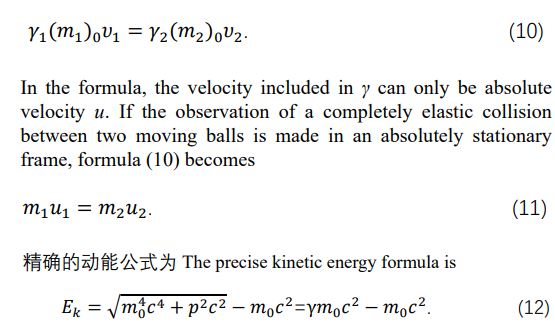
In the formula, momentum p=γm0u
From equations (5) - (12) and m = γm0 , it can be seen that in the context of the relative-absolute spacetime viewpoint, the qualitative increase in an object's momentum and energy due to relative motion remains correct. It is only quantitatively descripting more complicated than the description in the theory of relativity. Taking formula (4) as an example, the velocity in γ represents the absolute velocity u, while υ can represent the relative velocity. Only when υ is also the absolute velocity (i.e., u=υ= absolute velocity) does formula (4) become the most concise and accurately express the concept of "the kinetic energy of an object in absolute motion increases". If u≠υ, and u represents absolute velocity while υ represents relative velocity, the above 12 equations can quantitatively reconcile the expressions of physical laws relating to relativity and absoluteness (when the absolute velocity in these equations is treated as relative velocity, they become approximate expressions of physical laws in the context of relativity). "The clock runs slower in absolute motion" and "objects contract in absolute motion" are qualitative expression methods that reconcile relativity and absoluteness
The mathematical expression for Newton's second law is
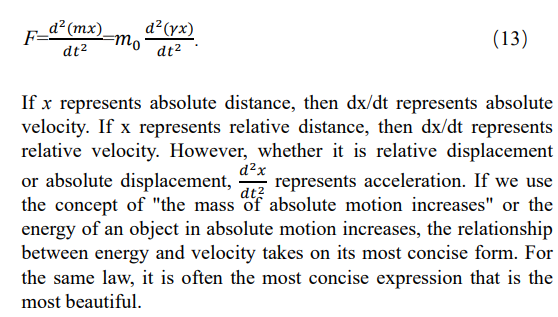
For quantitatively coordinating the relationship between relative and absolute, in addition to equations (3) - (12) and (14)-(17), there are also methods that consider the quantitative difference between relative velocity and absolute velocity.
This is also a discussion about whether all experimental results only support relativity theory and cannot be explained by the concept of coordinating relativity and absoluteness. The quantitative relationship between relative and absolute can be expressed using accurate equations.The viewpoints of "the clock of absolute motions slowing down, the ruler of absolute motion shorten, and the Lorentz transformation holds between the absolute stationary frame and the inertial frame of absolute motion" determine that the Lorentz coefficient is

In the equation,  ` is the absolute velocity of the inertial frame K in which the observer is located, and ` is the relative velocity of the observed object in the K frame. Equation (14) originates from the statement that the Lorentz transformation holds between an absolute stationary frame and an inertial frame of absolute motion, and that the coordinate transformation between any two inertial frames is a combination of coordinate transformations between two sets of absolute stationary frames and an inertial frame of absolute motion [17] (in the case of absolute velocity and relative direction). The absolute velocity of the Earth 63 years ago calculated by reference [10] is approximately 0.0005c (assuming that "measurement errors are entirely caused by the use of apparent velocity" calculation results). Therefore, at least the quantitative results of high-energy physics experiments conducted on Earth (experiments where the relative velocity of the measured object is greater than 0.0005c times) are very close to the results considering only relative velocity. According to equation (14), the relative error RE of relativistic effects calculated based on relative velocity and absolute velocity can be estimated.
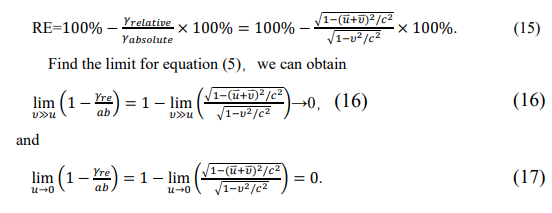
For equation (15), it can be seen that when |υ| is much greater than |u|, and u→0, calculating the motion effect based on relative velocity results in minimal error. If the relative velocity of the object being measured is 100 times the absolute velocity of the Earth and in the same direction, the relative error calculated according to (15) is RE=100%−99.9974%=0.0026% (where u and υ are relatively small) For  , the difference in calculation results between "using Lorentz velocity synthesis method" and "directly summing" is minimal. If the directions of the two speeds are not the same, this error is less than 0.0026% This calculation result indicates that when the relative velocity differs from the absolute velocity by 100 times, if the allowable error is not greater than 0.0026%, the interpretation of experimental results based on relative velocity is consistent with the interpretation of experimental results based on absolute velocity within the allowable deviation range. The condition of υâ?«u is equivalent to the condition of υ ± u → υ. If the size relationship between u and υ is υ=0.000005c, u=0.0005c, when u and υ are in the same direction, the calculation result is RE= −0.00000025%. When u is in the opposite direction to υ, RE=0. 00000025%. This quantitatively indicates that due to the relatively low absolute velocity of the Earth, low-speed experiments conducted on the Earth's surface are also consistent with relativity. Equations (14) and (15) are quantitative methods that reconcile relative and absolute.
Example calculations demonstrate the effectiveness of quantitative coordination. It can be seen that using the relative absolute spacetime concept of "the clock of absolute motion slowing down, the ruler of absolute motion is shortening, and the mass of absolute motion is increasing" can qualitatively coordinate relative and absolute, as well as quantitatively coordinate relative and absolute.
The analysis results here are combined with the discussion in the previous chapters on the phenomenon of predicting circumnavigation experiments in the north-south direction. It seems that the phenomenon of "a large number of experimental facts unanimously supporting the prediction of special relativity" is not a good material to deny the "relative absolute" spacetime view. All experiments related to special relativity conducted on Earth use relative velocities, but some of these relative velocities also include real motion, and people pay more attention to real motion. Taking the circumnavigation of atomic clocks as an example, the motion of clocks on airplanes is considered as real motion, while the relative visual motion of clocks on the ground observed by pilots is not taken into account. The relative visual motion between the two clocks sailing east and west was also not taken into account. The actual velocity of the electron emitted from the accelerator is the relative velocity of the high-speed electron relative to the accelerator minus the absolute velocity of the Earth. These are the reasons why using relative velocity can sometimes yield approximate conclusions that are in line with reality. Absolute motion is also a relative motion in a relative absolute stationary system. The absolute stationary system is the most superior, while the relative absolute stationary system has the strongest motion function. However, measuring absolute velocity is much more difficult than measuring relative velocity. Most of the time, directly using the calculation results of relative velocity is effective. Therefore, the positive results of the relative space-time view still have great usefulness. So, the relative absolute view of time and space does not completely deny the relative view of time and space.
Coordinate Theories, Technologies, And Applications of Relativity and Absoluteness
Establishing the theory of relativity and absolutism [1-4], acknowledging that the clock slows down due to absolute motion and the ruler of absolute motion shortens, and “that the mass and the energy increased by absolute motion” is a good solution that can first come to mind—the method and technology of reconciling relativity and absolutism. It can make the development of physics theories conform to the spiral upward law of absolute→relative→relative-absolute. Avoiding the binary opposition between relative and absolute. Successfully severed the connection between the existence of absolute stationary systems and the "absolute spacetime view", while also breaking away the connection between the "relative spacetime view" and the rigidity of "no absolute stationary system and absolute motion". Established a compatibility relationship between relative and absolute. It is possible to establish a new view of time and space: The "relative-absolute" spatiotemporal concept that can coordinate the relative and absolute. From a dialectical perspective, adhering to a "relative absolute view of spacetime" that can reconcile relative and absolute is more dialectical than solely respecting relative and absolute views of time and space. There is reason to say that it is a progress in human understanding of the world.
The Efficacy of The Basic Premise: Harmonizing the Relative and The Absolute, With A Spiral Ascent in Spacetime View
The starting point and principle behind this is the different functions of different inertial motions (which can replace the principle of special relativity). The concept of "clock slowing down in absolute motion" is the most direct expression and technical method for reconciling the "relative-absolute spacetime view" of relativity and absoluteness. The development from a relative spacetime concept to a "relative-absolute spacetime concept" that can harmonize the relative and absolute is an advancement rather than a regression in human cognition, for the following reasons. The starting point and principle behind this is the different functions of various inertial motions (which can serve as an alternative to the principle of special relativity). The concept of "time dilation in absolute motion" is the most direct expression and technical method for reconciling the "relative-absolute spacetime view" of relativity and absoluteness. The reason why establishing a relative and absolute space-time concept is progress rather than regression is as follows.
It conforms to the objective existence of absolute things. The relative-absolute spacetime concept does not mean returning to Newton's absolute spacetime concept, but rather seeking certain elements of invariance and absoluteness as the cornerstone of physics, based on the recognition of the relativity and variability of spacetime (there are both invariant and variable things in nature, or invariance and variability can be compatible). For example: a. Time and space remain unchanged in an absolutely static system. b. In the system of absolute motion, time and space undergo changes (this also falls within the category of variable spacetime in motion). c. The extension direction of the path traveled by a photon in a flat vacuum remains unchanged. d. Objectivity of events and worldlines in four-dimensional spacetime (the occurrence of events in spacetime is absolute, but different observers may measure their temporal order and spatial distance differently).
a. Dialectical synthesis: It avoids the extreme of "everything is relative" and does not return to a rigid absolute background, but recognizes that "there is absolute within relative" and "there is relative within absolute". b. More in line with scientific practice: Physics must acknowledge the relativity of observation while pursuing objective quantities that are independent of coordinate systems (such as spacetime intervals, scalar curvature, etc.). c. Addressing the issue of quantum gravity: Some theories of quantum gravity, such as loop quantum gravity, emphasize background-independence, yet still retain absolute structures (such as discrete geometric quantum). String theory, on the other hand, may possess the absoluteness of perturbative backgrounds. This new framework attempts to unify relativity and absoluteness at a deeper level. d. Expansion of the scope of empirical explanation: Each new theory can explain phenomena that the old theory cannot, and includes the old theory as an approximation. e. Enhanced predictive ability: Relativity predicts the need for time corrections in GPS, black holes, etc.; the relative-absolute spacetime concept attempts to predict Planck-scale physics at the quantum gravity level. f. Increased depth of concept. From the externally fixed spacetime container, to the dynamic spacetime interacting with matter, and then to the deeper ontological structure (such as spacetime possibly emerging from more fundamental quantum information or relational networks), our understanding of "what spacetime is" is deepening. g. It is a philosophical dialectical progression [absolute spacetime view (thesis) → relative spacetime view (antithesis) → relative-absolute spacetime view (synthesis)]. This is not a return to the old absolutes, but a synthesis at a higher level. It acknowledges the relativity of measurement and perspective, but insists on the objectivity of physical reality and the existence of certain absolute invariants.
The above process g conforms to the law of error, which is conducive to resolving old contradictions and facing new ones. Some logical paradoxes in relativity, as well as the experimental results of atomic clocks during global flights, require better explanations. Science will inevitably progress to a new stage, facing new problems (such as the differences between accelerating force fields and real gravitational fields in terms of large-scale effects and gravitational potential delay effects, etc.). Scientific understanding progresses in a spiral manner. Each time old contradictions are resolved and new ones emerge, the replacement of old and new concepts marks the beginning of deeper exploration, rather than a step back.
In summary, the progression from an absolute to a relative, and then back to a relative-absolute view of spacetime represents a gradual deepening and dialectical development of human understanding of the essence of spacetime. Each transformation broadens the scope of theoretical application, enhances prediction accuracy, and deepens conceptual unity, thus marking progress in cognition. The "relative-absolute spacetime concept" is not a throwback to the past, but rather a philosophical and conceptual preparation for constructing a more fundamental quantum gravity theory, based on the revolutionary achievements of relativity. It attempts to answer the fundamental question of physics, "What is invariant?" at a deeper level.
Innovation in Research Paradigm and Theoretical Paradigm
|
Comparative Content |
A. Relativity, relative spacetime concept |
B. Relative-absolute theory, relative-absolute spacetime concept |
The core difference between A and B |
|
1 |
The theory of relativity is based on the Lorentz transformation and/ or geometry, and uses deductive methods to establish a theoretical framework and make theoretical predictions, lacking the physical mechanisms of change and interaction |
Relativity theory is derived from experimental facts and production practices, using logical methods to connect physical mechanisms to obtain basic premises, establish theoretical frameworks, and deduce the Lorentz transformation |
A employs a method of exploring physical mechanisms that lack interaction and change, using deductive reasoning to establish a theoretical framework. B, "takes facts as the starting point" and uses logical methods to link physical mechanisms, thereby forming a theoretical framework and the mathematical foundation of the theory (employing inductive reasoning) |
|
2 |
The clock slows down due to the introduction of motion |
Clocks in absolute motion slow down |
A rejects absolute. B reconciles relative and absolute |
|
3 |
All inertial motions have the same function and equal power |
Relative motion and absolute motion differ in their functions and possess unequal powers (see Section 6.1 for experimental and logical foundations) |
A does not have superior inertial motion. The logical conclusion of B can change people's existing old observations |
|
4 |
Absolute motion and absolute rest are unverifiable |
Absolute motion and absolute rest are verifiable |
B designed instruments and methods for absolute motion |
|
5 |
The decisive experiment of special relativity is the MM experiment |
Validation experiment: speed measurement experiment using a geometric optical speedometer, and Jones experiment with a hollow disc |
Compared with the MM experiment, the speed measurement experiment using a geometric optical speedometer has obvious advantages (especially the ability to directly measure the absolute speed of the observer) |
|
6 |
Denying the existence of an absolutely static system |
Based on the necessary conditions for displacement and various other factors, we can predict and define the existence of absolute logical stillness |
B's logical reasoning, prophecy, and verification methods serve as the logical foundation for seeking and verifying the existence of an absolutely stationary system, as well as the precursor to the relative-absolute spacetime concept |
|
7 |
An observer cannot measure his own speed |
The superiority order of different approximate inertial systems can be found through experimental methods |
The conclusion of B can change established old beliefs |
|
8 |
There is no superior inertial system |
The superiority order of different approximate inertial systems can be found through experimental methods |
B. Following this order of superiority, one can trace back to a most superior system. A. Being bound by old observations, this line of thought was overlooked |
|
9 |
Prophecy: For the hollow disc Jones experiment, the gap in the glass disc can not affect the traction effect |
Prophecy: For the hollow disc Jones experiment, the gap in the glass disc can affect the traction effect |
In addition, B also made multiple prophecies that A cannot make |
|
10 |
It cuts off the historical process of motion formation and fails to consider the physical mechanism of motion and change of things |
Taking into account the historical process of the formation of motion, we should attach importance to the physical mechanism of the motion and change of things |
The approach taken by A results in an incomplete theory, a detachment of theory from reality, and low engineering application value of the theory. Using real clocks and rulers to experimentally verify relativity theory poses logical obstacles. The approach taken by B can avoid these issues |
|
11 |
Different observers cannot reach a consensus on the degree and order of changes in things due to motion, and it is rudely prohibited for observers in different inertial frames to use signal communication |
Observers in different inertial frames can generate consensus, allowing observers in different systems to communicate using signals |
The act of rudely prohibiting observers from different systems from exchanging information (observed results) is not determined by the logic of the theory itself. If there is scientific law, such behavior is in violation of scientific law. B does not exhibit such behavior |
|
12 |
It is believed that simultaneity in different places is relative |
Believe in absolute simultaneity. The simultaneity factor is a reflection of the Doppler frequency shift pattern |
B explains the reasons why Lorentz transformation is applicable in electrodynamics |
Table 2: Several Manifestations of Paradigm Innovation
Prophecies That Can Be Made in This Article but Cannot Be Made by Relativity Theory
Corollary 1 and 2 determine that the "Jones experiment result of hollow glass disk" must be that the cavity in the glass disk does not contribute to the pulling of photons, and this cavity does not belong to the same inertial frame as the moving glass disk.
This section discusses the relative ground motion of the Jones Tu device. Jones' experiment proved that the path that a photon has already traveled will remain in a superior system (at least in a relatively stationary system). This provides a new reason for the conclusion drawn in the section "Existence of Absolute Invariant Things—The Direction of Extension of the Path Traveled by Photons in Vacuum is Absolute Invariant"—that the direction of extension of the path traveled by photons is absolutely unchanged. The next section will introduce the situation of sending instruments to the space station and using the motion of the space station instead of the rotation of the glass disk. According to the Jones experiment phenomenon, it can be predicted (the first prophecy in this article: Prophecy 1) that replacing the solid glass disk used in the experiment with a hollow glass disk, the longitudinal pulling effect of the disk rotation on photons is not related to the cavity of the hollow disk, but only to the sum of the thicknesses of the two layers of glass. That is, the cavity inside the moving disk cannot longitudinally pull photons. This is equivalent to: for photons, the space inside the high-speed moving train is not the space in the train system. This will bring great trouble to special relativity (optical laws have different forms in ground systems and systems of relative ground motion). Because, in a flat space, the direction of light speed is independent of the longitudinal motion state of the light source, and the longitudinal motion of the light source cannot pull photons longitudinally. In this way, in different inertial frames, the path traveled by photons only rest in the only one single flat space. This unique flat space system is clearly a superior system. Under this premise, if there are chaotic electromagnetic waves (or photons) like cosmic background radiation in this infinite flat space, then the paths taken by these photons constitute a logically superior framework system related to entities. The experiment to verify this prophecy and its implications can be relatively easy to implement. Readers who have the conditions are requested to apply for funding to conduct this significant experiment. The value of the geometric optical velocimeter mentioned later is also determined by the significance of this prophecy. We can provide a definition of a 'superior system'. Definition 1: A flat space system that can make the "path traveled by photons" emitted by bare light sources in different motion states stationary is a logically superior space system. Note: The flat space system referred to here is an ideal system, while a real system can be an approximate flat space system.
Modify the single arm geometric optical velocimeter designed in the section "the difference in longitudinal traction between photons and electrons revealed by Jones' experimental phenomenon" to a "dual gun, one screen" single arm geometric optical velocimeter without rotating the device (the receiving screen is connected to the firing gun). After zeroing on Earth, it is sent to the space station. The author‘s prophecy (Prophecy 2) is that photon rays and electron rays can be separated to form a state with a non-zero angle α (the reason is that we add a real motion to the speedometer and has replaced the motion of the glass disk with the motion of the space station). Continuously changing the orientation of the instrument will result in a change in the magnitude of the angle β produced (when the space station is moved to different longitudes above the Earth, and/or in different seasons, and/or when the orientation of the instrument is changed, the magnitude of the angle α produced will vary). This prophecy was made based on the Jones experiment results shown in Figure 1. From Figure 1, it can be seen that the incident angle is π/2, while the incident angle is α [α ≠ π/2]. This violates the principle of relativity that the law of refraction covariates in different inertial frames. Therefore, this prophecy cannot be made by special relativity.
The author's third prophecy (Prophecy 3) is that the measured velocity u is between 0.0005c and 0.002c (provided that the aircraft flies high enough. If it does not fly high enough, this estimate decreases with a certain gradient, and the observer cannot measure their own motion velocity while stationary on the ground). Unable to find a reference object for the measured laboratory system's motion speed, logically, it can only be considered as referencing the motion speed of the most superior system. In this way, it must be acknowledged that different inertial frames are not equivalent. Special relativity has always believed that observers in an inertial frame can only assume that others are in motion. This experiment can prove that the experimenter themselves is in motion and different inertial frames are not equivalent, which is quite detrimental to special relativity. It is precisely this logically required superior system that preserves the longitudinal motion path of photons, causing the experimenter to move relative to the path that the photon has already taken. The most superior system is the logically absolute stationary system. Regardless of whether readers do not believe the author's viewpoint, it is at least worth discussing. The outcome of the discussion will affect the direction of theoretical research.
The theoretical calculations above indicate that observing from within the solar system can better explain the results of the atomic clock's bi-directional circumnavigation experiment. This is also the fourth Prophecy (Prophecy 4) in this article. Unfortunately, the accuracy of the Hafele Keating experiment is too low to accurately verify. If anyone could redo the bidirectional circumnavigation experiment of the atomic clock (using solar powered drones, no longer sailing in stages, and speeding up the navigation speed, greatly improving the experimental accuracy), that would be great. This can verify the author's prediction and also verify that the solar system is superior to the non-rotating geocentric system. As long as the ground system is not superior to the non-rotating Earth's center of mass, the non-rotating Earth's center of mass is not superior to the solar system, the solar system is not superior to the Milky Way, and the Milky Way is not superior to the total galaxy, the most superior is the absolute stationary system with zero degrees of freedom of motion. This is a tracking method along the gradient of motion degrees of freedom and superiority of the system. The tracking result can have a logical absolute stationary system (this is the second logical stationary system in this article).
Thinking of the Foucault pendulum, we firmly believe that there are other ways to prove the superiority of the solar system over the non-rotating Earth's center of mass system. Prophecy 5: As long as the accuracy of the Foucault pendulum experiment is significantly improved, the Fourier pendulum can be used to discover the effect of the Earth's revolution on its rotation by (1/365) revolutions per day, thereby measuring the Earth's revolution speed. Replacing Foucault pendulum with a laser gyro to measure the Earth's orbital velocity. Thus, it can be qualitatively and quantitatively demonstrated that the solar system is superior to the non-rotating Earth's center of mass system in determining motion effects. We can trace along the gradient of system superiority to the most superior system. The principle of special relativity (or complete equivalence of different inertial frames) recognizes that the motion of different inertial frames has the same superiority in determining motion effects. Once the difference of “superiority of different systems” is proven through experimental methods, it is extremely detrimental to the principle of relativity.
Conclusion, Discussion
We will summarize and discuss from the following aspects.
(1) The compatibility between theoretical positioning of the relative absolute spacetime view and the extensibility of relativity. The core of the "relative absolute spacetime view" proposed in this article is to break the binary opposition between classical absolute spacetime view and special relativity theory. By anchoring the reference frame with the smallest degree of freedom of motion (such as the total galactic mass center and the cosmic background radiation framework), a "logical absolute stationary frame" is constructed to reconcile the contradiction between "absolute" and "relative" and form a more inclusive spacetime theoretical framework.
From a theoretical logic perspective, this viewpoint is not a negation of relativity, but rather a incorporation into a more complete system: relativity revolves around "formal symmetry" and emphasizes the formal invariance of physical laws in different inertial frames; The relative absolute view of time and space aims for "content unity" and pursues objective consensus among different observers on the same physical event. When the relative velocity of the reference frame is much greater than its absolute velocity, the calculation results of the relative absolute spacetime view approximately coincide with the Lorentz transformation of relativity (as shown in equations 15-17 in the text). This means that relativity can be seen as an approximate form of the relative absolute spacetime view under specific conditions, and the two have a progressive compatibility relationship.
(2) The hierarchical nature of inertial frames prompts people to reflect on the principle of relativity.
In the Hafele Keating experiment, different approximate inertial frames (ground system, Earth's center of mass system, solar system) showed a clear "superiority gradient" in explaining the results of atomic clock circumnavigation: the interpretation accuracy of the solar system was better than that of the Earth's center of mass system, which in turn was better than the ground system. This phenomenon suggests that the inertial frame in reality is not completely equal, but rather has a hierarchy related to the degree of freedom of motion—the smaller the degree of freedom of motion of the reference frame, the stronger its explanatory power for physical phenomena. Due to the fuzzy boundary between the approximate inertial frame and the inertial frame that meets the requirements of relativity, it is difficult to obtain the approximate inertial frame equality using experimental methods in this approximate inertial frame on the ground, and it is also difficult to classify it as "these experiments strictly verify the ideal inertial frame equality".
The assumption of "equality of inertial frames" in special relativity does not take into account the "historical formation process" of inertial frames, nor does it clarify the boundary between "ideal inertial frames" and "approximate inertial frames". The difference in the photon pulling effect between the moving medium (glass disk) and vacuum revealed by Jones' experiment further illustrates that the spatial membership relationship of the inertial frame is limited, which directly challenges the core assumption of the principle of relativity that "physical laws remain unchanged in all inertial frames" and highlights the necessity of the "logical absolute stationary frame" as the underlying reference frame in the relative absolute spacetime view.
(3) Experimental verification path optimization of absolute stationary system.
The "Geometric Optical Velocimeter" and "Hollow Glass Disk Jones Experiment" designed in this article provide a direct and unambiguous experimental scheme for verifying the existence of an absolute stationary system. Compared with the MM experiment relying on the "Tai Feng" hypothesis, the logic is more rigorous.
Geometric optical velocimeter: Using the longitudinal inertia difference between photons and electrons, the absolute velocity is calculated by measuring the particle deflection angle (equations 2-3 in the text). Considering that the space station is less affected by the gravitational interference of the Earth, if experiments are conducted in this environment, it is predicted that absolute velocities ranging from 0.0005c to 0.002c can be measured, which will directly prove the existence of absolute motion.
Hollow glass disk experiment: Replace the solid glass disk in Jones' experiment with a hollow disk, predict that the vacuum inside the cavity has no pulling effect on photons, distinguish the inertial frame attribution between vacuum and moving medium, and verify the independence of the "logical absolute stationary frame".
Future experiments can further optimize accuracy: Such as using lasers with higher stability and detection equipment with lower noise, reducing the impact of environmental interference on experimental results, and improving the accuracy of absolute velocity measurement.
(4) Physical Mechanisms of Spatiotemporal Changes: From Superficial Description to Essence Explanation.
Relativity focuses on the mathematical description of spacetime phenomena with Lorentz transformation as its core, but does not clarify the physical essence of why motion leads to spacetime changes. The relative absolute spacetime view starts from the "energy mass relationship" and constructs a clear causal chain: absolute motion → energy increase → mass increase → atomic clock slowing down/object volume reduction.
In contrast, the "relative motion clock slowing down" in relativity lacks physical mechanism support and cannot fundamentally explain logical dilemmas such as the "twin paradox". It can only be resolved through special assumptions such as "cutting acceleration processes" and "transferring observers". The situation with the relative absolute spacetime view is different, as it allows all observers to reach a consensus on the result of "clock slowing down", fundamentally avoiding such paradoxes.
(5) The Value of Paradigm Innovation and Future Research Directions. The concept of relative absolute spacetime follows a spiral development path of "absolute → relative → relative-absolute", demonstrating the potential for paradigm innovation at multiple levels.
On the theoretical level: The fusion of the "absolute stationary system" of classical absolute spacetime and the "spatiotemporal variability" of relativity provides a new research perspective for cutting-edge fields such as quantum gravity and string theory. For example, we can try to combine the "logical absolute stationary system" with the "absolute structure" of loop quantum gravity and the "background dependence" of string theory to explore a more unified physical framework.
At the experimental level: In addition to the experiments designed in the article, it can also guide the development of high-precision atomic clock circumnavigation, space station MM experiments,etc., to further examine the impact of absolute motion on space-time.
At the philosophical level: It breaks the thinking pattern of the binary opposition between relative and absolute, reveals the dialectical relationship of "absolute in relative", such as the absolute invariance of the path traveled by photons, and provides new scientific basis for philosophical thinking on the essence of time and space.
Future research needs to focus on three major directions: Firstly, to carry out "geometric optical velocimeters" and "hollow glass disk experiments" as soon as possible to verify theoretical predictions; The second is to quantify the correction values of absolute velocity for existing experiments such as particle collisions and astronomical observations, and improve the practicality of the theory; The third is to explore the correlation between the "logical absolute stationary system" and cosmological backgrounds such as cosmic microwave background radiation, and to verify the universality of spacetime theory at the cosmic scale.
The new role of the mathematical foundation of relativity: Relative absolute theory under the background of absolute spacetime theory is a positive achievement that includes both the relativistic spacetime theory and the absolute spacetime theory. The theory of relativity and absolute spacetime under the background of the theory of relativity and absolute spacetime is a positive achievement that includes both the t relativity spacetime and the absolute spacetime. What we have changed is only the scope of application of relativity (including the principle of relativity and the principle of the constancy of the speed of light), and the role of the mathematical foundation of relativity has not been eliminated (to some extent, it can be used as a verification method for the relative absolute spacetime view and the relative absolute theory). From another perspective, the mathematical formal system of relativity can be preserved, and we only consider it as a purely mathematical tool.
References
-
- Einstein, A. (1905). Zur Elektrodynamik bewegter Körper.Annalen der Physik, 322(10), 891–921.
-
- Jones, R. V. (1971). Aberration of light in a moving medium.Journal of Physics A: General Physics, 4(1), L1.
-
- Jones, R. V. (1972). ‘Fresnel aether drag’ in a transversely moving medium. Proceedings of the Royal Society of London. Series A, Mathematical and Physical Sciences, 328, 337.
-
- Jones, R. V. (1975). ‘Aether drag’ in a transversely moving medium. Proceedings of the Royal Society of London. Series A, Mathematical and Physical Sciences, 345, 351–364.
- Lorentz, H. A. (1892). The relative motion of the Earth and the aether. Zittingsverlag Akad. V. Wet., 1, 74–79.
- Michelson, A. A., & Morley, E. W. (1887). On the relative motion of the Earth and the luminiferous ether. American Journal of Science, 34(203), 333–345.
- Tu, R. (1996). Relative absolute theory. Journal of Ningxia Institute of Technology, 8(2), 105–110.
- Tu, R. (2008). Asymmetry in retarded effects of fundamental interaction has far-reaching influence on electromagnetics and the theory of relativity. Scientific Inquiry, 9(2), 131–146.
- Tu, R. (2012a). Relativity principle brings about trouble for electrodynamics. Infinite Energy, 101, 53–54.
- Tu, R. (2012b). The essence of absolute relativity. Doc88.
- Tu, R. (2013). Relativity has not solved the problem of experimental verification well. In F. S. Florentin (Ed.), Unsolved problems in special and general relativity. Education Publishing & Journal of Matter Regularity.
- Tu, R. (2015). Some experiments supportive of relativity theory contain data that does not support the theory. Infinite Energy, 123, 35–43.
- Tu, R. (2022a). 4D space-time contraction PK 2D Lorentz contraction. International Journal of Scientific Reports, 8(7), 184–189.
- Tu, R. (2022). Relativistic effect of non-rigid in motion: Volume contraction in all directions; space around it warped. Physical Science International Journal, 26(2), 34–46.
- Tu, R. (2025). Principle of energy equilibrium shift and relative-absolute spacetime view. Adv Theo Comp Phy, 8(4), 1–14.
- Tu, R. (2026). Research progress on relative-absolute spacetime view: Logical basis, experimental verification, and paradigm innovation [Dataset]. Figshare.
- Tu, R. (2026). The centripetal acceleration does not have the function of causing spacetime bending, which seriously affects the equivalence principle. Zhihu.
- Li, Y. (1987). Relative absolut theory. Foreign Trade Education Press.
- Liu, Z. (2007). Relative absolut theory. Atomic Energy Press.
Supplementary Material
A. The Advantages and Characteristics of The Relative Absolute View of Time and Space
|
Comparative content |
The particles in the traction medium of motion |
The situation of the traction effect of particles after leaving the solid traction medium |
||
|
Target particles |
Electron |
Photon |
Electron |
Photon |
|
Traction efficiency |
The traction efficiency is 100% |
100% The traction efficiency is related to the characteristics of the solid medium. For ultra-pure glass, it is very close to 100% |
The longitudinal velocity component formed by traction is retained due to the fact that electrons follow the law of inertial motion |
The longitudinal velocity component formed by traction cannot be retained due to photons not conforming to the laws of inertial motion |
|
Observing in the laboratory, the direction of motion of radiation |
Same direction as the emission of radiation |
Same direction as the emission of radiation |
Deviation from the emission direction of the radiation |
Parallel to the direction of radiation emission |
|
Horizontal drift of radiation |
Nothing |
Nothing |
Nothing |
Longitudinal translation of the radiation by a certain distance (see Figure 1b) |
|
The ability of particles to recover their original state after being stopped by longitudinal traction |
(Still in the process of being pulled) |
(Still in the process of being pulled) |
Due to the fact that decoherent electrons conform to the law of inertia, the inertial motion caused by being pulled continues to persist |
The experiment confirmed that the longitudinal motion of photons does not conform to the law of inertia. The longitudinal inertial motion caused by being pulled is immediately terminated. Photons are 100% restored to their original state without any dragging [17] —the original propagation state in the absolute stationary frame, i.e., the vertical absolute stationary state |
Table A1: Comparison of The Sustained Longitudinal Pulling Effect of Emission Sources on Photons and Electrons Emitted Laterally
|
Comparison object |
A. Relative spacetime view,Theory of relativity |
B. Relative-Absolute Spatiotemporal View, Relative Absolute Theory |
Compare the advantages of A and B |
|
Aesthetic sense |
The covariance of physical laws and their invariance under Lorentz transformation possess the beauty of symmetry, belonging to the beauty of formal symmetry, including the beauty of formal unity |
The consensus that can be reached through observations in different systems regarding the process and outcome (or conclusion) of the same event has a unified beauty, belonging to the unified beauty of content, outcome, or conclusion |
Content determines form, and the beauty of unified content can outweigh the beauty of unified form |
|
The conditions of equal rights for different inertial frames confirmed by experiments |
The principle of 'equality of different approximate inertial frames' holds for objects that comply with the law of inertia, but does not hold for objects that do not comply with the law of inertia. Formal symmetry is conditional. Observers in different inertial frames cannot communicate and cannot reach consensus on the content, results, or conclusions of events, only on the form of physical laws |
Observers in different inertial frames can communicate with each other and reach consensus on the content, results, or conclusions of the same event |
In reality, there is no ideal inertial frame, only an approximate inertial frame. However, relativity itself cannot accurately delineate the boundaries between approximate inertial frames and inertial frames that satisfy the principle of relativity. Allowing communication and reaching consensus on content and results has obvious advantages |
|
Advantages in epistemology |
Observers in different inertial frames work independently and have opposing understandings of the results (for example, Observers who observe each other believe that the clock of the observed party has slowed down, etc.). From the perspective of evidence, this is one-sided. The concept of relative spacetime is completely opposed to the concept of absolute spacetime |
The understanding of the same physical event can be unified to the observer in an absolute stationary frame. Relative and absolute harmony coexist and are compatible with each other. A dialectical (comprehensive) view of things |
A comprehensive and dialectical view of a problem is better than a one-sided view |
|
Theoretical Features |
The way to construct a theoretical system is through deductive reasoning. Then treat the deductive result as a physical reality |
The method of constructing a theoretical system is induction. However, it is acknowledged that the deductive method of relativity is effective within a certain scope and can be used as one of the verification methods for induction |
B can balance both inductive and deductive methods |
|
Critical experiments |
MM experiment |
Jones Experiment on measuring absolute velocity using a geometric optical velocimeter; Hollow disc Jones experiment |
The current interpretation of the MM experiment is based on incorrect predictions using the Taifeng theory. Observing the motion of target photons (determining the optical path difference) without standing in the absolute stationary frame recognized by ether theory. Standing in the ground system, observing the absolute stationary motion of the ether forms the Ether wind. The motion of the 'absolutely stationary ether' is clearly contradictory |
Table A2: Comparison of Characteristics and Advantages Between Relative Spatiotemporal View and Relative-Absolute Spatiotemporal View
The Characteristics of This Article Are as Follows
It is not difficult to observe that the degrees of freedom of the Earth's surface system (System 1), the non-rotating Earth's center of mass system (System 2), the solar system (System 3), the Milky Way (System 4), the total galaxy (System 5), and the co moving coordinate system (System 6) exhibit a gradient distribution. System 2 is superior to System 1 in explaining the experimental phenomenon that atomic clocks fly westward faster than clocks on the ground. System 3 is superior to System 2. This is tracking along this gradient based on experimental facts and logical reasoning, which can terminate in a logically absolute stationary system. This is the tracking of a logically absolute stationary system based on experimental facts and logical reasoning. This article also uses other methods to obtain and define several different logical absolute statics.
This article discovers two new characteristics of photons in vacuum: the direction of light speed is independent of the motion state of the light source; The path traveled by photons is absolutely stationary, simultaneously independent of the observer and the motion state of the light source (including acceleration motion state) (only the apparent or visual motion path of photons is related to the observer's motion state). The latter characteristic of the speed of light can be utilized to manufacture a geometric optical speedometer, which can be used to measure the absolute velocity of the observer themselves and solve the empirical evidence difficulties of absolute motion. Verify whether the absolute stationary system in logic has superiority. This feature can also render the generalized covariance principle ineffective for photons emitted by bare light sources. This forces readers to contemplate the issue of developing special relativity by reconciling relativity and absoluteness. The results of this article can separate the strong correlation between the existence of absolute stationary systems and absolute spacetime views, and coordinate the relationship between relative and absolute. Using quantitative methods, it is pointed out that special relativity is an approximation of relative absolute theory where the relative velocity is much greater than the absolute velocity. In terms of the development of relativity, it guides people to follow the spiral upward thinking of "absolute → relative → relative-absolute", breaks through the concept of relative spacetime, establishes the "relative absolute spacetime concept", and opens up new research paradigms.
The viewpoints of "the clock of absolute motion will slow down" and "the methods geometrization method and theories of gravity are only pure tools" reconcile relative and absolute. In relativity absolutism, "relativity" is a tool and method for revealing "one aspect of absoluteness". Relativity is an approximation of relativity absolutism under certain conditions.
This article has the following characteristics and significance.
(1) Approach from the perspective of "prerequisites for movement" Grasping the fundamental logic of "motion requires space/force source", absolute stillness is derived from two perspectives: "infinite systems have no movable external space" and "the motion of the center of mass of a total galaxy lacks the first driving force". These entry points avoid the framework of traditional relativity and unfold from the underlying logic of ontology, demonstrating the obvious characteristic of independent thinking.
For example, we propose that "infinite space cannot move because there is no external space to accommodate its displacement". This logic is consistent in the classical view of space and conforms to human intuition's definition of "motion"—motion is a change in position relative to an external reference.
(2) Using 'asymmetry' to break through relativity
Pointing out the energy asymmetry, structural asymmetry, and difficulty asymmetry in changing the motion state between the total galaxy and small celestial bodies, in order to deny the equality of the two, precisely hits the core premise of special relativity that "all inertial frames are equal". If there are indeed these irreconcilable asymmetry between physical systems, then the universality of the principle of relativity will naturally be challenged.
(3) Using The argumentation method of multidimensional cross validation and "multi-path convergence".
Deriving the same conclusion from three different dimensions: the inability of vacuum virtual particles to be carried by multiple inertial frames simultaneously, the energy source dilemma that drives the motion of the center of mass of the total galaxy, and the inability of infinite space to satisfy displacement conditions. This "multi-path convergence" argument method can enhance the logical persuasiveness and avoid the loopholes of a single derivation path.
(4) Designed a geometric optical velocimeter that can be used to measure the absolute velocity of the observer themselves and the system they are in. Attempting to solve the empirical evidence problem of absolute motion.
(5) Strictly distinguish between visual motion (apparent motion) and real (objective) motionâ?»And found this 'different'objective manifestation in existing experimental data. This distinction has long been known, but in relativity it is believed that the functions of the motion effects caused by them are completely identical. This article argues that the functions of these two types of movement ar movement e significantly different. For example, this article asserts that "the clock of absolute motion slows down", while a clock of pure visual motion may not necessarily slow down (it is possible that the speed remains the same, or it may become faster).
(6) Strictly distinguish between the "visual displacement path of particles" and the path traveled by photons.
This difference is seriously overlooked by people. Understanding this difference immediately reveals that the extension direction of the path (straight line) traveled by photons is independent of both the motion and acceleration of the naked light source and the observer. This directly denies that the principles of special and general relativity do not apply to the path traveled by photons.
(7) Discovering new issues highlighted by Jones' experimental results.
The purpose of Jones' experiment is to extend and verify the Fresnel traction formula, while exploring the interaction boundary between photons and moving media. We found that the Jones experiment can prove that the path traveled by photons is independent of the motion state of the light source. When observed on a moving glass disk, the law of refraction does not hold when photons pass through the glass vacuum interface. The significance we discovered is much greater than the experimental significance reported by Jones. The reason is that our findings directly indicate that the principle of special relativity is not applicable to photons.
The theory that coordinates relativity and absoluteness can not only explain phenomena that relativity can explain, but also explain phenomena that relativity cannot explain, and predict phenomena that relativity cannot predict. In theory, we can incorporate relativity into the theoretical system of relativity absolute theory (relativity can serve as an approximation of relativity absolute theory under certain conditions). The theory of relativity, which can coordinate relativity and absoluteness, is more advanced than relativity.
In human social activities, there are several principles. Firstly, the concept and approach of gaining consensus among more people is more convincing. Secondly, theories and plans that are closely linked to practice are more accurate. Thirdly, mutual communication between people is one of the good ways to acquire correct thinking methods. Relativity pioneered the idea of "observers acting independently, allowing each observer in the system to act as a frog in a well—recognizing only the visual phenomena that occur in their own sky", opposing mutual communication, and denying that different observers have consensus on temporal and spatial changes. This is not a progress in human thinking methods. Relativity achieves the beauty of symmetry in the form of physical laws at the cost of cutting off the history of the causes of motion and separating theory from reality. The ability to coordinate relative and absolute theories can enable both parties involved in relative motion and third parties to reach a unified consensus, strengthening the connection between theory and practice.
The basic premise of absolute relativity is that the mass of an entity is related to its absolute state of motion, that is, the mass of an object in absolute motion increases. According to the definitions of meters and seconds, two inferences can be derived: "the moving clock slows down, and the moving ruler shrinks. In terms of determining the effects of movement, there is a functional difference between visual movement and actual movement: visual movement can only determine effects that are only related to visual movement, and cannot determine effects that are only related to actual movement states. For example, things related only to relative motion, such as momentum, motion, reception frequency, things related to inertial motion and laws of inertia, things described by Newton's laws, etc. They are approximately related to the apparent velocity of motion to some extent (or at low speeds). The law of conservation of momentum also approximates the law of apparent motion at low speeds. The increase in the mass of motion, the slowing down of the motion clock, the contraction of the moving object, the speed of light in an absolute stationary system is isotropic, etc., are only related to the actual motion speed (absolute motion speed).