Journal of Applied Engineering Education(JAEE)
ISSN: 3066-3679 | DOI: 10.33140/JAEE


Research Article - (2024) Volume 1, Issue 1
The Changing Stakeholder Roles, Responsibilities, and Expectations in Sustainable Modern Education
Received Date: Sep 02, 2024 / Accepted Date: Oct 28, 2024 / Published Date: Nov 12, 2024
Copyright: ©Â©2024 Shankar Subramanian Iyer. This is an open-access article distributed under the terms of the Creative Commons Attribution License, which permits unrestricted use, distribution, and reproduction in any medium, provided the original author and source are credited.
Citation: Iyer, S. S. (2024). The Changing Stakeholder Roles, Responsibilities, and Expectations in Sustainable Modern Education. J of App Eng Education, 1(1), 01-18.
Abstract
Most of the stakeholders of education, teachers, students, parents, governments, regulators, policymakers, and parliamentarians are puzzled about the way out, of the issues of modern education. Some of the issues of modern education are unemployment, adopting new technologies, manpower training, and learner discontent. The purpose of this study is to examine and analyze the education sector stakeholders and their importance in modern education, and to study the changes in the stakeholder’s roles, responsibilities, and expectations. These findings and analysis are useful to enhance the education system, sustain it, and manage the education system. The methodology of the study is secondary research conducted to identify the factors and constructs for the conceptual model for this research. Primary research was used to get a consensus on the factors that influence the successful implementation of the education system to meet stakeholders’ expectations. A pilot study and interviewing the experts were used to confirm the constructs for the conceptual model and then the quantitative questionnaire survey to be conducted across the various stakeholders via email using random sampling. The PLS-SEM has been used to validate and test the reliability of the conceptual model. The contribution of this study is the primary research done across the six countries and the contribution to integrating existing theories -the Lewin’s change management model, Iceberg Model of Wilfried Kruger and built on them. The practical viewpoints might interest the higher education policymakers, evaluation and accreditation institutions, universities, and learners. This will evaluate the now failing education business models.
Introduction
Modern education is going through turmoil and shakeup. Modern education issues vary due to high unemployment rates in most economies across the world. The idea of globalization is getting redefined with the local population preferred, in most countries, struggling for employment opportunities. The cost of education is disproportionate to the risk involved, for the student, in getting future employment [1]. The education imparted is not able to satisfy the expectations of the learners, professionals across the globe. The learner wants to decide his curriculum, the method of study, and its location. The other stakeholders need to recognize this mindset of the learner and structure the education system to suit the learner's needs. Since the learner is the final customer, and the source of revenue [2]. It is important to understand the stakeholders of modern education for this research study. Stakeholders are the persons who are interested in the success of the modern education business. These stakeholders can be divided into internal and external stakeholders, depending on whether they are part of the modern education system (Universities) or who are external to the system and interested in its wellbeing (Mohan, 2019).
Internal Stakeholders include the administration, management, faculty- teachers and in campus academicians, back-office staff, alumina [3]. External Stakeholders include learner’s, government- ministry, regulators- accrediting bodies inspectors and auditors, awarding body, society, competitors, employers, financiers/insurers, consultants, academicians, media, suppliers, NGO, activists, parents, technocrats, investors journals and publishers [4].
The earlier roles and responsibilities in the traditional education model, which was teacher- centric to new student-centric model, has changed drastically with the disruption due to the new technology [5,6]. The stakeholder’s roles and responsibilities have changed with their expectations. Expectations of these Stakeholders are also changing due to the education revolution due to new technologies. These changes need to be studied and analyzed. Ultimately the stakeholder satisfaction will benefit the business and education [7,8]. The current education imparted is not able to satisfy the expectations of the learner’s, professionals across the globe, due to various issues [9,10].
Sustainable modern education is technology-driven and disrupted. The shift to the new education model is going to be fast and disruptive. The various stakeholders are studying this
very carefully to adapt themselves to the changing scenario [11]. The education should be sustainable as it should be able to achieve its main objective or goal to disseminate information, knowledge, renew learner interests, impart competencies, impart new skills to the learners at an affordable price, to get employed and remove inequality in the globe.
Sustainable modern education has the responsibility to take care of the interests of all stakeholders at all times [12,13]. Lewin’s change management model advocates the spread of awareness for the need for this change, the benefits, arouse the desire in the concerned employee/user the desire to participate in this change, explain how to make these changes, to incorporate these changes in the system regularly and to reinforce the implementation of this change and keep it in place in future. [14,15]. The change Iceberg model of Wilfried Kruger reviews the factors which are not visible in most changes i.e. the perceptions and beliefs of the concerned Employee/User and the power politics to be both managed for the change to be implemented properly [16].
Survey Literature
The research plan is to study research journal articles as much as possible to collect information and variables involved. The keywords like stakeholders, education users, education changes, educational Business stakeholders, as listed above were used on Google Scholar, ProQuest and other research material that are available. The purpose was to identify the independent variable that contributes to the dependent variable. For this purpose, an intense listing of the Journal article variables was considered to see which are the most appearing variables and to identify gaps in the research till now. A good combination of these will set the research problems, research objectives and enable the conceptual model as shown below [17].
Research Problem
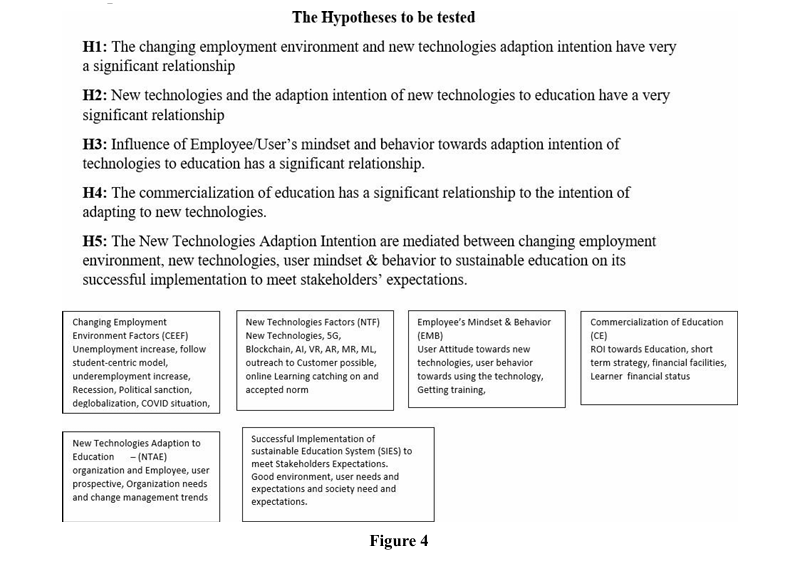
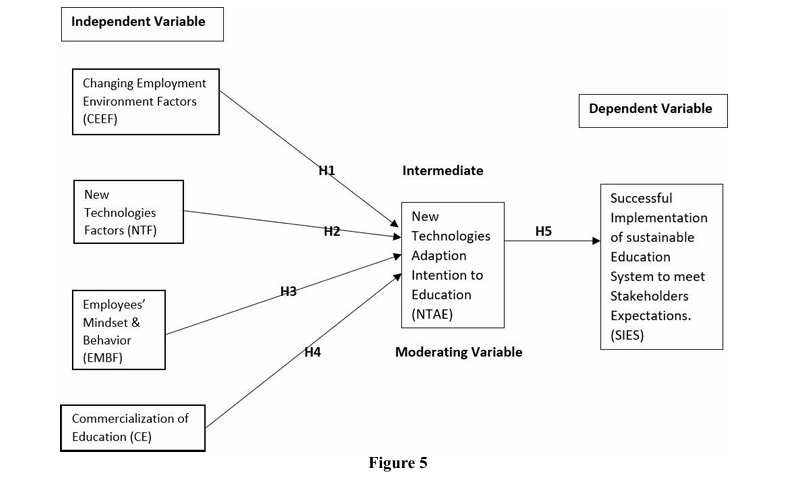
Is the Stakeholder Roles, Responsibilities and Expectations in Sustainable Modern Education, changing? Research Questions and Objectives have been formulated as Hypotheses to make the conceptual framework shown in figure 4. The independent variable was identified as “Successful Implementation of Education System to meet Stakeholders Expectations” [18]. These 28 articles shortlisted were analyzed, and the major findings, gaps to identify dependent variables.
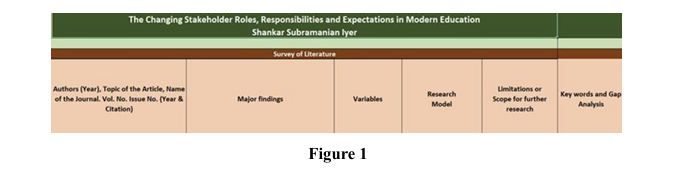
Subsequently, the variables which are frequented most are used as dependent variables. The same methodology is used for the keywords in the gap analyzed to get the most frequented variables. This leads to the independent variable being identified after categorizing them into similar groups.
- Changing Employment Environment Factors
- New Technologies Factors
- Employees’ Mindset & Behavior
- Commercialization of Education
- New Technologies Adaption Intention to Education
- Successful Implementation of a sustainable Education system (SIES) to meet Stakeholders Expectations.
The sub-variables for each of these independent variables are identified by using the same methodology. For each Variable, about 5 articles were researched and analyzed for the sub- variables [19-21].
|
Serial No |
Article Reference |
Major Findings or Gaps mentioned |
Factors or constructs Identified |
Factors or constructs used in the article |
|
1. |
Asiyai, R. I. (2015). Improving Quality Higher Education in Nigeria: The Roles of Stakeholders. International Journal of higher education, 4(1), 61-70. |
Internal and External Stakeholders identified, Geographical restriction of participants |
Survey countries and domains if possible to get better results |
Hence the participants were selected from different countries and across various educational domains as possible. |
|
2. |
Marshall, S. J. (2018). Internal and external stakeholders in higher education. In Shaping the University of the Future (pp. 77-102). Springer, Singapore. https://doi.org/10.1007/978-981-10-7620- 6_1 |
Strategy to use technology in higher education, change implemented, is meant to move the organization to a future point where a new strategy will emerge as more effective. |
Technological Integration, Organization readiness to adapt. |
Technology integration with emerging technologies |
|
3. |
Abidin, M. (2015). Higher education quality: Perception differences among internal and external- stakeholders. International Education Studies, 8(12), 185-192.URL: |
By comparing the perception between internal and external stakeholders, the university will find a comprehensive view to understand the gap between one another. Evaluation can be made on all programs and faculties of the university, by comparing one another. |
perception between internal and external stakeholders, programs and faculties and facilities available at the university |
Organization facilities available and infrastructure, perception of various stakeholders like Learners, faculty etc. |
|
4. |
Razak, N., Ab Jalil, H., & Ismail, I. (2019). Challenges in ICT integration among Malaysian public primary education teachers: The roles of leaders and stakeholders. International Journal of Emerging Technologies in Learning (iJET), 14(24), 184-205. |
Schools‘ leaders, especially the headmasters, should play their role in strategizing teachers‘ ICT integration by managing and transferring the ICT integration vision and mission to their subordinates. |
ICT integration, Geographic restriction, Scope to check other regions. |
The survey was taken across various regions and various education domains |
|
5. |
Belwal, R., Priyadarshi, P., & Al Fazari, M. H. (2017). Graduate Attributes and Employability Skills: Graduates' Perspectives on Employers' Expectations in Oman. International Journal of Educational Management, 31(6), 814-827 |
The research is based upon the students‘ perception of employers‘ preferences. A triangulation covering employers‘ perceptions will certainly boost the validity of our findings, which could be of interest to future researchers. Although the sample size was statistically determined, it would have been better to include some more alumni. |
Students‘ perception of employers‘ preferences, employers‘ perceptions, alumni. |
Successful implementation is very likely given the Employee‘s mindset and perceptions |
|
6. |
Nicolescu, L., & Nicolescu, C. (2019). Using PLS-SEM to build an employability confidence model for higher education recipients in the field of business studies. Kybernetes, 48, 1965-1988. |
*possibility of generalization *study can be extended to other geographical regions and countries and to another student/graduate categories
|
Primary Research using Questionnaire and PLS- SEM for validity and reliability and secondary research to identify these factors |
These independent variables and their relations need to be confirmed by the consensus of experts vide pilot survey, online interviews (30 participants) and online Questionnaire survey (Nicolescu et al.,2019). |
|
7. |
Browne, L., & Millar, D. K. (2019). Increasing student voice and empowerment through technology: not just listening to the voice of the learner but using their digital capabilities to benefit a whole college community. Journal of Further and Higher Education, 43(10), 1433-1443. |
This research aimed to enhance digital student practice by exploring how learners experience, use and wish to work, in a technology-rich environment. |
Student perception, technical skill acquisition, perceived improvements in soft skills |
With the technology enhancement and the ever- evolving structure of the modern workplace, Learner expectations are increasing |
|
8. |
Peredrienko, T., Belkina, O., & Yaroslavova, E. (2020). New Language Learning Environment: Employers'- Learner s' Expectations and the Role of Teacher 4.0. International Journal of Instruction, 13(3), 105-118. |
The fourth industrial revolution is substantially altering our reality. The phenomena and technologies like artificial intelligence (AI), augmented reality (AR), big data and the internet of things are sure to have an enormous impact on all jobs and industries, let alone education as change-sensitive and responsive to the needs and demands of society. |
Curriculum for soft skills development and technology capabilities |
The solution involves creating a holistic, customizable educational experience that allows each student to use their existing knowledge to master new skills and concepts |
|
9. |
Matthews, K. E., Garratt, C., & Macdonald, D. (2018). The higher education landscape: trends and implications. Discussion Paper. Brisbane: The University of Queensland, 2018. |
Technological advancements are reshaping education. New and emerging technologies promise integrative systems affording a nuanced and personalized student experience creating opportunities for flexible, relevant, and deep learning. |
New and emerging technologies promise integrative systems. How UQ invests in physical campuses to enrich the learning experience underpinned by seamless technological platforms |
At the end of the day, adult learner s can be expected to contribute as much to the classroom conversation as they take away from it (Matthews et al, 2018) |
|
10. |
Ehrenberg, R. G. (2020). The economics of tuition and fees in American higher education. In the Economics of Education. Academic Press. The Economics of Education (Second Edition), A Comprehensive Overview, 2020, Pages 345-352. |
With tuition levels, this high, many students have extremely large loan burdens upon graduation. Lack of accountability of the Universities towards learner skills imparted and relevant to Industry, to get jobs. How University invests in physical campuses to enrich the learning experience underpinned by seamless technological platforms |
Technological advancements are reshaping education. New and emerging technologies promise integrative systems. |
High fees, lack of employment opportunities, Technological integration and facilities invested by Universities. |
|
11. |
Selwyn, N. (2016). Is Technology Good for Education? Polity Press.Toronto, ON: John Wiley & Sons. Pages: 160. ISBN: 978-0-7456-9646-1 http://au.wiley.com/WileyCDA/WileyTitl e/productCd-0745696465.html |
Where there are failings and shortcomings in implementing educational technology theory or principles, these are large because, not to any inadequacies in the tools, but of too little attention being paid to the pedagogical, organizational, cultural and other factors that determine what fails, what works and what transfers successfully into other contexts. |
implementing educational technology, pedagogical, organizational, cultural and other factors |
The new technologies have a multi-faceted influence on the various stakeholders in Education. This has changed their roles, responsibilities and expectations of the stakeholders (Selwyn, 2016) |
|
12. |
Kövesi, K., & Csizmadia, P. (2016, September). Industry perception of new engineering graduates: the gap between requirements and reality. In 44-the SEFI Conference (pp. 12-15). |
In addition to more and more specialised technical knowledge, they need new multidisciplinary skills and competencies. There is a real mismatch between the industry demand and the labour market offer. |
Collaboration between universities and industries, Integration of technical and non-technical skills and competencies into education to meet Industry expectation. |
This is happening due to the mismatch in the skills and competencies of the job‘s requirement to the Employee/User with other skills which are not having any demand. The education system should recognize this mismatch and try to fill in the gaps |
|
13. |
Bell, D. I., Wooff, D., & McLain, M. (2019). Re-designing Design and Technology Education: A living literature review of stakeholder perspectives. Patt 37, 233. |
While this curricular flexibility, which has been an underlying feature of the subject‘s role in the school curriculum since inception is essential to ensure the subject equips future generations with essential skills, knowledge and understanding to develop both technological capability and confidence, this manifests as a fluid knowledge base, which makes it markedly different to other curriculum subjects. These subjects are ever-changing due to innovations and need to be updated every year |
Flexibility in the curriculum of technology, STEM |
The classroom technological tools have changed the way classroom learning can happen. So, the teachers need to be technology savvy to making the sessions and lessons interesting for the students who expect and embrace technology |
|
14. |
14. Byers, T., Imms, W., & Hartnell- Young, E. (2018). Evaluating teacher and student spatial transition from a traditional classroom to an innovative learning environment. Studies in Educational Evaluation, 58, 156-166. |
The teachers spent more time providing focused instruction, feedback (appraisal) and suggesting future direction (refinement) to individuals and small groups of students. Therefore, this observed change had a significant effect on reducing student distraction and off- task behaviours. |
providing focused instruction, feedback (appraisal) and suggesting future direction (refinement) to individuals and small groups of students. |
the regulators to track the student progress |
|
15. |
Halimi, K., & Seridi-Bouchelaghem, H. (2020, June). Where the Competency- Based Assessment Meets the Semantic Learning Analytics. In International Conference on Intelligent Tutoring Systems (pp. 295-305). Springer, Cham |
The scope of this paper is to address the issue of competency modelling in technology-enhanced learning systems to discover implicit competencies hidden behind students‘ activities and how to translate them into acquired competencies. To face these challenges, the authors proposed an approach of semantic analytics of students‘ activities data. |
Competency modelling in technology-enhanced learning systems |
The AI, Data analytics, ML has simplified the lives of administrators, government officials, the regulators to track student progress and their certifications |
|
16. |
Supasitthimethee, U., Waraporn, N., Porkaew, K., & Charoenkitkarn, N. (2017). Stakeholder involvement in teaching and learning. Proceedings of the Canadian Engineering Education Association (CEEA). 2017: June 4-7, 2017 University of Toronto. DOI: https://doi.org/10.24908/pceea.v0i0.10620 . |
Since knowledge and skills in IT change rapidly, it may be difficult for lecturers to always keep pace with new knowledge and gain new IT skills to educate students. By incorporating different stakeholders into the traditional teaching and learning undergraduate classes, it helps the school both in terms of educating the academic and teaching staff and the students |
(1) active learning, (2) problem-based learning, and (3) the closeness between students and the stakeholders |
Technology is the main cause of changing Stakeholders roles, responsibilities and expectations in Modern Education |
|
17. |
Che Musa, M. F., Bernabé, E., & Gallagher, J. E. (2020). The dental workforce in Malaysia: drivers for change from the perspectives of key stakeholders. International Dental Journal. |
This study provides evidence of â??policy- induced problems‘ in Malaysia, which, along with drivers from other domains that have potential implications for the recruitment, education /training, retention and future models of care, particularly in addressing the needs and demands of the population. |
Restricted to Malaysian dental workforce and senior professionals |
Technology is the main cause of changing Stakeholders roles, responsibilities and expectations in Modern Education |
|
18. |
Spencer, R. (2019). Managing Stakeholders: A Change Primer. International Journal of Business and Applied Social Science (IJBASS). VOL: 5, ISSUE: 4 April/2019. pp 1-10. https://ijbassnet.com/ E-ISSN: 2469-6501. |
Managing change then involves helping people move from one step of the process to the next and cope with emotional losses experienced along the way. Change as a contact sport requires open discussions of potential losses to help people move through the change process. |
Planning for Change Engaging Innovators Engaging Early Adopters |
It has also increased the cybersecurity threats and fake news dissemination concerns. This has to addressed by countermeasures also given by technology (Spencer, 2019). |
|
19. |
Qin, X., Shi, Y., Lyu, K., & Mo, Y. (2020). Using a TAM-TOE model to explore factors of Building Information Modelling (BIM) adoption in the construction industry. Journal of Civil Engineering and Management, 26(3), 259- 277. |
This study conducted an in-depth analysis of variables that have an impact on the implementation of BIM in the Chinese construction industry. However, relationships between these variables vary with the development of BIM technology, thus future research is needed to update the models and results to identify the key issues at different stages. |
An integrated TAM-TOE framework for BIM adoption. An integrated TAM-TOE BIM adoption model. Identify external variables, Technical factors, Economic factors, Organizational factors |
Hence, there's the necessity to vary the mindsets of those educators towards the utilization of technologies within the classroom to satisfy the present demands of learner s |
|
20. |
John Rodzvilla (2019) O‘Brien, K. L., & Jacobson, T. E. (Eds.) (2018). Teaching with digital badges: Best practices for libraries., Journal of Web Librarianship, 13:4, 312-313, DOI: 10.1080/19322909.2019.1656490 |
Changing Student Expectations Students seek:
Resistance to change and insecurity |
Insecurity, threat, Resistance |
The mindset to use and towards the usage of these technologies need to drastically change. The resistance and insecurity towards technology need to be removed by training and by workshops to give these Employee/users the feel of technology use and the benefits it brings (John et al., 2019). |
|
21. |
Yu, D. (2019). The Role of For-profit Educational Leadership Styles in Creating Shared Values. M.A. in Leadership Studies: Capstone Project Papers. 58. https://digital.sandiego.edu/solesmalscap/5 8 |
First, the sample size was relatively small. In addition, the data was collected from a very homogenous sample. Given that the samples are only from China and the United States, the diversity within the sample may be minimal. Furthermore, the parameter of limitations is that the research lacks a comparison group. The research assumed that in the for-profit education field with social benefits, the leaders are indicative of the innovation and organizational changes, which might not relate to the existence of creating a shared value program. |
Organizational cultural and economic environment effectively motivates leadership to align more community members in their organization. |
Change the mindsets towards technologies utilization in the classroom to satisfy the emerging cultural change in the teaching and learning process. The advantages and therefore, the way forward for the use of those technologies within the classroom by the teachers were concisely examined (Yu, 2019). |
|
22. |
A. Haldorai, S. Murugan and A. Ramu, "Evolution challenges and application of intelligent ICT education: An overview", Computer Applications in Engineering Education, Feb. 2020. |
Artificial intelligence (AI) aims at critically transforming the information and communication technology (ICT) sector through various technological advancements, such as machine learning, deep learning, and natural language processing. These technologies are meant to develop the process of communication, digital commerce, content, and apps. |
Integrating Emerging technologies in education |
The soundness of the Investments for successful implementation of the new technologies (Haldorai et al., 2020). |
|
23. |
Chandwani, V. S. & Bhome, S. M. (2013). A study of the impact of commercialization of education in India. Episteme: An online Interdisciplinary, Multidisciplinary and Multicultural Journal. 1(5). |
Education has today only become an option to make money than providing quality education to students. There is a strong need to change the basics of the education system, not its pattern, to revive education's real importance. |
Cost of education, Quality of education Infrastructure and Environment |
It is â??a process of private ownership and management of educational institutions whereby investments are made with the motive of earning profitâ?? |
|
24. |
Twebaze, R. M. (2015). Commercialization of education in Uganda; causes and consequences. International journal of recent scientific research, 6(7), 5107-5112. |
Lack of supervision and regulation was also cited as another contributing factor to the commercialization of education. Government supervisors are thin on the ground and poorly motivated. private proprietors can start schools to make a quick buck without being stopped or supervised by anybody. Corruption among school owners and managers was also cited as a major contributing factor to the commercialisation of education. Most of the institutions cannot serve their clients and are characterised by insufficient infrastructure, insufficient and poorly qualified human resource and poor management systems. In most institutions, remuneration for workers is poor thereby affecting efficiency, professionalism and productivity. |
Inefficiency, High cost, profit motive, over- supply of education, substandard education, very limited job opportunities, Lack of Infrastructure, Lack regulation, Lack of Infrastructure, Lack of regulation, corruption, Low salary for the teachers. |
So, the emphasis on making a profit rather than a social motive. Investors must be working on ROI which is not sustainable in the current scenario. |
|
25. |
Abraham, N. M. (2017). The Challenges of Funding Private Education in a volatile economy. Keynote Address presented at the National Association of Proprietors of Private Schools (NAPPS) Conference held at Obi Wali International Conference Centre, Port Harcourt, on November 15. |
Equal opportunities should not be limited to access alone, but the cost/who bears the cost, and, quality of instructional delivery, quality of learning environment, etc. Commercialization, Commercialization of Education, Dwindling Economy are the main reasons for the deteriorating education system in most countries. |
Profiteering, Substandard Education High cost Lack of Infrastructure Bad Teacher Quality due to low salary Higher Result projected Curriculum not updated |
This is due to the dropping volume of students keen to pursue courses due to the high fees, not so many opportunities at the end of graduation |
|
26. |
Lingard, B., Sellar, S., Hogan, A. & Thompson, G. (2017). Commercialisation in Public Schooling (CIPS). Sydney, Australia: New South Wales Teachers Federation. final report summary prepared for the New South Wales Teachers Federation. |
The increasing flows of knowledge, ideas, people and policy mean that both developed countries, and emerging markets and economies, all recognise the transformational value of education. These include attitudes towards school autonomy, teacher accountability, student behaviour, questions of student success and ability |
Survey countries, across periods to update the findings |
This can be done by Government intervention and by sponsored, philanthropic educational grants, investments from entrepreneurs who are looking at education as social investment or funding the education Infrastructure as a charity |
|
27. |
Iyer S.S., Seetharaman A., Maddulety K. (2020) Education Transformation Using BlockChain Technology - A Student Centric Model. In: Sharma S.K., Dwivedi Y.K., Metri B., Rana N.P. (eds) Re-imagining Diffusion and Adoption of Information Technology and Systems: A Continuing Conversation. TDIT 2020. IFIP Advances in Information and Communication Technology, vol 617. Springer, Cham. https://doi.org/10.1007/978-3-030-64849- 7_19. |
The student-centric education model is the future of Global Education. The Model is going to be powered by modern technologies like Blockchain Technology, Artificial Intelligence, Machine Learning, Virtual Imaging, Virtual Reality. It will reduce the cost, efforts, staff hour needs and security of the new education system. A smart city like Dubai is well poised to take this route due to the availability of Infrastructure, political will and the skilled workforce. Education student-centric model in smart cities like Dubai is going to make it the future. The investment and the process are well on their way for this educational transformation. |
"The relationship between constructs of technology- related factors, People‘s related Factors, Environmental related Factors, Organizational related factors and Adaption of Blockchain Technology for Education |
The viewpoint of each stakeholder will be from Journal references and reputed books and authors. To make an in-depth study, this quantitative research (after the pilot study) is confined to education transformation using technology and the change in the stakeholder roles, responsibilities due to this transformation (Iyer et al., 2020). |
|
28. |
Uddin, M. A., Alam, M. S., Mamun, A. A., Khan, T.-U.-Z., & Akter, A. (2019). A Study of the Adoption and Implementation of Enterprise Resource Planning (ERP): Identification of Moderators and Mediator. Journal of Open Innovation:
Technology, Market, and Complexity, 6(1), 2. MDPI AG. Retrieved from http://dx.doi.org/10.3390/joitmc6010002 |
The study follows the deducting reasoning approach with the positivism paradigm. Out of 235 responses, the study used 225 replies collected through a self- administered sampling, and the data were analyzed by using PLS-based structural equation modelling. The study revealed
that the hypothesized direct influences are significant except the influence of facilitating conditions on actual use. Likewise, the intention to use mediates the impact of facilitating conditions on the actual use of ERP |
Dependents: Performance Expectancy Effort Expectancy Social Influence Facilitating Conditions Education Firm size
Moderator: Intention to use ERP Actual Usage of ERP more studies with the increasing breadth of scope and larger sample size might strengthen the robustness of the model and generalizability of the findings. Other moderators like experience and voluntariness can be moderators. |
So, we accept the hypotheses and the results will prove that the new technologies adaption intention can adequately meet the requirements of the Education System and the successful implementation is very likely given the Employee‘s mindset and perceptions, new technologies features, the commercial angle to education and the changing environment both external and internal to the organization. |
Table 1: Table of references on which the Conceptual model constructs have been derived from
Literature Review
It is important to study each of these factors for this research. The factors, constructs, the dependent and independent variables are identified from the articles cited above using the gaps mentioned as per table 1.
Changing Employment Scenario, Changing Environment
The employment rate across the world has been ever increasing in the last decade [22]. This has been a major worry for all developed, developing and under-developing countries. It has come to such a extend it has become a social bane for all societies [23,24]. With the technology enhancement and the ever-evolving structure of the modern workplace, Learner expectations are increasing [25]. Instructors and institutions can maintain a competitive advantage by identifying the learner’s lifelong aspirations to advance and stay employable [26]. At the end of the day, adult learners can be expected to contribute as much to the classroom conversation as they take away from it [27]. The main reason is the fees paid by taking student education loan does not justify the employment opportunity available nor it justifies the employability skills that are imparted by most Universities [28]. The jobs scenario is disrupted as Industry demand in technologies like AI, Data Analytics, ML, VR etc. is ever increasing and at any time it is more than 1 million vacancies across the globe. At the same time, there is an ever- increasing unemployed or underemployed who are without jobs. This is happening due to the mismatch in the skills and competencies of the job’s requirement to the employee/user with other skills which are not having any demand [10]. The recessionary trend across the globe, anti-globalization trends, unemployment trends, educational costs, COVID 19 situation has changed the environment scenario in recent times.
â??â??â??â??â??â??â??New Technologies
The new technologies have a multi-faceted influence on the various stakeholders in education. This has changed their roles, responsibilities and expectations of the stakeholders [29]. The classroom technological tools have changed the way classroom learning can happen. So, the teachers need to be technology savvy to making the sessions and lessons interesting for the students who expect and embrace technology [30]. The Internet Infrastructure makes it possible for distance learning, video conferencing etc. which add to their interests. The AI, Data analytics, ML has simplified the lives of administrators, government officials, the regulators to track student progress and their certifications [31,32]. The digital revolution has made storing the certificates and transcripts electronically and to be retrieved by only authorized persons, an efficient system. Technology is the main cause of changing Stakeholders roles, responsibilities and expectations in modern education [33,34]. It has opened the world to everyone and social media is the place of self-expression and reality check across the World. It has also increased the cybersecurity threats and fake news dissemination concerns. This has to addressed by countermeasures also given by technology [2]. Technological innovations and emerging usefulness to education like online courses has come as an enabler in the current COVID situation and social distancing.
â??â??â??â??â??â??â??Employee/User’s mindset
IT and communication technology advances have forced Employee/User to change their mindset towards modern education. However, most administrators, Academicians and teachers are convinced that the traditional method of classroom teaching is the best [35]. Hence, there's the necessity to vary the mindsets of those educators towards the utilization of technologies within the classroom to satisfy the present demands of learners [35]. The educators, Academicians, teachers acquire and start using these technologies to improve classroom deliveries and improve efficiency [32]. The resistance and insecurity towards technology need to be removed by training and by workshops to give this Employee / User the feel of technology use and the benefits it brings (John et al., 2019). Training can change the mindsets towards technologies utilization in the classroom to satisfy the emerging cultural change in the teaching and learning process. However, the advantages and therefore, the way forward for the use of those technologies within the classroom by the teachers were concisely examined [37].
â??â??â??â??â??â??â??Commercialization of education
Commercialization of education means giving educational services and products with the motive of making a profit. Revenue is earned from the receivers of education or students, learners [38]. It is “a process of private ownership and management of educational institutions whereby investments are made with the motive of earning profit” [39]. Investors must be working on ROI which is not sustainable in the current scenario [40]. This is due to the dropping volume of students keen to pursue courses due to the high fees, not so many opportunities at the end of graduation [1,41]. So, the Investors need to be convinced to work on long term returns in Education instead of looking at short term returns. This can be done by Government intervention and by sponsored, philanthropic educational grants, investments from entrepreneurs who are looking at education as social investment or funding the education Infrastructure as a charity [42]. The employment model for change management (Lewin’s Change Management Model) is based on the “freeze, change and unfreeze” once the changes have been made.
The first part is the toughest to convince the employees for the change and the necessity of it to change, adapt the technology and monitor it. The technology acceptance model (TAM) explains the acceptance of the employees of the new technologies by the employees considering their resistance, spreading the awareness, change in perception, mindset and behaviour of the employees towards adaption of these new technologies. The Change Iceberg Model of Wilfried Kruger, return on Investment and NPV of investment determines the commercial viability and soundness of the Investments for successful implementation of the new technologies (Haldorai et al., 2020). So, looking at the above factors there seems to be a relationship and might be the important influencers in the successful implementation of a sustainable education system.
â??â??â??â??â??â??â??New Technologies Adaption Intention to Education
Gender bias was not a factor in using new technologies as most employers had the same mindset whether male/females. The firm size was not a good moderator as the or institutes whether big or small were equally not ready to experiment with new technologies as the current face- to -face model was working well and earning more revenue than the online versions. However, the current COVID situation has changed the whole scenario. The users/ employers had the prejudiced opinion that the online version was not so good as face- to-face. However, the social distancing norm has changed the opinion towards new technology usage including the organization to be ready to invest in them [43,44]. So, it was decided to test new technologies adaption intention as a moderator after using the Adanco outcome results run on the pilot study data from 30 participants, which confirmed this intuition that the new technology adaption intention was a good moderator to consider (Uddin et al., 2019).
â??â??â??â??â??â??â??Successful Implementation of a sustainable Education System to meet Stakeholders Expectations.
The outcome of the endeavour is to have a sustainable education system that is agile and take care of the changing environment, unemployment and the various challenges faced by the current education. The new education system should be learner-centric and take care of the stakeholder expectations [17,21].
Conceptual Framework