



Research Article - (2024) Volume 9, Issue 1
Study on Wild Edible Plant Used by Shinasha Ethnic Community at Metekel Zone, Northwest Ethiopia
Received Date: Jan 24, 2024 / Accepted Date: Feb 16, 2024 / Published Date: Feb 28, 2024
Copyright: ©Â©2024 Abesh Birhanu Morka. This is an open-access article distributed under the terms of the Creative Commons Attribution License, which permits unrestricted use, distribution, and reproduction in any medium, provided the original author and source are credited.
Citation: Morka, A. B. (2024). Study on Wild Edible Plant Used by Shinasha Ethnic Community at Metekel Zone, Northwest Ethio-pia. Adv Nutr Food Sci, 9(1), 01-11.
Abstract
Wild edible plants are an essential source of supplementary foods in many parts of Ethiopia. The aims of this study were to record and document wild edible plants used by shinasha ethnic community in Metekele Zone Northwestern Ethiopia. The Field surveys were conducted from Jun to Dec, 2022. Semi-structured interview, direct observation, focus group discussion, guided fled walks, and market surveys were used to collect data. A total of 120 informants were partic- ipated in interviewed. Descriptive statistical was made to analyze the data using SPSS version.20. A total 46 wild edible plants belonging to 38 genera and 30 families were recorded. Family Moraceae were the most popular edible plant. Trees were the dominant life forms (36.9%) and ripe fruits (58.6%) recorded plants par used in study area. The majority of (14 specie) were collected from natural forest followed by riverine banks habitat (12species). The majority of wild edible plants are mainly harvested and consumed during autumn followed by summer season. Based on the market surveys eight wild edible plants were sold and can provide additional income to the local community in study districts. The wild edible plants were consumed as raw. Agricultural land expansion, fuel wood collection, cutting for construction, uncontrolled fire and overgrazing were the major threats to the wild edible plants. Hence, the finding recommend that the community that practice in on-site and off-site conservation, public awareness raising, which requires participation the government's on sustainable forest management practices approach would help to protect wild edible plant in study area.
Keywords
Ethnic Group, Metekel Zone, Shinasha People, Wild Edible Plants.
Abbreviations
BGRS: Benishangule Gumuze Regional State, WEPs: Wild Edible Plants, Fgd: Focus Group Discussion, Ki: Key Informants, Ka: Kebeles Administration, Hh: Household.
Introduction
Wild edible plants (WEPs) can be defined as native species that grow and reproduce naturally in their natural habitat without being cultivated. Humans have gathered WEPs since ancient times, and they have become part of the human diet and traditional food systems. WEPs still play an important role when food crops are scarce, ensuring food sovereignty and food security, and they potentially contribute to wellbeing in vulnerable households [1]. Nearly 390,900 flora species are estimated to exist on our planet, of which 30,000 are edible plants species, but 150- 200 have been cultivated widely (RBGK, 2016) [2].
Millions of people in many developing countries do not have enough food to meet their daily requirements and a further more people are deficient in one or more micronutrients [3]. Edible wild plants have supplementary, and seasonal and emergency roles in the communities that use them for food; and some are also used as a source of income [4] . According to FAO more than 35% of Ethiopian people are food insecure. The country’s ever increasing population along with recurrent drought, war and poor agricultural practices with low productivity, have pulled the country into a vicious circle of food insecurity [5].
Nearly 6500-7000 flora species among this which 12% are endemic plant species estimated to be present in the country of Ethiopia [6]. A recent review documented nearly 413 species of EWPs representing 224 genera and 77 families [7]. Forests, grasslands, riverine environments and wetlands are home to numerous WEPs in the country of Ethiopia[8].Wild edible plants (WEPs) are all non-domesticated plants species used by people which are a continuum results from co-evolutionary relationships between humans and their environment [9,10] .
The rural populations in Ethiopia have a rich knowledge of wild edible plants and consumption of wild edible plants is still an integral part of the different cultures in country. Traditional knowledge on wild food plant uses has been kept in the memory of Shinasha ethnic groups as a heritage and passed orally through generations to generation. However, there has not been sufficient research document on indigenous knowledge the use of wild edible plants in study area. Therefore, this research aims to identify record and document wild edible plant species consumed, threats, and recommend the possible management setups for their conservation by shinasha community in Metekel zone of Benshagule Gumuz Regional State of Ethiopia.
Materials and Methods
Description of Study Area
The study was conducted Metekel Zone is geographical position located between 09.17° to 12.06° N latitude and 34.10° to 37.04°E longitude in Benishangul Gumuz Regional State of Ethiopia (Figure 1). The zone occupies an estimated total area of 22,028 km2. The total population of the zone was 276,367 (male 139,119 and female 137,248) of which 238,752 are rural setup while the remaining 37,615 are urban dwellers [11].
The mean annual rainfall is estimated to be around 1607.8 mm. The mean annual temperature is ranged between 16.2 and 32.5°C. The zone has a uni-modal rainfall pattern, with an extended rainy season, from March to September. The peak rainy season is from July to August. The coldest months are December and January whereas March and April are the hottest months of the area [12].
Methodology
Reconnaissance Survey and Site Selection
A reconnaissance survey was conducted in Metekel zone from Jun to Dec, 2022. The survey was employed to obtain general information from community leaders, traditional healers and governmental agricultural development agents about the study area, indigenous knowledge and practice surrounding use of wild pants for food. The past and current practices about the use, availability, accessibility of WEPs and vegetation coverage were discussed with these knowledgeable persons. After the discussion, two districts were systematically selected as study sites out of the total seven districts in Metekel Zone.
Site Selection
Multistage sampling technique was used for this particular study. In first stage, from Meteke zone the two districts namely Dibati and Bulen were selected for study area as based purposively based on 1) the potential and existence of wild edible plants, 2) has large forest with high population pressure which needs evidence for designing appropriate forest management system and (3) has given lower research attention because of distance and hot climatic condition, 4) and the availability of shinasha ethnic group in the districts. From each selected Districts, three representative kebeles and a total of six kebeles were selected in two districts. In the second stage, the study kebele namely, Gerze, Legebuna, and Parezyite, were selected from in Dibati district and Bulen Town, Dobina Enkoti and Morana Ekosaki kebele are selected from Bulen districts .The study village were chosen purposively based on availability of wild edible plants as advised by local administers and elders, proximity to the existing remnant forest resources and representativeness of the different agro-ecologies.
Selection of Sample Households and Key Informants
In this study the sample size for quantitative data was determined by applied the formula to calculate a sample size [13] . This study applied the simplified formula developed by and reviewed by as follows[ 13,14].
<img src="https://www.opastpublishers.com/scholarly-images/7087-69eaef3931ca1-study-on-wild-edible-plant-used-by-shinasha-ethnic-community.png" width="100" height="50">
Where n = sample size for the research, N= total number of households in all six kebels e= maximum variability or margin of error 10% (0.1) 1= the probability of event occurring.
Based on the above technique, 90 sample households were selected. Therefore, the total sample size was 90. A total of 120 informants (80 male and 40 female) 30 individuals from each of the study six kebeles from age of above 18 years was selected by purposive and snowball sampling techniques from the local communities, respectively.
Selection of Key Informants
Key informants in this study are persons who are knowledgeable about WEPs, experienced in growing, collection, and selling WEPs plants and who have always lived in the village and for a long time. From each of the six study KAs 5 key informants were purposively selected with the help of kebele administers and elders. The key informants included elders, wild edible plant collectors, sellers, cookers and buyers of the species. Finally, a total of 30 key informants were selected and used for the study.
Ethnobotanical Data Collection
The data were collected in six the selected administrative Kebeles of Dibati and Bulen district from Jun to Dec, 2022. As a result, semi-structured interviews, guided field walk, market surveys and group discussions were used to collect indigenous knowledge about wild edible plants with informed consent of local informants. All of the interviews were met on a one to one basis conducted using a checklist of questions developed in English and translated into shinashegina (Borna) the local language of the people. Ethnobotanical data were collected using the method and protocol proposed by [15,16] .
Plant Voucher Specimen Collection and Identification
Collection of voucher specimens was made with the help of informants and local field assistants. Wild edible plant specimens were collected pressed, dried, numbered, labeled, identified, and deposited at the Ethiopia Biodiversity Institute, in Assosa Biodiversity Center, Herbarium Room. Photographic records were also taken in the field to capture the field sites, plant parts and other useful information. Preliminary identification of specimens was performed in the field to family level and some cases to species level. Further identification was made using the flora of Ethiopia and Eritrea [17].
Data Analysis
The collected data from the questionnaires of household interview responses were coded and entered into Microsoft Office Excel sheet. After cleaning, the data was analyzed using SPSS version 20 software. The processed data presented using as chart, figures and tables for qualitative and quantitative data, respectively. Direct matrix ranking exercise was used to compare the use diversity of a given wild edible plant species using the methods proposed by [15,18] . The data collected was summarized and analyzed by means of descriptive statistics out for qualitative data such as edible parts, life forms, seasonal availability and habitats where edible wild plants are mainly found.
Results and Discussion
Taxonomic Diversity of Edible Wild Plants in Study Area
Overall, 46 WEPs belonging to 38 genera in 30 families were documented to be used by the people of study area (Table1). Family Moracea was best-represented, accounting for 4 species, followed by Cucurbitaceae and Myrtaceae (3 species in each), eight family’s (Amarathaceae, Annonaceae, Apocynaceae, Araceae, Discoreaceae, Rubiaceace, Sapindaceae and Sapotaceae) consisting of two species and 18 families represented by one species each. The highest number of plant species was recorded under family of Moraceae, Cucurbitaceae and Myrtaceae. This finding is in line with studies performed in Ethiopia researchers by [11,19-21] .This might be due to the better adaptation potential of WEPs in this family over the range of attitude deference, climatic change, soil type and other factors.
|
Table :1 Study of Wild Edible Plants Used By Shinasha Ethnic Community at Metekel Zone |
||||||||
|
No |
Local Name by Shinashegin |
Scientific Name |
Family |
Habit |
Plant part Consumed |
Method of preparation |
Habitat |
Collection Seasons |
|
1 |
Lama |
Amarathus cruentus .Thell |
Amarathaceae |
Herb |
Leaves & Seed |
The leaves are eaten cooked and the seed is grinded and eaten when it is changed to porridge |
wild |
Summer |
|
2 |
Gishita |
Annona cherimola Mill |
Annonaceae |
Tree |
Fruit |
The fruit is eaten raw |
Forest |
Summer |
|
3 |
Babuut’aa |
Annona senegalensis Pers. |
Annonaceae |
Shrub |
Fruit |
The fruit is eaten raw |
forest |
Summer |
|
4 |
Gohaa |
Borassus aethiopum Mart. |
Arecaceae |
Tree |
Fruit & young seedling |
Germinating part is eaten after being boiled and the fruit is eaten raw after soaking with straw for a month. |
Wild |
Winter |
|
5 |
Awawa |
Carissa spinarum ( Forssk) Vahil. |
Apocynaceae |
Climber |
Fruit |
The fruit is eaten raw |
Riverine |
Winter |
|
6 |
Koopha |
Colocasia esculenta( Hochst) |
Araceae |
Herb |
Tuber |
The tuber is cutoff, dried for one day and eaten after being properly boiled. Germinating part are eaten after being boiled |
Riverine |
All |
|
7 |
Laliaq |
Corchorus olitorius L. |
Malvaceae |
Herb |
leaves |
The young leaves eaten raw or after being cooked |
Forest |
All |
|
8 |
Banaja |
Cordia africana Lam. |
Boraginaceae |
Tree |
Fruit |
The fruit is eaten raw |
Wild |
Winter |
|
9 |
Mat’maara |
Cucuribita peop L. |
Cucuribitace |
Climber |
Leaf |
Young leaves are eaten after cooking |
Home garden |
Summer |
|
10 |
Maranta /Bukura) |
Diospyros mespiliformis hochst. ex a.dc |
Ebenaceae |
Tree |
Fruit |
The fruit is eaten raw |
River area |
Winter |
|
11 |
Annga |
Discorea prehensilis Benth |
Discoreaceae |
Climber |
Tuber |
The poisonous parts of tuber are removed and the remain part are eaten after cooking |
River area &Forest |
Autumn |
|
12 |
Uutsaa |
Discorea alanata L. |
Discoreaceae |
Climber |
Tuber |
Tubers are cut in to small pieces and boiled in water, water is decanted, cooked and used as food and then remain part are eaten after cooking. |
Home garden |
Summer |
|
13 |
Echecha |
Ensete ventricosum (Wild). |
Musaceae |
Tree |
Fruit |
The fruit is eaten raw |
Riverine |
All |
|
14 |
Zinigibila |
Etlingera littoralis L |
Zingiberaceae |
Herb |
Tuber |
The fruit is eaten raw |
Home garden |
All |
|
15 |
Badirbonga |
Eugenia uniflora L. |
Myrtaceae |
Shrub |
Fruit |
The fruit is eaten raw |
Forest |
Summer |
|
16 |
Eetsa |
Ficus sur Forssk |
Moraceae |
Tree |
Fruit |
The fruit is eaten raw |
River area |
Winter |
|
17 |
Fuuka |
Ficus sycomorus L |
Moraceae |
Tree |
Fruit |
The fruit is eaten raw |
Wild |
|
|
18 |
Doogena |
Ficus vasta Forssk |
Moraceae |
Tree |
Fruit |
The fruit is eaten raw |
Wild |
Autumn |
|
19 |
Qushuwaa |
Foeniculum vulgare (Mill) |
Apiaceae |
Herb |
Leaf |
Leaves are eaten raw or after being cooked with cucuribita peop. |
Home garden |
Summer |
|
20 |
Gabaa |
Gardenia ternifolia Schummach &Thonn. |
Sapindaceae |
Tree |
Fruit |
The fruit is eaten raw |
Forest |
Winter |
|
21 |
Enguula |
Gladiolus candies (Rendle) |
Cucurbitaceae |
Climber |
Young shoot |
Young shoots are eaten after cooking/raw of the furit. |
Forest area |
Spring |
|
22 |
Somoya |
Grewia bicolor Juss. |
Rubiaceace |
Shrub |
Fruit |
The fruit is eaten raw |
Riverine |
Summer |
|
23 |
Gali qoriya |
Grewia ferrugina Hochst.ex A.Rich |
Tiliacea |
shrub |
Fruit |
The fruit is eaten by raw |
Riverine |
Winter |
|
24 |
Kooriya |
Grewia mollis Juss. |
Tiliaceae |
Shrub |
Steam Bark |
The inner part of the steam bark is safely removed and soaked with water and grinded |
Forest |
All |
|
|
|
|
|
|
|
and collecting juice used as sauce. |
|
|
|
25 |
Duumuga |
Justicia schimperiana Hochst.ex Nees. |
Acanthaceac |
Shrub |
Flower nectar |
Juice of nectars is sipped by lip. |
Home garden |
Summer |
|
26 |
Bakuudaa |
Lepisanthes senegalensis Pers |
Sapindaceae |
Shrub |
Fruit |
The fruit is eaten raw |
Forest |
Summer |
|
27 |
Komandora |
Lycoperiscon esculentum Mill |
Sapotaceae |
Herb |
Fruit |
The fruit is eaten raw |
Home garden |
Spring |
|
28 |
Shimiya/ Qoolat’iya |
Mimusops_kummel A.DC. |
Sapotaceae |
Tree |
Fruit |
The fruit is eaten raw |
Riverine |
Winter |
|
29 |
Badha/ Daze mat’aa |
Momordica foetida Schumach. |
Cucuribitaceae |
Climber |
Leave & fruit |
Yong leaves are eaten after cooking and the fruit endocarp is eaten raw |
Forest |
Summer |
|
30 |
Injor |
Moras alba L. |
Moraceae |
Shrub |
Fruit |
The fruit is eaten raw |
Home garden |
Summer |
|
31 |
Sheferwu |
Moringa stenopetala Lam. |
Moringaceae |
Tree |
Young shoot leaf |
Cooked young leaf eaten with phaseolus vulgaris L and rice |
Home garden |
Al l |
|
32 |
Uula |
Oncoba spinosa Forssk. |
Flacourtiacea |
Shrub |
Fruit |
The fleshy endocarps is eaten raw |
Forest |
Summer |
|
33 |
Eeleta soha |
Oxytenanthera abyssinica (A.Rich.) Munro. |
Poaceae |
Herb |
Young seedling |
The young seedling boiled and eaten with bread |
Forest |
All |
|
34 |
Munuqa |
Pavetta crassipes (K.Schum) |
Rubiaceae |
Shrub |
Fruit |
The fruit is eaten raw |
Wild |
Summer |
|
35 |
Wolla |
Phoenix reclinata Jacq. |
Arecaceae |
Shrub |
Fruit & steam |
The fruit is eaten raw or after soaking with straw until it is ripened. |
River area |
Al& winter |
|
36 |
Maac’a |
Piliostigma thonningii (Schum.) |
Fabaceae |
Tree |
Fruit |
The fruit is eaten raw |
Wild |
Autumn |
|
37 |
Kawaa |
Portulaca quadrifida L. |
Portulacae |
Herb |
Leaves |
The shoot is ground together with allium sativum ,foeniculum vulugar and ruta chalepenss to form sauce and eaten with porridge and injeria (local bread) |
Home garden |
All |
|
38 |
Shaki janega |
Rhus retinorrhoea oliv. |
Amaranthace |
Tree |
Fruit |
The fruit is eaten raw |
Forest |
Autumn |
|
39 |
Bakiitela |
Rhus vulgaris Meilkle |
Anacardiacea |
Shrub |
Fruit |
The fruit is eaten raw |
Riverine & Forest |
Summer |
|
40 |
Ambat’aa |
Rumex abyssinica Jacq |
Polygonaceae |
Herb |
Tuber |
Root grinded by mortar and squeezed part used as food decoction |
Wild |
Autumn |
|
41 |
Fuuyaa |
Saba comorensis (Boji.) pichen |
Apocynaceae |
Climber |
Fruit |
The fruit is eaten raw |
Riverine |
Summer |
|
42 |
Func’a |
Solanum nigrum L |
Solanaceae |
Herb |
Fruit & leaves |
The fruit is eaten row &the leaves are eaten raw together with green pepper. |
Wild |
Summer |
|
43 |
Dak’uwa |
Syzygium guineense (Wild). Dc. Sp.guineense |
Myrtaceae |
Tree |
Fruit |
The fruit is eaten raw |
Wild |
Autumn |
|
44 |
Diwaa |
Syzygium guineense (Wild.)Dc ssp.macrocarpum |
Myrtaceae |
Tree |
Fruit |
The fruit is eaten raw |
River area |
Autumn |
|
45 |
K’uula |
Ximeni Americana L. |
Olacaceaeace |
Shrub |
Fruit |
The fruit is eaten raw |
Forest |
Autumn |
|
46 |
Goorka / Kokor |
Vitex doniana Sweet |
Verbenaceae |
Tree |
Fruit |
The fruit is eaten raw |
Forest |
Winter |
Life Forms and Parts of Wild Edible Plants
Life Forms of Edible Wild Plants
The largest numbers growth forms (habits) of edible wild plant in Metekel zone tree are (36.9%), followed by shrubs (26%), herb (21.2%), and climbers only (15.2%). This finding is in line with previous ethnobotanical studies conducted by [19,22-25] . Reported the abundance of wild edible trees in three Districts of Amhara Region, Debub Omo Zone, Konso Ethnic Community and Adola District in Northern and Southern Ethiopia. These similarities could be due to similarities in climatic conditions, WEPs species distribution and other environmental factors, harvesting from verity habitat ranging, or due to cultural variation among the community of the country the consumption of wild food.
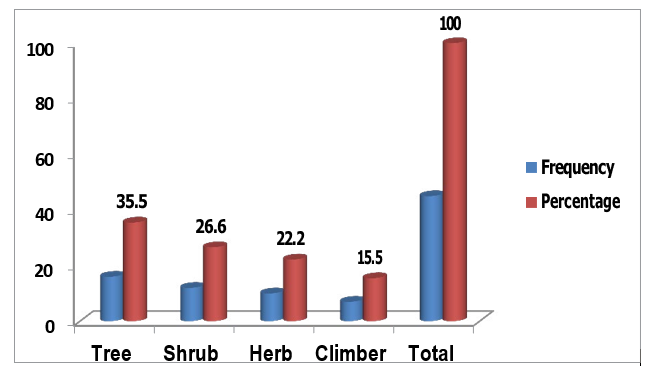
Figure 2: Frequency of Wild Edible Plant Taxa Arranged by Life Forms
Edible Parts of Edible Wild Plants
The edible plant parts in Metekel Zone used by shinasha ethnic group are fruit 26 (57.7%) followed by tuber 5(11.1%) and leaf 4(8.88%). As a result, the fruit was considered an important ele-ment of the wild food plant part by the people in the study area. This was consistent with the findings of research by [21,25- 30]. Due to the nature of the fruits that are not needed additional pro¬cessing and it might be good to consume in raw forms and the other reason might be raw fruits are good source of nutrients that does not loss its nutrients but if it is boiled or cooked some essen¬tial nutrients might be lost. This is consistent with other findings including these of [31].
Table 2: Number of wild edible plant parts used by the local people
|
Plant part that consumed |
Frequency |
Percentage |
|
Fruit only |
27 |
58.6 |
|
Tuber only |
5 |
10.8 |
|
Leaf only |
4 |
8.69 |
|
Fruit and young seedling |
2 |
4.3 |
|
Young Shoot |
2 |
4.3 |
|
Fruit and Leaf |
2 |
4.3 |
|
Leaf and Seed |
1 |
2.17 |
|
Flower Nectar |
1 |
2.17 |
|
Fruit and Steam |
1 |
2.17 |
|
Steam bark |
1 |
2.17 |
|
Total |
46 |
100 |
Source: From Survey Result (2015/2022
Plant Habitat Wild Edible Plant
The people in Metekel Zone collect wild edible plants from vari-ous habitats, such as forest, riverine, wild and home garden. The largest number 30.4% species) was collected from forest habitats only, and followed by riverine banks (26.08%). The third and fourth largest natural habitats were wild and home garden habitat that each comprised 23.9% and 19.56% respectively (Fig 2). This finding is in line with studies performed in Ethiopia [11, 30-32].
showed that most WEPs were gathered from forest habitats. Due they are not deforest by anthropogenic factors.
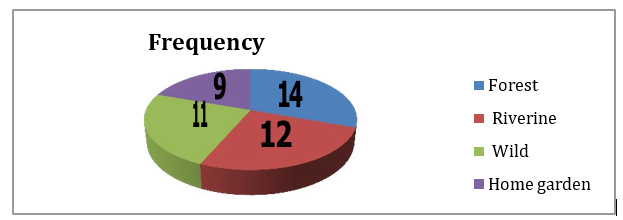
Figure 3: Wild Edible Plants Habitat of the Study Area
Preparation and Consumption of WEPs
In study area about WEPs as regards the mode of consumption, 21 (45.65%) are consumed raw, 9(19.56%) cooked, (6.52%) both cooked and raw and (4.34%) in juice form, (Figure 4). The highest percentage distribution on mode of consumption of wild edible plants is shown below (figure :4). This result is similar with the study conducted by[23,24,33-35].The high consumption of wild edible plants in the form of fruit and vegetable might be explained by their nutritional value and their desirable taste [ 22,36,37,]. The high percentage of raw edibles may be due to the nature of the fruits that are not needed further processing and it might be good to consume in raw forms and the other reason might be raw fruits are good source of nutrients that does not loss its nutrients but if it is boiled or cooked some essential nutrients might be lost. This is consistent with other findings including these of [31].
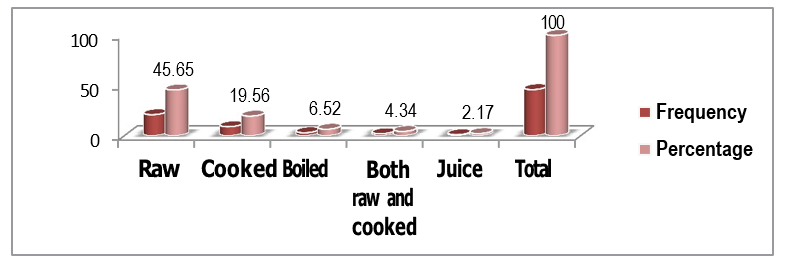
Figure 4: Mode of Preparation and Consumption of the Different Edible Plant Parts
Seasonal Availability of Wild Edible Plants
The plant parts used by Shinasha community were gathered in dif-ferent seasons/times for food at four seasons of the year in Ethio¬pia. These seasons are spring (Sep, Oct and Nov) winter (Dec Jan, and Fab), autumn (Mar, Apr and May) summer (Jun, July and Aug) in which the season consists of three months of the year respec¬tively. The highest number of edible plant parts15 (32.6%) were collected during the short rainy season of autumn 14(30.4) during winter rainy season, 10(21.7%) from winter season 7(15.2%), from all season and 1(2.17%) are also collected from spring sea¬son respectively. This due to the time of harvesting varies from plant to plant depending on its availability, and from place to place due to ecological and climatic conditions. The high uses of wild edible plants from March to May (autumn season) might be due to the high sprouting time for most WEPs. Besides, this season is the flowering time for most WEPs, and their fruiting is also harvest¬ed during this season. Likewise, studies performed elsewhere in Ethiopia by [30]. During the dry season, rural people rely heavily on a stored diet. The relative seasonal availability of WEPs highly affects the nutritional and food insecurity of households [38]. Ac¬cording to the interview and group discussion of key informants harvesting Seasons of WEPs depending on phenology of the re- spective WEPs species, parts are collected for food in all season. The present study showed that, the identified wild edible plants of the study area were harvested and consumed in different seasons of the year. According to the group discussion and observation in¬terview of the filed conducted also indicated that harvesting sea¬son and use of wild edible plant species vary from place to place, species to species and even from tree to tree. This might be due to climatic and intraspecific variations. Moreover, on their study findings reported that time and frequency of harvesting of wild and semi wild edible plants depends on the plant parts and varies from place to place [31]. The findings of this study revealed that, WEPs species of the study Districts were collected and consumed during dry season, wet season and year round.
Key informants explained that season and frequency of harvest¬ing vary from plant to plant based on the availability of WEPs. As well, seasons of collection varied from place to place due to ecological and seasonal conditions. For instance, from WEPs of the study area, Vitex doniana, Phoex reclinata, Mimuosops kum¬mel, Cordia africana, Ficus sur, Ficus Sycomorus, Ficus vasta and Disocorea prehensilis were harvested and consumed during win¬ter season. Wild edible plant species such Asannona sengalensis,Amarathus cruentus, lepisanthes sengalensis, Soloanum nigrum and Amarathus cruentus were commonly gathered and consumed during summer season. However, Colocasia esculenta, Moringa stenopetala, Oxytenanthera abyssinica, and Grewia mollis were available throughout all seasons and consumed year round.
Table: 5 Collection season/harvesting of wild edible plants in the study area
|
Collection Seasons |
Frequency |
Percentage |
|
Spring (Sep, Oct, Nov) |
1 |
2.17 |
|
Winter (Dec, Jan ,Fab) |
10 |
21.7 |
|
Autumn (Mar, Apr ,May) |
15 |
32.6 |
|
Summer (Jun, July ,Aug) |
13 |
28.2 |
|
All season (All month) |
7 |
15.2 |
|
|
46 |
100 |
Source: From Survey Result (2015/2022
Market Values of Wild Food Plants
In the study of both districts also few wild edible plants were ob-served at two daily and weekly local and urban markets from four kebeles. During the study we observed eight wild edible plants such as Portulaca quadrifida, Vitex doniana, Saba comorensis, Dioscorea prehensilis, Diosocorreas alanata, Syzygium guineense, Foeniculum vulgare, Cucuribita peop, and Grewia mollis were re¬ported to be sold by women and children can provide the opportu¬nity to house holding additional income to the local communities of the study area. A few numbers of wild foods sold in the market were also reported by other studies made in Ethiopia [8,39].
Market assessment of wild edible plant species showed that most of the edible plants are not sold only for food purposes but also for other purposes such as for timber, agricultural tools, construction, and fuel wood purpose. The other economically important and marketable species is Cordia africana. It is the most preferred tim¬ber species with higher value and price at local markets. In general income derived from the sale of wild plant species is of particular importance to the poor household to supplement their food product items and needs. Most of the identified wild edible plants were marketed in the other part of Ethiopia [31,40].
Multipurpose Use of Wild Edible Plants by Direct Ma-trix Ranking
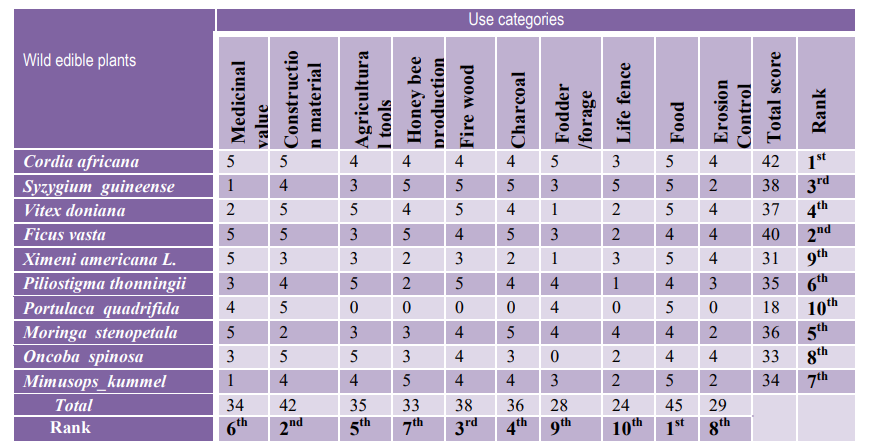
In Metekel zone, ten commonly reported multipurpose species and ten use-categories were used for in direct matrix ranking exercise. In addition to food values, the local people used the plants for oth¬er different purposes such as fuel wood, life fence, construction materials, medicine, agricultural tools and charcoal. The result of direct matrix ranking revealed that Cordia africana, Ficus vasta, Syzygium guineense, Vitex doniana and Moringa stenopetala were ranked first to fifth, respectively. Similarly, the ten use-values cat¬egories reported on ten selected plant species were summed up and ranked and, the result showed that food value, construction materials, fuel wood collection, agricultural tools , medicine value, honey been hugging, erosion controlling ,life fence were ranked first, second, third, fourth, fifth, sixth and seventh, respectively. Cordia africana were also reported to be the most commonly used parts for baking bread and in rope preparation respectively.
Table 4: Direct Matrix Ranking of Ten Wild Edible Plant Species by Twelve Informants Based on Ten Use Criteria (5 = Best; 4 = Very Good; 3 = Good; 2 = Less Used; 1= Least Used And 0 = No Value
Threats and Conservation of WEPs in the Study Area
Threats to Wild Edible Plants
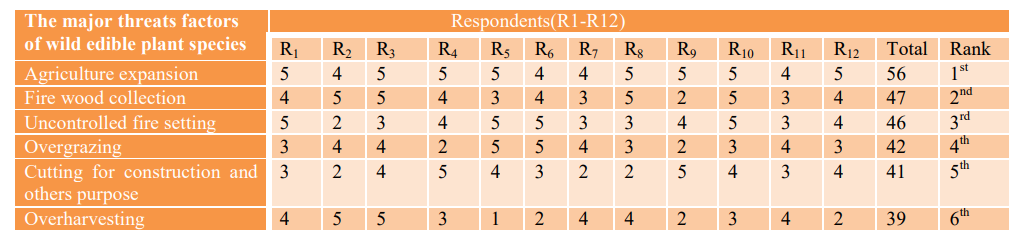
Informants ranked study area comparison of six threatening fac-tors of wild edible plants was conducted using 12 key informants. The results (Table 5) indicated that expansion of agricultural land, fuel wood collection, timber production, cutting for construction, un-controlled fire setting and overgrazing management problems of plant resources respectively. Similarly, these threats to WEP resources have been reported in ethnobotanical studies conduct- ed in Ethiopia by [20,21, 26,29-31]. This is because rapid human population and high demand for forest and forest products uses in the study area from time to time. Due to these reasons, plant species such as Phoenix reclinata, Mimusops, kummel, Syzygium guineense, Carissa spinarum and Pappea capensis, Cordia africana and Diospyros mespiliformis are among the wild edible plants un¬der series threatened and near threatened species respectively in the study area.
Table 5: Priority Ranking of Threats to Wild Food Plants Used on Their Degree of Destructive Effects/Values Of 1–6 That Were Given: 1 Is the Least Destructive Threat And 5 Is the Most Destructive Threat
Conservation of Wild Edible Plants and Associated Knowledge
The local communities in the study area have a various indigenous knowledge on management and conservation of wild edible plants. For example, many wild edible plants are left to widely grow in farmlands, farm boundaries watershed areas, homesteads as live fence, shade, along road sides and degraded areas.
This practice was actually observed by the researchers in the study areas. For example, Cordia africana, Justicia schimperiana ,Cucu-ribitia peop and were widely grow in farmlands, farm boundaries and watershed areas and others frequently appear around home¬steads as live fence (Moringa stenopetala, Oxytenathera abyssi¬nica, Diosocorea alanata, Justicia schimperiana and Moras alba), shade (Phoenix reclinata, Ficus Vasta, and Moringa stenopetala) and along road sides and degraded areas. Similar trend has been reported in the indigenous communities in and the buffer area of Awash National Park [40].
Besides, personal observation and communication revealed that children and livestock herders bring the seeds after consuming the fruits back to homes and cultivate them around homesteads and fence the seedlings saved from livestock foraging. This gives some hint for the possibility of conservation and domestication of wild edible plants. These are sustainable modes of resource use that need to be encouraged and applied by combination them with standard modern management practices.
Although the understanding of the local people about the impor-tance of conserving the wild edible plants, only some in-situ and ex-situ conservation methods like planting in home garden the form of fences and protected pasture land in different worship ar¬eas (churches, mosques) and in their farm margins are being prac¬ticed in the study area. This indicates that the necessary conserva¬tion measures are not being taken in the area, and hence the wild edible plants are not free from threats. Awareness rising Commu¬nity-based forest management, enclosure, reforestation, afforesta¬tion activities, and supplying of alternative energy sources to the community will have a huge chance conserving of the wild edible plants as well as the entire frost.
Conclusion and Recommendations
Conclusion
A total of 46 wild edible plants were recorded in the study area and these plants were distributed in 38 genera and 30 families. Wild edible fruit species have an appreciable role in supplemen-tary food provision, income generation and diversification, nutri-tional security in different parts of Ethiopia. The result of growth forms was study area that trees were the highest proportion of the edible species followed by shrubs. Fruit is found to be the most edible plant part and mostly taken as raw. The identified WEPs also mainly harvested and consumed in different season of the year including during autumn, summer, and winter season, spring and all season year round. Based on the market surveys conducted in the two study Districts, eight WEPs such as Portulaca quadrifida, Vitex doniana, Saba comorensis, Dioscorea prehensilis, Diosocor¬reas alanata, Syzygium guineense, Cucuribita peop, Foeniculum vulgare and Grewia mollis were reported to be sold and can pro¬vide additional income to the local communities. WEPs are highly threatened for anthropogenic factors such as (agricultural expan¬sion, firewood collection, controlling fire setting overgrazing, cut¬ting for construction and others and overharvesting). As a result, wild edible plant species such as Borassus aethiopum, Diospyros mespiliformis, Mimusops kummel, Vitex doniana ,Oncoba spi¬nosa, Ximeni americana, and Phoenix reclinata are under serious threaten and extinction status in the study area.
Recommendation
Based on the Findings of this Study, the Following Statements were Recommended
• There should be an extensive Public awareness raising and com¬munity based forest management practice need to be encouraged at all levels in order to overcome the threats of wild edible plant species in study area.
• The government should be included the food agricultural policy makers, NGO, and researchers give attention in exploitation the potential use of wild edible plants.
• Participatory forest management needs to be practiced extensive¬ly and effectively in the study districts for the conservation of for¬ests in general and wild edible plants in particular.
• Decision creators and policy makers should include traditional conservation practices such as in-situ (on-site and ex-situ (off-site) conservation and ecological restoration in their natural conserva¬tion program should be implemented in study area.
Competing Interests
The authors declare that they have no competing interest
Acknowledgements
The authors wish to thank the local people of Metekel Zone Dibati and Bulen District Shinasha ethnic community and all informants for sharing their knowledge about wild edible plants and their hos¬pitality. The Ethiopia Biodiversity Institute, Assosa Biodiversity Center Herbarium Room is also acknowledged for its kind help in identifying wild edible plant species.
References
- Borelli, T., Hunter, D., Powell, B., Ulian, T., Mattana, E., Ter-mote, C., ... & Engels, J. (2020). Born to eat wild: An integrated conservation approach to secure wild food plants for food security and nutrition. Plants, 9(10), 1299.
- Royal Botanic Gardens Kew (2016, May 9).State of the World’s Plants 2016.Kew report makes new tally for number of world's plants. Retrieved from
- Jacques, D. (2004). The State of food insecurity in the world: Monitoring progress towards the world food summit and millennium development goals. Rome (Italy): Food and agriculture organization of the united nations.
- EBI, (2015). Ethiopia’s Fifth National Report to the Convention on Biological Diversity.
- FAO (2010). Global forest resources assessment, main report; forestry paper Food and Agriculture Organization of the United Nations, Rome; 143
- Mesfin F, Demissew S, Teklehaymanot T. (2009).An ethnobotanical study of medicinal plants in Wonago Woreda, SNNPR, Ethiopia. J Ethnobio Ethnomed.5:1–28.
- Lulekal, E., Asfaw, Z., Kelbessa, E., & Van Damme, P. (2011). Wild edible plants in Ethiopia: a review on their potential to combat food insecurity. Afrika focus, 24(2), 71-122.
- Asfaw, Z. (2008, March). The future of wild food plants in southern Ethiopia: ecosystem conservation coupled with enhancement of the roles of key social groups. In International Symposium on Underutilized Plants for Food Security, Nutrition, Income and Sustainable Development 806 (pp. 701-708).
- Bell, J. (1995). The hidden harvest in seeding. The quarterlynewsletter of genetic resources. Action international, 1-8.
- Chikamai, B., Eyog-Matig, O., & Mbogga, M. (2004). Review and appraisal on the status of indigenous fruits in East-ern Africa. IPGRI-SAFORGEN raport, 131.
- Abera, M. and Belay, K. (2022). Ethnobotanical Study of Wild Edible Plants and Their Indigenous Knowledge in Sedie Muja District, South Gondar Zone, Northwestern Ethiopia. American Journal of Plant Sciences, 13, 241-264.
- Esayas, A. (2003). Soils of Pawe Agricultural Research Center. National Soil Research Center Ethiopian Agricultural Research Organization Technical paper, (78).
- Israel GD (2012). Determining Sample Size, Agricultural Education and Communication Department, Florida Cooperative Extension Service, Institute of Food and Agricultural Sciences, University of Florida, Science and Education. An Open Access and Academic Publisher.
- Yamane, T. (1967). Statistics: An Introductory Analysis, 2nd Edition, Harper and Row, New York.
- Martin, G. J. (1995). Ethnobotany: a methods manual, Chapman y Hall. Nowy Jork..
- Alexiades, M. N. (1996). Collecting ethnobotanical data: an introduction to basic concepts and techniques. Advances in economic botany, 10, 53-94.
- Hedberg, I. (1996). Flora of Ethiopia and eritrea. In The Biodiversity of African Plants: Proceedings XIVth AETFAT Congress 22–27 August 1994, Wageningen, The Netherlands (pp. 802-804). Springer Netherlands.
- Cotton, C. M. (1996). Ethnobotany: principles and applications. John Wiley & Sons.
- Tilahun T, Mirutse G. (2010). Ethnobotanical study of wild edible plants of Kara and Kwego semi-pastoralist people in Lower Omo River Valley, Debub Omo Zone, SNNPR, Ethi-opia,” Journal of Ethnobiology and Ethnomedicine, vol. 6, article 23.
- Tariku B and Eyayu M. (2017). Study on the Diversity and Use of Wild Edible Plants in Bullen District Northwest Ethiopia. Journal of Botany Volume, Article ID 8383468, 10 pages nhttps://doi.org/10.1155/2017/8383468
- Girmay, G., Lulekal, E., Belay, B., & Gebrehiwot, K. (2022). Wild edible plants study in a dryland ecosystem of Ethiopia. Daagu International Journal of Basic and Applied Research, 4(2), 105-119.
- Getachew, G. A., Asfaw, Z., Singh, V., Woldu, Z., Baidu-For-son, J. J., & Bhattacharya, S. (2013). Dietary values of wild and semi-wild edible plants in Southern Ethiopia. African Journal of Food, Agriculture, Nutrition and Development, 13(2).
- Teklu, Y., & Abduljabar, A. (2019). Ethnobotanical study on the diversity and utilization of wild edible plants in Majang Zone of Gambella Region, Southwest Ethiopia. Int J Innov Sci Res Technol, 4(7), 880-6.
- Dejene, T., Agamy, M. S., Agúndez, D., & Martin-Pinto, P. (2020). Ethnobotanical survey of wild edible fruit tree species in lowland areas of Ethiopia. Forests, 11(2), 177.
- Demise, S. (2020). Ethno Botanical Study of Wild Edible Plants in Adola District, Southern, Ethiopia. IJRAR-Interna-tional Journal of Research and Analytical Reviews (IJRAR), 7(2), 212-228.
- Aschalew E, Sintayo D,Temesgen G and Wakeyo T. (2022).Ethnobotanical Study of Wild Edible Plants in Liben and Wadera Districts of Guji Zone, Southern Ethiopia, Global Journal of Agricultural Research , Vol.10, No.3, pp.47-65
- Betti, J. L., Kourogue, R. L., Mbong, F. A., Fils, P. E. B., & Njukouyou, O. F. N. (2020). Diversity in the usages of edible wild plants by the Baka and Bakwélé in the periphery of the Tala Tala Forest Management Unit, North Congo. Ethnobotany Research and Applications, 19, 1-20.
- Mutie, F. M., Rono, P. C., Kathambi, V., Hu, G. W., & Wang,Q. F. (2020). Conservation of wild food plants and their potential for combatting food insecurity in Kenya as exemplified by the drylands of Kitui County. Plants, 9(8), 1017.
- Derebe A, (2020). Ethnobotany of wild edible plants in Yil-mana Densa and Quarit Districts of West Gojjam Zone, Amhara Region, Ethiopia. Ethnobotany Research & Applications 20:47; 1-14.
- Muhidin T , Abdulaziz A , Tigist B , Gedefa D , Tilahun G ,Yo-sef A , Patrick Van D, Umer Seid G and Amin M (2023).The traditional use of wild edible plants in pastoral and agro-pas-toral communities of Mieso District, eastern Ethiopia. Tropical Medicine and Health 51:10
- Kebu B and Fassil K, (2006). Ethnobotanical study of wild edible plants in Derashe and Kucha Districts, South Ethiopia. Journal of Ethnobiology and Ethnomedicine 2:53 doi: 10. 1186/1746-4269-2-53
- Mersha, A., Zemede, A. and Ensermu, K. (2016). Ethnobotanical Study of Wild Edible Plants in Burji District, Segan Area Zone of Southern Nations, Nationalities and Peoples Region (SNNPR), Ethiopia. Journal of Ethnobiology and Ethnomedicine, 8, 12-32.
- Mulugeta k and Gemechu L. (2016) Wild Edible Plant Bio-di-versity and Utilization System in Nech Sar National Park, Ethiopia. International Journal of Bio-resource and Stress Management, 7(4):885-896. DOI:
- Abebe Y, Sirawdink F, Getachew A. (2021). Ethnobotanical study of wild edible plants used by Meinit Ethnic Community at Bench-Maji Zone,Southwest Ethiopia. Research square, 1-17 DOI:
- Kidane, L., & Kejela, A. (2021). Food security and environment conservation through sustainable use of wild and semi-wild edible plants: a case study in Berek Natural Forest, Oromia special zone, Ethiopia. Agriculture & Food Security, 10(1), 29.
- Addis, G., Asfaw, Z., & Woldu, Z. (2013). The role of wild and semi-wild edible plants to household food sovereignty in Hamar and Konso Communities, South Ethiopia. Ethnobotany Research and Applications, 11, 251-271.
- Benta, S., Hewan, D. (2015). Knowledge and use of Wild Edible Plants in the Hula District of the Sidama Zone. International Journal of Bio-resource and Stress Management, 6(3), 352−365.
- Ojelel S, Mucunguzi P, Katuura E, Kakudidi EK, Namaganda M, Kalema J. (2019). Wild edible plants used by communities in and around selected forest reserves of Teso-Karamoja re-gion, Uganda. J Ethnobiol Ethnomed.15:3.
- Mekuanen, T.,Yohannis, G., Tadesse, M., Asmamaw, A., Am-salu, A. and Dagim, F. (2018). Uses of Wild Edible Plants in Quara District, Northwest Ethiopia: Implication for Forest Management. Agriculture and Food Secure, 7, 12-35.
- Tinsae, B., Zemede, A., Sebsebe, D. (2013). Wild edible plants: Sustainable use and management by indigenous communities in and the buffer area of Awash National Park, Ethio-pia. SINET: Ethiopia. Journal of Science, 36(2), 93–108
- Central Statistical Agency (CSA) (2007). Summary and statistical report of the 2007 population and housing census: population size by age and sex, Addis Ababa. p.113.
- Asaye A, Ermias L, Tamrat B, Asfaw D, Eyob D,Samuel T. ( 2020). Ethnobotanical study of edible wild plants in Ensaro district, Amhara regional state, Ethiopia.