

Advances in Theoretical & Computational Physics(ATCP)
ISSN: 2639-0108 | DOI: 10.33140/ATCP
Impact Factor: 2.6

Research Article - (2026) Volume 9, Issue 3
Statistical Principles of Elastic Particles in Digital Phase Space

Received Date: Jun 11, 2026 / Accepted Date: Aug 04, 2026 / Published Date: Aug 21, 2026
Copyright: ©2026 Zhong-Cheng Liang. This is an open-access article distributed under the terms of the Creative Commons Attribution License, which permits unrestricted use, distribution, and reproduction in any medium, provided the original author and source are credited.
Citation: Liang, Z. C. (2026). Statistical Principles of Elastic Particles in Digital Phase Space. Adv Theo Comp Phy, 9(3), 01-16.
Abstract
By introducing the path subspace, this study extends the energy phase space to a digital phase space (�?-space), thus accomplishing the numerical statistics of the elastic particle equilibrium systems. Unlike the �? -space (6N dimensions) of Gibbs statistical ensemble, the �?-space (18N dimensions) is divided into three areas: liquid, solid, and gas, and their energy probability distributions have cyclic symmetry. The interaction between particles in �?- space is characterized by the degree of association/dissociation, thereby avoiding the problem of potential energy integration in �?-space. This article presents the macroscopic and mesoscopic equilibrium conditions for elastic particle systems and derives the partition functions and state functions for three areas. In addition, the differential equations of thermodynamics are generalized to the entire range of matter states by extending the definition of the entropy function. The results show that the states and changes of the thermodynamic system can be completely expressed by five independent parameters (two digits and three scales), and the first and second laws of thermodynamics can also be naturally derived from the statistical theory of digital phase space.
Keywords
Statistical Physics, Elastic Particles, Statistical Phase Space, Partition Function, Thermodynamic Functions, Thermodynamic Laws
Introduction
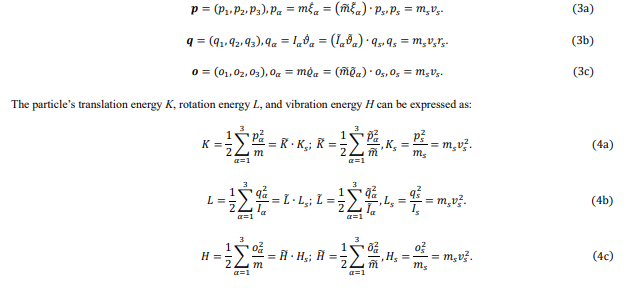
Unlike point particles, elastic particles possess three modes of motion in the barycenter reference frame: translation, rotation, and vibration. Based on the elastic particle model, we have previously established a theoretical paradigm known as Real Physics [1-7], which includes the theories of particle field [1, 8-10], particle dynamics [2, 11-14], and particle statistics [3, 15-18]. Within particle statistical theory, the statistical quantities of the particle’s three motion modes constitute an energy phase space. This phase space encompasses both equilibrium and non-equilibrium states, with the equilibrium states located on three parabolic surfaces. The distribution of the equilibrium states on these surfaces is discrete and non-uniform, making direct integral statistics of the equilibrium states particularly challenging. To address this fundamental challenge, we introduce a mesoscopic statistical approach based on the distribution vector of midsons (clusters). This approach bridges the microscopic dynamics of baseons and the macroscopic thermodynamics of the system, effectively bypassing the intractable problem of direct integration over the curved equilibrium surfaces. This allows us to derive the system’s state functions and differential equations rigorously, providing a powerful tool for studying phase transition phenomena [3].
The mathematical foundation of Real Physics is the theory of actual quantities. An actual quantity is the product of a scale factor and a digit factor. Representing physical quantities as actual quantities and determining their scales and digits are referred to as digitization. A complete physical theory must achieve the digitization of all its physical quantities. Energy phase space statistics [3,13,14] is a microscopic statistical method at the level of baseons, which achieves the digitization of the system’s macroscopic quantities. To investigate the equilibrium properties of systems, particle statistics introduces parameters at the level of midsons that characterize particle interactions. Determining the numerical values of these mesoscopic quantities to achieve the complete digitization of the particle statistics theory is an anticipated goal.
This research introduces the path subspace and the momentum subspace, expanding the energy phase space into a digital phase space, thereby completing the statistical theory for elastic particle systems. The method of digital phase space statistics is analogous to that of Gibbs’ ensemble theory [19]; however, their physical principles and mathematical foundations differ significantly. This article presents the principles of digital phase space statistics, provides the probability density within the digital phase space, and calculates the system’s partition function and state functions. By extending the concept of the entropy function, the thermodynamic differential equations applicable to all states of matter (liquid, solid, and gas) are derived. Crucially, this formalism demonstrates that the vast information encoded in a thermodynamic system can be compressed into a minimal set of five independent parameters.
The success of this unified method across the state of matter not only established the position of digital phase space as a tool in statistical physics, but also laid the foundation for exploring the connections between microscopic dynamics and macroscopic thermodynamics. As examples, this paper uses a set of five parameters to derive the state functions of liquid materials, and applies differential equations to formulate the fundamental laws of thermodynamics, thereby demonstrating the nature of statistical mechanics of elastic particles as a meta-theory.
Energy Phase Space Statistics
Motion of Particles
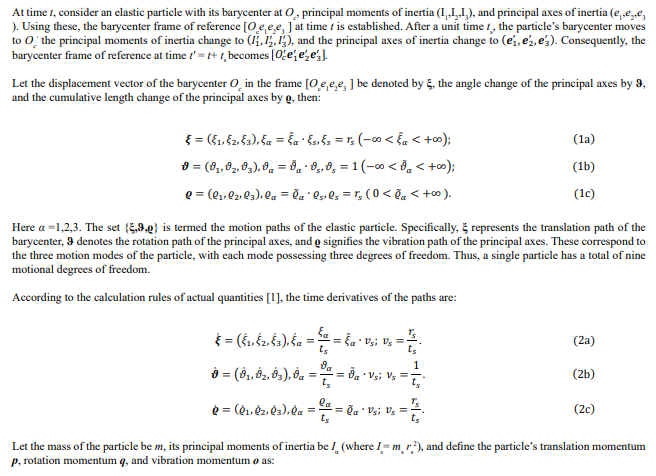
An elastic object is a closed system composed of a conserved number of elastic particles. The spatial states of an elastic particle are described by its Position, Posture, and Profile (the “3P” states). The Position is defined by the location of the particle’s barycenter (center of mass), the Profile by the eigenvalues (principal moments of inertia) of its inertia matrix, and the Posture by the eigenvectors (principal axes of inertia) of the inertia matrix. In the barycenter reference frame, the particle’s motion consists of three modes: translation, rotation, and vibration, which correspond to changes in its position, posture, and profile, respectively.
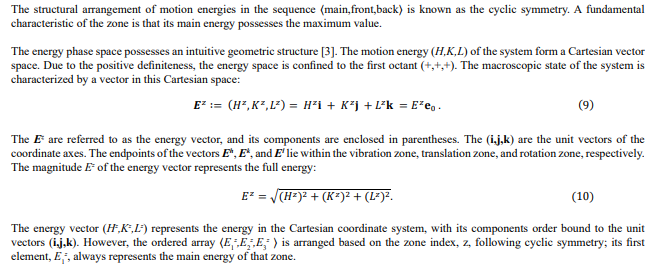
Energy Phase Space
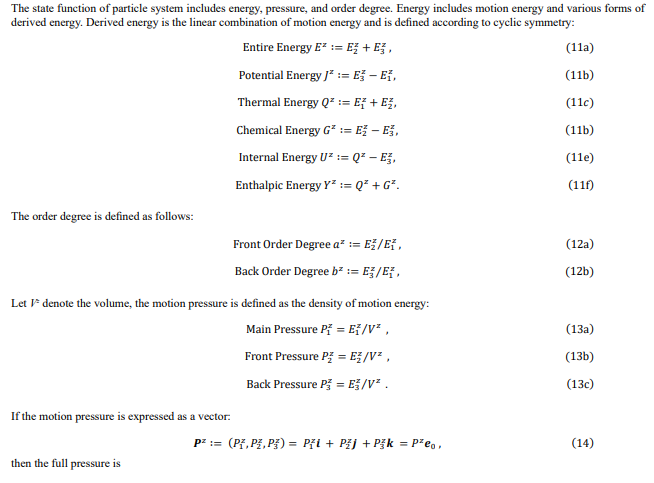
State Functions

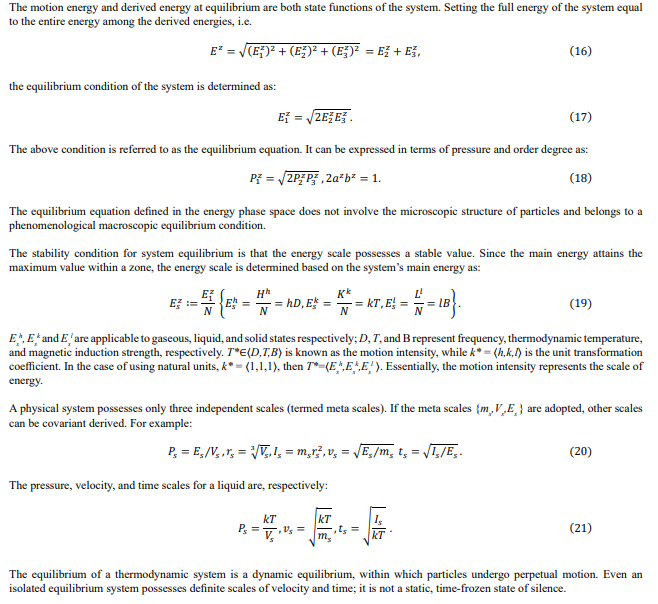
Equilibrium Condition
Equation of State

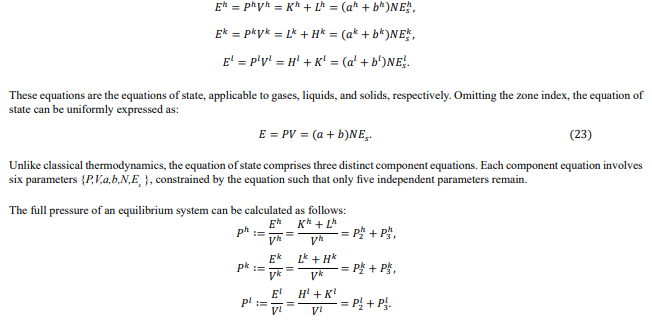
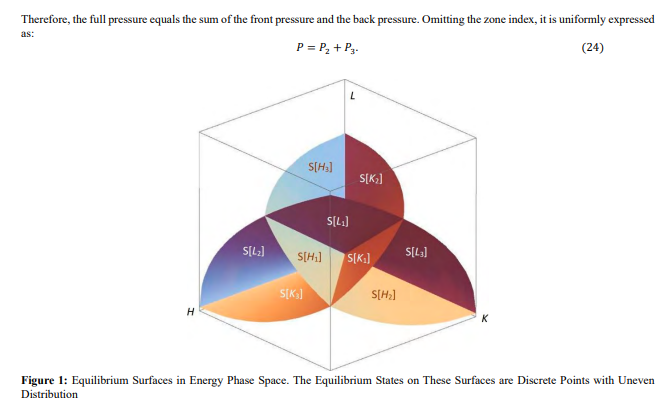
In the energy phase space, the equilibrium equations represent three parabolic surfaces [3], as illustrated in Figure 1. The states on these equilibrium surfaces are discrete points with uneven distribution. Statistical analysis of the equilibrium states on the curved surfaces requires the development of specialized mathematical methods.
Digital Phase Space Statistics
Interaction of Particles
The energy statistics of baseons form the foundation of the energy phase space. Within this space, energy, pressure, and order degree are defined phenomenologically. They do not consider the microscopic structure of objects or volume calculations, nor does it elucidate the physical significance of the order degree. Although the energy phase space incorporates particle interactions, these are implicit in the equilibrium constraints of the system and do not address the physical mechanisms.
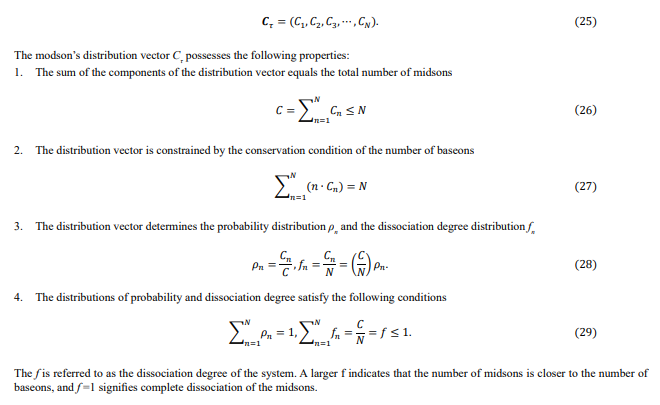
To investigate interactions, the elastic particle theory employs a hierarchical nesting model [3,13]. This model divides the structure of an object into four levels: hidson, baseon, midson, and topson, where the midson is a mesoscopic particle situated between the baseon and the topson (the system). Baseons attract each other due to mass, combining to form larger midsons---a process termed association. Conversely, baseons repel each other due to motion, resisting the combination of baseons---a process termed dissociation. When association and dissociation reach equilibrium, a relatively stable distribution of midsons is formed. The strength of particle interactions is characterized by the association degree g or the dissociation degree f.
A midson composed of n baseons is denoted as C(n), and the number of C(n) is represented by Cn. An equilibrium system exhibits a stable distribution of midsons, characterized by a distribution vector of midson as:
Energies of Midson
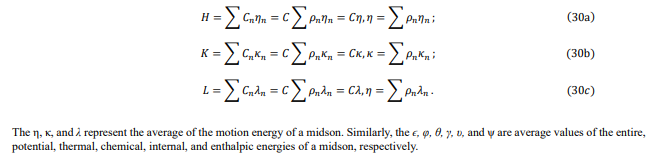
The vibrational, translational, rotational energies of a midson are denoted by the Greek letters ηn, κn, and λn, respectively. The corresponding system energies are obtained by statistically summing these over the number of midsons:
Statistical Principles
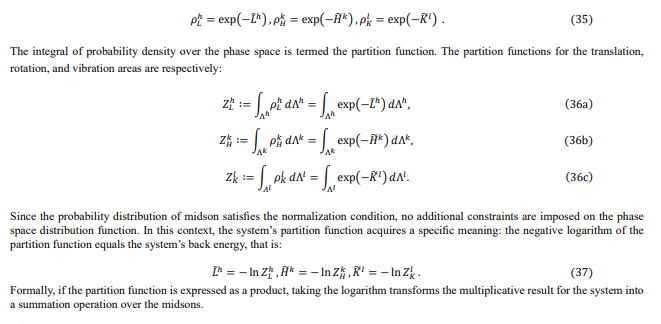
Partition Functions
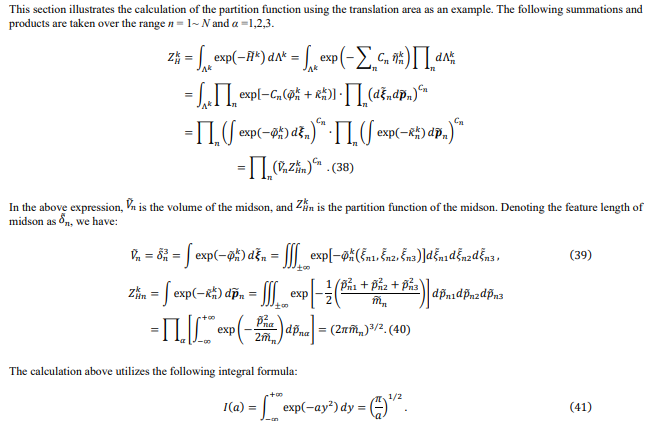
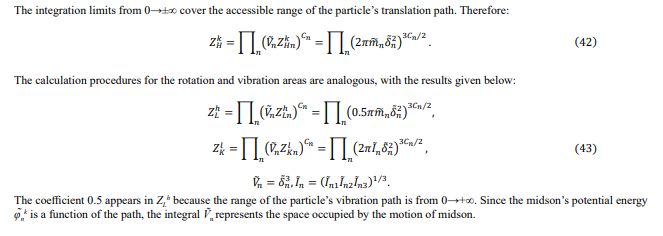
Energy and Pressure
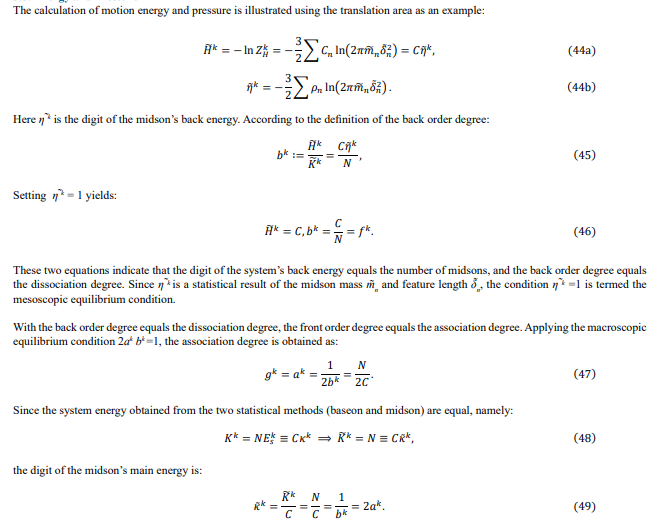
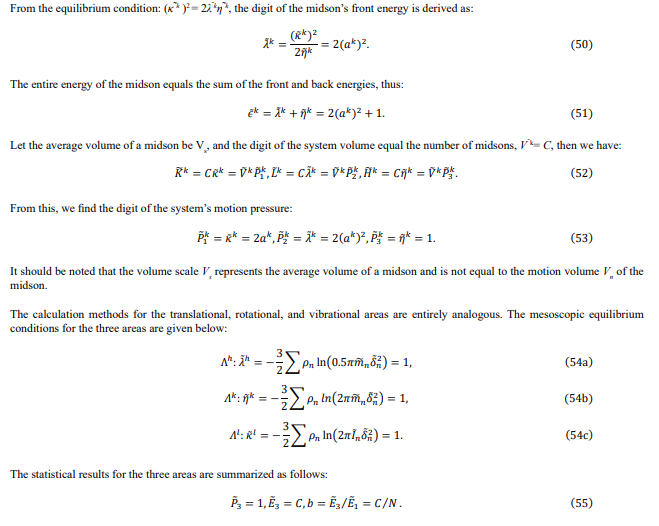
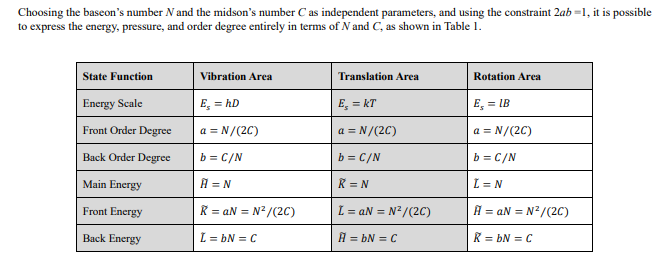
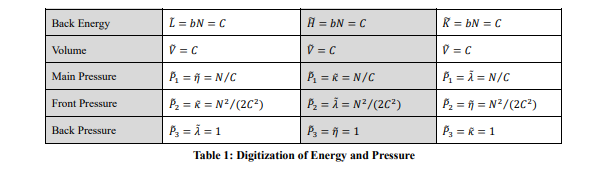
Differential Equations of State
Five-Parameter Theorem
TABLE 2 presents the digits of derived energy for the equilibrium system. Since a = N ⁄((2C) ) and b = C⁄N, all values are functions of N and C
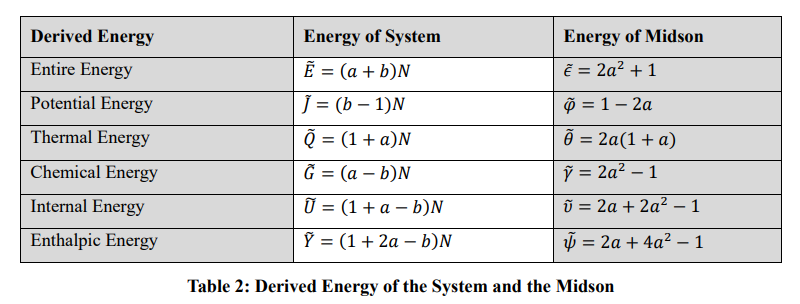
It can be seen that only two particle numbers, N and C, are sufficient to express all digits of motion energy, derived energy, pressure, and order degree. Meanwhile, all scales of the system can be covariant derived through three meta scales, {ms,Vs,Es}. Therefore, all thermodynamic functions can be fully represented by two digits and three scales. This conclusion is known as the five-parameter theorem of particle statistics.
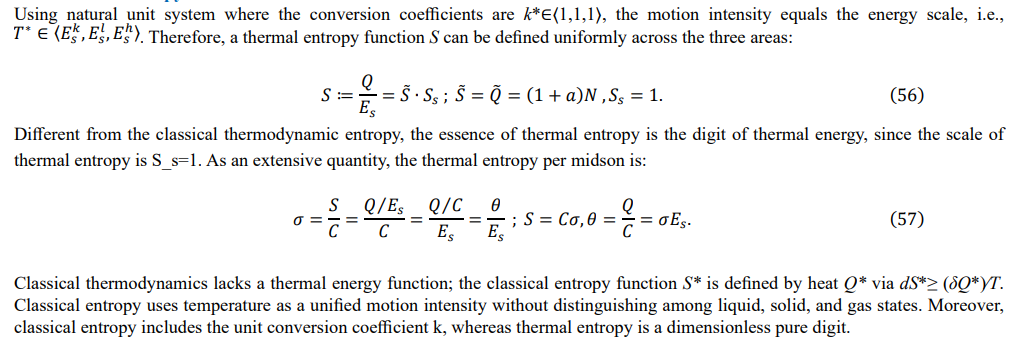
Thermal Entropy Function
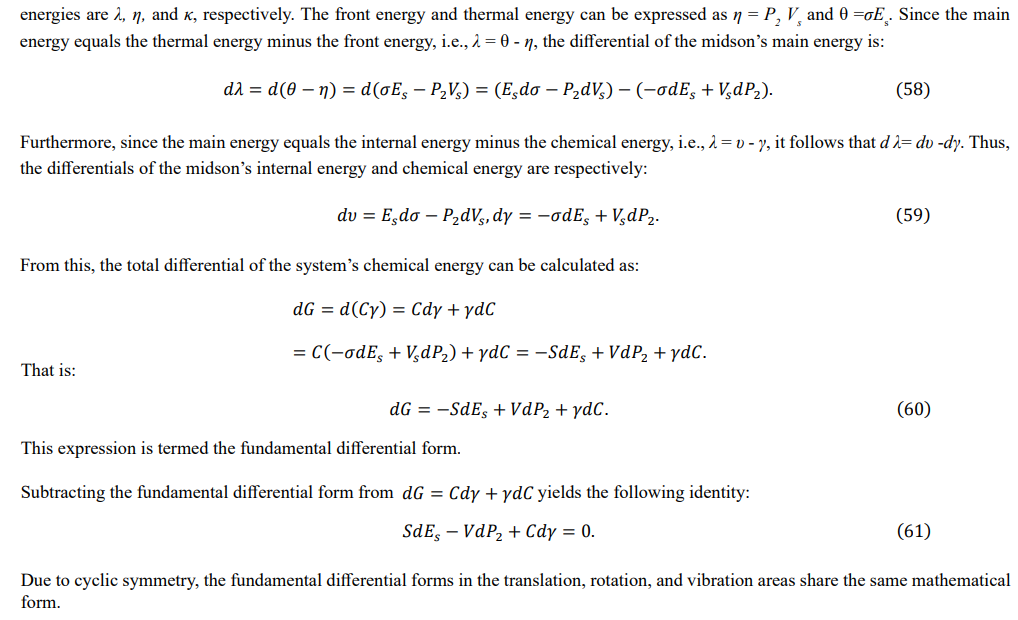
Fundamental Differential Form
This section derives the fundamental differential form in the rotation area. For a midson in the rotation area, the main, front, and back
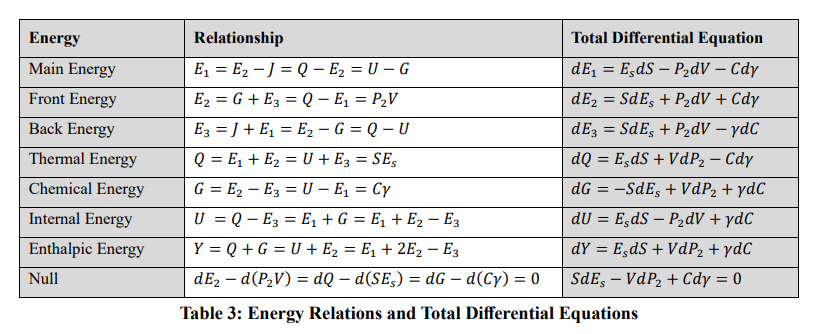
Total Differentials of Energy
Starting from the fundamental differential form and applying Legendre transformations, the total differentials of various energies can be derived. The results are summarized in Table 3
Thermodynamic Application
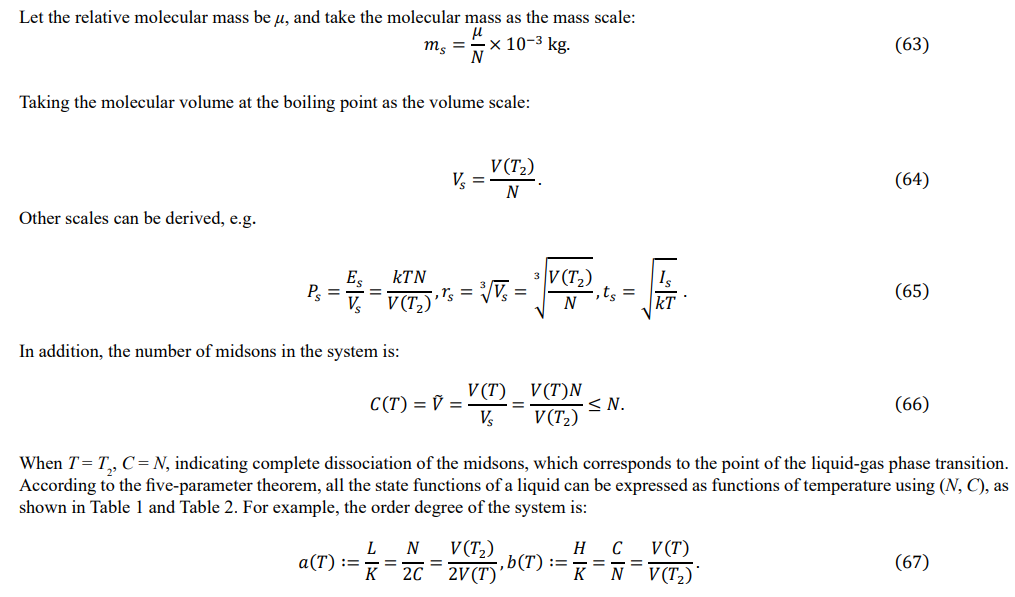
State of Liquids
According to the five-parameter theorem, we calculate the state functions of liquids. The energy scale for a liquid is Es= kT, with the main, front, and back energies being K, L, and H, respectively. If the boiling point temperature T2 of the liquid is known, and the molar volume as a function of temperature V(T) is measured, then the number of baseons (molecules) in the system equals Avogadro’s constant NA:

Laws of Thermodynamics
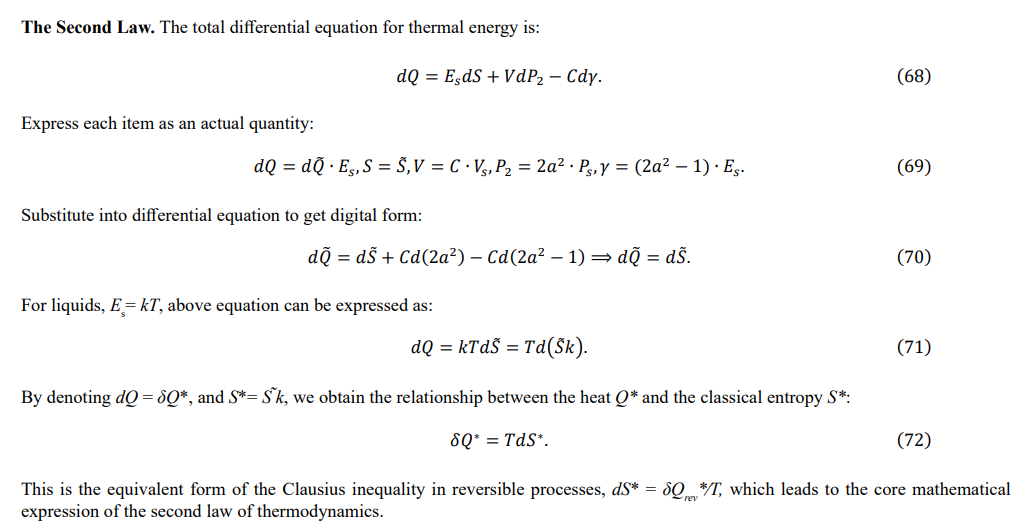
The laws of classical thermodynamics can be derived from the total differential equations in TABLE 3.
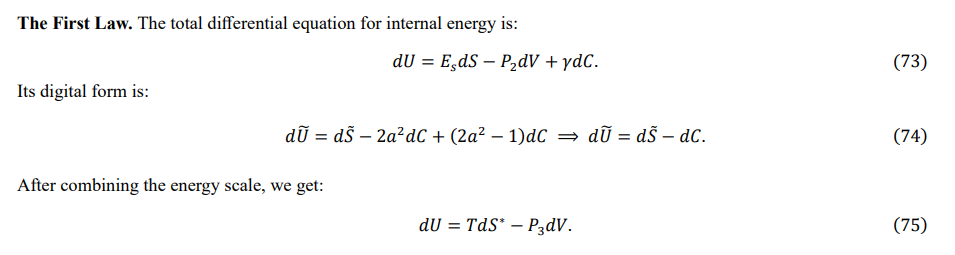
This equation is consistent with the mathematical form of the first law of classical thermodynamics. However, here P3 = Ps represents the back pressure; the back pressure of a liquid corresponds to the density of vibrational energy.
Above, we have recovered the classical laws of thermodynamics from the total differential equation of energy. Consequently, within this theoretical framework, the mathematical formulations of the first law of thermodynamics (conservation of energy) and the second law (the principle of entropy increase) naturally emerge as logical corollaries of statistical equilibrium properties. Specifically, the form of the second law, dQ = TdS, follows directly from the definition of thermal entropy S = QQ⁄Es and the energy scale, Es = kT. Meanwhile, the form of the first law reproduces the classical statement that “the change in internal energy originates from heat transfer and volume work.” Since the applicable energy scale Es varies across different areas, the energy mode conversion channels for solids and gases must be analyzed specifically based on cyclic symmetry.
Conclusion and Outlook
Digital phase space statistics and energy phase space statistics jointly constitute a complete statistical theory for elastic particle systems. This represents not merely a technical extension of Gibbs’ ensemble theory, but rather a paradigm shift founded upon the concepts of “elastic particles” and “actual quantity mathematics.” The Λ-space operates at the mesoscopic level, naturally describing particle interactions through the distribution of midsons (clusters), thereby circumventing the complexities and conceptual dilemmas associated with many-body potentials. The theory’s core principle of “cyclic symmetry” provides a universal mathematical framework that elegantly encompasses the gaseous, liquid, and solid states.
The central achievement of this paper is the demonstration that all thermodynamic information of an elastic particle equilibrium system can be compressed into five independent parameters: the number of baseons N, the number of midsons C, the mass scale ms, the volume scale Vs, and the energy scale Es. This result provides a profound and simple new description framework for understanding the state of matter.
Crucially, building upon this framework, we have systematically derived the total differential equations for all thermodynamic potentials, from which the mathematical forms of the classical first and second laws of thermodynamics naturally emerge. This demonstrates that the two foundational laws of classical thermodynamics are no longer empirical postulates in this theory, but rather logical corollaries of the statistical equilibrium properties of elastic particle systems.
Looking forward, the intrinsic consistency and unified explanatory power exhibited by the real physical paradigm in the realms of particle field theory, dynamics, and statistical mechanics have laid a solid foundation for this theoretical framework. A rigorous direction for future research is to systematically explore the intrinsic connections between this framework and the fundamental principles of quantum mechanics and relativity. Preliminary interpretations of this paradigm regarding phenomena such as quantization and the spacetime background suggest that such explorations are highly likely to unveil a more fundamental physical picture, thereby advancing our unified understanding of the material world.
Acknowledgments
The research leading to these results received funding from the NSFC under Grant No.61775102. The Chinese preprint of this article is available from ChinaXiv via https://chinaxiv.org/abs/202601.00178.
Conflict of Interest
The authors declare no conflict of interest.
Data Availability
As a purely theoretical work, all mathematical derivations, models, and findings are fully contained within the article.
AI Usage Statement
AI tools were used only for language editing.
Conclusion and Outlook
Digital phase space statistics and energy phase space statistics jointly constitute a complete statistical theory for elastic particle systems. This represents not merely a technical extension of Gibbs’ ensemble theory, but rather a paradigm shift founded upon the concepts of “elastic particles” and “actual quantity mathematics.” The Λ-space operates at the mesoscopic level, naturally describing particle interactions through the distribution of midsons (clusters), thereby circumventing the complexities and conceptual dilemmas associated with many-body potentials. The theory’s core principle of “cyclic symmetry” provides a universal mathematical framework that elegantly encompasses the gaseous, liquid, and solid states.
The central achievement of this paper is the demonstration that all thermodynamic information of an elastic particle equilibrium system can be compressed into five independent parameters: the number of baseons N, the number of midsons C, the mass scale ms, the volume scale Vs, and the energy scale Es. This result provides a profound and simple new description framework for understanding the state of matter.
Crucially, building upon this framework, we have systematically derived the total differential equations for all thermodynamic potentials, from which the mathematical forms of the classical first and second laws of thermodynamics naturally emerge. This demonstrates that the two foundational laws of classical thermodynamics are no longer empirical postulates in this theory, but rather logical corollaries of the statistical equilibrium properties of elastic particle systems.
Looking forward, the intrinsic consistency and unified explanatory power exhibited by the real physical paradigm in the realms of particle field theory, dynamics, and statistical mechanics have laid a solid foundation for this theoretical framework. A rigorous direction for future research is to systematically explore the intrinsic connections between this framework and the fundamental principles of quantum mechanics and relativity. Preliminary interpretations of this paradigm regarding phenomena such as quantization and the spacetime background suggest that such explorations are highly likely to unveil a more fundamental physical picture, thereby advancing our unified understanding of the material world.
Acknowledgments
The research leading to these results received funding from the NSFC under Grant No.61775102. The Chinese preprint of this article is available from ChinaXiv via https://chinaxiv.org/abs/202601.00178.
Conflict of Interest
The authors declare no conflict of interest.
Data Availability
As a purely theoretical work, all mathematical derivations, models, and findings are fully contained within the article.
AI Usage Statement
AI tools were used only for language editing.
References
- Liang, Z. C. (2025). A Physical Theory Based on Barycenter Reference Frames I: Principles of Particle Flow Fields. Adv Theo Comp Phy, 8(4), 01-17.
- Liang, Z. C. (2025). A Physical Theory based on the Barycenter Frame of Reference II: Principles of Particle Dynamics. Adv Theo Comp Phy, 8(4), 01-19.
- Liang, Z. C. (2025). A Physical Theory based on the Barycenter Frame of Reference III: Principles of Particle Statistics. Adv Theo Comp Phy, 8(4), 01-20.
- Liang, Z. C., & Dong, K. J. (2025). Return to simplicity and reality: Road to final theory of physics [Preprint, in Chinese]. ChinaXiv.
- Liang, Z. C. (2020). Outline of real physics. Global Journal of Science Frontier Research: A, 20(9).
- Liang, Z. C. (2019). Modeling of real particles. Journal of Physics: Conference Series, 1391, 012026.
- Liang, Z. C. (2015). Physical principles of finite particle system. Scientific Research Publishing.
- Liang, Z. C. (2021). Dark matter and real-particle field theory. Global Journal of Science Frontier Research: A, 21, 27.
- Liang, Z. C. (2019). The origin of gravitation and electromagnetism. Theoretical Physics, 4, 85.
- Liang, Z. C. (2018). Essence of light: Particle, field and interaction. In Proceedings of SPIE 10755: Photonic Fiber and Crystal Devices: Advances in Materials and Innovations in Device Applications XII (Paper 107550I).
- Liang, Z. C., & Chen, N. N. (2023). The distortion and quantization of the earth's orbit. Journal of Physical Chemistry & Biophysics, 13, 361.
- Liang, Z. C., & Xie, L. H. (2023). Wave or particle? Quantum behavior of solar system. Global Journal of Science Frontier Research: A, 23(7), 9.
- Liang, Z. C. (2019). Motion, energy, and state of body particle system. Theoretical Physics, 4, 66.
- Liang, Z. C. (2019). Motion of elastic particles and spectrum of hydrogen atoms. Global Journal of Science Frontier Research: F, 19(4), 18.
- Liang, Z. C. (2019). Cluster ensemble statistics of body particle system. New Horizons in Mathematical Physics, 3, 53.
- Liang, Z. C. (2021). Ion-cluster model and charge-transport properties of ionic liquids [Preprint]. ResearchGate.
- Bi, L., & Liang, Z. C. (2015). Features of velocity-cross-correlations in ionic liquids. Journal of Molecular Liquids, 212, 775–781.
- Bi, L., & Liang, Z. C. (2015). Investigation on dynamics and self-diffusion coefficient of [BMIM][PF6] via molecular dynamics simulations. Russian Journal of Physical Chemistry B, 9, 978–984.
- Lin, Z. H. (2007). Thermodynamics and statistical physics. Peking University Press.